




Abstract
This article explores ethical challenges in qualitative research by bringing forward examples from the literature and from IN•GAUGE®, a research program spanning over 15 years and focusing on the significance of multiple perspectives and the value of gauging the health needs of young people and their families. In addition to exploring the ethical challenges in working with children and youth in research, we make the case that ethical considerations need to extend beyond research ethics boards protocols and present “sustaining mindful presence” as a conceptual frame practical guide for working through ethical challenges in qualitative research. We contend that greater participation of research subjects, including children and youth, is the way forward for developing more holistic and effective approaches to ethics within research institutions.
What is already known?
While there is a significant shift in thinking around the roles of children and youth in qualitative research, a substantial knowledge gap remains with regards to how to institutionalize such ethical principles so that they can be put into practice.
What this paper adds?
This paper further advances the case that ethical considerations need to extend beyond REB protocols and present `sustaining mindful presence’ as a conceptual and practical frame for working through ethical challenges in qualitative research that involve children and youth.
Introduction
A number of ethical challenges can emerge when engaging participants in qualitative research approaches (Morse, 1994; Orb, Eisenhauer, & Wynaden, 2001; Kelly, Jones, Wilson, & Lewis, 2012). Toward mitigating such challenges, organizational (i.e., university and other research institutes) research ethics boards (REBs) develop procedures for assessing research ethics protocols through collaboration between academics, practitioners, and other knowledge holders (e.g., people from the community) and through a review of best practices relating to different fields (Haggerty, 2004). Such reviews and the development of protocols, however, do not always sufficiently account for many of the issues that can arise when employing qualitative research methods, such as interviews and focus groups. There are often instances where researchers must make judgment calls and take actions outside of what is described in REB approved protocols and must do so through accessing finely tuned knowledge that assists them in choosing responses that they consider to be “ethical” and/or “appropriate.” Scholars working in qualitative research have referred to this type of accessing of knowledge as “ethical mindfulness and reflexivity” (Warin, 2011, p. 805), mindfulness as an “affective-discursive practice” (Stanley, Barker, Edwards, & McEwen, 2015, p. 61), and “reflecting the process aspects of what has taken place” in the research (Rooney, 2015, p. 82).
We explore ethical challenges in qualitative research by bringing forward examples from the literature and from IN•GAUGE®, a research program spanning over 15 years led by Dr. Roberta Woodgate. Through IN•GAUGE®, Dr. Woodgate focuses on the significance of multiple perspectives and the value of gauging the health needs of young people and their families. The research involves children, youth, and families engaging with clinicians, caregivers, researchers, and decision makers toward knowledge exchange and innovation. The studies address what children and youth think about their illness and health conditions and contribute to building insights into their lived experience of physical and mental illness. In addition to exploring the ethical challenges in working with children and youth in research, we make the case that ethical considerations need to extend beyond REB protocols and present “sustaining mindful presence” as a conceptual and practical frame for working through ethical challenges in qualitative research.
Challenging Traditional Perspectives
The United Nations’ (1989) Convention on the Rights of the Child (UNCRC), Article 3, outlines a child’s right to protection. Following this protective approach and relating to children’s limited social power and ambiguous legal status as minors (Thompson, 1992), traditional REBs have developed guidelines for research with children who are premised on their vulnerability, emphasizing issues of consent, competence, protection, and confidentiality (Arditti, 2015; Carter, 2009; Lahman, 2008). Children have regularly been perceived as unknowing objects by ethics boards leading to amplified power differentials between children and adults (Atwool, 2013). Jones (2008) describes the traditional approach to research ethics with children as creating a conceptual difference or “other” between researcher (adult) and subject (child), ultimately being detrimental to how research agendas are framed. Therefore, the traditional view of children as intrinsically vulnerable and in need of protection both protects and limits their rights (Thompson, 1992) and raises crucial questions about how researchers might design richer systems for ethics approaches. Several of these questions can be understood through exploring issues around “everyday” and relational ethics, and the paradigm shift that is underway in health care and research occurring in response to these questions (Holloway & Wheeler, 2010; Skelton, 2008). Related to the shift toward including youth in research is increasing agreement that children and youth (and research participants in general) are competent and that their voices need to be included in the research process (Clavering & McLaughlin, 2010; Woodgate, 2001).
Arditti (2015) situates the “vulnerability of children” as related to their being part of a “protected class,” and states that “overprotection can silence vulnerable participants” (p. 1568), primarily by limiting their agency. Several scholars have laid a strong foundation for challenging limiting assumptions about children’s agency and abilities and have called for changes to research methodologies toward attempting to understand the lives of children on their own terms (Alderson & Goodey, 1996; Morrow & Richards, 1996; Oakley, 1994). Oakley (1994) argues that the way that children are often treated in research processes (e.g., are not empowered to share their perspectives regarding research protocols) is grounded in a philosophy of exclusion and control, and the supposed differences between children and adults as research participants disappear once they are more closely examined. Alderson and Goodey (1996) contend that it is important that researchers give children the opportunity to be involved in the setting of research agendas and strategies, and Morrow and Richards (1996) talk about the importance of children seeing their perspectives as being worthy of inclusion.
The reflexive research practice that is part of IN•GAUGE® and the expression of agency in the research has highlighted the need for further ethical considerations with regard to the agency of youth. Söderbäck, Coyne, and Harder (2011) describe the transition in the context of family-centered care as moving from a “child perspective” to a “child’s perspective” where children are encouraged to engage and provide their “insider perspective on conditions, experiences, perceptions, and actions” (p. 100). Furthermore, there is a growing awareness that the active participation of children and youth in research can influence adult minds in a way that enhances their awareness of children’s roles within research (Carter, 2009). Therefore, the direct involvement of children and youth in research can serve to challenge the power differentials that could be affecting the ethical framing of the research (Harley, 2012; Vince & Petros, 2006). Nairn and Clarke (2012) suggest that one preliminary way of addressing power is by ensuring that children understand the purpose of the research in which they are involved.
Recognizing the importance of a child’s right to be heard, Article 12.1 of the UNCRC asserts that “States Parties shall assure to the child who is capable of forming his or her own views the right to express those views freely in all matters affecting the child, the views of the child being given due weight in accordance with the age and maturity of the child,” or as the “child friendly” version states, children “have the right to give your opinion and for adults to listen and take it seriously.” Associated with this is Article 13 that points to a child’s freedom with regard to expression and the right to information. Scholars have found that children and youth appreciate being able to exercise their right to be consulted and can feel empowered through research processes (Nairn & Clarke, 2012; Woodgate & Kreklewetz, 2012; Woodgate & Skarlato, 2015). In the United Kingdom, there is consensus among governments and non-governmental organizations (NGOs) that “real service improvement is only attainable through involving children and youth and listening to their views” (Nairn & Clarke, 2012, p. 3). Further, large organizations like Save the Children (2004) promote seeing children and youth in research as active agents and not subjects and suggest participatory approaches as being the most empowering and effective for creating positive and meaningful experiences with research.
While there is a significant shift in thinking around the roles of children and youth in qualitative research (Woodgate, 2001), a substantial knowledge gap remains with regard to how to institutionalize such ethical principles, so that they can be put into practice. Traditional REB protocols typically have relied on provisions such as the tailoring of questions, protocols for conduct with participants, anonymity, and informed consent (Haggerty, 2004). Such categorical approaches, however, do not prepare researchers (or others engaging participants through research, such as clinicians) for navigating the situational and relational qualities of research that engages participants with their full range of thoughts and emotions, which should not only be anticipated challenges of the research process but celebrated aspects of research adding further depth and interest. In the following sections, we present ethical challenges and approaches to research that underscore the necessity for richer approaches to health research and ethics.
Relational and “Everyday Ethics” and Ethical Challenges in Research With Children and Youth
Rossman and Rallis (2010, p. 379) define everyday ethics as “moments that demand moral considerations and ethical choices that arise as a part of a researcher’s daily practice.” They, and Austin (2007), explain how ethical procedures outlined by research boards are often insufficient to deal with the moral challenges that can arise when engaging in research, especially when research is focused on health and well-being, and explain that ethical considerations ought to move from being purely procedural toward being relational (Rossman & Rallis, 2010). Similarly, Guillemin and Gillam (2004) talk about “ethically important moments” and use the concept of “microethics” as “discursive tool to allow us to talk about, validate, and better understand the ethically important moments in research practice” (p. 277). McCosker, Barnard, and Gerber (2001) assert that sensitive research topics are emotional and deal with issues that are often more “private” or related to fear and/or stigmatization. Holland, Williams, and Forester (2014) refer to such challenges as ethical “speed-bumps” that require the researchers to engage in ethical negotiations involving relational, interactive, responsive, and often reciprocal responses.
Working through the IN•GAUGE® research program, Dr. Woodgate and her research team have experienced several instances where relational ethics were important, especially in light of the “sensitive” nature of what was being explored through the interviews (i.e., health and wellness, illness, and quality of life across a range of health conditions).
1
Across a number of different IN•GAUGE® research studies,
2
youth expressed deeply emotional and personally involved (i.e., nonneutral) responses to interview questions. This required researchers to respond to the youth in a fashion that followed the outlined ethics procedures; however, researchers also had to rely upon relational ethics due to the sensitive nature of the scenarios. As previously experienced and discussed by other researchers like Oakley (1994), researchers in IN•GAUGE® often felt like they were required to “walk a fine line” with participants, taking into consideration the appropriateness of their responses, the amount of probing, as well as the nature and degree of intervention in the research encounter in order to provide youth with positive affirmations to self-deprecating statements. For instance, during an interview that was part of the Youth Living with Anxiety Study, a youth spoke negatively, on multiple occasions, about her body image and shared that she often put towels over the mirror to hide from her reflection and that she “despised” her body. Interviewer field notes: I responded by telling her she was beautiful—it was instinctual and in many ways an automatic (though genuine) response. But I’m wondering to what degree my response was appropriate in the research setting? Interviewer field notes: Typically this participant either avoided eye contact or said “I don’t know.” She made some reference about being stupid and I [the researcher] tried to reassure her that we weren’t looking for right answers, just her thoughts and ideas about health. (Youth Speaking for Themselves about Health within their Own Life-Situations Study) Interviewer field notes: I felt a deep sadness as she shrugged her shoulders explaining that she was not sure why she cried but felt she “couldn’t help it.” I am not sure to what extent she is fully aware of what anxiety is and her own experiences of anxiety (for instance, she commented on two different occasions that “my mum told me I have anxiety”) and I am always unsure as to the interviewer’s role in these situations. (Youth Living with Anxiety Study)
Researchers also talked about challenges in representing the true meanings that youth would convey around difficult topics in the research. Youth participating in the IN•GAUGE® research program at times would confide negative feelings and in some cases would talk about how their feelings and the way that they would express themselves were often misunderstood by the adults in their lives. During the Youth Living with Anxiety Study,
3
a youth explained how it was challenging for her to talk about “dangerous” topics like suicide because adult perceptions of and reactions to the topic were not proportional to what she was expressing. Interviewer field notes: She explained that even though she had listed “dying” as a fear/worry on the Spence Children’s Anxiety Scale,
4
she did not want me to think that meant suicide. She explained that she and her friends have talked about the ways in which they try to discuss suicide. She noted that some kids made light of the topic, but that adults “overreact and make up their own minds thinking that I want to do something to myself when that’s not the case”…I wondered about the current approach to discussing suicide with young people, in the sense that it seems that young people are worried about voicing their questions or concerns for fear of the adults in their life “overreacting.” “A” spoke on the topic at length, and I noticed that by the time she had finished on this topic, she had turned her body to face me, pulled the hair from her face, and sat much more relaxed, without her shoulders being hunched.
Green and Thorogood (2014) reinforce that a lot may be asked of individuals who agree to participate in the research process. In addition to a considerable time investment, individuals are asked to invest in close relationships with researchers and trust them enough to share sensitive and personal information of what goes on behind the scenes of their everyday lives. If not careful, there is the potential for researchers to ask and take a lot without giving anything back (Hatch, 2002). Stemming from this view, the involved and lengthy nature of qualitative research is often labeled by REBs as “burdensome” to the participant. This perspective of the research process, however, does not account for the participant’s agency, and how qualitative research designs can often create the space for participants to express their personal truths through stories. A participant from the Aboriginal Youth Living with HIV Study explained how she had never told her story until being engaged through the research because she felt that others in her life did not have the time or capacity to listen.
I’ve never told anybody that before.
No. So it was in 2011.
Yeah.
So okay.
So I’ve been keeping that in for that long. (3 years)
Yeah.
This information I just told you just…
Oh no way, so you never told, no one knows at all.
Well my, the people at the Front Desk know like this guy whatever but, I never told them how I, how I’ve really felt about it.
Yeah.
It’s just like work to them you know like ‘cause they hear it all day like every day, like it’s just like paperwork to them.
The telling of a story through the research process can be empowering and on several occasions youth and their families stated that the interview process was even therapeutic. IN•GAUGE® participants also often reflected on the research as something that could potentially benefit others in similar situations and expressed that they felt like this made their participation worthwhile. Relational ethics therefore must also consider communication with participants about how their stories will be used and how they might impact the future (e.g., through policy), including any limitation. Follow-ups with participants on how their data/stories will be used are therefore an essential component of ethical research.
Relational considerations would also come into play when youth would occasionally “go off track” from the research topics during interviews requiring the researcher to respond sensitively and acknowledge that what was being said was important to the youth, such as issues with everyday life and/or their detractors. A researcher from the Youth Involvement in Health Care Decisions study noted this and that creating the space for this more free-flowing kind of dialogue enabled youth to share their story and feel more comfortable when they returned to speaking about the subject of the interview. Interviewer field notes: Towards the end of our conversation, the son seemed eager to talk about his work experiences, and the hardships he’s had to endure in school and in the workplace. Though I thought about getting back to more “relevant” material, his train of thought revealed how much he needed to “prove” himself to his detractors, and again how meaningful it was for him to receive love and support since his diagnosis. It was remarkable to see the change in the participant’s comfort level throughout the interview, from someone seeming to be quite shy and reticent about talking about his experiences.
Tensions between researchers and participants were at times palpable and were expressed among participants in a variety of different ways, ranging from complete avoidance (e.g., playing with mobile phone and not paying attention to the researcher) to direct opposition. When this occurred, the interviewer would check-in with the participant to see if they were comfortable continuing the interview. Typically, the participant would state that they wished to continue the interview, and on a few rare occasions, the participant requested that the interview continue at a later date. Even though the youth used primarily body language to express their negotiation of power and sentiments about the research experience, the combination of body language and verbal information was important for understanding how participants negotiate power (Woodgate & Leach, 2010). Interviewer field notes: I noticed that there were several things she would do during the interview (i.e., put her feet up on the desk, say something sarcastic) and then watch me. It seems like she was trying to gauge my reaction and was trying to figure me out. The participant expressed some strong negative reactions to some adults like teachers and her uncle and positive reactions to others like her mother—it seemed like it was important to her to figure out where she could place me even if it was just during the interview. (Youth Speaking for Themselves about Health within their Own Life-Situations) Interviewer:…faces will be blurred to kind of protect people’s identity. Father of participant: Well yeah that’s fine sure, although I’d have to say given the nature of most of those pictures, taking his face out would ruin the whole point of the picture…And his face is where all of his communication and expression is, so you might as well not use the pictures if you’re going to blank out his face, but anyways.
Tensions can affect research participants but can also cause stress on both seasoned and newer (i.e., more vulnerable due to lack of experience) researchers (Woodby, Williams, Wittich, Burgio, 2011). Aluwihare-Samaranayake (2012) stresses the importance of considering how a research design will affect the worlds of both participants and researchers. Issues of physical and psychological safety can become entangled in the research process (McCosker et al., 2001), and moral distress can become part of relational and everyday ethics, especially when interviews become confounded by social, power, and gender dynamics. Interviewers sometimes encountered ethically challenging moments with parents who would offer statements that were factually inaccurate and at times were also distasteful. An interviewer described her personal struggles with a parent’s comments on race. Interviewer field notes: I personally struggled when “A” spoke about the “facts” and made disparaging comments about race. I asked questions for clarification thinking [the parent] was suggesting that mixed race children may struggle with identity issues, and was surprised to hear [the parent’s] response. (Youth Living with Anxiety Study) Interviewer field notes: When I first asked “Mi” for the memory card so that we could review the photographs together on the laptop, he shook his head no, and stated that he preferred to review them on the camera. He lay down on the bed and scrolled through the pictures. As such, I usually had to ask “Mi” to turn the camera around so I could see the photographs and lean towards him. Part-way through the interview, and uncomfortable with the spatial setting of the interview, I asked to see the camera for myself, and realized that there were a number of photographs on the camera that he had not shown me or even given me the chance to ask questions about. …As I reflect on the interview, I felt that much of the session was an exercise in power and control, as if “Mi” was purposely not answering or giving vague answers to the questions asked to gauge my reaction. At other times, I believe he was using jargon (related to computer programming as an example) to test my own knowledge. At times, I have to admit that my patience was tested as “Mi” repeatedly stated in quite a firm voice “I don’t know” when I would ask him the purpose or message behind a particular photograph. It may have been best if I asked “Mi” to caption each photograph, perhaps by telling him (more explicitly) how others may interpret those photographs, though in this sense I wonder if this would have aggravated “Mi.” …I wonder if his reluctance to share is in some ways gendered and to what extent a male interviewer would have yielded different results. …This was a challenging interview, and in many ways, particularly in the latter half of the interview, I felt that “Mi” was trying to test me in a way, attempting to manipulate the interview process, saying things only to gauge my reaction.
Other challenges that were difficult to navigate included when youth would ask researchers personal questions that were either related (Have you ever experienced depression?) or not related (e.g., “Are you married?”) to the research topic. There were also instances when personal boundaries became blurred (e.g., youth would ask for interviewer’s cell phone number or request to add them to their social media network).
The next section discusses how ethical challenges can be navigated and children, youth, and families can be meaningfully engaged in the research experience through employing ethical considerations outside of the standard REB protocols for ethics.
Navigating Ethical Challenges in Research Through Sustaining Mindful Presence
In order to fill a number of gaps relating to everyday ethics in clinical practice (e.g., influence of sex, gender, religion, and culture, type and severity of illness, organizational contexts, etc.), we advocate for a move toward richer ethical approaches inclusive of systems of active engagement between researchers and youth and concepts connected to moral agency (Delany, Edwards, Jensen, & Skinner, 2010). Austin (2007) speaks about this approach in terms of building “moral community” and the “moral habitability of the environment,” focusing on how ethical spaces need to be transformed according to contextualized knowledge and moral considerations not captured by protocols such as those outlined by REBs. The acknowledgment of the importance of “everyday” ethics creates the potential for enhancing the moral and relational imperatives through shifting the dynamics around ethics toward being participatory. This in turn gives researchers the tools to deal with situations in a flexible manner and empowers research participants to play a direct role in determining research process, in turn shifting their position from subjects to agents. We describe this process of being morally and relationally engaged with the research as “sustaining mindful presence.”
Sustaining mindful presence involves moving through the research field with careful forethought, attentive pace, and receptive attention to and awareness of what is taking place with the potential for the authentic expression of participants (Reid, 2009). Such an approach directly relates to improving the psychosocial and physical care of research participants by developing greater understanding of their perspectives and of the worlds in which they live. Sustaining mindful presence also helps to ensure that the youth, regardless of age, views his or her participation positively throughout the research process (including the development of research ethics prior to research) and results in enhanced self-esteem. Similar concepts have been positioned in the qualitative research ethics literature, such as Collins and Cooper’s (2014) discussion on emotional intelligence as a refined quality of a researcher, which can increase the connection with the participant, involve skillful listening, and enhance a researcher’s understanding of the lifeworlds of participants. Similarly, Aluwihare-Samaranayake’s (2012) “critical consciousness stance” is meant to “involve questioning and reflecting on how participants and researchers can work together to ensure that the participants’ voice and experiences are represented with due considerations to respect of persons, justice, non-maleficence, and beneficence” (p. 67).
We advocate for sustaining a mindful presentence a framework inclusive of and extending the above qualities toward guiding the researcher through the research process. Sustaining mindful presence includes the following characteristics that can become highly developed within a researcher: (i) openness and curiosity, (ii) empathy and acceptance, (iii) receptive attention and deep listening, (iv) relationally engagement, (v) flexibility and reflexivity, (vi) self-awareness and self-regulation, and (vii) being nonjudgmental and respectful (Figure 1; Table 1). We view these qualities as being developed over a continuum (i.e., rather than being simply present or absent).
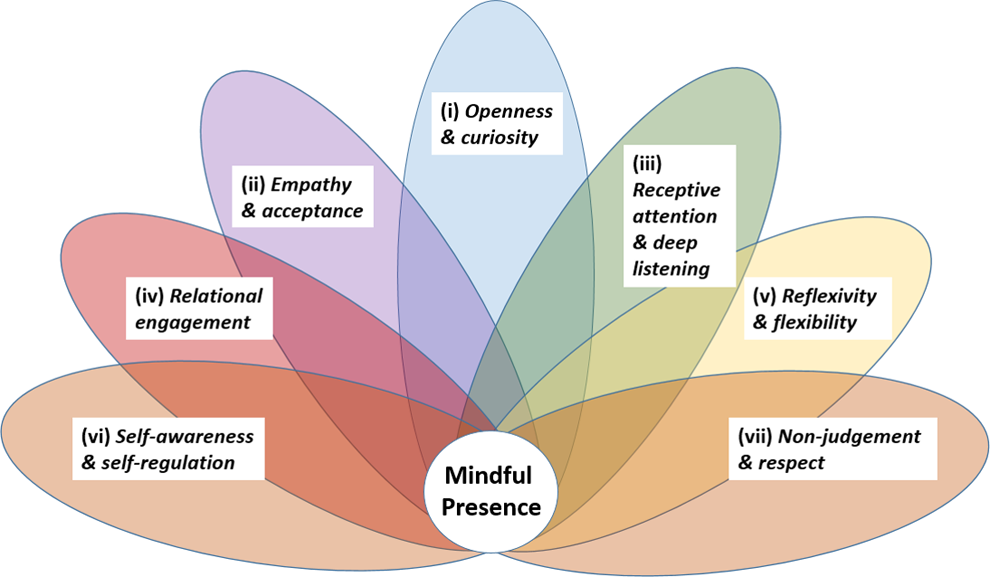
Sustaining mindful presence as involving multiple qualities working together within the researcher.
Qualities of Sustaining Mindful Presence.

Taking this approach within IN•GAUGE® meant keeping what youth shared through the research intact and not adulterating their interpretations with adult versions of realities (Mannion, 2007). Toward illuminating the privilege of being keepers of a story and the importance of maintaining the integrity of stories, we consider a quote from Roy’s (1997) The God of Small Things. Instinctively colluding in the conspiracy of their fiction, taking care not to decimate it with adult carelessness. Or affection. It is after all so easy to shatter a story. To break a chain of thought. To ruin a fragment of a dream being carried around carefully. Like a piece of porcelain. To let it be, to travel with it…is much the harder thing to do. (edited removed “as Velutha did”)
Mindful presence begins even before the launching of a study through the inclusion of youth perspectives in the research planning through reflective and flexible forums, such as youth advisory committees. Similarly, Pinter and Zandian (2015) studied ethical issues around sharing research results and other late stages of research with children and argue that in order to fulfill ethical responsibilities, it was important to “explore children’s own interests and assumptions about research, such as what concepts like anonymity, confidentiality and representation actually mean to them” (p. 247). Further, the views of children are heavily circumscribed by social and cultural norms and values, and these norms and values need to be respected in order for the research to be ethically sound (Graham, 2014). Participatory research methods have proven to be valuable for engaging youth in research and planning toward accessing their unique meaning constructs (Woodgate et al., 2017) and are especially effective when the process begins with the space to share opinions before decision-making processes begin (Åkerström & Brunnberg, 2013; Lukes, 2005).
By paying special attention to engaging the qualities of sustaining mindful presence with youth in research, we can also shift the common perspective of youth as being “pre-social,” unfinished, or in process (France, 2000). Sustaining mindful presence also shifts the perspective on youth toward present tense, as they exist in their own everyday lives, and away from their lives being understood in the future tense as they develop into adults (Mason & Danby, 2011). The above challenges can be addressed through sustaining mindful presence in a fashion that elevates the youth to a position in which they are being considered as competent beings, regardless of their psychosocial developmental stage. It creates pathways for more open and meaningful research experiences through youth being able to make decisions with regard to the way that research unfolds. One way that youth can influence the research process is in the development of the interview schedule. A statement made by a participant from the Aboriginal Youth Living with HIV Study shed light on why such input would be valuable and empowering to participants.
All these studies just make me feel like a statistic.
Really.
Yeah not only this. There are other things.
They are not just studying it. They’re just trying to help other kids.
Help the future, right…
So do you think that some of these questions could be worded a little bit differently, because I could do that?
It’s always a touchy subject. They could always be worded differently. The way I take it, it’s helping, it’s a step in the right direction, but some people would be like all touchy about it.
Sustaining mindful presence relates directly to the everyday and relational ethics. While sustaining mindful presence IN•GAUGE®, researchers used their “ethical radars.” Through looking for body language, researchers were able to gain insights regarding the youth’s emotional state, by looking for whether they were expressing discomfort even though they say that they are happy with a process. There were times when youth’s expressions were reasonably easy to read and times when it was more difficult to discern their emotions. This was especially difficult when interviews were conducted over the phone (i.e., the interviewer could not observe body language). Being present and attentive to context was also helpful for preventing other ethical challenges, such as the potential for intrusion into the youth’s world, interference in the youth–family relationship, and harm to the child’s physical and psychological sense of self (Woodgate, 2008). We found that sustaining mindful presence was important for dealing with some of the ethical challenges related to providing a space for youth agency through research. Through sustaining mindful presence, the researcher was able to provide a safe and comfortable research environment, consider the youth’s physical and psychological state and avoid placing demands on the youth that could cause harm to them physically or psychologically, and make careful preparations for exiting from the field.
With regard to everyday ethics and the sustaining of mindful presences, we encourage researchers to trust their “gut feelings” and their “inner voice.” We acknowledge that “objective research” often shies away from this; however, we emphasize that it is important to pay attention to the iterative qualities of the research process through employing an adaptive strategy capable of responding to feedback from those who are involved in research. The relational quality of everyday ethics creates the possibility for relationships to be built and maintained through accountability and reciprocity—attributes having strong effects on ethics. It should also be noted that sustaining mindful presence is not without its challenges, and it alone cannot adequately frame ethics for working with youth and their families. Ethics protocols can support research utilizing mindful presence. One example is the development of informed consent protocols, such as opt-in/opt-out activities, which disentangle the researcher and participants in turn alleviating some of the social pressure (e.g., to act in a socially appropriate manner, such as responding positively or negatively depending on the circumstances) that participants may be feeling as a result of their participation (Kustatcher, 2014).
Our discussion also sheds light on the possibility of the coproduction of knowledge that is possible when REBs support richer approaches to ethics. We contend that REBs should support research that acknowledges youth’s rights to expression, including the right to be heard in a way that does not diminish or skew their perspective of their constructed realities. Toward this end, we suggest that youth should have a stronger presence in the development of ethical protocols through direct involvement with REBs. Youth Advisory Councils could play a significant role in the development of ethical guidelines for research, resulting in protocols for research with youth, created by youth. Such involvement would be useful for all types of research involving youth, including research not engaging participatory protocols. REBs would benefit from the advice of people who have the lived experience relating to topics that would be under review for study at a university, or other research institution.
Conclusions
The insights gained through the literature and through conducting research with youth and their families through the IN•GAUGE® research program provide evidence for the everyday and relational ethical challenges within qualitative research. Such challenges are not accounted for by REB protocols and require researchers to engage more intuitively and build in different forms of reflexivity within the research process. We propose that sustaining mindful presence as a novel and inclusive framework through which researchers can navigate ethical challenges in research. This approach is also important for filling ethical “gaps” relating directly to the research experience and outside of REB protocols. Mindful presence should be reflected upon by researchers before entering the field and should be implemented prior to the formal initiation of research. An area requiring further exploration is how to go about fine tuning mindful presence in researchers. Mindfulness teaching is an emerging area in adult education (Campbell & Christopher, 2012; Schoeberlein & Sheth, 2009) and has the potential for creating direct benefits for research ethics (Cullen, 2011). This type of teaching would be relevant to researchers involved in small- and large-scale and short- and long-term projects. Consideration also needs to be given to the development of pilot projects (van Wijk & Harrison, 2013) and how to adapt REB protocols, so that they can adequately account for everyday and relational ethical challenges and mindful approaches. We believe that greater participation of research participants, including youth, is the way forward for developing more holistic approaches to ethics within research institutions. New pathways for REB participation will need to be explored and are best discovered through applying the participatory and democratic approaches that could become part of future REB processes.
Footnotes
Authors’ Note
Funded studies discussed in this article that R.L.W. received funding for are as follows: Aboriginal youth living with HIV: From diagnosis to learning to manage their health and lives (abbreviated: Aboriginal Youth Living with HIV). CIHR Operating Grant, Priority Announcement (PA): First Nations, Inuit and Metis Health from the Institute of Aboriginal Peoples’ Health (Grant #: CIHR IPH 131574) and CIHR-Manitoba Regional Partnerships Program Funding (Manitoba Health Research Council), 2013–2015. Youth’s voices: Their lives and experiences of living with an anxiety disorder (abbreviated: Youth Living with Anxiety). CIHR Operating Grant (Grant #: CIHR MOP 119277), 2012–2016. Changing geographies of care: Using therapeutic landscapes as a framework to understand how families with medically complex children participate in communities (abbreviated: Changing Geographies of Care Study). CIHR Operating Grant (Grant #: CIHR MOP 89895), 2008–2014. Youth involvement in health-care decisions: Ethical, social, and cultural perspectives (abbreviated: Youth Involvement in Health Care Decisions). CIHR Operating Grant (Grant #: CIHR MOP 89366) and CIHR-Manitoba Regional Partnerships Program Funding (Manitoba Health Research Council), 2008–2010. Youth speaking for themselves about health within their own life situations: An ethnographic study of youth’s perspectives of health and their own health interests (abbreviated: Youth Speaking for Themselves about Health within their Own Life-Situations Study). Social Sciences and Humanities Research Council Research of Canada (Grant #: 30715), 2007–2010. All procedures performed in studies involving human participants were in accordance with the ethical standards of the institutional and/or national research committee and with the 1964 Helsinki declaration and its later amendments or comparable ethical standards. Informed consent was obtained from all individual participants included in the study.
Acknowledgments
The authors are grateful to all the young people and their families who shared their experiences with us.
Declaration of Conflicting Interests
The author(s) declared no potential conflicts of interest with respect to the research, authorship, and/or publication of this article.
Funding
The author(s) disclosed receipt of the following financial support for the research, authorship, and/or publication of this article: R.L.W. is supported by a Canadian Institutes of Health Research (CIHR) Applied Chair in Reproductive, Child and Youth Health Services and Policy Research (Grant#: CIHR APR-126339), 2012–2017.