




Abstract
Within research addressing issues of social justice, there is a growing uptake of participatory action research (PAR) approaches that are ideally committed to equitable participation of community members in all phases of the research process in order to collaboratively enact social transformation. However, the utilization of such approaches has not always matched the ideal, with inconsistencies in how participation and action are incorporated. “Participation” within various research processes is displayed differently, with the involvement of community members varying from full participation to their involvement as simply participants for data collection. Similarly, “action” is varyingly enacted from researchers proposing research implications for policy and practice to the meaningful involvement of community members in facilitating social change. This inconsistency in how PAR is utilized, despite widespread publications outlining key principles and central tenets, suggests there are challenges preventing researchers from fully embracing and enacting the central tenets of equitable participation and social transformation. This article intends to provide one way forward, for scholars intending to more fully enact the central tenets of PAR, through critically discussing how, and to what extent, the principles of PAR were enacted within 14 key exemplars of PAR conducted with older adults. More specifically, we display and discuss key principles for enacting the full commitment of PAR, highlight a critical appraisal guide, critically analyze exemplars, and share strategies that researchers have used to address these commitments. The critical appraisal guide and associated research findings provide useful directions for researchers who desire to more fully embrace commitments and practices commensurate with enacting the promise of PAR for equitable collaboration and social transformation.
Keywords
What Is Already Known?
Participatory action research (PAR) encompasses three central constructs: participation, action, and research, each of which is tied to key tenets. These tenets encompass equitable participation of researchers with community members and a commitment to collaboratively address action or social transformation. To guide researchers in enacting these tenets, scholars have highlighted key PAR principles, acknowledging it to be a social, co-learning process embodying cycles of planning, acting, observing, and reflecting. PAR is participatory, collaborative and cooperative, equitable, critical, reflexive, emancipatory, liberating, transformative, capacity building, empowering, and inclusive of interconnected research and action.
What This Paper Adds?
This critical interpretive synthesis critically analyzes 14 PAR exemplars carried out with ageing coresearchers and highlights strategies that effectively enabled embodiment of key PAR principles. A guide for critical analysis, development, and enactment of PAR projects is presented as a means to challenge researchers to more fully embrace the key principles and support research practices that reflect equitable participation and social transformation.
Background
“Social justice research is about more than one’s intent to believe it can get better; it is bound up in questioning and dismantling power structures” (Johnson & Parry, 2015, pp. 7, 8) as a means to guide social transformation. Participatory action research (PAR) embodies a social justice agenda (Brown & Strega, 2005; Brydon-Miller, Kral, Maguire, Noffke, & Sabhlok, 2011), with origins dating back to the late 1930s. For example, Kurt Lewin, a social scientist, forwarded a research approach that incorporated democratic participation of people facing exploitation with emancipatory goals (Adelman, 1993). Scholars from the Global South, such as Freire (1993) and Fals Borda (2006), also addressed emancipation of the oppressed through involving them as agents of sociopolitical transformation (Jordan, 2009). Approaches from the South further challenged dominant research approaches by shifting away from participants as subjects to be researched on toward incorporating participants as coresearchers to research with (Johnson & Parry, 2015). As well, a commitment to democracy within the research process included deepening understandings of social realities in collaboration with people living these realities through the opening up of communicative spaces where people critically reflect together on shared issues as a means to address social transformation (Kemmis & McTaggart, 2005). Thus, PAR broadly encompasses three central constructs: participation, action, and research (Greenwood & Levin, 2007) and can incorporate a variety of methods and methodologies to enact tenets of equitable participation and social transformation.
By embodying these central tenets of “equitable participation” and “social transformation,” PAR seeks to dismantle unequal power relations both within research and society to simultaneously enact an emancipatory agenda. This emancipatory agenda, addressed through the democratic collaboration of researchers with people experiencing injustices, locates PAR within a critical paradigm (Kemmis, McTaggart, & Nixon, 2014). Critically informed research holds ontological commitments to “historical realism,” where reality is considered as constantly changing over time and shaped by various contextual forces (Guba & Lincoln, 1994) that situate certain individuals and collectives to experience injustices. Its epistemological stance is seen as “transactional and subjectivist” (Guba & Lincoln, 1994), where researchers’ values are considered to be central to the research process and outcomes (Ponterotto, 2005). In turn, critically informed PAR challenges traditional notions of the dispassionate researcher, along with notions of science being value free and universally true (Parry, Johnson, & Stewart, 2013), seeking instead to work “with others to make a shared social practice more coherent, just, rational, informed, satisfying and sustainable” (Kemmis et al., 2014, p. 187).
Critical paradigmatic values are embodied within various theoretical perspectives, with PAR often informed by certain theoretical underpinnings. Commonly cited underpinnings include the work by Freire (1993) on critical pedagogy, emphasizing the need for critical dialogue and reflection by community members experiencing oppression as a means to raise critical consciousness and inform social change. Critical consciousness is defined by Freire (1993) as “learning to perceive social, political, and economic contradictions, and to take action against the oppressive elements of reality” (p. 17). Another theoretical perspective often used to frame PAR is the work of Habermas (1984) on the theory of communicative action that highlights the process through which people engage in communication to reach intersubjective agreement, mutual understanding, and consensus to guide deliberate, collaborative social action (Kemmis & McTaggart, 2005). PAR has also been linked with feminist theories and indigenous epistemologies that embody an emancipatory agenda for individuals and collectives experiencing marginalization and oppression. As such, PAR is informed by a variety of theoretical underpinnings that are often grounded in individuals’ lived experiences presenting as a “bricolage” (Gayá Wicks, Reason, & Bradbury, 2008). These theoretical underpinnings inform the central tenets of PAR, which attend to issues of power, oppression, and injustices through embodying democracy and addressing emancipation and social transformation.
While some authors have proposed that “participation” within PAR can be viewed as a continuum (Grimwood, 2015), PAR ideally aims for equitable collaboration of researchers with community members in decision-making in all research phases and action processes (Cargo & Mercer, 2008; Denzin & Lincoln, 2011; Meyer, 2000). As Kemmis, McTaggart, and Nixon (2014) articulate, “responsibility for the research is taken collectively, by people who act and research together in the first- person (plural) as ‘we’ or ‘us’.” (p. 16). More specifically, community members are involved in identifying issues and participating in the cyclical process of shared reflection and dialogue to collaboratively understand the issues of concern to the community and address social transformation. This participatory commitment acknowledges that all individuals, irrespective of age, gender, race, ability, or educational status are knowledge producers and social actors in driving social change (Brydon-Miller, 2008). However, if “participation” is represented as passive or partial involvement of community members, it “creates the risk of cooption and exploitation of people in the realization of the plans of others” (McTaggart, 1991, p. 171). Therefore, PAR seeks to embody an authentic participatory process with true democracy to transform inquiry into action (Denzin & Lincoln, 2011).
Consistent with critical theoretical underpinnings, “action” or “transformation” within PAR processes addresses contextual forces that create situations of injustices for specific individuals and collectives, rather than seeking to “fix” individual deficiencies (Kidd & Kral, 2005). Action can range from the raising of critical consciousness among individuals and communities about a shared concern (Freire, 1993) to changes in practices, social structures, institutions, or policies (Kemmis et al., 2014; Kidd & Kral, 2005). Action plans need to be flexible, adaptable, and responsive, based on information gathered through the cyclical PAR process. Ideally, PAR broadly embodies an agenda to go beyond raising the awareness of a social problem to enacting social transformation (Fine & Barreras, 2001; McTaggart, 1991; Meyer, 2000).
Best practices of PAR, in relation to central tenets, features, practices or principles, have been discussed by numerous scholars (Baum, MacDougall, & Smith, 2006; Blair & Minkler, 2009; Cargo & Mercer, 2008; Grimwood, 2015; Kemmis, 2006; Kemmis & McTaggart, 2000; MacDonald, 2012; McTaggart, 1991; Minkler, 2000). Key principles highlight PAR as a social, co-learning process embodying cycles of planning, acting, observing, and reflecting. PAR is also repeatedly situated as participatory, collaborative and cooperative, equitable, critical, reflexive, emancipatory, liberating, transformative, and addressing capacity building, empowerment, research, and action. These principles and characteristics broadly support researchers in more fully enacting the central tenets of equitable participation and social transformation.
As Grimwood (2015) outlines, PAR has been increasingly considered acceptable and legitimate, leading to an increase in its application among international organizations working with marginalized collectives; it has been increasingly taught in universities; and there has been an increase in its credibility within government sectors. However, as Brydon-Miller (2008) shares, “as our practice becomes more broadly accepted it is also at risk of being tamed, routinized, and redirected toward more mundane and less threatening objectives” (p. 3). Indeed, as PAR has been increasingly taken up across disciplines, early concerns about “attempts to represent research deliberately as inspired by communitarian values when it is not” (McTaggart, 1991, pp. 169, 170) have been compounded, in addition to concerns that definitions and practices contrary to its critical roots have evolved (McTaggart, 1991; MacDonald, 2012). Although PAR is a value-laden and context-specific approach to inquiry that resists methodological dogmatism (Grimwood, 2015), the contemporary rise in the uptake of PAR mandates critical discussions surrounding what constitutes an authentic PAR project that is aligned with its critical tenets and practices (Farias, Laliberte Rudman, Magalhães, & Gastaldo, 2017).
Purpose of This Article
To address the need for ongoing critical reflexivity to inform future developments of PAR, this article presents a framework to guide the critical appraisal and development of PAR projects that focuses on how, and to what extent, the principles of PAR have been utilized. This approach is illustrated using key exemplars of PAR projects carried out with older adults, as this article stemmed out of a larger project that broadly explored the application of PAR among older adults. Moreover, given the pervasiveness and impacts of ageism (McGrath, Laliberte Rudman, Spafford, Trentham, & Polgar, 2017), older adults can be framed as an often marginalized group with whom enacting PAR in ideal ways may be constrained by broader ageist beliefs and practices. Through critically analyzing and discussing these exemplar PAR articles, we highlight guiding questions that address the key principles needed to fully enact PAR and strategies researchers have used to enact these principles. This framework also provides useful directions to support future scholars to optimally embrace PAR through demonstrating a commitment to enacting equitable collaboration and social transformation.
Methodology and Methods
This article presents a critical interpretive synthesis (CIS) of literature, which is a review approach designed by Dixon-Woods and colleagues (2006) that seeks to go beyond summarizing literature toward explicating the dominant tendencies and assumptions that a body of research implicitly and explicitly embodies. This review approach produces a critically situated analysis of literature predicated on the tenet that identification of underlying assumptions in a body of research can reveal the boundaries that have shaped its development and point to alternative directions. In keeping with the CIS methodology, which does not embody a linear process with discrete stages of literature searching, data extraction, critique, and synthesis (Markoulakis & Kirsh, 2013), this synthesis approach was a nonlinear, iterative, process where the research questions for this article were developed and shaped within a broader project exploring how PAR has been carried out with older adults. On analyzing articles within the scope of that paper, we identified a set of exemplars that we considered as embodying, to a great extent, the key principles of PAR. This identification of exemplars was based in our team’s review of literature addressing key tenets, principles, and practices of critically situated PAR. As such, a CIS does not focus on assessing study quality and including them based on the hierarchy of evidence seen within conventional systematic reviews nor does it seek to represent all articles that fit the scope of a specific topic but rather draws from specific and relevant examples to guide discussion and advance research possibilities around a topic of inquiry (Dixon-Woods et al., 2006). Identified exemplars were further explored and critically analyzed to guide discussion around how the central tenets and key principles of PAR were enacted and could be more fully embraced by researchers moving forward. The key questions guiding this CIS included: (1) How, and to what extent, are identified PAR research exemplars with older adults enacting PAR principles? and (2) What strategies are researchers using to enact these principles? In addressing these questions, the objective is to present a useful guide to support critical analysis, and future development, of PAR. Overall, a CIS does not seek to perform an aggregative synthesis of information but rather seeks to question, challenge, and expand beyond dominant tendencies embodied within the literature explored (Markoulakis & Kirsh, 2013).
A systematic search was carried out across various databases including CINAHL, Medline, Scopus, Embase, PsychINFO, Social Science Citation Index, JSTOR, AMED, and Sociological Abstracts, to identify relevant articles that fit the inclusion criteria for the broader project focused on exploring how older adults have been involved in PAR. Specifically, research articles needed to be (1) a PAR project, (2) situated as qualitative research (we do acknowledge that PAR can utilize both quantitative and qualitative methods and methodologies, however, due to the critical nature of PAR, closer links between PAR and qualitative methodologies have been articulated: Kidd & Kral, 2005), (3) carried out among older adults with a median age of 60 years or older, (4) framed around experiences or issues of seniors, and (5) published in English between January 2008 and May 2017. An additional inclusion criterion for this article included that the article should be an exemplar PAR article that effectively embodied most, if not all, of the principles of PAR. The larger search identified 32 articles, and from these, through an iterative process of analysis by the first and second author, 14 articles were identified as exemplars (see Table 1 for a list of included articles).
List of Articles Included in This Critical Interpretive Synthesis.

Note. PAR = participatory action research.
Analysis critically examined how, and to what extent, the key principles of PAR were utilized within the identified exemplar PAR projects. Specifically, by drawing from various sources (Baum et al., 2006; Blair & Minkler, 2009; Grimwood, 2015; Kemmis, 2006; Kemmis & McTaggart, 2000; MacDonald, 2012; McTaggart, 1991; Minkler, 2000) and engaging in collective reflexivity and multiple discussions, the authors codeveloped a set of six principles and associated guiding questions (see Table 2) with which to critically analyze these PAR articles. In addition, the development of these principles was informed by the various authors’ experiences of engagement within PAR processes in their own programs of research.
Critical Analysis Guide.
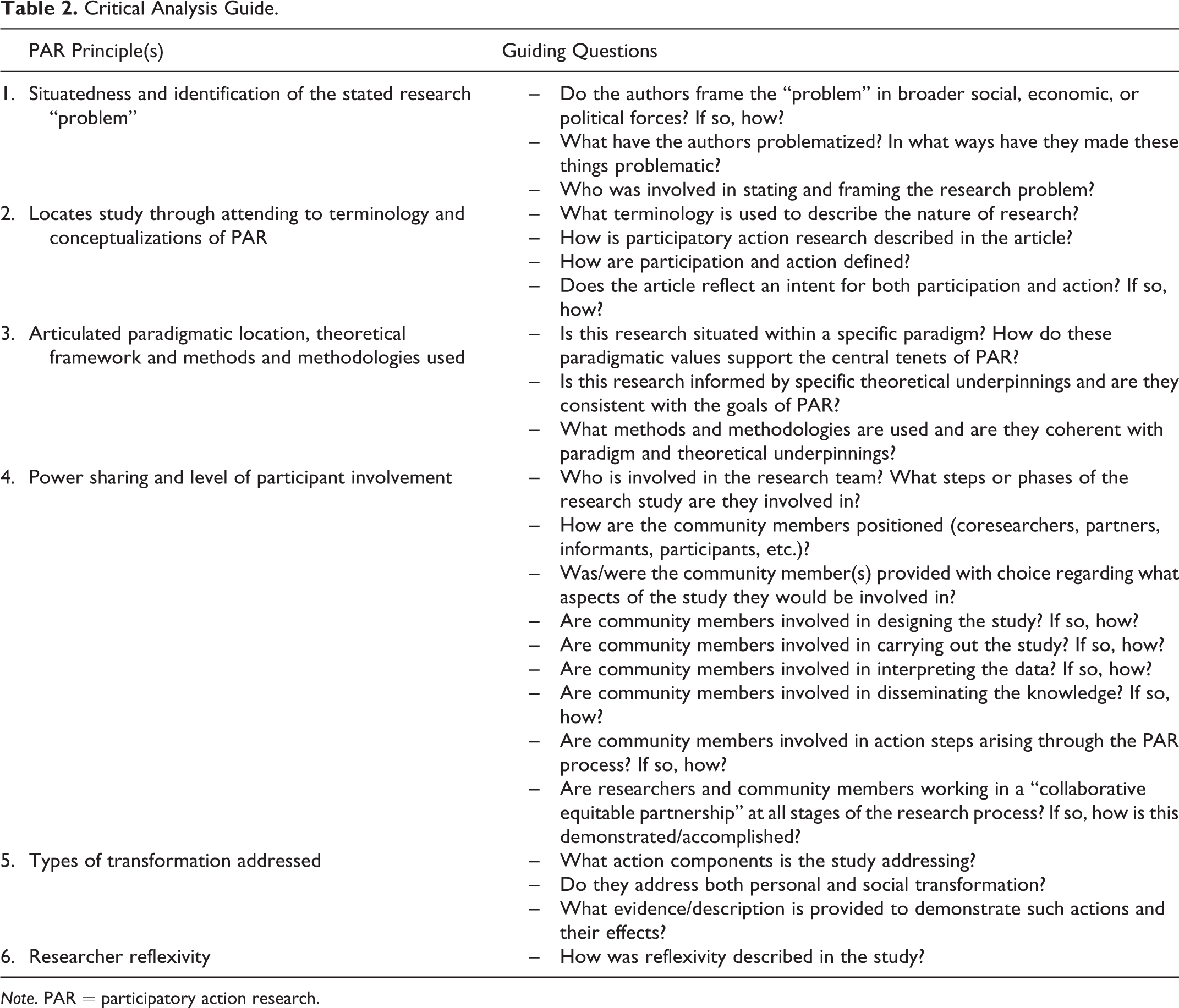
Note. PAR = participatory action research.
Critical Analysis Guide and Explicating the Application of PAR Principles
In this section, we first highlight each principle, discuss its significance, and provide guiding questions for critical analysis of each principle. We then apply these guiding questions to the PAR exemplars to discuss the extent to which these principles were taken up by researchers and the strategies used to enact these principles.
Principle 1: Situatedness and Identification of the Stated Research “Problem”
Critically informed research situates a problem as mediated by unequal power relationships and contextually shaped by sociopolitical, historical, cultural, gender, and economic forces (Carpenter & Suto, 2008). In turn, such research seeks to address contextual forces informing and shaping the issues of injustices experienced by specific collectives. As such, “the intersection of power, oppression, and privilege with issues of human suffering, equity, social justice, and radical democracy results in a critical ethical foundation” (Cannella & Lincoln, 2011, p. 81). Researchers practicing PAR need to explicitly identify the contextually situated nature of an issue, avoiding individualizing social issues, and ensuring a foundation to guide transformative agendas beyond the individual level. Moreover, to be able to better address social transformation, the dialectic interactions that support the identification of problems as well as solutions by people holding firsthand experiences of the issue are considered as central within this research approach (Walter, 2009).
Guiding questions
Do the authors frame the “problem” in broader social, economic, or political forces? If so, how? What have the authors problematized? In what ways have they made these things problematic? Who was involved in stating and framing the research problem?
Critical analysis of exemplars
Within this examination, almost all exemplars situated the research problem as contextually shaped and informed versus placing the problem at the level of the individual. Specific physical, institutional, social, political, and cultural forces were highlighted and problematized. For example, the physical environment was highlighted as creating problematics for social participation of older adults (Andonian & MacRae, 2011); institutional factors were identified as bounding autonomy as experienced by older adults within residential homes (Baur & Abma, 2012); policies were problematized due to their limiting influence on older adult participation levels (Raymond & Grenier, 2015) and a failure to consider sociopolitical dimensions of age-friendliness (Annear, Keeling, & Wilkinson, 2014); and sociocultural forces, such as ethnicity, language barriers, available activities, and services were highlighted as having an impact on positive ageing for older adults (Fang et al., 2016) and hospital experiences of older people from minority communities (Ellins & Glasby, 2016).
Although not always explicitly apparent within articles, it was common across exemplars for researchers to establish the research priorities. However, this examination also reveals that the research questions and priorities preestablished by researchers were often broad and open-ended, thus providing a space for participants to shape the focus of what knowledge was generated, and in turn, how action was addressed (Flinn, Sanders, Yen, Sommerich, & Lavender, 2013; Ronzi, Pope, Orton, & Bruce, 2016; Yankeelov, Faul, Ambrosio, Collins, & Gordon, 2015). For example, within Ronzi and colleagues’ (2016) project, participants were given a broad preidentified problem related to “respect and social inclusion” and were asked to photograph aspects that revealed how they were enabled or prevented from feeling valued within their communities and potential solutions. There were also some exemplars that reflected the collaboration of researchers with community organizations or councils in establishing research foci (Baur & Abma, 2012; Ellins & Glasby, 2016; Harding, North, Barton, & Murray, 2011; James, Blomberg, Liljekvist, & Kihlgren, 2015; Raymond & Grenier, 2015), which in some instances involved community organizations or councils reaching out to researchers for initiating projects on specific issues versus research agendas being researcher-driven (Baur & Abma, 2012; James et al., 2015; Raymond & Grenier, 2015).
Principle 2: Locates Study Through Attending to Terminology and Conceptualizations of PAR
A myriad of terms are used synonymously to PAR, with each approach embodying different historical and disciplinary roots leading to different kinds of PAR reflecting “different aspirations” (Kemmis et al., 2014, p. 4). However, common across this diversity are intents for participation and action. In turn, researchers are called to specifically choose a terminology and explicitly define it, so as to clearly situate their research and ensure coherence with how research is carried out and how it addresses the tenets of equitable participation and social transformation.
Additionally, how “participation” and “action” are defined will guide how these tenets are enacted within the research process. Scholars have problematized the application of “participation” (Cargo & Mercer, 2008; McTaggart, 1991) when it shifts from equitable collaboration toward tokenism. Moreover, the conceptualization of participation can reflect varied understandings about the extent to which participants can be involved within projects based on their positionality with their communities. PAR seeks to ensure reciprocal and balanced power relations between researchers and community members through embodying mutual trust and respect (Cargo & Mercer, 2008; McTaggart, 1991). This can be achieved through ongoing reflexivity addressing power differentials so that “when status or power differentials exist among participants, these must be suspended to allow collective work to begin, but combatted in the course of that work” (McTaggart, 1991, p. 174).
Similar to how participation needs to be defined, action or transformation also needs to be explicitly articulated and defined, which can embody different intents based on the purpose of the research and its disciplinary location, addressing personal transformation, social transformation, or both. However, within critically informed PAR, action cannot be limited to seeking for transformation at the individual level but individual transformation can be addressed as a means for social transformation. Thus, how action is defined would inform how and until when the research project is carried out. As such, change is an ongoing process, and researchers need to mobilize change based on strategies or solutions identified within the research process. Action within PAR is inextricably linked to changing social practices (Kemmis et al., 2014), with emphasis on mobilizing sustainable changes (Blair & Minkler, 2009).
Guiding Questions
What terminology is used to describe the nature of research? How is PAR described in the article? How are participation and action defined? Does the article reflect an intent for both participation and action? If so, how?
Critical analysis of exemplars
Within this CIS, articles used varying titles to identify their research approaches, namely, PAR (Adili, Higgins, & Koch, 2012; Annear et al., 2014; Flinn et al., 2013), participatory and appreciative action and reflection (James et al., 2015), action research (Andonian & MacRae, 2011; Baur & Abma, 2012), community-based PAR (Andress & Hallie, 2017; Bauman et al., 2012; Fang et al., 2016; Raymond & Grenier, 2015; Ronzi et al., 2016; Yankeelov, Faul, D’Ambrosio, Collins, & Gordon, 2015), and participatory research (Ellins & Glasby, 2016; Harding et al., 2011). In spite of the varied terminology used, the intent for community collaboration as well as for addressing personal or social change was common within all exemplars as reflected in the way researchers defined the research approach they utilized.
More specifically, a predominant number of projects explicitly emphasized the need for local knowledge or knowledge from lived experiences of participants to guide social action addressing policy, program development, or service interventions or improvements (Andress & Hallie, 2017; Bauman et al., 2012; Baur & Abma, 2012; Ellins & Glasby, 2016; Harding et al., 2011; Raymond & Grenier, 2015; Ronzi et al., 2016). Some projects emphasized the process of reflection and learning (Adili et al., 2012; James et al., 2015) or participant empowerment (Baur & Abma, 2012; Fang et al., 2016; Flinn et al., 2013) through their involvement within research and as a means to guide action (Annear et al., 2014; Fang et al., 2016; Flinn et al., 2013; James et al., 2015). Furthermore, in one project, the principles of PAR were specifically identified with Maori principles and cultural practices (Harding et al., 2011) highlighting community collaboration. Overall, projects intended to embody the three constructs of PAR: participation, action, and research.
Throughout the exemplars, participation often referred to challenging power differentials between researchers and community members. It involved community members working alongside researchers engaging in dialogue and collaborative knowledge generation on shared lived experiences regarding a specific issue to guide action. Participation was situated within the need for understanding specific issues as well as identifying strategies and solutions generated from communities to guide action (Adili et al., 2012; Andonian & MacRae, 2011; Andress & Hallie, 2017; Harding et al., 2011; Raymond & Grenier, 2015; Yankeelov et al., 2015). Additionally, in terms of how action was situated, in some instances, projects explicitly focused on addressing changes in programs, services, policies, or institutions (Annear et al., 2014; Baur & Abma, 2012; Ellins & Glasby, 2016; Bauman et al., 2012; James et al., 2015; Ronzi et al., 2016), and some projects focusing on individual empowerment as well (Bauman et al., 2012; Baur & Abma, 2012; Flinn et al., 2013; Harding et al., 2011). All exemplars within this analysis embodied intents for both participation and action; however, this may not always translate when executing their projects.
Principle 3: Articulated Paradigmatic Location, Theoretical Framework, and Methods and Methodologies Used
Theoretical frameworks or underpinnings inform how a researcher approaches the research process. Theory guides researchers in choosing and articulating a research purpose, interpreting information, and in methodological choice (Finlay, 2002). Theoretical frameworks are ideally informed by the paradigmatic location of the researcher, which refers to a set of beliefs and values that informs how one views and understands reality through the nature of the relationship between the knower and the would-be knower (Guba & Lincoln, 1994). PAR is inextricably linked to values within the critical, transformative, and participatory paradigms (Kemmis et al., 2014), as it explicitly identifies injustices faced by particular collectives as sociopolitically shaped and constructed and seeks to address social transformation through challenging traditional boundaries between researchers and community members. As such, situating PAR research within a specific paradigm and being explicit about its theoretical underpinnings is key to carrying out research in a manner that is epistemologically coherent as well as rigorous (Tracy, 2010).
Paradigmatic location as well as theoretical underpinnings inform what methods and methodologies are used within a PAR project. A method is defined as a procedure used to gather information within research, and a methodology includes a philosophical underpinning informing how a method should be utilized within research (Schwandt, 2001). Methods and methodologies utilized within projects need to reflect the commitment of PAR to equitable participation and social transformation and be coherent with theoretical and philosophical location. PAR is an approach that acknowledges different ways of knowing, and various methods and methodologies are specifically situated as participatory methods. However, utilization of approaches labeled participatory does not automatically make a method or methodology participatory, and researchers need to continually work toward addressing power differentials and facilitating reciprocity within the research process. As such, research methods can be used in hegemonic and objectivist ways as well as in a manner that is participatory and equitable.
Guiding Questions
Is this research situated within a specific paradigm? How do these paradigmatic values support the central tenets of PAR? Is this research informed by specific theoretical underpinnings and are they consistent with the goals of PAR? What methods and methodologies are used and are they coherent with paradigm and theoretical underpinnings?
Critical analysis of exemplars
It was not common for researchers to articulate the paradigmatic location of their research project; however, there were some instances where researchers explicitly called for disrupting positivist approaches to research by articulating the need for breaking traditional boundaries between the researcher and the researched (Ellins & Glasby, 2016; Fang et al., 2016) and calling for researcher collaboration with communities (Fang et al., 2016), an embodied value within the critical, participatory, and transformative paradigms. Furthermore, one article was explicitly positioned within a transformative paradigm (Baur & Abma, 2012), two embodied a critical perspective (James et al., 2015; Raymond & Grenier, 2015), and one project was situated within an action research paradigm (Andonian & MacRae, 2011). By embodying values from specific paradigmatic locations, a few exemplar projects were propelled in a manner that explicitly addressed the central tenets of equitable participation and social transformation.
Similarly, only a few projects explicitly mentioned theoretical frameworks informing their research. Depending on the focus of each project, theoretical frameworks named included Lewin and Tuckmann’s model in group dynamics (Adili et al., 2012), Koch and Kralik’s “look, think and act” framework to PAR (Adili et al., 2012), the notion of relational empowerment (Baur & Abma, 2012), as well as models that were specifically situated within methodologies like the “making, telling and enacting” model within participatory design (Flinn et al., 2013) and Freire’s work on the raising of critical consciousness within photovoice (Ronzi et al., 2016). These theoretical underpinnings reflect that the goals within PAR to facilitate collaboration, shared reflection, and action were central in guiding the exemplar research projects.
There were a wide variety of methods used within the exemplars, including traditional methods such as interviews (Andress & Hallie, 2017; Ellins & Glasby, 2016; Flinn et al., 2013; James et al., 2015; Raymond & Grenier, 2015; Ronzi et al., 2016), observations (Flinn et al., 2013; James et al., 2015; Raymond & Grenier, 2015), and focus group discussions (Adili et al., 2012; Andress & Hallie, 2017; Annear et al., 2014; Baur & Abma, 2012; Harding et al., 2011; James et al., 2015; Raymond & Grenier, 2015; Ronzi et al., 2016), as well as emerging methods and methodologies such as photovoice/photo-novel (Andonian & MacRae, 2011; Andress & Hallie, 2017; Bauman et al., 2012; Raymond & Grenier, 2015; Ronzi et al., 2016; Yankeelov et al., 2015), participatory design through clay modeling (Flinn et al., 2013), and participatory community mapping activities (Fang et al., 2016). These emerging methods and methodologies embodied different ways of knowing through the use of visuals and other sensory representations to explore issues and solutions and further enabled exploration of the contextually situated nature of identified issues and generation of place-based, relevant solutions. Although all methods and methodologies supported the participation of older adults within the research and action processes, projects that incorporated emerging methods and methodologies seemed to have better embodied participatory intents by incorporating strategies and steps for the researcher to involve older adults within the different phases of the research project, from data collection to dissemination. For example, within Yankeelov and colleagues’ (2015) project, they had an initial training process on the research methodology, followed by 2 weeks of taking photographs, which was followed by participants selecting photographs they wanted to share along with providing accompanying narratives. Additionally, they also participated in a focus group discussion that facilitated their involvement in the interpretation of visuals. Finally, a community event was organized for them to showcase their posters, thus extending involvement into knowledge mobilization and raising community awareness.
Principle 4: Power Sharing and Level of Participant Involvement
Equitable participation and collaboration of community members within the research process is a central tenet of PAR; community members need to be collaborators within the research and action processes, and the extent of their involvement can reflect collaboration. Collaboration is reflected in the way participants are positioned within the research process, ideally as coresearchers working alongside researchers as well as community stakeholders. More importantly, power needs to be shared within the research team, and how each member contributes to the research process reflects how the central tenet of participation has been embodied within the research process.
Reciprocal relationships between the researcher and community members need to be initiated prior to starting the project and carried forward even after the research phase is completed to address mobilizing community change and facilitating strong and sustainable transformation. Reciprocity forms the basis for ethical research practices especially within participatory approaches to research that are considered as a relational process (Maiter, Simich, Jacobson, & Wise, 2008).
Power sharing plays an important role in promoting collaborative participation of community members within the research and action processes, and PAR seeks to challenge unequal distributions of power between researchers and others involved in PAR projects. However, power differentials will always exist and may play out differently within the different contexts where research is carried out. As such, researchers utilizing PAR need to continually and consciously address differences in power and continually attempt to balance such power differences (Cargo & Mercer, 2008; Frisby, Reid, Millar, & Hoeber, 2005; Kidd & Kral, 2005).
Equitable collaboration would be reflected in all participants being involved in different aspects of the research process in ways that align with their desires, skills, resources, and knowledge. Equitable participation does not necessarily mean that all participants are involved in all aspects of PAR, but rather participants need to be given the opportunity to decide on, and be supported in, whichever aspects of the research process they would like to be involved in (Blair & Minkler, 2009). As such, “participation” can be a seen as a continuum (Grimwood, 2015). However, if research reflects that participants are often only involved in data collection and not in other phases that could raise questions about participation and the difference between a PAR project versus other projects.
Guiding Questions
Who is involved in the research team? What steps or phases of the research study are they involved in? How are the older adults positioned (coresearchers, partners, informants, participants, etc.)? Was/were the older adult(s) provided with choice regarding what aspects of the study they would be involved in? Are older adults involved in designing the study? If so, how? Are older adults involved in carrying out the study? If so, how? Are older adults involved in interpreting the data? If so, how? Are older adults involved in disseminating the knowledge? If so, how? Are older adults involved in action steps arising through the PAR process? If so, how? Are researchers and older adults working in a ‘collaborative equitable partnership’ at all stages of the research process? If so, how is this demonstrated/accomplished?
Critical analysis of exemplars
To facilitate the sharing and negotiation of power, several exemplar projects reflected the importance of researchers building community relationships with organizations as well as with older adults prior to initiating their PAR projects (Adili et al., 2012; Fang et al., 2016; Ronzi et al., 2016). Adili and colleagues (2012) had one-on-one interviews for 12 months with a group of women and only when relationships were strong did they proceed with conducting PAR groups with the same women. Similarly, Fang and colleagues (2016) had developed strong relationships and community ties through a previous project and articulated its importance prior to initiating participatory community mapping workshops.
In some instances, the language used by researchers such as “enabling participants to be the expert” (Fang et al., 2016), older women were “researching alongside” (Adili et al., 2012), older people as “coresearchers” (Ellins & Glasby, 2016), “individuals with rich background” (Baur & Abma, 2012), older adults consenting to “collaborate in the research” (Annear et al., 2014), intents to “co-create knowledge” (James et al., 2015), and being a “self-directed project of older people” (Raymond & Grenier, 2015) reflected attempts to share and negotiate power between researchers and research participants. Additionally, in one project, service providers were oriented to their role as a “learner” and “knowledge user” from the experiences of older adults (Fang et al., 2016).
The sharing of power within the research process was also reflected in particular types of involvement, specifically, participants were found to collaboratively set the research agenda (Baur & Abma, 2012) as well as establish group norms (Adili et al., 2012), meeting agendas (Adili et al., 2012; Yankeelov et al., 2015), and research time lines (Andonian & MacRae, 2011). Participants also directed knowledge generation activities such as mapping activities (Fang et al., 2016), needs assessments, and problem-focused data collection activities based on issues raised during audits (Bauman et al., 2012), designed and created ergonomic jar lids for people experiencing hand pain or limitations (Flinn et al., 2013), and conducted interviews (Baur & Abma, 2012; Ellins & Glasby, 2016). Participants were also involved in modifying research processes by suggesting changes in how tasks were carried out. For example, having language translation during meetings (Ellins & Glasby, 2016) or the incorporation of cultural values and practices within PAR groups (Harding et al., 2011), as well as taking the lead in mobilizing the change process following the identification of issues (Baur & Abma, 2012). Collaboration also extended to other community members who were involved within the research process to conduct or co-moderate focus group discussions with participants (Andress & Hallie, 2017; Harding et al., 2011) or coresearchers who were involved in analyzing data, studying theory, and proposing changes (James et al., 2015).
Beyond data collection activities, data analysis within various projects was also coconducted with older adults (Andonian & MacRae, 2011; Annear et al., 2014; Baur & Abma, 2012; Ellins & Glasby, 2016; Fang et al., 2016; Yankeelov et al., 2015), although with varied levels of older adult involvement. For example, Fang and colleagues (2016) had two levels of data analysis that involved coanalysis with older adults through a process of group discussions and then a third level by the researcher. Ellins and Glasby (2016) involved older adults within a debriefing process after every interview, as well as collaborated with them in reviewing transcripts, discussing meanings, and in identifying themes and issues. In photovoice projects, often after participants had presented their work to the rest of the group, their descriptions and narratives were noted and brought back to participants for review as well as further analysis (Andonian & MacRae, 2011; Yankeelov et al., 2015). However, in some projects, older adults were only involved in the final review of propositions made by either the research team (Ronzi et al., 2016) or other community stakeholders (James et al., 2015).
Older adults were also involved in the dissemination of research findings (Baur & Abma, 2012; Ellins & Glasby, 2016; Fang et al., 2016; Raymond & Grenier, 2015; Yankeelov et al., 2015). For instance, to specifically facilitate older adults to continually conduct community presentations, the maps created by participants in one project were left with the older adults (Fang et al., 2016). In another project, older adults were given the space to conduct presentations on their own with government officials and other key stakeholders (Yankeelov et al., 2015). Furthermore, older adults from Baur and Abma’s (2012) project decided to become coauthors in Dutch publications resulting from the project.
Although older adults played a key role in identification of issues and providing recommendations, only a few projects involved them within the process of affecting change (Bauman et al., 2012; Baur & Abma, 2012; James et al., 2015; Yankeelov et al., 2015). In one such example, the older adults from Baur and Abma’s (2012) project played a key role in facilitating practice improvements within a particular residential home as they collaborated and developed a relationship with those responsible for making changes within the organization. In turn, direct communication between residents and cooks was established, and residents were able to choose their own menu versus having a menu preestablished solely by the cooks.
As a means to support collaboration, older adults often received training to engage in particular aspects of the research. For example, projects that employed photovoice, had training sessions addressing camera use, safety, risks, and ethical protocols (Andonian & MacRae, 2011; Andress & Hallie, 2017; Ronzi et al., 2016; Yankeelov et al., 2015). Additionally, older adults were trained on maintaining consent and confidentiality (Ellins & Glasby, 2016) as well on advocacy methods (Bauman et al., 2012). Since projects in some instances also involved other community stakeholders, there was training for these groups as well. For example, Harding and colleagues (2011) trained several Maori community leaders in techniques for generating and verifying data.
Academic researchers also exhibited reflexivity about their position to intentionally facilitate the sharing and negotiation of power by not dominating discussions and having research processes led by older adults (Fang et al., 2016). Researchers also expressed positioning themselves as democratic facilitators by creating spaces for participants to determine meeting agendas as well as drive the research and action processes (Adili et al., 2012), with facilitators intentionally adopting supportive roles and lessening their role as appropriate (Baur & Abma, 2012).
Principle 5: Types of Transformation Addressed
As Potts and Brown (2005) articulate, “committing ourselves to anti-oppressive work means committing to social change and taking an active role in that change” (p. 255). Social transformation is a key tenet of PAR that researchers are called to embrace, which includes expansions beyond the identification of injustices but also mobilizing the steps toward addressing such injustices. The change process is often depicted as involving overlapping spirals of planning a change, acting, reflecting, replanning, acting, and reflecting (Kemmis et al., 2014). As such, researchers and coresearchers need to circle back to share and critically reflect on the kinds of transformation addressed as well as what was achieved or not achieved. Thus, transformation is an ongoing process encompassing personal changes within researchers, participants, and community members (MacDonald, 2012; Potts & Brown, 2005). However, if researchers are focusing solely on personal transformation, then they could run the risk of individualizing issues that are actually sociopolitically constructed (Farias et al., 2017).
Guiding Questions
What action components is the study addressing? Do they address both personal and social transformation? What evidence/description is provided to demonstrate such actions and their effects?
Critical analysis of exemplars
Although one exemplar focused solely on personal transformation of participants in relation to changes in knowledge, lifestyles, and confidence (Adili et al., 2012), almost all other exemplars sought to address socially transformative agendas. As a first step toward addressing social transformation, encompassing changes in programs, policies, institutions, or practices, older adults were given the space to explore and identify issues as well as propose strategies, solutions, and recommendations to relevant stakeholders and/or community members (Andonian & MacRae, 2011; Andress & Hallie, 2017; Annear et al., 2014; Bauman et al., 2012; Baur & Abma, 2012; Ellins & Glasby, 2016; Fang et al., 2016; Harding et al., 2011; Raymond & Grenier, 2015; Ronzi et al., 2016; Yankeelov et al., 2015). Some projects took a step further in mobilizing these transformative agendas (Bauman et al., 2012; Baur & Abma, 2012; Yankeelov et al., 2015), which included infrastructure changes within communities where a sidewalk was repaired (Yankeelov et al., 2015), creation of a community garden (Bauman et al., 2012), and organizational changes addressing the functioning of a residential home (Baur & Abma, 2012). Proposed plans or generated guidelines were also incorporated within community strategic planning initiatives guiding community-level changes (Yankeelov et al., 2015) as well as incorporated by politicians at the policy level to mobilize change (James et al., 2015). However, reflections about the impact or effects of such transformations were left unarticulated within the exemplars. When addressing social transformation, transformation was also articulated to have occurred at the personal level and researchers shared that participants had developed a sense of pride regarding their contributions (Baur & Abma, 2012; Flinn et al., 2013; Ronzi et al., 2016), attained critical awareness on issues (Baur & Abma, 2012; Ronzi et al., 2016), developed social identity (Baur & Abma, 2012), and felt empowered (Baur & Abma, 2012; Flinn et al., 2013; Ronzi et al., 2016; Yankeelov et al., 2015).
Principle 6: Researcher Reflexivity
Reflexivity involves the process of engaging in explicit self-awareness, with the intention of interrogating one’s motives, feelings, roles, thoughts, and actions (Finlay, 2002). This process of reflexivity guides researchers in exploring how their personal values and sociopolitically shaped experiences influence the research and action processes (Berger, 2015; Brydon-Miller et al., 2011; Grimwood, 2015). As such, “critical PAR therefore rejects the notion of the ‘objectivity’ of the researcher in favour of a very active and proactive notion of critical self-reflection—individual and collective self-reflection that actively interrogates the conduct and consequences of participants’ practices, their understandings of their practices, and the conditions under which they practice, in order to discover whether their practices are, in fact, irrational, unsustainable or unjust.” (Kemmis et al., 2014, p. 6)
Guiding Questions
How was reflexivity described in the study?
Critical analysis of exemplars
Many exemplars articulated the need for author’s reflexivity (Adili et al., 2012; Andonian & MacRae, 2011; Andress & Hallie, 2017; Baur & Abma, 2012; James et al., 2015; Ronzi et al., 2016); however, reflexive notes were shared in only a few publications which included, reflexivity about the researcher’s position within the scope of the project (Adili et al., 2012; Andress & Hallie, 2017; Baur & Abma, 2012) and exhibited transparency within research and action processes (Adili et al., 2012; Baur & Abma, 2012; Fang et al., 2016; Harding et al., 2011). Specifically, authors articulated challenges related to logistics (Bauman et al., 2012; Fang et al., 2016), power dynamics (Fang et al., 2016; Annear et al., 2014; James et al., 2015), situated cultural norms (Baur & Abma, 2012), and participant expectations (Adili et al., 2012) and highlighted how the flexibility of the PAR process accommodated community needs (Harding et al., 2011). However, only a few projects shared how researchers engaged in shared reflexivity with older adult coresearchers either during specific moments during the research process (Baur & Abma, 2012) or after a specific part of the research process (Eliins & Glasby, 2016).
Conclusion
PAR is a form of social practice (Kemmis et al., 2014) that is political (McTaggart, 1991), addressing transformation both as a means and an end. However, it does come with challenges, including institutional (Potts & Brown, 2005) and sociopolitical factors that can prevent researchers from enacting the promise of PAR to its full potential. As such, “becoming anti-oppressive is not a comfortable place to be. It means constantly reflecting on how one is being constructed and how one is constructing one’s world” (Potts & Brown, 2005, p. 283).
Within this CIS, most projects carried intents for equitable participation and social transformation. As well, most projects demonstrated attempts to facilitate the sharing and negotiation of power through involving older adults beyond the process of data collection, extending collaboration into data analysis and dissemination and, to a lesser extent, within the process of mobilizing action. However, notable absences often included a lack of descriptions regarding the impact of actions that addressed social transformation. There was also a lack of description of researcher as well as coresearcher reflexivity within the research process, even though reflexivity was acknowledged and identified as central within PAR. Additionally, only a hand full of projects was explicit about the paradigmatic and theoretical underpinnings informing their work, which is central to guide ethical and coherent research practices.
This article presents one approach to critically analyzing PAR through drawing exemplars of PAR with older adults. However, it does not intend to reduce PAR to a list of principles or strategies, as PAR is a complex and diverse approach constantly being shaped and negotiated within specific contexts. We make a call for researchers who carry out PAR to reinterpret and apply these core principles in a manner that is relevant and applicable within situated sociopolitical and cultural contexts and to further address power sharing through carrying out research in ways that embrace diversity through adopting different ways of knowing. These set of principles and guiding questions, we propose, could act as a tool for researchers to examine and reflect on their work and guide them in carrying out PAR in ways that are not only epistemologically coherent but also adhere to the promise of PAR for equitable participation and social transformation.
Footnotes
Declaration of Conflicting Interests
The author(s) declared no potential conflicts of interest with respect to the research, authorship, and/or publication of this article.
Funding
The author(s) disclosed receipt of the following financial support for the research, authorship, and/or publication of this article: This project was supported by funds from Western University SSHRB Seed Research Grant.