




Abstract
Researchers undertaking qualitative interview and focus group research with people in prison must consider the research methods they use, given the ethical and practical complexities of prison-based research. In particular, there are explicit and implicit coercion risks and barriers to access, privacy, and confidentiality. To examine how the challenges of conducting rigorous qualitative research with prisoners were handled, we undertook a scoping review of recruitment and data collection processes reported in qualitative research with prisoners. We searched for peer-reviewed articles of qualitative interview and focus group research with adult prisoners, published in the English language from 2005 to 2017, using MEDLINE, Embase, PsycINFO, and CINAHL databases. There were 142 articles reporting on 126 studies which met the review inclusion criteria. Challenges related to coercion risk, participant recruitment, sampling, confidentiality, privacy, and working with prison-based intermediaries should be explicitly addressed and reported. Our findings highlight key considerations and contextualized strategies for recruitment and data collection for researchers who seek to conduct rigorous and ethical qualitative research with prisoners.
Keywords
What Is Already Known?
There is growing appreciation of the need to explore the experience of people who are in prison through qualitative research. However, undertaking such research is complicated by the restrictions of imprisonment and the inherent controls and power imbalances in prison contexts. There are increased risks of coercion and of impediments to research participation. The closed and inflexible nature of prison and custodial processes affects the confidentiality and privacy of participants and limits access to participants.
What This Paper Adds?
Using scoping review methodology, we provide a comprehensive review of recruitment, sampling, and data collection reported by contemporary researchers undertaking interviews and focus groups with people in prison. We provide insight into the challenges of qualitative health research in the prison context and highlight strategies used by researchers to undertake ethical, feasible, and credible qualitative research. Our review also emphasizes the importance of reporting adequate methodological information due to the unique characteristics of each prison context. Researchers can enhance the integrity and rigor of their research by considering the effects of custodial surveillance, prison-based intermediaries, and recruitment and sampling methods on their research.
Introduction
There are a number of choices and dilemmas in research when participants are imprisoned, particularly when qualitative researchers seek to understand their perspectives and experiences through in-depth interview and focus group research. Limits on access, privacy, and confidentiality, as well as implicit and explicit coercion risks, are commonly encountered during recruitment and data collection and can affect the ethics and feasibility of the research.
The heightened risk of coercion is a central concern. People who are in prison may not feel they are in a position to refuse research requests and choices to participate may be influenced by their relative deprivation (Hanson et al., 2015). A well-defined power imbalance exists between people in prison and those who may prevent or facilitate their research participation, namely, prison authorities, prison health-care providers, and correctional staff. These authorities and the prison system itself exert power over all aspects of prisoner life (de Viggiani, 2007).
Scholars such as Byrne (2005); Coughlin, Lewis, and Smith (2016); and the National Commission for the Protection of Human Subjects of Biomedical or Behavioral Research (1976) have emphasized the history of high-risk research and unethical research designs in prisons. Studies have included experimental exposure to serious health threats such as viral hepatitis and agents used in chemical warfare (Hornblum, 1997).
Research with people in prison clearly requires careful ethical consideration before proceeding. Nevertheless, people in prison also have the right to participate in research that might benefit them and others, and qualitative research can have substantial value. For example, there is a call for more health services research in prisons (Kouyoumadjian, Schuler, Hwang, & Matheson, 2015), and the perspectives of people in prison on their health needs and health care are vital to such research. Therefore, a balance between safeguarding prisoners and enabling research participation is necessary (Coughlin, Lewis, & Smith, 2016). Such a balance is more likely to be achieved when research is carefully planned in the knowledge of specific challenges in the prison research context and how such challenges may be addressed through suitable research methods.
There has been little systematic review of qualitative research methods undertaken in prison-based research. One review, which aimed to inform standardized data collection procedures for cross-study comparisons, found low reporting of data collection processes in research with violent offenders (Daniels, Angleman, & Grinnan, 2015). We were prompted to undertake this review by our own research with women’s experiences of health care in prison (Abbott, Magin, Davison, & Hu, 2017), during which we reflected on the challenges of conducting rigorous qualitative health research in this setting, particularly related to recruiting participants and collecting data. We saw the need for guidance as to the ways qualitative researchers undertake research within the constraints and opportunities provided by the prison setting.
We followed the methodological framework of Arksey and O’Malley (2005) to undertake a scoping review of the extent and nature of participant identification, sampling, recruitment, and data collection processes reported within qualitative interviews or focus group research with prisoners. Scoping reviews allow synthesis of broad research topics, while remaining systematic and accountable across a wider conceptual range than standard systematic reviews (Peterson, Pearce, Ferguson, & Langford, 2017). In this article, we aim to provide insight into contextual considerations and useful strategies to assist researchers to undertake ethical, feasible, and credible qualitative health research with people who are in prison.
Method
The review was guided by the following research questions: What research processes are reported in qualitative interview and focus group research in people in prison, in particular relating to ethical approval, participant sampling, participant recruitment, and data collection? How can reported processes inform the planning and conduct of future research? We approached these questions from our perspective as a research team comprising an academic general practitioner experienced in prison-based health care and research, and three university-based researchers with backgrounds in psychology, medicine, and qualitative health research.
Eligibility Criteria
We included studies in which the primary research approach was qualitative wherein prisoners participated in interviews or focus groups. Peer-reviewed articles in the English language published after 2005 were eligible for inclusion. This period was chosen to ensure sufficient breadth of recent literature in our sample. An initial search was conducted on September 10, 2015. A subsequent search, using the same protocol, was done on June 15, 2017, to capture recently published articles and the results were merged in the final sample of scoped articles.
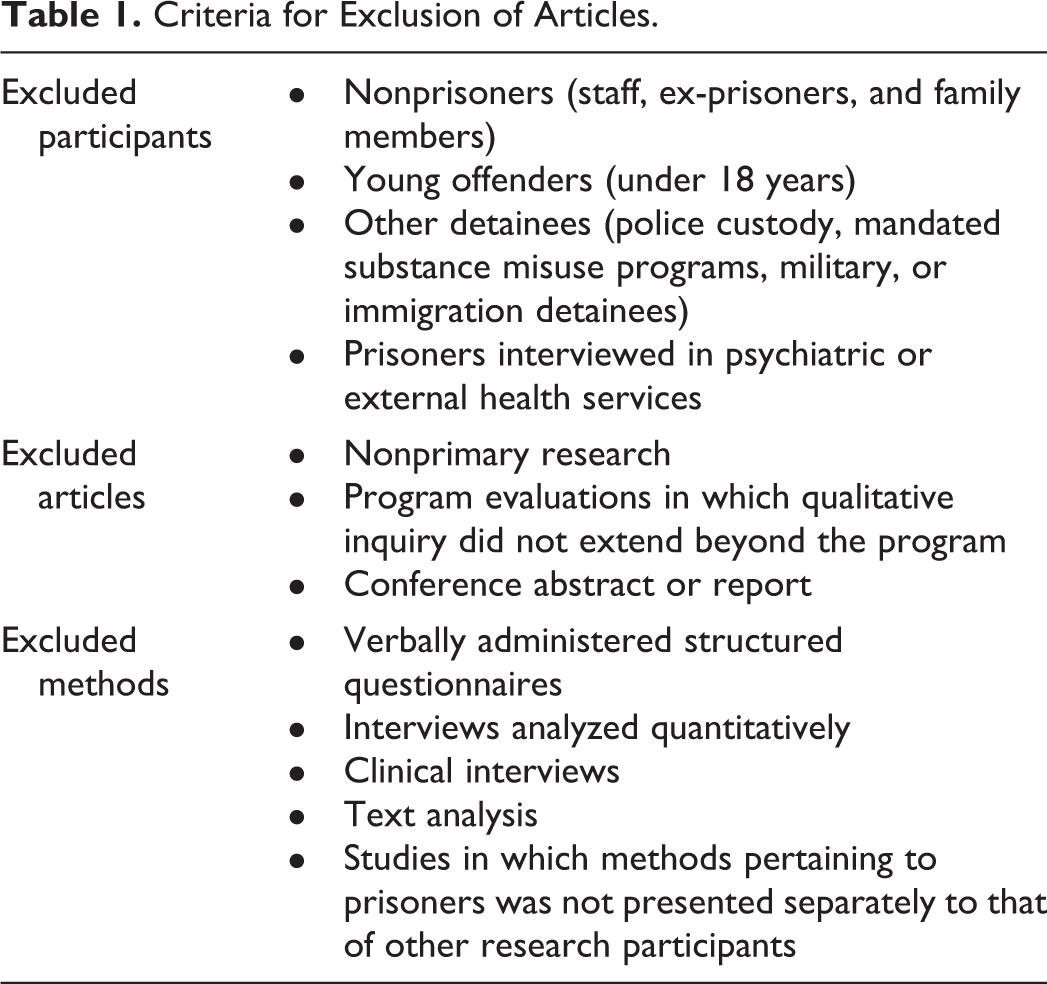
We included research that was driven by qualitative inquiry and excluded research in which qualitative data were collected through structured interviews, open-ended survey items, or was done solely for program evaluation. This distinction was made because such data are more distanced from the participant’s perspective and subsequently, issues of confidentiality and coercion and the effect of the interviewers and researchers on the data are less marked. Other exclusion criteria were determined according to participants, type of article, and research methods (Table 1).
Criteria for Exclusion of Articles.
Information Sources and Searching
We searched MEDLINE, Embase, PsycINFO, and CINAHL databases using the search terms “prisoner” (detainee; inmate; offender; incarcerat*), “prison” (gaol; jail; penitentiary; custody; detention; correctional settings/facilities/health services). and “qualitative research” (qualitative studies; interviews in qualitative research; interviews as topic; focus group; focus groups as qualitative research). The terms were searched as key words, topics, Medical Subject Headings (MeSH) terms, and subject headings. Hand searching references for information-rich or linked research articles was done to maximize the yield of relevant papers. The search protocol was developed with a health librarian and tested against preselected articles. We made these database choices to focus our review on research published in the health literature, given our interest in health research. All articles elicited by the search protocol were, however, considered in our review, including those which did not relate to health care. The research topics were then tabulated for clarity.
Study Selection
One reviewer (P.A.) screened titles and abstracts according to the inclusion and exclusion criteria. A second reviewer (M.D.) undertook a verification check on one third of randomly selected articles and a third researcher (W.H.) adjudicated contested articles. We reviewed multiple articles from the same study together as they often provided complementary detail on research methods, and subsequently the first article published on the study is cited (all included articles are reported in the Online Appendix).
Data Extraction and Analysis
Two authors (P.A. and M.D.) tabulated study characteristics and extracted data into a spreadsheet using categories related to recruitment and data collection, informed by the Standards for Reporting Qualitative Research (SRQR) critical appraisal checklist (O’Brien, Harris, Beckman, Reed, & Cook, 2014). Although this checklist was developed by medical educators, it seeks to apply to both health-care- and non-health-care-related qualitative research. It was not used to critically appraise the included articles, rather to determine which data to extract from the articles, given the checklist comprised key components of methods which should be reported. We also reviewed whether data were reported by authors to have been collected in private or nonprivate conditions, as this is a particular issue in prison research. We defined prison staff as correctional officers, prison employees who were not involved in health care, or those who were identified only as staff by authors. Having extracted descriptions of methods, including excerpts of article text, into categories, we then undertook content analysis on the extracted data (Hsieh & Shannon, 2005).
Results
Our first search generated 626 articles after duplicates were removed and our second search a further 167 articles. After screening abstracts, we undertook full-text review of 474 articles, determining 142 articles reporting on 126 studies to be eligible for inclusion (Figure 1). Articles were mainly excluded because participants were not prisoners (primarily ex-prisoners, prison staff, and family members) or methods were quantitative or open-ended surveys.

Search results.
A summary of the characteristics of the included studies is shown in Table 2. In keeping with the databases searched, most articles reported on findings related to health and well-being and to health services. Most articles originated from the United States and United Kingdom and reported on interview studies.
Study Characteristics.
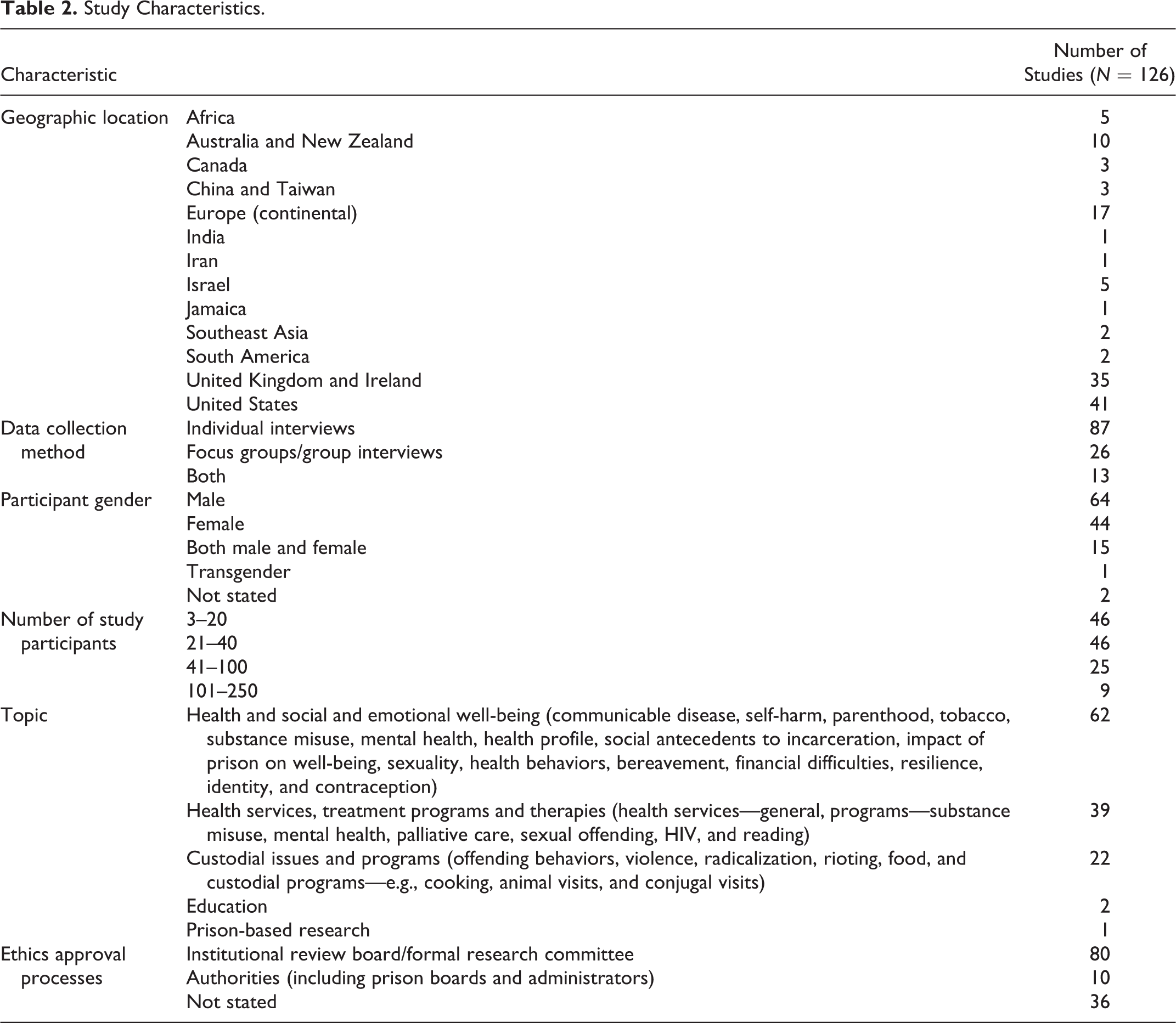
The application of the SRQR checklist brought to light that a significant number of the reviewed articles do not report their methods in detail (Tables 2 –4). Approximately a third of studies had no information about approval by ethics committees or appropriate authorities or on recruitment procedures. In some studies, the limited reporting precluded clear understanding of how participants were identified or sampled. Statements on privacy during data collection or on researcher background were not usually included in articles.
Participant Identification, Sampling, and Recruitment.

Data Collection Processes.

Participant Identification, Sampling, and Recruitment
Findings related to recruiting research participants are presented in Table 3, including identification of participants, recruitment processes, and sampling methods. Articles that are illustrative examples are cited. Where researchers have used multiple strategies, the studies have been charted in more than one category. Sampling strategies were determined by our review of the study methods as a whole.
Participants were commonly identified via self-response to advertisement. Advertisements could target all or selected prisoners using flyers, posters, and letters instructing interested individuals to contact staff, researchers, or to demonstrate interest by choosing to attend focus groups. A potential advantage of this method is it avoids screening of participants by researchers or prison staff or administrators (Moe & Ferraro, 2006). However, in many studies, as seen in Table 3, prison staff and health-care providers advertised the research or identified potential participants through their own knowledge of eligible prisoners. At times, this was because they had dual roles as researchers as well as prison employees or visiting staff or students (Kennedy, 2014; O’Grady, Rolvsjord, & McFerran, 2015; Treloar, McCredie, & Lloyd, 2015). At other times, prison staff or health-care providers undertook recruitment and consent on behalf of the researchers (Einat & Rabinovitz, 2013; Soffer & Ajzenstadt, 2010; Tzvetkova et al., 2016).
Another way in which prison staff or health-care providers acted as intermediaries was when researchers consulted with them after potential participants had been identified but before recruitment. This was done as part of purposive sampling (Dinkel & Schmidt, 2014; Howerton et al., 2007) or to exclude those with impaired capacity to consent or whose health may be put at risk by participation (Condon et al., 2007; Earle, 2011; Fogel et al., 2014; Mercer, Gibson, & Clayton, 2015) or who presented a risk to researchers (Condon et al., 2007).
Researcher presentations to group meetings or direct researcher approach to prisoners, including by letter, were a means of recruitment to some studies. Ethnographic researchers who were embedded in prisons described recruiting prisoners by seeking volunteers, selecting from custodial records, and convenience sampling (de Viggiani, 2007; Earle, 2011; Kjaer Minke, 2014; Liebling & Arnold, 2012; Mjaland, 2015). Inviting all the participants in a particular prison-based program was common and could be a means of access and opportunistic recruitment rather than a sampling strategy in which the research topic related to the program.
The most common sampling method was convenience sampling or sampling of a group sharing characteristics of interest. Custodial or health records or previous research records could be used to select participants with certain characteristics, such as health conditions or offending behaviors, or for convenience and random sampling. Purposive sampling for variation of selected characteristics or for information-rich cases was most commonly achieved through the assistance of prison staff and health-care providers. Another strategy allowing sampling for variation was to undertake an initial survey and subsequently determine who to invite to the qualitative study (Smirnova & Owens, 2017; Wainwright, McDonnell, Lennox, Shaw, & Senior, 2017). Purposive sampling also occurred at the level of the prison or prison unit, such as through choosing prisons or units with different security classifications or purposes. Snowball and theoretical sampling were uncommon.
Coercion risk at recruitment was explicitly discussed by some authors (Earle, 2011; O’Grady et al., 2015; Woodall, Dixey, Green, & Newell, 2009), including regarding monetary incentives (Howerton et al., 2007; Moe & Ferraro, 2006) and exclusion of participants with mental health vulnerabilities. Careful informed consent was emphasized by some authors (Guin, 2009; Kuo et al., 2014; Woodall, 2010). A well-articulated strategy used to decrease coercion risk and increase the reliability of informed consent was to require that a period, such as a day or a week, should elapse between the researchers providing detailed participant information and actual recruitment (Garrett, 2010; Howerton et al., 2007; Plugge, Douglas, & Fitzpatrick, 2008).
Data Collection Processes, Privacy, and Confidentiality
Key data collection processes are charted in Table 4. The location of research visits was often not specified or noted to be “a private room.” Specified locations varied, including education rooms, common rooms, prison wings or cells, visitor rooms, offices, or health clinics. Recruitment by a usual health-care provider in a usual clinical room, or choosing an accustomed or usually accessed setting for interviews, was reported to increase the confidentiality of research participation (Garrett, 2010; Guin, 2009; Plugge et al., 2008; Saraiva, Pereira, & Zamith-Cruz, 2011). Such a setting meant participation would not be noticed, which could be important for sensitive research such as related to HIV (Shalihu, Pretorius, van Dyk, Vander Stoep, & Hagopian, 2014). Decreasing staff awareness of the research could also be achieved through minimizing custodial escorts to research-related interactions (Copes, Hochstetler, & Brown, 2013).Some articles detailed the custodial involvement with research interactions. Custodial involvement included officer escort to the interview (Einat & Rabinovitz, 2013), unspecified guard supervision (Magee, Hult, Turalba, & McMillan, 2005; Weldon & Gilchrist, 2012), video surveillance (Harner & Riley, 2013; Lee, Fu, & Fleming, 2006; Supiano, Cloyes, & Berry, 2014; Yap et al., 2014), monitoring through windows (Smirnova & Owens, 2017), and an officer outside the closed room (A. N. Chambers, 2009; Dinkel & Schmidt, 2014) or out of earshot (Condon et al., 2007; Copes et al., 2013; Moe & Ferraro, 2006; Todrys & Amon, 2011). Surveillance could also include officers periodically entering the interview room (Copes et al., 2013; Harner & Riley, 2013; Supiano et al., 2014). Some authors did not provide details but acknowledged the setting was semiprivate (Harawa, Sweat, George, & Sylla, 2010; Harner, Wyant, & Da Silva, 2017).
Some authors acknowledged or discussed the privacy and confidentiality implications of this surveillance. Confidentiality tended to be carefully reported in HIV research (Guin, 2009; Lee et al., 2006; Shalihu et al., 2014). Some authors reflected on how limits on privacy and confidentiality affected research data (Earle, 2011; Giertsen, Nylander, Frank, Kolind, & Tourunen, 2015; Kennedy, 2014; Lee et al., 2006; Supiano et al., 2014) and on potential repercussions for prisoners if data were collected under surveillance of prison staff (Miller, Tillyer, & Miller, 2012; Plugge et al., 2008).
Authors most commonly reported that participant confidentiality and privacy were safeguarded by prison staff not being present during interviews or focus groups, without further detail. Additional strategies used included institutional confidentiality agreements (Kjaer Minke, 2014), restating the rules of mandatory reporting during interviews (Harner et al., 2011; Mangnall & Yurkovich, 2010), avoiding collecting demographic information (Pedlar, Yuen, & Fortune, 2008; Staton-Tindall et al., 2007) or signed consent forms (Copes et al., 2013), and otherwise maintaining anonymity during recruitment, data collection, and dissemination of findings (Guin, 2009; Hatton, Kleffer, & Fisher, 2006; Havnes, Clausen, & Middelthon, 2014; Lee et al., 2006; Tzvetkova et al., 2016).
Confidentiality was of concern to some authors reporting on focus group research. Some reflected on its limits due to other prisoners participating in the groups (Harner & Riley, 2013; Hatton et al., 2006; Kuo et al., 2014; Lee et al., 2006; Stöver, Casselman, & Hennebel, 2006). Focus groups were usually on topics that were relatively safe to talk about in front of peers and relevant to discuss in a group, for example, program availability or smoking cessation. However, at times, focus groups explored potentially sensitive topics such as HIV, sexuality, and intimate partner violence. Researchers reported managing this through informed consent and focus group invitation and facilitation strategies. These included encouraging people to speak generally about sensitive topics in focus groups without personal disclosure (Hatton et al., 2006; Pritchard, Jordan, & Jones, 2014; Staton-Tindall et al., 2007) and designing study advertisements to allow people to attend groups because of general views on a topic rather than personal experience (Pritchard et al., 2014). Some researchers discussed the need to carefully ensure participant understanding of focus group methods and the limits on privacy and confidentiality in the prison context (Akerman & Geraghty, 2016; Kuo et al., 2014). A useful strategy was to hold meetings ahead of the focus groups to discuss their scope and process so participants were more comfortable and were less likely to disclose any sensitive personal matters during the actual focus groups (Akerman & Geraghty, 2016).
Interviewer and Researcher Characteristics
Interviewer and researcher characteristics were usually reported briefly by gender, language, or professional roles, such as “doctoral student” or “prison nurse,” or in terms of experience in prison-based research (Dinkel & Schmidt, 2014; Harner & Riley, 2013; Hatton et al., 2006). Working in partnership with prisoners was part of some research (Hatton et al., 2006; Torre & Fine, 2005) and some reported on the absence of prior relationships with participants (Copes et al., 2013; Loeb et al., 2013).
It was uncommon for authors to include substantial detail on researcher positioning or the effect of the researcher on the research, although this was included at times (Cloyes, 2007; Moe & Ferraro, 2006). Reflections on the effects of interviewers or researchers on the research or on relationships with participants usually related to independence from the prison (Bourke, Ward, & Rose, 2012; Bowen, Rogers, & Shaw, 2009; Giertsen et al., 2015; Plugge et al., 2008). Some authors who were embedded within the prison in ethnographic studies emphasized the ways they were independent from the prison and why that was important (de Viggiani, 2007; Woodall, 2010). Some reflected on how their role as a clinician or program director currently or previously working in the prison system affected the research (Harner & Riley, 2013; Kennedy, 2014; O’Grady et al., 2015; Shalihu et al., 2014).
Discussion
Commonly used qualitative research processes are likely to require adaptation and increased planning when participants are in prison. In our review, a number of articles did not provide enough methodological details to meet recommended reporting standards for qualitative recruitment and data collection processes. Clarity on how qualitative research data may have been affected by recruitment and data collection processes is needed for understanding the trustworthiness of findings (Kristensen & Ravn, 2015). However, adequate detailing of recruitment and data collection processes is perhaps even more important for understanding the ethical conduct and credibility of the research with prisoners, given the challenges to access and rigorous sampling, the explicit and implicit coercion risk, and the heightened yet impeded need for privacy and confidentiality.
Nevertheless, a number of articles in our review provided details of and reflections on research processes which highlight some of the important considerations in prison-based qualitative research and could assist other researchers. Given the diverse and highly contextual nature of prison-based research across the world, it is not possible to create universal procedural “guidelines” for researchers to follow, beyond the broad and frequently stated principles of research with prisoners. However, a detailed examination of procedures used in recruitment and data collection will assist researchers to consider whether methods used by other researchers are transferable to their own context. We discuss some of the key contextual issues which were highlighted by our review below.
Consent and Coercion
There is tension between minimizing coercion while ensuring inclusion of prisoners in research. Research participation can bring benefits, such as access to treatments through clinical trials (Eldridge, Robinson, Corey, Brems, & Johnson, 2012). Equitable prisoner access to research participation is consistent with the principle of equivalence in prison health care (Charles, Rid, Davies, & Draper, 2016) and some qualitative research indicates that prisoners believe coercion risk is overstated (Copes et al., 2013). However, given the relative deprivation of prisoners and the power differential between prisoners and prison staff and managers, coercion risk goes beyond the explicit loss of choice and control in the prison environment. Decisions whether to participate in research can be affected by subtle incentives of access to services or resources and promotion of positive relationships with prison staff. Even the prospect of visiting researchers may be an attractive opportunity for social support and a break from boredom (Eldridge et al., 2012; Hanson et al., 2015; Johnson, Kondo, Brems, & Eldridge, 2015).
Informed consent is a critical safeguard of ethical research and particular care is required to ensure consent really is informed in the prison setting. Literacy, communication skills, and cultural or linguistic barriers may limit understanding of participant information (Eldridge et al., 2012; Johnson, Kondo, et al., 2015; Pont, 2008). Limits to confidentiality in the prison setting may need careful emphasis, as highlighted in our review. Participants may conceivably disclose risk of self-harm or danger to others. Furthermore, the requirement of mandatory reporting to protect the “public good” must be clear to potential participants. For example, any security risk or disclosure of crimes for which the person has not been charged would be passed on to authorities by researchers (Cowburn, 2010; Quraishi, 2008).
A minority of studies in our review reported that monetary or other participant incentives were offered and a comparable number stated they were not given. Usually incentives were not mentioned and it is likely they were not available. Providing incentives to prisoners for research participation is frequently disallowed to avoid inducement (Hek, 2006; Institute of Medicine Committee on Ethical Considerations for Revisions to DHHS Regulations for Protection of Prisoners Involved in Research, 2007). It is likely different jurisdictions have different rules. Recent arguments have been made that people in prison have the same right to receive recompense for their time and lost wages as other community members and that participant incentives for prisoners is a socially just practice (Matheson, Forrester, Brazil, Doherty, & Affleck, 2012).
Access, Sampling, and Research Intermediaries
In prison, there are time-limited windows of access within a regulated daily schedule and a transient population serving custodial sentences which may be short or include frequent movements between prisons. Custodial imperatives take precedence and participants may be unpredictably unavailable when researchers visit. This may be resource intensive and determine what research designs are feasible in different prison contexts and may lead to a choice to use opportunistic sampling, as was common in our review, instead of more rigorous sampling methods. Focus groups may be chosen to sample more participants quickly (Sondhi, Birch, Lynch, Holloway, & Newbury-Birch, 2016). Other mechanisms of promoting rigor in qualitative research may be impeded by access barriers, such as through limiting opportunities to interview participants more than once or to check findings with participants. Co-creation of research with people in prison is rarely reported, although collaborative and participatory approaches may be growing more common (Martin et al., 2016).
Importantly, there is particular reliance on prison-based intermediaries to bring researchers and participants together and multiple stakeholders need to approve the research and work together (Johnson, Kondo, et al., 2015). Researchers cannot usually make direct contact with prisoners, even after self-response to prison-approved advertisements. Use of intermediaries, also known as research mediators or gatekeepers, is common in all research practice and well known to have implications for ethics and rigor (Kristensen & Ravn, 2015). As highlighted in our review, prison authorities, staff, or health-care providers commonly mediate participant identification and recruitment. Recruiting prisoners to qualitative research without any prison-based mediator or researcher involvement would appear unlikely. As well as increasing coercion risk at recruitment, there is also significant risk of privileging certain prisoners to research participation because of the reliance on prison-based intermediatories. The risk that “difficult” voices are silenced is high in prison-based qualitative research and of added significance, given the power differential inherent to incarceration.
The role of prison-based intermediaries and the control exerted on researchers and participants does require reflection when undertaking research in the prison context. In articles in this review, the predominant reflection from authors emphasized their independence from the prison. Researchers are likely to be concerned about research integrity and that authorities may censor their work (Byrne, 2005). This is a valid concern as there may be political threat to prisoners and to those working in prisons if research is on a sensitive topic or if they are cast in a negative light (Cowburn, 2010). Nevertheless, when research is undertaken with prisoners, researcher independence is operationalized in a context of permission and facilitation by prison authorities, correctional officers, and prison health-care providers. Prison authorities and staff may be represented as a potentially malevolent force who need to be overcome by researchers (Bladt & Nielsen, 2013; Magee et al., 2005), even though the research has been facilitated by many prison-based mediators. Such reporting may result from qualitative researchers’ epistemological standpoints or advocacy aims, but risks stereotyping of prison intermediaries.
Confidentiality and Privacy
In the closed system of the prison, confidentiality and privacy can be compromised during recruitment and data collection, a particular consideration in research on prisoners with stigmatizing conditions. Researchers were particularly mindful of the effect of custodial surveillance. Correctional officers have a responsibility to be aware of the movements of inmates, staff, and visiting researchers, with surveillance being a trade-off between researcher security and participant privacy (Eldridge et al., 2012). In our review, some authors detailed how they decreased the visibility of their research within the prison, such as by undertaking visits in frequently accessed areas where they would be many reasons for prisoners to be present or, alternatively, in areas that were infrequently accessed and participants were unlikely to be seen.
Focus group research in prison raises particular considerations. Focus groups are useful to seek views and experiences in a collective context and may empower people to be more confident in speaking out (Halcomb, Gholizadeh, DiGiacomo, Phillips, & Davidson, 2007). However, participating in groups with other prisoners and then continuing to live with them in the closed prison community may be problematic (Lee et al., 2006). Findings from our review suggest that focus groups in prison are best suited to topics which do not require personal disclosure. Care when informing participants about the proposed research and the limits of confidentiality in this method is needed.
Dissemination of research findings may have significant confidentiality implications, as highlighted by some authors in our review. For example, participants who have committed high-profile offenses may conceivably be identified if researchers are not diligent. This is a known risk for participants in qualitative research (Wolgemuth et al., 2015), but greater when participants are prisoners.
Reflecting on Being a Qualitative Researcher in Prison
The rigor of qualitative health research is enhanced if the researcher’s positioning in relation to those being researched is explicitly considered (Doyle, 2013). This is particularly acute in the restrictive setting of the prison and because of the many possible power differentials between researcher, prisoner, and prison staff. In our review, the majority of articles did not include significant detail about the researchers or interviewers. Reflexive approaches to research undertaken in prison will also allow consideration of philosophical as well as pragmatic methodological challenges (Freshwater, Cahill, Walsh, Muncey, & Esterhuizen, 2012).
Researchers also need background knowledge of local prison systems and research regulations (Johnson, Brems, Bergman, Mills, & Eldridge, 2015; Kondo, Johnson, Ironside, Brems, & Eldridge, 2014), and of the prisoner population, so that their research is inclusive of participants with differing perspectives and needs. Participants who are perceived to have vulnerabilities or to be harder to reach may be excluded from research, thus excluding many prisoners, such as those with mental health issues, cognitive disability, or limited proficiency in the local language. Prison-based research which includes Indigenous participants should be planned according to locally defined values, principles, and requirements, including those of partnership, consultation, and self-determination (Castellano, 2004; Smith, 1999).
Limitations
The databases searched were health-related and literature from the sociology and criminology disciplines was less likely to be included in this review. Health journals are more likely to have a positivistic approach, include more articles which require less reflexive reporting, and have more restrictive word limits and decreased focus on qualitative rigor than the sociological literature. The majority of studies in this review came from Europe and the United States; different prison systems necessitate different approaches.
Finally, we only reviewed selected elements of methodological reporting directly relevant to our focus on recruitment, sampling, and data collection. Other components relevant to research rigor were not examined in detail.
Conclusion
Despite the unique challenges of conducting qualitative research with people in prison, to date, there has not been a review of how contemporary researchers have approached participant sampling and data collection within the limits imposed by the prison context. Coercion risk, informed consent, participant identification, recruitment, sampling, confidentiality, privacy, and working with prison-based intermediaries require specific consideration and reporting. This article aims to assist researchers through encouraging reflection on the specific challenges and solutions to support ethical and rigorous qualitative research with people in prison.
Supplemental Material
Supplemental Material, Appendix_-_reference_list_IJQM-17-0134.R3 - A Scoping Review of Qualitative Research Methods Used With People in Prison
Supplemental Material, Appendix_-_reference_list_IJQM-17-0134.R3 for A Scoping Review of Qualitative Research Methods Used With People in Prison by Penelope Abbott, Michelle DiGiacomo, Parker Magin, and Wendy Hu in International Journal of Qualitative Methods
Footnotes
Acknowledgments
We thank Jane Van Balen, Information Services Librarian (University of Technology Sydney), for assistance with the search protocol and Jenny James, Kelly Watt, Anna Green, and Hayley Passmore for their generous advice.
Declaration of Conflicting Interests
The author(s) declared no potential conflicts of interest with respect to the research, authorship, and/or publication of this article.
Funding
The author(s) received no financial support for the research, authorship, and/or publication of this article.

Supplemental Material
Supplemental material for this article is available online.
References
Supplementary Material
Please find the following supplemental material available below.
For Open Access articles published under a Creative Commons License, all supplemental material carries the same license as the article it is associated with.
For non-Open Access articles published, all supplemental material carries a non-exclusive license, and permission requests for re-use of supplemental material or any part of supplemental material shall be sent directly to the copyright owner as specified in the copyright notice associated with the article.
