




Abstract
In this article, I address a methodological issue that has come into focus after the advent of the “material turn”; the matter of how to study historical, sociomaterial practices. In response, I propose a method for materially oriented qualitative interviews, in which historical artifacts are used as elicitation devices. I focus on three ways in which material devices can aid historical research in interviews: I first emphasize that materiality can aid the qualitative interviewer by providing specificity, as the material presence of historical artifacts can urge participants to remember details, directing the conversation toward the specificity of mundane artifacts whose characteristics can be difficult to recollect. Second, I suggest that such artifacts may be used also to aid narrative structure, guiding and prompting participants to follow the story they infer from a particular setup of artifacts. Third, I propose that the active engagement with historical artifacts in the qualitative interview allows participants to access body memories of using these artifacts, eliciting the particulars of abandoned bodily practices. I end by discussing the possibilities for improving the “materially oriented qualitative interview”—method and applying it in other contexts.
Keywords
Introduction
Interviews are arguably the core social science data collection method. They take on a variety of formats, ranging from standardized structured interviews to explorative and focus group interviews. Several methodological issues regarding interviews have been debated, such as the artificiality of the interview situation, issues relating to knowledge construction, and the ambiguity of language (Fontana & Frey, 2000; Kvale, 1983; Rubin & Rubin, 2012). Advancing the methodology of interviews and keeping the practice of interviews in line with developments in the humanities and social sciences are necessary for interviews to remain consistently relevant as a valid and central data collection method.
In this article, I address a methodological issue that has come into focus following the advent of the “material turn” (Packer & Wiley, 2012) in the humanities and social sciences—the matter of how to study historical sociomaterial practices. While written or audiovisual archival material sometimes allows researchers to study the technical and material constitution of everyday technologies, they rarely provide information about how these artifacts were used in practice. This is especially the case for mundane household technologies, such as the refrigerator or mailbox, in which use practices are seldom seen as sufficiently exotic to document. In cases in which the study period is recent enough to allow for the recruitment of relevant respondents, the qualitative interview provides a good alternative or supplement to archival work. However, the minutiae of practices relating to mundane everyday technologies can be difficult to draw out. Studies of the everyday hold an element of taken for grantedness that require researchers to “make the familiar strange,” as discussed in the ethnographic literature (Mannay, 2010; Sikes, 2006). However, making the familiar strange becomes increasingly difficult when the everyday under scrutiny is historical and when most informants have long since replaced older technologies with newer technologies and practices.
The above section depicts some of the challenges I encountered at the beginning of a research project on telephony in Denmark between 1950 and 2000. With a point of departure in studies on the “domestication” (Silverstone & Hirsch, 1994) of technology in the home, the project was aimed at mapping an overlooked development—the social appropriation of the domestic landline telephone in the late 20th century following the initial introduction of telephony, albeit before the widespread use of mobile telephones.
Based on the experience generated from this project, I propose a method for the “materially oriented qualitative interview,” in which historical artifacts are used as elicitation devices. The method shares its mantra—the defamiliarization of the mundane—with visual research methods such as photo elicitation (Mannay, 2010) or drawing (Kaomea, 2003), but instead of granting primacy to vision, this approach takes a material, embodied perspective. In this article, I focus on three ways in which material devices can aid historical research through the medium of interviews: first, materiality as an aid for specificity, using artifacts as a point of reference to center the conversation on technology and materiality; second, using artifacts as a narrative structure to guide the conversation; and third, materiality as a memory device, drawing on artifacts, especially to recall auditory and haptic memories.
Theoretically, the methodology and reflections presented here draw on elicitation as understood in phenomenology. Phenomenological theory is a frequently used resource in the social sciences and has sparked one of the classic qualitative interview research methodologies: interpretative phenomenological analysis (Smith, Larkin, & Flowers, 2012). However, it is primarily as a cornerstone in the philosophy of technology that phenomenological theory becomes an advantageous point of departure for interviews relating to material artifacts. Under the Husserlian credo of “to the things themselves” (“zu den Sachen selbst”), phenomenology encourages us to study, from a firsthand perspective, how the world’s phenomena are experienced by humans. In phenomenology, there is no external consciousness from which to understand the objective, real world. However, in the classical Husserlian tradition, the researcher works toward setting aside the usual “natural” or “naive” (Husserl, 1989) approach, in which phenomena are regarded as known and habitual, in order to reach a theoretical perspective from which to gain insights into things themselves, a moment Husserl (2014) called the “epoche”, which has been labeled “bracketing” in English (Spinelli, 2005).
In the present study, however, I draw more heavily on Husserl’s successor, Heidegger, for whom the insight into phenomena or things goes not through theoretical reflection, but through everyday things in use. When we go about our daily lives using things and tools, Heidegger argues, the environment is revealed to us not just through our consciousness but also through “things” or technology: “Technology is a mode of revealing. Technology comes to presence in the realm where revealing and unconcealment takes place, where alētheia, truth, happens” (Heidegger, 2009, p. 13). This thought has implications both for “things” and for our perception of the world. Heidegger distinguishes between two ways of relating to our environment through things or tools: “Zuhandenheit” (“ready-to-hand”) and “Vorhandenheit” (“present-at-hand”; Heidegger, 1993). In the first case, we are actively engaged in the practical use of an object, while in the second instance, we regard the thing separately as “just there,” like a broken hammer lying on a table, removed from any praxis it could be part of. In Heideggerian phenomenology, the active Zuhandenheit relationship is primary, a point of departure for disclosing the world. In this relationship, the thing-in-use withdraws from direct observation (because our focus will be on a practical doing), though at the same time revealing itself in a way that Heidegger emphasizes is impossible for the thing that is “just there” for theoretical reflection.
For interviews on material artifacts and material practices, this phenomenological approach entails a focus on an active engagement with materiality, an understanding that something else is made possible when interview participants are able to physically interact with material objects. Ideally, this Zuhandenheit relationship enables a praxis-based insight into telephony and its significance in shaping our world, as opposed to a situation in which the interviewer and interviewee are engaged in mere theoretical reflection of an imagined telephone.
Furthermore, in the phenomenology of Merleau-Ponty (2005), the role of the body in remembering becomes central. A principal endeavor for Merleau-Ponty was the undoing of dichotomies, such as that between the mind and the body. Moreover, under the heading “I am my body,” Merleau-Ponty (2005), in Phenomenology of Perception, established that our lived bodily experience is our only way of accessing the world. Fuchs uses the term “body memory” to theorize the role of the body in relation to Merleau-Ponty: If following Merleau-Ponty, we regard the body not as the visible, touchable, and moving physical body, but first and foremost as our capacity to see, touch, move, etc. then body memory denotes the totality of these bodily capacities, habits, and dispositions as they have developed in the course of one’s life. (Fuchs, 2012, p. 9)
Method
Fifteen participants were interviewed for this study. The sample design in a qualitative study is often a balancing act between that which is feasible to analyze and that which will allow for a satisfactory understanding of the phenomenon under study. Following Gaskell and Bauer (2000), I considered that 15 participants would allow for sufficient breadth in my understanding of the social history of telephony. Additionally, the figure approached the upper limit for a project involving a single researcher, especially considering the workload involved in the subsequent coding and analysis of the interview content. I experienced a point of meaning saturation during the process of conducting the 15 interviews; therefore, no further participants were recruited after the initial round.
The participants were recruited through several sources so as to maximize variation in terms of media habits: a sponsored Facebook post through the telecompany TDC (once a publicly held national telecompany), which ran a campaign encouraging users to share their memories of telephony and telephones; word of mouth; and the newsletter of the Danish Post & Tele Museum (since renamed Enigma).
1
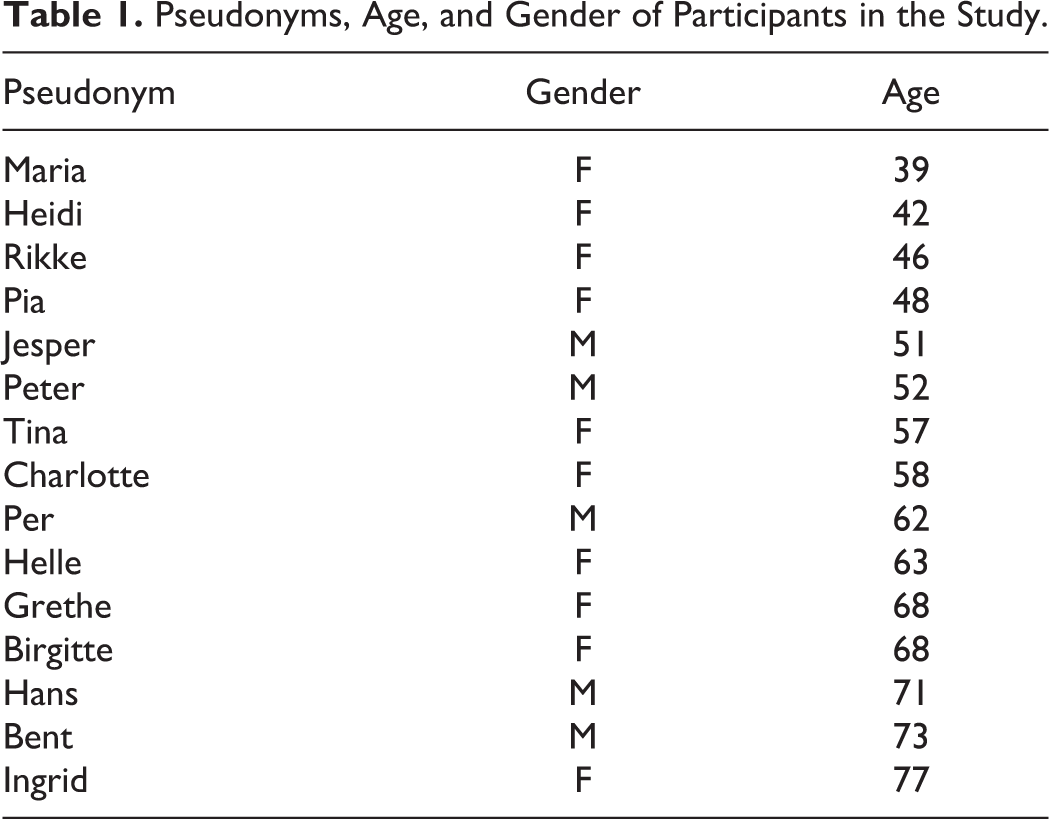
To ensure that the participants would have memories of the landline telephone, including children and adults within the study time frame of 1950 to 2000, participants younger than 35 and those older than 75 at the time of the interviews were excluded (with the exception of Ingrid, a 77-year-old participant with an excellent memory, who was deemed close enough to the cutoff point to have relevant recollections of the era under study). Table 1 provides an overview of the age and gender of all the participants involved in the study.
Pseudonyms, Age, and Gender of Participants in the Study.
To allow participants to influence the direction of the interviews, but at the same time maintain a structure that enabled comparison between conversations, the interviews followed a semistructured approach (Brinkman & Kvale, 2015). The interviews ranged in length from 2 to 4 hr, depending on the level of detail in a participant’s answers. A central research question in the project was to uncover shifting norms and perceptions of the telephone during the 20th century, so it was important for participants to be precise about the timing of their practices or experiences. The interviews were, therefore, structured chronologically around telephone culture in different “life phases,” defined as childhood phase (0–12 years), teenage phase (13–18), young adult phase (19–28), adult phase (29–64), and elderly phase (65–). With the exception of one question—the first memory of using a telephone (in childhood)—questions were repeated in each phase. Questions from the interview guide tackled the telephone’s placement in the home, asking participants to describe different telephone models, a concrete good or bad experience using the telephone, and what rules existed for telephony at this point in the participant’s life.
The interviews were held in 2015 at Enigma, then located in the center of Copenhagen. The central location was advantageous in terms of easy access to the museum for most participants, but more importantly, it was possible to borrow artifacts—landline and mobile telephones—from the museum’s collection for the use during the interviews. These telephones were chosen, with the help of Enigma staff, to represent the most commonly used landlines and early mobile telephones from 1950 to 2000 in Denmark. It was possible to establish a canon of models in use because until the late 1980s, access to telephones was predominantly through renting one from the local telephone company, which carried a very limited (if any) selection. As subscribers would use each model for an extended period of time, models from the early 20th century were included in this collection.
The landline telephones on display were: Magneto phone, produced by Kristian Kirks Telefonfabrikker from 1935; Magneto phone M51 with wing, produced by Kristian Kirks Telefonfabrikker from 1951; Magneto M51 with rotary dial, produced by Kristian Kirks Telefonfabrikker from 1951; Ericophone, produced by L. M. Ericsson from 1957; F68, produced by L. M. Ericsson from 1968; DA80, produced by GNT Automatic from 1980; DK80, produced by Standard Electric Kirk from 1980; and Generic wall telephone, circa 1985.
These were supplemented by three mobile telephones: Mobira Cityman 900, produced by Nokia-Mobira from 1987; Dancall DCM, produced by Dancall from 1988; and Nokia 3210, produced by Nokia from 1999.
During the interviews, the telephones were lined up in chronological order on two tables alongside each other, each telephone with a number in front of it. The numbers were used to quickly reference a model for the audio recording of the interviews. In addition to sound recording, I took handwritten notes during the interviews to describe and remember significant gestures by participants as well as their interactions with the telephones.
So as not to draw the participants’ attention and initiate a conversation about the telephones before the start of the interview, all telephones were covered under two black pieces of cloth prior to each interview. Figure 1 illustrates the telephones setup in the meeting room used for the interviews, with a corner of the cloth covering the mobile telephones seen on the right and the table used for the interviews in the foreground. Figure 2 shows the same setup from another angle, with no cover over the mobile telephones.

Telephone setup in interview room.

Telephone setup seen from the side; mobile telephones visible at the bottom.
At the first mention of a particular model, the interviewer would remove the cloth over the landline telephones and then over the mobile telephones:
I borrowed some telephones from the Post & Tele Museum uh, so we have a lot of telephone models
Oooh
If we didn’t have something for you to show me 2 (yes, yes), we could have
But I know all of these
You do?
But of course I do. (yes) Yes.
Um so that is
There is my whole life (in telephones) [laughs]. That is a funny thing.
In many cases, there was immediate delight in recognizing these well-known domestic artifacts, such as in the above excerpt from my interview with the participant who was given the pseudonym Ingrid. Like names, personal information, and places mentioned in the interviews were pseudonymized to ensure the anonymity of the study participants. As seen in the format of the example above, all quotes from the interviews are presented with a line break between the interviewer’s and the interviewee’s speech, while shorter interjections from the other speaker are written in parentheses. Square brackets are used for nonspeech utterings (such as laughter and sighing) and gestures.
The interviews were transcribed with the help of a research assistant and coded in NVivo 11 in several iterative rounds of coding. The first coding round recreated topics from the interview guide, such as life phases and telephone models, while later coding rounds focused on evolving analytical notions such as “ownership” and particular rules for telephony.
The interview quotes provided in this article were translated from the Danish original by the author.
Materiality as Specificity
The first aspect I focus on in terms of the use of material artifacts in qualitative interviews is rather straightforward: That talking about a thing that is present leads us to become more concrete and specific about the functionalities, oddities, and frustrations of living, or having lived, with that thing.
If we take our point of departure from the interviews, which all dealt with the role of telephones as material artifacts in everyday life, talk during the moment of introducing the artifacts underscored the difference between talk “about” or “with” material artifacts:
What kind of telephone do you buy, what does it look like?
Well, it was just one of those you get when you phone the uh telephone company and you say you want a phone. No one asked what it looked like. I think yes, I wonder if it was not black or gray; I don’t remember, but it was a rotary phone, one of those old-fashioned ones.
As mentioned earlier, at this point in the interview—the first description of a concrete telephone in the participant’s home—the interviewer would remove the black piece of cloth that covered the telephones on the table adjacent to where the participant was sitting and would show him or her the telephones borrowed from the museum:
Do any of these remind you of the one you got?
That one (that), yes (the number 5 here), yes (we’ll bring that one over), yes
[the telephone is placed on the table in front of Birgitte]
I think that’s the one because do you know anything about when this came on the market?
Well, I am not an expert in these models, but this one, it says it’s from 68; that’s when it’s made
Yes, well, we got it in ‘68.
There is a shift in this interview, wherein a participant, Birgitte, initially delivers a superficial and general account of the telephone she rented (in the 1960s, telephones were usually rented from telephone companies, not owned) when she got her own home as a young adult, but the introduction of the material artifacts changed the situation. After initially describing her first telephone as “one of those old-fashioned ones,” Birgitte points to a particular model, produced the year she acquired a telephone. Figure 3 shows this model, the F68.

The “Model 5” rotary-dial F68, produced by L. M. Ericsson from 1968.
Later in the same interview, Birgitte describes the first time she acquired a telephone with push buttons instead of a rotary dial. This model (number 6) is moved to the table, where she studies it alongside number 5 model from 1968:
It is nice that it does not take so long when you need a number
[dials the rotary dial of the number 5 model] which contains a zero.
That’s a nice sound there.
[laughs] Yes, yes (yes). And then we have a little thingie out here with a little [sighs] note that is put in a frame, which is not on this model, where you can write the telephone numbers so you can—when you can’t remember the telephone numbers—but you could back then. All those you usually call yourself, the kindergarten and all those, you remember by heart. And there it’s used a lot as a means of communication, like: They are not coming today because they have a tummy ache or have the chicken pox, or when can they come, booking an appointment with the doctor, I mean.
This situation, in which she examines the telephones on the table and contrasts the different models from her life, opens a space for Birgitte to reflect on the particular difficulties of using a rotary dial telephone versus the more recent push-button model. Further, talking about how she would write important telephone numbers on a notepad on this new telephone elicits another memory—that of her previous practice of memorizing several telephone numbers.
This instance also displays another common feature of the way in which material artifacts aid specificity—that small differences between the technology owned by the informant and that used in the interviews were not seen as obstacles, but rather as a fruitful opportunity for informants to describe “their” model in order to clarify dissimilarities for me—and for themselves.
Materiality as Structure
In this section, I emphasize a second aspect of the way in which material artifacts act as interview elicitation devices, as aids for accessing and structuring memories. As mentioned, the semistructured interviews conducted in the present study followed a guide that focused on chronological life phases. However, in this scenario, such a structured approach to the conversation interacted with another structure, that of the numbered telephones placed on a table in the order in which they were produced. For some participants, this organization of telephones represented different times in their lives:
What do you think when you see these telephones in relation to the old gray telephone [number 4] there?
But that is what we can call epochs in my life (yes), I mean childhood and youth right (yes). And um that is very different than than than…something has simply happened, well a big development, where these are similar to what you can find today right [gesturing toward late 20th-century telephones]
Yes, not much happened there, right?
No. But a quantum leap took place between 5 and 6.
Here, the interview participant is looking at the telephones on display, marveling at the major developments that took place in communication technologies existing before her birth and those up to the point she became an adult. Pia was born in 1967 and had lived without a landline until 1975, so the older telephones were part of an unrecognizable time, preceding her personal experience with telephones, while the models from her childhood and youth were points of entry for what these life phases consisted of for her (see Figure 4 for illustration of model 6).

The “Model 6” push-button telephone DA80, produced by GNT Automatic from 1980.
Following this, in many cases, the telephones functioned as fruitful openings in combination with an interview guide built chronologically around life phases. The chronological presentation of telephones according to their production date seemed to suggest a narrative after which the participants could model their life accounts:
Well, as I remember it, we had that one first, and then that one came in for a time (number 1 and number 2), and then it was that one (and then 5). We did not have number 3 because I cannot remember that, and I also thought it was so cool, but we didn’t have that one either. And of course, then we had number both number. I mean later in my life, I had 6, 7, and 8.
Tina is here using the telephone setup as a checklist, running through her memories of owning telephone models at different times in her life: I had this one, and the next, but not that one. Since the telephones on display were produced in an era in which there were few models on the market, many participants recognized all models and could remember who in their family or friend circle owned those models that were absent from their own home. In this way, the telephones worked as a way of sorting out the sequences in the participants’ experiences, or when things happened, guiding the conversation with a “narrative of telephone models.”
As mentioned so far, the telephones structured the interviews as narrative checklists and entry points to particular periods because different telephone models represented different times in the lives of the participants. As most of these telephones were landline telephones, meant to be fixed in place, they also elicited access to particular places:
Do you get a telephone in your room at some point? (yes) Yes, when is this?
Yes, yes, I am about 15 or something like that (yes, where is it, can you describe it?), and I had sort of a corner table that was painted and stuff like that. And I had a giant lamp my big brother had made in paper, I remember, um and painted in these—that was very modern—with spirals that were painted [laughs], a board where you just pour paint down and move it around, and he made that for me, and then on that table was a telephone [points to the Model 5 telephone]. Just like that, a light green one (a number 5 here). Yes, because I had a green theme in my room, I got a green phone.
In answering the question of whether she had a telephone of her own at some point, Charlotte describes the design of her room as a teenager, what was considered modern decor, and who was involved in helping her design the room. She is one of several participants for whom the color and design of a telephone, especially the one in a place that was hers, is talked about as part of her self-representation at different times in her life.
By eliciting memories of particular places where a telephone stood, the different models worked to guide the interviews in soliciting details about, as in the above example, a participant’s evolving identity as a teenager. In other instances, the placement of telephones in different rooms offered an understanding of power structures in the participants’ family life, of who was seen as needing or deserving of access to telephones, or the degree to which private telephone conversations were made possible in particular locations.
In sum, material artifacts in qualitative interviews function not only as aids for enhancing specificity but can also help informants access and structure their memories. I have suggested that the ordering of artifacts—for instance, in chronological order—can provide a narrative structure for participants and that in many cases, familiar artifacts work as entry points to important times and places for participants.
Materiality as Body Memory
Having discussed material artifacts as effects that provide both specificity and narrative structure in qualitative interviews, the third and final way in which the study found material artifacts serving as interview elicitation devices is the “body memory.” I shall focus on how habitual memories related to lifting, touching, listening to, and otherwise actively using a telephone arose when the participants had the opportunity to engage with them as material artifacts.
In my interview with Heidi, we had just established that she had had a Model 5 telephone in her childhood home, followed by Model 7:
This one, you did something like this, I remember
[Heidi squeezes the Model 5’s receiver between her shoulder and ear]
I can see that; you have that on your shoulder and then squeeze it tightly
[laughing] Can see it looked damn familiar, right?
Yes, yes, you just had um, the moves, so so there you could um that one you could use
That one was like…
[Heidi tries to squeeze the Model 7’s receiver between her shoulder and ear, fails, and drops it]
Then it fell off; you dropped the receiver
I can see that; it doesn’t fit the ear as well.
(…)
Yes, well but um it is surprisingly familiar that one (yes with just) like with oh telephone books and how was that…
[Heidi makes air gestures to mimic note taking]
Yes, you needed your hands free right?
…if you needed to find a piece of paper and note something down.
Heidi frequently chooses to use in the term “familiar” in connection with these telephones. In fact, these telephones become, not just familiar, but “surprisingly familiar,” as Heidi interacts with the devices in the same way she did as a child and teenager. The source of this surprising familiarity seems to be what Merleau-Ponty would term “body memory”—memories held by Heidi’s arms, shoulders, and ears—her lived body—of what it is like to be a telephone user. These memories led Heidi to distinguish between her favorite, Model 5, and the more recent Model 7 in terms of what fit her body best for hands-free conversations. Subsequently, she remembers the related practices of note taking and using a telephone book during telephone conversations, which necessitated hands-free use of the telephone.
Heidi’s memories of using the telephone in a hands-free manner were echoed by Peter at the sight of the earlier Model 3:
What was it like using that phone?
Ah, but it was delightful (yes); yes, well it was easy. It fit the ear and mouth
[Peter puts the Model 3 receiver between his ear and shoulder]
Can you like, um…
Yes, but not when you were a kid
No, it’s too big, right (you still can), to fit on the shoulder?
Yes, oh yes. It gets better with that one over there (yes, that’s number 5). The receiver is not so big (this one is…), and the receiver is not so heavy either.
(…)
But then it’s like, when you need to call “Bella,” you know in a heartbeat that it’s a B and an E right (yes) to get in touch with that telephone exchange.
But it’s in the fingers or how—that’s how you feel?
It’s coming, right (yes), yes.
Similarly to Heidi, Peter has a particular preference for a model that was well-suited to his body, which is prompted by using the older Model 3 telephone, contrasting it with the more recent Model 5. Moreover, the process of using a telephone from his childhood again leads the participant to experience body memories coming back to him–this time, of dialing particular letter combinations to connect with nearby telephone exchanges.
A different matter emerging from this interview is that the Model 3 telephone experienced by Peter today is not similar to his childhood experience, in the sense that the telephone suited him differently as a child. Back then, it was too big and too heavy to use for hands-free conversations. For some participants, however, such contradictions between body memories and bodily interactions with the telephones during the interviews lead to confusion:
We had, as far as I remember, for most of the time, just one telephone because I remember very vaguely when I was little and up in my parents’ bedroom, there was a very beautiful old black telephone—that really heavy one that I don’t know what it’s made of, but it is really nice (yes). A really nice old rotary phone that I regrettably threw out later for a simply—it was so beautiful, almost like an installation (yes); I think, for a time, we also had one in um the bedroom (okay)
(…)
But you are welcome to look at the telephones
[models 3 and 5 are placed on the table]
Yes, I clearly remember it [number 3]. I just thought ours seemed heavier; I think this seems like a lighter version. It may be that I am remembering it as heavier because I was a child.
In this interview with Rikke, her memory of the really heavy, beautiful old black telephone is challenged by the Model 3 (see Figure 5) placed on the table during the interview. Rikke is surprised that the telephone is not nearly as heavy as she remembered. But was it made of a different material from her childhood telephone or was she struggling with aligning her body memory of lifting the same telephone as a child with how it felt to her as an adult? In fact, among the study’s participants, Rikke’s response to the older model was common, despite my own expectations that participants’ use of contemporary telephones would make them unprepared for the weight of the older models, which were made of metal, wood, and Bakelite.

The “Model 3” rotary-dial Magneto M51, produced by Kristian Kirks Telefonfabrikker from 1951.
The above reaction to a telephone that was otherwise “clearly remembered” underscores the impossibility of truly accessing the past, even in cases where the artifacts are identical to those used then (which could not be verified here). Body memory in relation to material history presents the issue that the body is not constant over time; thus, bodily memories from childhood can challenge present-day experiences of interacting with materiality.
Conclusion
In this article, I have proposed an approach to qualitative interviews that draws on historical material artifacts as elicitation devices. I interviewed 15 men and women between the ages of 37 and 77 about their lives as telephone users, drawing on a setup of eight landline and three mobile 20th-century telephones that were common in Denmark between 1950 and 2000. The interviews were audio recorded, while visual impressions were noted in writing.
I have sketched out three aspects of such a method of materially oriented qualitative interviews. First, I emphasized that materiality can aid the qualitative interviewer by providing specificity, as the material presence of historical artifacts can urge participants to remember details, directing the conversation toward the specificity of mundane artifacts whose characteristics can be difficult to recollect. Second, I suggested that such artifacts may also be used to aid narrative structure, guiding and prompting participants to follow the story they infer from a particular setup of artifacts. Finally, I proposed that the active engagement with historical artifacts in the qualitative interview allowed participants to access the body memories of using these artifacts, eliciting the particulars of abandoned bodily practices.
In conclusion, this materially oriented method shows promise as an enquiry into everyday technological practices of the past. As noted earlier, some limitations are also clear. Discrepancies between recollected habitual use of an artifact versus the experience of interacting with the artifact in the present were often unproductive, highlighting the difficulty of remembering past material practices. Furthermore, eliciting sustained and insightful reflections of mundane everyday technologies is demanding in itself. Thus, the most common response, despite my efforts at establishing a setup that would elicit the opposite, was to describe the historical artifacts as “nice enough.” In future work, however, the method could be improved by using video in addition to audio recording. In the qualitative interview, audio recording is commonly preferred over video, as it is considered less intrusive and ethically challenging (Hancock, Ockleford, & Windridge, 2007; Kelly, 2010), but in the approach described here, the combination of audio and handwritten notes threatens to omit crucial nonverbal signs about how participants regard and interact with artifacts.
While I have focused on the use of historical material artifacts in semistructured qualitative interviews, I see broad application of this materially oriented methodology. To mention a few ways of adjusting this method, interviewers could draw on everyday contemporary materialities instead of historical artifacts, using the interview setting to shed light on mundane details that are normally overlooked or that are difficult to draw out without bodily engagement. Another variant could be to follow an unstructured interview form, allowing the conversation to essentially follow a narrative, influenced by the artifacts, which could be displayed in interesting setups to prompt reflection or curiosity from participants. Lastly, while the logistics of most ethnographic interviews (Spradley, 1979) would prohibit bringing in and introducing artifacts, another version of this method is the materially oriented ethnographic interview, where the interviewer draws on the interview’s naturally occurring material surroundings.
Footnotes
Declaration of Conflicting Interests
The author(s) declared no potential conflicts of interest with respect to the research, authorship, and/or publication of this article.
Funding
The author(s) disclosed receipt of the following financial support for the research, authorship, and/or publication of this article: This research was made possible by a grant from the Independent Research Fund Denmark, ID DFF – 4180-00048.
