




Abstract
Music is an underutilized resource for research in the social sciences. This article presents examples of musical elicitation methods that were used within a study that explored how adolescents who were referred to group music therapy for aggression produced meanings of aggression through the therapeutic process. The study was conducted within a poststructuralist paradigm, particularly using the theoretical thinking tools of Deleuze and Gergen. The elicitation methods discussed include drumming, creating images during music listening, and songwriting. The article argues for the role of musical elicitation methods particularly within research that values a radical relational stance that allows participants to comfortably territorialize the research encounter, and in light of considering the transformative potential of research itself.
Introduction
At-risk youth may be ill-equipped to fully articulate their experiences and emotions verbally when effective communication strategies have not have been learned within the home environment (Hill, 2007). Interviews can, therefore, fail to offer these youth opportunities to adequately explain their views (Didkowsky, Ungar, & Liebenberg, 2010). Relying on verbal language alone can result in the collection of more superficial data (Epstein, Stevens, McKeever, & Baruchel, 2006). Moreover, interviews can limit the generation of responses to a subarea that the researcher deems to be important and can lead participants to believe that there is an expectation of “correct” or “good” answers as the interview situation can enhance a sense of adult authority (Blackbeard & Lindegger, 2007).
Experiences that may be difficult to voice verbally can be expressed through the arts (Denzin, 2003; McNiff, 2011). The arts can be used within research to evoke, inspire, spark emotional responses (Allett, 2012), and elicit memories (DeNora, 2006; Keightley & Pickering, 2006), as well as to invite opposition, subversion, resistance, and transformation (Chilton & Leavy, 2014). While arts-based research usually involves methodological tools that are employed throughout each phase of a research study (Leavy, 2015), arts-informed research provides possibilities for researchers who are solidly rooted within a qualitative approach to nevertheless draw on resources that the arts provide in at least some aspect(s) of their study (Rolling, 2010). As Gergen and Gergen (2012) clearly argued, if the overall aim of the social sciences is to expand our potentials for living, a singular understanding of the world is strangulating. If scientific progress is not a march toward truth, but a matter of increasing possibilities for action, then maximizing our “ways of seeing” is imperative. Now the door opens to the arts. (p. 28)
Musical Elicitation
Visual elicitation methods such as photography (Barrington, Villa-Torres, Abdoulayi, Tsoka, & Mvula, 2017), drawing (Kortesluoma, Punamaki, & Nikkonen, 2008), relational mapping (Bagnoli, 2009), pictorial narrative mapping (Lapum et al., 2015), and life story boards (Chongo, Chase, Lavoie, Harder, & Mignone, 2018) have been used in a range of qualitative studies. Music features infrequently as an elicitation tool in the social sciences. Daykin (2004) explained that this may be due to challenges of interpretation. She argued, however, that the representational complexity that can be held within music resonates with the heterophonic nature of qualitative research. Welcoming ambiguity also enhances the recognition that meaning is formed in local and specific contexts (Daykin, 2008).
Using music and music making as data (typically situated within an arts-based approach) has been distinguished from using music to elicit verbal reflections that are collected as data (located in qualitative research more broadly; Allett, 2012). Some researchers have critiqued this division. Hara (2011), for example, conducted music elicitation interviews where musicking, 1 particularly interactive singing, was welcomed as a means of gathering information in addition to purely verbal dialogue. Value lies not only in seeking to understand what and how music means but in exploring the enactment of musically articulated meanings (Daykin, 2008; DeNora, 2000).
Another example where music was used within a qualitative study can be found in research by Jonas-Simpson (2003). Participants facing ongoing health challenges described their experiences of being understood and then guided the researcher to play music on her flute, directing her through body movements, and/or singing. Afterward, participants discussed their feelings of being understood while listening to the recording of the music that had been created. This music was transcribed along with the verbal interview data.
Music is a complex resource that affords researchers both benefits and challenges. Its success as a research tool depends on the choice of activity, the skill of the researcher, and the orientation of the participants. As Daykin (2008) explained, the meanings of music data need to be examined reflexively in grounded studies that consider the properties of the music, the role of mediating discourses, and the listener’s situated responses. When used in this way, music can offer creative possibilities for enriching and enlivening research.
Overview of the Study
Theoretical Framing
This research was conducted with a broad poststructuralist underpinning, specifically using the thinking tools of Deleuze and Guattari’s (1987) creative ontology as well as Gergen’s (2009) relational ontology. While the theoretical perspectives of these authors cannot simply be superimposed, the fruitfulness of exploring conceptual connectivity afforded stimulating ground for the evocation of productive ideas. A number of their key ideas are important to articulate at the outset in order to establish the theoretical frame within which the elicitation methods were developed.
Gergen’s (2009) argument was that there is no utterly private experience and, indeed, no bounded, isolated self. We live in “a world of co-constitution” (p. xv). Individual, preexisting beings do not come into relationship with one another. Relationships precede the self; the self emerges from relationship. Gergen also offered the concept of confluence as a departure from ideas of agency and causation. At a concert, we offer applause and at a dinner party we eat. We are not forced to do this, but we partake in this behavior as participants of a confluence of relationships within which these actions make sense. As Gergen explained, “all meaningful action is co-action” (p. 39).
Deleuze (1988) and Deleuze and Guattari (1987) argued that all objects, bodies, social entities, and abstract concepts have no ontological status apart from what is produced through their relationships with other concepts, bodies, and things. As St. Pierre (2017) has articulated, there is also no longer a subject position available within the poststructuralist understanding of assemblage (Deleuze & Guattari, 1987). It remains difficult, however, to think and write without an “I.” Deleuze and Guattari argued for reaching “not the point where one no longer says I, but the point where it is no longer of importance whether one says ‘I’” (p. 3). In response to this conundrum, we have elected to write [-I-], attempting to critically, yet playfully, elude to lines of affective interconnection and relationship through the dashes. By being placed in brackets the concept of “I” is present for pragmatic purposes, yet it is also absent. In addition, the brackets can indicate how any idea of “I” is produced within the frame of a relational meaning system.
Deleuze and Guattari (1987) wrote of “assemblages” (p. 4) that are unfolding forces of multiplicities and connections. Affective flows between the elements in an assemblage are rhizomic rather than hierarchical. Deleuze and Guattari compared a rhizome (as a bulb or tuber) to an arborescent (a tap root). The idea of the arborescent relates to the modern valuing of a unitary, stable identity, and a core Truth below the surface. “Root” knowledge affords binary constructions. Rhizomatic thinking, however, involves endless connections. A rhizome has many entry points and one can plug into it anywhere because it is an open system.
Deleuze (1988, 1990) distinguished between the actual (the actual creature) and the virtual (the virtual creating). Adolescents and adolescence can be viewed as dynamic, continuous systems in flux, an ebbing and flowing of ongoing interrelationships. A researcher is a becoming-researcher, and an adolescent is a becoming-adolescent. This does not imply that a becoming-adolescent is becoming an adolescent (progressing toward a synthesized identity). Becoming-adolescent is itself a changing, fluid, transforming, interacting process.
Deleuze and Guattari (1987) explained a territory as an “act that affects milieus and rhythms, that ‘territorializes’ them” (p. 316). For example, if one were to walk into a setting where one feels uncomfortable (perhaps it is too noisy, crowded, or filled with people who appear very “different” to oneself), one has entered a space that is not one’s territory and that one cannot territorialize. For Deleuze and Guattari, the “self” is not a continuous soul-like entity but rather a set of habits. In this setting, one’s habits seem to have no place as it has been territorialized by others. The configuration of an organism “is a function of the way it inhabits its territory [and] a function of its being in its world” (Hallward, 2006, p. 95). Deterritorialization refers to separation from a certain purpose and reterritorialization entails repurposing in another area. For example, a branch is deterritorialized when it is reformed into a club (Deleuze & Guattari, 1987).
Lines of articulation are homogenizing, hierarchizing, and normalizing discourses and practices that reinforce the status quo (Martin & Kamberelis, 2013). A label such as “aggressive adolescent” operates as a line of articulation, and it implies that a particular trajectory will be followed. Deleuze (1995) also wrote of “lines of flight” (p. 85). These engage with limits in playful ways (Jackson, 2003) and are creative acts of resistance that “give rise to new possibilities for living” (Winslade, 2009, p. 338). Even a subtle bend of a line can produce a significantly different trajectory (Hickey-Moody & Malins, 2007; Winslade, 2009).
Deleuze and Guattari (1987) wrote, “Music has always sent out lines of flight” (p. 11). Improvised music is synonymous with the rhizome (Smith, 2012). It is an assemblage where musicians and sounds collide and create new configurations. Improvisational music facilitates a move away from the confines of damaging arborescents and invites creative relational connections. Such musical events create certain, temporary musical territories, and they also deterritorialize and reterritorialize (Lines, 2013).
Method
Becoming-adolescents were recruited from an underresourced school in Eersterust, South Africa. Eersterust was established in 1963 as a “township,” close to Pretoria. There are high levels of unemployment in Eersterust (Stige, Ansdell, Elefant, & Pavlicevic, 2010) and crime and gangsterism is prevalent (Steyn, 2010). Regular random police searches are conducted in the community for illicit drugs (Dreyer, 2012). Fighting between learners in schools is prevalent (Louw, 2013).
This study was concerned with exploring the questions of how these becoming-adolescents (re)present and participate in their relational confluences, what aggression does in these confluences, and what becomings group music therapy produces. Six becoming-adolescents participated in the music therapy group. The terminology “becoming-adolescent” was not used directly with the participants as the decision was made to engage with clear, easily understood language. The philosophy of becoming that underpinned the entire process was, however, central at all times. For example, although the participants were referred for extreme aggression toward their parents, teachers, and peers, they were not received into the study and into the music therapy room as static molars wrapped in lines of articulation. They were considered and engaged with as continuous, fluid, and transforming processes throughout.
The first author of this article was both the music therapist and the researcher, which required careful ethical consideration and management throughout. In poststructuralist research, ethics is no longer transcendental and clearly defined in advance as an overarching set of rules and prior judgments for every person in every context (St. Pierre, 1997). Deleuze (1995) argued for an immanent form of ethics that dwells within, not above or outside, matter and praxis. This approach evaluates relations as they emerge. An ethical becoming-research study works toward the emergence of ethical social forms (Bignall, 2007). The question that requires addressing is what we, as fellow participants in the research process, are capable of, and how may the relationships within the method assemblage be reducing or enhancing those capacities (Smith, 2011).
The variety of therapeutic techniques used in sessions served as elicitation methods for data collection. Rather than judging how these methods may offer the generation of valid knowledge claims by assessing the “truth” of a participant’s captured voice, the quality of the data generated in this study was considered in terms of the dialogical relationship between researcher and participants (and between participants) as well as the multiplicity of lines of meaning that could be invited and responded to. In the realm of poststructuralism, one does not aim to look closer or harder but to look at what frames and constructs the way one sees. Validity claims are multiple, partial, and endlessly deferred (Lather, 2007). Useful stories are those that unblock closed truths so as to open up a freer future for thought and practice. According to Masny (2013), a Deleuzian rhizoanalysis becomes a move towards a place where research is not judged in relation to an external set of criteria, rather research is assessed immanently according to its creative, affective powers. What does research produce? What hitherto unthought-of lines of flight does it open? What does it make possible to think? (p. 346).
Musical Elicitation Methods
The following sections offer three examples of the musical elicitation methods that were used to produce data within this study. As Liebenberg (2009) explained, a combination of methods of reflection results in participants’ accounts being more richly representative of their own interpretations of relationships, realities, and decisions. This contextual accuracy and regard for participants as authorities on their own lives heightens the meaningfulness of the research. The three examples that will be discussed are drumming, “three circles,” and songwriting.
Drumming
Drumming (e.g., with djembes) is an effective tool to explore any group interaction as minimal musical skills are required from the participants (dos Santos & Lotter, 2017). While this technique was used as part of a music therapy session in the current study, group drumming is used in a broad range of settings (Akombo, 2013; Flores, van Niekerk, & Le Roux, 2016; Moore & Ryan, 2006; Watson, Washington, & Stepteau-Watson, 2015) and can be employed creatively in research, for example, as part of a focus group with adolescents.
Although research findings can be presented more vividly through the arts than in a verbalized report, a false binary is not useful to promote. As Gergen and Gergen (2012) argued, rather than unnecessary distance between words and the arts, between reason and emotion, objectivity and subjectivity, these can draw great sustenance from one another. In the current study, a detailed textual description of the recorded drumming improvization was produced, in addition to retaining and working with the audio during the analysis process. This text was not an interpretation of the meaning of “the music itself.” As the orientation of this study valued a creative ontology of becoming and a relational ontology of coaction, the data that were produced related to the flow of musical interaction between participants. The musical interactions produced forms of coaction that were then responded to further by the researcher through the analysis process (which involved additional improvization, image making, and the mapping of assemblages).
The following presents an excerpt from the description of the djembe improvization that took place with the becoming-adolescents who participated in the study. Although they had been referred to music therapy for unmanageable aggression in the school and home context (as disclosed by the becoming-adolescents and their becoming-parents within meetings), the musical interaction documented below clearly demonstrated the broader behavioral repertoire that they had available to them. Their music was characterized by expressions of fun, playfulness, strength, presence, and engagement as these becoming-adolescents produced themselves through relationship. [-I-]
2
begin a slow, firm, regular beat on the djembe (playing a dotted quarter note, eighth note, quarter note, quarter note pattern) to establish a steady and predictable musical foundation. [-Devon-]
3
and [-Malaika-] begin to play along with [-me-] on the second repetition of [-my-] pattern. [-I-] indicate gently with [-my-] hand that they need to wait a little. [-I-] play the pattern one more time (to create a stable musical foundation that they have all had a sufficient chance to listen to) and then indicate to [-Devon-] that [-he-] may start playing. [-Devon-] joins in firmly (repeating the following pattern: an eighth note, two sixteenth notes, and two quarter notes). [-Malaika-] lifts [-her-] hands to start to play, looking at [-me-] as [-I-] am still watching [-Devon-]. [-Malaika-] moves her hands back to her lap. Again [-she-] lifts her hands to the drum, ready to play, but [-my-] gaze remains on [-Devon-]. [-Malaika-] returns [-her-] hands to [-her-] thighs. Soon [-I-] nod to [-Malaika-] and [-she-] enthusiastically begins to play [-her-] djembe. [-She-] beats the same rhythm that [-Devon-] is playing and with finely attuned timing. [-I-] then nod to [-Aaliyah-], who joins by also imitating the same rhythm. When it is [-Natalie’s-] turn to play, [-she-] also aligns her rhythm precisely with the others’, however [-her-] dynamic level is stronger. [-I-] nod to [-Cherise-], who initiates an alternate rhythm (a repeating sixteenth note pattern). As the group reaches the second bar of this new ‘section’ the rhythm shifts. It now includes more accents and each member starts to contribute an array of new, complimentary rhythmic patterns. This is the point at which the group begins to ‘groove,’ where the music becomes organic, as if it has a life of its own. The current sweeps the group along, with a wave that becomes increasingly powerful. The group members are smiling broadly. [-Cherise’s-] body is slightly stiffer, but the rest of the adolescents are moving rhythmically and synchronously in their chairs to the music. [-I-] nod to [-Leihlani-], who joins firmly (with a dotted quarter note, eighth note, quarter note, quarter note, eighth note, eighth note, half note pattern). The others align with [-her-] and this becomes the over-arching groove, still with a few accented beats offered by different members in between. The first beat in each bar is played very strongly. The tight groove holds a unified rhythm with space for individual variation and flexibility. The group members begin to add their voices. As all are playing and vocalizing together the energy level begins to rise even further, with increasing tempo and an ever-surging dynamic level. Body movements become even more expressive, and group members show an increased use of space. Facial expressions are open, engaged and excited. [-I-] begin to count: “1…2…3…4…STOP!” (as [-I-] lift my hands). All the group members stop precisely in time with [-me-]. [-I-] call: “…2.3 GO!,” and begin again. The group joins in with perfect alignment and vibrant energy on beat one, as the becoming-adolescents powerfully beat their djembes with festive forcefulness.
The audio recording of this musical exchange can be found at the following link: https://www.dropbox.com/s/tksf8osgtcplyy2/Drumming.mp3?dl=0. In this excerpt [-I-], as the music therapist, played a more directive role as this moment was part of the first session. [-I-] was introducing the becoming-adolescents to the space and slightly more structure was offered with the intention of enhancing feelings of safety. This was also part of an assessment phase to gauge how the group members could listen to one another, follow musical changes initiated by others, initiate creative material themselves, and work as a team. [-I-] also sought to gain a sense of the quality of presence and energy that they were willing to produce within this confluence. This excerpt demonstrates facets of the confluence that were immediately present. Following one another closely was considered to make sense in this relational assemblage, including following [-my-] directions. At this point, [-I-] was still largely viewed by them through their lenses of expectation as an “authority figure,” but they nonetheless embraced this leading with vibrancy. An intermingling between leadership and fun is produced through the process. In the confluence, there is a “dance” between wanting to join in enthusiastically on one’s own terms and stepping back to wait for another person to be heard. A territory is established in the “groove” that is shared but does not require the relinquishing of the production of unique expressions of self. The becoming-adolescents are produced through their musical interactions with one another (as am [-I-] as the becoming-music therapist/researcher).
Deterriorialization of force occurred when musical pounding, rather than physically pounding a peer, emerged as a creative line of flight. This musical becoming produced the adolescents as multiplicities. This enables a researcher to gain a more nuanced understanding of how participants produce themselves within relationships and it gives access to becoming in the here and now (that is not an end in itself, but captures something that is more open-ended and ongoing, always with transformative potential). A technique such as this could be employed in a focus group exploring, for example, how becoming-adolescents use aggression in the school context. Relational dynamics and the productions of selves as multiplicities (rather than in alignment with lines of articulation that solely construct the “aggressive adolescent” as a molar form) could be explored more richly than if one were to rely on verbal data alone.
Three Circles
Participants in this study were invited to construct meanings of becoming-aggression, as opposed to the meaning of the concept being predefined by [-myself-] as the researcher at the outset. Definitions of aggression depend on what is considered as socially appropriate within a certain context (Richardson & May, 1999). Gergen (1984) argued that aggression is linguistically grounded and should, therefore, be “deontologised” (p. 57). It does not stand in relationship to any referential spatiotemporal reality and the pragmatics of meaning making become the valuable research endeavor. Gergen’s (2009) relational ontology implies that aggression is not “within” participants but is situated in the region of “the between” (p. 76). The music therapy process and the research process in this study were responsive to the becoming-adolescents’ ongoing production of meaning within relationship.
In the spirit of rejecting simplistic binary formations in favor of rhizomatic complexity and continuous becoming, identities were also not cast as static. For example, although participants had been referred to the music therapy process for aggression, when the notion of bullying was raised this was explored in light of possibilities of having bullied others, having being bullied, and the complex (ambiguous, uncomfortable, confusing, and rich) interconnections between these. An increasing number of studies have identified the “victim–offender overlap.” Researchers (e.g., Berg, Stewart, Schreck, & Simons 2012; Broidy, Daday, Crandall, Sklar, & Jost, 2006; Jennings, Higgins, Tewksbury, Gover, & Piquero, 2010) have found that those who suffer from violence and those who perpetrate it are frequently the same people. Berg et al. (2012) wrote, “although victimization and offending often are considered two separate domains, they are so intimately connected that perhaps it is not possible to understand them fully apart from one another” (p. 2).
[-I-] offered each of the becoming-adolescents a piece of paper upon which three circles (the size of side plates) had been lightly drawn in pencil. While listening to a piece of music (in this example, Lisanga by Gerald Toto, Richard Bona, and Lokua Kanza), they were invited to allow the music to mentally and emotionally “transport” them to a happy memory and to draw or write anything that represented that memory within the first circle. The circle shape was merely provided as a guide; they did not have to remain within the bounds of the shape if they chose not to. Once they had completed their drawing, they then listened to a second piece of music (The death of Cisco by John Barry was selected on this occasion). While listening to this piece, the participants were invited to reflect on being bullied or bullying others and to represent this through images or words in the second circle. For the third circle, the group members were asked to allow the music (Walking the path by Peter Kater) to evoke an experience of being in a safe place and to draw and write accordingly. [-I-] asked open questions afterward to facilitate discussion. Figures 1 and 2 show examples that were drawn, each followed by a short excerpt of the transcript from the discussions that followed.
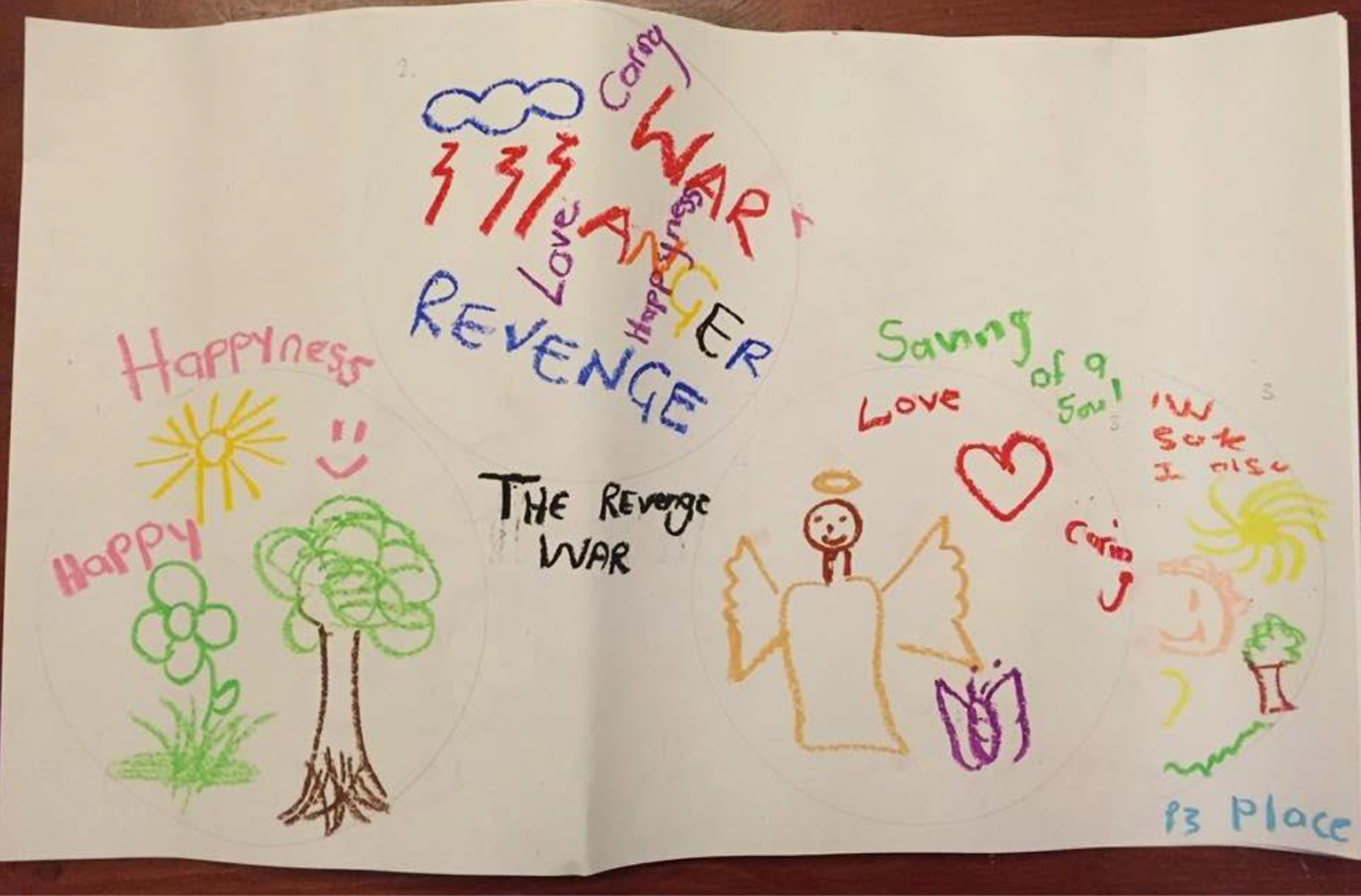
First example of the images that a participant drew while listening to the music.

Second example of the images that a participant drew while listening to the music.
What was the experience like for you to draw these?
Interesting
Was there anything that it made you think about differently?
[She places her finger firmly and decisively on the middle circle.]
Are you bullying someone else or is someone bullying you?
Both, ma’am.
Both of them. Ja. Are those the two faces?
Yes ma’am.
And how are you feeling about that space?
Heart sore.
[She points to the middle circle.)]
So there are times when it’s like this?
Yeah
And what happens there?
Eish [very softly]. I like to bully others.
You like to bully others. Ok. And what’s that about? How do you feel when you do that?
It’s not nice, Miss, to bully somebody else. You’re hurting someone’s feelings.
How do they feel?
Not nice
Small
They feel small?
Yes.
Why do you think you keep doing it?
Just to impress your friends.
To impress your friends [she nods]. So if you bully someone then other people think you’re quite strong?
Mmm. But I’m working on it Miss, I don’t like doing it, hurting children and other people. [She shakes head sharply.]
Have you also experienced someone else doing it to you?
Mm
And when you say you’re working on it what are you doing? How are you working on it?
I go to church. [She points to the third circle.]
So that’s what this piece of music made you think of?
[She nods.]
Did you have any pictures in your mind or did you have any feelings while you were listening to it?
Pictures in my mind.
What did you see?
Eish. [She laughs slightly.]
[She looks at N’s picture.] She saw an angel.
Ja.
When you’re in this space [pointing to the third circle], how do you feel?
I feel happy, Miss, because I’m working with something that’s true and light. I think God will help me.
What do you take from this space [pointing to circle 3] that could help you here [pointing to circle 2]? When you’re in this situation with someone, how can these two circles ‘speak’ to each other?
Sho.
What do think this angel would say to you when you here [circle 2]?
“Do the right things.”
While this technique was used within a music therapy process, it offers potential for thinking about how carefully selected music can be employed as an elicitation technique as part of, for example, interviews. It is oversimplistic (and theoretically incongruent within the paradigm used in this study) to consider this process in relation to music simply functioning as a projective screen. Ansdell (2014) argued that people involved in musicking (which includes music listening) are using musical things (such as organized sounds, song tracks, and audio equipment) and nonmusical things (paper, pastels, the desk, and the classroom), and they are also involved in particular relationships (which in this study was considered as being ontological). In order to understand how people use music, we also need to consider the interactions between people, music, and situations. Musical worlds take shape in relation to where people are, how they are relating, and what resources they have available to them. Music offers particular affordances, and these are then appropriated within certain contexts. Nonmusical (or para-musical) things, such as emotions, identities, memories or movements, take shape in relation to musical things within a confluence where some connections appear to make more sense than others because of past learning and relational connections, and these are then actively worked with by the participant.
Songwriting
The becoming-adolescents responded with cautious enthusiasm when [-I-] suggested a process of songwriting. [-I-] offered a theme for the song, “My life,” and they agreed to this idea. As newspapers were handed out group members were invited to select a few headlines that captured statements they wanted to use to enact meanings about their lives. Through a creative process of negotiation, the becoming-adolescents then decided how they would like to arrange the headlines as lyrics for their song. 4
As one of the becoming-adolescents began to sing a melody for the first verse, this creative offering was affirmed: Others added their voices to his and the group continued to develop the music for the song together. The lyrics (e.g., “I will face my sings on my own” and “On the road to restart”) offered fruitful material for further verbal exploration. The creative possibilities of songwriting and the way that the becoming-adolescents took hold of the experience afforded lines of flight in their productions of self within relationship with one another. Again, while this songwriting technique was used within a music therapeutic process, it holds potential as a data elicitation method in broader contexts as well. Songwriting is engaged in naturally in childhood. Children create lyrics and melodies easily as part of play (Wigram & Baker, 2005). While social judgment as one grows older can dampen this creative freedom, an accepting environment can be created within the encounter with a participant who welcomes any creative expression. In this example, participants were invited to select newspaper headlines to begin the process of writing lyrics. There are a multitude of ways to engage a group in songwriting without evoking a sense of uncertainty or anxiety in participants (or in the researcher). For example, participants can be invited to “fill in the blanks” when words in precomposed songs are erased and new ones can then be inserted. As opposed to this more structured approach, free association can be used, after a certain idea is presented by the researcher, to generate words or phrases that the participant or group can arrange into lyrics. A melody from an existing song can be used or adapted. The group can begin humming together or developing a rhythm together into which they can experiment with inserting their lyrics. One member may initiate a melody upon which the rest of the group can build their accompaniment. The group dynamics in this process can be as useful to document, as in the example of drumming explored earlier, when this is relevant to the research question at hand. Both the content of the lyrics and the relational process offer rich data.
Discussion
This article has assumed a highly collaborative and relational stance, due to the theoretical underpinnings of the study and the relationships [-I-], as the first author, engaged in with the participants through [-my-] dual roles. Through this interactive process, and the layering of different musical elicitation methods so as to develop material that emerges, interpretation can also become a shared event. This affirms the move in qualitative research toward valuing intersubjective coexistence and radical relatedness (Bickel et al., 2010; Harvey, 2015; Mercieca & Mercieca, 2013).
The use of musical elicitation methods can put participants at ease. When familiar music is used, for example, if lyrics of popular songs become a springboard for discussion in a focus group with adolescents, the research encounter is de/reterritorialized. The space becomes a familiar one for the participants. They can enter a space where their “habits” have a place. It is their expressive territory.
Research can hold the potential of being a transformative experience for participants. This goes beyond offering a platform to have one’s voice heard (which is a problematic concept from a poststructuralist perspective anyway as it privileges the true, authentic voice of an individual subject [St. Pierre, 2008]). Indeed, the current study explored the becoming-adolescents’ meaning making within a music therapeutic process that was designed to offer a transformative experience. Even when data elicitation methods such as the ones discussed in this article are employed in interviews or focus groups, for example, they can offer opportunities for the production of meaning, relationships, and “kinds of selves” in the here and now of the research encounter. Research can be part of a line of flight for a participant. It does not only need to capture “what was” or “what is.” It can be part of creating what could be.
Conclusion
Although the elicitation methods presented in this article were employed within a process of group music therapy, they offer resources for research in other fields within the social sciences. The value of such methods lies in the invitation they give becoming-participants to produce themselves through the intermingling of musical and human relationships that, in turn, are connected within broader assemblages. They provide vehicles for creative and explorative production of meaning in research not only with adolescents but with participants of all ages.
Footnotes
Declaration of Conflicting Interests
The author(s) declared no potential conflicts of interest with respect to the research, authorship, and/or publication of this article.
Funding
The author(s) received no financial support for the research, authorship, and/or publication of this article.