




Abstract
Every year thousands of presentations of qualitative research findings are made at conferences, departmental seminars, meetings, and student defenses. Yet scant scholarship has been devoted to these presentations, their nature and relevance to qualitative research, and how they can be improved. This article addresses this important gap by positioning “research findings” presentations as a distinctive genre, part of qualitative method, and an expression of scholarly discourse. From the theoretical basis of genre theory, a number of common and damaging mistakes are found to be evident in the manner in which qualitative research findings are usually presented. These have negative implications: reducing the methodological quality of, engagement with, and overall influence of the qualitative research presented. We draw on genre theory to make recommendations for future qualitative research findings presentations to improve the rigor, influence, and impact of such presentations.
What Is Already Known?
Qualitative research findings presentations serve many enduringly important knowledge-related functions to academics, students, disciplines, and communities alike—extending to both workplaces and the work itself. Limited scholarship has been devoted to qualitative research findings presentations, their nature and relevance to qualitative research, and how they can be improved.
What Does This Paper Add?
This paper positions “research findings” presentations as a distinctive genre, part of qualitative method, and an expression of scholarly discourse. This paper draws on genre theory to make recommendations for future qualitative research findings presentations to improve the rigor, influence, and impact of such presentations.
Introduction
Presentations of qualitative research findings should be effective, but what makes them so and how can they be improved? Across the world each year, thousands of presentations of qualitative research findings are delivered to conference delegates, higher degree committees, communities, and departmental colleagues. Moreover, new platforms for presenting—such as webinars and podcasts—offer tantalizing new possibilities for presenting qualitative research findings more widely, with more accessibility, and allowing for more creativity. Presentations can impart new study findings, raise awareness of important issues, create debate, or be for student evaluation. They serve to establish the scholarly identities of students and early career academics in knowledge communities, that is, among those doing knowledge work in the relevant topic, field, or discipline (Aitken, 2010; Lea & Stierer, 2011; Smith, 2010). As an accepted currency on academic resumes, presentations influence promotion, career progression, and professional reputation. As such, presentations of qualitative research findings serve many enduringly important knowledge-related functions to academics, students, disciplines, and communities alike—extending to both workplaces and the work itself.
Yet the reality of qualitative research findings presentations is much removed from this reflection. Being involved in presenting at, chairing, and organizing over a dozen international, national, and local conferences around qualitative research, we have collectively been audience to thousands of such presentations over our careers. While some presentations are compelling, too many are unengaging, formulaic, or do scant justice to the quality of the material being presented and the talents of the presenters or researchers involved.
Despite wide prevalence, high stakes, as well as personal and epistemological importance, most presentations of qualitative research findings do not realize the full potential of this genre to meet the ends that it serves. Moreover, scholarship to address these shortcomings is comparatively neglected. As we will show, while books on writing (and even writing qualitative research) proliferate, specific help and support for presenting qualitative findings is notably absent. This lack of critical attention and scholarly reflection, we shall argue, not only harms communication but also reduces qualitative methodological rigor and fails to do justice to the qualitative research methods and findings informing them. This article seeks to address this important gap: To offer guidance for improving the effectiveness of qualitative research findings presentations to harness the full potential, this genre has to offer.
Qualitative Research Findings Presentation as Genre
What are presentations of qualitative research findings? While we do not offer an extensive theorization of “the presentation,” we position the presentation of qualitative research findings in its institutional, disciplinary, and rhetorical context as being a particular kind of genre, an aspect of qualitative method, and a contribution to a bigger scholarly conversation.
As a distinctive genre, presentations share common features of structure, form, and rhetorical functions (Table 1; Frowe, 2006; Hammersley, 2008; Swailes, 2005). We thus position the qualitative research findings presentation as a distinctive form of engagement, a genre in and of itself, at or close to the end stage of knowledge production.
Aspects of the Genre of the Qualitative Research Finding Presentation.

The genre of presenting qualitative research findings shares many characteristics with the genre of writing such findings. Like writing (Hyland, 2002a; Thomson & Kamler, 2013), the presentation, when viewed through genre theory, is a distinctive form of discursive activity that both constructs and expresses knowledge. Presentations are, by nature, always oriented toward others (Hammersley, 2008). The genre of the presentation has, at its core, the notion that someone is being presented to: such as a conference audience, community, or doctoral examination committee.
The presentation never just “is” but incorporates a multitude of choices and assumptions in its framing, emphasis, content, and delivery. The presentation expresses all manner of interpretations, values, and ideologies of its presenters around what is included and what is excluded, what is emphasized and what is downplayed, dismissed, or otherwise ignored. The presentation is also always enacted within a social context and subject to various unstated norms. Resonant presentations usually involve clear exposition and appropriate audience relationships, with particular techniques being employed to build rapport, persuade, or otherwise communicate (Hyland, 2002b).
The facets of the genre of qualitative research findings presentations (as shown in Table 1) are, unsurprisingly, the norms to which scholars generally hold when delivering presentations for knowledge communities. These facets as norms impart a sense of order or structure, with conformity often being the standard to which ostensibly successful academic presentations are held. Occasionally, with the aim of imparting concepts of disorganization or fluidity, presenters may intentionally “play” with these facets as norms. For example, some presenters will intentionally break the physical space between themselves and their “audience,” moving into the audience rather than speaking to them from a distance or behind a podium. Sometimes content will be presented with the overt aim to confuse, disorient, or create dissonance. Nevertheless, the aim of the presentation remains to retain focus on the supposed nature of the subject material and the impression this material is intended to convey.
Qualitative Research Findings Presentation as Method
Qualitative research presentations are not merely a “genred” form of communication but also an integral part of qualitative research method. Qualitative methods, in turn, are increasingly diverse in form and theory—around epistemology, rigor, methods, data collection techniques, sampling, and analysis. Nevertheless, and despite these differences, the act of presenting qualitative research findings is never merely about communication, dissemination, and engagement but serves to reflect the purpose(s) of qualitative studies, and ultimately, methodological rigor. Different qualitative research methods or movements seek to generate particular effects, including eliciting emotions (Denzin, 1984), creating verisimilitude (Schwandt, 2007), answering questions about reality (Hammersley, 2008), representing elements such as a “good story” (Clandinin & Caine, 2008), how people view and experience the world (Hammersley, 2008; Morse, 2012) or particular needs or problems (Morse, 2012). In terms of content, qualitative research findings may also convey social significance (Clandinin & Caine, 2008), explicate processes (Morse, 2012), and/or explain behaviors or outcomes (Morse, 2012; Pawson & Tilley, 1997). Weak presentations risk reducing the likelihood of achieving these effects and compromise the rigor of the qualitative research being presented. Thus, depending on the approach, authors presenting qualitative studies use their findings to perform a variety of functions linked to representing the interplay between the text itself and the perception and understanding of those being presented to.
Qualitative Research Findings Presentation as Contributions to Scholarly Conversations
The enactment of a presentation is embodied, involving the presenter variously as the vehicle, source, and focus of the presentation. Elements of the presenter’s voice, bodily position/stance/movement, and psychosocial status are involved—the presentation is never, however, merely physical.
Indeed, presentations form part of discourses known as scholarly conversations that, as with journal articles, social media, and corridor conversations, are vehicles to share, contest, or debate knowledge among members of knowledge communities (Thomson & Kamler, 2013). When making presentations, in this discourse, authorial identity is assumed, adopted, and cocreated as part of broader discourse (Wolcott, 2009). Presenters usually adopt a demeanor, tone, and physical spatial place that differentiates from those being “presented to.” Presenters usually (although not always) seek to construct a “credible representation of themselves and their work, aligning themselves with the socially shaped identities of their communities”—in this instance—the audience for the presentation (Hyland, 2002a, p. 1091). This is reflected, for example, in speech, tone, and comportment. Presentations, when part of a disciplinary discourse associated with competency, can render the act of presentation particularly challenging, as with writing (Hyland, 2002a), for novices or those presenting to groups outside their “familiar” knowledge or disciplinary communities. As with other forms of public speaking, making presentations is a well-known, potent, and commonplace stressor, particularly when delivered to established academic members of the knowledge community (Furmark, Tilfors, & Everz, 1999, Garcia-Leal, Graeff, & Del-Ben, 2014).
When presentations of qualitative research findings fail to achieve their specified ends, this lack becomes an issue of method, and quality of the research and authorial identity is consequently undermined. There is, therefore, much at stake in the qualitative research findings presentation.
Characteristics of Current Presentations of Qualitative Research
The qualitative research findings presentation, as a distinct genre, conventionally shares particular facets of genre (Table 1) entwined and contextualized in method and scholarly discourse. Despite the commonality and centrality of these presentations, little is known of the quality of current presentations of qualitative research findings. No published research exists examining the quality of the qualitative research findings presentations or indeed how to judge this. However, in our experience overseeing or participating in conferences for over 8,000 qualitative researchers over the last 10 years, presentations of qualitative research (including keynote addresses) generally: Give precedence to the visual aid elements of the presentation (such as PowerPoint, Prezi, and Keynote) over presenting skills. Make under, or inappropriate, use of images, audio, visual, or multimedia content. Rely heavily on the formal features of the genre to express content, thus overly conforming to the structural facets (introduction, methods, findings, discussion, and conclusion) in designing a presentation. Thereby, the flawed default becomes to enact formulaic presentations based on normative presumptions and practices of written academic papers. Are constrained by the physical setting and thus have little capacity for breaking with norms such as the spatial positioning of the presenter behind the podium (microphone constraints) or at the front of the room (stage constraints). Express a strong sense of prevailing “socialized norms” regarding what a presentation should consist of, and how it should be delivered.
Accordingly, presenters demonstrate, with high consistency, common problems associated with ineffective presentations (Table 2). This has a range of negative implications for the presenter, their audience, and the qualitative method being used.
Common Problems in Qualitative Research Findings Presentations.
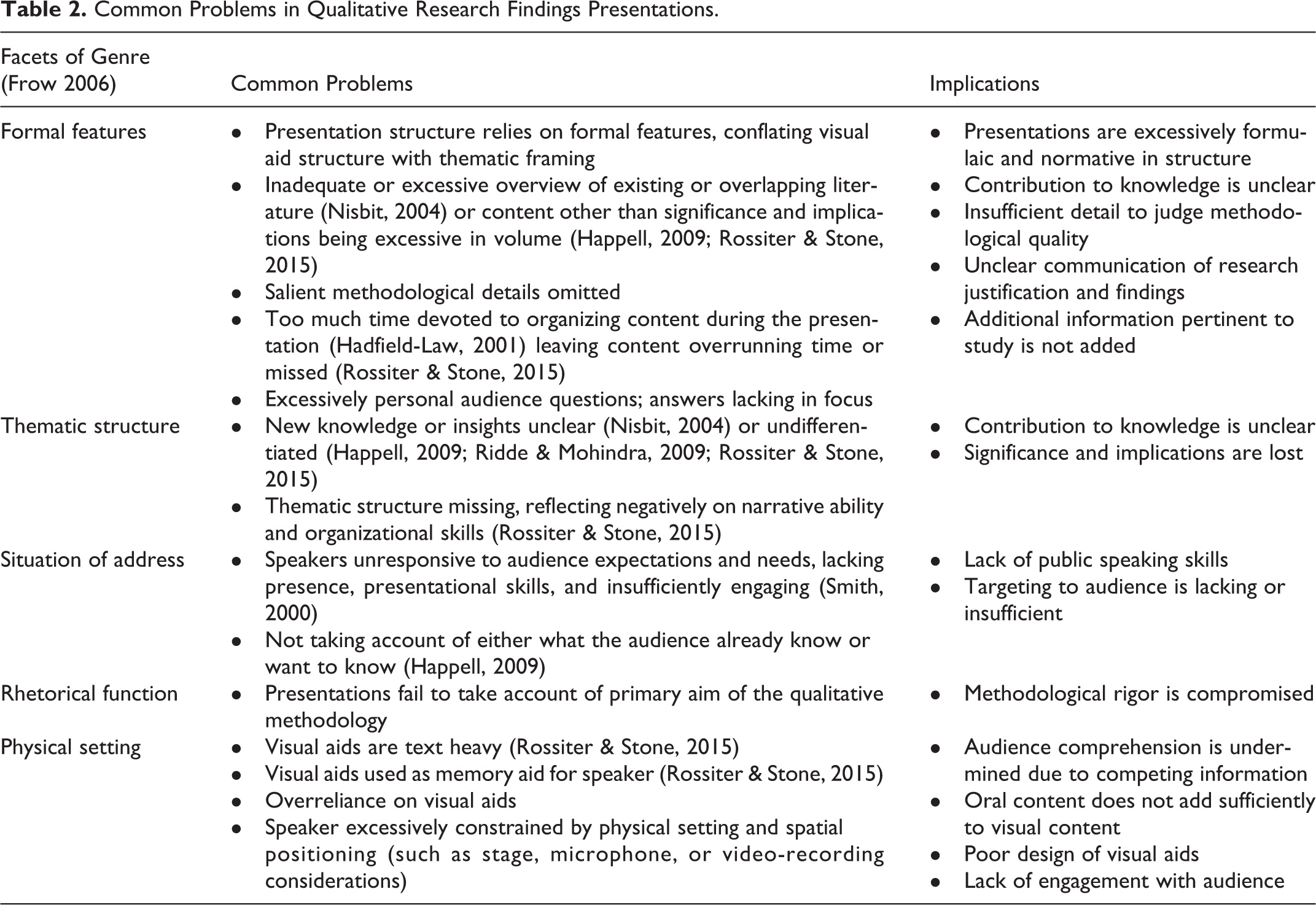
Why, given the potential of qualitative research to be memorable and evocative, do so many presentations fail to achieve their potential resonance? Current styles of presentation tend to bend to facets of genre and thus reflect academic norms which, such as writing (Sword, 2013), are often lacking in style and engagement. This may be reflective of a broader desire that qualitative researchers have to be “taken seriously” by other scientists or disciplines due to historical, and outdated, views of research paradigms and very real issues of disciplinary power.
This norm is often expressed in the manner in which the presentation is viewed by those presenting—most commonly this results in the visual aid being conflated with the act of presentation itself. Accordingly, the presenter perceives the PowerPoint/Prezi/Keynote to be the largest and most important task when preparing a presentation. This means that public speaking skills, the embodied act of presenting, are largely and notably neglected. The most obvious manifestation of this is when the formal and physical features of the presentation (usually text-heavy slideshows) serve as a memory aid for the presenter(s) rather than as true visual aids that enhance audience communication (Rossiter & Stone, 2015).
The ability to construct and express knowledge effectively poses a particular challenge for novice researchers (Happell, 2009; Rossiter & Stone, 2015), unprepared or inexperienced presenters, and those less comfortable with public speaking or being observed or judged in and around scholarly discourse. Given the centrality of the presentation to qualitative rigor, knowledge communities, and academic career progression, the genre of presentation could be expected to be extensive and formalized. However, doctoral programs remain focused on developing substantive knowledge and methodological expertise (League of European Research Universities, 2010). Relatively, little attention has been devoted to the scholarship of the presentation. Courses, groups, and books on and for academic writing have proliferated in recent years (Aitchison & Lee, 2006; Aitchison, 2009; Sword, 2013); however, this has not been the case for presentations. Mainstream books on presentations remain focused on lay readership and audiences (e.g., Duarte, 2008), while methodological textbooks for qualitative researchers (e.g., Barbour, 2014; Silverman, 2013) remain silent on how to present qualitative studies well.
This neglect of the genre of presentation is puzzling and concerning. While others bemoan the lack of theorization of writing in research training and degrees (Aitchison & Lee, 2006), this predicament is magnified for presentations of research findings. Thus, the genre of the qualitative research findings presentation remains relatively underexplored and tacit.
Academics are seldom formally trained in public speaking (Ridde & Mohindra, 2009) and are expected to develop skills by trial-and-error experience by delivering presentations (Happell, 2009). As such, presenter(s) tend to conceptualize and deliver presentations as “verbalized manuscripts” by incorporating standard sections and large amounts of text and quotes that characterize written academic papers—resulting in visual aids being used to mimic “the page.” This conflation of presentations with written academic papers neither responds to the distinctive genre of the qualitative research findings presentation nor fully realizes the potential of public speaking skills to communicate or achieve the ends that rigorous qualitative research should. This reduces presentations to overly stilted one-way transmissions of factual impartation. The qualitative research findings presentation as a discursive activity within a knowledge community should be understood as a unique genre and thusly framed as having distinct requirements. Presentations demand of the researcher the ability to communicate (Hadfield-Law, 2001) in a manner that is resonant and which conveys significance by connecting with an audience.
This reliance on normative presentation structures exposes the difficulty researchers often have in articulating the contribution and significance of their research concisely—which tends to be relegated to tacit impartation and consequently not communicated effectively (Ridde & Mohindra, 2009). This occurs when the implications of findings are not explicitly stated or are implied rather than identified. Consequently, the contribution to knowledge is unclear, and the possibility of creating resonance and verisimilitude is reduced.
The Potential of Qualitative Research Findings Presentations
Is quality in presentations of research findings entirely subjective, or more specifically, determined by the views of the presenter? Does a presentation become “good” simply because the presenter believes this to be so? Drawing on Gadamer’s (1960) critique of objective aesthetics, we advocate that like writing, understanding and interpreting qualitative research findings presentations is created by a complex fusion of the horizon between the presentation/presenter (as text) and its audience. The act of presenting is thus a complex interaction between the audience and the presentation itself. Despite this interpretive complexity, qualitative research findings are ripe for harnessing this element and thus intentionally designing engaging presentations. We will now consider recommendations for the improvement of future presentations of qualitative research findings.
Improving Presentations of Qualitative Research Findings: Considerations and Suggestions
Attempts to provide advice on scholarly writing are inevitably compromised when this guidance is presented as expert “tricks and tips.” This normative coaching is alluringly tangible and specific, but because scholarly writing is always genred and context-bound, it is also limited. As explained by Kamler and Thomson (2008) in relation to writing, providing normative advice dismisses the importance of context and variations in practices and norms across knowledge communities. Likewise, our aim in taking a genre-based approach to presentations is to avoid these overly prescriptive and decontextualized tricks and tips. Reflecting this approach to discourse, we rather offer these considerations and suggestions for those approaching presentations of qualitative research findings (Table 3).
Genre-Based Suggestions and Considerations for Future Research.

The Aim of Presentations as a Discourse
This genre-based approach does not downplay the core purpose of the presentation in scholarly discourse. Genre-based approaches harness a wide variety of expressions of the facets of normative genre (noted in Table 1) but also beyond these variations, allows for a common purpose. Although the stand-up comedy genre can be diverse (think Tina Fey vs. Richard Prior vs. Rowan Atkinson), comedians share the common aim of making people laugh. As such, presentations of qualitative research findings can, and should, be diverse in form, structure, and rhetorical and physical elements but still share the common purpose of constructing and expressing knowledge so that the nature, contribution, significance, and implications of the qualitative research are communicated clearly.
Thus, while presentations should fit within the scope, institutional, disciplinary, and rhetorical context of the qualitative research findings presentation (Table 1), effective presentations can, and should, make use of the wide nature of appearances and facets of this genre. We will now show that the genre of the qualitative research findings presentation can successfully serve these multiple and compatible ends.
Formal Features and Thematic Structure
Echoing written manuscripts, presenters of qualitative research findings tend to deliver a normative presentation structure dominated by fixed formal sections—introduction, methods, findings, discussion, and conclusion—with clear demarcation and reliance on text and scholarly wording. This may do little to serve the effectiveness of the genre of qualitative research findings “presentation.” In genre terms, presentations are not oral utterances of manuscripts—this conflates the oral presentation genre with the written manuscript genre. Yet a tendency to confuse these genres is evident when presenters use text and quote-heavy slideshows of mostly undifferentiated prose and concepts (Table 3).
Rather than an initial focus on formal features of manuscripts in the construction of a presentation, presenters could alternatively frame the presentation primarily in the significance and implications of the research first, such as the so what, who cares? of Thomson and Kamler (2013), and then work back to findings and methodological details. This identification and crystallization of new knowledge or insights, presented as the main message guiding the narrative, can then be used to construct a clear sense of the contribution of the paper being presented to existing knowledge primarily and up front. Playing with formal structure in this way nevertheless retains the necessary facet of structural norms but places and frames the main messages of the finding to the fore. The presenter is best placed to provide this representative scholarly knowledge using insightful awareness that reflects “bigger picture” thinking around the significance and contribution of the work.
Storification in the Genre
More than many other research methods, qualitative research has, at its core, the accounts, behaviors, and contexts of people. Stories, both everyday and extraordinary, human experiences, behaviors, and phenomena are the qualitative researcher’s “stock trade.” Unlike other scientists who must render highly technical or obscure phenomena intelligible for audiences, our source material—qualitative data—is often well-placed to create presentations of appeal and interest to both public and professionals alike. Given the particular suitability of qualitative research data to stories shared through emotive language, innovation, novelty, and/or curiosity within the boundaries of the formal features of presentation, such facets are well suited to resonance. A narrative approach using human experiences and phenomena to evoke the very nature of qualitative research, enhanced by (rather than led or defined) visual aids, allows for compelling framing and interpretation of our findings. Audiences are more likely to be engaged in, and to remember, research that is presented in such a way that it evokes an emotional response through the use of story (Kensinger & Corkin, 2003).
The researcher Dr. Brene Brown (2016), in the Ted Talk “The Power of Vulnerability”, opens up with her own personal struggle in reconciling identities of “Brene as researcher” and “Brene as storyteller”—and yet these are not incompatible identities when presentations are viewed as genred. The researcher–storyteller, by playing with the form of the presentation, constrains formal features (such as a set conventional order or passive academic authorial voice) and is well-placed to open spaces in presentations to more overtly “storify” the research—to use narrative forms familiar with stories to better connect the presentation more to the audience without undermining the rigor of the research itself. This value of story in relation to the nature of communication has been articulated more generally (Simmons & Lippman, 2009), and a range of techniques can be used to develop skills and confidence in presenting through storytelling (Buster, 2013). Rethinking and reimagining qualitative research findings and the way in which they are presented, within the boundaries of the genre, offer scope for creativity by bending and playing with scholarly norms, thereby reshaping them.
Situation of Address and Rhetorical Function
Bland, unengaging presentations are not conducive to sharing, contesting, and/or debating knowledge. Evocative and effective presentations, on the other hand, may be viewed as a platform to build rapport and conversation around research. Yet responsiveness and respect to audiences, whichever knowledge community is involved in the presentation, is important in any genre. Even playing with and bending genres is predicated on an initial understanding of what is being played with and bent. For qualitative research findings, the level of methodological detail and framing of a presentation is likely to vary widely by discipline(s) of the audience and their familiarity with qualitative methods. A researcher presenting qualitative findings to an audience predominantly of clinicians or researchers not familiar with qualitative methods may seek to adapt the framing, content, and style of their presentation accordingly. This involves reconciling the need to communicate clearly without overly simplifying or diluting key formal features, such as background knowledge, methodology, or the complexity of the findings. Emphasis can be placed on storification, evocative analogies, metaphors, and examples to present complex concepts simply with wider appeal.
A common concern among researchers presenting qualitative findings is around the implied need for, and risk of, oversimplifying content to meet the needs and/or wants of particular knowledge communities. As with word limits of journal articles, researcher/presenters are often apprehensive about the lack of capacity during 15-min presentations to fully do justice to the complexity of qualitative research. This concern is frequently expressed when communicating qualitative findings to physicians or at interdisciplinary conferences. While this challenge is recognized, all disciplinary groups are potential knowledge communities with which to initiate scholarly conversation—including those less familiar or comfortable with qualitative methods—and it remains ethically problematic to consciously avoid or reject engagement with any one community due to such differences.
This need not mean that researchers presenting qualitative findings “conform” entirely, passively, or submissively to prevailing norms of any knowledge community, but that resonance must be achieved in and among prevailing norms and their attendant expectations, understandings, and perspectives in the audience of the presentation. Conceptualizing and framing (Anderson, 2013) significance and implications with clarity and brevity (Rossiter & Stone, 2015) are important to communicate with resonance and verisimilitude.
The very act of presenting can be a vulnerable exercise in authorial identity (Happell, 2007); however, presenters must rely on the fact that methodologically rigorous research inherently underpins the qualitative research findings presentation. Thus, the need to reinforce authority on the subject during a presentation is unnecessary. Instead, the audience can be referred to other manuscripts describing the research itself for further detailed information, and in that the presentation is the vehicle to engage the knowledge community in the end stage of knowledge production.
Material Aspects of the Presentation
In genre terms, visual aids are not the presentation. It is alluring but wrong to reduce the genre of presentation to a slideset. Verbal narrations of points written on slides may stand in for a presentation in the eyes of the presenter, but it significantly compromises the genre. Yet signs of this are all too common. Slides contain far too much text used for the wrong purposes. Over 90% of presentations arguably contain too much text (Kosslyn, Kievit, Russell, & Shephard, 2012)—a tendency particularly challenging in presentations of qualitative research findings given the need to include corroboratory data to support themes (Kalyuga, Chandler, & Sweller, 2004; Reynolds, 2011).
Too much text is problematic because it is counterproductive to the presentation aims. Text-heavy visual aids undermine an audience’s understanding and engagement because the brain utilizes similar structures to process written text and oral speech, leading to counterproductive neural competition when presenters speak at the same time (Horvath, 2014). When audience members are required to read the text on slides silently during presentations, the majority of the audience will process this by “hearing” each word as if they were speaking (Horvath, 2014). Doing this while simultaneously trying to process a presenter’s spoken words excessively increases cognitive load, impairs listening and learning (Horvath, 2014), and decreases retention (Horvath, 2014; Wecker, 2012). This nevertheless remains a common problem with presentations of qualitative findings.
Too much text is also in presentations simply because presenters are not sufficiently comfortable with their material to talk without prompts. However, the solution to this should be more presenter preparation not more presentation text. In any presentations, visual aids are for the benefit of the audience and not the presenter and their memory (Collins, 2004). As such, assessing whether or not visual aids add value (Foulkes, 2015) to a presentation is a key but overlooked step. Presentations do not have to incorporate slides. More consideration is needed as to whether audio extracts, music, video, or indeed nothing should replace the slideset. Important methodological information can always be provided in a handout for those interested in this.
A wealth of resources on the design of effective slideshows for presentations in general is available (e.g., Duarte, 2008). Many do suggest developing slides with less text (Pros, Tarrida, Martin, & Amores, 2013; Reynolds, 2011; Wecker, 2012). Making use of images instead of text is also an effective alternative for which there is experimental support (Horvath, 2014; Stenberg, 2006), as visual images are not processed in the same ways or brain locations as speech (see summary of Horvath, 2014; Werner & Chalupa, 2013). Sourcing images has been made easier with the advent of free, reuse with attribution or open licenses as opposed to traditional copyright (e.g., images licensed under Creative Commons; Unsplash). Another alternative is to avoid using particular software altogether (Kosslyn et al., 2012), such as PowerPoint, and to instead focus on the verbal impartation of knowledge through the embodied genre of presentation. Given content that elicits an emotional reaction, such as the use of storytelling or images, is also more memorable for both presenter and those being presented to (Kensinger & Corkin, 2003), presenters should consider these, at the very least, likely to appeal to emotions.
Presence: The Human Element of the Presentation
The presenter’s presence and actions during the presentation remain integral to the genre. In the same manner in which the written word is subjected to numerous drafts that are edited and refined, the presentation (the visual aids, the content, and the embodied practice of the presentation itself) can be subjected to the same developmental process through practice presentations.
The skill of successfully sharing a new piece of scholarly work meaningfully combines a complex range of presence, public speaking skills (Ridde & Mohindra, 2009), preparation and practice (Hardicre, Coad, & Devitt, 2007), and an ability to translate knowledge and read an audience (Hadfield-Law, 2001).
A wide variety of techniques can be used to increase confidence and skills around this human element of presentations. Developing public speaking skills and presence therefore is then important (Collins, 2004; Happell, 2009; Rossiter & Stone, 2015). Rehearsal provides the chance to refine what is said, how this is said, and with what mannerisms this is imparted (Collins, 2004). Seeking constructive feedback can be used to improve skills and style and can be used to ensure the aims of the presentation are clear to a wide range of audience members or particular target audiences (Happell, 2009; Rossiter & Stone, 2015). “Improvisation” skills can be improved and developed to improve the comfort and confidence of the presented to be “more preparedly” unprepared (Poynton, 2013). This can help not only during presentations but also in reactions to unexpected questions, reactions, and feedback. Improvisation abilities foster a higher level of comfort with a lack of control, facilitate listening, and promote a lack of defensiveness to others (Poynton, 2013).
Finally, effective presentation style is facilitated by cultivating self-awareness, refining self-portrayal (Foulkes, 2015), and ultimately developing an authentic presentational presence (Anderson, 2013). Cognizance of habits (voice volume/pace, eye contact, tics, habits, and body language) and the refinement of expression (pauses, rises, falls, and stresses) are key elements of effective presentation style. Audience cues are an important gauge for the pace and delivery of a presentation (Collins, 2004; Nisbit, 2004). Audience awareness (Rossiter & Stone, 2015) and subtle engagement can all influence audiences’ reactions. Well-prepared speakers are more likely to have the presence of mind to be aware of audience cues and thus have the ability to make subtle adjustments while presenting.
The Social Media Back Channel
A new and important consideration for research presentations is the back channel of social media. With the advent of such platforms (most notably, microblogging platforms such as Twitter) and smartphones, it can now be considered a given that presentations will be discussed online both during and after the presentation itself. This conversation is referred to as the back channel (Atkinson, 2009).
It is important to note that most conferences now encourage and foster conversations on social media (e.g., conference hashtags on Twitter). Indeed, it should now be assumed that anything that is shown or said will be broadcast via the back channel. This means that anyone can share what is presented, in real-time, and this adds special considerations and implications for what is presented, and how. Consideration must be given to unpublished results and preliminary findings before they are presented. Smartphone cameras have made it easier to take photographs of slides, and it is imperative that presenters ensure that the images on slides are not protected under copyright and that correct attribution is given to all elements on each slide.
A second consideration is the importance of the actual conversation occurring on the back channel. This can be a double-edged sword. Presenters can make full use of the back channel to follow and foster engaging conversation around their work; on the other hand, the back channel provides a critical platform for audience members to voice an opinion if they find the presentation to unengaging or out-of-date (Atkinson, 2009). Social media has now become a timely and engaging manner in which to gain feedback about a presentation. As such, it has become increasingly important for researchers to be aware of the conversation around not only their work, but all work in their field that is occurring on the back channel. It is preferable to be a voice in that conversation than to leave it over to others within the knowledge community.
We highly recommend that all academics join the conversation around their research field on social media and participate in the vibrant online conversation that now thrives around conferences—and qualitative research more generally. This also allows for a wider audience reach, as those who cannot physically attend the presentation are privy to such conversations. Providing video/audio recordings of the presentation (e.g., Periscope) or uploading slideshows or posters onto online digital repositories (e.g., Figshare) can also expand influence beyond the presentation itself. The back channel is an effective tool in research communication and is an important component of the end stage of research dissemination.
The Qualitative Research Findings Presentation as a Sociocultural Act
We would be remiss not to reflect on the qualitative research findings presentation in terms of its social, cultural, and relational meaning. In this way, presentations—and thus presenters themselves—are received and perceived in accordance with the worldviews and biases of the audience. Thus, in closing, we reflect on presentations as sociocultural acts.
Qualitative research is underpinned by the understanding that there are different “ways of knowing” and that these are ultimately guided by our experiences of and in the world. Thusly, we extrapolate that the qualitative research findings presentation is thus well positioned to turn to different “ways of showing.”
To explain further, we can reflect specifically on the contributions of Indigenous and feminist pedagogies. These lenses provide cause to reflect on the oft-gendered and highly cultural nature in which a presenter, and thus the presentation itself, is perceived and received. Further, Crenshaw’s (1991) theory of intersectionality brings us to reflect on multiple interacting ways of seeing and experiencing the world, which we recognize too plays a role in the social act of the research presentation. Who is able to successfully push boundaries, when and how this is received, is thereby a question that gives pause to reflect. On this view, the presentation is shaped by, steeped in, and responsive to its social and cultural context.
Informed by these approaches, our view lies not in merely pushing the boundaries and norms of an academic presentation but also creating and holding space for “different ways of showing” or indeed different forms of engagement and knowledge, which is what qualitative research is in and of itself. This is the strength of the genre approach. In this way, we call for the qualitative research findings presentation to ultimately hold true to its epistemological roots, to lean more fully into our “different ways of knowing.”
Recommendations for Future Research
In this analysis of the qualitative research findings presentation as genre, we have provided considerations based on our reading of genre theory and pedagogy (including academic writing) as well as observations and experiences. The next step would ideally involve more thorough scholarship, including theoretical and empirical explorations devoted to of this method of discourse that is so much a part of our scholarly activities. Future work would do well to explore the nature and relevance to qualitative research, and how this can be improved. With so much current focus on new methods of knowledge dissemination (e.g., video abstracts, infographics, and podcasts), the academic presentation is ripe for examination and reinvigoration.
Conclusion
In summary, the genre of the qualitative research findings presentation is important in terms of personal reputation and career progression, methodologically, and for the growth and reputation of qualitative methods. Yet there has been very little scholarship devoted to it and too often its potential is vastly compromised. Taking a genred approach allows a better theory-based appreciation of the various dimensions of the presentation genre. Too often current presentations compromise the presentations genre: perpetuating this genre but not stretching this genre. We have offered considerations and suggestions for approaching and undertaking the presentation differently. Presentations are not an optional extra to academic work, or an element of academic work to be endured, but rather an opportunity fused with the potential to reflect both the work itself and the passion that underpins it.
Footnotes
Authors’ Note
A. M. Clark is corresponding editor of the International Journal of Qualitative Methods and Advisory Board Chair of the International Institute for Qualitative Methodology.
Declaration of Conflicting Interests
The author(s) declared no conflicts of interest with respect to the research, authorship, and/or publication of this article.
Funding
The author(s) received no financial support for the research, authorship, and/or publication of this article.
