




Abstract
Scant information is available to guide the selection and modification of methods for doing research with people with communication impairments. In this article, we describe and illustrate a novel combination of methods used to optimize data generation in research with 13 disabled youth who use augmentative and alternative communication (AAC). Using a critical dialogical methodology developed for the study, we explored links between dominant calls for social inclusion, disabled youths’ social relations and life circumstances, and their position-takings in relation to inclusion. Building on emergent methodologies, we selected and integrated complementary methods: photo-elicitation, a graphic elicitation method termed “Belonging Circles,” observations, and interviews. The interview methods were modified to recognize all AAC modes used by participants and to acknowledge the relational, situated and thus, dialogical nature of all communication in interviews. Each method is described, and rationales for their selection and modification are discussed. Processes used to combine the methods, generate data, and guide analysis are illustrated using a case example from the study. The integrated methods helped illuminate the lives and practices of youth who use AAC and the strategies they used to negotiate inclusion across the social spaces that they traversed. We conclude with reflections on the strengths and limitations of our approach, future directions for development of the methodology, and its potential use in research with a broad range of persons experiencing communication impairments.
Keywords
What Is Already Known?
Researchers have reported on emergent methods for doing qualitative research with people who have communication impairments, but normative judgments about which types of communication are “authentic” and “valid” have raised concerns about how to interpret research participants’ accounts in this context.
What This Paper Adds?
This article forwards an approach that overcomes concerns about the value and validity of research accounts generated with persons whose communication is mediated by technologies or a communication partner. Processes for combining methods to optimize data are explicated and then illustrated using a case example from empirical research with youth who use augmentative and alternative communication.
Introduction
Augmentative and alternative communication (AAC) describes a range of modes of communication used by persons with communication impairments to substitute for or augment speech (e.g., nonspeech vocalizations, facial expressions, personal communication books, human assistants, and computer technologies such as speech-generating devices). Until recently, there has been very little interview-based research conducted with youth who use ACC, partly because investigators have lacked methods for eliciting their perspectives and/or gatekeepers judged them as incapable of contributing to research (Morris, 2003). However, in the last decade or so, with calls for more inclusive research methods (Lloyd, Gatherer, & Kalsy, 2006; Morris, 2003), researchers have explored methods for generating data with persons who have little or no speech (Boggis, 2011; Lloyd et al., 2006; Low, 2006; Morris, 2003; Morris, Dudgeon, & Yorkston, 2013; Philpin, Jordan, & Warring, 2005; Teachman, Mistry, & Gibson, 2014; Wickenden, 2011b) and a small body of work that examines substantive issues with youth who use AAC has emerged (Bennett, 2011; Gibson, King, Teachman, Mistry, & Hamdani, 2017; Gibson, King, et al., 2014; King et al., 2014; Mitchell, 2010; Raghavendra, Olsson, Sampson, Mcinerney, & Connell, 2012; Wickenden, 2011a, 2011b). Still, there remains a relative lack of information to guide the selection and modification of methods for eliciting the perspectives of this group.
Complicating this knowledge gap is the scant attention paid to how “voice” is conceptualized in interview-based research with persons who communicate in ways other than speech. Nor does extant literature address the effects of normative judgments in qualitative research about which types of “voices” are valid and authentic. For example, standard approaches to qualitative interviews (face-to-face, dialogue-based, single researcher with single participant) are likely to limit the quality and quantity of data generated because the process of independently generating text-based responses using a speech-generating device or spelling board is time intensive and often associated with extraordinary exertion and fatigue on the part of the person using AAC (Boggis, 2011; Morris, 2003; Teachman et al., 2014). Persons who use AAC have reported that they are able to say more, and with less fatigue, when supported by a familiar communication partner (Collier, McGhie-Richmond, & Self, 2010). Yet this type of mediated communication in the context of research interviews has surfaced concerns about “whose voice” is being represented (Philpin et al., 2005) and whether researchers’ interpretations of a participants’ alternative communication modes can be considered “valid” (Boggis, 2011). Left unexamined, tacit assumptions about capturing a person’s “own voice” and interpreting one “true” meaning tend to undermine the accounts of people who use AAC.
In designing research that critically explored the notion of “inclusion” with youth who use AAC (Teachman, 2016), we aimed to advance emergent methodologies by explicitly surfacing and addressing the above noted concerns about the authenticity of accounts generated with persons who communicate primarily in ways other than speech. To address this goal, we looked to Mikhail Bakhtin’s dialogism (1981, 1994) to help theorize communication difference and to argue that talk generated using mediated communication modes is no less authentic than any other interview data. We reframed “voice” in interviews, and communication more generally, as always multiple and relational by drawing on dialogical approaches, which we have described in more detail elsewhere (Teachman, McDonough, Macarthur, & Gibson, 2017). This article contributes to methodological literatures by focusing on how we combined interviews that involved mediated communication with visual methods to elicit high quality, multifaceted data with youth who use AAC. To our knowledge, this was the first study to combine these methods in research with this population. We suggest these methods might equally be used to optimize interview-based research with other groups experiencing communication impairments (e.g., following stroke or head injuries; across the course of dementia or critical illness).
In what follows, we begin with an overview of the study and a brief description of how we theorized communication difference to overcome validity concerns and frame the interview methods that are described herein. Next, we introduce the study methods. After providing descriptions and rationales for each of the visual methods selected, we review the specific study processes used to integrate the visual methods with interviews. Using a case example from the study, we illustrate how the novel combination of methods generated complementary data and multiple perspectives on inclusion. We conclude by reflecting on the methods and directions for their ongoing development in future research.
Study Overview
Study context and aims
Disability advocates and researchers have suggested that youth with physical and communication impairments experience high levels of social exclusion (Morris, 2001, 2003; Smith, 2005, 2014; Whitehouse, Watt, Line, & Bishop, 2009). Yet no research with these young people has explicitly explored their perspectives on inclusion or exclusion in relation to the social contexts in which they are positioned. In addition to this lack, there is the broader problem of how “inclusion” and “exclusion” are conceptualized in research and policy (Ravaud & Stiker, 2001). Dominant social inclusion discourses assume a predetermined normative center that constructs people as either insiders or outsiders along a moral hierarchy that privileges the so-called normal bodies and abilities (Edwards & Imrie, 2003; Gibson & Teachman, 2012; Graham & Slee, 2008). We might well ask, however, into what are disabled persons to be included; what exclusions might this entail; and whose interests are served through inclusion practices?
These gaps and issues informed the development of a critical qualitative study which aimed to (1) contribute detailed descriptions of the daily activities, social networks, personal geographies, and material environments of youth who use AAC and their perceptions of inclusion and (2) interpret the ways youth who use AAC accommodated, resisted, or reformulated dominant social inclusion discourses to position themselves in and across various social fields (Teachman, 2016). We used a multicenter design that combined face-to-face interviews with participant-generated photographs, a graphic elicitation technique termed Belonging Circles (McKeever et al., 2015), and observations (in the form of extensive field notes). The study design combined these methods in order to optimize the data generated and to support analyses of participants’ understandings of their social worlds alongside rich data that reflected the social, cultural, and material contexts that shaped their views (Bourdieu & Wacquant, 1992; Green & Thorogood, 2014; Shuttleworth, 2012). Drawing on Bourdieu’s (1990, 2000) theory of practice, we analyzed the reciprocal relations between participants’ “emplacement” in disadvantaged positions within sociospatial topographies (what Bourdieu termed fields), their dispositions, and their practices (the mostly prereflexive ways they navigated their everyday lives within and across fields) to understand how they made sense of dominant notions of inclusion.
Study participants
Thirteen Canadian youth who use AAC (aged 15–24 years, 6 young men, 7 young women) participated in the study. Participants were recruited from three regional children’s treatment centers encompassing urban and rural communities that ranged in size and density. Institutional ethics approval was obtained from each treatment center’s research ethics board. We combined purposive and convenience sampling strategies to maximize diversity across the sample (in relation to age, gender, socioeconomic status and rural vs. urban location); this strategy helped optimize data quality, depth, and variation (Sandelowski, 1995a). All participants had cerebral palsy with associated communication and mobility impairments, three had cortical vision limitations, and two had a concurrent chronic disease. Youth in the study were in high school or had completed high school within the past year, and all lived in southern Ontario.
This group of young people was targeted for several reasons. In the Ontario school system, disabled students who require curriculum modification or adaptation may remain in high school longer than their same-aged peers, which accounts for the age range across participants. We anticipated high school–aged youth who used AAC were more likely than their younger peers to have developed the requisite communication skills to support participation in the study (e.g., a consistent yes/no, ability to compose a simple message using text). Finally, adolescence is a time when youth who use AAC confront rapidly changing social and communicative expectations (Smith, 2005, 2014) which might potentially “widen the gap” (the social distance) separating them from their “typically developing” peers. Thus, we expected participants would have experienced and been able to reflect upon shifts in their everyday social worlds and their perceptions of inclusion.
Study Method
In the next two sections, we introduce each method individually, providing a brief description and rationale for their selection. Then, we describe the study processes in greater detail to share how the study unfolded as we worked to integrate the methods and data analyses.
Dialogical Interviews
In setting out to develop interview methods to optimize data generation with youth who use AAC, we first considered how to increase the quantity and quality of data generated while attending to the need for an interview approach that would not be unduly onerous for participants. Use of a communication device has advantages for people with communication impairments because the output is generally clear and readily understood across environments. However, the process is often extraordinarily arduous and fatiguing for the person using the device. In the intimate and routinized context of the home, persons who use AAC might use communication devices much less than in other spaces. In part, this occurs because AAC devices cannot be physically accessed during a variety of activities. It also happens that, over time, families tend to develop idiosyncratic, situated systems of communication that are more reliant on nonverbal gestures, facial expressions, dysarthric speech, and nonspeech vocalizations. Given these considerations, we elected to conduct the interviews in participants’ homes and encourage use of all their preferred modes of communication including mediation by familiar communication partners which had the potential to greatly reduce participant fatigue.
Second, we reflexively queried tacit assumptions about “voice” that underpin positivist/postpositivist interview-based research traditions. In these traditions, participants’ utterances during interviews are idealized as “authentic” and “autonomous” voices that can be captured and ascribed verifiable “true” meanings (Kvale, 2007). These types of assumptions call into question the value and authenticity of mediated communication. Particularly in cases where a communication partner might be involved, the autonomy of the participant using AAC may be brought into question. Researchers may assume that participants possess singular a priori views and responses (their own voice), and that these “independent” views can and should be captured by the researcher. Thus, mediation by a communication partner raises concerns about how to verify the account as belonging to the participant alone and whether the partner’s mediation influenced the account and how. In the face of these notions of “voice,” it seems logical to question whose perspectives are being expressed: those of the person using AAC or those of the communication partner.
To contest notions about “authentic” voice as singular and autonomous, we drew on the work of Bakhtin (1981, 1994) who argued the nature of all dialogue is relational and situated. Bakhtin examined how power relations are enacted through language. He argued that dominant groups assert power through dogmatic, authoritative truth claims (which he termed monologic). This has the effect of obscuring dialogical communication where meanings are acknowledged as temporal, constructed in the space between listeners and speakers, and open to multiple interpretations (Frank, 2005). For Bakhtin, each utterance and each voice is always already permeated with those that went before, so that no one person’s voice is ever her or his own; rather, it is the product of the interaction between speakers and the broader social context in which the utterance emerges (Bakhtin, 1994). Although Bakhtin did not specifically address effects of communication impairments, his work explicitly attended to normative value judgments that deem some forms of “talk” more valid than others, so that some social groups are silenced or subjugated while the status quo is maintained and reproduced. Whereas a focus on “independently” generated speech valorizes the notion that persons possess a singular, unique voice, we adopted a more dialogical approach to the interview conversations (Teachman et al., 2017). Using this approach, interviews involving participants, communication partners, communication devices, and the interviewer were analyzed as situated social relations where each played a role in co-constructing participants’ accounts.
Visual Methods
Dialogical interviews were augmented by two visual methods: photo-elicitation and a graphic elicitation technique termed Belonging Circles. These were selected, in part, because they offered the added value of being aligned with what are termed “visual strategies” in AAC (Beukelman & Mirenda, 2012) where graphic symbols, line drawings, or photographs are used to support conversations. Visual information can set a topic, provide details, or clarify an utterance. Photographs or items, such as a concert program or a movie ticket, might be kept in a communication book to support sharing news or telling a favorite story.
Photo-elicitation is a method where photographs are used primarily to scaffold, contextualize, and enrich interview discussions to add complexity and depth to research results (Allen, 2012; Smith, Gidlow, & Steel, 2012). The method can involve images generated by participants within the context of the study, self-selected from their personal or family photograph collections, or introduced by the researcher. We elected to include both participant-generated and self-selected photographs to provide choices about how participants might show and talk about their perceptions of inclusion. Participant-generated photo-elicitation has been used in research with disabled youth to examine topics including self-perceptions of impaired bodies (McLaughlin & Coleman-Fountain, 2014), resilience and micro-mobilities (Porcelli, Ungar, Liebenberg, & Trépanier, 2014), identities and masculinities (Gibson, Mistry, et al., 2014), and optimal activity settings (Gibson, King, et al., 2014; King et al., 2014).
Photo-elicitation methods afforded at least five advantages in our study, consistent with advantages reported by other researchers. First, the collaborative interaction between researcher and participant in preparing to take the photographs, viewing the photographs, and talking together about the photographs proved to be a key strength of the photo-elicitation method. Participants shared their reasons for taking particular photographs and interpreted the meaning of their images, which provided for “a situation of coanalysis” during interviews (Gibson et al., 2013, p. 387). Second, the photographs revealed “embodied and material manifestations” of phenomena that might have been difficult for youth to articulate (Allen, 2011, p. 488). Third, photographs taken by participants in the course of their everyday lives helped introduce topics unknown to the researcher and revealed aspects of participants’ lives beyond their own perceptions and descriptions (Croghan, Griffin, Hunter, & Phoenix, 2008; Drew, Duncan, & Sawyer, 2010; Drew & Guillemin, 2014; Gibson, 2005; Meo, 2010). Fourth, photographs aided rapport and helped avoid potential awkwardness by providing a point of focus that supported communication (Drew et al., 2010; Meo, 2010; White, Bushin, Carpena-Méndez, & Ní Laoire, 2010). Finally, participants were asked to add captions to their photographs to suggest meanings they ascribed to the images (Packard, Ellison, & Sequenzia, 2004). The feasibility of using this method has been established in previous research with disabled youth who use AAC (Gibson, King, et al., 2014) and was further developed for the study described here.
Like photographs, graphics can be used in interviews to enhance participants’ reflexivity, elicit discussion about abstract concepts, and generate data in ways that are nonlinguistic (Bagnoli, 2009). Graphic elicitation methods can involve graphics brought into the study by the researcher or those generated by participants within the study. In the first approach, the researcher introduces participants to a diagram representing concepts or relationships that are integral to the research focus and might be difficult to express in words alone. Participants’ responses to the diagram “may clarify vaguely understood concepts and hint at previously unconsidered ones” (Crilly, Blackwell, & Clarkson, 2006, p. 305). The latter approach, where graphics are generated by participants, refers to drawing methods, which are well-established, particularly in research with children (Bagnoli, 2009; Punch, 2002). In research with young adults, participant-generated drawings termed “diagrammatic maps” have elicited information about complex or “difficult to discuss” phenomena, for example, migration and identities (Bagnoli, 2009) or social settings of drug use (Ravn & Duff, 2015). However, since drawing tasks are often challenging for disabled youth, and because graphic symbols are a familiar and commonly used AAC strategy, we elected to incorporate a researcher-generated diagram called Belonging (or Inclusivity) Circles (McKeever et al., 2015) to elicit discussions about inclusion.
Belonging Circles is a graphic elicitation method where participants are asked to indicate their sense of belonging or inclusion by selecting a location on a simple schematic diagram of three concentric circles (see Figure 3 for an image of a completed Belonging Circle). We used the Belonging Circles graphic to help elicit dialogue about youths’ perceptions of inclusion in relation to the places and events recorded in their photographs. The completed Belonging Circles contributed nonlinguistic data about participants’ perceptions of being more or less included in the sociomaterial spaces represented by their photographs.
Study Processes: Integrating Visual Methods With Interviews
In research with people who use AAC, it is crucial to modify consent processes that rely on written text and oral speech so that potential participants are provided information about the study in accessible formats (Cameron & Murphy, 2007; Carlsson, Paterson, Scott-Findlay, Ehnfors, & Ehrenberg, 2007; Lloyd et al., 2006; Nind, 2009). Consent was obtained from each participant and a parent or guardian prior to the onset of the first interview, using a “visual consent framework,” developed by the first author, where visual pictures, communication symbols, and AAC strategies are used to support the process (Teachman et al., 2014). An “ethics-as-process” approach (Cutcliffe & Ramcharan, 2002) was used to confirm participants’ ongoing consent through frequent interviewer-initiated checks and reminders that participants could stop the interview, refuse to answer any questions, or withdraw from the study at any time.
Two interviews (ranging from 30 to 150 min each) were conducted at home with each participant and were videotaped to record their nonverbal communication, audible responses, and responses mediated by human or technological assistance. In ethnographic interviews, researcher observations complement and contextualize interview data (Green & Thorogood, 2014). The first author, who has considerable knowledge of AAC through her previous clinical roles, conducted all the interviews and recorded extensive notes after each. These notes included descriptions of participants’ appearance, communication preferences, and overall presentation (e.g., impressions of their comfort level and their engagement with the research topic); descriptions of other people present and their role(s) in the interview; the interview setting; interactions over the course of the interview; and any initial analytic impressions. These observational data helped contextualize case narratives which integrated data across each participant’s interviews, photographs, and Belonging Circles.
Participants used multiple modes of communication during the interviews. All communicated nonverbally using idiosyncratic gestures, facial expressions, or movements such as eyegaze or pointing. Ten of the 13 used a speech-generating device and 7 responded at times with dysarthric speech that was understood by their familiar communication partners. All youth in the study elected to include a communication partner in the interviews. In one case, the partner was an older sibling (aged 17 years); in all other cases, participants’ mothers (or a female guardian) took on this role. In four instances, other family members asked whether they could join the interview briefly to learn more about the research. In those cases, clarification of participants’ responses was more fluid as the role was shared among family members who were present. Several ongoing strategies were used to clarify participants’ meaning and intent. For example, verbal rephrasing was used to confirm nonverbal communication and frequents checks established participants’ agreement with a communication partner’s interpretation of their responses (Teachman et al., 2014).
Interview 1
The first interview established rapport and built familiarity with participants’ modes of communication through discussions of everyday routines, activities, and social settings (e.g., Tell me about yourself, Who is in your family? What types of things do you like to do? Describe a typical day). A one-page questionnaire was completed by a parent or guardian at the onset of the interview to collect demographic information (e.g., participant diagnosis, education level of parents, family cultural identity, and family income range). This information was used to describe the study sample and guide purposive sampling. At completion of the interview, the purpose and procedures for taking photographs were reviewed. To promote opportunities for participants with physical impairments to control the process of taking photographs, each received a 2-week loan of a switch-adapted digital camera, switches, and wheelchair mounting equipment (as per their individual abilities). A written reference sheet was provided, outlining “Suggestions for Taking Photos” (summarized in Figure 1). Participants were advised they could also select existing photographs from personal albums if they wished to use these to show and talk about their experiences related to inclusion/exclusion. Finally, participants were informed about what to expect in the second interview when they would engage in a review and discussion of their photographs as well as captioning and/or completion of Belonging Circles for selected photographs.

Suggestions for taking photographs.
Interview 2
After a 2-week loan period, the camera was retrieved. This enabled previewing of participants’ photographs to individualize the interview guide prior to the second interview, which occurred 3–4 weeks after the first. At this interview, discussions were elicited by jointly viewing the photographs on a laptop computer and prompting participants to assign captions and/or complete Belonging Circles to correspond with their photographs. Topics included (a) participants’ intentions and decisions to take or select photographs for the research, (b) what aspects of everyday life were depicted and their significance, (c) whether/how particular images represented participants’ understandings of inclusion/exclusion, and (d) important activities or environments not represented in the photographs (see Figure 2 for sample questions). For each event or setting represented in the photographs, participants were invited to complete a corresponding Belonging Circle to visually indicate their recall of feelings of inclusion and/or exclusion. The process was adapted to suit each participant’s abilities; some marked an “x” or pointed to one or more spots on the printed graphic to show their perception of being included, while others used an AAC technique known as partner-assisted scanning, where the interviewer pointed or described the concentric circles and the participant signaled where they wanted to place a mark.

Sample questions for Interview 2.
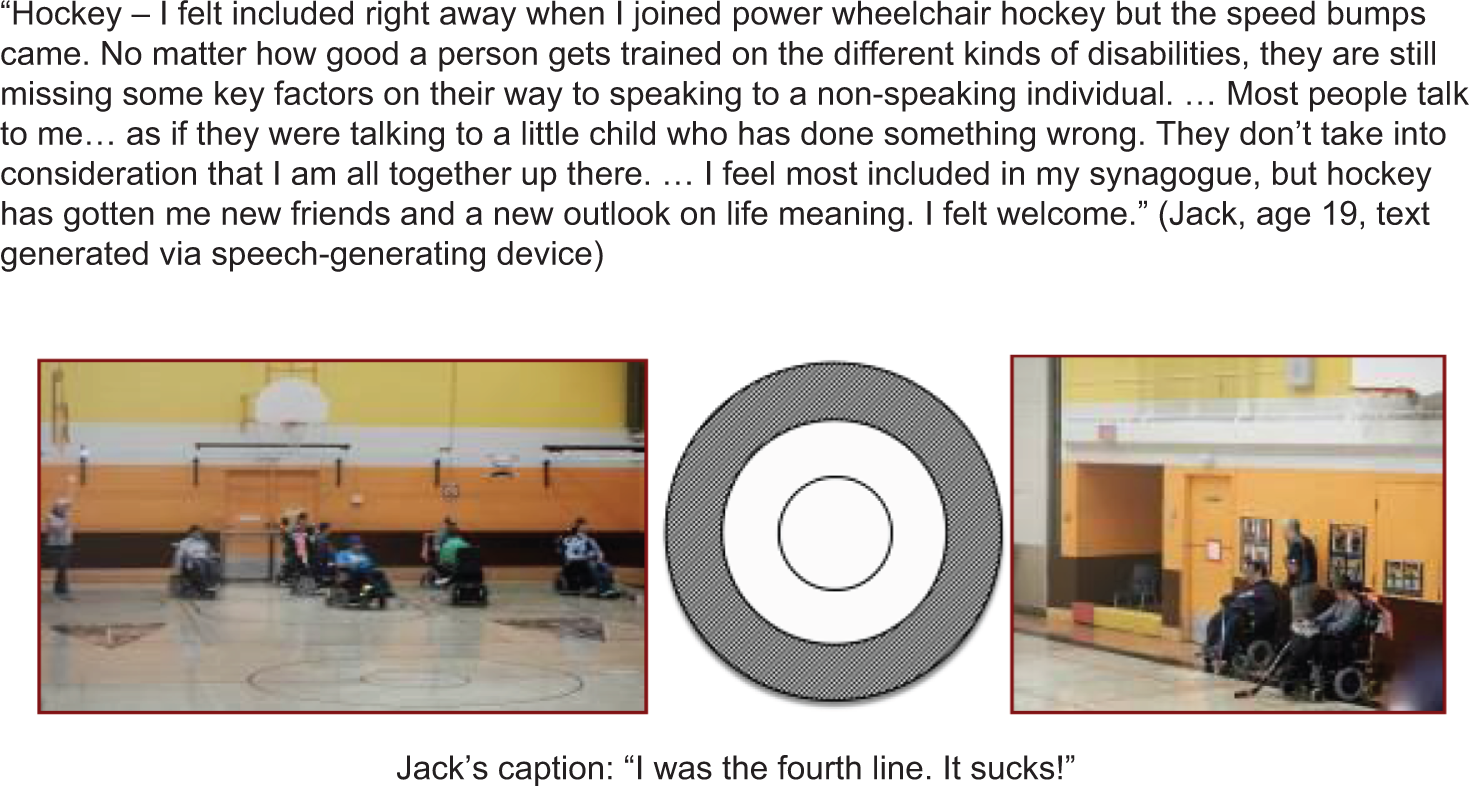
Jack and wheelchair hockey.
All youth in the study expressed excitement about the novelty of portraying their lives through taking and talking about photographs. Participants took between 10 and 100+ photographs. Although we had suggested upper and lower limits (20 and 10 photographs, respectively) as a guide (Gibson et al., 2013), all but one participant exceeded the upper limit. The three youth who had cortical vision impairments engaged with varying levels of support in taking photographs: one needed occasional assistance to frame the images she wanted to capture; the other two directed another person to take their photographs. Relatively independent use of a switch-adapted camera was new for 9 of the 13 participants. There was variation across and within participants’ approaches to taking photographs: 10 opted to take some photographs on their own and to direct another person for other photographs; 3 had limited or no reliable switch-use so directed others to take all their photographs. In five cases, photographs were included from a personal collection to tell about vacations or special memories. Each participant’s set of photographs sketched out the places or events that were regularly incorporated into their everyday lives. When it was not possible to discuss all the photographs taken or submitted, interview discussions focused on one or two photographs from each activity/event represented across the set.
The following field note excerpt illustrates how we integrated the visual methods with the interviews and was recorded by the first author following the second interview with Chloe (all names are pseudonyms), an 18-year-old with cerebral palsy and cortical vision limitations. Chloe had taken 74 photographs (many were repeats) depicting her home life with family and personal support workers, her school classroom, activities at her local community center, and at a children’s treatment center: Chloe primarily communicated using very dysarthric speech. I understood only a few words, usually her one-word responses but her mom understood and repeated Chloe’s utterances. A few times, I needed to interrupt to ask for clarification if Chloe’s mom forgot to repeat what Chloe had said. Chloe’s mom suggested…she could adjust in the photograph size and position of the screen to help ensure that Chloe could see the photos.…After setting up, we proceeded to talk about the pictures. Both mom and I provided verbal description of the photos while Chloe leaned in close to look at them. It took a few minutes for Chloe to process the visual information before responding. Chloe used her [speech-generating device] to provide information that her mom couldn’t clarify. She was excited to look at her photos, but didn’t seem to relate to the captioning activity. She more readily responded to the Belonging Circles and showed a lot of enthusiasm for this way of sharing her feelings about a place.…Chloe was keeping us ‘on track’ by correcting [my interpretations]…I could quite clearly make out her comment: “Boring!,” as we looked at photos from an appointment at her local children’s treatment center. She couldn’t point fast enough to an outer location on a Belonging Circle for that photograph, explaining that she felt left out of the adults’ discussions.
Integrated data analyses
Data collection and analysis were conducted concurrently to allow for new information to be investigated as the study proceeded (Green & Thorogood, 2014). Interviews were video recorded to ensure that rich nonverbal interactions, which would be largely diminished through transcription, could be viewed and reviewed in all their complexity (Gravois, Rosenfield, & Greenberg, 1992). Although methods to guide transcription in research with people who use AAC have been developed (Soto & Hartmann, 2006; Von Tetzchner & Basil, 2011), they tend to reproduce the very issues we aimed to overcome with our critical dialogical approach. For example, interview accounts are attributed, interpreted, and legitimated through the work of transcription, which unavoidably reduces and simplifies multimodal communication. The production of written transcripts is an analytic process wherein only a small fraction of the nonverbal communication is interpreted and represented (Poland, 1995). In interviews with persons who use AAC, the implications of missing nonverbal communication are magnified, so that the quality of the data generated might be greatly diminished. Accordingly, we elected not to produce transcripts to represent the interview interactions. Instead, all interview video recordings, observational field notes, captions, and photograph data were entered into Atlas.ti v.7 software, which allowed direct coding and memoing of the interview video data. Later, following multiple iterative stages of data analysis, representative interactions were extracted as descriptions and quotes to support written reporting of the study results.
Analysis followed recommended approaches for ensuring the quality of qualitative research (Kvale, 1996; Miles & Huberman, 1994; Sandelowski, 1995b; Sandelowski & Barroso, 2002). The first author led the study analyses, in close consultation with the coauthor, to interrogate, refine, and confirm conceptual categories and interpretations of patterns across the data. An analytic guide, consistent with the questions, aims, and conceptual framework of the study, was developed and revised during inductive and deductive cycles of analysis. The guide framed our interrogation of inclusion across participants’ accounts. Initially, multiple viewings of each participant’s interviews, alongside related field notes, photographs, and Belonging Circles, helped make it possible to get a sense of the whole (Sandelowski, 1995b). Memos were recorded at this stage and throughout the analyses to make links with related literature and to theorize the data.
Next, “facts” were extracted for later use in contextualizing participants’ accounts. Facts are “those elements of data that are least subject to errors of inference” (Sandelowski, 1995b, p. 374), for example, assistive devices used by participants and places that were part of participants’ daily routines. At this stage, and before moving to analyze across participants’ accounts, narrative case summaries were drafted (Miles & Huberman, 1994; Sandelowski, 1995b). The case summaries integrated the data generated with each participant (interviews, photographs, captions, Belonging Circles, and field notes) and addressed the first study aim which was to describe each participant’s everyday activities, social networks, personal geographies and material contexts, and their perceptions of inclusion.
To maximize the value of the study results and bring together data that reflected multiple perspectives, the analysis engaged a process of “crystallization” (Ellingson, 2009; Richardson, 2000; Richardson & St. Pierre, 2005) where the complexity of the views afforded by each type of data is retained to produce layered multidimensional interpretations. Crystallization involves researchers reflexively “embracing knowledge as situated, partial, constructed, multiple, embodied, and enmeshed in power relations” (Ellingson, 2009, p. 10). Multiple iterative cycles of analysis followed where data were compared and contrasted to discern patterns and ambiguities. It was evident that the photographs, Belonging Circles, and field notes complemented and illuminated the interview data, revealing contradictions, complexity, and insights in ways that interviews alone would not.
Analyses of the photographs, captions, and Belonging Circles were linked with meanings described by participants while remaining open to “multiple meanings that may change over time” (Drew & Guillemin, 2014, p. 56). While the photographs contributed data (e.g., about participants’ material environments and preferences), they were not analyzed on their own nor were they viewed as representative of particular “truths.” Rather, the photographs were interpreted in relation to (1) the objective conditions in which they were taken, (2) participants’ expressed intentions in making or selecting the images, and (3) the meanings participants ascribed to the photographs during the process of coanalysis afforded during the interviews (Drew & Guillemin, 2014; Gibson et al., 2013; Jenkings, Woodward, & Winter, 2008). In short, they were made meaningful through participants’ talk and the role they played in generating particular topics or stories.
Case Example
We move now to examples drawn from data generated with one of the study participants to illustrate the types of data produced and how they were complementary once integrated through our analyses. Figures 3 and 4 represent data generated in the second interview with Jack, a 21-year-old participant. Each includes an interview excerpt, corresponding photograph(s), a caption, and a completed Belonging Circle. During the first interview, Jack’s communication modes included a speech-generating device, head nods, gestures and facial expressions, and a communication partner (his mother). For his second interview, Jack had preprogrammed some messages in his device, anticipating some of what he wanted to share about the photographs he had taken. Meanings were negotiated in real time and arose out of the interactions among Jack, the interviewer, his mother, and his communication device.
Jack had completed high school in the previous year and had a part-time job at the time of the research. His set of photographs included portrayals of himself participating in several sport-related activities as well as a few images taken at home, work, and synagogue. Several images conveyed his experiences during tryouts for a power wheelchair hockey league. Jack was especially keen to discuss the hockey photographs, stating that when he played hockey, he felt like “a free bird.” Figure 3 displays multiple types of data generated with Jack around this topic.
Jack’s talk emphasized that he felt “included right away” and described the “new friends” and “new outlook on life” that were benefits of his involvement with the microfield of power wheelchair hockey (in the broader field of sport). Yet he described feeling stigmatized by the way people spoke to him as if he were a misbehaving child or assumed that he was intellectually disabled. The photograph captioning technique evoked a rather candid “It sucks!” as Jack recalled being assigned to “the fourth line” (the lowest ranked players) because of the relative severity of his physical impairments. In contrast to his positive statements about feeling included, Jack indicated on a Belonging Circle that the outer ring of the graphic corresponded to his sense of inclusion. Taken together, the interrelated data point to a dynamic and layered interplay where Jack’s perception of being included coexisted with experiences of feeling devalued and marginalized (he was positioned at the bottom of the social hierarchy of players) because of the relative severity of his physical and communication impairments.
Later in the same interview, while reviewing photographs taken at his part-time job, Jack proudly declared, “I’m a working man now!” As with the hockey photographs, much of the interview discussion focused on Jack’s positive sense of inclusion in the field of paid work. Yet the visual methods provided opportunities for Jack to show and talk about aspects of his work experiences that might have been difficult to discuss otherwise. One photograph (see Figure 4) illustrated a set of stairs that led to the office he was initially assigned. Because this office was wheelchair inaccessible, Jack booked temporary workstations when he was in the building, some of which he portrayed in photographs. Through a caption, Jack employed humour, perhaps to downplay what otherwise might appear as an affront and unacceptable workplace accommodations.

Jack at work.
Photographs of smiling coworkers elicited a conversational shift, returning to Jack’s sense of achievement in having challenged disability stereotypes by securing a job. Although he marked a position outside of the center on the corresponding Belonging Circle (Figure 4), Jack explained he preferred this somewhat sidelined positioning because he felt there would be “too much pressure” in the center. Maintaining any level of inclusion in the field of paid employment required ongoing extraordinary efforts on his part. For example, to prepare for each work day, he spent several hours tediously programming his speech-generating device with relevant phrases and chunks of information. To elaborate, Jack gestured to another photograph of a large whiteboard that showed his intense schedule of work, attendant care, travel arrangements, assistive technology service appointments, and structured leisure/sport activities.
The contradictions across the data generated with Jack are representative of multiple instances across the study where the visual methods elicited responses that differed in spontaneity and tone from the mostly positive ways that participants presented themselves and their lives in the interview discussions. Since the terms “inclusion” and “exclusion” are discursively charged with positive and negative values, we anticipated that it might be troubling for participants to think and talk about “exclusion” or to name social settings where they felt unwelcome, stigmatized, or less valued. As other researchers have noted (Bagnoli, 2009; Gibson et al., 2013), visual methods can provide an alternative means to access topics that are relatively difficult to broach and express using language alone. By integrating multiple methods, rich data were generated and made more meaningful through the coanalyses that emerged during the interview interactions.
Reflections on Methods
The study design and integrated methods approach had three strengths. First, we found there was considerable value in designing the study with two interviews for each participant. The first interview yielded important data that sketched participants’ daily routines and personal geographies (the places and journeys that were part of their daily lives). It also provided crucial opportunities to establish trust and rapport, clarify the purpose of the research, and importantly, build familiarity on the part of the interviewer with participants’ modes of communication. Discussions at the first interview prompted youth to reflect on how or where they felt included (or not) and begin to creatively plan to portray their lives through photographs. It helped participants focus on taking or selecting photographs that portrayed not only how they wanted to present themselves in the research but what they imagined we wanted to learn as “absent but present” researchers (Gibson, 2005).
Second, we found that encouraging youth in the study to use all their preferred modes of communication, which could include a communication partner, was less taxing than if we had privileged “independently generated” responses. This observation was based on our previous research with youth who used AAC (Gibson, King, et al., 2014) where participants’ interview responses, generated primarily using speech-generating devices, were very brief and lacked detail. The critical dialogical interview methodology allowed participants, with their communication partners and other preferred AAC modes, to narrate their accounts with relatively greater ease and comfort, which produced more and better quality data.
Furthermore, because we explicitly encouraged youth to use their preferred communication modes during the interviews, we gained a surprising insider’s view of the unique and intimate ways that participants communicated with other family members, especially their mothers. As noted above, all the young people elected to include a communication partner during the interviews. Under these conditions, 7 of the 13 putatively “nonspeaking” participants (i.e., the term is often used to describe persons who use AAC) used quite a lot of speech that, while not understood by the interviewer, was mostly understood by their communication partner. Thus, we learned that within the home and supported by the shared history among family members, some youth clearly self-identified as being a person with speech. This insight highlights a likely disjuncture between the practiced ease and intimacy of communication interactions among family/familiar communication partners and those outside of familiar relations.
A third strength is that the combination of methods made it easier to readily adjust our interview approach for each participant. While the overall study procedures were consistently implemented, the individual methods were deployed using a flexible approach to suit participants’ abilities, strengths, and preferences. For example, although the captioning technique evoked emotional responses from some participants, others interpreted this more as a descriptive or labeling activity (e.g., This is me with my sister), which provided less insight into their intentions in taking photographs and the meanings they ascribed to them. Most participants (11 of the 13) readily embraced the graphic elicitation activity and completed between five and 10 Belonging Circles. But two participants indicated they did not understand the abstract graphic and preferred not to respond using this method. As the interviewer noticed variations in how participants responded to the visual methods, she could immediately adjust to focus on those which seemed most engaging or the best “fit” for that young person.
We identified two potential limitations of these combined methods and developed approaches for mitigating each. First, contextual factors, such as policies governing photography or gaining access to a space, mediated the range and types of photographs youth generated. In some settings or with some people, permission to take photographs was not granted. In other situations, youth described feeling pressured to include certain people in posed group “selfies.” These interactions illuminated ways that people in the environment appeared motivated to present themselves and the setting as inclusive through the research. Rather than view these factors as problematic, we used their occurrence to prompt considerations of how contextual mediators made certain photographs possible, while others were not permitted or even “unthinkable” (Gibson et al., 2013).
Second, the Belonging Circles provided a means to elicit youths’ recall of emotions, impressions, and sensations associated with particular times and spaces in ways that were less bound by the discursive constraints of language but not free from discursive effects. We considered how the graphic might “prime” respondents (Crilly et al., 2006) since, on one hand, the concentric circles of the Belonging Circle diagram reproduced dominant centric inclusion discourses that idealize a central “belonging” position. This potential influence could have been mitigated by asking participants to generate their own conceptual drawings (Crilly et al., 2006); however, because we anticipated most participants would have difficulty drawing, we did not consider this option. On the other hand, the concentric rings of the diagram afforded many options for youth to indicate their perceived positions in social spaces along a gradation either within or outside of the graphic.
Our learning supported a few practical summary recommendations for research with this population. Researchers contemplating studies that will include people with communication impairments will benefit from training to increase their competence in communicating with persons who use AAC. They may wish to incorporate visual methods, such as photo-elicitation or graphic elicitation, which can help scaffold interview discussions as well as add alternative means for participants to express their views. Crucially, researchers must be prepared for AAC-mediated interviews to proceed at a slower pace than oral interviews, requiring considerable physical and mental effort on the part of participants, but also extra efforts from the interviewer who actively works to clarify understandings (Carlsson et al., 2007; Morris, 2003; Teachman et al., 2014). In planning a study that integrates participant-generated photo-elicitation methods, researchers should allow for the additional time and expenses that may be accrued. Attention should be paid to ensure that potential participants are supported to access information about the study and provide consent using familiar communication modes that optimize their understanding and engagement. Last, interviewers should incorporate frequent checks and breaks to help accommodate for potential participant fatigue.
Conclusion
In this article, we have outlined a novel methodological approach that combined participant-generated photography, a graphic elicitation method termed Belonging Circles and dialogical interviews to generate data in a study examining the notion of “inclusion” with youth who had communication impairments. We were interested in learning how participants’ everyday lives and their perceptions of inclusion were shaped by broader social values, beliefs, and assumptions that structured the various sociomaterial spaces they occupied. To achieve the study aims, we modified and integrated visual and interview methods, enabling participants to direct some aspects of data generation outside of the interview context, and reflect on their experiences of inclusion. These innovative visual methods are relatively new in research that involves persons who use AAC. To our knowledge, this study is the first to combine them in interviews with youth who use AAC. The combination of methods opened multiple, alternative means for youth to express themselves, generating in-depth, multifaceted and frequently contrasting data that illuminated the lives and practices of youth who use AAC. This study is the first that we know of to report on the use of direct video analysis of interviews with augmented speakers. We suggest this analytic method merits further development to advance methods for research with people who use AAC.
Our methods were developed in tandem with a novel critical dialogical interview methodology informed by Bakhtin’s dialogism. We extended Bakhtin’s work to propose a shift away from thinking about “valid” participant accounts as those that represent an individual’s “own” independent voice, toward a stance where participants’ accounts were viewed as interdependent, relational, and open to multiple interpretations; that is, they were dialogical. With this move, interview dialogue mediated through technologies or another person (as a communication partner) was judged no less valuable or valid than dialogue generated entirely through putatively “natural” speech. With significant modifications to “traditional” interview methods, it is possible to ensure that youth (and people of all ages) who use AAC can actively contribute to research that is about them and that has the potential to affect their lives. We look forward to developing these methods and this methodological approach further in ongoing research with children and youth who use AAC.
Footnotes
Acknowledgments
We are grateful to the study participants who generously contributed their time and insights.
Declaration of Conflicting Interests
The author(s) declared no potential conflicts of interest with respect to the research, authorship, and/or publication of this article.
Funding
The author(s) disclosed receipt of the following financial support for the research, authorship, and/or publication of this article: This work was supported by the Canadian Occupational Therapy Foundation. Gail Teachman was supported by a Vanier Canada Graduate Scholarship from the Canadian Institutes of Health Research. Barbara Gibson was supported by the Bloorview Children’s Hospital Foundation Chair in Childhood Disability Studies.