




Abstract
In this article, I seek to disrupt the idea of the meaningful engagement of young people in policy-making by raising questions about what it means to engage policy makers meaningfully in responding to the work of young people. Paradoxically, we have extensive work on how young people might become engaged in social research particularly through participatory visual methodologies and, increasingly work on how young people themselves voice their concerns about social issues through vlogs and other do-it-yourself social media platforms, and yet relatively little on how their productions can have an impact either directly or indirectly on the policy-making process. Participatory work with young people is often dismissed as being tokenistic or romanticized, and the term “from the ground up” policy-making runs the risk of being overused and undertheorized. To illuminate the issues, I draw on work with a group of policy makers responding to the photo images produced by young people, all students in Agricultural Technical Vocational Educational Training Colleges in Ethiopia. Critically their responses, ones like “the girl should just clean up the mess,” highlight the implications of audience and especially the notion of how adults/policy makers view young people in youth-focused projects.
What is already known?
Although there is a great deal of emphasis in meaningfully engaging young people in research, we know very little about what meaningful engagement means in relation to the stakeholders. This is a critical area of policy research.
What this paper adds?
This article offers a close look at what meaningful engagement means in relation to stakeholders by offering a case study.
The Context
The idea of youth voice and youth engagement remains a critical area of concern, as various governments in both the Global North and Global South embark on the development and implementation of youth strategies for civic engagement and as numerous researchers seek to consider the meaningful engagement of young people in policy-making. While there may be many agendas served by this work, at least one major one is that communities of young people might themselves shape policies and practices that are of importance to their lives. It is an area that is seen to be critical at the global level where the idea of youth as protagonists has been central to policy-making, at least in theory, since the late 1990s with the Bracha Declaration. And it is possible to see the “results” in, for example, the Ethiopian National Youth Policy and National Youth Strategy, the Australian Government’s Youth Strategy, and in the Canadian context with the setting up of the Prime Minister’s Youth Advisory Panel. 1 Alongside these more formal structures, there are numerous projects linked to youth participation, agency, and citizenship more broadly (Alderson, 2001; Alaparone & Risotto, 2001; Camino & Zeldin, 2002; Combe, 2002; Cunningham, Jones, & Dillon, 2003; Denov, 2006; Denov & Gevais, 2007; Denov & Maclure, 2009; Fielding, 2007; Gaunle & Adhikari, 2010; Hallett & Prout, 2003; Livingstone, Bober, & Helsper, 2005; Livingstone & Tsatsou, 2009; MacKinnon & Watling, 2006).
On the one hand, there is an increasing recognition that young people are by themselves choosing to represent their perspectives on such critical social issues as feminism, violence, and environmental issues, separate from any type of adult-organized work, in the form of do-it-yourself (DIY) media, drawing in particular on such social media platforms as Facebook and YouTube. Some of this work can be seen in youth-led social movements such as Idle No More among Indigenous young people in a Canadian context, while other work, as Caron, Raby, Mitchell, Théwissen-LeBlanc and Prioletta (2016) highlight, can be found in the efforts of individual young people reaching many other young people through, for example, “social change–oriented” vlogs and other forms of social media. This work draws extensively on more than a decade of research that is organized around the significance of youth participation, digital media, and agency (Bloustien, 2003, 2007; Buckingham, 2003, 2007; Carrington & Robinson, 2009; De Castell & Jenson, 2003; Jenkins, 2006; Mallan, 2009; Morrison, 2010; Poletti, 2008). On the other hand, an important area of inquiry that draws together much of the participatory work with young people concerns the ways in which youth-focused methods can be decolonizing in and of themselves through the use of participatory digital and other arts-based methods (Gubrium & Harper, 2013; Gubrium, Harper, & Otanez, 2015). Participatory interventions are typically part of community-based research, drawing on audio, visual, and performance-based research methods such as photovoice, participatory video, drawing and map making, digital storytelling, theater performance, radio production, podcasts, and collage (see Mitchell, 2011a; Mitchell, 2011b; De Lange, Mitchell, & Stuart, 2007; Moletsane, Mitchell, Smith, & Chisholm, 2008; Clacherty, 2005; Denov, Doucet, & Kamara, 2012; Didkowsky, Ungar, & Liebenberg, 2010; Gubrium, 2009; Liebenberg, 2009a, 2009b; Malone, 2008). Gonick’s (2016) work in film with Inuit girls in Iqaluit, Liebenberg’s (www.youthspacesandplaces.org) work with participatory video with Aboriginal youth in Atlantic Canada, Mitchell (2015) work with rural South African girls and the use of cellphilms, and Author’s work with youth in the area of photovoice in Southern and Eastern Africa (see Mitchell, 2009; Mitchell, 2011a, b; Moletsane et al., 2007) all point to the ways in which these various narrative modes build on storytelling conventions of communities and as such have the potential to both subvert some of the researcher-researched power dimensions and contribute to a milieu where the perspectives of young people are recognized.
The Problem and Key Questions
To date, there has been extensive work in the area of youth participation using visual media on the actual process, which Rose (2012) describes as the site of production in image-making and on the images themselves (e.g., photos, videos, vlogs, and cellphilms). At the same time, there has been increasing recognition of the need to interrogate the idea of what counts as the meaningful engagement of young people. This work has ranged from Milne’s (2012) notion of the rights of young people to be nonparticipants through to work that questions meaningful engagement through a retrospective lens (Author, 2014). Paradoxically, given the discourse community that talks about “from the ground up” policy-making (Choudry & Kapoor 2010, p. 1), much less has been written about the impact of this work on various audiences or what Rose (2012) refers to as audiencing. As Alexandra (2015) notes, the idea of “voice” only works if someone is actually listening, viewing, and engaging in some way. In the area of photovoice, a notable exception is Delgado (2015) who, in his comprehensive study of the use of photovoice with urban youth, acknowledges the significance of the exhibiting phase in photovoice work. As he observes, “Having an exhibition boycotted because of its controversial content, or, even worse, simply ignored, with minimal attendance and no media coverage, can have a long lasting impact on the participants” (p. 99). Perhaps the most compelling point is one that he shares from the work of Haw (2008) and the idea that the opposite of having a voice is being silenced. Failure (on the part of researchers) to come up with a way for photos or other visual images to reach appropriate audiences is part of that silencing. In a sense, then this presents an ethical issue that sits alongside the various other ethical issues attached to photovoice as a participatory visual methodology. As highlighted by Author (2011a) elsewhere, these include issues of privacy and consent as well as ownership of the actual photos. What is challenging methodologically, then, is to take this work to a new level of engagement in order to deepen an understanding of influence in relation to communities and policy-making bodies. It is one thing to produce media texts, but how can they reach the audiences who need to see them, and how can the audiences (including policy makers) be responsive to what the producers are saying? In essence, how can we understand the processes of meaningfully engaging young people without considering as well ways of meaningfully engaging policy makers as audiences in relation to young people?
The Fieldwork
The fieldwork for this study comes out of a much larger project in Ethiopia being carried out over 6 years and involving partners in Canada and Ethiopia, all focusing on Agricultural Technical Vocational Education Training (ATVET) Colleges. 2 The overall goal of the project is to “increase the supply of male and female graduates from agricultural technical and vocational education and training (ATVET) institutions who have the necessary skills and knowledge required by the labor market to develop the commercial agriculture sector in Ethiopia” (Agricultural Transformation through Stronger Vocational Education (ATTSVE), 2014, n.p.). An important component of this 6-year project aimed at contributing to transforming these four colleges to better serve students in agriculture was to start with a needs assessment that included perspectives of the students themselves. What did they see as issues and concerns, and how could they represent these issues through photovoice?
Participants
The student group was made up of 80 participants (roughly equal numbers of male and female students) between the ages of 18 and 22, with 20 from each of the four participating ATVET colleges. The policy-making group, all male, was made up of 8 deans and deputy deans from the four ATVETS who were present for the launch of the ATTSVE project in Canada.
Method and Tools
The fieldwork was divided into two parts with the focus of this article being on Part 2. In Part 1, image-making, the students were engaged in a type of participatory needs assessment through the use of photovoice. Following from the work of Wang (1999) who coined the term photovoice, we asked participating students at each ATVET to take photographs in response to the prompt, “being a male [or female] ATVET student,” but with lead in discussions related to what they saw as challenges at their ATVET college as well as things that they liked. The students, working in small single-sex groupings, were given simple digital cameras to use for the activity and had approximately an hour to go anywhere they wanted on the campus to take pictures. The time frame for carrying out the workshops was short and so instead of printing out the pictures when the students had finished as might be typically done in a photovoice project (Author, 2011a), we simply went with digital projection by inserting the memory card from each camera into a laptop connected to an LCD projector. As the images were projected on to a wall, each group had an opportunity to talk about their photos to the larger group and to the research team (offering a type of oral caption) and to make recommendations on what they thought needed to be done to improve the colleges or to ensure that they continued to do things that were working well. All of their presentations were audio recorded and later transcribed. In total, the students produced 250 photos. The themes in their photos and oral captions were quite varied. On the positive side, many took photos of the types of topics they were learning about in their courses in agriculture and science (climate change, environmental issues, and technology). They also took playful pictures of each other and, in their oral captions, talked about how much they were going to miss the companionship of fellow students when they had to go home at the end of the term. On the more critical side, the students identified many issues, ranging from inadequate toilets, lack of water, insufficient food, difficulties in paying fees, struggles with examinations, high levels of sexual violence, inadequate support in terms of technology, and absentee instructors. In all cases, they were asked “who should see these pictures?” It is worth noting that generally the deans and other members of the management team were identified by the students as potential audiences along with representatives from the Ministry of Agriculture and the Ministry of Education.
Part 2 of the fieldwork—audiencing—involved the deans and deputy deans of the four ATVETS and took place several months after the initial photovoice work and after the research team had the opportunity to look across the photos and captions to find key themes and issues identified by the students. Coincidentally, as the research team was carrying out this analysis of the images, we had the opportunity to mount what would become a traveling exhibition Our Photos, Our Learning, Our Well-being of 30–40 photos and which was officially opened at a launch event for the project as a whole at Dalhousie University in Nova Scotia, Canada. 3 It is the setting up of this exhibition for the launch in Canada and in particular the vetting of it by the deans and deputy deans of the four colleges who were present for the Canadian launch of the project before it was exhibited, which forms the basis for the analysis. 4 Presenting the analysis related to audiencing in a reflexive way below, I am interested in the ways in which the deans and deputy deans—as a group of policy makers in the ATVET system—would respond to the images produced by students. Because the deans and deputy deans were going to be seeing the images for the first time at the launch event, it was important for them to know what was in the pictures (before all the visiting dignitaries from government would) and of course to see for themselves how their students regarded their learning. This preview the day before the launch which forms the data for the article was particularly important because some of the images were very negative (concerned about the food insecurity in relation to living in residence, sexual violence, absentee instructors), although it is important to note that the images were exhibited as one collection and were not organized in any way that highlighted a specific ATVET. No place names were used, although it would be very easy for someone familiar with one of these ATVETS to recognize a building or particular landmark.
Working With the Audience Data
In the previewing activity with the deans and deputy deans, I was interested in what could be learned about audience and audience response particularly in relation to the idea of engaging policy makers. In so doing, I posed questions such as the following: What did they think of their students’ work overall? Were there any images that stood out for them either positively or negatively? Were there any images that they questioned having as part of a public exhibition and especially for this launch event? and Were there images that they thought should be removed from the exhibition?
When the various faculty members viewed the images, they expressed first of all a sense of being pleasantly surprised about the photography skills of the students especially since they were aware that it was the first time many students had ever taken photographs. In actual fact, the photos were of high quality in and of themselves, and when exhibited as part of large 24 in. × 40 in. posters with typeset captions were very attractive (see Figure 1).
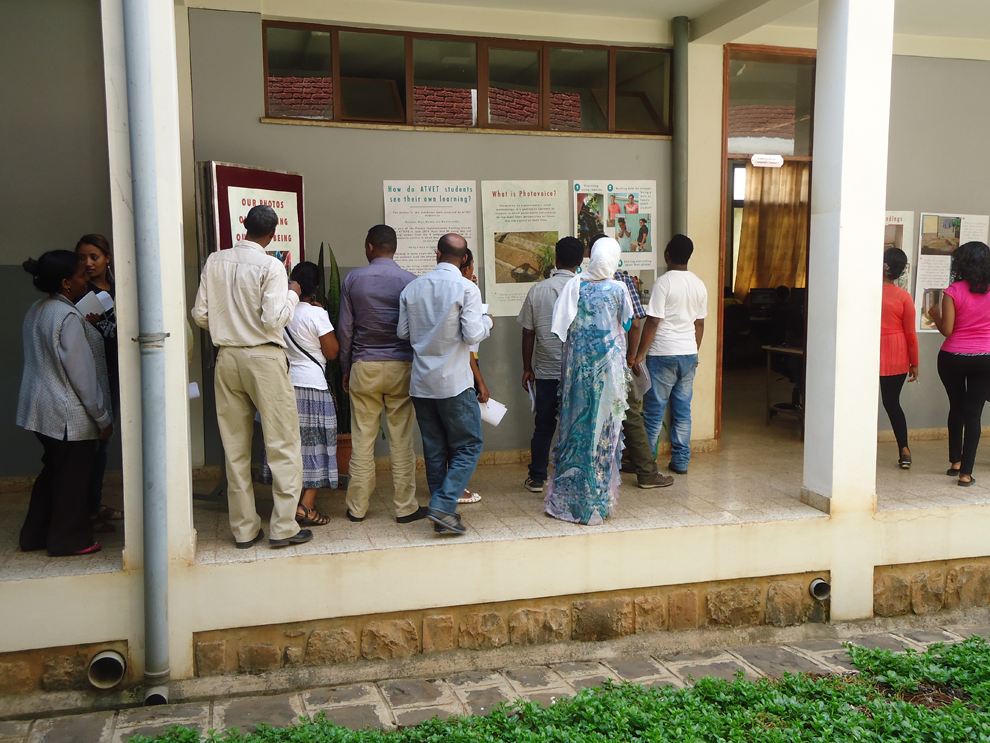
Our Photos, Our Learning, Our Well-being launch of exhibition in Ethiopia.
The deans also indicated that they were impressed by how much their students knew about topics such as climate change and environmental issues. At the same time, they were concerned about some of the pictures. Ahead of time, several of my colleagues had been worried about the number of pictures that displayed dirty toilets and the lack of water and wondered whether the fact that this exhibition was being shown outside of Ethiopia was perhaps playing into National Geographic stereotypes about Ethiopia. I was also concerned about some of the images that dealt with instructors and thought they might be of concern to the deans since the students were clearly being critical of the quality of instruction. For example, several photographs showed images of classrooms without instructors to highlight the fact that instructors were often later or absent. There were also numerous photos representing sexual violence. However, those were not the photos the deans objected to. The photo that stirred up the most discussion and controversy among the deans was just one photo that showed an image of a chair with a half empty plate on it, with the rest of the dining hall in the background (see Figure 2). The students who took the picture offer a caption about the lack of food available.
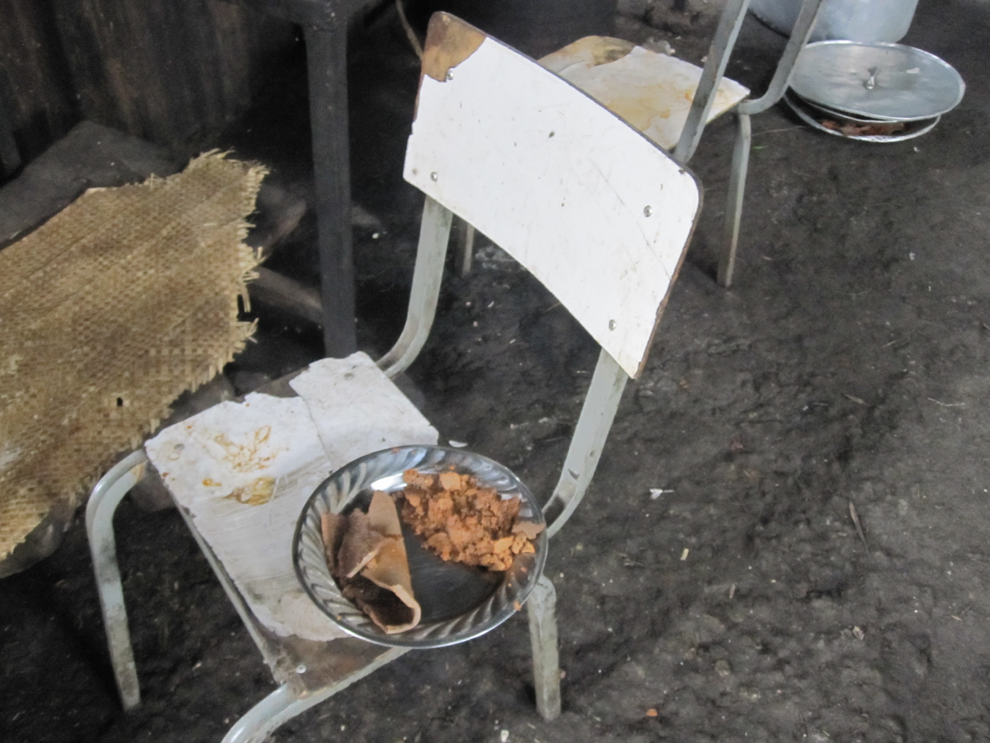
The issue of food is very specific to females. They go out very late, they have to cook, they have to eat, and then they have to come back. When they come back, it gets late, and at times the doors close, and they have nowhere to go.
In considering Rose’s notion of audiencing, I return here to my field notes from the session to highlight the responses of the deans to the students’ work: Three of the deans, one from each of three colleges, are clustered around the image. One is adamant that it should be taken down. For one thing, he says, the student who took the picture should not be showing a picture of a plate on a chair. He thinks it should be removed and that the girl should just clean up the mess. It is not clear what good removing the picture will be other than that it doesn’t appropriately represent what it should and whether it is a bad reflection on the college or not is not the point—it just shouldn’t be. Another Dean steps in and assures him that actually this is how things are and we should all be open to looking at the truth. It is a back and forth dispute that goes on for 20 to 30 minutes or more and as an outsider I stay out of it, but in my heart I am hoping that they will agree to leave the image in the exhibition. It is what the students wanted to say, it is only the next day at the time of the launch that I learn the outcome. The person who is most adamant about removing the picture asks if he can say something to the assembled group of dignitaries and makes a comment that although many of the images of the colleges are very negative in that they show problems with sanitation and the conditions of the cafeterias, and it is too bad the students had to take them, but that perhaps at the end of the 6 years of the project they will be taking different pictures. It will be a test of the success of the project. (Author fieldnotes, January 2015)
Discussion
There are numerous limitations to the study as presented above, particularly in relation to the meaningful engagement of young people. These range from the abbreviated version of photovoice (half an hour lead in time, 1 hr for taking pictures, and approximately 90 min for the participants to work with and present their photos as oral captions) to the fact that the young people were not directly involved in selecting photos for an exhibition and were not present for the launch of the exhibition. It is worth reiterating, however, that they did indicate that they wanted the deans to see their photographs, so that it is entirely appropriate that all deans and deputy deans saw the photos before they were ever exhibited to anyone else. I highlight these limitations from the outset of the discussion, given the criticism that the participation of young people might be regarded as tokenistic. At the time of the photovoice workshops, there were limited opportunities for student participation beyond the 3-hr sessions. However, it is worth noting that the exhibition Our Photos, Our Learning, Our Well-being has now traveled to all four ATVET campuses, and there have been special discussions about the exhibition set up, giving students an opportunity to say more about what they think needs to be done.
At the same time, the study goes beyond a consideration of the images and the process of image-making to include audience in an “up close” way. As Rose (2012) and others highlight, audience research has many complexities to it. How do we know what audiences really think? Clearly, the field of audience reception is vast and is an issue that forms the basis for study in television, film, advertising, and so on. Fiske’s work (1994) is particularly relevant because he, like Rose, includes in his work the idea of three “sites” of production: the primary text (the image), the production text (or what the producers say and experience as part of image-making), and the audience text. What is interesting about Fiske’s work is the idea that these various aspects of textuality are not separate; they leak into each other. In the example of the viewing of the image of the half-eaten plate of food on a chair in a cafeteria, especially of the dean who is against having it included in the exhibition, there are clearly mixed feelings, and it seems as though regardless of whether students have some rights, they do not have the right to take this picture. Ironically, this is not an image that most viewers would even find provocative, but it has been provoking to this one viewer. We also might ask how can we be sure that audiences even look at exhibitions and screenings of the work of young people in public events? As noted earlier, Delgado’s (2015) work highlights the potential of silencing young people if there is little attempt to ensure that the images are exhibited appropriately—something that includes attention to audience engagement? Rivard, in her photovoice work in Rwanda involving secondary school girls and their perspectives on sport and fitness, created photo reports to present to policy makers (Rivard & Mitchell, 2013). In each case, Rivard arranged an individual audience with specific ministry officials and sat with them as they looked at the photos and captions. This was a way of ensuring that they actually looked at the girls’ images. As the researcher, she, in a sense, “occupied” the offices of each of the relevant stakeholders and policy makers. Using photo reports as she terms them, she had each policy maker individually look at the images, and she also left a copy of the photo report with the policy maker. In many ways, the previewing activity with the deans performed a similar function with the added benefit that the deans could, if they wanted to, actual veto the exhibiting of certain photographs.
This example of working with an audience in order to deepen an understanding of the process of engaging policy makers highlights several key features. First of all, there is a level of pragmatism, the very practical question posed during the previewing activity about whether there were images that they wanted to leave out serve focus their discussion. As I explore elsewhere (Author, 2015), there are several other questions that can guide what might be termed an “engaging policy makers” approach in participatory visual research: Which images have an impact on them and why? How do they feel about the images and the image-making? Are there certain images that offer new perspectives? What do they intend to do (if anything) as a result of seeing an exhibition or screening of a video? What is the main message (or messages) in the exhibition/videos? How are these images the same (or different) from the images that one typically see in local media on the issue being represented? Are there questions that they would like to pose to the producers about image-making?
In many projects that are meant to engage young people, this final question may of course be explored more directly through face-to-face contact between producers and audiences. However, this may not always be possible, and depending on the issues, the situation may not even be desirable. Kindon, Hume-Cook, and Woods (2012) in their work with participatory video offer an example of audience members being very unreceptive to the participants’ video, even though the producers and the audience were from the same community. A direct response by the dean to the producers of the photo in Figure 2 could have a similar consequence. MacEntee and Mandrona (2015) in their discussion of audiences and visual productions talk about how rural South African teachers as producers of cellphilms dealing with content related to sexuality chose their own students as an audience even though in the study context they could have chosen parents, other teachers, school board members, and so on. They speculate that perhaps the children were a safer audience or at least a known audience.
There is also a reflexive aspect to this work. In the previewing activity, the deans as policy makers are thinking about and discussing the content and intent of the images in the exhibition. Working with photographs inevitably draws attention to the interpretative process (Author, 2011a, b) rather than “one right answer.” The fact that the deans were working in a small and contained group of colleagues meant that there were opportunities for appreciating more than one perspective. 5
As a third point, we might also think about the participatory process in which the deans are engaged. 6 They are encountering the images as members of a viewing group, and because they are all deans or deputy deans and are previewing the exhibition in part to see whether there are any images to which they object, there is perhaps a sense of group cohesion and group process as part of participatory engagement. Alongside this, one might think of what Alexandra (2015) refers to as political listening in work with the digital storytelling productions of asylum seekers and refugees in Ireland. Alexandra builds on the work of Bickford (1996) who talks about the idea of “democratic communication” that is based “not on the possibility of consensus but the presence of listening” (p. 18). While it is not easy to mandate how exactly audiences should encounter images, these three points, the pragmatic, the reflexive, and participatory process, suggest some sense of an appropriate viewing context.
Finally, if we are to take seriously the idea of impact in relation to audiences, and especially the idea of engaging policy makers, it is important to look at actions and what has changed as a result of the students voicing their concerns through image-making and the policy makers viewing the images. A year after the previewing activity, I had occasion to visit the ATVET college of the dean who objected to the photograph. The traveling exhibition Our Photos, Our Learning, Our Well-being (complete with the photo of the image of the half empty plate of food) had just arrived at the college and was being viewed by students and staff. The dean pointed to an image in the exhibition of a desolate space on campus bereft of any vegetation (see Figure 3). The students had taken the picture a year earlier to draw attention to the ways in which the campus itself was neglected. The dean very proudly noted that one can no longer see that image since the college, as part of its environmental strategy developed within ATTSVE, had embarked upon a project of cleaning up the campus, planting trees and flowers, and generally making the place a much more attractive place for both teaching and learning. This initiative relied on the work of the environment club, a staff and student organization, but also the leadership of senior management. The point is that engaging policy makers also involves some accountability for doing something.

Desolate space on campus.
Conclusion
The meaningful engagement of young people in policy-related participatory visual research necessitates the meaningful engagement of policy makers as audiences in relation to this work. This idea of “engaging policy makers” is a critical piece of the puzzle. Audience research is a legitimate area of study in television studies, cultural studies, and communication studies and, indeed in the context of digital and social media, has become increasingly diversified and more complex, as several new collections have highlighted (Carpentier, Schrøder, & Hallett, 2013; Zeller, Ponte, & O’Neill, 2014). To date, however, audience research in participatory visual research has not received in depth attention. How can we build the idea of audience into research design and especially in relation to the funding that might be required? To date, we know much more about the images and the image-making process in youth-focused participatory visual research, and relatively little about the politics of looking and being heard, let alone the politics of doing. If we are to take seriously participatory visual research with young people and the potential of this work to influence policy and social change, we are obliged to go full circle to study the audiences.
Footnotes
Declaration of Conflicting Interests
The author(s) declared no potential conflicts of interest with respect to the research, authorship, and/or publication of this article.
Funding
The author(s) disclosed receipt of the following financial support for the research, authorship, and/or publication of this article: This study was funded by Global Affairs Canada.