




Abstract
Visual methods are not new within education research field, but they are certainly an innovative approach, especially in higher education where students’ voice is understood as a central need. In this positional article, the authors intend to accomplish two key objectives. First, the article aims to emphasize that visual method, especially photovoice, can be enriching for studying the ways students engage in learning activities and support authentic conversations about how learning takes place and what students are thinking about this process (metacognition). The second objective is to set theoretical and methodological grounds to apply visually based methods such as photovoice and bubble dialogue in education research, particularly in learning research area. The considerations regarding specific methodological aspects are based on the discussion of a study conducted by using photovoice methodology. The authors suggest that participatory analysis and particularly interpretative phenomenological analysis are appropriate to complete the process of data analysis. The article, therefore, contributes to expanding knowledge about specific visual methods and set the ground for methodological innovation in learning research.
What is already known?
A lot of research has been conducted in the field of learning. Despite this, there are voices claiming that the traditionally applied research methods (in qualitative, quantitative, or mixed research designs) failed to deeply capture the process of learning.
What does this paper add?
Thus, in this paper the authors aim to broaden the use of photovoice to research the learning process. Photovoice is not new in the field of social sciences, but its use within the field of education sciences is. The paper raises some of the basic methodological assumptions of photovoice and explains how to apply this method in a learning research study. Challenges and limits are discussed.
Introduction
There has been an intense ongoing debate regarding the prevalence of qualitative and quantitative methodologies in education research, particularly with respect to learning studies. Clegg (2005, as cited in Price, 2014), expressing concern about using largely quantitative approaches in learning research, argues that such approaches fail to provide a reliable understanding about the actual practices and their impact on student learning. Additionally, mixed methods research has strengthened its position and become increasingly more popular over the last 25 years (Creswell, 2015, as cited in Archibald, Radil, Zhang, & Hanson, 2015, p. 5). If these methodologies offer a true reflection of reality, however, it remains an open question. Richardson (2000, 2013), consistently, discusses the contribution of both quantitative and qualitative studies to the understanding of learning styles, approaches, and orientations in higher education and concludes by arguing the complementarity of these approaches with respect to their proven strengths and weaknesses. However, as Banks (2001), Collier (2001, p. 59), and Woolner et al. (2010, p. 3) argue, it seems to be a silent commitment to overuse language-based methods in education research. Despite the vivid presence of visual representations in our everyday life, visual methods are underused within the social sciences and education fields (Moss & Pini, 2016; Woolner et al., 2010, p. 3). Thus, we take this as an opportunity to propose a shift in using visual methodologies such as photovoice (PVM) to research learning in the field of higher education field. Moreover, the opinions of scholars warn about the lack of academic literature with respect to visual methods in education (Moss & Pini, 2016, p. 1).
The researchers have invested considerable time and effort to understand and explain the subjective experience of learning in higher education (Richardson, 2000). Moreover, there are those who claim that scientific research has failed to explain how learning can be improved (Biggs, 2003; Price, 2014; Richardson, 2000), whereas Vanthournout, Donche, Gijbels, and Van Petegem (2014) discuss research traditions in learning studies. However, until now, little attention has been devoted to research learning patterns and the subjectivity of learning by using visual methodologies.
Following this line of thought, this article is intended as a step forward in arguing the necessity to develop person-oriented research methodologies and the need to implement such methodologies in higher education studies. Thus, the choice of visual methodologies to gather students’ views on how learning occurs in various contexts could mitigate the limitations of self-reports and verbally based research methods. As Ruto-Korir and Lubbe-De Beer (2012, p. 404) argue, it is possible to overstate the contributions of visual methods and photo elicitation in capturing the subtleties of participants’ beliefs toward a specific subject.
Hence, this article unfolds in two directions. The first is to emphasize that visual methods, particularly photovoice, can enrich the study of the way in which students engage in learning activities, can support authentic conversations about how learning occurs, and can inform on what students are thinking regarding the process of metacognition. The second is to set theoretical and methodological grounds for applying visually based methods, such as photovoice and bubble dialogue, to study learning patterns in higher education. This article presents examples from a research where visual methods, that is, photovoice, were applied to research learning patterns of undergraduate students at three Romanian universities. Methodological aspects and findings of this research project are referenced to illustrate the use of photovoice, its contributions, and its drawbacks to research the learning process. This article focuses on considerations regarding photovoice for those who wish to consider using this method in their future studies.
Learning Patterns in Higher Education: A Theoretical Background
With respect to learning in higher education, a significant corpus of studies attempted to explore not only what students learn but how they learn (Ellis & Calvo, 2006; Martínez-Fernández, Corcelles, Bañales, Castelló, & Gutiérrez Braojos, 2016; Prosser & Trigwell, 1999; Vermunt, 1996; Vermunt & Vermetten, 2004). From an historical perspective, student learning has been understood as a quantitative change based on the intake of facts and procedures (see Bransford, Brown, & Cocking, 2000, for a detailed review). Over the last three decades, an extensive approach to learning in higher education has been committed to proving and sustaining the concept that learning is developmental. The core of this research trend is based on four pillars (Bouffard, Bouchard, Goulet, Denoncourt, & Couture, 2005), namely, achievement goals, self-efficacy beliefs, self-regulation, and learning strategies. Studies indicate an intricate relationship between these factors is sustained (Bouffard et al., 2005; Clercq, Galand, & Frenay, 2013; Neuville, Frenay, & Bourgeois, 2007). Recent tendencies in learning conceptualization have focused on the concept of authentic learning, which is understood as a developmental and subjective process. Herrington and Oliver (2000), Slavkin (2004), Rule (2006), Herrington and Herrington (2006), Lombardi (2007), Ciolan (2013), among others make the case for a deeper understanding of learning as a lived experience.
To support our methodological shift, we follow the phenomenography tradition of students’ approaches to learning (SAL). According to SAL, students can engage in learning tasks from two perspectives, namely, surface and deep approaches (Biggs, 1994; Marton, Dall’Alba, & Beaty, 1993). More recently, these approaches have been categorized as fragmented and cohesive (Ellis & Calvo, 2006; Martínez-Fernández et al., 2016; Yang & Tsai, 2010).
From the traditional SAL, several learning models have emerged. This study is based on the learning pattern model and proposes four pillars or components to explain learning behaviors (patterns), namely, processing strategies (PSs), regulation strategies, learning conceptions, and orientations to learning (Gibels, Richardson, Donche, & Vermunt, 2014). PSs refer to thinking strategies used to perform specific learning tasks. The regulatory component of learning is defined in relation with metacognitive skills, namely, the planning, monitoring, and evaluating of learning. That which is learned is referred to as conceptions of learning (CLs), namely, students’ perceptions and beliefs about what learning is, whereas students’ orientation to learning is perceived as their personal goals, intentions, motives, attitudes, expectations, concerns, and doubts with respect to their studies (Vanthournout, Donche, Gijbels, & Van Petegem, 2014).
Based on these components, the broad theoretical framework proposed by the learning pattern model encompasses four patterns that are prototypically named reproduction directed (RD), undirected (UD), meaning directed (MD), and application directed (AD; Martínez-Fernández & Vermunt, 2015; Vanthournout et al., 2014; Vermunt & Vermetten, 2004).
MD and AD are the best patterns when considering academic performance in higher education (Martínez-Fernández & Vermunt, 2015, p. 281). To support deep learning, the former is based on cohesive conceptions, metacognitive skills, and personal interests, whereas the latter combines concrete processing with cohesive conceptions and vocational orientations. Conversely, Martínez-Fernández and Vermunt (2015) argue that the UD and RD learning patterns are related to failure. Nonetheless, both foster surface learning, fragmented conceptions of learning, a lack of regulation, and ambivalent orientations.
Photovoice Methodology: A Brief Description
Building on a rich tradition, Caroline Wang and her colleagues are associated with the inception of photovoice methodology (Wang & Burris, 1994, 1997; Wang, Yuan, & Feng, 1996). Scientific literature describes photovoice as a participatory action research method in which participants use cameras to take photographs of persons, contexts, or situations they consider representative of a particular aspect of their individual and/or social life (Harley, 2012; Sutton-Brown, 2014). The essential feature of PVM is that the participants select and capture in situ, without external intervention, life experiences, actions, and states. By tracking the everyday lives of subjects, PVM gives access to both relevant objective aspects (e.g., activities, facts, and persons) and subjective factors (e.g., emotional states, thoughts) that contribute to a deeper understanding of human behavior.
Three theoretical frameworks define the epistemological roots of photovoice, namely, empowerment education, feminist theory, and documentary photography. Each of these frameworks emphasizes the role of individual agency to assure change and progress within communities. Empowerment education for critical consciousness stresses that the individual–community dyad can contribute to social equity. Critical dialogue, which is the core of this theoretical pillar, allows community members to identify, discuss, and address social issues that affect the individual and collective well-being. Consistent with this line of thought, feminist theory acknowledges the role of women’s experiences in changing the unbalanced gender relations, while documentary photography empowers vulnerable populations to capture and express their subjective stories about the world. By so doing, individual stories and perceptions become powerful tools from both emotional and political perspectives (Kuo, 2007).
Typically, photovoice has been adopted by populations that are the most marginalized, stigmatized, and underacknowledged (Hernandez, Shabazian, & McGrath, 2014). Starting with the work of Caroline Wang and Mary Ann Burris in the early 1990s, the use of PVM was extended to health and nursing research (Allen & Hutchinson, 2009; Burke & Evans, 2011; Epstein, Stevens, McKeever, & Baruchel, 2006; Harley, 2012; Nykiforuk, Vallianatos, & Nieuwendyk, 2011; Shea, Poudrier, Thomas, Jeffery, & Kiskotagan, 2013; Wang & Burris, 1997). From being a health promotion tool, PVM became increasingly popular as a participatory action research strategy due to its accuracy in gathering data (Graziano, 2004), as underscored by Lal, Jarus, and Suto (2012, as cited in Sutton-Brown, 2014, p. 169). Accordingly, the use of PVM was extended to other disciplines, including education, disability studies, public health, international development, parenting, and refugee studies (Sutton-Brown, 2014). Additional qualitative studies adopting PVM were conducted in the fields of sociology (Barlow & Hurlock, 2013), anthropology, economy, and social geography (Guell & Ogilvie, 2015; Power, Norman, & Dupré, 2014).
Simmonds, Roux, and Ter Avest (2015, p. 35) argue that PVM promoters highlighted this methodology as one that enables people to document their lives, strengths, and weaknesses of the community in which they live and reflect on them. Despite its increasing use, Sutton-Brown (2014) expresses concerns about a lack of scientific literature supporting a methodological foundation from which to conduct PVM studies. Despite these assumptions, PVM has not been widely employed in learning research (Moss & Pini, 2016, p. 1).
Photovoice: Its Contributions to Education and Learning Research
PVM offers learning researchers several key methodological advantages. First, PVM provides access to settings and subjective experiences that are difficult to access in retrospective or observational research. Second, PVM urges subjects to engage in the research process and offers instantaneous data collection. For example, photographs are taken during real-life experiences, thus reducing bias caused by retrospective reporting. Third, PVM gives access to learning experiences of a vast number of subjects and supports intensive qualitative research.
In PVM research, subjects are asked to take photographs during classes, homework preparation, and collaborative workings in individual and private settings. This approach provides access to personal experiences that are rarely, if ever, available to the researcher. Some research practitioners may argue that observational research might offer the same experiences accessible to the researcher himself or herself. However, the insertion of the researcher may cause changes in learning patterns, especially in cognitive and regulatory strategies (Richardson, 2013). Another advantage of PVM is that it provides access to information of which participants may not be aware. Magolda (2001, p. 530, as quoted in Gibels et al., 2014, p. 297) criticized the positivist assumption that the findings of research into students’ epistemological development reflected an objective reality and were generalizable. Rather, she argued that “reality is local and context bound.” Even conducting interviews with undergraduates can be challenging when researching learning. Therefore, applying PVM on underacknowledged research participants offers several benefits to the investigation of learning.
Photovoice emphasizes the expression of the participants’ perspectives through the combined use of imagery and narrative (Stroud, 2014, p. 99). By providing access to an inner perspective that is rarely accessible to the researcher, PVM allows the researcher to sharpen his/her selection of and interpretation of phenomena and experiences. As previously argued, the focus of PVM, which is based on an active participatory methodological concept, is on subjects. In this sense, in addition to being involved in the data collection process, participants become coresearchers during data analysis. The focus on instantaneous images reflecting the subjects’ states of mind may provide support not only from a methodological framing perspective, but it may also facilitate the whole process according to the thinking processes of those involved who are accustomed to operating in with images, pictures, and so on, in all aspects of their lives.
As PVM offers a flexible design and reconsiders the role of researchers and participants, it becomes highly adaptable to the needs of both researchers and participants by fostering authentic discussions (Wall & Higgins, 2006). Nevertheless, the concern regarding the lack of a “uniform regimented structure” (Sutton-Brown, 2014, p. 171) remains. Thus, we ground our approach in a general framework originally proposed by Wang and Burris and outline the following steps: (1) select the research problem, (2) recruit photovoice participants, (3) photovoice group meetings, (4) collect data, and (5) analyze data (discuss photographs). The particularities of photovoice methodology are discussed in the subsequent sections of this article, which is structured as follows. A methodological overview is provided depicting the general steps to be followed during a photovoice study. Each step encompasses two sections, conceptualization and focus. The former presents general opinions based on the scientific literature on PVM, whereas the latter refers to a study of undergraduate students conducted by the authors to investigate learning patterns in higher education.
The Field of Photovoice: Selecting Research Problems
Conceptualization
The use of visual methods in education is certainly a turning point within the field (Wall, Hall, & Woolner, 2012). As Wall, Higgins, Hall, and Woolner (2013) suggested, the field of visual methods has been traditionally associated with the fields of anthropology and criminology or with the attempt to capture events in scientific experiments (p. 4). Today, the expansion of new technologies and the creativity of the researchers challenge the use of photovoice and other visual methods (Wall, Higgins, Hall, & Woolner, 2013). Leipert and Anderson (2012) directed nursing students to take photographs that expressed the perceived challenges and facilitators of rural nursing practice. Zenkov and Harmon (2009) incorporated photovoice within a curriculum designed to enhance the writing process for urban youth. Cook and Buck (2010) found that photovoice provided a reflective means of expression for middle school students who participated in a water research project.
With respect to the field of education, the use of PVM ranged from photovoice as a research method (see the work of Bland, 2012; Chao, 2014; Hernandez et al., 2014; Keeffe & Andrews, 2015; Madden & Smith, 2015; Moss & Pini, 2016; Popa & Stan, 2013; Shah, 2015) to photovoice as an instructional method to improve the quality of academic performance (Bailey & Van Harken, 2014; Chio & Fandt, 2007; Christensen, 2012; Cook & Buck, 2010; Edwards, Perry, Janzen, & Menzies, 2012; Leipert & Andreson, 2012; Lichty, 2013; Perry, 2006; Stroud, 2014; Zenkos & Harmon, 2009). That said, within the field of education, PVM remains underused. Bland (2012) applied freehand drawings to research the problem of ideal learning environments, and Copperman, Beeri, and Ben-Zvi (2007) used visual modeling to research the learning process when participants attempt to learn a new concept or solve a problem. Although extensive quantitative studies can assess learning and learning patterns, we emphasize the importance of investigating experiences in the specific contexts in which they occur. Moreover, consistent with others’ opinions, we strongly believe that visual methods such as photovoice can facilitate the collecting of learners’ experiences and perspectives on learning in various contexts and ignite authentic discussions in the context of participatory data analysis.
Despite the increasing interest, Wall, Hall, and Woolner (2012) call for critical analysis and reflection on the selection of problems to be addressed through visual methods.
Focus
In our study, we applied photovoice to acquire new information on an old research topic, learning in higher education. To narrow the research problem, we focused on learning patterns among undergraduate students. Thus, the research aimed to (1) identify undergraduates’ perceptions on learning and learning strategies and (2) analyze the relationship between the two to identify specific learning patterns. Thus, PVM has been applied in a descriptive study to explore the daily experience of learning. Applying visual methods allowed the subjects to communicate their ways of learning, their needs, and their emotional states associated with learning.
Recruiting Photovoice Participants
Conceptualization
During this phase, members of a specific population are selected to contribute to the data collection and analysis processes. The photovoice participants were given the responsibility of creating the photographs that would eventually become the object of further discussions and analyses. Because of the participatory nature of the PVM, the recruitment process is critical for supporting the authentic dialogue between researchers and participants. The literature on PVM presents two primary methods for recruiting photovoice participants, namely, conventional or formal and nonconventional or informal means (Wang & Burris, 1997). Conventional means refer to posters, notices, and e-mail campaigns, whereas nonconventional methods could include a snowball sampling, that is, the researcher identifies a core group of subjects who are willing to participate and then have those subjects recruit other participants. Reviewing 31 photovoice studies, Hergenrather, Rhodes, Cowan, Bardhoshi, and Pula (2009, p. 689) note that majority of them (n = 26) used nonconventional recruiting strategies that have been associated with convenience and snowballing sampling through partnerships with community groups. Fewer studies applied conventional recruitment strategies (n = 12) via the Internet and outdoor campaigns (Hergenrather, Rhodes, Cowan, Bardhoshi, & Pula, 2009). Sutton-Brown (2014) argues that depending on the selection criteria, either purposeful or convenient recruiting strategies may be applied. To attract persons based on gender, health status, or ethnicity criteria, purposeful recruiting may be adopted (Wang, 1999). Convenient recruiting usually involves third parties, such as local authorities or associations, in the selection process to gain access to a consistent group of participants (Sutton-Brown, 2014).
Both conventional and nonconventional means may have both advantages and drawbacks. Using conventional means may result in raising the project’s awareness and broadening the range of potential participants. Thus, to gain access to a broader perspective of the investigated problem, it is possible to select a more diverse group of photovoice participants. Alternatively, in the case of informal strategies, the researcher could select experiential participants by employing aid of a community facilitator. If a local facilitator is involved, the success of the project depends on the time commitment and the skills of the facilitators. Conversely, in formal recruiting, potential participants can determine whether they are interested in participating with no external pressure. In this specific situation, the selection relies on the subjects’ capacity to identify themselves as part of the target group. The risk of selecting subjects who are not able to provide an inner perspective is significant. Although using Internet campaigns may be effective for teens and other medium and heavy users of social media and e-mail, such campaigns depend on the subjects’ access to the Internet and their usage behaviors. This may result in low response rates and increase the costs of and time required for the project.
Focus
Given the undergraduates’ engagement in social medial and their Internet usage behaviors, a purposeful sampling strategy based on conventional means was used to recruit photovoice participants, and social media and online ads were used to encourage students to apply. Flyers and posters were distributed on three campuses. Undergraduate students from three regular universities were recruited and selected to participate in data collection and analysis processes.
The goal of recruiting a heterogeneous group to provide a broader perspective on learning patterns oriented the selection process. The selection criterion was the undergraduate’s field of study, which included science, technology, engineering, mathematics, sociohumanities, and economics. To participate in our photovoice project, 89 students between 19 and 23 years of age (M age = 21.7), of whom 46 were females and 43 were males, were selected. Participation was voluntary, and the subjects were allowed to withdraw from the project at any time. All participants completed a written informed consent before beginning the project. The form guarantees that the photographs will be the object of analysis in this sole research project, and they will not be released to a third party. All participants in the research project received incentives at the end of the project. Through PVM, the goal of empowering participants is achieved. However, we must not assume that voice data from students who participated are representative of the whole category of students (Hadfield & Haw, 2001).
Photovoice Group Meetings
Conceptualization
Applying PVM involves longitudinal research designs and is based on an interpersonal relation between researchers and participants. Preliminary group meetings ensure researcher–participant cohesion.
The goal of these meetings is to learn about the photovoice process and build a community of practice where members assume the roles of participants and coresearchers. Olivier, Wood, and De Lange (2009, pp. 13–15, as cited in Simmonds, Roux, & Ter Avest, 2015) define four central pillars to guide this step, namely, (1) conceptualization of the project, (2) introduction to the methodology, (3) discussion of the prompt to guide photo taking, and (4) training on the use of the cameras. The prompt must be unambiguous and widely agreed upon by both the researchers and the participants. As Simmonds et al. (2015) argue, it is essential for the participants to reflect on the given prompt to arrive at a clear understanding of what they are required to do (p. 38). As for researching learning in tertiary education, the initial theme or prompt becomes the object of a negotiation of the meaning process. To achieve this, the participants are called upon to narrow the concept of learning and identify different dimensions in a collaborative way.
Accordingly, the above situation is ideally suited for discussing procedural ethics and ethics in practice during the group meetings (Guillemin & Gillan, 2004, as cited in Phelan & Kinsella, 2013). From the perspective of the participants becoming coresearchers, the ethics in practice could be more challenging than the procedural ethics. In addition to the voluntary participation and informed consent, the researchers must be prepared to negotiate ethically important moments (Guillemin & Gillan, 2004, p. 262, as cited in Phelan & Kinsella, 2013, p. 82) to answer everyday ethical issues.
Focus
During this stage, the participants benefited from a training session. The training session was broken down into an introduction about photovoice and what it is, ethics as they apply to this type of research, group discussions about photos and their content, the development of photo titles, and the creation of narratives to describe the context and substance of the pictures. The prompt given to the participants was, “Take photographs of objects, people (including yourself), and situations anywhere in your faculty and home environment to capture the way you learn, i.e. what do you do to learn, and what learning means to you.” The need to write short narratives that depict the learning experience represented in the picture was emphasized. During this stage, the participants were encouraged to ask questions about photovoice and to anticipate situations or issues that may interfere with taking photographs and creating short narratives.
Taking pictures during courses and seminars was considered an important ethical issue. Consequently, the subject was discussed at length during the initial meetings. To mitigate potential risks, the participants were advised to inform teachers and colleagues about their participation in this research project and express their intentions to take photos during activities. In addition, the researchers strongly recommended that pictures of teachers and colleagues not be taken from a full-front perspective.
Data Collection
Conceptualization
Data collection in photovoice studies is an ongoing process that occurs over an extended period of time. This extended period allows participants to capture and represent a varied repertoire of their experiences. Thus, the amount of time participants need to take photos depends on the research problem and the nature of the project (Sutton-Brown, 2014, p. 175). Due to the longitudinal nature of the PVM design, data collection is constantly evolving and generating a large amount of visual and narrative data. The nature of PVM studies involves the overlapping of the stages in the research process. Therefore, group meetings should continue during data collection to motivate and support participants who are struggling to find relevant experiences to capture (Wang, 2003).
Sampling experiences in PVM studies
A strong advantage of PVM is the focus on the immediacy of the event or experience in that data are collected in the moment. When the immediacy of the moment has passed, a number of cognitive and emotional processes, as argued by Kahneman (2011, as cited in Zirkel, Garcia, & Murphy, 2015), shape the retrieval of information. Consistent with the opinions of other authors (see Zirkel et al., 2015, p. 9), the importance of investigating the present self rather than the retrospective self is emphasized (Conner & Barrett, 2012). PVM offers a type of “just-in-time” witness to its own processes and the way they are experienced, giving a more accurate basis for reflection and meta-reflection on a retrospective basis.
After the collective negotiation of the prompt, the researchers must determine when to capture the experiences related to the prompt. We argue that an appropriate response might be the sampling approaches used in intensive longitudinal studies, such as experience sampling methodology (ESM).
To strengthen the participatory aspect of PVM, experience sampling is ideally suited. The Experience Sampling Method is a research procedure for studying what people do, feel, and think during their daily lives. It consists of asking individuals to provide systematic self-reports at random occasions during the waking hours of a normal week” (Larson and Csikszentmihalyi, 1983, p. 21, as cited in Engel, 2015, p. 147)
Zirkel, Garcia, and Murphy (2015) enforce the subjective nature of ESM and state that its main feature is the repeated examination of participants’ actions, thoughts, and feelings in the moment they occur. Thus, ESM is a systematic way of collecting samples of ongoing behaviors. As the cited authors contend, the theoretical underpinnings of the ESM emerged from the phenomenological approach (Zirkel et al., 2015, p. 1).
Bolger and Laurenceau (2013) identify three primary protocols for sampling experiences, namely, (1) fixed or interval-contingent sampling, (2) random or signal-contingent sampling, and (3) event-contingent sampling, which is triggered by the occurrence of predefined events. A combination of the three is also possible (Conner, Tennen, Fleeson, & Barrett, 2009). Event sampling has been one of the primary means applied in PVM studies. The participants are free to choose what and when to photograph according to their understanding of the given prompts. In random studies, the experiences are assessed at random times, generally with the help of randomly set alarms on a mobile device (Zirkel et al., 2015, p. 12).
In this second approach, data collection may occur during particular events, for example, when students prepare for exams or when they engage in regular learning tasks for core or noncore disciplines. This approach is suitable for both high and low frequency events when investigating the role of personal and contextual factors in learning.
Finally, the third protocol refers to fixed or interval-contingent sampling. In this context, the reporting times are known and anticipated. Conner, Tennen, Fleeson, and Barrett (2009, p. 312) suggest this protocol be applied to experiences and behaviors that are (1) less susceptible to memory bias, (2) able to be recalled over the prior interval, (3) not disrupted by mental preparation, and (4) temporally investigated.
When coupled with experience sampling, photovoice offers an opportunity for participants to engage actively in the research process of their own learning experiences. Empowering the participants can result in personal abilities to critically observe and reflect on learning behaviors and their effectiveness. Therefore, PVM contributes to a better understanding of how context and information influence learning activities and outcomes. By assessing subjects’ learning experiences “in-the-moment,” PVM reduces bias that may appear in retrospective self-report research. Accordingly, PVM strengthens researcher’s proximity to the lives of the subjects.
Focus
With respect to our study, we considered random sampling a suitable approach. The participants took pictures during one university semester. PVM and ESM contributed to the relevant sample experiences. The pictures are the results of a random and event-based sampling procedure. Blending random sampling with event-contingent protocol has strengthened the participatory nature of the discussed PVM study. Regarding random selection, the authors guided the process. For instance, in the morning, we sent a text message to all participants asking them to take pictures of themselves during courses, labs, or other learning activities throughout that day. The students themselves, however, guided the event-focused sampling. Based on contexts and learning activities discussed during the training session, the students were encouraged to take pictures of learning activities involving friends and colleagues. The participants continuously built an online collection of pictures and associated narratives to describe each picture. Writing the narratives defines the second stage of the deeper reflection on learning strategies. The narratives are ways to create and imbue meaning regarding the way learning occurs, while also adapting learning behaviors to different contexts and persons. Thinking and writing about what occurs when learning takes place activates, renews, and completes metacognitive knowledge about persons, strategies, and tasks. The researcher’s recommendations were to continue writing narratives to maintain the point-in-time accuracy of the methodology. To upload pictures and write narratives, the students used the Survey Gizmo® (Boulder, CO) online data collection platform. The participants were given unique access to a permanently open link to upload pictures and write descriptions.
Data Analysis
Conceptualization
In traditional research methodologies, data collection and analysis are distinct parts of the research. In participatory research and PVM, the borders between these two aspects are less obvious. Data analysis in photovoice research is broken down into two main stages, namely, (1) participatory analysis, wherein participants assume the role of coresearchers, and (2) nonparticipatory analysis, wherein researchers apply computer-assisted techniques and then compare and combine the results with those of participatory analysis. According to Wang and Burris (1997), there are three ways to conduct participatory analysis, namely, (a) selecting photographs, (b) contextualizing, and (c) codifying. Wang (1999) further suggests a structured dialogue technique be implemented to support group discussions. In this technique, the participants select five to seven favorite pictures, the SHOWED technique then guides the dialogue. The word (SHOWED) is an acronym for a set of “questions that are analytical and action oriented” (Simmonds et al., 2015, p. 39). The questions are as follows: “What do you See in this picture? What is actually Happening in the picture? How does this relate to Our lives? Why does this situation, concern or strength Exist? What can we Do about it?” (Wang, 1999, p. 188).
Nevertheless, the technique was not effective in every context. For example, McIntyre (2003) reveals that in her work, the model proved to be constrictive. She suggests a less structured technique wherein participants explain why they chose the photos based on questions that are more personal: “What does this mean to you?” “What was the relationship between the content of the picture and how the women perceived the community?” (McIntyre, 2003, p. 53). Additionally, we suggest that the SHOWED technique be combined with projective techniques to reveal feelings, beliefs, attitudes, and thoughts that many undergraduates may find difficult to articulate in relation to learning. (Roos, Maine, & Khumalo, 2008, 2012) developed an expressive projective technique called the Mmogo-Method™ to access, in a culturally sensitive manner, the dynamic interactions between people in relation to their community. The Mmogo-Method has proven effective with both undergraduate and postgraduate students (Roos, Maine, & Khumalo, 2008; Ross & Strong, 2010).
Two reappearing issues have repeatedly been related to data analysis in photovoice studies. The first focuses on the lack of clarity in explaining the data analysis process (Brunsden & Goatcher, 2007, p. 47). Traditionally, researchers have preferred versions of content analysis, thematic analysis, and narrative approaches. The second issue is the status of the pictures in data analysis. Two main approaches can be identified, namely, (1) pictures formed as part of the data analysis and (2) pictures that were used as a visual support for individual or group discussions. We endorse the use of a blended approach that relies on applying techniques to analyze visual and verbal data.
The analysis of visual data is problematic due to weaknesses in analytic procedures. One technique that seems suitable for analyzing visual and verbal data is interpretative phenomenological analysis (IPA; Smith & Osborn, 2007).
The aim of IPA is to explore in detail how participants make sense of their personal and social worlds (Lonka, Olkinuora, & Mäkinen, 2004). “The focus of a phenomenographic analysis is on individual variations but it aims at a collective analysis of individual experiences” (Åkelind, 2005, as cited in Yang & Tsai, 2010, p. 73).
Based on this research methodology, researchers of higher education learning have studied students’ CL (Marton et al., 1993; Prosser & Trigwell, 1999; Säljö, 1979; Yang & Tsai, 2010, 2012; Vermunt, 1996). Smith, Flowers, and Larkin (2009, p. 79) posit that the existing literature on the analysis of IPA is not convergent on a single method for working with data. That is, to conduct an IPA, various strategies can be applied to draw an iterative and inductive cycle (Smith, Flowers, & Larkin, 2009). During the first step, the researcher can conduct a line-by-line analysis of the participants’ meanings and understandings of their lived experiences. The second step draws on applying the initial noting strategy. Identifying emergent themes and searching for connections across themes and cases complete the cycle of the IPA.
Focus
The methodology proposed in our study had a strong participatory note. Thus, we paid careful attention to reflect the participatory research in the data analysis process. When data collection was completed, the researchers gathered all the pictures and narratives and briefly analyzed them. All photos, their titles, and the narratives were coded. A database containing the images’ codes and their attributes was designed, and the photographs were included in the data analysis process.
To collect and analyze the data, the photovoice and IPAs were blended. Due to the complexity of the learning phenomenon, IPA was considered a suitable approach to investigate learning patterns from the perspective of the insider or learner. Based on the preliminary findings, a focus group protocol was designed to support participatory analysis. This is because the focus group interviews enabled participants to share their photographs and narratives with each other and then engage in dynamic interactions regarding the themes that emerged from the photographs (Simmonds et al., 2015, p. 39). In the beginning of the focus group, the participants viewed all of the pictures. They then selected 10 of the pictures according to the criteria of personal and collective relevance, that is, photographs that present familiar contexts, ways of learning, or factors that enhance or affect learning. The moderator emphasized that the selected pictures must be representative of their learning experiences.
The participants examined the images they had previously selected. The participants first completed a free association task whereby subjects were asked what came to mind when they saw the pictures. Next, the students applied a storytelling construction technique and collaboratively wrote a story about five pictures they considered to be related and relevant. Completion tasks were based on bubble exercises. That is, the researchers placed empty bubbles in the photos to depict the thoughts, feelings, or actions of the students. The participants then figuratively filled-in the bubble by answering SHOWED questions: What do you see in this picture? What do you think is really happening in the mind of subject(s) in the picture? What does this picture tell about the way students learn? Can you describe this type of learning? Do you think there is something that can be done to improve this situation? In this way, the SHOWED model was mixed with construction and completion projective techniques.
To synthetize the discussions, students wrote short phrases describing the way they learned, for example, “I read the text many times” or “I underline passages of text I consider important.”
During the focus groups, researchers and participants discussed the experience of participation in terms of benefits and challenges. All subjects mentioned they felt comfortable, relaxed, and happy when taking pictures of themselves and their colleagues (for a detailed discussion of participants’ experiences, see Manasia, 2015).
“I enjoyed doing that (taking pictures). We take pictures all the time when we are at the university. This was a new opportunity for selfies or groupies.”
IPA has been performed on interview transcriptions. After rereading the transcriptions, the researchers marked the participants’ relevant quotes. To facilitate the identification of the emergent learning patterns, we associated comments with the identified quotes. In the third step, we grouped the quotes and observations according to their conceptual and experiential convergence. Emergent themes (e.g., working with peer learners, teachers’ regulatory role in learning) were identified. In the last step, the emergent themes were gathered in clusters according to the model of learning patterns (see Gibels et al., 2014, for a more expansive discussion) that represented learning components, namely, cognitive processes during learning, regulation strategies, CLs, and orientations to learning. Picture codes were also associated with the quotes, and each quote was synthesized in a single item describing a feature of a learning pattern. At the end of this process, each cluster had a number of specific quotations. By applying polarization (Smith et al., 2009, p. 97), emergent themes and items describing learning behaviors, activities, and conceptions were grouped to identify patterns. In the cases where overlapping occurred, consensus regarding the relevance of the quotes with respect to one learning pattern or another was reached.
We searched for connections between emergent subjects and clusters. Exploratory comments were associated with quotes and themes. Within learning components of each pattern, learning dimensions were coded as main and achieved, according to Yang and Tsai (2010). Main categories were determined based on the key idea with the highest frequency in narratives and interviews, while achieved categories were based on a key idea appearing at least once and representing the highest level of the hierarchy.
Key Results of the Methodology
In the following, PSs and CLs with respect to the UD learning pattern will be described and illustrated with relevant experiences as mentioned or captured by students during the taking of pictures and their participation in focus group interviews. Student quotes are indicated by “S.”
Cognitive PSs
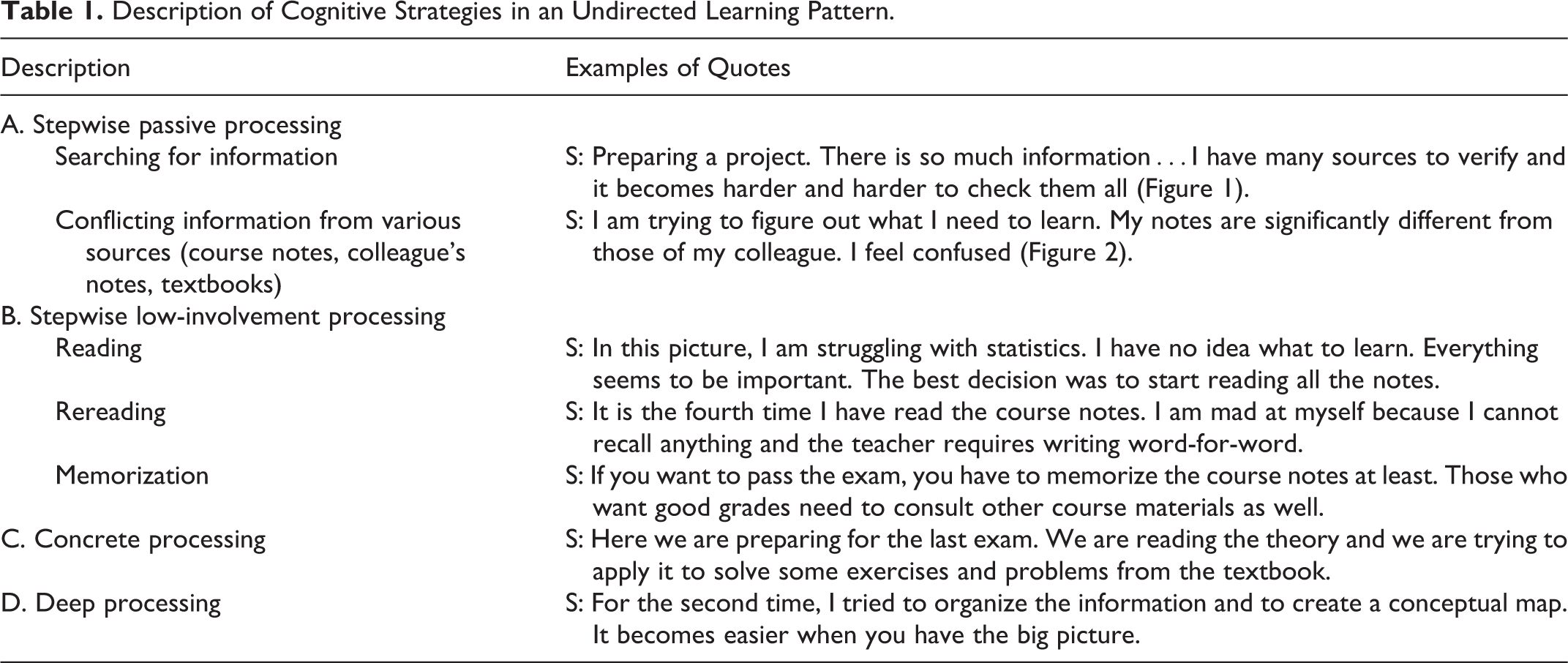
With respect to cognitive PSs, our findings illustrate qualitative and hierarchical variations in UD student approaches. Analyses suggested a framework of stepwise, concrete, and deep PSs. Table 1 depicts the categories of strategies and associates them with relevant quotes. The letters accompanying the categories (A, B, C, and D) suggest the hierarchy among the categories.
Description of Cognitive Strategies in an Undirected Learning Pattern.

Searching for information.

Puzzling information.
Table 1 suggests that UD undergraduates apply stepwise, concrete, and deep processing cognitive strategies. To analyze dominance, the categories have been recoded into main and achieved. Those in the main category were determined based on the key idea with the highest frequency in narratives and interviews, whereas those in the achieved category were based on a key idea appearing at least once and representing the highest level of the hierarchy. The frequency analysis revealed the prevalence of stepwise PS, whereas concrete application and deep processing were identified only at the achieved level.
The presence of memorization and other stepwise strategies sustains undergraduates’ orientation toward a negative learning pattern. As Vermunt (1996) acknowledges, learning patterns can change over time, persons, and contexts. In our study, the concrete and deep processing at the achieved level sustain the thesis of the variation of learning patterns. Together, concrete application, relating, and structuring account for 23.3% of achieved PS. This suggests that students can improve their learning, as argued by Yang and Tsai (2010).
Stepwise processing, the lack of regulation, and poor knowledge about tasks (Vermunt, 1996; Vermunt & Vermetten, 2004) articulate a circular reaction that entails learning as an unpleasant activity (see Figure 3).

It is one way or another you sleep or you study.
The lack of internal regulations (Vanthournout et al., 2014; Vermunt, 1996) results in a false diagnosis of the learning situation. Because students are not able to select relevant information, apply an appropriate PS, or focus on survival learning associated with reading strategies and memorization, emotions such as fear and contempt appear. High motivational intensity results in cognitive narrowing (Harmon-Jones, Price, & Gable, 2012).
“Reading, reading, and reading. I am tired of sitting at the desk and writing. It seems easier just to read. Well, it seems…shortly after I have finished reading, I know nothing and my concern increases. What shall I do in my exam if I only read the notes?”
Perceptions and Orientations Toward Learning
CLs are related to the objects and processes of learning as perceived by the student (Yang & Tsai, 2010, p. 73). As Vanthournout et al. (2014) argue, UD students perceive learning as a cooperative process dependent on the task division between fellow students and teachers. Table 2 illustrates the structure of the CLs among the students participating in this research, and they were categorized in terms of horizontal and vertical collaboration. Inside these categories, hierarchical structures are also revealed (Vermunt & Vermetten, 2004; Yang & Tsai, 2010). Our study reflects that academic success is perceived as a function of collaboration. Each category in the table is followed by a quote to depict the meaning of the category.
Description of Conceptions of Learning in UD Students.

Note. UD = undirected.

Undirected students can hardly manage a big amount of information.

Collaboration sustains understanding.
UD students expect the teachers to structure and explain the course materials well. The disconnection between learning success and the learning environment is mediated by an inappropriate teaching style (Martínez-Fernández et al., 2016, p. 113).
The research results suggest that peer collaboration encourages understanding and promotes perceiving learning in a different way (41.7%). With respect to vertical collaboration, students believe teachers promote rote learning (16.3%). With respect to the achieved level, CS encourages perceiving learning in a different way (23.3%) and peer collaboration to foster the construction of knowledge (37.5%). The construction of learning was frequently related to working in groups and project-based learning.
The Pearson χ2 test was performed and revealed an association between main CL and PS: χ2(24, N = 43) = 49.36, p < .001. Thus, most of the students adopting passive PS (n = 14, 86.7%) tend to perceive a positive relation between peer collaboration and learning outcomes.
At the achieved level, the χ2 test revealed a similar result, χ2 (12, N = 43) = 21.83, p < .05. Students with stepwise PS (n = 33, 76.7%) believe peer collaboration has a positive effect on learning outcomes, and students achieving deep PS expressed similar opinions (n = 10, 23.3%). Therefore, we conclude that PS and CL are associated, as proven in previous studies (Ellis & Calvo, 2006; Ellis, Goodyear, Brillant, & Prosser, 2008; Yang & Tsai, 2010).
Considerations and Limits in PVM Research
Similar to other qualitative methodologies, PVM has its own conceptual and methodological benefits and challenges. To clarify the use of photovoice in higher education learning research, there are several important methodological aspects that should be emphasized.
First, PVM requires a longitudinal approach. Therefore, the commitment of the participant is essential, especially given that taking relevant photographs requires time and effort. Another critical factor in sustaining the subjects’ enjoyment is to state clearly the prompts to guide participants. In PVM studies, participants continuously make choices about what to include and what not to include in their photographs. It is highly recommended that the researcher plays the role of a facilitator by offering support and guidance through the evolving process of data collection. When using PVM for learning research, one of the issues of concern could be the representation what learning means to students. Richardson (2013) noted that focusing on the images and perceptions of students may mislead the research by revealing their ways of learning. Thus, the research can benefit from a training session or a group meeting to discuss and broaden the concept of learning.
It is also possible that participants may drop out over the course of the project. Although dropout rates may vary, the researcher could facilitate the retention of members by keeping them actively engaged. Additionally, a virtual community of practice could improve the sharing of ideas and build cohesion between participants and researchers. Moreover, emphasizing to the participants that they are coresearchers in the study may result in a higher retention rate and increase their engagement. Finally, the researchers may consider introducing special considerations, bonuses, or incentives.
With respect to learning research, we argue that initial conceptualization is essential. The rationale behind this is 2-fold. One practical consideration is that the researcher provides the participants with a clear description of the project and establishes the prompts. Furthermore, the researcher bases all methodological decisions regarding sampling criteria and protocol on theoretical models. It is also noted that the researcher may be interested in investigating research problems with certain characteristics, such as learning processes during exam sessions, learning in peer groups, informal learning, regulation strategies in virtual learning environments, and cheating behaviors in self-paced learning. The theory will lead to a decision regarding the time required for data collection, for example, 1 week, a semester, a year, and the set of research methods to be combined to provide the best answers to the proposed research questions.
In sum, the planning and timing of the research study are key considerations in PVM research as failing to do so could bias the research based on certain missing factors, that is, contexts, persons, activities, due to an inappropriate chronological placement of the study.
Conclusions
The unprecedented transformation in human habits and behavior, as the result of multiple variables, but especially due to technological development and digitalization of everyday life, is openly challenging our understanding of what authentic and self-regulated learning are and urges the need for articulating new tools for learning research.
This article aimed to broaden the use of photovoice in education and especially in learning research. It is argued that PVM is an innovative methodology to explore in situ the subjective dimension of learning in everyday contexts and experiences. In addition to giving access to subjective proximity, PVM supports the involvement of participants as coresearchers. Used in design with other research methods (e.g., ESM), PVM offers access to realities that otherwise are hardly reachable for an external researcher or even for the participants themselves. There is still a debate on the low level of awareness of subjects in relation to their learning processes. PVM reframed for learning research takes advantage of the capacity of today learners to work efficiently and operate with images and makes from those images a valuable support for selective and accurate remembrance to feed the meta-cognitive reflection. A deeper understanding of the learning process and learning mechanisms is not just a contribution to the authenticity of one’s learning but sets the ground for creating and designing genuine learning experiences for others. PVM enables the researchers to place learning in real contexts, diminishing the bias of retrospective approaches. It is pointed out that the use of PVM in educational and learning research is underharnessed.
Footnotes
Declaration of Conflicting Interests
The author(s) declared no potential conflicts of interest with respect to the research, authorship, and/or publication of this article.
Funding
The author(s) disclosed receipt of the following financial support for the research, authorship, and/or publication of this article: This work was supported by the University of Bucharest Research Institute (ICUB) under Young Researchers Excellence Grants 2015.