




Abstract
Variations in grounded theory (GT) interpretation are the subject of ongoing debate. Divergences of opinion, genres, approaches, methodologies, and methods exist, resulting in disagreement on what GT methodology is and how it comes to be. From the postpositivism of Glaser and Strauss, to the symbolic interactionist roots of Strauss and Corbin, through to the constructivism of Charmaz, the field of GT methodology is distinctive in the sense that those using it offer new ontological, epistemological, and methodological perspectives at specific moments in time. We explore the unusual dynamism attached to GT’s underpinnings. Our view is that through a process of symbolic interactionism, in which generations of researchers interact with their context, moments are formed and philosophical perspectives are interpreted in a manner congruent with GT’s essential methods. We call this methodological dynamism, a process characterized by contextual awareness and moment formation, contemporaneous translation, generational methodology, and methodological consumerism.
Keywords
Introduction
No inventor has permanent possession of the invention … a child once launched is very much subject to the combination of its origins and the evolving contingencies of life. Can it be otherwise for a methodology?
Grounded theory (GT) methodology is marked by differences of opinion and divergences in paradigms, philosophies, genres, approaches, and methods. For a methodology that is only four decades young, GT has evolved significantly over this period. Nonetheless, GT is still characterized by a lack of consensus on what it is and how to “correctly” use it. We view the evolution of GT methodology as no happy accident; rather, it is the product of an individual’s epistemological and ontological interpretations applied in the context of GT methods. We refer to this process as methodological dynamism. We describe and detail this process and offer observations to researchers who wish to understand how new methodological interpretations become ensconced in GT.
Background
New interpretations of GT methodology have arisen throughout its brief yet rich history. The differences in these interpretations have led to ongoing and robust debate among grounded theorists. From the postpositivism of Glaser and Strauss (Glaser & Strauss, 1967), to the symbolic interactionism and pragmatism of Strauss and Corbin (1990), to the constructivism of Charmaz (2000), the field of GT is interesting in the sense that grounded theorists offer markedly new ontological and epistemological perspectives at specific moments in time that have developed “followings.” Such changes reflect an inherent dynamism in interpreting GT methodology and the philosophies applied to guide its use. Philosophical positioning defines how GT methods are used, thus emphasizing the need for grounded theorists to develop a strong ontological and epistemological self-awareness.
Awareness of what is, and what is not, GT is essential to preventing the perception that GT lacks boundaries or limitations in how it is used. For instance, irrespective of the guiding philosophy in GT, its essential methods (see Figure 1) have been similarly valued across the GT spectrum by its users. Nonetheless, some GT methods are emphasized where a philosophical “bent” exists. Glaser and Strauss, for example, are viewed as critical realists operating in a postpositivist paradigm (Benoliel, 2001; Chen & Boore, 2009; Mills, Bonner, & Francis, 2006a), who emphasize objectivity, inductive logic, and the emergence of data, thus focusing on the constant comparative method in order to produce GT (Annells, 1997a; Glaser, 1978; Glaser & Holton, 2007). Strauss and Corbin are seen as pragmatic interactionists with a constructivist intent, leading them to emphasize axial coding and coding paradigms for the purpose of explicating the nature of relationships within the data (Bryant & Charmaz, 2010; Corbin & Strauss, 2014; Mills, Bonner, & Francis, 2006b; Strauss & Corbin, 1990). Charmaz views GT as a constructivist methodology with symbolic interactionist underpinnings, thus emphasizing writing as a method because it facilitates the reconstruction of events and generation of data (Charmaz, 2001; Mills et al., 2006a).

Grounded theory’s essential methods.
Clearly, GT allows the researcher to consider his or her ontological and epistemological position. It also permits the expression of different perspectives in that emphasis will be placed on a particular essential method to suit one’s philosophical viewpoint. Such nuances of GT reflect a situation in which its “users” position themselves philosophically to faciliate their interpretation of what is “going on.”
These changing standpoints in GT are not only representative of its struggle for currency, as Annells (1997a) suggests, but also an indication of the role that symbolic interactionism plays in forming these methodologically dynamic viewpoints. If researchers symbolically interact with sources of data, they also interact with the broader environment to identify and interpret social contexts and their application to GT. If moments arrive as a consequence of the impact of wider social changes that Annells (1997a) alludes to, in turn, grounded theorists adopt the ontology and epistemology of the moment they are working in. Annells reveals in Birks and Mills (2011) that without having ontological and epistemological standpoints to refer to during the moment of postmodernism, she arrived at her own application of GT that was characterized by undergoing a process similar to Clarke’s (2003) situational analysis. It is apparent that GT is a dynamic methodology in that it is characterized by the contemporaneously interpreted philosophical perspectives of the researcher in response to their interaction with wider social forces. Therefore, the grounded theorists’ ontological and epistemological perspectives are expressed in their use of GT’s essential methods.
While the use of its essential methods is consistently applied across the development of GT thinking, philosophical drivers are far more fluid and raise questions regarding what GT really is. Morse et al. (2009, p. 8) asks, “if a method is well developed and that method is published, taught and used, and that method is changed by the second person, is it still the same method?” These authors (2009, p. 17) answer their own query in part by stating that “science changes, develops and usually improves over time.” So long as the essential methods are observed in the course of developing GT, the use of theoretical lenses need not be singular among grounded theorists. As Holton (2009) explains, GT adopts an epistemological perspective appropriate to the data and an ontological stance aligned with the researcher. It is in the process of shifting philosophical perspectives over time that we see the methodological dynamism of GT. Researchers appear to be responding to social pressures and changes over time and approaching GT with new philosophies to guide how they apply its essential methods.
Methodological Dynamism in GT Thinking
In exploring the dynamism that characterizing GT and its driving philosophies, we began to note salient points that seemed to illustrate the process of how new interpretations of GT came to prominence. These points are ensconced in the idea of methodological dynamism, a process guided by symbolic interactionism, in which generations of researchers contemporaneously interact with their context, moments are formed, and philosophical perspectives are translated in a way that is congruent with the essential methods of GT. Methodological dynamism is comprised of the following processes: contextual awareness and moment formation, contemporaneous translation, generational methodology, and methodological consumerism (see Table 1).
Defining Methodological Dynamism.
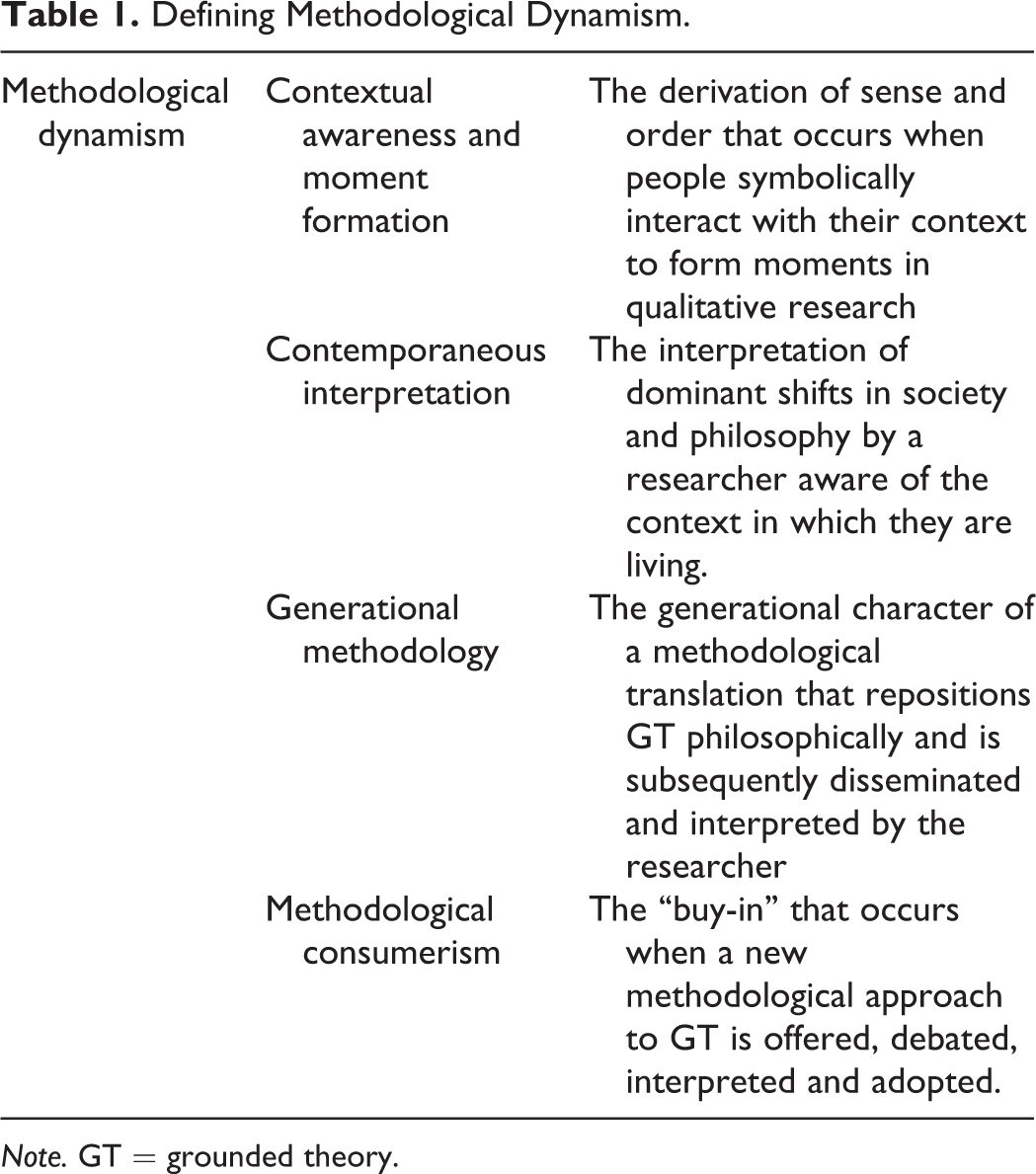
Note. GT = grounded theory.
Contextual Awareness and Moment Formation
Contextual awareness results from individuals responding to broad societal shifts that influence contemporaneous thinking and contribute to the formation of philosophical interpretations of GT. Such shifts set the scene for the methodological dynamism of GT in that informants of context—real-world events—influence the hegemony of academic thought, giving rise to the formation of moments in research.
An awareness of context influences the formation of moments in research in the all-pervading context of symbolic interactionism. In demonstrating this point, we must examine GT contextually. The ebb and flow of moments in research in the context of historical change is a noted phenomenon that must be understood in order to comprehend the varying interpretations of certain elements within GT (Annells, 1997b; Birks & Mills, 2011). Although we contend that the essential methods of GT have endured the tests of time, its history is complex, and “like most difficult subjects, it is best understood historically” (Suddaby, 2006, p. 633). According to Denzin and Lincoln (2011), research, and thus GT, can be viewed in seven “moments” that came to prominence in a specific period and continue to overlap and operate simultaneously in the present: namely, traditionalism (1900–1950), modernism (1950–1970), blurred genres (1970–1986), the crisis of representation (1986–1990), postmodernism (1990–1995), postexperimental inquiry (1995–2000), and the methodologically contested present (2000–2010). These moments represent the emergence of particular philosophies or paradigms throughout history. As the underlying assumption of GT is that people make sense of and order their social world (McCann & Clark, 2003), so too is the relationship between contextual awareness and moment formation. For example, the moment of traditionalism is colored by the rise in Victorian positivism with its objectivist absolutes placing priorities on rigor in research (Anger, 2001). Similarly, ructions in American culture gave rise to the moment of blurred genres, as researchers questioned their position in society as well as their position in texts (Birks & Mills, 2011). Consequently, sense and order are derived when people symbolically interact with broad philosophical paradigms to form moments in qualitative research.
Therefore, a relationship between contextual awareness and moment formation appears to be the product of symbolic interactionism, as researchers interpret social forces and employ newly formed perspectives in the context of GT research. This point leads to the concept of contemporaneous interpretation in the context of methodological dynamism.
Contemporaneous Interpretation
Contemporaneous interpretation refers to the timing and nature of contextual and paradigmatic interpretation by researchers who contribute to the formation of moments in research. It is marked by the process of making philosophical sense of GT in a contemporaneous manner and is informed by broad, wide-ranging forces in society that occur over time. Contemporaneous interpretation is carried out with an awareness of the dominant context at play and how we symbolically interact with and are cognizant and conscious of such forces in relation to GT. The concept of macro influences on the social consciousness is not new, as Yuginovich (2000) argues that historically, social paradigms are a stronger force than language in the molding of social consciousness.
The unfolding of contemporaneous interpretation in GT methodology can be seen in the context of concurrent developments in contextual awareness and moment formation. If we observe movements in the work of Strauss and Corbin (1990, 1994), we note they shift from postpositivism to constructivism over time. Given their work occurred during the transition from the moment of blurred genres (1970–1986), to the crisis of representation (1986–1990), to the moment of postmodernism (1990–1995), and finally to postexperimental inquiry (1995–2000), it is interesting to note the congruency between the characteristics of the dominant philosophical paradigm of the moment and developments in GT methodology. Such congruency is evidence of contemporaneous interpretation occurring, as researchers are contemporaneously interpreting their context in a moment of time and translating its meaning to GT methodology.
For instance, the moments of blurred genres and the crisis of representation are typified by relativistic postpositivism in that Strauss and Corbin’s early work outlines a prescriptive method in order to limit the biases of the researcher and foster a more reflexive approach (Denzin & Lincoln, 2011). As the moments of postmodernism and postexperimental inquiry are ushered in—periods characterized by constructivist thought—Strauss and Corbin (1994) and Charmaz (2000) explore constructivism and its relationship to GT (Birks & Mills, 2011). It is noteworthy that Charmaz constructs an approach that incorporates positivist methods with a postpositivist approach while remaining cognizant of the researcher’s position in relation to the text and their research subjects (Charmaz, 2006). Furthermore, Charmaz’s focus is implicit of the importance of reflexivity when theory is being developed (Birks & Mills, 2011). Ironically, Charmaz’s approach is a construction of the defining elements of different moments in research evident in the positivism of traditionalism, the postpositivism of modernism, the position of the researcher in blurred genres and crisis of representation moments, the pragmatism of the postmodernism moment, and the multiplicity of philosophical frameworks as represented by the moment of postexperimental inquiry.
These examples demonstrate how contemporaneous philosophies are aligned and applied to form new interpretations of GT methodology. In effect, contemporaneous interpretation is an active process in which ontological and epistemological standpoints are interpreted and reinterpreted over time by grounded theorists situated in the dynamic of shifts in society and philosophy. Moments color the grounded theorist’s perspective, and they are influenced by broad shifts of context and respond by adopting a congruent philosophical standpoint. Contemporaneous interpretation is fundamental to the formation of new methodological approaches to GT, and thus we observe the importance of methodological dissemination and interpretation—an event that establishes a generational methodology.
Generational Methodology
Even at first glance, GT is a methodology of generations. Each generation is characterized by a particular methodological translation that repositions GT philosophically and is subsequently disseminated and interpreted by the researcher. For example, classic or Glaserian GT characterizes the first generation in the same manner that constructivist GT marks the second generation.
There is an ongoing perception that seminal texts produced by first-generation grounded theorists contain methodological gaps that have seen subsequent generations of grounded theorists arrive at certain philosophical perspectives for the purpose of planning and executing a course of study (Birks & Mills, 2011). The researchers who addressed these gaps are referred to as second-generation grounded theorists, a label attached to those who identified with a body of students operating under the guidance—either directly or indirectly—of Barney Glaser and Anselm Strauss (Morse et al., 2009). Despite Glaser and Strauss’ resolve, original texts remained largely silent on the methodology of GT. This silence is tacitly indicative of the fact that GT is not prescient of future ontological and epistemological perspectives.
Voltaire, a French philosopher and historian, is purported to have said “history should be written as philosophy” (Dingle, 2000, p. 244), as the cultivation of dominant philosophical paradigms and the progression of social history are indelibly intertwined. The absence of ontological and epistemological perspectives in first-generation texts is representative of a true focus on emergence as to have it otherwise may force a philosophical standpoint onto future GT studies. To bind future generations to modernist philosophy potentially restricts the translational impact of GT, as it would anchor it to antiquarian schools of thought rather than leaving it subject to philosophical influences over time. Nonetheless, the anchoring force of Glaser’s perspective is in our view valuable, as his prolific writings on classic GT offer a constant platform of reference for subsequent generations. Glaser has been largely constant, in spite of the evolution of GT propelled by these generations. Second-generation grounded theorists have been influential in filling in what they perceive to be methodological gaps left by the first-generation by using the early work of Glaser and Strauss as a reference point for their own interpretations of grounded theory (Birks & Mills, 2011). It is this process of “filling in” that defines a generational methodology as it gives fit and form to a new methodological approach in GT and enables it to be subject to the process of methodological consumerism.
The role of generations as interpreters of the contemporaneous interpretation is pivotal to the development of methodological understanding, as individuals have interpreted new formations of GT methodology in their own context. It is thus the role of the third-generation to stand on the shoulders of giants and translate, interpret, and debate the works of the first- and second-generation in order to arrive at a contemporaneous understanding of GT. As such, the first-generation grounded theorists, such as Glaser and Strauss, can be viewed as custodians of its infancy, responsible for its birth, and nurture in the same manner that second-generation grounded theorists carried it through its childhood and encouraged its growth. GT is now potentially situated before third-generation researchers who wrestle with questions regarding a methodology in adolescence, trying to establish its identity in the grand scheme of methodology, philosophy, and inquiry.
Methodological Consumerism
We view methodological consumerism as the final phase of methodological dynamism. The defining feature of methodological consumerism is the “buy-in” that occurs when a new methodological approach to GT is offered, debated, interpreted, and adopted. In aid of illustrating this point, it is remarkable to note that Denzin and Lincoln (2011) suggest that newcomers from traditionally quantitative fields were attracted to GT as a result of Strauss and Corbin’s (1990) cookbook approach for conducting analysis. The subtext of this situation is that quantitative researchers were drawn to GT because it was morphing into a recipe for conducting research with which they were familiar. Such uptake demonstrates methodological consumerism in action and highlights the power that contemporaneous interpretation has on this process.
Even the discovery of GT itself harkens to the idea of methodological consumerism It is well reported that Glaser and Strauss—two men with epistemological assumptions embedded in sociological theory and influenced by symbolic interactionism—moved to counter the influence of quantitative positivist science by “discovering” GT (Benoliel, 2001; Suddaby, 2006). Their original paradigmatic position was postpositivist (Annells, 1997a; Benoliel, 2001), a stance that reflected the essence of the second moment of qualitative research. This stance was representative of the newly powerful paradigm for inquiry of the time (Benoliel, 2001; Denzin & Lincoln, 2011) and established a context in which The Discovery of Grounded Theory would become one of the most widely used methodologies in research. These events highlight methodological consumerism in action as Glaser and Strauss articulated an approach to research that suited the philosophical shifts of the time.
It is the symbolic interactionism between context, moment formation, contemporaneous interpretations, and grounded theorists everywhere that knits consensus in a somewhat serendipitous way to bring a methodology to the point where it is ready to be consumed “en masse.” This process demonstrates the macro level at which methodological consumerism occurs. Thus, without the occurrence of methodological consumerism, the nuances of variant GT methodologies are not disseminated, therefore not discussed, and consequently not consumed. At its most extrapolated level, methodological consumerism is about allowing the processes of methodological dynamism (see Figure 2) to occur in order to reach an understanding of how to employ GT methodology in one’s own research.

The process of methodological dynamism.
Conclusion
The methodological dynamism of GT is an appropriate means of observing and explaining both how and why it has changed since its inception. In many respects, the constancy and flexibility of how its essential methods are applied, albeit in different ways, still appeal to Glaser and Strauss’ goals of discovering theory in a systematic manner. GT’s essential methods establish a systematic approach for those wishing to produce GT while allowing researchers the room to apply their interpretations in different ways. Although variations in how GT is used clearly exist, the implication is that GT is dynamic because of its differences in philosophical standpoints within its monolith. In this dynamic state, GT responds to social pressures, changes over time, and adapts to the moment in which it is used. This adaptation is represented by methodological dynamism—a process informed by symbolic interactionism in which generations of researchers contemporaneously interact with their context, moments are formed, and prevailing and personal philosophical perspectives are translated into products of research.
Footnotes
Declaration of Conflicting Interests
The author(s) declared no potential conflicts of interest with respect to the research, authorship, and/or publication of this article.
Funding
The author(s) received no financial support for the research, authorship, and/or publication of this article.