




Abstract
The application of both Indigenous and Western knowledge systems in research may provide a well-rounded understanding of health, illness, and wellbeing for Indigenous communities in colonised societies. While many researchers have used a dual approach to researching Indigenous communities in colonised societies, tensions continue to exist around the use of Indigenous and Western ways of knowing together. There are also ongoing tensions between Indigenous methodologies and ethics processes rooted in Western understandings of research. Kaupapa Māori research is an Indigenous Māori approach to research that is about being Māori, is connected to Māori philosophy, culture and knowledge, and centres priorities for Māori. Grounded theory is a Western scientific approach to produce a theory grounded in qualitative data. This paper presents a novice researcher’s reflections on using kaupapa Māori research and grounded theory to explore the relational aspects of acute health care in Aotearoa, New Zealand. The research design attempts to utilise the ethics of kaupapa Māori research and the essential methods of grounded theory to develop a research approach that is robust and culturally appropriate. Conforming to conventional Western science-based research methods while endeavouring to privilege Indigenous realities is challenging and, at times, impossible. However, grounded theory can be flexible enough to adapt to the ethics of kaupapa Māori research. Research at the interface between Indigenous and Western knowledge systems presents opportunities for innovation in research design and can provide an ethical foundation for conducting research with Indigenous communities.
Keywords
Introduction
Indigenous and Western research approaches are rooted in distinctive philosophies and methodologies. Western research approaches, which have dominated research globally, often disregard Indigenous knowledge as credible and valid (Smith, 2022). However, Indigenous scholars internationally are critiquing the dominance of Western paradigms and reclaiming Indigenous knowledge systems (Brayboy et al., 2012; Cyganik, 2017; Held, 2019; Hiha, 2016; Reid et al., 2017). At the same time, ethics committees and university support services are biased towards Western research approaches, leaving an ill-defined ethical space for novice Indigenous researchers to navigate (Held, 2019). For many Indigenous scholars, the goal of reclaiming Indigenous knowledge systems in health research is to divest Western science as the absolute truth and to disrupt the institutional racism that exists in academia (Bourque Bearskin, 2023; Came et al., 2021; Cyganik, 2017; Smith, 2022; Sunseri, 2007). Indigenous led research aims to revive Indigenous epistemologies and ontologies and reframe Indigenous peoples from being the subject of research to being contributors to co-creating new Indigenous knowledge (Bourque Bearskin, 2023; Came et al., 2021; Cyganik, 2017; Smith, 2022; Sunseri, 2007).
There is increasing evidence in health research globally that the application of both Indigenous and Western knowledge systems may provide a well-rounded understanding of health, illness, and wellbeing for Indigenous communities living in colonised societies (Durie, 2004; Massey & Kirk, 2015; Quinn, 2022; Ryder et al., 2020; Singh & Major, 2017; Wepa & Wilson, 2019; Wilson et al., 2022). For example, in the Aotearoa, New Zealand context, Wilson et al. (2022) drew on kaupapa Māori research methodology and grounded theory to generate an explanation of how Māori women keep safe in unsafe relationships. Wepa and Wilson (2019) also used this dual approach to develop a theory to explain the processes Māori whānau (family group) use when engaging with healthcare services. Internationally, Ryder et al. (2020) found that weaving Indigenous and Western research methodologies to explore burns among Aboriginal and Torres Strait Islander communities provided an innovative, respectful, culturally safe, and ethical methodology. First Nation researchers used the Two-Eyed Seeing approach to emphasise community and participant involvement and ensure data were not misinterpreted by non-Indigenous researchers (Jeffery et al., 2021). Sarmiento et al. (2020) used intercultural dialogue to bridge Western and Indigenous knowledge to address poor maternal health in Guerrero, Mexico.
This paper discusses how the lead author used Indigenous kaupapa Māori research and grounded theory to explore relational practice in acute healthcare. This paper does not intend to report on the findings but rather discuss research at the interface between Indigenous Māori and Western methodology from a novice researcher’s perspective. We have used the Standards for Reporting Qualitative Research (SRQR) to guide writing this paper. Sharing these insights adds to the growing body of knowledge that seeks to understand the intersections in applying Indigenous and Western knowledge systems in research to promote Indigenisation within academia. We also highlight the tensions experienced between Indigenous methodologies and ethics processes rooted in Western understandings of research. While some of the tensions identified are common to all researchers working at the interface of Western and Indigenous knowledge, many have occurred because the lead author is a novice researcher who identifies as an Indigenous Māori and Pākehā (New Zealander of European descent).
The reflective nature of this paper necessitates an introduction of the authors, particularly the lead author, BP. We will then outline the philosophical differences between Western and Indigenous Māori knowledge systems, explicitly referring to kaupapa Māori research and grounded theory. The paper will discuss how we identified opportunities for using both approaches and the tensions found along the way. Māori words and phrases are used throughout this paper. These will be translated in parenthesis and explained further in the glossary of Māori terms (see Table 2).
Who are We?
Lead Author
The lead author, Bobbie Pene (BP), is a Māori (Indigenous person to Aotearoa, New Zealand) from Ngāi Tūhoe Iwi (tribal group) and Pākehā (New Zealander of European descent) Registered Nurse. Her upbringing privileged the Pākehā worldview, so Māori culture was not emphasised or encouraged in day-to-day life. Embarking on a PhD and Māori-centred research (Hudson et al., 2010; Smith, 2022) is as much a personal journey of learning and reclaiming what it is to be Māori as it is an academic journey. Her research interests lie in exploring healthcare delivery experiences and have led her to study relational practice from an Indigenous Māori perspective in fulfilment of a PhD in Nursing. BP is also a researcher in the Fundamentals of Care research group, bringing an Indigenous lens to the group. Her positioning within this study is that of Māori, Pākehā, mother, grandmother, researcher, student, nurse, and community member.
Co-Authors
Authors MG, TC, and JS are BP’s supervisors and have been integral in shaping this study. JS is Pākehā (European descent), originally from London, England. She is a nurse, Associate Professor, and the head of the School of Nursing at the University of Auckland. JS is the primary supervisor for BP and a nurse academic passionate about patient care. She is also a researcher in the Fundamentals of Care research group. MG is English and Welsh and has lived with her husband and two children in Aotearoa, New Zealand, for 15 years. She is a critical social scientist who co-directs the Te Ārai Palliative Care and End of Life Research Group with Dr. Tess Moeke-Maxwell, Ngā Tai, Ngāti Porou iwi (tribal groups), and with support from Te Ārai Kāhui Kaumātua (Māori Elder Advisory Group). TC is an Indigenous woman from Ngāpuhi, Ngati Wai and Ngāti Whātua ki Kaipara iwi (tribal groups). She is a nurse, a professor, a mother and has a physical disability. TC works in child and youth wellbeing, Māori health, mental health, public health, and social inequities. TC utilises a range of qualitative and quantitative research methodologies with a kaupapa Māori lens.
Indigenous Māori of Aotearoa, New Zealand
Māori are the Indigenous people of Aotearoa, New Zealand. Like many Indigenous cultures globally, we were impacted by colonisation, resulting in the loss of language, culture, and land, population decline, and a decline in health and wellbeing (Durie, 2004). Pre-European settlement, Māori social structure was a collective kinship structure. At the heart of Māori culture is our connectedness to the spiritual realm, the sacredness and vitality of all things, and reciprocal relationships (Henry & Pene, 2001). These ethics of Māori culture inform Māori ontology and epistemology about what is real and true for Māori (Hikuroa, 2017). Mātauranga Māori describes the knowledge system of Māori and underpins how knowledge is organised, understood, and passed on. Traditionally, some knowledge was available to all people for day-to-day activities. Specific knowledge was protected and had cultural restrictions that determined who could know and use it, such as rongoā (Māori medicine) (Walker et al., 2006).
Historically, research was done “to” and not “with” Māori by researchers who were predominantly non-Māori (Bishop, 1999). This resulted in research that prioritised the interests of researchers with little regard for the participants, misconstruing or misappropriating understandings of Māori knowledge and perpetuating the colonial superiority and gaze. Regarding Māori health and wellbeing, acute hospital care has presented many challenges regarding access, suboptimal care and communication, discrimination, and racism (Graham & Masters‐Awatere, 2020; Pene et al., 2021; Thomas et al., 2022). The ongoing process of colonisation and its adverse impacts on Māori and our assumptions as Māori and non-Māori researchers, academics, and healthcare professionals have been carefully considered in developing and conducting this study.
When we started exploring kaupapa Māori research in the context of this study, the contentions associated with who can do kaupapa Māori research came to light. Our team is not exclusively Māori, and we don’t speak te reo Māori (Māori language) fluently or have the traditional Māori cultural knowledge. Does this mean we shouldn’t use kaupapa Māori research to explore our research question? Smith (2022) suggests the answers to these questions are complex and depend on how kaupapa Māori research is interpreted. Smith proposes that some interpretations of kaupapa Māori research state that it is exclusively for Māori and initiated by Māori communities and not within Western academic institutions, while other perspectives leave space for novice Māori researchers and non-Māori involvement (but not leadership by non-Māori). As a novice researcher with growing traditional Māori knowledge and a mixed Māori and non-Māori supervisory team, BP felt it was not ethically or culturally appropriate to use kaupapa Māori research exclusively. However, she wanted to develop an approach that centres a Māori worldview and is respectful, reciprocal, and beneficial to those involved in the study. Whilst her supervisors supported her in developing the research design, all decisions about the study sat with BP.
Philosophical Orientations of Western and Indigenous Māori Knowledge
In Western science, ontological positioning is concerned with proof that something exists (quantitative) or the how and why of the situation being studied (qualitative) (Al-Ababneh, 2020). Epistemology considers the nature of knowledge and how we know what we know. In Western science, quantitative research generates knowledge deductively by testing existing theories or hypotheses, and qualitative research generates knowledge inductively from the data to generate a theory or understand an experience (Al-Ababneh, 2020). Inherently different to Western philosophy, the foundations of Māori philosophy are language, culture, ways of knowing, and discourses about the relationships between people, things, the environment, and the world (Stewart, 2021). Māori philosophy centres around pūrākau (traditional narratives) of identity and the essential knowledge systems for collective survival and welfare. Mātauranga Māori (Māori knowledge) originates from Māori ancestors and encompasses whakapapa (genealogical framework), tikanga (social practices), manaaki (hospitality), pūrākau (traditional narratives), maramataka (Māori lunar calendar), and taonga tuku iho Māori (treasured artefacts and heritage) (Hikuroa, 2017). Like Western science, mātauranga Māori incorporates observation and inductive and deductive reasoning. For example, maramataka (Māori lunar calendar) was developed over centuries of critically analysed and tested hypotheses, predictions and observations about the moon’s orbit around the Earth and how it impacted activities such as fishing and planting, gathering, and harvesting of kai (food) (Hikuroa, 2017).
Kaupapa Māori Research
Kaupapa Māori is embedded in Māori culture and means the “Māori way” of intuitively doing, being and thinking within a Māori worldview (Henry & Pene, 2001). Kaupapa Māori research emerged to challenge the dominant Western research approaches and legitimise Māori knowledge systems and research methods (Bishop, 1999; Smith, 2022; Walker et al., 2006). There is an emphasis in the literature on the emancipatory intent of kaupapa Māori research (Mahuika, 2008; Mikahere-Hall, 2017; Moyle, 2014; Walker et al., 2006). Bishop (1999) and Smith (2022) lay the foundation for kaupapa Māori research and are proponents of a decolonising approach to research Māori perspectives. However, while a decolonising approach aims to restore social justice, sovereignty and self-determination, it can also unintentionally reinforce the very colonial systems it seeks to emancipate Indigenous people from (Barnes, 2018). Barnes (2018) argues that aligning Indigenous paradigms with postcolonial epistemology and ontology simplifies complex Indigenous knowledge systems. Barnes also contends that decolonising research methodologies are complex and often ill-defined and may misrepresent the lived experiences and knowledge of the communities they intend to give voice to. However, there is agreement that decolonising research is less about the actual methods used and more about the ethics around how research is considered and conducted (Datta, 2018; Hiha, 2016; Lipscombe et al., 2021; Walker et al., 2006; Zavala, 2013). More recently, academics have used kaupapa Māori with Western research approaches to generate new knowledge within the context of being Māori in a colonised society (Brewer et al., 2014; Edwards, 2014; Hotu, 2021; Wepa & Wilson, 2019). This approach aligns with our intention to use kaupapa Māori as an ethical foundation for the study and grounded theory methods to develop a theory grounded in Indigenous Māori data.
Kaupapa Māori Research Principles and Practices.

Note. Adapted from Decolonizing methodologies: Research and Indigenous peoples (p. 136-137), by Smith, 2022, Bloomsbury Academic. Copyright 2021 by Linda Tuhiwai Smith.
Grounded Theory
Grounded theory is a Western approach to qualitative research that aims to produce a theory grounded in the data (Charmaz, 2014). It proposes a systematic, flexible, and iterative method for collecting and analysing data, which is why we chose it for this study. Grounded theory emerged when positivist quantitative research dominated scientific inquiry (Charmaz, 2014). It gave legitimacy to qualitative research methods, particularly in the healthcare context. Grounded theory has evolved through several paradigms from positivist, post-positivist, criticalist, postmodernist, constructivist, and, more recently, constructionist (Birks & Mills, 2023).
Constructionism has parallels with kaupapa Māori research because it emphasises the cultural, historical, contextual and social position of knowledge construction and reconstruction (Ward et al., 2015). Regardless of the philosophical position, Birks and Mills (2023) outline a standard set of methods they consider essential for a study to be grounded theory (see Figure 1). These will be discussed in greater detail. While providing a robust research structure, the grounded theory methods outlined in Figure 1 potentially offer the flexibility required to conduct the research respectfully and culturally appropriately and prioritise the participants’ voices. Essential grounded theory methods. Note. This figure illustrates each phase of the essential grounded theory methods. Adapted from Grounded theory: A practical guide (p. 19), by Birks & Mills, 2023, Sage. Copyright 2023 by Melanie Birks and Jane Mills.
Weaving Kaupapa Māori Research Principles With Grounded Theory Methods
Weaving is synonymous across Indigenous cultures and represents an inter-generational art form and a practical and purposeful practice intrinsically linked to Indigenous values, beliefs, and knowledge systems. Raranga (weaving) is considered a taonga tuku iho (treasured artefacts and heritage) by Māori (Te Kanawa, 2022). Weaving as a metaphor for the study design symbolises the distinctiveness of each approach and the complementary spaces where their methodological relationship can enhance the study.
Kaupapa Māori and grounded theory have been used in other studies (Edwards, 2014; Hotu, 2021; Wepa, 2016). Edwards (2014) found kaupapa Māori and constructivist grounded theory helped to explore how sensitive hegemonic and pedagogical concepts constrained Māori women to achieve optimal breastfeeding. Constructivist grounded theory provided structure to Hotu’s (2021) study of Māori with chronic airway disease, while kaupapa Māori added a critical lens. Wepa (2016) argued that the findings from kaupapa Māori with constructivist grounded theory would significantly benefit Māori who live at the interface of te ao Māori and a colonised community.
Drawson et al. (2017) argue that while Indigenous methods necessitate Indigenous methodologies, Indigenous methodologies can use Western methods, and how this is done should be determined by the Indigenous peoples involved in the research. Their view supports typical decolonising research approaches that centre Indigenous knowledge, values, practices and protocols (Datta, 2018; Lipscombe et al., 2021; Smith, 2022). The most critical aspect of weaving kaupapa Māori research principles and practices and grounded theory methods is to ensure that the study centres the Māori worldview and that the construction of the grounded theory is a collaboration between the researchers, the participants, and the people consulted with along the way. This relational approach is supported by Brayboy et al. (2012), who argue that Indigenous knowledge is inherently relational and subjective, so Indigenous research should be built on relationality, responsibility, respect, and reciprocity.
Guidance from the study site’s Kaimanaaki (Māori support staff) and BP’s PhD supervisors was essential. Kaimanaaki have and continue to provide advice and support to ensure the study aligns with the kaupapa Māori research principles and practices and local tikanga (social practices). They have also helped in recruiting participants. MG, TC, and JS have helped to unpack the complexities of navigating research and provide food for thought, allowing BP to work through some of the challenges. Figure two presents a conceptual model of how each study component supports the others. The grounded theory of relational care will be developed from Indigenous Māori thinking (philosophy) using the essential grounded theory methods (see Figure 1). The principles and practices of kaupapa Māori research (see Table 1) underpin the ethics and conduct of the study. (Figure 2) Conceptualisation of the proposed methodology.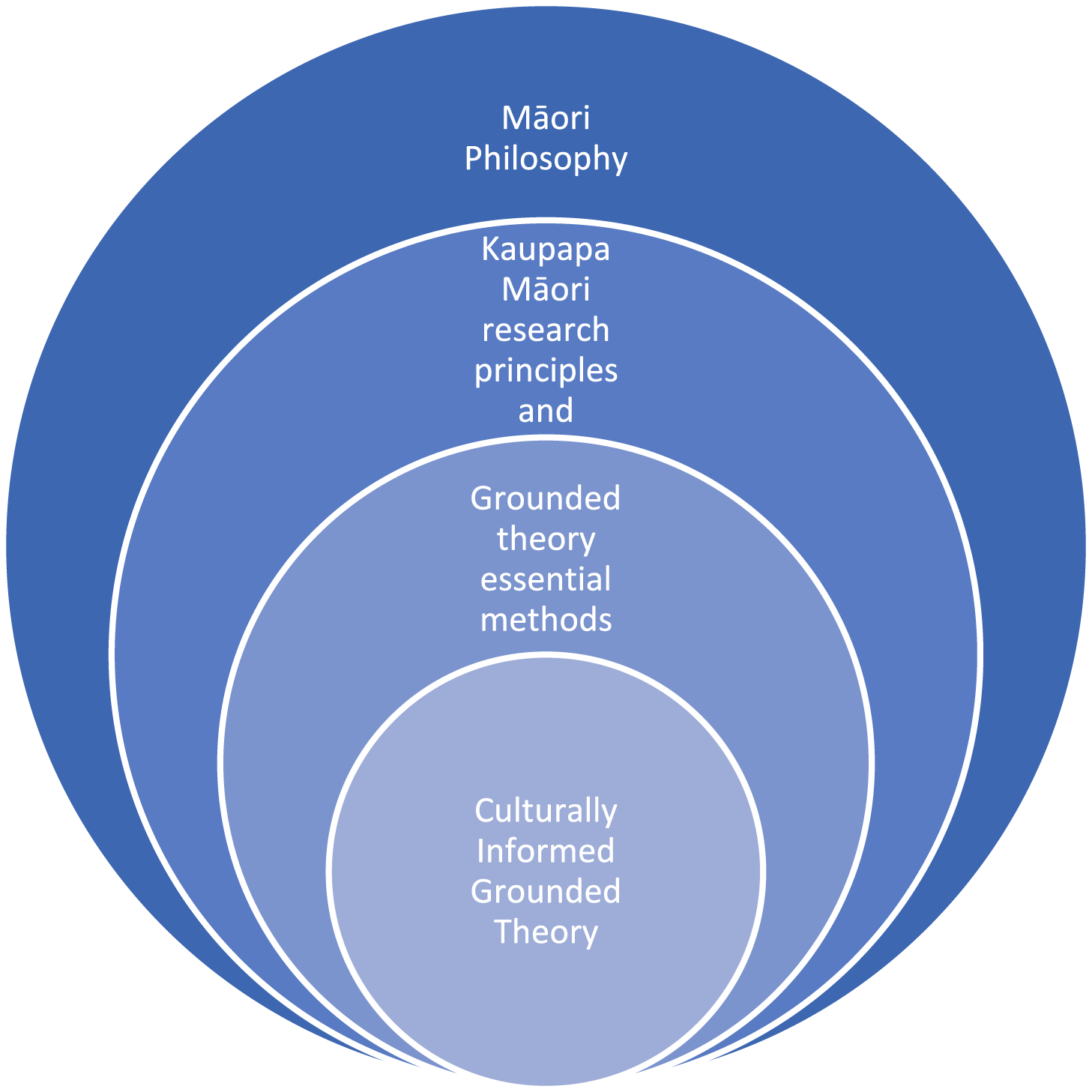
The following sections explain how we applied the kaupapa Māori and grounded theory principles, practices and methods to our study. The institutional ethics process will be discussed because this is where the most significant tensions were identified.
Applying the Kaupapa Māori Research Principles and Practices
Kaupapa Māori research principles offer an ethical and culturally specific framework to consider how the study was designed and conducted. We have drawn on several kaupapa Māori and other Indigenous scholars to interpret and apply these principles to the study. Although we present each principle separately, it is essential to acknowledge that they are interrelated and are not mutually exclusive.
Aroha Ki Te Tangata (a Respect for People)
We advocate for a participatory research process, as Bishop (1999) suggested, to promote self-determination and allow participants to define their terms of participation. Systematic review findings by Drawson et al. (2017) support this approach and indicate that a respectful and reciprocal research process involves the Indigenous community in consultation, data collection, analysis and dissemination of the results. Consultation with local Māori leaders ensured the study design was appropriate for the community, and tikanga (social practices) guided all research-related interactions. The study design allowed participants to be involved in data analysis and refinement of the culturally informed grounded theory. At times, adhering to the essential grounded theory methods was challenging because, in keeping with aroha ki te tangata, emphasis was placed on using a narrative approach that allowed participants to tell their stories in their ways. Baker and McGuinness (2009) state that establishing a research relationship with participants will enable them to maintain conceptual and interpretive control over the data throughout the research process. The authors contend it is the researcher’s responsibility to connect the data within participant stories to the study requirements.
Kanohi Kitea (Present Yourself to People Face to Face)
Traditionally, kanohi kitea refers to being physically present and meeting people face-to-face and emphasises the relational aspects of kaupapa Māori research. Bishop (1999) argues that establishing and maintaining research whānau (family group) relationships is integral to kaupapa Māori research. Smith (2022) claims that creating knowledge is based on the principles of relationships and connections that are initiated face-to-face and can then be maintained without direct contact. Kanohi kitea was implemented in several ways to offer different ways of connecting and engaging for all involved. Planning the research project with Kaimanaaki (Māori support staff) was primarily done kanohi ki te kanohi with email progress updates. A hui (meeting) will be planned to refine the grounded theory and co-create a set of recommendations for the organisation based on the findings. Recruitment of staff participants was done by email or word of mouth in the first instance and followed up by phone, email, or face-to-face. One interview was conducted using a video conferencing platform at the participant’s request. Patient and whānau (family group) participants were approached initially by Kaimanaaki (Māori support staff), who had pre-existing connections. We would have preferred a more relational approach to meet with participants kanohi ki te kanohi so they could get a feel for us and our study, but this is not considered appropriate by the institutional ethics committee. Two whānau (family group) interviews were conducted using a video conferencing platform at the participant’s request. We negotiated how much each participant wanted to participate in the data analysis and the best way to keep in contact.
Titiro, Whakarongo, Kōrero (Look, Listen, Then Speak)
In kaupapa Māori research, the researcher is the non-expert, and the participant is the expert (Smith, 2022). Hence, the researcher’s role is to look, listen and learn. We situated each participant interview within te ao Māori (Māori worldview) and allowed participants to share their stories the way they wanted. Respect and trust are developed when participants are given the space to tell their stories and the researcher shows a genuine interest to understand and learn from their story (Pipi et al., 2004). Interest and understanding are demonstrated through eye contact, affirmations to acknowledge or support what is being said, and questioning or paraphrasing to clarify understanding. Sometimes, the researcher may be expected to share personal information to develop trust and the research whānau (family group) relationship. This is considered inappropriate by the institutional ethics committee, which advocates for an “us” and “them” relationship (Tauri, 2014). Applying this principle respectfully centres the study participants and gives them uninterrupted space to contribute their whakaaro (thoughts, opinions, ideas).
Manaaki Ki Te Tangata (Share and Host People, be Generous)
Manaaki ki te tangata ensures a collaborative and reciprocal research approach and participants’ comfort and wellbeing (Pipi et al., 2004). As researchers in a kaupapa Māori space, we prioritised relational accountability (Vaeau & Trundle, 2020). Our participants are invested in the outcomes of this study, and we have a responsibility to ensure they are valued and cared for during the research process and that their stories are disseminated for the betterment of their community. This is expressed in various ways that privilege Māori preferences, norms and practices and demonstrate respect for tikanga (social practices) and people (Walker et al., 2006). For example, we used a process similar to the Hui Process (Al-Busaidi et al., 2018) to ease all involved in the interview process. We began each interview with karakia (prayer), then engaged in whakawhanaungatanga (the process of establishing relationships), and discussed the whakapapa (history) of the research project. As the host, kai (food) was offered, and tikanga (social practices) were maintained. Time and commitment to participating in the research were acknowledged with a koha (gift). Each interview closed with karakia.
Manaaki ki te tangata is also about ensuring participants exercise tino rangatiratanga (autonomy and self-determination) over their contributions to the study. As mentioned earlier, transcripts were returned to participants to ensure their stories were accurately captured, and they were contacted during data analysis to clarify concepts emerging in the data. A storyline was constructed from the data for participants to refine and affirm it reflected their kōrero (story) and whakaaro (thoughts). Participant involvement in data analysis and theory generation is considered unnecessary in grounded theory because of the high analytical abstraction produced by the grounded theory methods (Birks & Mills, 2023; Charmaz, 2014). This claim is at odds with kaupapa Māori research principles and practices and the collective responsibility of Māori processes. Adherence to the grounded theory methods, in this instance, could disrupt the power balance between the researcher and participants and diminish the relationality of the study. We chose to prioritise manaaki ki te tangata.
Kia Tūpato (Be Cautious)
On the researcher’s part, kia tūpato is about understanding the power dynamics, being culturally safe, being reflexive about our positioning as insider/outsider and ensuring we fulfilled our collective responsibility to Māori (MG, JS) and as Māori (BP, TC) (Pipi et al., 2004; Smith, 2022). For the participants, kia tūpato is about respecting and protecting their wairua (spirit), acknowledging intergenerational trauma, and mistrust in research and healthcare services. All participants spoke of intergenerational trauma and previous bad experiences in healthcare. Ensuring the participants maintained control over what and how they shared their stories was vital. This was facilitated through a whanaungatanga (meaningful relationships) approach to our engagements that fostered connectedness, trust, respect, and aroha (compassion). Caution was exercised to maintain the integrity of kaupapa Māori and grounded theory during the study. The tensions associated with this principle were around ensuring one approach did not infringe on the other and noting when they did.
Kaua e Takahia Te Mana o Te Tangata (Do Not Trample on the Mana of People)
Mana is a principle that is not easily described in English. Its most straightforward translation refers to the spiritual prestige, power, control, and authority in a person, place, or object (Moorfield, 2011). In kaupapa Māori research, this principle concerns how we whakamana (empower, uplift, value) participants. The foundations for conducting this study were considered carefully and discussed over many months with Kaimanaaki (Māori support staff) to ensure all processes were culturally informed and appropriate. Our priorities for ensuring the mana of our participants were uplifted were to ensure self-determination and Māori cultural values, processes and actions were maintained. Our responsibility was to ensure that participants were fully informed about every aspect of the study and involved in refining and endorsing the final grounded theory for dissemination. This principle added a relational approach to the study and ensured the participants’ priorities were at the forefront of all research activities.
Kia Māhaki (Don’t Flaunt Your Knowledge)
Demonstrating respect and humbleness are essential qualities of kia māhaki. As Walker et al. (2006) state, in kaupapa Māori research, the researcher is the non-expert and in alignment with the principle titiro, whakarongo, kōrero, is the one to ‘look, listen, and learn’. In te ao Māori (Māori worldview), the idea of collectivism on our part as healthcare leaders and researchers is to resist flaunting our knowledge and achievements and to serve our research whānau (family group) and community interests and priorities (Roche et al., 2018). The culturally informed grounded theory that develops out of this study will be a collaboration of minds, and we, as researchers, won’t own the grounded theory generated from this project; we will be its kaitiaki (custodian). We can benefit the community through the knowledge, expertise, and experiences that our participants have shared. Once again, this relational and inclusive approach to generating an Indigenous Māori grounded theory is at odds with Charmaz (2014) and Birks and Mills (2023), who refute the need for participant involvement in data analysis and theory development.
Te Tiriti o Waitangi (Aotearoa New Zealand’s Treaty)
Aotearoa, New Zealand, has one Treaty and two documents, te Tiriti o Waitangi and the Treaty of Waitangi. Te Tiriti is the reo Māori (Māori language) document, and the Treaty is English. They are not versions of each other, as each text is fundamentally different. Most Rangatira (Chiefs) signed te Tiriti. Drafted by the British Crown, the contra proferentem rule favours te Tiriti over the Treaty. He Whakaputanga (declaration of independence) preceded Te Tiriti o Waitangi in 1835 and asserted Māori rights and sovereignty in respect of the lawmaking powers over their land to safeguard Māori at a time when European contact challenged the Māori way of life (Mulholland & Tawhai, 2011). These documents highlight the pre-existing sovereignty and rights of Māori.
While not included in Smith’s (2022) kaupapa Māori research principles and practices, te Tiriti o Waitangi is essential because it offers a framework to ensure that the individual and collective rights of Māori are respected and protected and that the study addresses issues of importance to Māori (Hudson et al., 2010; Reid et al., 2017). Enacting the original intentions of Te Tiriti and He Whakaputanga in this study recognises the importance of relationships and connectedness, partnership, and self-determination. It values mātauranga (Māori knowledge) and tikanga (social practices), and it accords Māori the right to influence policy and practice change in acute healthcare. Framing this study within te Tiriti o Waitangi recognises the rights and priorities of all Māori involved and acknowledges the support provided by non-Māori engaged in this study.
Applying the Essential Grounded Theory Methods
Birks and Mills’ (2023) essential grounded theory methods outlined below give structure for collecting and analysing the data to develop the grounded theory.
Initial Coding and Categorisation of Data
Codes represent the data’s similarities, patterns or conceptual reoccurrences (Birks & Mills, 2023). Categorising the most significant or frequent codes helps to conceptualise the developing theory and identify the centrality of certain concepts. Charmaz (2014) is a proponent of the heuristic method of coding with gerunds to define implicit meanings and actions from the participants’ perspective. While not a tension per se, gerunds were novel to us and understanding how Māori words function as gerunds more so. For example, two Māori words used frequently by participants were whakawhanaungatanga (the process of establishing relationships) and manaakitanga (showing respect, generosity, and care). Manaaki is a Māori verb that means to show respect, generosity, and care. Whakawhanaunga is a Māori verb that essentially means to have a relationship. Adding the suffix -tanga to these words turns the verbs whakawhanaungatanga and manaakitanga into a noun, thus indicating the action or process. The importance of understanding the linguistics of the Māori language became explicit as we worked through the essential grounded theory methods. For example, two in-vivo (participant quote) codes were “making people feel welcome” and “making connections”, which are also gerunds. These became categories under which the processes “whakawhanaungatanga” and “manaakitanga” sat.
Concurrent Data Generation or Collection and Analysis
In typical grounded theory, the process of recruitment, data collection and analysis are cyclical, whereby the researcher purposively samples a participant and collects some data, then analyses and codes this data before repeating the process. While we attempted to stick to this method, the logistics of recruiting participants and their availability meant that, at times, we had multiple participant interviews in a week, without time between each to transcribe and analyse data. This deviation in grounded theory methods prevented theoretical sampling to pursue angles of inquiry that arose during data analysis. To offset the deviation from this method, we negotiated with participants to contact them for further information or clarification. Providing participants with a copy of their transcript aided this because some used the transcripts to clarify and build on the concepts they discussed during our interview. Candela (2019) supports a more flexible and relational approach to data collection and analysis because it fosters collaboration and trust between the researcher and participant, enhances the participant’s narrative and strengthens the analysis process.
Writing Memos
Memo writing involves noting processes, thoughts, feelings, analytical insights, decisions, and ideas about the study (Birks & Mills, 2023). Memos recorded BP’s reflections as a novice researcher, the nuances in engagements with participants, the recording of processes, and general thoughts and feelings regarding the study. Memos were used extensively while coding data to describe initial impressions and to document questions that developed from the data. Memo writing complemented the kaupapa Māori research principles because it enabled attentiveness during participant engagements. It also provided an avenue to reflect on and question methods and processes so we could adapt and develop the study, which Lipscombe et al. (2021) identified as imperative for decolonising research.
Theoretical Sampling
The premise of theoretical sampling is that clues will arise during concurrent data collection and analysis, and more information will be required to develop and saturate the categories (Birks & Mills, 2023). Birks and Mills (2023) state that strategically sampling data sources this way will meet the analytical needs of the study. Theoretical sampling presented a point of tension with kaupapa Māori research approaches, which have redefined the terms in which Māori participate in research (Smith, 2022). We took a flexible approach to how and when we recruited to the study in alignment with manaaki ki te tangata (share and host people, be generous). While we could not utilise theoretical sampling to recruit every participant, we took every opportunity to pursue clues in the existing data, which sometimes meant going back to participants with questions. Applying kaupapa Māori principles to the study meant allowing participants to share their experiences and priorities in their own way, which didn’t always align with the grounded theory processes or the clues in existing data. Birks and Mills (2023) acknowledge the impracticalities of strictly adhering to theoretical sampling and emphasise that producing a theory grounded in the data is what matters.
Constant Comparative Analysis
Constant comparative analysis requires comparing codes to codes, incidents to incidents and categories to categories (Birks & Mills, 2023). In essence, there is a constant comparison of existing data with newly acquired data that uses induction, deduction, and abduction during the analytical process. Data analysis moves back and forth between codes, incidents, and categories to understand them fully and their relationship to one another. This process is akin to using a whakapapa analytic framework that positions the participants’ narrative within conceptual and contextual interrelationships (Ware et al., 2018). While grounded theory uses terms such as property, dimension, and relationship to categorise and connect data, a whakapapa analytic framework links individual narratives and contextualises them within broader Māori concepts. For example, a narrative about making connections was contextualised within te ao Māori (Māori worldview) concepts of whakawhanaungatanga (the process of establishing relationships) and manaakitanga (showing respect, generosity, and care).
Constant comparative analysis between each interview was unfeasible when multiple engagements occurred within a short period. We adapted this process by giving transcripts to participants, maintaining contact with them, and allowing them to refine the developing theory. However, as mentioned earlier, Charmaz (2014) argues against participant involvement in data analysis and views member-checking as redundant because of the high analytical abstraction associated with grounded theory. We argue that involving participants at every stage maintains the relational approach to data collection and analysis that Candela (2019) describes. It is also essential when considering a kaupapa Māori approach because it fosters collaboration and trust between the researcher and participants, which historically has been overlooked (Bishop, 1999).
Theoretical Sensitivity
Birks and Mills (2023) describe theoretical sensitivity as “the ability to recognise and extract from the data elements that have relevance for a developing theory” (p. 17). The authors explain it as a two-part concept reflecting the researcher’s insight into themselves, their research area, and their intellectual history. Theoretical sensitivity increases as the researcher becomes immersed in the data. Theoretical sensitivity was complemented with a concept mapping approach akin to the whakapapa analytic framework (Ware et al., 2018). We used concept mapping during interviews to link individuals’ thoughts, then transcribed these to a larger concept map where individuals’ ideas were connected. Our concept map took eight iterations to develop a culturally grounded theory from the collective narratives.
Intermediate Coding
Intermediate coding connects sub-categories, developing them into complete categories, and reconnects data into more abstract conceptualisations. According to Birks and Mills (2023), the researcher moves between initial and intermediate coding during the data collection and analysis. This was not a tension point but a challenge to connect concepts in te reo Māori (Maori language) with concepts in English. Participants used Māori and English interchangeably in their kōrero (narrative), and words such as whanaungatanga (meaningful relationships) that comprise multiple concepts were described in English and Māori. Heaton (2018) describes this problem as the juxtaposition of Māori words with English concepts and cautions that misinterpretation and simplicity of translation may attenuate the richness of meaning. The juxtaposition is also evident as we write this paper and decide how best to translate Māori terms to English for the reader. As mentioned earlier, understanding the linguistics of te reo Māori is essential to making connections between Māori and English concepts. We used concept maps to connect Māori and English words and phrases within a te ao Māori (Māori worldview) lens.
Identifying a Core Category
Birks and Mills (2023) convey that this stage is achieved through full theoretical saturation of the core category, sub-categories, and their defined properties. Like the initial coding and categorising, identifying a core category requires the researcher to move between initial and intermediate coding, which is directed by theoretical sampling. Given the challenges identified with concurrent data generation, analysis, and theoretical sampling, this stage did not conform to the precise use of grounded theory methods. Like the other grounded theory components outlined, participant refinement is required to ensure the core category reflects their whakaaro (thoughts and ideas), which is at odds with the essential grounded theory methods but fits more comfortably with a kaupapa Māori approach.
Advanced Coding and Theoretical Integration
Advanced coding and theoretical integration provide the means to assist in amalgamating the final grounded theory. In previous studies, storylines and theoretical coding have been used to achieve theoretical integration (Birks & Mills, 2023). Birks and Mills suggest advanced coding offers flexibility and opportunities for innovation. While this process is in progress as this paper is written, we anticipate several modes of amalgamating the final grounded theory to suit the audiences we intend to disseminate. A storyline will be used to construct and convey the grounded theory to our participants and Kaimanaaki (Māori support staff). Storylines can be akin to pūrākau, the traditional form of Māori narrative used to present complex codified mātauranga Māori (Māori knowledge) in a way that is easy to understand (Hikuroa, 2017). Birks et al. (2009) advocate for a separate discussion outside of the storyline to explain the development of the theoretical concepts, which will be considered for broader dissemination to the academic community and the study site.
Institutional Research Ethics Boards
Current health research ethics structures in Aotearoa, New Zealand, are prescriptive and do not consider the collective and relational practices of Indigenous Māori (Tauri, 2014). For example, when sampling and recruiting for a study, health research ethics requires indirect methods for recruitment. As our topic suggests, connecting with people is central to Indigenous Māori. Participants may prefer to meet face to face to kōrero (discuss) about the research as an individual or a collective before deciding to participate. Participants may also choose to participate based on existing whanaungatanga (meaningful relationships) between the researchers, which is viewed by institutional research ethics boards as inappropriate and has a potential for power imbalance. Kovach (2010) argues that researchers must have trustworthiness for people to participate in the research. We believe the ethical boundaries we had to work within hindered the recruitment of patients and whānau because we could not develop the trusting relationship necessary for them to feel safe in sharing their stories for research. Some Māori staff were excluded from participating because the institutional research ethics committee deemed our relationship, albeit professional, a potential for a power imbalance.
Documentation such as the participant information sheet, the consent process, and the requirement to provide the interview questions are incongruent with the collective and relational intention of kaupapa Māori research principles and practices (Tauri, 2014). Providing a list of questions for ethics approval is also incongruent with the essential grounded theory methods because it hinders theoretical sampling. Having previously written research ethics applications, we knew the terminology and procedures required for ethical approval for this study. Giving ethics committees what they want to gain approval for research is sadly commonplace for Indigenous research and does nothing to decolonise the research ethics process (Tauri, 2014). It also undermines the researchers’ ethical and respectful intent for conducting research with Indigenous peoples, which is at odds with many of the kaupapa Māori principles and practices (Smith, 2022).
Discussion
The purpose of this paper was to discuss how a novice researcher in Aotearoa, New Zealand, has used Indigenous kaupapa Māori research and grounded theory to explore relational practice in acute healthcare. Planning this study raised several questions: what are the philosophical and methodological implications of weaving Indigenous and Western ways of knowing? Should researchers attempt to weave Indigenous and Western approaches, and how do we preserve the integrity of each? Research methodologies provide a rationale for the methods used to generate new knowledge and justify the researcher’s decisions and actions. Reflexively documenting the development of an approach that utilises Indigenous and Western ways of knowing has partly answered these questions and created more questions and challenges.
Tensions were experienced along the way, albeit primarily due to the immovable structures of the institutional research ethics committee. Despite having Māori representation in an attempt to consider Māori research methodologies, the institutional research ethics committee continue to perpetuate colonial ethics criteria. For example, recruiting participants directly by researchers may be seen as coercive under traditional ethics norms, but Māori participants often want to see and ‘get a feel’ for researchers first before they decide to participate. We feel a disservice has been done to Indigenous scholars, Māori research participants, and ourselves by structuring the ethics application and study design so that it would be approved with little resistance from the ethics committee. Tauri (2014) argues for the assessment of Indigenous research protocols by Indigenous people and against ethical standards generated by the Indigenous people themselves. Te Ara Tika (Hudson et al., 2010) guidelines were intended to provide a framework for ethics committee members to address Māori ethical issues; however, our institutional ethics committee falls short of having an exclusively Māori committee to assess Māori research proposals.
The essential grounded theory methods were relatively flexible. When tensions were experienced, we usually found ways to mitigate them, which Lipscombe et al. (2021) describe as having insight into adapting and developing a decolonising approach. Mitigation was not always possible; for example, the tension of allowing participant contribution to data analysis and refinement of the grounded theory conflicted with Charmaz (2014) and Birks and Mills (2023). In this instance, we prioritised collective ownership of the data and emerging theory over adhering strictly to the essential grounded theory methods. The premise of this research project is to centre the priorities for Māori and develop a theory grounded in Indigenous Māori data, which can only be done collectively and inclusively throughout the study.
Glossary of Māori Terms.

Note. Te Aka Māori-Dictionary was primarily used to develop this glossary. To listen to the pronunciation of Māori words and phrases, visit the Te Aka Māori Dictionary online. Adapted from Te Aka Māori Dictionary, by J. C. Moorfield, (https://maoridictionary.co.nz/). Copyright 2003–2024 by John C Moorfield.
Birks and Mills’ (2023) contemporary approach to grounded theory describes it as inherently flexible and argues the approaches are limitless. The level of analytical detail to be included in the final grounded theory varies depending on the audience and how the grounded theory will be presented. A storyline framework can be akin to pūrākau (traditional Māori narrative) and is an accepted narrative structure for conveying a grounded theory. Pūrākau has been used in contemporary contexts to convey cultural codes and better understand the experiences of Māori (Tiakiwai, 2015; Ware et al., 2018). It might be the best approach to stay true to the data and each research approach.
Weaving Indigenous and Western research approaches presents opportunities to expand knowledge and understanding in health research and, arguably, in other disciplines. It also delivers opportunities to Indigenise academia through methodological innovation. It is an iterative process that cannot be written in stone from the start and requires ongoing reflection, consultation with everyone involved, flexibility, and trust in the process. At the outset, our assumptions about the study were rigid. They focused on the methods and where they intersected, with little thought given to the greater potential for weaving Indigenous and Western approaches. Ryder et al. (2020) describe the intersecting points of weaving methodologies as the interface where mutual respect, shared benefits, human dignity, and discovery occur. Roche et al.’s (2018) self-determination theory suggests wellbeing is facilitated by collective autonomy that, in the context of research, is espoused by a kaupapa Māori approach. Ryder et al.’s description of the interface between Indigenous and Western methodologies becomes more apparent as we progress through this study. What do the points of intersection mean? Our experience with this study is that the intersecting spaces are not spaces where the approaches overlap but where they complement one another to enhance the research activities. It is a space where the two approaches challenge the status quo and influence innovation.
The politics of interpretation and application associated with kaupapa Māori research and grounded theory had BP second-guessing her ability as a novice researcher to develop a method of inquiry that would privilege the worldview of Indigenous Māori and satisfy scholarly critics. That is not to say scholars will not critique this approach. Grounded theory as a methodology has evolved since Glasser and Strauss’ seminal work in 1967 and will continue to evolve as researchers innovate their research approaches. Grounded theory offers structured yet flexible methods to generate and analyse data and construct a theory grounded in data. Kaupapa Māori research principles and practices are a respectful, reciprocal and relational approach to guide research conduct to ensure it is appropriate, centres the priorities for Māori, and protects their rights and interests. Will the final product be a grounded theory? Although we followed the grounded theory’s essential methods, flexibility and adaptability were necessary, as Birks and Mills (2023) advocate. Have we used the kaupapa Māori principles and practices appropriately? Only our participants can determine whether our approach to this study and them addressed the kaupapa Māori principles and practices.
Conclusion
This paper describes the development of a methodology that weaves Indigenous Māori and Western ways of knowing. The process has presented many challenges through reflexive transformation as a novice researcher and as Māori and non-Māori researchers. Kaupapa Māori research principles and practices provide an ethical foundation for conducting research with Indigenous Māori people. Grounded theory has evolved, and this study promotes the continued innovation of grounded theory design. Kaupapa Māori and grounded theory share complementary spaces in this research design and enhance the qualities of each other. Being reflexive, thinking innovatively, and being flexible in research design and execution mitigated some of the tensions experienced during this study. With a flexible approach, it is possible to weave Indigenous and Western research methodologies.
Footnotes
Acknowledgments
This review will contribute in part to a PhD in Nursing for the first author with support from the School of Nursing, The University of Auckland, New Zealand.
Declaration of Conflicting Interests
The author(s) declared no potential conflicts of interest with respect to the research, authorship, and/or publication of this article.
Funding
The author(s) disclosed receipt of the following financial support for the research, authorship, and/or publication of this article; This paper was funded with a Māori Health Clinical Research Training Fellowship HRC 22/253 from the Health Research Council of New Zealand.
