




Abstract
In my doctoral studies at the University of Bristol, I took part in an experimental process of free writing, and my paper begins with the short story that emerged from this. During the taught unit we discussed ethical dilemmas that might arise from writing as inquiry, and in the commentary that follows my story, I reflect on how this practice requires an awareness of care for self and others. I describe my process, and discuss how it allowed me to transcend my dominant voice and restructure some of my ideas about what I study. I propose that by writing fiction I was able to consider complex issues in a way that opened up multiple meanings for me, and offered different views into social experience. I was guided by my practice as a visual artist and inspired by the writings of Ursula Le Guin (2004), Miller Mair (1989), and Ronald Pelias (2004), who encouraged me to listen in an empathic way, and write from the heart.
That Winter
They had always wondered if she would go back to the sea. At least that's what they tell each other that winter. They keep a light in the window. It is too cold and dark to leave the curtains open as they had done in the late summer and autumn. They sit with them closed. Their minds crouched at the edge of the woods.
The people at the shore tell them that they saw the girl push her small blue boat into the water. The man looks at the ground and the woman looks straight ahead. They say nothing, and the tide sweeps in and out, laying its salty tongue on the sand.
A few summers ago, the man suggested they burn her boat. They imagined pulling it from the back of the barn and dragging it up the track to the top field.
It was just an idea. They left it quietly under the tarpaulin.
They imagine it again these dark nights. She would still be with them now, this side of the curtain. They shape their regret into memories that they can both bear, rewritten in dark waiting.
In the beginning, the shore people heaved their nets through the cold green water. Wrapped in the cords they found a tiny girl. The man and woman stepped up and said they would do their best to look after the castaway. There was a label tied around her wrist, but the sea had washed away the ink and they had to guess at the story that had been written there.
The girl clung to these new strangers like seaweed to the rocks. They kept their house warm, they baked and they brushed. They looked at their square brown hands and her long white fingers and wondered how they could ever make them match. The woman licked the girl over and over again, and always came away with the taste of salt on her tongue.
She carefully combed the child's long green hair.
‘I don't like looking back,’ said the girl.
‘What happens when you look back?’
‘It's dark.’
‘And tangled?’
‘Yes, and tangled. How did you know?’
‘I can see behind you.’
When spring came they built a small blue boat. They took it to the shore and the man and girl sailed on the water. The girl could feel the sea tugging behind her. She was wordless, sailing into a storm. From the beach the woman saw the rumbling clouds reflected in the girl's grey eyes. She waded into the water, the salt stinging her legs. She pulled the boat ashore, and wrapped her green jacket around the girl's shoulders.
‘I saw through my looking glass eye,’ said the girl.
‘What did you see?’
‘A map written on my bones.’
‘I pretended I could see it as well,’ said the woman to the man later, when they were alone.
Every morning they walked up the track and along the top field to school. The girl collected leaves and made little nests in the grass. At the end of the day the other children swarmed around the yard. The girl stood perfectly still, on the lookout. When she caught sight of the woman, she flew to her, wrapping her thin arms around the sturdy waist.
‘I thought you weren't coming.’
‘I will always come,’ said the woman.
‘When I look back there's empty sea.’
‘I know.’
‘Will I turn to salt?’
‘I don't know. Don't look back,’ said the woman, inadequate, as people are.
In the summer barn, tiny splinters of straw were held in the hot breath of sunlight coming through the open door. At the back of the barn it was dark. The wooden walls were thick with tar. The girl pressed her thumb into its sticky softness. She pulled the tarpaulin off her blue boat and climbed in. Looking through the wrong end of her telescope. The people who should have been the closest were the furthest away.
Suspended in darkness, the man and woman imagine her out there on her own. They had always wondered if she would try to find her way back from where she came. They sit as shadows, passing memories back and forth. Still.
They share an after-image of the girl stumbling into the kitchen, head hot, cheeks crimson. They took her into their bed and she lay like a glowing wire between them. They stared at the dark ceiling all night. In the morning the man got up to do the chores whilst the woman stayed tethered. She put damp flannels on the girl's burning face and pushed teaspoons of cool water into her dry mouth. The girl almost left; shedding life like a skin, but the woman kept hold of her. After three fevered nights, the girl returned. Home again.
She found her tar thumbprint in the barn the next summer. Her feet already fitted her mother's shoes, and she wore the green jacket as her own. Standing in the shimmering dust, she felt a longing in her limbs and a tugging at the roof of her mouth.
‘Nothing fits,’ said the girl.
‘We can fix it. We can pretend.’
Sometimes the girl took things from other children. Nothing big: a ribbon, a pencil, a toffee. The woman turned out her schoolbag and walked back along the top field, her shameful pockets jangling. On her way home, she kicked a grass nest high into the air.
The woman brushed the girl's long green hair.
‘Ouch!’ said the girl. ‘It's tangled.’
‘The tangled bit is behind you. Keep looking forwards.’
One autumn afternoon the girl brought home a prize. A cloth badge embroidered with a gold acorn. The woman sewed it onto the collar of the green jacket. The girl put it on and spun in dizzying circles round the kitchen. Round and round and round and round and round.
Sometimes the woman found notes on her pillow when she turned back the covers at night.
I will always love you
Written again and again on scraps of paper in the girl's soft hand. A spell she was willing to come true.
I will always love you
I will always love you
I will always love you
The woman treasured the notes in her bedside cabinet. She opened the drawer and slipped her hands into the fragile paper leaves. Doubt crackled in her mind. She had always believed the notes were for her.
I will always love you
Now she wondered. She carefully withdrew her hands. Without looking back, she left the room. Later that afternoon the woman went upstairs with an armful of clean laundry. The man had closed the drawer. She did not open it again.
The kitchen is still, and they sit. Night is here and no one is young in this house anymore. The girl has gone, taking her weightlessness with her. They are older and it is winter. They are sitting in the dark. Willing her to come home.
But the girl is at sea. The night has been long and she has been filled with imaginings and regret. The water has threatened to drown her and it has kept her afloat. She has wished herself back in the house, saying good night and going up the steep stairs to her room. She imagines them sitting, waiting. She wonders if they have put a lamp in the window.
She takes a drink of water. It would be good to have something hot. She pictures them coming downstairs and putting the kettle on for morning tea. She does not see that they sat in their chairs all night like so many nights before. They cannot go to bed while she is out there. They sit upright in their stiff clothes. Guard dogs, neither sleeping nor awake. Waiting for the night to end, for a knock at the door, for a figure to step out of the woods.
The sun rises on the eastern horizon, and the girl can see the shore ahead. There are trees, taller than she has seen before. She sails towards them. There is someone on the shore. He is waving. The sun is behind him and she cannot see his face.
She is the returned. Her boat crunches on the sand. The man steps forward.
The woman sits holding the green jacket. In her mind stands a tall man. She cannot see his face. She has played let's pretend for so long that she no longer knows what is real.
‘Do not harm her,’ she says to thin air.
The woman sits by the window. She unpicks the stitches of the gold acorn on the collar of the green jacket. Her husband takes it from her tired hands. The heavy curtains are closed, shutting out the future. They climb the steep stairs. Their girl is not coming home. They get into bed. It is warm and dark, and full of regret.
Reflection
Transcending my dominant voice
When I talk about writing, I am referring to working with both words and pictures. As a visual artist, much of my thinking happens through making images, and whilst my finished story found itself in words, using two modes of representation offered me particular ways to approach my inquiry. As Bagnoli (2009) suggests:
The inclusion of non-linguistic dimensions in research, which rely on other expressive possibilities, may allow us to access and represent different levels of experience. (p. 547)
I let my thoughts drop onto the paper in several forms including conversations, drawings, and photographs, and I have illustrated this essay with some of the images from this process.
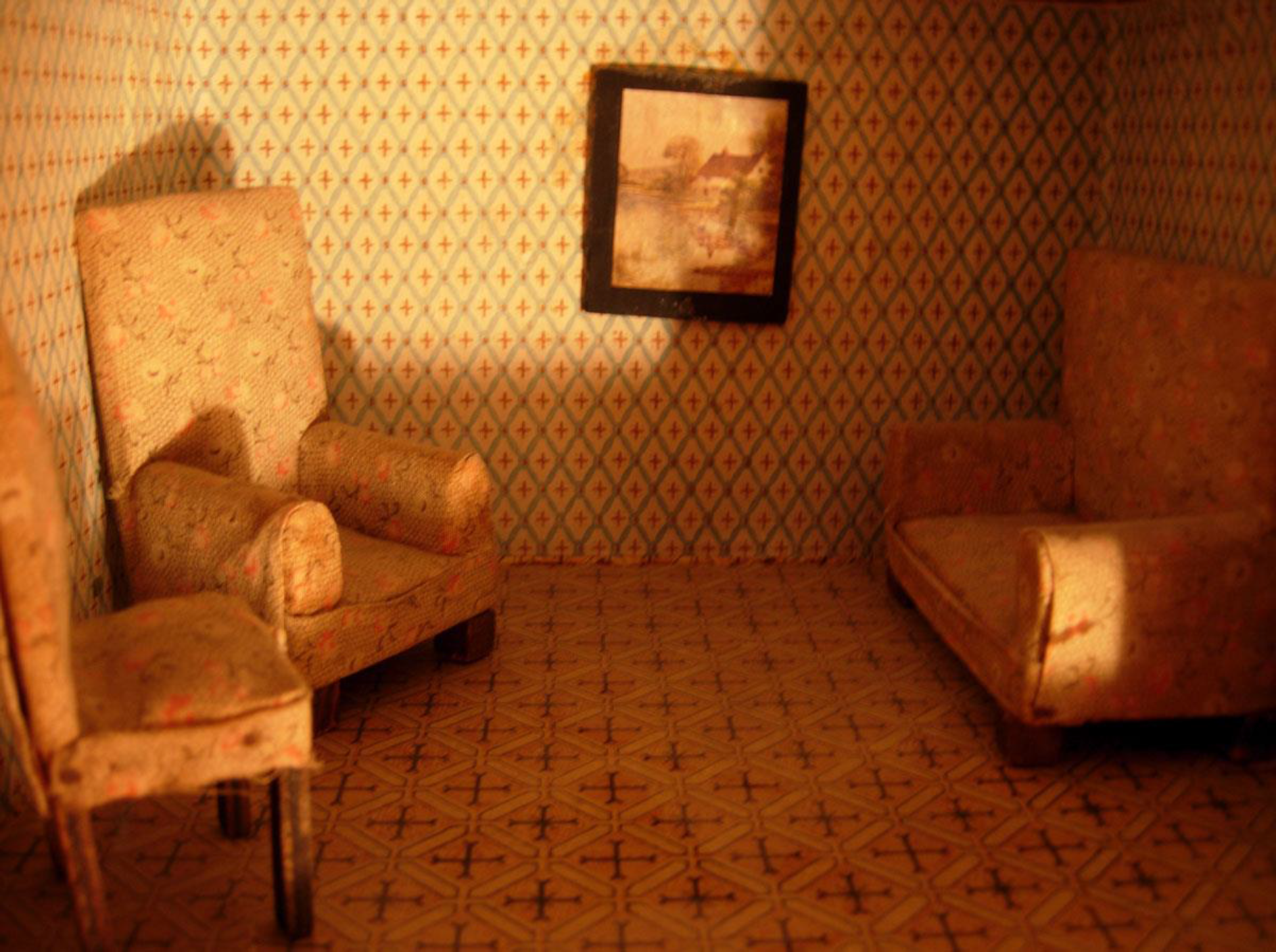
Photograph of my sister's dolls' house, Luci Gorell Barnes, 2011.
The suggested structure that I followed was to write continuously in sessions of at least 2 hours, over three alternate days. We could choose a specific theme if we wished, but I decided not to, feeling confident that my genuine concerns would emerge through the act of writing itself:
You find your voice by doing something with your voice. (Pateman, 1998, p. 156)
I think I was anxious about what might emerge if I gave myself free rein, because I was quite resistant to the process, which I manifested through feeling bored, distracted, and utterly blank. The purpose of writing as inquiry, however, is to get beyond our resistance and the instruction was to keep writing without looking back. This was crucial, as it allowed me to suspend my judgment and enter a curious, playful space. As I continued to write, my commitment to the process let me sidestep an aspect of myself that overrides other parts of me. Cixous and Calle-Gruber (1997) describe an internal “stranger” (p. 36) restricting their expression and Boal (1995) calls it the “cop in the head” (p. 8). In order to present a composed, objective version to the world, we can deny our more emotional selves, silencing some of who we are. The voices that appeared in my writing were hurt, scared, and needy, and I wondered how they could be part of any academic discourse. However, I felt contained by the parameters of the task, and encouraged by Speedy (2013) who writes:
I continue to claim a solidarity in my life and in my work with the unsorted, the unsafe, and the unhinged—sometimes from my own life experience, but even more importantly, from my very real and imagined sense of what might have been. (p. 30)
I found myself in a vulnerable place far away from rational, everyday life, where the boundaries between what I was recalling and what I was reaching towards seemed porous and fragile. I felt excited by this different world, inhabited by voices that spoke softly of thumbprints in tar and tangled green hair. Hunt (2010) describes writers making “a sort of autobiographical pact” (p. 234) where they allow experience to turn into fiction, and unconscious selves to surface. Committing to this instinctive process of writing, I pursued my ideas across the page without focusing on a final product, and was able to feel my way towards a set of ideas and images with their roots deep in my experience.
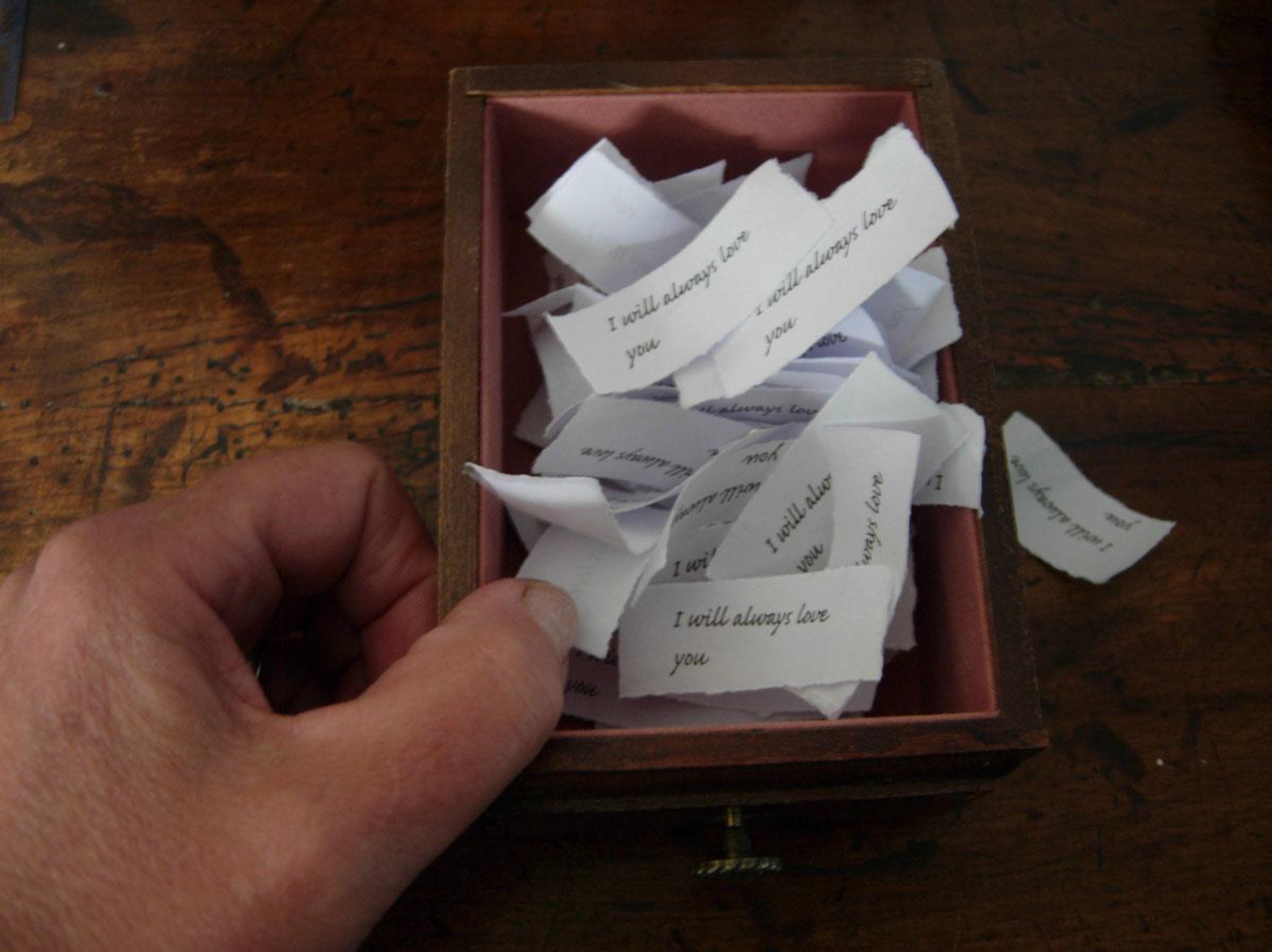
Photograph, Luci Gorell Barnes, 2013.
Listening to myself
In amongst the mass of writing I produced was the piece about the couple waiting in the dark, and I chose to develop this because it felt central to ideas that I touched on in my process. It also made me feel tearful and excited, and I trusted this feeling:
Truth gives us pleasure. It makes us burst out laughing, trembling. Blushing. It's hot. (Cixous & McGillivray, 1993, p. 95)
At first I felt anxious in case I destroyed the fledgling story in my attempt to polish it. However, Goldberg (2005) proposes that to write well you must listen well (p. 58), and I tried to attend in an open hearted way and stay connected to the felt experience it described. Mair (1989) suggests:
Try to listen to how it feels.
Just try and listen to how it feels.
How it silently tugs and strains at you. (p. 60)
Developing my story was a quiet, focused undertaking. Banks (2008) writes about “the selective ordering of experience” (p. 160), and I listened carefully to hear the precise tone, sound, and rhythms of my language. Leavy (2012) describes how art can “build resonance” (p. 517), and I almost held my breath, suspended, as I listened to what my body was trying to tell me:
Remembering begins in the body, in vague feelings, in the sensuous before it claims its story. Memory is made from traces, fragments, and images, from what cannot be let go, from what insists on a psychic place. (Pelias, 2004, p. 50)
By staying loyal to this vulnerable part of myself, I approached a “curious realm” (Mair, 1989, p. 65), unknown, yet intensely familiar, and explored some uneasy emotions that I have not consciously felt before.

Ink on found label, Luci Gorell Barnes, 2013.
Ueland (1938) writes about ideas as having been “tested inwardly” (p. 38), and the thematic concepts in my story described deep and genuine concerns of mine. I have explored similar ideas of attachment and loss in my visual art practice, but it was a new experience for me to do this with words. I found that entering the world of my story brought me closer to aspects of my experience:
Researchers, therapists (or co-researchers), poets and novelists alike then, have an interest in opening up spaces in conversations and texts where that which has not been previously thought, imagined or acted upon might emerge. (Speedy, 2008, p. 32)
Fiction allowed me the freedom to explore a familiar set of ideas in a new way, taking me to places within me that had previously been silent and remote.
Writing beyond myself
Leggo (2008) reminds us that we comprehend and define our experience through words (p. 166); and I believe that my dominant voice fixes my perspective and constrains my understanding:
The limits of my language mean the limits of my world. (Wittgenstein, 1974, p. 68)
This instinctive writing process extended my language and ideas, allowing me to gain a new perspective on my area of inquiry. Mair (1989) describes speaking “from a possibility of knowing” (p. 61), and my story allowed me to examine my fears for the future, and grief for the past, through memories and imaginings:
A person's identity involves more than the thoughts, feelings and behaviors of the current self; it also includes reflections of what a person was like in the past and hopes and fears of what a person may become in the future. (Strahan & Wilson, 2006, p. 2)
I explored what Boal (1995) calls the “realm of the possible” (p. 21), and found representations of thoughts and feelings that had eluded me before:
Paradoxically it is this suspending of intentions associated with the truth of the self that makes fictional autobiography potentially a very powerful tool for exploring “truths” that lie beneath the surface of conscious self-knowledge: when people relinquish conscious control over their self-representations, they open up the possibility of thinking about, and experiencing, themselves differently. (Hunt, 2010, p. 234)
I wrote without trying to keep control, which allowed me to reach the “further-than-myself in myself” (Cixous & Calle-Gruber, 1997, p. 56). Through this surrendered process I “strayed into the ontological” (Reed, 2011, p. 31), where the boundaries of what I knew and felt about myself were shifted. I reached new understandings, and felt compassion for aspects of myself and others that I had previously felt only troubled and saddened by.
In my writing, people were deeply connected with each other, unlike in my rational mind where I have learned to keep them separate. I did not find a single essential self, but many selves and perspectives. Our experience takes place in the ambiguity of the in-between, and when we use our imaginations, barriers dissolve and we can speak from these associations:
I am talking about creating an identity through art, a fictional I which is both me and not me, a quest for a sense of self when there is no solitary self to be found but a multiplicity of selves—all claiming to be me—in encounters with others. (Lyons, 1999, p. 77)
I found that in fiction I did not have to assume a specific standpoint, but could express how my lived experience is merged with others.
Labouvie-Vief (1994) writes that meaning comes from the “bond” between self and other (p. 35), and through this inquiry process, I found understanding in the spaces beyond myself. Pelias (2004) describes writing as the “making and unmaking of masks” (pp. 71–72), and by letting fact dance with fantasy, I found a form in which I could be other as well as myself.

Digitally manipulated ballpoint pen and crayon drawing, Luci Gorell Barnes, 2013.
Thinking about ethics
My story did not come from one stimulus, but from many memories and imaginings constructed over time, and there are tricky issues of authorship as I give my version of events, albeit in fictional form. Hardwig (1998) describes how one person can assume a central role in a family's story, suppressing other members' accounts (p. 60), and I acknowledge that my story is unreliable and skewed, however true it feels to me.
It is exciting to reveal tales “that might otherwise remain untold” (Speedy, 2008, p. 169), but I need to consider preserving the anonymity of the people and events that prompted my story. There is a possibility that by using fiction, I can protect them from being identified, but people have a way of recognizing themselves and each other, and I am aware that fantasy settings do not guarantee an ethical solution.
Orr (2002) suggests that fiction can shift difficult events to a “bearable distance” (p. 4), allowing us to take active control over how we represent experiences that feel too painful to be told in other ways. In undertaking this writing as inquiry process, I understood that I might well encounter difficulties. Through it I gained a sense of agency, but I also felt upheaval and grief. It was as though, through the experimental process, I had confided in myself and once on the page there was no going back. Stories can be powerful creatures:
They can evoke deeper parts of the self, heal wounds, enhance the sense of self—or even alter one's sense of identity. (Richardson & St. Pierre, 2005, p. 965)
I realized things about others and myself as I wrote, and felt written into a different awareness as I broke down the resistance of my conscious self. I released some buried emotions, and although this was exhilarating, I was upset by it as well:
The author and the text write each other and that fold in the research process can no longer be ignored in the new ethics of inquiry. (St. Pierre, 1997, p. 414)
I knew I needed to stay aware of where my writing was leading me and to have some means of self-care within that, which I attended to accordingly. Lyons (1999) describes one of the uses of poetry as being “the imaginative healing of wounds” (p. 78) and Le Guin (2004) proposes that:
The imagination can transfigure the dark matter of life. (p. 268)
I believe fiction has the potential to increase insight and compassion as people recognize themselves in others. However, exposure can feel risky, and care must be taken to find a balance between healing and harm.
How I represented my ideas
I was an avid reader as a child, excited and independent, as I cast off from the shores of everyday life. I return to stories from that time because they continue to resonate for me. Realistic accounts of experience can fall short in describing how we feel, and I enter fictional worlds with relief at their power to speak differently. My visual art is often set in timeless places, frequently borrowing from the language of folk stories and fairy tales:
We writers all stand on each other's shoulders, we all use each other's ideas and skills and plots and secrets. Literature is a communal exercise. (Le Guin, 2004, p. 277)
My story explores issues of attachment and loss, in a world connected to childhood, as if taken from the pages of an old picture book. This fantasy world was a useful place to examine ideas about how people are merged and distanced from each other, and I journeyed in the spaces between aspects of what I think of as my self:
We therefore only appear to others as unified and whole identities, when just under the surface of appearance we are a fragmented and diverse assemblage of voices, demands, intentions and possibilities. (Burkitt, 2008, p. 165)
Using fiction let me describe the disorderly, overlapping nature of being, representing these notions as half-told secrets, whispered and ambiguous.

Illuminated cardboard model, Luci Gorell Barnes, 2010.
We move through many realms as we reconstruct the past using memory and imagination, pulled together by our current understanding of what was and what might be. Roy (1999) urges us to “never simplify what is complicated” (p. 105), and I am attracted to genres where such complexities can be grappled with, showing the layered nature of experience. Bowers (2004) describes magic realism as combining the opposing notions of magic and reality to create new standpoints (p. 3), and Le Guin (2004), who mainly writes fantasy, states:
Fiction is experience translated by, transformed by, transfigured by the imagination. (p. 268)
Sparkes (2002) describes how fiction can evoke the “emotional texture of the felt human experience” (p. 182). This can be hard to reach with rational language, and is sometimes best expressed through metaphor. My chosen form let me touch on deeply affecting things and suggest the physical nature of experience:
‘When I look back there's empty sea.’
‘I know.’
‘Will I turn to salt?’
‘I don't know. Don't look back.’
Thoughts insisted themselves as I wrote: glimpses from moments that cannot be forgotten, but which everyday concepts do not prioritize. For me, these were best understood in a setting free from literal representation, where membranes between people, places, and time are thin:
It speaks to much about human ingenuity and resilience that when actual minds find possible worlds constraining or oppressive many of them can find a way through life's thornier thickets by recourse to impossible and magical worlds: not as a retreat from reality, but as a way of tunnelling through to life's different possibilities. (Speedy, 2008, p. 172)
My story is a vehicle that “honours the fragmentary” in myself (Leggo, 2012, p. 153), describing intricate feelings deep within me:
‘I saw through my looking glass eye,’ said the girl.
‘What did you see?’
‘A map written on my bones.’
This writing was the net in which I tried to catch the intimate splinters of my experience.
To communicate the understandings of our research we need to find forms that can faithfully represent our perceptions. Lafrenière and Cox (2012) suggest that it is not possible to convey some experiences in everyday language, and that these would remain undisclosed if we relied on conventional research methods (pp. 319–320). Fiction can allow the interiority of experience to be shown, offering persuasive insights into the lives of others, as Gottschalk (1998) writes:
Rather than attempting to convince the reader of the truth of his or her account by appealing to traditional and increasingly challenged authorities and criteria (Clough, 1990; Lather, 1993; Richardson, 1995, 1992a, 1992b), postmodern ethnographers seek instead to promote an understanding through recognition, identification, personal experience, emotion, insight, and communicative formats which engage the reader on planes other than the rational one alone. (pp. 213–214)
We can gain insight and understanding by imagining ourselves alongside others. Fiction operates beyond the rational plane, and by inviting people to engage in a sensory and feeling way we can evoke subtle but significant reactions. Behar (1996) proposes that writing “vulnerably” (p. 16) can elicit tender responses, and I suggest that the ideas represented in my story can produce emotional and intellectual understanding in its readers. It is a version of experience that I offer as a means for readers to think “creatively and imaginatively with” (Geertz, 1973, p. 12). I am not claiming truth or authority for its world of salty skin and green hair, but if others recognize themselves in fiction, then it is shown to be a legitimate way to portray social experience.
Not trying to reach a verdict
I am interested in the themes of attachment and loss and, like St. Pierre (1997) who wonders if her data collection will ever cease (p. 405), every day brings fresh information and insights to my inquiry. Fiction allowed me to talk about my ideas without having to settle on a verdict or suggest a solution:
Good stories … rattle commonplace assumptions; they surprise and disturb taken-for-granted beliefs to generate thought and discussion by suggesting rather than concluding. (Sparkes, 2002, p. 182)
My story is not a map, though it might guide me for a while. It is a slide in a magic lantern, offering a flickering moment of recognition before it is swallowed again by the dark. We do not need to know where we are going, but notice where we have been, using “reverse engineering” (Parker, 2012) to see the meaning of our work once it is made.

Gouache on paper, Luci Gorell Barnes, 2013.
I think by nature I am a “nomadic researcher” (St. Pierre, 1997, p. 412). Cixous (2004) describes writing at “top speed” (p. vii) to keep abreast of what presents itself to her, and I too, find myself chasing signs scattered across the landscape like clues in a treasure hunt. It seems that through the act of writing what I know is changed, and then changed again:
As I write, I think, I learn, and I change my mind about what I think. (St. Pierre, 1997, p. 408)
My subject is not pinned down by any single representation, but wriggles into its next iteration. Ever curious, I grasp the latest version, knowing that it will shift again to open up a new set of images and meanings.
Conclusion
I believe that research should be beneficial: connecting people, promoting discussion, and increasing our understanding of social experience. My purpose in using writing as inquiry was to get beyond my own resistance, and by doing this I found a valuable way to explore a set of ideas, gain new insights, and revise things that I thought I knew. Some perceptions are not easily expressed in academic language, and to make new discoveries we need to extend beyond traditional methods:
We learn to allow ourselves to experience living in worlds figured by myth and poetry and drama, because from time immemorial these have been ways in which we have mediated how our worlds work on us. (Reed & Speedy, 2011, p. 117)
Geertz (1988) mistrusts the idea that by using imagination in our research, we leave fact behind (p. 140), and Pascale (2011) questions epistemological suppositions:
For example, the concept of evidence as some thing to which one can physically point is just an assumption. (p. 4)
By representing my experience as fiction, I gained a more complex and compassionate understanding of the issues I was exploring. There are many ways of reading and validating research texts, and legitimacy is not fixed. For me, writing as inquiry was a valid approach, because it brought me closer to what I was trying to understand, and showed me a different way to know the world.
It is not unusual to feel that we should stand back from what we study, separating our intellect from our emotions, as if our feelings cannot be trusted to lead us to intelligent understandings. However, I want to write from a place of emotional perception within an academic discourse, and I believe that if we observe in a detached way we may miss significant things:
I speak the heart's discourse because the heart is never far from what matters. (Pelias, 2004, p. 7)
This writing as inquiry process gave me the structure and understanding that allowed me to disrupt my dominant self, follow my heart, and be faithful to what feels true. My story is neither real nor made up: it seems I have pressed my thumbprint into soft tar and kicked grass nests high into the air.