




Abstract
The growing acknowledgement of the value of listening to children's views and experiences in social research, popularly termed as “listening to their voices,” brings with it methodological consequences. Regarding children as expert informants about their own lives carries with it the simultaneous call for researchers to be experts in developing and employing appropriate strategies that can effectively elicit the insights that children can bring to a research topic. With younger children, the use of participatory methodologies has been foregrounded as the key to unlocking their potential to contribute rich and useful perspectives to inform research into their lives. This article explores the usefulness of employing preschoolers' drawings within the context of a co-construction process to facilitate the children's construction of ideas and reinforce their voices in research. The case is made that the quality of the dialogical engagement is as important as the drawing itself, and both visual images and the verbal exchanges are central to the children's meaning-making process. In the co-construction process, both adult and child are (ideally) equal players and the resulting dialogical process plays a major role in the constitution of the phenomena. The role of the researcher as the co-constructor can be a challenging one because it entails engaging and supporting children's views and the expression of these views. The discussion and illustrations from the first author's research projects contribute to the literature base on positioning preschool children as valid social actors in their communities.
We operate through an ethos of empowerment of all participants, and aim for participatory research practice which has at its heart an active involvement in promoting the rights of children as citizens with voice and power. (Pascal & Bertram, 2009, p. 249)
We operate through an ethos of empowerment of all participants, and aim for participatory research practice which has at its heart an active involvement in promoting the rights of children as citizens with voice and power.
(Pascal & Bertram, 2009, p. 249)
The inclusion of children's voices in social research has been given due attention in recent decades, along with improvements in research methods to elicit richer, first-hand data from children's experiences and perspectives. In particular, the evolution of participatory and creative methods and a shift in paradigmatic stance about children as agents and thinkers (e.g., Christensen & James, 2008; Greene & Hogan, 2005; Hallet & Prout, 2003; MacNaughton, Smith, & Davis, 2007; Thomson, 2008) means that social research could better influence practices and policies toward becoming more child-centered and appropriate to children's contemporary circumstances.
This article espouses the value of employing participatory methodology in empowering children's voices in terms of children's construction of knowledge and worldviews. Utilizing an interactive “draw-and-talk” method (Brooks, 2005; Coates & Coates, 2006; Cox, 2005; Hopperstadt, 2008, 2010; Jordan, 2004; White, Bushin, Carpena-Mendez, & Laoire, 2010), the article draws from two examples of how young children contributed to a constructivist research process by talking while drawing. With selected data from the first author's research with 4- to 6-year-old preschoolers in the Singapore context, we describe the use of drawings and conversations within a co-construction process (Jordan, 2004) to generate children's first-hand experiences, perspectives, and understandings. The discussion contributes to the literature on participatory methodology by demonstrating how a participatory framework can be successfully created through the integration of child-friendly methods and in-depth one-to-one individual conversations within a co-construction process. The illustration also brings to the forefront the critical role of the adult co-constructor in the process, and accentuates the range of strategies that he or she needs to be equipped with in order to support children as competent meaning-makers and communicators of their thinking and lived experiences. Prior to showing the two examples and discussing these points, we outline relevant theoretical premises that have influenced our argument in favour of developing more child-friendly research with children.
Including Children's Voices in Research: Theoretical Perspectives
The last two decades have seen a plethora of discussions around the issue of how children should be positioned and included in research (Christensen & James, 2008; Greene & Hogan, 2005; Kellet, 2010; Mukherji & Albon, 2010; Pascal & Bertram, 2009; Schiller & Einarsdottir, 2009; Soto & Swadener, 2005). From these impassioned discourses, two theoretical premises have shaped our thinking about including children's voices in research—the concept of children's agency found in the early childhood and sociology literature, and the concept of children's rights as expressed in the United Nations Convention on the Rights of the Child (UNCRC) (United Nations General Assembly, 1989).
Children's agency is premised on the philosophical belief that children are capable of making sense of their views and sharing their views on issues concerning them, and as human beings, they are entitled to express these views. This belief is especially championed by reconceptualists in early childhood education as well as scholars within the new sociology of childhood, both which emerged in the 1990s (James & Prout, 1997; Matthews, 2007). These scholars have shown evidence of children as active, competent, and reflexive constructors of their own worlds, and they have argued that children have a rightful place as social actors capable of influencing societal matters and policies that directly impact them. This has involved a reconceptualization of children and childhood by seeing the child as actively engaging the world and adeptly constructing ideas and theories (Dahlberg, Moss, & Pence, 1999). The child is described as “rich in potential, strong, powerful, competent, and most of all connected to adults and to other children” (Malaguzzi, 1993, p. 10). In other words, children are their own experts whose “voices can be powerful and possibly richer than those adults acting on behalf of children” (Sorin, 2003, p. 31). Wright (2003) has similarly argued that an insider's perspective holds greater value in informing research, practices, and policies. Moore, McArthur, and Noble-Carr (2008), whose study included children in the preschool age range as well older children, shared a remark made by one of the children in their study, and it left us with little reason not to include children's views in adult-created research agendas: “Kids should be asked about stuff that's got to do with them … They can tell you stuff you'd never think of— cos you're not a kid” (p. 90). We agree with this child that researchers must listen attentively to the lived experiences of children so that the data generated can become the “essential basis for developing genuinely child-centered policies” (Woodhead & Faulkner, 2000, p. 33).
The second theoretical premise that has influenced our belief about including children's voices in research comes from the UNCRC (United Nations General Assembly, 1989). Our country, Singapore, has been a signatory of this international convention since 1995, and yet the spirit of the UNCRC has been slow in shaping public thinking and social policies concerning children. In particular, Article 12 of the UNCRC has been downplayed because it gives due recognition to children's rights in having a voice and the capability to express their views in matters that relate to their lives. We have yet to locate academic literature discussing why the UNCRC has not been part of public and policy discourse in Singapore. We think that the idea of children having rights may be in conflict with our largely pragmatic and Confucianist society (Chang, 2003), which places emphasis on filial piety and children being obedient to the wishes of their parents. We understand that honouring children's rights does not mean that parents, teachers, and other significant adults in the child's life relinquish their rights to act as a protector and guide to their children, and the UNCRC view could, in fact, be in line with a popular quote from the Confucius Analects:  (when three people walk together, one of them could be my teacher); children count as knowledgeable human beings too. We note that Lundy (2007) has proposed 4 key dimensions to conceptualize the provision of Article 12:
“Space” in terms of creating opportunities for children to express their views.
“Voice” in terms of facilitating the expression of these views.
“Audience” in terms of actively listening to these views.
“Influence” in terms of responding appropriately to these views. (p. 933)
The formal endorsement of children's rights within the social-political framework of UNCRC has garnered a greater mandate for eradicating the marginalized social status of children and respecting their role as active citizens in society. It recognizes the individual as well as the collective agency of children.
With a strong conviction driven by these theoretical underpinnings, we argue the importance of research with children such that listening to their voices does not become merely tokenistic (Dockett, Einarsdottir, & Perry, 2011).
Child-Friendly Methodologies
While there is a positive move toward listening to children's and young people's perspectives, there is apprehension as regards to eliciting the views of younger preschool children below the age of 8 years (Hill, 2005; Lee, 2011). There is a strong tradition of adults conducting research on younger children in the 0- to 8-age range, mainly within the fields of developmental psychology and education. Researchers working from this developmentalist stance are generally concerned with the early identification of developmental deficiencies and early intervention strategies. Such a focus on what young children cannot do tends to overshadow young children's ability to contribute meaningfully to research. As a result, children's voices are often muted by adults professing to be more knowledgeable about children and devising policies and practices that may not entirely address children's realities. Pascal and Bertram (2009) have argued the following:
This situation particularly characterizes the reality of our youngest children, who can remain “silenced” and often excluded from the decisions which shape their lives with the rationale that they are “too young” to express their rights and voice and that we, as adults, have to act on their behalf. (p. 253)
Such an adult view has been contested, with strong arguments for young children's rights as participants in co-creating more child-friendly research processes (MacNaughton et al., 2007). The onus is on researchers to be more sensitive toward young children's competencies and more skilled in, respectfully and creatively, eliciting their views (Einarsdottir, Docket, & Perry, 2009; MacNaughton et al., 2007; Mukherji & Albon, 2010).
The inclusion of preschool children's voices in research therefore necessitates the utilization of suitable methods and methodologies that are capable of empowering children to share their lived experiences and perspectives. This calls for shedding the traditional positivist paradigm that defines children as passive objects of research and embracing more participatory principles (Greene & Hogan, 2005; MacNaughton et al., 2007; Punch, 2002; Woodhead & Faulkner, 2000) that enable participants to “define their own reality and challenge imposed knowledge” (Veale, 2010, p. 254).
In other words, listening to preschool children's voices in research is about being accountable to children in understanding their strengths as communicators and allowing their voices to be projected through mediums that empower them as adept informants of their own lives. It is about using child-centered methods as a means of listening to children and reaching into children's worlds (Clark & Moss, 2011; Hall, 2009; Mukherji & Ablon, 2010; Pascal & Bertram, 2009). For preschool children who may have less confidence in articulating abstract concepts using only words, tapping into a range of child-friendly methodologies and methods may encourage them to construct and articulate their views with greater ease. Buchwald, Schantz-Laursen, and Delmar (2009) have also commented that research that explores children's lives essentially entails an imposition of certain requirements on the researchers' choice of methods for data collection. Utilizing inappropriate strategies that fail to elicit preschoolers' views effectively is equivalent to marginalizing their voices and disempowering them as social actors. Wright (2003) has also emphasized that when preschool children engage in multiple domains of expression, they are “liberated to mentally manipulate and organize images, ideas and feelings, and to use a rich amalgam of both fantasy and reality to portray experiences” (p. 24). Many recent empirical studies with children below the age of 7 have demonstrated the efficacy of employing multiple techniques to gain valuable insights into the children's worlds (Angelides & Michaelidou, 2009; Brodkin, 2005; Einarsdottir et al., 2009; Grace & Bowles, 2011; Harris & Barnes, 2009; Jesuvadian & Wright, 2011; Lee, 2009; Stephenson, 2009; Wei & Di Santo, 2011; White et al., 2010; Yin, Lee, & Ebbeck, 2003). These studies have employed innovative child-friendly methods and methodologies together with traditional conversations/interviews. The range of methods includes the use of drawings, persona dolls, drama, storytelling, mapping, photography, tours, journal reflections, and film shows. In this article, we focus on the use of drawing and talking.
Children's Drawings
The Developmental Approach to Children's Drawings
Much of the literature on children's drawings has predominantly focused on examining the structural aspects of children's emerging ability to make visual references of their world. This is underpinned by a developmental perspective, which emphasizes the stage theory approach proposed by Kellogg (as cited in Nixon & Adwinkle, 2005). In this regard, children's drawings are seen, primarily, as a representational tool to depict objects in the world, with particular emphasis on the properties of the drawings such as the compositional and aesthetic qualities inherent in the pictures. The end product is regarded as the standard to assess children's ability to reflect accurately on visual realities. The drawing-as-artefact takes central stage in informing adults of the child's abilities and progress. Such an approach to studying young children's drawings has its place in early childhood education when the focus is on the physical domain of fine motor and graphomotor skills, or in the cognitive domain of prewriting and symbolic representations. Children's drawings have also been used to evaluate their psychological development (Holliday, Harrison, & McLeod, 2009). These are often utilized as tools for psychiatrists, psychologists, and therapists for diagnostic purposes. Overall, the approaches described in this paragraph serve diagnostic and assessment purposes.
Drawings and the Discourse of Meaning-Making
For the purpose of understanding children's meaning-making, the developmental lens falls short in capturing the communicative power of children's drawings. Recent literature exploring children's drawings, and the developing discourse on meaning-making, have led to the adoption of a new paradigm that looks into the integration of perceptions and meanings in children's drawing processes (Coates & Coates, 2006; Cox, 2005; Mukherji & Albon, 2010). This theoretical stance reflects current visual theory, which emphasizes the inter-link between the interpretative conceptual and the perceptual dimensions of children's drawings. It applies even to very young children. Defending against children's so-called “random” markings, some scholars have contended that there is communicative potential even in children's scribbles and squiggles (Cote & Golbeck, 2007; Hall, 2009).
Combining these recent visual theories and knowledge that drawing is an open-ended and familiar activity for young children, the use of drawing in research has become a more common strategy in research with younger children. Through drawing, young children can enter the research process and be understood by researchers on their own terms (Einarsdottir et al., 2009; Hall, 2011; O'Kane, 2000). Researchers focus on the drawing process and the children's accompanying narratives in order to listen attentively to children's voices. Scholars have advocated for the “draw-and-talk” method, which they see as more promising as a research tool than the “draw and followed by talk” method (Brooks, 2005; Coates & Coates, 2006; Cox, 2005; Hopperstad, 2008, 2010; White et al., 2010). For instance, Cox (2005) has observed that “talk and drawing interact with each other as parallel and mutually transformative processes” (p. 123). In her analysis of British nursery-aged children's drawings, Cox sees this as generating the central source of data. Coates and Coates (2006) drew similar conclusions from their study of children in early-years settings, when they asserted that it was the “children's simultaneous utterances” that “inform[ed] the nature and content of the work and help[ed] to elucidate their intentions and processes of thinking” (p. 221). They cautioned against placing too much emphasis on the tangible outcome rather than on the relationship between children's narratives and their drawing process because this can lead to a failure to capture the most crucial aspects of children's meaning-making. In her work, Brooks (2005) examined the interpersonal and intrapersonal dialogues of young children's drawings and concluded that young children are capable of exploring complex ideas when given the right platforms to express themselves.
In summary, such a draw-and-talk method records the journey of meaning-making right from the start of the drawing activity. This has greater potential of providing a more complete and comprehensive account of children's perceptions on the research issue at hand. As early childhood educators, we also know that preschoolers often enjoy drawing and talking with adults and peers around them. What children say when they draw and what they draw should be considered together, and both “languages” should be seen as an integrated unit if we want to obtain critical information about children's perceptions. The nature of the interactive process, therefore, has a central role in this methodology and is key for our interpretation of the data.
The Role of Co-Construction in the Drawing Process
In addition to the literature on the draw-and-talk methods, Jordan's (2004) strategy of using a co-construction process in early childhood classrooms has convinced us that young children can authentically participate on their own terms in adult-created research agendas. This differs from “scaffolding,” a concept that has origins in Jerome Bruner's early work on children's language learning (Bruner, 1983). Scaffolding refers to adults or more capable peers providing the necessary structures and helps to support the novice in his or her learning. While scaffolding a child's learning, the adult remains the knowledge expert who directs the child's learning process. In contrast, when adults encourage children to co-construct, shared understandings about particular topics and issues develop. Jordan (2004) has emphasized the need for both adult and child to establish inter-subjectivity as they each enter into a common space of meaning-making. The discussion is kept open-ended and the child's voice is given room for expression and exploration as the adult contributes respectfully by making links between the child's thoughts, affirming the child's ideas, and extending the child's views. As the adult facilitates the child's “sense-making,” she or he also acquires a shared understanding of the child's perspective. This approach allows for the fluidity of the child's ideas to emerge, to develop, and to be shaped and defined in the process. In line with the UNCRC's view of children as active agents, a co-constructive research process also projects the child as a powerful contributor with unique expertise within the joint interactive meaning-making activity.
While investigating how a group of 5- to 6-year-olds conveyed meaning in their drawings, Hopperstad (2010) began as a nonparticipant observer with the intention of quietly appreciating the children's drawing processes. The children, however, included her in their drawing activity by spontaneously interacting with her. The children's invitation to engage her made her an active participant. Although, initially, it was not what she intended, she respected the children's choice, and her participant role resulted in more extended conversations and provided her with greater insight into the children's views.
Overall, within the framework of co-construction (Jordan, 2004), the interview dialogue moves beyond the traditional procedure of extracting facts from participants toward a social constructionist perspective. The social interaction between the interviewer and the child is accorded a pivotal role in the construction of the phenomena or the research topic in question.
Illustrations From Two Research Projects
In this article, we illustrate the use of a draw-and-talk method within Jordan's (2004) co-construction approach, with examples from two research projects conducted by the first author. We describe the approach with conversation transcripts and the children's drawings, hoping to show readers how each child was accorded respect as capable meaning-makers and powerful communicators of their own perspectives.
Example 1
The first research project was a study that investigated preschool children's peer rejection experiences within an early childhood setting in Singapore. The objective was to gain insights into a holistic understanding of the phenomenon of peer rejection from the perspective of children. This in turn provided a basis for the design and implementation of appropriate pedagogical practices to help the preschool children cope more effectively with peer rejection in their lives. Even though the research activity was initiated by adults, the children's voices and sense-making were given pre-eminence through in-depth individual interviews involving drawing—an activity they were familiar with and enjoyed doing.
The following excerpt from an interview transcript is accompanied by Figures 1 and 2 below. All were taken from a spontaneously occurring draw-and-talk session with a 4-year-old called Chen (pseudonym):

Chen's first drawing.

Chen's second drawing.

The above draw-and-talk episode represented by the interview transcript (Lines 1–78) demonstrates the dynamic manner in which Chen (pseudonym) constructed an understanding of her peer rejection experience caused by Jason (pseudonym). The interviewer (Joan, abbreviated name for first author), as the co-constructor, provided the impetus for Chen to accomplish this by employing three strategies. The first strategy was utilizing open-ended questions, which encouraged the child to reflect more deeply on her circumstances. For example, the interviewer asked a series of open-ended questions (Lines 63–74), which probed Chen to examine why she felt rejected by Jason. This resulted in Chen arriving at her own understanding that her rejection was attributed to gender differences. Moreover, the upsurge in her tone (Line 75) when she asserted the reason for her rejection added further significance to the construction of the experience by reflecting the intensity of her rejection experience.
The second strategy was giving the child room to pursue her ideas. Throughout the conversation, the interviewer allowed the child to take the lead and to explore her emerging ideas. Hence, on several occasions, Chen initiated new angles into the discussion, which demonstrated her understanding that rejection was a matter of the “heart” (Lines 21–25), that it was an intense affair (Lines 28–33), that the teacher was to be her rescuer (Lines 34–36), and that a “making-up” episode would eliminate the negative feelings (Lines 37–62). The active verbal interaction and the drawing activity enabled the sense-making process to unfold in a fluid manner; this was evident from the way Chen reflected, narrated, and proactively added the main protagonists (Chen, Jason, and the teacher) and critical features (the facial gesture, the three “Noes,” the hearts, and the arrows) to present a detailed and poignant picture of her rejection experience.
A third strategy was valuing the child's ideas. The interviewer utilized interjectory phrases (Lines 33, 46, 52, 54, 57, 61) throughout the conversation to demonstrate her keen interest and her respect for Chen's developing ideas. By affirming Chen's contributions, a safe and conducive environment was created, which encouraged Chen to be forthcoming in her sharing. Hence, through co-construction, the child was given the critical space to develop and expand on her ideas. The use of drawing to accompany the dialogue enabled the child to have as much control as the interviewer over the development and the pace of the conversation. Although the agenda originated from the adult, this retelling episode became very much the child's agenda as well. This can be seen when the child's depiction of her rejection experience took on a momentum of its own, as she developed her drawing and narrated the circumstances accompanying it. Hence, there was joint control over how the dialogue and sense-making evolved, leading to a shared understanding of the child's perceptions. The dialogical interplay between child and adult resulted in the co-construction of the meaning and essence of the rejection experience as seen from the child's point of view. The overall picture of rejection that emerges is a multi-faceted one. The force of the rejection experience can be vividly felt in the repeated and rising tone of the “No! No! No!” The child experienced emotional distress (anger and frustration), employed retaliation (scare tactics), and sought the teacher's help (seen as the authority figure in the children's lives) as coping mechanisms. She attributed the issue of gender (heightened by the tone used) and the lack of generosity of the rejecter (accentuated by the “big heart” in Figure 1) as the causes of rejection. She also showed how the act of rejection moved in tandem with the make and break quality of friendship, which is represented effectively by the arrow indicating a patched-up relationship. The episode revealed clearly that the method employed empowered the child to be the expert informant of her own life experiences.
Example 2
The second example originates from another research project, which explored how the critical thinking of a 6-year-old, Glen (pseudonym), could be facilitated, again, through a co-constructed and in-depth draw-and-talk session with an adult. The objective of this study was to investigate a child's critical thinking processes by empowering the child's voice through his expressions and constructions of a phenomenon of his interest. It employed the draw-and-talk method as the main data-generation tool. The child selected the topic of space travel for the conversation. He drew a picture of space travel (Figure 3), which created the common space for the interviewer (Joan, the author) to enter into the child's world of meaning-making.

Glen's drawing of space travel.
The child was very enthused and participative throughout the informal conversational interview. Joan, the interviewer, had created an encouraging environment for the child to be forthcoming in actively constructing his ideas and articulating his thoughts. In embracing the role of the co-constructor, the interviewer empowered the child in his critical thinking through several strategies. One strategy was allowing the topics of conversation to emerge from the child.
Throughout the conversation, the child was given joint autonomy to direct the flow of the discussion. This placed emphasis on the valuing of the child's ideas and ensured that the conversation remained child-centered. The main topic selected by the child was space travel; however, many other sub-topics also surfaced because the child was given the critical space to take ownership of the creation of ideas. Table 1 shows excerpts of the interview transcripts, which illustrate the range of ideas and theories that emerged from the child's meaning-making process.
Examples of the Child's Active Formulation of Ideas

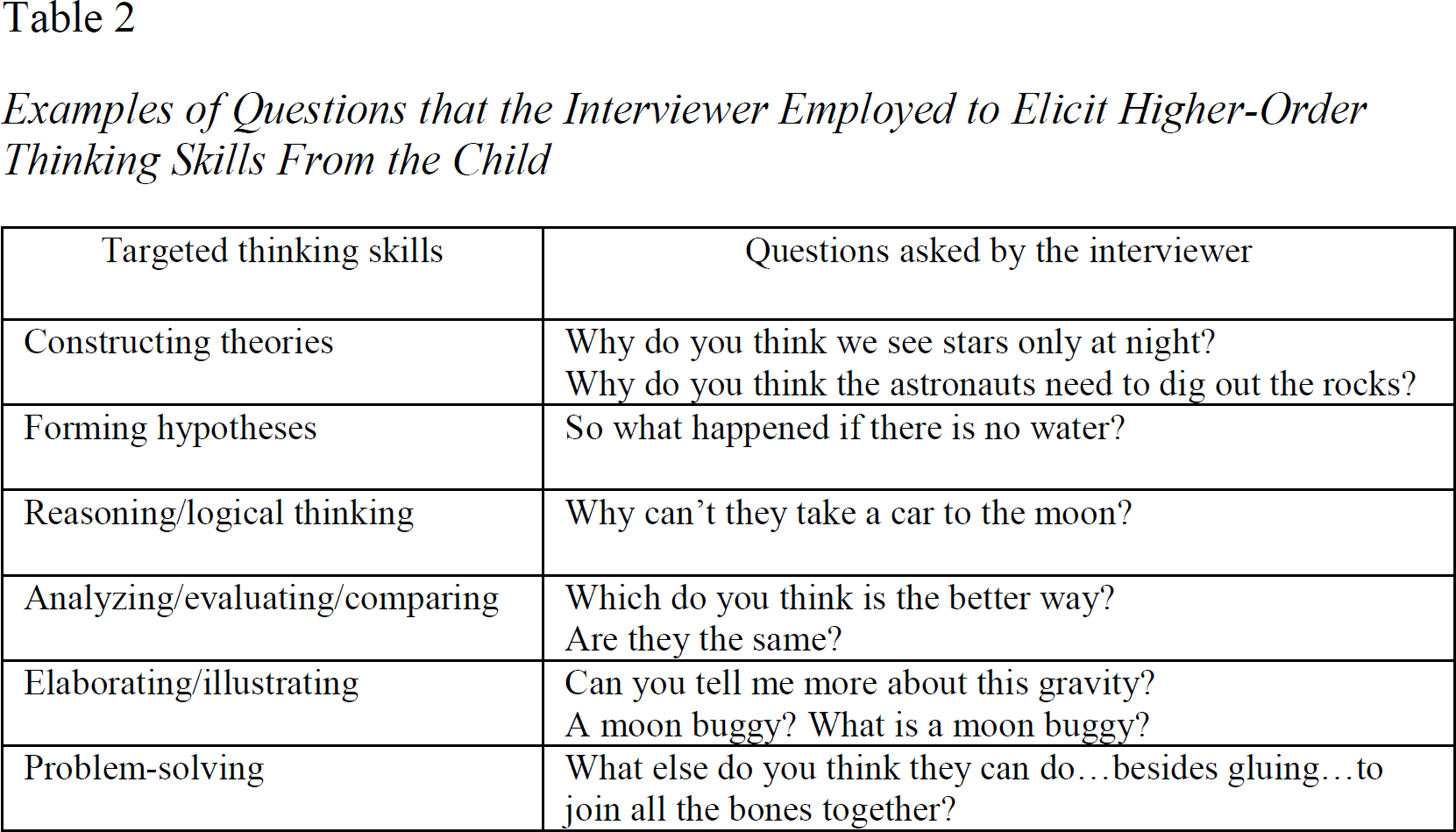
A second strategy was utilizing probing questions to extend the child's thinking. Reflective discourse was fostered through skilful questioning to facilitate the child's thinking process. Table 2 shows examples of questions that were posed to the child to engage him in critical thinking.
Examples of Questions that the Interviewer Employed to Elicit Higher-Order Thinking Skills From the Child
Evidence of Glen's active employment of the meaning-making process in response to the interviewer's engagement of his ideas can be seen from an interesting episode about the routes to Pluto (see interview transcript below and Figure 4). Through the interviewer's inquiry, Glen was prompted to revisit his idea, which led him to generate a scenario to justify his stance on why route 3 was the slowest route to Pluto. The episode demonstrated how the use of the draw-and-talk method, within a co-construction process, led to very fluid and creative on-the-spot problem solving by Glen:

Glen's drawing of routes to Pluto.

A final strategy that empowered Glen in the co-construction process was affirming his ideas. The interviewer listened actively to the child's construction of his understandings of the world without any preconceived ideas of what was valid or correct; instead, there was constant acknowledgement through the use of phrases, such as “Oh I see” “Okay” and “Well this sounds interesting,” and gestural postures, such as nodding and leaning forward to examine the child's drawings. These were employed to indicate a keen interest in the child's developing ideas.
We feel this example was illustrative of how we could play down the binary distinction between adult and child, enabling the child to emerge as the expert in the discussion. The interviewer's responsibility was to refrain from jumping ahead and from being judgemental about the child's ideas; instead, the interviewer played the crucial role of co-constructor. She used strategies to elicit, support, and extend the child's thought processes; she asked challenging open-ended questions, used probing remarks, sought clarifications, showed a keen interest in the child's development of his ideas, and fully respected these ideas. After the conversation, Joan drew a conceptual map (Figure 5) to represent the discussion topics that had emerged from her dialogue with Glen. It demonstrates the richness and complexities of ideas and perspectives emerging from Glen's imagined world of space travel. It can therefore be seen that the inter-dialogic engagement with Glen and his drawings was instrumental in getting him to probe deeper into his own developing ideas. This constituted the co-construction process in which both adult and child were equally active and responsible for the ensuing display of critical thinking by the child. The result was not simply a description of facts about space travel. Rather, this example provided insights into the process of how the child employed a range of critical thinking skills to construct and make meaning of his world of space travel.

Conceptual map.
Discussion and Conclusion
The two examples described in this article have revealed explicitly how the voices of young children can indeed be engaged and facilitated in investigations of their life experiences and thinking. For young children, the use of in-depth draw-and-talk methods, in which an adult researcher takes on the role of co-constructor, can allow them to demonstrate capabilities and understandings as active meaning-makers of their own circumstances. Ultimately, research with children should allow children to be as articulate as possible, and encourage them to share the way they make sense of the world around them.
Going beyond the research agenda, the methodology described in this article also has resonance for teaching and learning in early childhood settings. It accords credence to the use of co-construction as a powerful pedagogical tool in educational settings, which value the development of children's thinking and the construction of knowledge as significant goals. These will be schools that emphasize “the study of meaning rather than the acquisition of facts” (MacNaughton & Williams, 2010, p. 230). Integrating socio-cultural theory within a Vygostkian framework, the employment of co-construction within child-friendly tasks has the potential to emerge as a useful strategy, which teachers can utilize to develop the “tools of the mind,” that is, to foster children's cognitive processes (Bodrova & Leong, 2007). Jordan (2004) documented that young children displayed higher-order thinking, and were more empowered and engaged in the learning processes, in classes where their teachers set up collaborative inquiry and employed the strategy of co-construction as their pedagogy.
The success of the method however depends very much on the adult being able to use the strategy of co-construction effectively. Children can be disempowered and their agentic status tokenized when researchers fail to capitalize on opportunities to unlock the children's potential as thinkers, constructors, and communicators of their realities within the co-construction process. This can be the case when researchers embrace wrong attitudes, such as holding a deficit view of preschool children's competency, or do not possess the appropriate co-construction skills to competently negotiate the research space with children in order to extend their ideas and thinking. Waller and Bitou (2011) have warned that researchers cannot assume that “the [methodological] tools themselves somehow automatically enable participation” (p. 5). The researcher should be adept in promoting meaningful interaction with young children, and let the emerging dialogical interactions shape their role as co-constructor of children's worlds. The implication of this is that researchers, who intend to conduct research with preschool children employing the methodology, should develop the relevant skill-set that will enable them to apply the co-construction techniques effectively. Hence, appropriate training and practice is indispensable when one aims to be efficient in utilizing the methodology discussed within this article. This applies to early childhood practitioners as well as those who want to use co-construction as a key pedagogical strategy they can employ in their classes.
The approach we have described in this article is but one of many child-friendly methodologies. We believe that any similarly genuine approach, when used skilfully, should allow young children's voices to further contribute authentic, insightful, and ultimately more influential data, which can inform policies and practices in the “best interest” of children.