




Abstract
The article examines the contribution of method triangulation to the study of the self-construction of a schizophrenic inpatient in several encounters with a psychiatrist. We used institutional conversation analysis to probe the data for interactional sequence organization, while a positioning analysis enabled us to explore different levels of interpersonal positioning. Positioning is defined as a process whereby interlocutors locate one or several dimensions of their self in relation to others. Using these analyses, we identified, described, and interpreted the inpatient's discursive attempts, successes, and failures to construct who she was in the psychiatrist-inpatient encounters. The theoretical, methodological, and method frameworks are presented in the first, second, third, and fourth sections. Then, illustrative data are presented and analyzed in the fifth and sixth sections. Finally, the insights gained from the analyses, as well as the contribution of method triangulation, are elaborated on in the discussion.
Keywords
The aim of the article is to present and illustrate the contribution of method triangulation to the analysis of the discursive positioning (i.e., the expression of one or more dimensions of the self in ongoing interactive discourse [Wortham, 2004]) of a schizophrenic inpatient in qualitative interviews (Hunt, Chan, & Mehta, 2011). In this study, method triangulation is defined as the use of two or more methods in the same study (Denzin, 1978; Janesick, 1994) in order to explore the phenomenon in question from different angles (Kupferberg, 2010a). Accordingly, data analysis was first conducted via the lens of institutional conversation analysis (ICA) (Heritage & Clayman, 2010); then, a positioning analysis (Kupferberg & Green, 2005) was applied, and finally the combined use of these methods was described, applied, and evaluated.
The study has been inspired by a qualitative tradition that foregrounds the discursive construction of experience and self of the troubled (Kupferberg & Green, 2005) and the sick (Hydén & Brockneier, 2008; Hyuärinen, Hydén, Saarenheimo, & Tamboukou, 2010) in naturally occurring discourse (Speer, 2007). We adopted Speer's (2007) claim that “all data can be natural or contrived” (p. 307), depending on the research aims. Accordingly, the qualitative interviews affording the inpatient a discursive space to talk about whatever she wants are defined as “naturally-occurring.” Such focus has been considered an important contribution to the medical perspective that often frames the illness experience in objective, depersonalized terms (Mishler, 1984).
Affecting about 1% of the population worldwide, “schizophrenia is a clinical syndrome of variable, but profoundly disruptive, psychopathology that involves cognition, emotion, perception and aspects of behavior” (Sadock & Sadock, 2008, p. 156). Currently, schizophrenia researchers have also highlighted a qualitative perspective on this chronic illness that centers attention on the patient's voices, or self-positions (Hermans, 2008; Lysaker & Lysaker, 2006), in order to complement the medical perspective with vital patient-centered information on moral, emotional, social, and cultural dimensions (Velpry, 2008).
In view of the research emphasizing that schizophrenics find it difficult to move meaningfully among their different self-positions and express their voice (Lysaker & Lysaker, 2006), this study employed two methods to probe this claim in psychiatrist-inpatient encounters in the context of a mental health center. Together, the methods employed in this study were focused on the inpatient's positioning as it was displayed in the interaction. As far as we know, this is the first study that combines the two methods to explore the ongoing speech of a schizophrenic inpatient.
The first method, institutional conversation analysis (ICA) (Heritage & Clayman, 2010), advocates the microanalysis of naturally occurring data in the quest for the main features of institutional practices, without using a priori theory or models. The second method explores interlocutors' discursive positioning (Kupferberg, 2010b). Discursive positioning is a social activity that constitutes “a dynamic alternative to the more static concept of role” (van Langenhove & Harré, 1999, p. 14), and it is defined as an “event of identification” (Wortham, 2004, p. 166) in which a recognizable dimension of one's self gets explicitly or implicitly applied to an individual (e.g., in Example 1 below, the inpatient positions herself as a person who is seeking help).
You can choose any topic you want.

Discursive positioning is connected to self-construction because interlocutors position themselves in ongoing discourse, and it is the researchers who employ the methods of analysis in their attempt to identify, describe, and interpret interlocutors' positioning and construct the study participants' selves. Self-construction is therefore not an a priori resource but rather “something that people do which is embedded in some other social activity” (Widdicombe, 1998, p. 191) that the researcher is able to explore.
At this point, it is important to define the following terms: discourse analysis, an approach, methodology, and method, which are pertinent to the study. Discourse analysis is broadly defined as the study of language produced in action (Hanks, 1996) in a certain context. Accordingly, in this article we present the approaches and methodologies underlying the two discourse analysis methods used for the analysis of the interactions that took place in the institutional context (Linell, 1998; Schiffrin, 1994) of a mental health center. An approach comprises theory, methodology, and method (Creswell, 1998). Methodology, in turn, is defined as “a theory of how inquiry should proceed” (Schwandt, 2007, p. 193), and a method is “the set of investigative procedures used within a particular field of study” (Schwandt, 2007, p. 191).
Following the introduction, the second section of the article defines institutional conversation analysis (ICA), discursive psychology, and discursive positioning, which inform the methods used in the study. In the third and fourth sections, the frameworks pertaining to methodology and method are reviewed. In the fifth and sixth sections, the data are presented and examples analyzed in order to illustrate the application of the two methods. In the discussion, the insights gleaned from the analyses and the contributions of method triangulation are further explored.
Institutional Conversation Analysis and Positioning Analysis: A Theoretical Framework
The study has been inspired by ICA (Heritage & Clayman, 2010) and discursive psychology (Hepburn & Wiggins, 2007). Adopting conversation analytic theory, methodology, and method (Sacks, 1992; ten Have, 1999), the ICA approach has been of considerable benefit to the study of interactional institutional processes in various professions such as law, medicine, the media, and psychotherapy (Heritage & Clayman, 2010). Applying micro-analytic tools, ICA has focused on the “the unique fingerprint” (Heritage & Clayman, 2010, p. 18) of institutional practices that is manifested in naturally occurring sequence organization in interaction.
Discursive psychology (Hepburn & Wiggins, 2007) is another approach that has adopted conversation analytic tools in order to study how psychological phenomena such as emotion, cognition, attitude, and memory are interactionally co-constructed in discourse—not as an a priori resource but as a process unfolding in interaction. Discursive psychologists emphasize that discursive positioning is a central social process “whereby selves are located in conversations as observably and subjectively coherent 1 participants in jointly produced story lines” (Davies & Harré, 1990, p. 40). In other words, discursive psychologists view self and self-construction as discursive actions accomplished by interlocutors and the researchers who study them via the process of positioning rather than as a priori theoretical constructs.
The construct of positioning derives from evaluation—a central structural element in Labov's (1972) model of past-tense stories 2 —which presents the narrators' points of view as to why the story was told. Pursuant to this traditional definition of evaluation, self-displaying evaluative language resources have been extensively explored in different genres 3 of discourse, including narrative discourse, which constitutes “a privileged mode for self-construction” (Georgakopoulou, 2007, p. 15).
Cortazzi and Jin (2000) criticized Labov's (1972) definition, arguing that it focuses on evaluation in the narrative (i.e., narrators' use of self-displaying evaluation in the past-tense story), but fails to relate to the interactional dimensions of evaluation that are co-constructed by interlocutors. They further contended that this definition does not relate to the researcher's interpretive task.
Bamberg's (2004) analysis of discursive positioning in narrative discourse highlighted the interactional dimensions of the narrative and explored self-construction on three interrelated levels of discourse. On the first level, the texts 4 are analyzed in the quest for narrators' discursive positioning vis-à-vis significant others in the narrated past events. On the second level, the researcher explores how interlocutors position themselves in relation to others in the present ongoing interaction. On the third level, the researcher shows how narrators actually situate themselves vis-à-vis a priori ideological positions that are accepted by the community and have been sculpted in the self by historical and social practices.
Kupferberg and Green (2005) developed a positioning analysis for troubles discourse that involves problem presentation and the negotiation of ways of coping and of reaching possible solutions. Participants are help-seekers addressing professional help-givers (e.g., psychiatrists, psychologists, doctors, and lawyers) in face-to-face (Kupferberg, Gilat, Dahan, & Doron, 2012) or digital dialogues (Kupferberg & Gilat, 2012; also see Kupferberg & Gilat, forthcoming).
The analysis is based on the tenet that narrative time is “a back-and-forth movement between the past and the present that furthermore relates to the future, even if it might not always be present” (Brockmeier, 2000, p. 54). Accordingly, narrative time enables troubled humans to overcome the limitations of chronological time by focusing on the complexities of the troubled past and the possibilities of a better future in the present ongoing conversation (Kupferberg, 2010b; Kupferberg & Green, 2005). The researcher is supposed to micro-analyze these levels without using a priori guiding definitions in order to extract meaning from them, and then the researcher constructs an interpretive interface on a fourth level.
Two features characterize Kupferberg and Green's (2005) level analysis of positioning. First, this approach emphasizes the centrality of the present moment as the workshop in which humans interactionally attempt to reach global coherence or agreement on the meaning of their past and future. In addition, this analysis foregrounds the importance of self-displaying, positioning language resources—the main building blocks of the discourse levels. For example, pronouns indicate how interlocutors position or locate themselves discursively in relation to others as individuals (I) or groups (we) (Malone, 1997). For instance, in Example 3, the pronouns I, he, and we enable the inpatient to change her positioning vis-à-vis her male friend—from being an individual I facing a he to being a member of a couple we. Repetition shows that interlocutors wish to emphasize certain points (Buttny & Jensen, 1995) (e.g., in Example 1, the inpatient repeatedly emphasizes that she is seeking the psychiatrist's help).
Everyone's walking in couples.

Metaphorical language (i.e., the use of a source domain to define a target domain that is often difficult to define [Cameron, 2009]) enables interlocutors to define who they are (Kupferberg, Green, & Gilat, 2002). For instance, in Example 1, the inpatient used the metaphor multilayered as a source domain to define her illness, the target domain. Constructed dialogue (i.e., reported speech) (Buttny, 1997; Georgakopoulou, 1997) recycles past voices of significant others and the narrator's own voice. For instance, in Example 4, lines 3–4, the inpatient says that her lover said to her, “You're a whore.” Although rhetorical questions (Quirk, Greenbaum, Leech, & Svartnik, 1985) are syntactically interrogatives, semantically they constitute a protest (e.g., see Example 5, lines 18–21). Following Georgakopoulou (1997), we do not study these resources as preconceived lists of linguistic devices but rather pay attention to their specific functions in the context in which they are produced.
Who am I and what am I?

So till when will I stay?

In sum, to explore the interactional dimensions of the interviews and the inpatient's discursive positioning, we espoused ICA and discursive psychology, which eschew a priori models or definitions that may guide the data analysis. We also chose a positioning analysis that advocates the division of the interaction into levels of positioning so that we could see how the inpatient positions herself via language resources in relation to her interviewer as well as to significant others in the past and the future.
Institutional Conversation Analysis and Positioning Analysis: Methodological Issues
Data analysis in this study has been guided by method triangulation—a qualitative process-oriented inquiry procedure (Kupferberg, 2010b) that strengthens credibility (i.e., trustworthiness of the research findings [Tracy, 2010]). We used ICA to explore the sequential organization of the conversations, and the level analysis assisted us in probing the inpatient's positioning on each level. The two methods involve interpretation. Following Lorand (2010), we define interpretation as a conscious cognitive process that attempts to illuminate the phenomenon in question according to the aims of the study.
ICA espouses several methodological assumptions (i.e., theoretical ideas guiding the analysis). Heritage and Clayman (2010) summarize these ideas, emphasizing the relevance of the approach to the study of institutional discourse. First, “interaction is informed by institutionalized structural organizations of practices to which participants are normatively oriented” (Heritage & Clayman, 2010, p. 13). Consequently, it is possible to identify the institutional characteristics of the practice, or action, that is the object of inquiry.
The second assumption foregrounds the primacy of naturally-occurring recorded data over other data sources collected via interviews, questionnaires, and ethnographic field notes, and analyzed by means of content-analytic coding “that lock aspects of the interaction” (Maynard & Heritage, 2005, p. 428) into a set of categories. Such data are central to the recovery of the “detail of interactional organization” (Heritage & Clayman, 2010, p. 13).
Finally, ICA is “occupied with the analysis of the sequential organization of interaction” (Heritage & Clayman, 2010, p. 14) as it is manifested in the participants' turns. A turn is defined as the time when one interlocutor speaks until a change takes place and another interlocutor takes over (ten Have, 1999). For instance, in Example 1, lines 7–8 and lines 9–10 constitute the psychiatrist's and inpatient's turns, respectively.
The level analysis of positioning (Kupferberg, 2010b; Kupferberg & Green, 2005) is based on the assumption that narrative time enables humans to shift from the present to the past and the future and position themselves, or be positioned by others (van Langenhove & Harré, 1999, p. 17), on each level. This analysis also foregrounds the centrality of language resources—the building blocks of the positioning levels (Kupferberg & Green, 2005) that indicate where the interlocutors' mental life is located at a certain point (Chafe, 1994). The present is expressed via language resources that explicitly construct the interlocutors' positioning in the ongoing conversation. For instance, in Example 1, lines 9–10, the inpatient produces an utterance, “I must have a direction.” Using the pronoun I, the modal of necessity must, and the metaphor direction, the inpatient positions a help-seeking self in relation to the psychiatrist.
The level of past experience is defined as what participants say about their life until the present, when they are engaged in a conversation with other interlocutors (e.g., see Examples 3 and 4, where the inpatient unfolds past events that took place subsequent to her arrival in Israel). The future is defined as what participants say about their future plans and wishes (e.g., see in Example 5, lines 18–19, where the inpatient uses rhetorical questions to protest against her hospitalization and construct a future landscape). The level analysis also emphasizes the researcher's construction of meaning on a fourth interpretive level, interfacing between the microanalysis of the levels (i.e., the present, past, and future) and theory.
Institutional Conversation Analysis and Positioning Analysis: Methods of Analysis
In this section, issues related to the methods of analysis (Schwandt, 2007) are summarized. Each member of the research team read the transcribed interviews several times and analyzed them separately, applying one of the two methods. We also listened to the audiotaped interviews to ensure that the interpretive process was grounded in concrete empirical evidence (Tracy, 2010).
The following transcription symbols have been used in the translated examples: Verbal description and author's comments are indicated by double parentheses; metaphors are indicated by italics; and incomplete utterances, complete utterances, and questions are indicated by a comma, full stop, and question mark, respectively. Constructed dialogue is marked by quotation marks. Overlapping speech is indicated by square parentheses. Hesitations are indicated by e: and a short break and a long pause are marked by (.) and (pause), respectively.
In addition, we have used descriptive statistics to illuminate the inpatient's positioning of self as it was registered in the interviews at three levels. Quantification called for choosing the units of analysis. Turns proved to be unsuitable because the inpatient often moved from one level to another in the very same turn. For instance, see Example 2, line 20, where the narrator shifts from the past level to the present level to check if the interviewer understands her. Utterances (i.e., speech units that are autonomous in terms of their communicative functions [Quirk et al., 1985]) were also not suitable because the boundaries between the inpatient's utterances were often fuzzy. Therefore, we counted words in the transcripts as part of our analysis.
I'm stopping here. I'm stopping here.

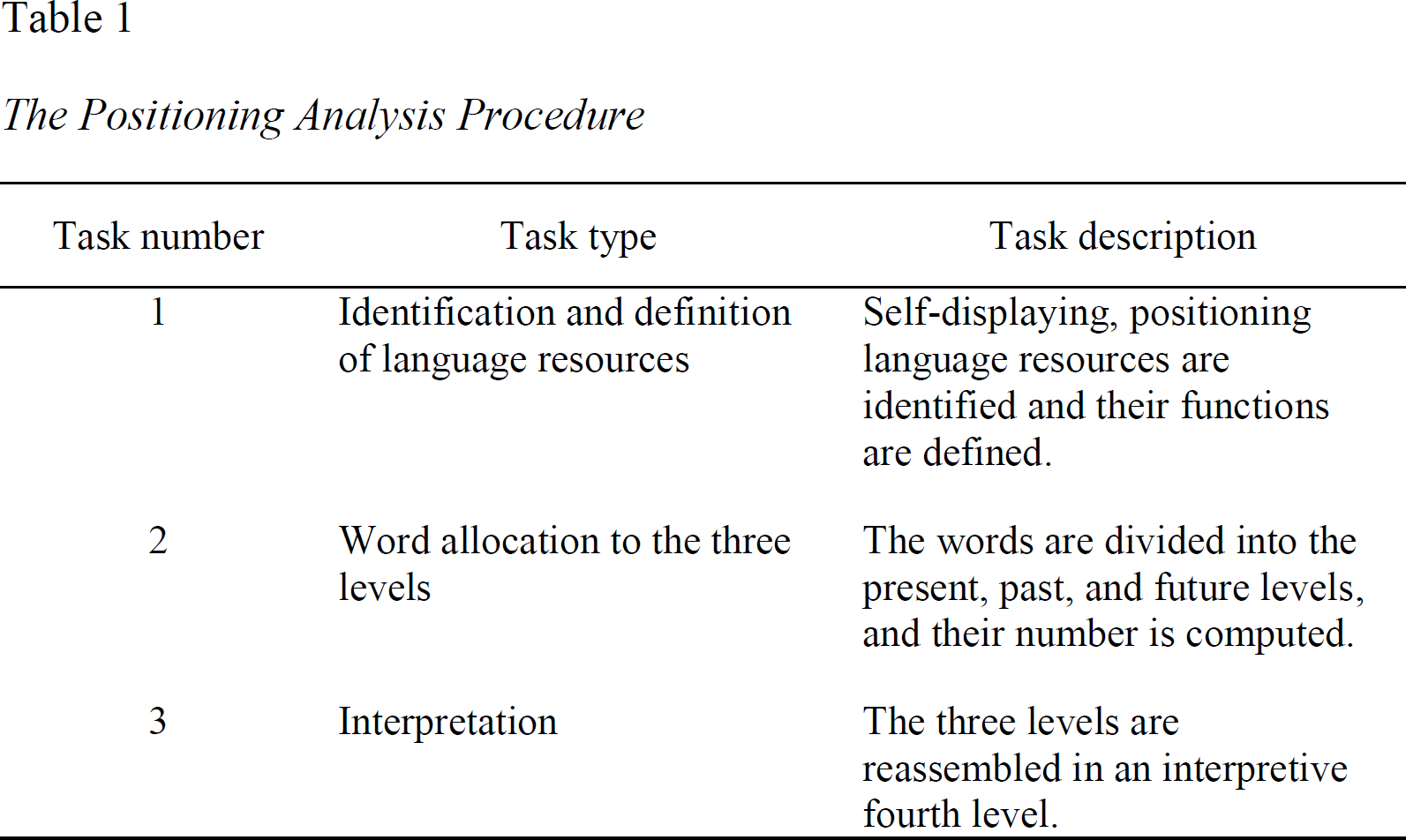
Following ICA, Author 3 and Author 4 conducted a turn-by-turn analysis in order to identify, describe, and interpret the turn design as it emerged in the conversations. Then, Author 1 and Author 2 applied the level analysis by dividing the text into levels (i.e., present, past, and future) so as to extract meaning from each. Finally, we reconstructed those levels on the fourth interpretive level, presented in the findings and discussion sections of this article, when the insights gleaned via microanalysis of the other levels were associated with theory. Table 1 summarizes the positioning analysis procedure.
The Positioning Analysis Procedure
Aims and Research Questions
The aim of the study was to focus on the contribution of the procedure of method triangulation in the study of a schizophrenic inpatient's positioning. Accordingly, we asked two research questions: How does each method contribute to the data analysis? How does the combined use of the two methods enhance self-construction?
The Present Study: Participants, Data Collection, and Transcription
The study was conducted by a team comprising two psychiatrists working in a mental health center in Israel, a psychologist, and a discourse analyst. The study was approved by the Helsinki committee at Lev-Hasharon Mental Health Center, and strict measures were taken to preserve the complete anonymity of the inpatient.
The interviewee is Rita (pseudonym), a 59-year-old woman diagnosed as a paranoid schizophrenic (American Psychiatric Association [APA], 2000). She was born in Europe and immigrated to Israel when she was 25-years-old. She is married and has children. She has been hospitalized 21 times in open and closed wards since 1983, and has been treated with antipsychotic medications.
Author 3 and Author 4, who work in the mental health center, decided to interview Rita because she enjoys talking and they were convinced that she would benefit from the interviews. Data collection comprised audio recordings of eight 30-minute, semi-structured qualitative interviews (Hunt et al., 2011) over a six-month period. They were conducted by Author 3 who is trained to conduct interviews with inpatients, and who was acquainted with Rita and could thus ensure that she felt comfortable during the interviews. The interviewer told Rita that the interviews were being conducted for research purposes, and she was encouraged to choose conversation topics that interested her. We did not videotape the interviews because Rita's psychiatrist thought it would create a disturbance. Rita agreed to participate in the interviews and signed an informed consent form.
Guided by the aims of the study, to explore Rita's positioning as it was constructed via language resources, we used a selective transcription procedure (Davidson, 2009) that highlighted the positioning language resources. We had the excerpts presented in this article translated by a professional translator, a native speaker of English. Subsequently, two bilinguals read the Hebrew and English versions of the excerpts and evaluated the adequacy of the translated versions. The readers suggested several minor changes, which we accepted.
Summary of the Findings
Institutional Conversation Analysis
ICA showed that every interview consisted of three parts. In the first part, there was an opening initiated by the interviewer's turns addressing Rita to find out how she was feeling. In the second part, the interviewer's turns afforded Rita a discursive space to talk about topics of her choice. In the third part, the interviewer signaled to Rita that they had to terminate the encounter. In sum, ICA highlighted the turn-taking design, thereby demonstrating that the interviewer's turns set the institutional boundaries of the interview.
This structural description is supported by descriptive statistics. When we counted all the words from the eight interviews, we found 96% were produced by Rita and 4% were produced by the interviewer. In part one, Rita produced 4% of the total number of words, in part two 78%, and in part three 18%. In other words, the statistics emphasize that in these interviews, Rita did most of the talking and the second part was the longest part.
Examples 1 and 2 illustrate the interviewer's contribution to the turn-taking design of the interviews. Example 1 is taken from the very beginning of the first interview. “Ier” and “Iee” stand for “interviewer” and “interviewee,” respectively.
In Example 1, the interviewer opens the conversation (line 1) and encourages the inpatient to speak about the topic that she has chosen (lines 7–8, 11–12, 14, 17–18, and 22). The interviewee asks several clarification questions (lines 13, 15–16, and 28) and seeks a direction from him (lines 9–10, 23, and 30–31). When he reassures her that all she is required to do is talk, she takes three turns in which she repeatedly seeks his help in defining the topic of the conversation. The interviewer consistently but amicably (as the recording attests) refrains from supplying a direction, thereby obliging the inpatient to verbalize topics of her choice. Example 2 is taken from the end of the first interview. It shows how the interviewer attempts to terminate the interaction.
Example 2 shows that although the interviewer attempts to bring the interaction to an end (lines 1, 3, 23, and 28–29), Rita ignores his repeated signals to do so (lines 2, 4–5, and 24–25). It is noteworthy that Rita's attention is selective: When the interviewer does relate to the content of Rita's turns and suspends the request to terminate the interview, she is attentive to his questions. Rita's selective attention probably shows that she wishes to go on talking. The same pattern is revealed in the third part of all the other interviews.
Together, Examples 1 and 2 provide empirical evidence showing that in these institutional encounters, the interviewer gives Rita the floor, signals the shifts from one part of the interview to the next, and is the custodian of the institutional time resources that are available in the hospital setting. Although Rita partially accepts the boundaries that have been set, when it is time to terminate the interview, she does not abide by institutional norms and attempts to continue the conversation. In sum, the use of ICA highlights the institutional dimensions of the interactions that take place in a hospital.
Level Analysis
After we completed the ICA analysis, we applied the level analysis by dividing the text into levels (i.e., present, past, and future). We computed the percentage of words produced by Rita on each level of analysis out of the total number of words produced in the eight interviews. Across the different parts, Rita produced 16% of the total number of words in the present, 80% in the past, and 4% in the future.
Rita's positioning in the present
Reanalyzing Example 1 via the positioning analysis, we see that metaphors constitute a salient self-displaying language resource. In response to the interviewer's initiating turn giving Rita the floor (lines 7–8), she produces several metaphors in order to position herself in the ongoing interaction as an inpatient who is seeking help (direction, the next stage, receive a tiny tiny bit of order, to tidy up, return to the same track, a branch.)
The interviewer only intervenes to ask a clarification question or when Rita addresses him directly. As a result, Rita is placed at a critical discourse junction where she has to choose a conversation topic. In lines 23–28, she verbalizes her process of choosing among various topics. When she does not succeed, she produces a cluster of metaphors (i.e., two or more metaphors occurring in a sequence and focusing on the same theme, produced when interlocutors experience an external or internal obstacle undermining communication [see Cameron, 2009 for a summary of other functions of metaphorical clusters; Kupferberg & Green, 2008a, 2008b]). This cluster enables her to express how she views this process. Using metaphors, Rita accomplishes two complex discursive tasks. She defines her illness (multilayered, scatterbrained) and relates to the possible effect of the help she would get (my gain, to receive a tiny tiny bit of order from you, to tidy up, we don't return to the same track another time, talk about this branch or that branch). It is interesting to note that at this point, Rita actually shifts her attention from the ongoing conversation in the present to the future.
In sum, Example 1 shows that on the interpersonal level of the present, within the space that is afforded her by the interviewer, Rita succeeds in positioning herself coherently in relation to the psychiatrist as a help-seeker who requests this help because she is a bit multilayered (Example 1, line 29) and scatterbrained (line 29). Her success in positioning herself in relation to the psychiatrist is repeated in other encounters as well. In other words, at this encounter level, Rita knows who she is and succeeds in constructing this dimension of herself vis-à-vis the psychiatrist.
Rita's positioning in the past
In Example 3, produced in the second part of the first interview, Rita describes her life after emigrating from Romania to Israel, when she studied Hebrew at an Ulpan (i.e., a school where new immigrants lodge and study Hebrew intensively for a period of time).
In this example, Rita positions herself clearly in two sequentially ordered past-tense stories (see note 2) (lines 1–10 and 12–18). In the first story, Rita depicts the first two weeks at the Ulpan when she was alone and therefore read a lot. In the second story, she describes how she and Zeev, a male friend, met and became good friends.
The two stories are prefaced by orientation (see note 2) (lines 1–6), providing the background and showing that, like other narrators, Rita is mindful of the presence of the psychiatrist at this point in the conversation, and wishes to provide him with all the necessary information regarding the story.
Pronouns, which appear in italics, are a salient positioning language resource in Rita's stories. In the first story, Rita (I)—a young and lonely woman seeking a male partner—positions herself vis-à-vis other couples she does not know (e.g., everyone's walking in couples). In the second story, Rita focuses on the formation of a tie (we) with a male friend (he).
Syntax is another positioning resource indicating how Rita locates herself in relation to Zeev. In “there's someone to teach me how to swim,” she is the object, or recipient, of the action of teaching rather than the agentive subject initiating it. Berman and Slobin (1994, pp. 520–522) show how high, medium, and low degrees of agency are constructed in narrative discourse by means of evaluative syntactic devices. A high level of agency is effected when an agent is in the subject position of an active sentence; a medium level when the subject agent is demoted to a prepositional phrase; and a low level when the agent is embedded in a prepositional phrase and functions as a source adverbial.
The same dependence on men was also illustrated in Rita's positioning vis-à-vis the interviewer in the analysis of the level of the present. In sum, in Example 3, emphasizing her dependence on men, Rita positions the self of a young lonely woman who consoles herself by reading and then in the company of a young male friend.
With the exception of Example 3, Rita fails to position coherent dimensions of herself in any of the stories she produces. Example 4 was produced in the second part of the first interview. Following a remark made by Rita that Boris (a male friend she met after meeting Zeev) was a spy, the interviewer asks her how she knew this.
In Example 4, Rita narrates two stories (lines 1–10 and 10–17); however, her positioning (i.e., who she is) in these stories is not clear. In response to the interviewer's question, she produces a reassuring “listen to what happened,” and subsequently unfolds the first story, focusing on an event that took place when Zeev, her first male friend, met her and called her “a whore” in public. The story is not related to the interviewer's question. The second story unfolds following another apparently logical comment (”What turns out”). Chronologically, the second story took place before the first and it focuses on a rape that she allegedly experienced.
Constructed dialogue (Buttny, 1997) is an important positioning resource by means of which Rita attempts to recycle Zeev's voice (line 3–4) and her own voice (lines 7–10). It is important to bear in mind that it is Rita who produces these voices. It is possible that Rita interprets Zeev's attempt to position her as a woman who engages in sexual acts for money as an indication that he is angry that she has left him for another man. Then, when Rita recycles her own voice in lines 7–10, it is not clear who is talking and which self is positioning itself. Does Rita position the self of a whore? Or is she perhaps a young woman who wishes to get married and have children and therefore protests against Zeev's attempt to position her as a whore? In the second story, a third dimension of Rita's self is presented: that of a rape victim.
In sum, in Example 4 it is difficult to identify which dimensions of the narrator's self are positioned because four selves are presented: a whore, a would-be wife, a mother, and a rape victim. It is unclear how the four selves are related to each other. When Examples 1, 3, and 4 are compared, Rita's positioning in Examples 1 and 3 is recognizable, but it is not evident who Rita is speaking as (Malone, 1997) in Example 4. This difficulty is identified in most of the other past-tense stories she narrates in the encounters. This example provides empirical evidence supporting Lysaker and Lysaker's (2006) claim that schizophrenics find it difficult to move meaningfully among their different self-positions whereas healthy human beings manage to do so (Hermans, 2008).
Delusional discourse and the future level
Our analysis also showed that Rita produced delusional discourse (see Example 5 below). A delusion is defined as “a persistent false psychotic belief regarding the self or persons or objects outside the self that is maintained despite indisputable evidence to the contrary” (Sadock & Sadock, 2008). Descriptive statistics showed that 11% of Rita's words were delusional, 75% in the past, 22% in the present, and 3% in the future. Example 5 is taken from the second part of the fifth interview when Rita asks if she can talk about going back home to live with her husband. In this interview, the levels of delusions and future are mixed together.
In response to the psychiatrist's question about why she has not been discharged, Rita explains that another hospital therapist informed her that because she was involved with the General Security Service, she cannot be discharged and has to continue her clandestine activities in the hospital. Employing rhetorical questions (lines 18–21), Rita protests against this decision. These questions also construct an alternative, a future, where Rita locates herself both geographically and emotionally at home. There, she emphasizes, she can continue her activities as a secret agent.
In sum, in this interview, the levels of delusion and future are mixed together and are not salient as the word count presented earlier shows; however, from the point of view of positioning, Rita does manage to position a clear dimension of herself that is delusional but clearly shows who she thinks she is (see analysis of delusional discourse in Kupferberg et al., 2012).
Discussion
The application of two methods enabled us to illuminate different dimensions of the schizophrenic interviewee's discursive positioning that was interactively constructed with the interviewer. Turn-by-turn institutional conversation analysis (ICA) (Heritage & Clayman, 2010) shows that the interviewer conceptualized these encounters in terms of the limited chronological time resources available at the hospital. Accordingly, his turns fulfilled various institutional functions: they afforded the inpatient a floor to speak about topics of her choice, signaled shifts from one part of the interview to the next, and brought each interview to a conclusion. Thus, the institutional turn design positions the inpatient in a time-bounded setting. ICA also shows that the interviewee did not accept these limitations and attempted to continue the interview even when it drew to an end (see Example 2).
The positioning analysis illuminates how the schizophrenic inpatient functioned discursively in the institutional discourse space afforded her, as demonstrated by the first analysis. Specifically, it shows qualitative differences related to her discursive positioning. The level analysis shows on which level the inpatient was able to position herself. On the level of interpersonal communication vis-à-vis the interviewer in the familiar hospital room, Rita successfully positioned different but coherent (see note 1) dimensions of herself (e.g., a patient seeking help, a grandmother knitting for her grandchildren, a keen cook, an embittered wife, etc.). On this level, she was also able to use language in order to define, compare, and even meta-cognize. However, when she attempted to unfold her tormented past-tense stories and had to rely on her memory, or when she planned future narratives dealing, for instance, with her longed-for homecoming, she usually did not cohere, at times wondered who she was, and produced delusional discourse (see Examples 4 and 5). In other words, the study provides naturally occurring empirical evidence that emphasizes both the strengths and the weaknesses of the inpatient as revealed in her minute-by-minute attempts to conceptualize discursively who she was in the interviews.
The findings that emerge from the present study suggest that the process of discursive positioning should be redefined. Previous definitions presented earlier in the theoretical review state that humans position themselves coherently in interaction (e.g., Davies & Harré, 1990; Wortham, 2004). Such definitions do not acknowledge the unique positioning of people suffering from mental illness, where partial positioning such as Rita's is manifested. A more comprehensive definition of positioning would describe the process in terms of a continuum comprising different degrees of positioning, including shifts into a delusional landscape (Kupferberg et al., 2012).
We further claim that the present study provides empirical evidence supporting Lysaker and Lysaker's (2006) explanation regarding schizophrenics' experience in narrating the story of their lives. These researchers espouse a dialogical approach to self (Hermans, 2008), which emphasizes that the healthy human self has no central core but instead multiple self-voices (or I positions) that are in dialogue with each other. Schizophrenics, Lysaker and Lysaker (2006) argue, find it difficult “to move meaningfully among self-positions” (p. 176) as we show, for example, in Example 4.
In this vein, the present study foregrounds the contribution of the level analysis of positioning, which shows when the inpatient succeeded or failed to position herself. Lysaker and Lysaker's (2006) general explanation does not fully account for Rita's partial success in positioning herself. Accordingly, in our current research we have been applying the level analysis to the discourse of other schizophrenia inpatients to see to what extent the level analysis is able to identify when inpatients succeed or fail to position themselves on different levels.
In what way does the use of method triangulation contribute to the research on the communication of schizophrenics? ICA enabled us to draw the rather expected doctor's time-bounded linear trajectory. The positioning analysis was sensitive to the minute-by-minute changes in the inpatient's non-linear trajectory that her consciousness paved as she was trying to interact with the psychiatrist, relate to past experiences, or construct possible future landscapes. To our knowledge, no study has used a positioning analysis to explore a schizophrenic patient's trans-level shifts in naturally occurring discourse.
In conclusion, the use of two methods enabled us to conceptualize the interviewer-interviewee encounters from two perspectives. ICA highlighted the institutional dimensions of the interviews where chronological time plays an important role. The level analysis revealed the strengths and weaknesses of the schizophrenia inpatient's discursive positioning in journeying back and forth across the levels of narrative time within the institutional context. The findings gleaned from both analyses suggest that each one contributed to the exploration of text complexity brought about by mental illness, and illuminated different aspects of it (Tracy, 2010).
Footnotes
Acknowledgements:
We thank the anonymous readers for their valuable comments on an early version of the article.
1.
A full definition of coherence is beyond the scope of this article. Following Bublitz (1999), Kupferberg and Green (2005), and  , we define discourse coherence as a process interactionally constructed in naturally occurring discourse in a specific context during which interlocutors attempt to construct meaning. The process may be successful or unsuccessful.
2.
Following Riessman (2007), we emphasize that what distinguishes a story from other genres of discourse is “sequence and consequence: events are selected, organized, connected, and evaluated as meaningful for a particular audience” (p. 430). Narrative analysts often use Labov's model (1972) of the personal story, which comprises: an abstract, which summarizes the gist of the story; orientation, which furnishes the background; complicating action, which is the sequence of events creating a problem or an unexpected situation; evaluation, which provides the narrator's attitude; resolution, which shows what happened in the end, and a coda, which shifts the perspective to the present. Narrative evaluation “is the means used by the narrator to indicate the point of the narrative, its raison d'ětre, why it was told” (Labov, 1972, p. 366).
3.
We adopt Georgakopoulou's (2007) action-oriented definition of genre, which is informed by “recent re-theorizing of genres away from formal classifications as the basis for text-distinctions and with an emphasis on the members' conventionalized expectations about the activities they are engaged in, the roles and relationships typically involved and the organization systems of those activities” (p. 78).