




Abstract
In this paper the author tells the story of how the technology she used in her research reshaped her thinking about her research as she reshaped the technology for purposes beyond its initial intent. Her research story provides a real-life example of the dialectical relationship between humans and technology. When she immersed herself in a multimedia authoring environment called Flash in the process of her research, the experience led to the reorganization or restructuring of her thinking, and her research looks very different than it would have if she had used technology only as initially planned. She discusses the performative potential of new media and, in particular, a digital environment she created to store, organize, and represent her data, and she discusses the role of the digital environment in providing a meeting place for the participants and the researcher in the study. Thinking with new media on an ongoing basis in her study meant thinking about research data, analysis, and presentation through the lens of new media's affordances: multimodality, multilinearity, and performance.
Introduction
I set out to research poets' views of poetry and their views of the teaching and learning of poetry in a new media age. What constitutes “new” in “new media” is evolving rapidly. In this paper I use the phrase new media to refer to the multilinear and increasingly multimodal and performative (which I will elaborate on later in this paper) nature of digital communication. As part of the research process, I used the multimedia tool Flash to create digital poetry explorations that represented or extended the ideas of the poets. These were shared with the poets and served as objects for further attention to and discussion of the poets' ideas. At the start of the research, my intended use of Flash was limited to the creation of the digital poetry explorations. However, as I immersed myself in using Flash, my view of data storage, organization, analysis, and representation was disrupted and reorganized. The boundaries between the various stages of research became blurred as I began to use Flash as a tool for handling the video data from my interviews with the poets. I also began to see my research as a research performance, as I stored and thematically organized my video data in a publicly accessible website.
Flash became not only a tool that I used to create a digital environment for carrying out all stages of my research but also a collaborator in my research process, whose multimodal, multilinear, and performative affordances permanently stained my research thinking. At the same time as Flash disrupted and reorganized my thinking, I used it for purposes for which it is not typically intended. Flash is commonly used to create many of the sleek ads we see online. It is also used for creating online interactive content and sometimes educational content used in social science research. However, it would be uncommon to label Flash as a research tool. I should note that although I have so far attributed the transformations I experienced to my use of Flash, I see Flash as an instance of the multimodal, multilinear, and performative affordances that permeate today's new media world. Therefore, the focus and claims of this research are not about Flash specifically but, rather, about the possibilities of new media in general.
It is interesting that in conducting this study of poetry in a new media age, my view of poetry was also influenced in a fashion similar to what I experienced about my view of my research process. My use of Flash to create digital poetry explorations and to also store and analyze my video data drew me to attend to the role of performance in poetry and, more specifically, to digital performance. Before I began this research, I would have considered a poem and its performance as two distinct, separate artifacts. A poet writes a poem: That is poetry. A poet reads a poem: That is performance. I would have seen the poem ending at the edge of the page and the performance starting on the stage. But it seems to me that this perception, this separation of poetry and performance, is rooted in a view of poetry as a printed artifact.
Reading or writing poetry in a new media environment, however, facilitates the integration of a variety of modes of expression. For example, in a new media environment the poem might be read, with only some of the words printed on the screen; images or video clips may be incorporated to express the feelings that the poet wants to portray; perhaps some form of music might be added at appropriate places in the reading of the poem; the poet might also add video clips of herself telling stories that relate to the poem; she might want to share more than one version of the poem, perhaps earlier or simply alternate versions, in the same way we sometimes see an artist's earlier drawings or sketches hanging beside the finished artwork in an art gallery. The question in my mind would then be, Where does the poem end, and where does its performance begin?
The preceding paragraphs represent the highly condensed story of my research experience with new media and introduce the ideas that will be the focus of this paper. Below, I situate these ideas within the research literature and offer a rationale for attending to them. I then briefly describe the study that serves as a background for this paper. Then I tell the more detailed story of my research experience and the role played by new media in my research thinking process. Finally, I return to the performative pull of research with new media and elaborate on its meaning and implications.
Situating my work
What is new or interesting about my experience with using new media in my research? Others, such as Dicks, Mason, Coffey, and Atkinson (2005), have created more elaborate digital environments for multimodal data storage, analyses, and representation. However, as Dicks et al. have noted, “qualitative researchers have still not made the best uses of technology” and “social scientists can and should explore what new technologies can do for them and their research” (p. 2). In this context, my experience serves as one more of the few examples that exist of using technology across the various stages of research. It also offers a glimpse into the researcher immersing herself in the “minefield of complexity” that results from the plethora of technological resources (p. 87) available. It is one thing to use new media artifacts and processes; it is another thing to create new media artifacts and processes as I have done in my research. What are the challenges faced by the researcher in the latter case, and how does she deal with becoming familiar with new technologies and the effect on her research?
In addition, the idea of performance in research is not new, having at least two decades of history in performance ethnography (McCall, 2000), and “the attention to performance is interdisciplinary” (Denzin, 2000, p. 905). However, I did not set out to use a method that is oriented toward performance. I initially focused on social constructivism and grounded theory, a hybrid method that might be referred to as constructivist grounded theory (Charmaz, 2000). What is new or interesting about my experience is the transformation that occurred during the research process: the reorganization and restructuring of my thinking about my data storage, organization, analysis, and representation that unfolded as I started to use Flash to develop digital artifacts that were meant to be objects of the research. My research story provides a real-life example of the dialectical relationship between humans and technology, what Levy (1997) has called a “cognitive ecology” (p. 200) and what Borba and Villareal (2005) have suggested to be the “reorganization of thinking” (p. 13) when working with new media. Levy argued, “The system for the production and distribution of knowledge doesn't depend on the individual features of the human cognitive system alone, but also on collective methods of organization and the instruments with which information is communicated and processed” (p. 200). Issues of a cognitive ecology, where the researcher's thinking interacts with or is mediated by the digital media, are new issues in qualitative research. In part, my intention in this paper is to initiate a dialogue about the process for developing a conceptualization of how conducting qualitative research using new media changes the research process, the way we construct and conduct our research, and the way we communicate our research to the broader research community.
Borba and Villareal (2005), researching students doing mathematics with new media, suggested that different media reorganize thinking in different ways. They quoted Noss and Hoyles (1996), who have emphasized the role of computers or any tool as mediators of knowledge: “Focusing on technology draws attention to epistemology—all technologies—inevitably alter how knowledge is constructed and what it means to any individual” (p. 106, emphasis in original). The authors also quote Tikhomirov (1981), who claimed that the computer plays a mediating role similar to the one played by language in Vygotskian theory (Vygotsky, 1978). “Tikhomirov bases his theory of reorganization on Vygotsky's notion of regulation by language and on the argument that regulation provided by computer technology is qualitatively different when compared to that provided by language” (Borba & Villareal, 2005, p. 13). In my case, a reciprocal relationship developed as I immersed myself in Flash in developing the digital poetry explorations. Flash became a thinking tool for me, and although Flash was not created for research purposes, it soon became clear to me that I could use this technology for a variety of stages in the research process.
The general idea that the use of technology is not neutral is not new. More than four decades ago McLuhan (1964) coined the phrase “the medium is the message” (p. 9) and drew our attention to the structural and sometimes subtle and unnoticed changes that are introduced in our lives as a result of the use of a new innovation or idea. In this model knowledge is seen as contingent and is “negotiated” among the various “participants” (human and digital) in the research environment. In addition, as Kress (2003) has pointed out, “knowledge changes its shape when it is realized in … different modal material. Multimodality, and multimodal design, has therefore deep epistemological effects” (p. 50). In the research elaborated here, new media's affordances, namely multimodality, multilinearity, and performance, had a direct impact on the research process and how I viewed the research in general. As social science researchers make use of new media in their research, it is important to be aware of the changes that might inadvertently be introduced. The case of my experience with new media offers insights into how such changes can occur when they were not initially planned or anticipated, and into the dramatic ways in which new media can mediate changes in the research process. The case of my experience also suggests that the use of new media adds a performative pull to the research process.
Background: the study
In this section I outline the initial intent of the study, which serves as the context for this paper and describe my view of the study before I immersed myself in using new media in my research.
Overview of the study
The study (which formed the basis for my doctoral dissertation [Hughes, 2006] focuses on poets' views of poetry, and of the teaching and learning of poetry, in a new media age. The study is situated at the intersection of (a) poetry, (b) digital learning environments, and (c) multiple literacies and new literacy studies. In it I explored the boundaries of what can be done with poetry in schools, especially in a digital environment. I began this study with three broad questions, which were designed to address pressing issues related to new literacies study in general and the teaching and learning of poetry in a digital age in particular: According to poets, (a) what are the most important things to appreciate about poetry, (b) how should poetry be taught, and (c) how might new media help us reconsider what poetry is and does in the classroom? Each of the poets chose one of their poems to talk about and, when appropriate, to use as a context for illustrating some of the ideas they discussed.
The study is based on interviews with four prominent contemporary Canadian poets: Cornelia Hoogland, Penn Kemp, John B. Lee, and Molly Peacock. It was the opportunity of engaging poets in conversation about poetry and poetry teaching that made this research so interesting for me. I wanted to go to the poets: to hear them, to listen to them, to attend pedagogically to what they had to say about poetry and poetry teaching. I also wanted to explore their thinking about the role of new media in poetry. All of the poets in the study have an education background as well as being well respected and published poets. I purposely chose poets with an education background because I considered that they might be better able to address implications for the teaching and learning of poetry.
Theoretical framework
The argument for a pedagogy that takes into account not only traditional print and oral literacies but also visual and multimodal representations has been well established in the literature (Cope & Kalantzis, 2000; Hammett & Barrell, 2002; Kress, 2003; Kress & Van Leeuwen, 1996; Lankshear & Knobel, 1998, 2003; Luke, 1996; New London Group, 1996). A new literacy approach focuses not only on responding to printed texts but also on understanding how texts are constructed and what meaning is conveyed through multimodal representations. According to Knobel and Lankshear (2003), the new literacy studies (NLS) “refers to a new way of looking at literacy,” one that takes a sociocultural approach to understanding and researching literacy (p. 23). A new literacy approach also focuses on “new forms of literacy” (p. 23).
Our students are growing up “digirate” (Pack, 1996). They have been weaned on MSN and Nintendo, and the field continues to grow with their ever-increasing engagement with multiplayer Internet games, e-zines and wikis, and blogs and other social software. As Goodson, Knobel, Lankshear, and Mangan (2002) pointed out, “Young learners inhabit a world of burgeoning new literacies different in kind, scope, and purpose from conventional literacies and familiar language uses forged in pre-digital times” (p. 126). Luke (2003) has argued that the growing abundance of text in digital form makes it necessary for us to redefine our literacy practices. As she pointed out, the “very term and underlying assumptions of literacy probably warrant considered attention because so much of the social and institutionalized ‘schooled’ practice of reading and writing is already so utterly transformed into much more iconographic communications practices” (p. 400, emphasis in the original). What happens when these new reading and writing technologies are used by students and teachers in the English classroom? How can instruction be adapted in response to the changing literacy landscape? (Reinking, 1998). We know from studies in the areas of multiple literacies, new literacy studies, multimodal literacies, and digital literacies that students bring with them sets of skills that remain untapped in the classroom setting (Alvermann, 2002; Alvermann & Xu, 2003; Burke & Rowsell, 2005; Gee, 2003; Knobel & Lankshear, 2003; Kress, 2003; Marsh, 2003; Pahl & Rowsell, 2005; Short, Kauffman, & Kahn, 2000). We need to investigate how digital media are changing the literacy practices of our students.
Ignoring this phenomenon in our classrooms would be a mistake. If we do so, we run the risk of losing touch, and school might become boring and irrelevant for students as a result. “ICT and the Internet are not going to disappear any time soon. Rather, access and use will become easier and simpler” (Hammett & Barrell, 2002, p. 13). Using an “asset model,” which suggests a more constructive approach to exploring the impact of new technologies on students' literacy practices, I am working on the assumption that engaging in reading, writing, speaking, listening, viewing, and representing with new media “can work as a benefit to literacy instead of as a social deficit” (Mackey, 2002, p. 199).
Methodology
In the early stages of my research (before I immersed myself in new media as part of the research process) I had a clear idea of what methods I would use but had some difficulty identifying the method I would use. I settled on a constructivist grounded theory framework (Charmaz, 2000) because I felt that it was flexible enough to meet my needs for this research project and also because I think the emphasis on the cyclical nature of gathering the data and then using the data to generate insights, hypotheses, and further questions fit well with the shape and purpose of my research. Grounded theory (Charmaz, 2000; Glaser & Strauss, 1967) employs techniques of induction and deduction to develop theory. According to Charmaz, constructivist grounded theory “celebrates first hand knowledge of empirical worlds, takes a middle ground between postmodernism and positivism, and offers accessible methods for taking qualitative research into the 21st century” (p. 510).
The use of a constructivist grounded theory was a good fit within the initial intent of the research and the multiliteracies theoretical framework used as the foundation for the research. Working from the assumption that we are embodied, social, and situated beings, a multiliteracies approach promotes “immersion in meaningful practices within a community of learners who are capable of playing multiple and different roles based on their backgrounds and experiences” (New London Group, 1996, p. 33). Such a pedagogy draws on the expertise and experiences of all members of the community, and takes into account the “affective and sociocultural needs and identities” of all learners in the group. A constructivist grounded theory approach “assumes the relativism of multiple social realities, recognizes the mutual creation of knowledge by the viewer and the viewed, and aims toward interpretive understanding of subjects' meanings” (p. 510).
Method
In brief, I initially planned to use the following method:
Conduct initial interviews with each of the poets, using questions that elaborated on the study's main questions. Video record the interviews.
View and transcribe the video recordings of the interviews.
Conduct a content analysis (Berg, 2004) of the transcripts, identifying themes and designing follow-up questions for the poets.
Create poetry explorations that represented or extended some of the ideas discussed by the poets. Post these on my website for the poets to view.
Conduct follow-up interviews (videotaped) with the poets based on the new questions designed. As well, get the poets' reaction and feedback on the poetry explorations.
View and transcribe the new videotaped interviews.
Conduct a content analysis, identifying themes that emerge.
Compare and contrast the themes from the first and second interview data, and create a merged listing of themes.
Conduct a second content analysis of all interview data, verifying the themes.
Select quotes from the data that help illustrate the themes identified.
Thinking with new media
Below I relate how I used new media in my research and how this influenced the research process.
The poetry explorations
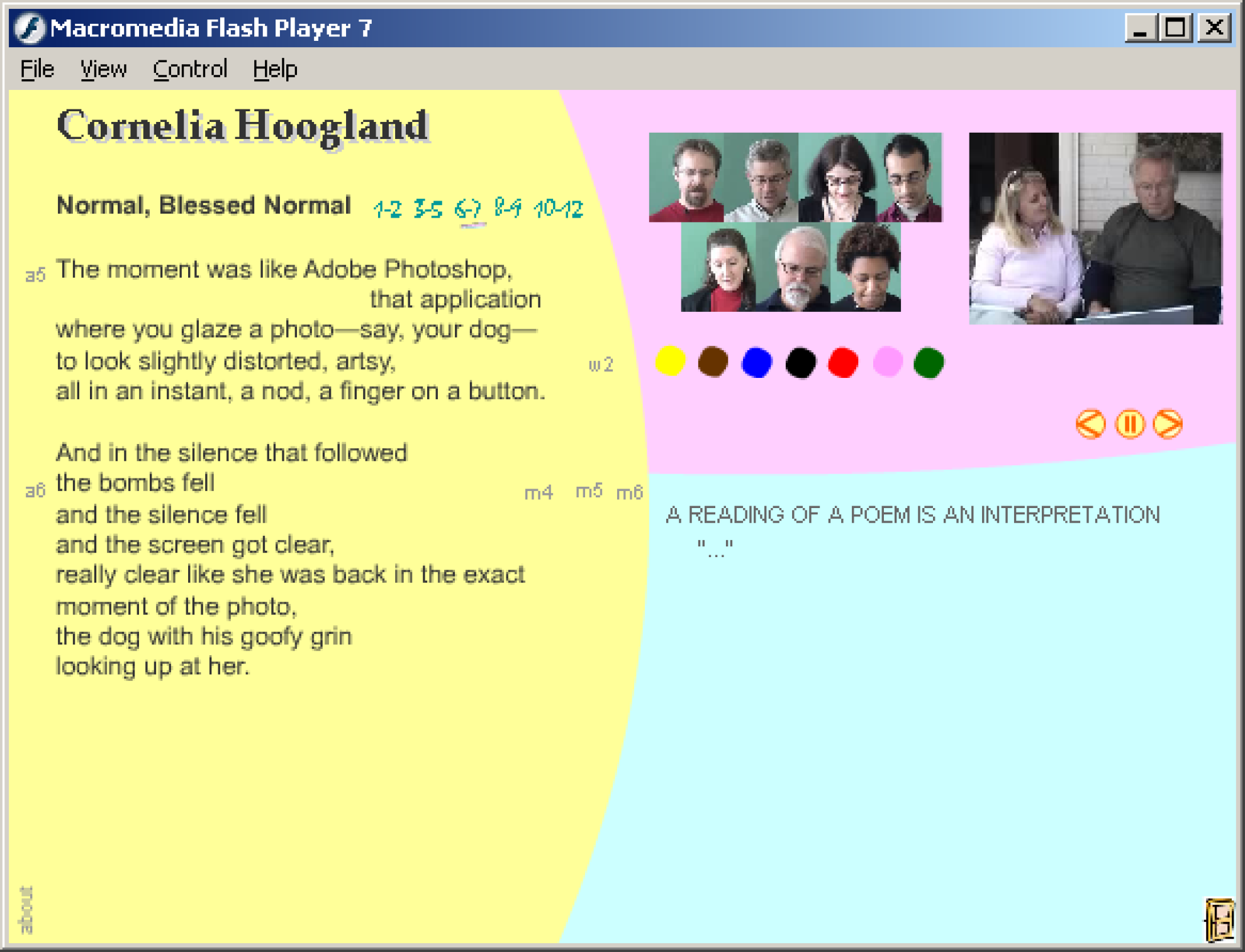
As noted earlier on the process of gathering the poets' expert opinions on the nature of poetry and poetry teaching and learning, the research involved creating poetry explorations based on the poets' poems that illustrate and explore their ideas about poetry and new media and serve as objects for further discussion. For example, one exploration focuses on the oral reading of a Hoogland poem by eight readers of different ages, ethnic backgrounds, and genders, including the poet herself (Figure 1). This was based on Hoogland's comments about the importance of oral readings of poems and the effect that different readings have on the same poem, adding layers of meaning and changing its feel. In the poetry exploration each reader offers his or her inflection, drama, and interpretation. Such a multimodal approach (with an emphasis on the aural, in this case) can offer new and powerful ways to think about and understand poetry (Luce-Kapler, 2003). Another poetry exploration models Peacock's suggestion that looking at the verbs or nouns in a poem is one way to “read” the poem. This poetry exploration allows the user the option of reading the original poem, or just the nouns or verbs in the poem, or both the nouns and the verbs, or just the adjectives. The poetry explorations were intended to allow the researcher to explore and play with ways identified by the poets of reading or representing their poems.
Multiple readings
It is important to note that in developing interactive content in Flash (and other Web tools), it is common practice to design the videos, images, and interactive pieces that comprise the interactive content as separate digital entities that sit outside the “shell” of the initial user interface and are loaded as needed. This type of design is vital in an online environment because otherwise the user would have to initially wait much longer for the poetry exploration to load. It is more efficient to load the various content components as needed in response to user interactions. I draw attention to this design process because it was this affordance of the multimedia authoring program that gave me the idea—that metaphorically modeled for me—that I could also represent my data of all the video interviews with the poets in a similar fashion.
The video data
Initially the video data informed the poetry explorations but was not part of them. However, as I became familiar with the process of designing the poetry explorations in an environment where different components were loaded as needed, I naturally wondered what else might be needed to add meaning. In the first stage of thinking about the design of the poetry explorations through the lens of the authoring environment, I decided that including the poets' video comments that prompted the poetry exploration would help add context and meaning. Consequently, going through the process of creating small video clips, converting them to a format that was readable by Flash, and compressing them so that they would be accessible in an online environment helped me see my streams of video data as collections of short clips.
Viewing the video data as clips on research topics or themes is compatible with the content analysis that I intended to do as part of my research process. I started to see Flash as a tool that I could use to store video clips I identified in the process of my content analysis and to organize them thematically in a digital environment. The first iteration of this digital environment involved taking the first Hoogland interview, creating small clips, labeling each with a meaningful title, and using the titles as links in the digital environment that, when clicked, loaded the appropriate videos in a video player. I also added Hoogland's poem “Normal, Blessed Normal,” which Hoogland referred to in her interview, to the environment so that I could have ready access to it when viewing the video clips. Figure 2 shows this first state of the digital environment, with Hoogland's poem, the hyperlinked titles that loaded the various video clips, and the video player. Although, as all researchers do, I made decisions about which portions of the interviews to include in the study, the bulk of the editing done was in rearranging the sequence of what the poets said (based on research themes) rather than editing out parts of the interviews.

The initial design of the digital environment
The digital environment
The digital environment I created to house the data enabled me to move segments quickly and easily from place to place or from one category to another. It allowed me to play with various ways of organizing the video data, the poems, and the poetry explorations before settling on an organization that best represented the research. It also allowed me to return to the interview data repeatedly, multimodally rather than through transcripts, without having to search through files and folders. Most important, its hypertext features facilitated the linking of ideas. For example, as shown in the screen image in Figure 3, I was able to link one of the poetry explorations (an exploration of the nouns in Peacock's poem) with comments on the prototype by Penn Kemp.

The nouns and verbs in a poem
One of the arguments against using software for data analysis is that it sacrifices “the process of spending endless hours sitting on the floor surrounded by piles and piles of paper,” which leads the researcher “to a very rich and thorough familiarity with their data” (Weitzman, 2000, p. 816). Weitzman has argued that using software does not necessarily decrease this familiarity, but I would argue that in my case it intensified my familiarity with my data because I experienced it over and over again in multimodal ways. I spent so much time seeing and hearing the poets in my study—in the processes of video editing, creating video annotations in the digital environment, and considering different ways of organizing the digital artifacts—that I really feel that I know them well. I became familiar with their words, of course, but also with their facial expressions, their gestures, and the tone and inflection of their voices in a way that I would not have if I had transcribed the interview footage into print. I also went back to the video annotations when I wanted to check an idea or refresh my memory of what was said and how it was said, and a big part of the reason I did this is because the technology—the digital environment—made it so easy for me to do so (I did not have to search my shelves for a videotape, find a video player, and search through an hour of video recording to find the short clip I wanted to see. Furthermore, when I saw the video clips, I saw them in the context of other artifacts of my research (the poems, the poetry explorations, and related video clips). Using the technology in this way allowed me to move beyond the static transcript and the linearity and inaccessibility of a standard video recording, and I used the technology to see and analyze my data in an organic, contextual way that honors the qualitative.
I initially viewed the digital environment as my research tool, not as an environment to be shared with the poets or the wider community. However, as I worked to create the environment shown in Figure 2, a number of ideas were emerging:
I could share the video clips with the poets.
I could integrate the poetry explorations into the digital environment
I could use the video comments made by the poets to annotate the poems and the video explorations.
I could make the digital environment publicly available on my website.
I could seek comments from the poets on one another's video clips and explorations, and use video clips of those comments as a further layer of annotations.
I could add my own commentary and analysis of the data using video clips of myself, placed as annotations in appropriate places in the digital environment.
I could use the digital environment as the authoring environment for my dissertation.
Thus, a reciprocal relationship developed as I immersed myself in Flash in developing the digital poetry explorations. Flash became a thinking tool for me, and although Flash was not created for research purposes, it soon became clear to me that I could use this technology to also store, organize, and represent my interview data, and even as an authoring environment for my dissertation.
I discussed the above ideas with my dissertation advisory committee, and they were excited about the prospect of moving in these directions. However, the idea of a digital dissertation was new and unprecedented for our faculty of education, and we decided to check with the graduate studies department before I proceeded. It was noted that moving in this direction would be an uphill battle, and it was recommended that if I did pursue the digital path, I should also create a print version of the dissertation. Dicks et al. (2005) have noted that “academic writing, on the whole, has so far failed to take real advantage of the Web as a creative medium” (p. 59) and that academics venturing in this direction “may find that their work is not acknowledged as properly ‘scholarly’” (p. 67). Although I was excited about the prospect of a digital dissertation, I was hesitant about having to create two versions of my dissertation because (a) the print version seemed redundant and (b) I was looking forward to finishing my doctoral program in time to take on a faculty position in the coming academic year, and preparing two dissertations would delay my graduation. Consequently, I decided (at least for the purposes of my dissertation) not to pursue the last two ideas in the above list but instead to write a print dissertation and attach a CD of the digital environment to allow the reader to view the poems, poetry explorations, and video clips from the interviews.
The research community
Through the digital environment (
The Jello, oh the Jello. I needed it really badly because everything was so tense and foreboding. I just needed to get out of there, I needed to break out, I needed to laugh, and Jello was the way to do it… . It would be interesting to do that with another color to see what the effect would be. For instance, maybe somebody may want to try their favourite color there—what would the effect be?
Consequently, I created a poetry exploration where the user can change the color of Jell-O in the poem to consider its effect. The poetry exploration also contained an image of a bowl of Jell-O, with the color changing based on the reader's choice. Being able to create such a poetry exploration, to physically (digitally) embed it within the context of Hoogland's poem, to annotate it with video segments of Hoogland reading this section of the poem and commenting on it, and then to share it with Hoogland created an opportunity for further discussion and reflection for the poet and for the researcher that is impossible without new media. In addition, it allowed the other poets to see what Hoogland said, to see the poetry exploration, to comment, and to have their video comments added as new annotations in the digital environment. Hoogland could then see video annotations of John B. Lee and Penn Kemp looking into a computer screen, commenting on her work as a poet and on the poetry exploration. Lee noted,
What this [poetry exploration] makes me think about is the difference between yellow as a word and yellow as an actual concrete color because when you go across (and use the poetry exploration to change the color) and see what happens to yourself visually you realize it's very different than what happens in terms of the meaning of the word yellow and what it sounds like when it comes in your mouth… . everything else [other than yellow] seems so entirely wrong and instantly wrong.
The digital environment was an organic (evolving) representation of the data of my research as well as a glimpse into my analysis of the data, as represented by the themes I chose to organize the poetry explorations and video clips. In addition to bringing the poets and researcher together, the digital environment brings concepts, ideas, and technologies together to create and compile rich, descriptive, contextually situated data. In the digital environment all of the data is being enacted even as the discussion happens; that is, all the past conversations and developments are accessible thus producing a collapse of the usual temporal constraints.
New media tools
In developing the poetry explorations and the digital environment, I used a variety of software: Sorenson Squeeze to import video from the video camera and to export shorter, compressed clips in a format that was readable by Flash, Flash to create the digital explorations and the digital environment, and Dreamweaver to create the Web page where the digital environment was published. I was fortunate to have a colleague that I could rely on for expert advice and for some of the initial programming in Flash. This saved a lot of time and made the development task manageable. It also helped me to quickly get a good sense of the potential of Flash and made it easier for me to immerse myself in the development process. Dicks et al. (2005) have noted the “challenge of becoming familiar with a wide range of digital equipment and computer software” (p. 87). It definitely was a challenge for me, especially in becoming acquainted with Flash, which has an extensive and complex programming language, even though I have used technology extensively in my teaching, scholarly work, and personal life.
It would have been possible to store the video data on the Web without using Flash, and this might be an alternative for researchers who do not want to learn how to use a programming language or do not have the funds to hire a programmer. For example, the researcher could use the fairly simple program Sorenson Squeeze to import video from a video camera, to create smaller clips, and to export the clips as compressed video that can be posted on a Web site. Then the researcher could create a simple Web page that contains the poets' poems in one column and the hyperlinks to the video clips in another column, which point to other individual Web pages for each of the video clips. Even more simply, the hyperlinked structure could be created in a presentation program like PowerPoint and then exported as HTML and published on a Web site. For me, the advantage of using Flash was that I had more control over the presentation of the video clips and a way of situating video clips in the context of the poems, the poetry explorations, and other video clips.
Had I not used Flash, the performative pull of new media might have been less compelling. Flash and other software of its genre, such as Director (note the performance metaphor), model the performative affordances of new media not only through the integration and presentation of multiple modes of communication but also by embedding performance metaphors in the language used by the programmers: In these environments you program on what is called a stage, where the objects you create are referred to as actors and actors participate in scenes, interacting with other actors based on their programmed behaviors, which are written in scripts. Immersion in Flash was, in effect, an immersion in a performative metaphor.
Research as performance?
Might research as performance be a useful metaphor, a useful lens, for looking at research using new media? Conducting research in a digital environment facilitates the integration of a variety of modes of expression with performative attributes, which has important implications for researchers not only in terms of collecting, organizing, and analyzing data but also for the representation of the data and dissemination of the findings. The use of digital media introduced for me two performative perspectives: blurring of the boundaries between poetry and performance and between research and its representation.
Using Flash in the research process added a performative aspect to my research method. Had I not used it in the ways that I have described, my research would have looked very different. Using a more traditional approach would not have allowed me to see the data arranged through hyperlinks around the poems and the poets would not have been able to see the comments of the other poets in the same context. I might have used excerpts transcribed from the videotaped interviews in a print version, and the presentation of my data would have been linear. In contrast, what I ended up with was data that are accessible by me, the poets, and the public (on my Web site). The work is embedded within a meaningful context, and because there is a wider audience than the researcher looking at the data, there is an element of performance in the method.
It is new media's performative potential that is most exciting for me as a researcher. A multimodal expression of commentary allows the reader to hear the tone and inflection of the participants, the pauses and emphases, and even the laughter. In addition, we are able to see the participants' facial expressions and gestures, all of which add layers of meaning to their words. Although some of the context might still have been lost, I would argue that more of the original context has been retained in this multimedia representation because of its multimodal nature: The reader can see and hear the poets and can interact with the poetry explorations created from their ideas, and can do so in a contextually meaningful fashion.
Audience
One of the unique features of this research is that the interview data, in the form of video clips, are visible and arranged in a hypermedia format that anyone can access online. Brown (2002) has argued that “digital convergence,” what Covell (1999) defined as the convergence of improved computing capabilities, new digital multimedia technologies and content, and new digital communications technologies, can aid “openness by using it to preserve the original streams of consciousness that qualitative data so often reveals but is so difficult to carry through to representation” (p. 23).
Because it is located on the Internet, the digital environment became a public place that assumes an audience. That audience certainly consisted of the poets and the researcher, but it is also accessible by the general public. My site is also linked from Hoogland's, Peacock's and Kemp's Web sites. Peacock wrote an article for the February 2006 edition of O Magazine in which she discusses her one-woman show The Shimmering Verge, which she performed off-Broadway in New York City in the same month. In the first week of the magazine's publication, Peacock's Web site had an astonishing 4,000 hits. The hits on my site rose dramatically during the first two weeks that the magazine was released at more than 1,300 hits.
Ethics
The fact that the data are available in a public space raises the issue of confidentiality. Although each of the poets was given the opportunity to participate in the study anonymously, they consented to have their names and images used in this format. Had they not consented to have the information displayed on the Web, I could still have used the technology privately by putting the digital environment on DVDs and sending copies to each of the poets. The use of the Internet certainly made the process easier as the digital environment was changing almost daily and the updates could be viewed immediately by the poets at any time. The poets have expressed interest in reading any articles that emerge from the study, and I will provide them with a draft before I present the information to the public. This ensures that we are engaged in the kind of dialectical relationship that I believe is fundamental in qualitative research.
The requisite ethics approval was obtained before the research began. The poets participating in the research are all public figures and chose to participate in this public way even though they were given the option of participating anonymously or not publicly. Other researchers might use a digital environment similar to this one even if their research participants are not public figures but agree to participate as part of a focus group where the data are available to all of the participants as well as the researcher. The site could be protected by password so that only the participants and the researcher would have access. Alternatively, in a situation where all of the participants need to remain anonymous, a researcher might use a digital environment of this kind to sort and organize the data. The site would be accessible only by the researcher, but it would facilitate the sorting and organizing of data and allow the researcher to keep video and audio clips from interviews in their original form, for the most part. Some editing and chunking is necessary but the interview data retains their richness, complete with participants' facial expressions, gestures, tone of voice, and pacing. Such attention to the way the utterances are made, not just what was uttered, serves to honor the qualitative as well.
Lather (1986) has called for a reciprocal relationship between researcher and research participants. To promote this type of relationship, she advocates interviews “conducted in an interactive, dialogic manner,” sequential interviews of both individuals and small groups to facilitate collaboration, negotiation of meaning, and discussions of false consciousness (p. 266). In keeping with this program of openness and in connection with her emphasis on reflexivity for both researcher and research participants, Lather also suggested that the researcher's subjectivity should be evoked in a dialogue with participants and that the changing nature of identity needs to be acknowledged and appreciated. As Stake (2000) has pointed out, “qualitative researchers are guests in the private spaces of the world. Their manners should be good and their code of ethics strict” (p. 447). I involved the poets in this study in the research process by engaging them in conversation, seeking their comments and feedback about the digital poetry explorations I developed, and by returning to them periodically to clarify something they may have said in an interview. In addition, I attended to their voices in a very literal way by ensuring that they are heard by others who are interested. Because the digital environment that houses the research data is available on a website, the poets are able to see how they are presented and quoted.
Multimodality
When transcribing the poets' spoken language for scholarly articles such as this one, I am faced with the dilemma of how best to convey their intended meaning, out of context, to the reader. In a written version I attempt to remain true to the poets' intent and to what was uttered, but the reader does not have access to the cues of inflection, gesture, facial expression, or tone that are incorporated in the multimedia version. Similarly, the screen captures of the digital environment included in the print version of this paper do not transmit the color, graphics and animation, interactivity, or audio and video components of the actual digital environment of the Web site. Although the data available at the Web site are coded in a way that might not be easily accessible to the general public at this point, visitors to the site can experience what it is like to “read” the data in multimodal ways.
New media offer multimodal affordances that we cannot experience through textual form. Of course, there is a long history of using videos in research, particularly as an observational tool (Banks, 2001; Emmison & Smith, 2000; Jewitt, 2006), and interactive content is becoming more pervasive, but using new media in research involves more than just using video. New media enable the researcher to represent multimodal content closer to its original form than is possible with video alone, partly because new media are inherently multimodal and partly because of the ability of new media to represent various modes of content in a multilinear fashion. The linearity of traditional video makes it a cumbersome way to organize and share research data, artifacts, and products with the reader of the research. Searching through an hour of video to find the segment that illustrates a point is not practical. However, the hyperlinking possible with new media offers the researcher and the reader the opportunity to view digital data of various modes contextually.
Kress (2003) has argued that very soon the screen will govern all of our communication practices and language use. Students will understand language use within an electronic medium. As Pahl and Rowsell (2005) pointed out, “Language is not, and clearly will not be, printed texts with incidental images, but instead texts of all kinds with color, different fonts, on monitors or mobile phones with sound, gesture and movement” (p. 4). In digital environments words are no longer static. They are visual and aural and can change size and color; they can rotate, jump, twirl, and fly in; and they can fade and intensify. Different modalities—aural, visual, gestural, spatial, and linguistic—come together in one environment in ways that reshape the relationship between printed word, image, and sound (Jewitt, 2006).
This change in the materiality of text inevitably changes the way we read or receive the text and has important implications for how we construct or write our texts. New digital media are changing our communicative practices, enabling us to express meaning in new ways. What implications do these changes have for qualitative researchers? Dobson (2005) pointed out that “our writing tools—whether chisel and stone, reed pen and papyrus roll, press and vellum, typewriter and paper, or keyboard and computer screen—necessarily influence the way we compose and respond to text” (p. 126). She noted that different types of technologies allow certain kinds of thinking while discouraging other kinds. She also advised, however, that although “new technologies modify human ways of knowing and being” it is a reciprocal relationship because human ways of knowing and being also “bring about changes in technology. We are, after all, both agents and subjects of change” (p. 127). I have certainly found this to be the case in my research.
Trustworthiness
Gaining the trust of research participants is the primary issue in establishing trustworthiness in a qualitative research study (Glesne & Peshkin, 1992). To establish credibility, Merriam (1998) recommends the incorporation of persistent observation, triangulation, peer debriefing, and member checking into the research design. The last three also help to provide assurances that the research participants' experiences as they are represented by the researcher, closely fit their views of the experience. To this end, I engaged in an interactive, dialectical relationship (Lather, 1986) with the research participants, as described in the previous section.
Trustworthiness is also established through the visibility of the data (Mishler, 1990). Not only can the poets see how their words are being used and interpreted; other investigators have access to the data and can determine for themselves whether my findings are accurate or reasonable.
Methodology
New technologies are emerging rapidly, and there are few research models to draw on in our exploration of digital literacies or new literacy studies. Luke (2003) has called for researchers to “craft new hybrid methodologies and theories that, in effect, must play catch-up with the unprecedented textual and social practices that students are already engaging with, often on the sly” (p. 402). Although I did not intend to do this at the outset of my research, I did end up using a hybrid method, adding a methodological layer of what I tentatively call research as new media performance, which draws attention to the multimodality of data, to a sense of audience for the researcher, and to a sense of research as performance. I considered shortening this title to “research as performance”; however, performance within new media is qualitatively different from physical performance. For example, physical performance is linear (in that the events within the performance are experienced in one given sequence) and temporal, whereas new media performance is (or can be) multilinear and it persists digitally after its initial creation. “Hypertext has the potential to realize new interactions between word, image and sound” (Jewitt, 2006, p. 12) and allows us to view the data, in this case, in a variety of ways.
The point I am making is that new media, unlike the printed page, are (much more so) performance media. Writing poetry or conducting research with new media blurs the boundary between the task and its performance. Of course there already exists a performative trend in some research paradigms, such as performance ethnography (Denzin, 2000; Dicks et al., 2005); however, I am suggesting that my research experience points to an important difference. Unlike a performance ethnographer, for example, I did not set out to focus on performance or to use a performance perspective in my research. In the same way that an oral or a text-based culture restricts some and affords other ways of communicating because of the nature of the materiality of the “text,” new media have their own restrictions and affordances. Although I do not believe that the case of my research experience is generalizable to the extent that we can claim that researchers using new media will experience similar disruptions and reorganization of research thinking, it does identify the potential for new media to shift research attention and nudge the researcher towards performative methods.
Thinking with new media on an ongoing basis in a research study means thinking about research data, analysis, and presentation through the lens of new media's affordances: multimodality, multilinearity, and performance.
A look back and a look ahead
Looking back on this paper and the arguments I have presented about new media's performative affordances and their impact on the research process, I feel that I need to add a final qualifying remark about “where performance comes from” (to paraphrase the title of Dissanayake's 1992 book, Homo Aestheticus: Where Art Comes from and Why). Dissanayake has argued that art is not simply a choice or a frill or an activity for people that we label as artists but a biological need. Further, she talks about our “aesthetic sensibility” that “acts as one of our primary meaning-making capacities in all domains” (p. 25). If the use of new media helps to draw us into performative (artful) relationships with our research, I suggest that it is drawing us toward a direction that is entirely human and fulfils a human need to express, to represent, to “elaborate.” Denzin (2003) has pointed out that “we inhabit a performance-based, dramaturgical culture. The dividing line between performer and audience blurs, and culture itself becomes a dramatic performance” (p. x). The performative pull of new media is coupled with the performative push of our desire to perform. Perhaps an example of this from popular culture is the YouTube phenomenon. YouTube, whose slogan is “Broadcast yourself,” plays millions of clips daily in which people from all walks of life take on the multiple roles of artist, actor, musician, performer, and producer.
I mentioned at the beginning of this paper that what constitutes “new” in “new media” is evolving rapidly. It has been just over a year since I defended my dissertation, and what I view as “new media” has expanded to include the collaborative, read/write affordances of what is referred to as Web 2.0. In my current research I have used wikis to create community and collaborative relationships between preservice teachers in Canada and elementary school students in Tanzania. I am also in the process of writing an online textbook for the elementary preservice teachers I teach that includes multimodal content and is published in a publicly available wiki. This “textbook” will serve as a collaborative knowledge construction environment for my classes, raising questions about what constitutes a textbook and who writes course content.
If I were doing my dissertation research today, I would still use Flash to create the poetry explorations, but I would not use Flash to create the digital environment. Rather, I would use a wiki, which would allow me to more easily create a complex, hyperlinked environment that includes my research data but also affords a more collaborative research relationship between me and the poets in the study (who would have the same level of writing and editing rights as the researcher). My immersion in wiki technology has once again restructured my thinking about my research and has helped me ask new and exciting questions around the collaborative affordances of new media and the evolving nature of how I conduct, represent, and publish my research in a collaborative new media environment.