




Abstract
In this article the author presents a scheme that can be used to evaluate the results of focus groups. The novel feature of the scheme is that it involves the situational factors in the analysis: interactional factors, the environment, time factors, the content, personal characteristics of the participants, and the characteristics of the moderator. The author argues that it is worth taking these into account in making an analysis. If the analysis incorporates recognition that the data used are not independent of the concrete situation but are to be seen in context, the conclusions can be richer and more useful.
Keywords
Introduction
Reading the literature, one is struck by the fact that writings on the organization of focus groups are far more numerous and more detailed than those on the analysis of the results. The question of analysis appears to be one of the less well elaborated parts of the methodology of focus groups (Vaughn, Schumm, & Sinagub, 1996). This article is an attempt to fill that gap. In it I present a scheme for evaluation of the results of focus group studies that takes into account certain characteristics of the situation of group discussions.
In focus groups data are generated by the participants in the research, who collectively communicate on a given theme (Vicsek, 2006). 1 When analyzing the discussions, we have to decide whether we want to deal in the analysis with the fact that the data are derived from a group situation; that is, whether we will take into account the concrete situation of the meetings, the nature of the interactions, and the forms of manifestation of group influence.
At present two main trends can be distinguished in this respect. Representatives of the older, dominant trend do not take the group situations into account in their analyses, often quoting separate contributions and sentences rather than longer extracts. The existence of individual internal opinions and their appearance in the focus groups are often implicitly assumed (Kitzinger, 1994; Wilkinson, 1998).
Another trend, in which it is argued that certain situational factors should be taken into account, has appeared only recently. Its advocates have adopted the position that it is important to analyze the interactions, group dynamics, and group situation (Kitzinger, 1994, 2004; Wilkinson, 2006). Among those who favor involving group factors in the analysis, some have assumed, in harmony with the traditional approach of social psychology, that individuals have an essential individual internal opinion. They have stressed that there is external and internal pressure toward conformity on participants in groups that can modify the manifestation of the real opinions and have taken the position that these phenomena must be considered in the analysis of the results (Carey & Smith, 1994; Kidd & Parshall, 2000; Schindler, 1992; Sim, 1998). Some of the representatives of this view consider that attention must also be given to the group factors and group influence; in their opinion, these represent distorting factors for the analysis of results as the goal is to identify individual internal opinions independent of the situation. Others have taken the constructivist approach and have stressed the process of the emergence and shaping of opinions (Kitzinger, 1994, 2004; Puchta & Potter, 2002; Wilkinson, 1998). Among other things, they have used the concepts of social representation theory (Kitzinger, 2004) or have performed discourse analysis based on discursive psychology (Puchta & Potter, 2002).
In all events, when I searched among the published articles, I observed the continued dominance of the older trend. Often these analyses include not only isolated quotations from the groups but also a mixture of quotations from different groups; in many cases it is not even clear which discussion the quotation has been taken from. So far, for the most part, publications exemplifying the newer trend have emphasized the basic assumptions of the trend, putting forward arguments and examples to show why it is important to take group dynamics and situation into account, but I found few published articles where this approach was, in fact, applied in the concrete analysis.
In this article I present the scheme that I developed during my focus group research. In it I treat, besides group interaction, other situational factors as part of the analysis. When conducting focus group studies for basic research with a social theme, where the focus group component plays not merely a subordinated, secondary role compared to the questionnaire, I generally apply at least some of the elements of the scheme. I hardly ever use all of the parts but instead select those that could be important for the given investigation. The different elements of the scheme are illustrated with examples taken from focus group research that I conducted in Hungary.
The Scheme
I find convincing the arguments that the concrete situation and group nature of the focus group should appear in some form in the analysis. If we incorporate into the analysis the fact that the data obtained are not independent of the concrete situation but must be seen in its context, the resulting conclusions will be richer and more useful. If the situational factors are left out of the interpretation, distorted conclusions may be reached (for example, if conformity is not taken into account). Writing about the execution of the groups also enables quality control of the analysis (Waterton & Wynne, 1999).
Situational factors can be incorporated in the analysis in a number of ways. This can be done in such a way that the situational analysis is not separate from the thematic analysis, or a separate part can be devoted to the situational factors of the focus groups and another part to thematic analysis of what was said in the groups. Although in the former case the situation is analyzed at the level of the statements, in the latter case the circumstances of the group discussions are analyzed together.
In the first version we combine thematic analysis with a contextual analysis that examines the role of interactional factors and forms of communication at the level of selected statements. It is possible to analyze the types of interactions (for example, a person changed his opinion to bring it into line with that of the others, opinion coinciding/not coinciding with that of others) and kinds of communication (laughter, telling stories, jokes) occurring within the focus group in combination with the content of selected sentences. For example, the reactions evoked from the group by a given statement can be coded.
My practical experience is that this kind of detailed analysis of the context of individual statements is extremely time consuming; for this reason, it is difficult to apply it systematically to a large quantity of text. However, for certain research purposes it might be worth devoting the extra time to perform an analysis of this type. When this is done, the analysis is directed much more at how the participants say something and what they want to achieve with their communication than at what they are saying. The emphasis is placed on the interactions themselves (this can include conversation analyses [ten Have, 2002] and discourse analysis based on discursive psychology [Potter, 1996, 1998, 2003]).
In my analyses I do not always pay attention to the context at the level of statements, but I almost always feel that it is important to consider the situation of the focus groups as a whole (and not just group interaction but other situational factors as well).
A number of writings dealing with the methodology of focus groups mention factors of varying scope that influence the outcome of focus groups, but they do not discuss these in connection with the analysis (Fern, 2001; Krueger, 1994; Stewart & Shamdasani, 1990). They stress that attention should be paid to these factors when organizing focus groups because if groups having different basic characteristics are created, the results will also differ. 2 However, it appears to me logical that if we recognize that these factors have an influence on the outcome of the focus group, then this should be reflected in the analysis.
My analyses usually consist of two components. The first part is the analysis of the situational factors. Here I discuss the similarities found in the different situational factors for the research groups as a whole, also mentioning the essential differences between the groups. This is followed by a thematic analysis, in which I concentrate largely on what they said and not how or through what interactions, as in my research the content of what was said has generally been more important than the way in which it was said.
In the scheme I rely heavily on the ideas of mainstream social psychology, although I also use some elements of the constructivist approaches (Gergen, 1996, 1997, 1999; Gergen & Gergen, 1997; Jost & Kruglanski, 2002). The constructivists emphasize that even individual pollings are not neutral situations. In light of this position, when I compare what has been said in the focus groups with what has been written in the screening questionnaires, I do not assume that the questionnaires are necessarily faithful reflections of the individual opinions. In the matter of attitudes my position is closer to the views of the mainstream. Accordingly, I assume that there exists an individual internal attitude, but I do not think that this is necessarily stable or focused on a fixed point; rather, I consider that it moves over a wider spectrum. I take into account the limitations, the fact that we can obtain only an estimate of the individual's internal attitude, as the polling, too, is always conducted in a concrete situation. Another piece of advice from the constructivists I use is that wherever possible I like to quote extracts from the discussion containing several contributions rather than only isolated manifestations (Kitzinger, 1994). The views of the constructivists have also helped me to think about my philosophy of science convictions and the limitations on what it is we can learn from research.
The scheme does not include as a basis any assumptions that certain group phenomena, such as conformity, are necessarily harmful for the research. I believe that this always depends on the goal of the given investigation. Some of my research endeavors were directed not at individual, internal opinions but at external manifestations acknowledged in front of others, in such a way that they model everyday communication during which group influence might also occur.
Analysis of situational factors
In Figure 1 I have summarized the main assumptions underlying the scheme.

Thus, I assume that the interactional factors, the characteristics of the participants, the moderator, the environment, the time factors, and the content influence the course of the focus groups. I call these situational factors. Naturally, there are also points of connection between the situational factors, but in the figure I have shown only the influence paths that have a direct impact on the outcome of the focus group.
In analyzing a given situation, besides characterizing the situational factors, wherever possible I also formulate assumptions about the influence the factors could have had on the results. For example, besides noting that the moderator is a woman and that the theme of the discussion is evaluation of the situation of women, I also consider how this fact could have influenced the course of the discussion. Naturally, if there was only one kind of moderator in the given research, this might be a limiting factor in such an assumption. We can argue in support of our assumption on the basis of the literature, by logical deduction, or by drawing on earlier experience.
Some situational factors are related to others, so in the concrete analyses I do not necessarily structure the situational factors separately, in contrast to the way I group them in the following presentation of the method.
Interactional factors
I apply the term interactional factors to social psychological and psychological mechanisms that appear when several persons enter into interaction with each other. Part of the interactions take place among the group members and the other part between the moderator (or the researcher) and the participants.
An important group of phenomena seen in the approach of mainstream social psychology are the forms of social influence occurring in the course of interactions among people, when they influence each other's real or openly declared opinion (Eagly & Chaiken, 1993). Several types of this influence can be distinguished: conformity, when the majority of the group exercise influence on the individual (Hewstone, Stroebe, Codol, & Stephenson, 1988; Smith & Mackie, 2000); minority influence, when the influence is exercised by a minority (Bray, Johnson, & Chilstrom, 1997); and the case where one individual influences another (Eagly & Chaiken, 1993; French & Raven, 1959; Kelman, 2002). One of the elements of the scheme is that I examine whether social influence can be detected. Of course, very often all we can note is that the opinion expressed changed in the course of the group or that there is a difference between the opinion in the group and in the screening questionnaire. Often it is not possible to determine what kind of conformity was present in the group: whether only the externally expressed opinion changed during the group or there was also a change in the internal opinion. However, we can express assumptions about this, for example in the light of the social rewards and punishments experienced in the group.
It can also be worth considering how the free expression of opinions can be influenced by what ideas the participants have of how many persons represent the minority position in the group and who those persons are. If a minority or perhaps only one person supports an opinion, this can also influence the position of others, especially if the members representing the deviant view are the reference group for the potential objects of influence or have high status and put forward convincing arguments. If several persons have the same position, coalitions might be formed within some groups, and these might confront each other in the debate on different questions. Other modifying factors might be the extent of the difference between the minority and the majority opinions and how homogeneous the opinion of the majority is. The determining factor here is not how many persons actually have similar individual opinions but what the participants think of this; after all, some of the group members might not yet have expressed a view on the theme. What matters is what they believe the other person thinks, not what the other person's real internal opinion is.
In the situational analysis I pay attention to the possibility of so-called asymmetrical deduction. If differing, conflicting opinions appear in the group, it can generally be assumed that this divergence also exists in the area of individual views. On the other hand, if consensus is found, it could indicate strong group norms pointing toward public conformity. The individual internal opinions might differ to a greater extent than the openly stated opinions (Sim, 1998). In such cases, if I am curious to know the individual positions or I would like to have a clearer picture of the group processes, I examine how far the results can be the outcome of public conformity, repression, or conflict avoidance. One way of doing this is to use individual polling (for example, in the form of a questionnaire) and compare its results with what was found in the focus group. This can help to decide whether the consensus was genuine or the result of group pressure. If a discrepancy can be observed between the answers given to the screening questionnaire and what was said in the focus group, this could also be caused by the participants changing their real opinion under the influence of the debate. The change of opinion may be only temporary, or it might even be permanent. However, in the case of certain themes it is not likely that the internal opinion will change or be changed. Another factor influencing the results could be whether individual polling methods are applied before or after the focus group (see example in Table 1).
Comparison of the screening questionnaires and what is said in the group

It is an important phenomenon of social psychology that people like to present themselves in a good light, and they tone down their replies because they feel that they have to give a socially acceptable answer. In the segment of my analysis dealing with situational factors, I also formulate assumptions about the group in this respect if I feel it is relevant.
Some researchers distinguish the different stages of group development (MacKenzie, 1997; Tuckman, 1965; Yalom, 1970). The well-known Tuckman model presumes differing types of interactions in the different stages. In the norming stage, for example, there is more content expressing agreement, whereas later in the performing stage differences of opinion appear more strongly and the emergence of coalitions is more likely. What is said in the group can be largely influenced by how the different stages are realized and how long they last. In my opinion, it is also important to take into account that the focus group does not always develop an atmosphere in which striking differences in opinion dare to appear.
It is also worth considering the phenomenon of polarization and depolarization in the analysis, if it can be observed in the groups. Depolarization is the term applied to situations where, through the processes of group influence, the opinion reflecting the position of the group falls between the individual positions held before the debate. Group polarization is used for the effect where a collective position emerges in the course of the discussion that is more extreme than the individual, internal opinions held previously (Stoner, 1961, cited in: Smith & Mackie, 2000) (see example in Table 2).
Inclusion of polarization in the analysis

The atmosphere and mood in the group can also influence what is said, so I generally mention it in my analyses. A point to be considered in the analysis is how far the moderator succeeded in creating a relaxed atmosphere of trust in the group where the individual participants feel that they can freely offer more intimate information about themselves, or feel confident enough to express opinions that might not meet social expectations. We can also note whether the “ice-breaking” effect appeared (Table 3).
Characterization of the mood

If it is important, I also turn my attention to the question of the participants' motivational level. In the case of focus groups it can be interesting to consider whether the theme itself aroused the interest of the participants, whether they were curious to see how a focus group works, or participated in the group merely for the sake of the fee.
The dominance of a theme in a focus group's discussion does not necessarily mean that it is also important (Sim, 1998). In the course of interactions individuals select from the information at their disposal items that they consider could be interesting or important for their partners in the discussion, the themes they think it would be good to discuss together (see example in Table 4).
Evaluation: Is the most discussed topic also the most important?

It is well known in the social sciences that more attention directed at the subjects of research can influence the behavior of the individuals observed (Perrow, 1997). It can therefore be expected that the information given in the focus group can also be influenced by what the participants think about the fact that what they say will be analyzed in a research project, a video film is being made of them, or simply that several persons are observing them during the group (even if only in another room and through a one-way mirror), and who they think is conducting the research.
Personal characteristics of the participants
It might also be worth considering certain personal characteristics of the participants in the groups in the course of the situational analysis; for example, personality, age, gender, education, their knowledge of the theme discussed, their experience, physical properties, and how they behaved in the group, how they felt there and what roles they assumed. We can characterize the degree of social power they have (French & Raven, 1959), their social status and the place they occupy in the formal/informal hierarchy, ethnic identity, and other social and demographic background factors.
The personal characteristics have an influence on two levels. First, the individual's characteristics influence him or her, what he or she says and how; second, the characteristics of the group members compared to each other (e.g., homogeneous/heterogeneous group or group composed of acquaintances/ strangers) have an influence on the behavior of the group.
The individual's personality determines whether he or she is sensitive to the different social sanctions and how he or she reacts to them. I often note in the analysis whether there was a participant with a dominant personality in the group who exercised a strong influence on the others. A participant might hardly speak at all in the focus group, and there can be several reasons for this. It is possible that the person agreed with what was said but did not wish to speak, but it could also be that the person spoke relatively little because he or she did not want to represent a differing opinion in the presence of the others. If the participants in the focus group are interviewed individually, it can help to reveal the causes for the silence, and if this is important for the analysis, it can also be mentioned.
The informal structure of the group is formed by the pattern of connections among its members, based on the positions they occupy in the group. Using the “role” concept of the traditional approach, Síklaki (2002) distinguished several roles that the individual members can aim for in focus group research (e.g., “the challenger”: dominant personality, who wants to gain power over the group; “the negative”: who speaks critically of everything). Where such roles have been observed in the groups, they can be mentioned in the situational analysis if it is thought that their appearance influenced the results.
In the situational section I generally formulate hypotheses concerning how the composition of the group could have influenced the factors of group dynamics and the course of the groups.
When the social and demographic characteristics of the participants are similar, this generally creates a more pleasant atmosphere, and it is easier for the group members to understand each other. Typically their vocabularies, knowledge, capabilities, and so on are closer. Their experiences and individual opinions might also be closer than they would be if their social backgrounds differed more widely. In the case of groups with heterogeneous composition, the responses of persons with greater social power can greatly influence the manifestations of the other participants, and persons of lower status might be less willing to speak. A number of authors have stressed that individual opinions tend to appear more in homogeneous groups (Sim, 1998). The reason for this could be that in groups composed of persons of similar status, participants do not remain silent merely because of the differences in status (Stewart & Shamdasani, 1990). In addition, the similarity can also mean that the opinions are close to each other. If there is only a small difference in these opinions, it can be easier to represent them than if the positions differ widely. The more pleasant atmosphere, the feeling of similarity and the group cohesion can evoke greater sharing of more intimate information. At the same time, the greater cohesion can also strengthen conformity.
The conversations take a different course if the participants knew each other before the group than if strangers come together. If the members of the group were already in contact with each other before the research, in the focus group they might put forward their views in less detail because they “know” each other's thoughts. There is a danger that the researcher will not understand or will misunderstand some of what is said. On the other hand, participants might not tell personal stories that the other members of the group already know and might not speak about things that they all take for granted even though these might be relevant for the research (Leask, Hawe, & Chapman, 2001; Macnaghten & Myers, 2004). In the case of a group of acquaintances, the discussion partners bring into the group earlier relationships about which the researcher knows nothing (unless he or she has also done fieldwork). The hidden and open system of relations among acquaintances, including their formal and informal hierarchy, can influence what each of them says in the group. Although the participants in a big-city group of strangers will in all likelihood never meet again after the group, members of a group of acquaintances will probably remain in contact, so they can also reward or sanction each other later for what was said in the group. If they know each other, the participants can represent a more important reference group for each other. All this can influence what is said in the debates. A few focus group experts have stressed that groups composed of acquaintances can be expected to make a greater effort to achieve consensus, place less emphasis on differences and doubts, and show a greater degree of conformity (Leask, et al., 2001; Macnaghten & Myers, 2004).
Some authors consider that strangers are readier to declare and stand by their opinions in a focus group (Bloor, Frankland, Thomas, & Robson, 2002; Litosseliti, 2003). However, the question is not so simple. The most that we can say with certainty is that when people are among acquaintances, they are often less willing to declare an opinion differing from that of the group. If the internal opinion of the group members is also similar, it is possible that a person will be more open in a group of acquaintances than in a situation where he or she is surrounded by strangers. For example, if the group members know of each other that they all believe in something regarded as deviant in the society, it might happen in the course of the discussion that they openly declare their views because they anticipate that they will not be condemned by the other group members for these views. It can be useful in the case of groups of acquaintances to mention what formal and informal hierarchy is known in connection with them and what could be observed of it in the group.
It can also be worth mentioning what influence the recruiting process and recruiter had on the composition of the group (see Table 5).
Characterizing group composition and its potential effects
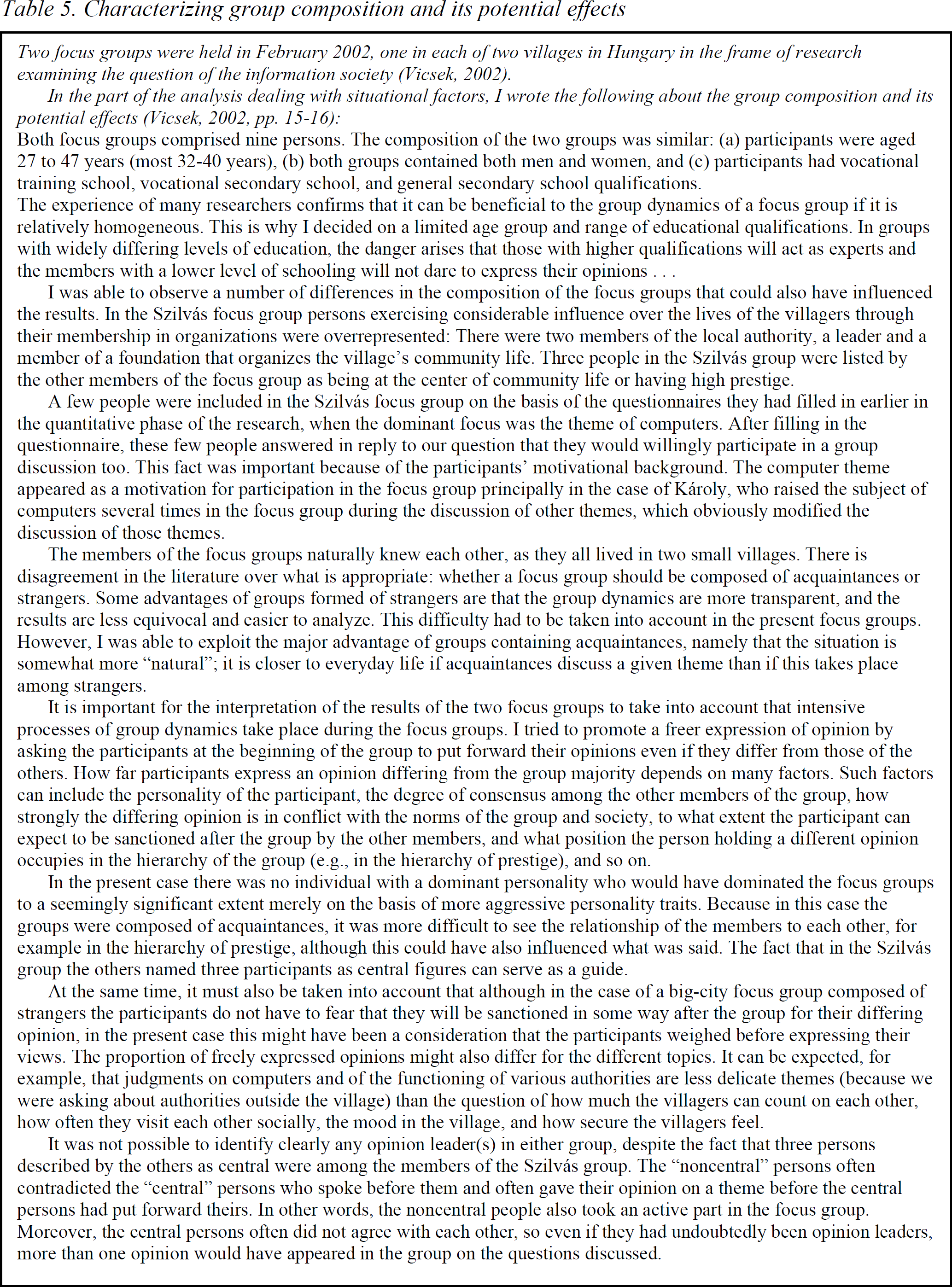
Sometimes it is useful to give the characteristics of group composition in detail. This can be done in the form of a table within the main text or, if a table would be too long, in an appendix. If the research comprises only a few groups, profiles of individual participants, with proper care taken to protect anonymity, can even be included in the table, for example, by listing individuals in separate rows. If the research involves many groups, I generally give the composition of the different groups in one line and do not list individuals separately.
The moderator
It might be worth also dealing in the analysis with the characteristics of the moderator. We can consider the moderator's style: To what extent did he or she exercise control in the various groups? We can touch on the moderator's professionalism, knowledge of the question examined, and roles assumed during the groups. Krueger (1994) has defined a number of roles that can be taken by moderators in the course of groups. The moderator can act, for example, as challenger who questions inconsistent replies. Another role is that of expert on the theme. He can present himself as someone who is not familiar with the details of the questions examined and looks to the participants for enlightenment. It can be important to compare the social and demographic characteristics of the moderator with those of the participants, and we can formulate hypotheses about how this could have influenced the course of the group. The moderator's social power might appear in the fact that he or she often has a high level of schooling and perhaps also a higher status occupation than the participants.
The environment
The physical characteristics of the environment where the discussion is held can also be included in the analysis if they are judged to be important. We can consider how peaceful the environment was, how separated it was from others, its degree of formality, and the furniture in the room and what influence these factors could have had on the outcome of the discussion.
Time factors
We might feel that the results obtained were significantly influenced by the time of day when the group was held and how long it lasted, or by how far the participants were able to concentrate on certain questions, for example because they arose only at the end of the group. In such cases it is worth examining these factors too.
Content
The content of the focus group is a situational factor, and at least some of its elements should be included in the situational analysis. These are characteristics of content that do not appear in the participants' replies but can be found in the focus group guide itself or are introduced by the moderator (the theme of the group: the main considerations of the guide; characteristics of the questions; the order, style, and language of the questions; special techniques applied in the course of the groups; and what information the participants obtained on the theme of the research). How personal or intimate the matters discussed were, whether there are strong expectations in the society and among the participants of the group in connection with the problem examined, and what the “correct” response to them is can all be relevant to the theme.
An important analytical consideration is whether the moderator used various techniques during the focus groups that could have influenced the free expression of opinion. For example, did the moderator point out at the beginning of the group that the researchers wanted to know everyone's real opinion even if it differed from the views of the other discussants? Were participants asked first to give their individual answers in writing, with the common discussion taking place only afterwards? and so on.
Thematic analysis
In the second half of the analysis I generally do a thematic analysis, a qualitative data analysis based on coding (Coffey & Atkinson, 1996). I generally structure the content of the thematic analysis in such a way that I characterize the similarities among the majority of groups regarding the individual analytical criteria; then, where this is important, I examine the groups where there was a differing manifestation or trend. Occasionally I also discuss the results of the individual groups separately under the different analytical criteria. In other cases I perform the analysis by grouping together the analysis of groups of similar composition. However, it is not always worth dealing with groups of similar composition together because it is possible that although the composition was similar, there were substantial differences in the group dynamics.
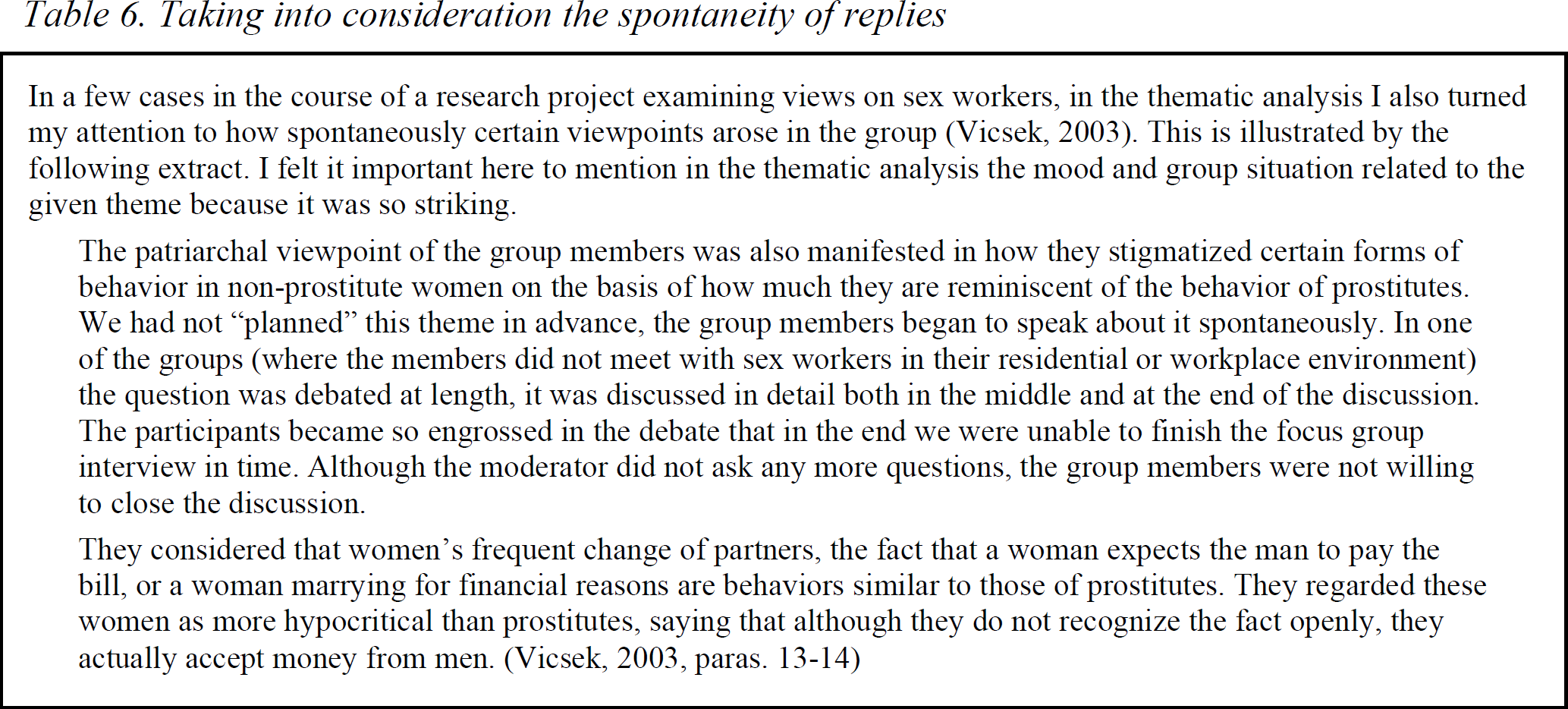
In the thematic analysis I often cite not isolated manifestations but a fragment of discussion containing several contributions. Under each citation I always note which focus group the excerpt comes from (if it is not obvious from the text). When it is important, I also note whether the participants mentioned something spontaneously or not. Sometimes I also include in the analysis the consistency or changeability of the manifestations. I refer in the main text to the reception of the concrete statements and the concrete situation only if I feel that it is important. I might also point out certain group influences in this section if I consider them relevant (see example in Table 6).
Taking into consideration the spontaneity of replies
Conclusion
The presented scheme is only one way to analyze focus groups while taking into account the concrete situation of the group discussion. It relies heavily on mainstream social psychology. Whether one chooses this scheme depends on the theoretical approach of the researcher (adherents of discursive psychology, for example, will certainly analyze differently). The particular research goal also exerts influence. I applied the scheme when I was conducting nonapplied sociological research in cases when social influence and other group processes were not the central research questions, and the topic of what was said was more relevant than the way in which it was said. If, for example, social influence itself is the study subject, then even from a mainstream social psychological perspective, other ways of analysis should be applied. Social influence could be an important research subject amongst others for market research. Many market researchers view group processes in focus groups as harmful for their research. I, on the other hand, agree with Schindler (1992), that studying social influence would be very useful for market research in the case of certain products. For such research, however, other schemes of analysis have to be devised.
Footnotes
1.
In the definition I have intentionally indicated collective communication as a criterion rather than oral discussion because I include computer-mediated groups under focus groups.
2.
Many authors discuss only some of the factors having a potential influence on the outcome of focus groups, and even then not in depth, if they touch on them at all.
3.
I have changed the first names of the participants to protect their anonymity.