




Abstract
Using videotaped data as the sole source for a study produces unique challenges that have not been fully addressed in the literature. Our particular interest was the analysis of videotaped data in which the scene–that captured within the frame–is the sole source of data. The researcher does not have access to interviews or other interpretive data to provide the participants' perspective, therefore analysis relies on the actions of the participants as they occurred. When recording video data in this manner, nothing is manipulated or staged for the recording. The challenge for the researcher is to describe and to analyze the scene as it stands. How does one make sense of such data? And how can one be assured that the research interpretation is correct? We argue here that the level and accuracy of interpretation possible depends on the context–on what is being studied, and what is known about the topic of interest.
In this section, we will address issues inherent in analysis of sole source videotaped data, with particular attention to the selection and use of a scaffold for analysis. The example that we use is a study that came later in the research program: a secondary analysis of videotaped data to explore nurse-patient-family interactions in a trauma-resuscitation room of the Emergency Department (Morse & Pooler, 2002).
Using videotaped data as the sole source for a study produces unique challenges that have not been fully addressed in the literature. Our particular interest was the analysis of videotaped data in which the scene–that captured within the frame–is the sole source of data. The researcher does not have access to interviews or other interpretive data to provide the participants' perspective, therefore analysis relies on the actions of the participants as they occurred. When recording video data in this manner, nothing is manipulated or staged for the recording. The challenge for the researcher is to describe and to analyze the scene as it stands. How does one make sense of such data? And how can one be assured that the research interpretation is correct? We argue here that the level and accuracy of interpretation possible depends on the context–on what is being studied, and what is known about the topic of interest. In this section, we will address issues inherent in analysis of sole source videotaped data, with particular attention to the selection and use of a scaffold for analysis. The example that we use is a study that came later in the research program: a secondary analysis of videotaped data to explore nurse-patient-family interactions in a trauma-resuscitation room of the Emergency Department (Morse & Pooler, 2002).
Model of suffering
Prior to this study, Morse and her colleagues had explored suffering for a number of years, developing the concept using phenomenology, grounded theory, participant observation, and linguistic analysis (Morse & Carter, 1995; Morse & Carter, 1996; Proctor, Morse, & Khonsari, 1996; Penrod, Morse, & Wilson, 1999). A model of suffering had been developed from these studies that revealed that suffering was comprised of two distinct states: enduring, in which emotions are suppressed and emotional suffering, in which emotions are released. 1 Studies using videotapes of trauma care demonstrated that nurses enhanced enduring when patients were in extreme distress and almost losing control (Morse & Proctor, 1998). From other studies and participant's descriptions, we were reasonably certain that we could identify behaviors of patients and family members who were enduring and those who were emotional suffering, by observing their behaviors and the type of emotions displayed. Nevertheless, many questions remained about those behaviors, as well as the interactions with and among those who were enduring, and those who were emotionally suffering. Thus, the purpose of this secondary analysis was to further describe the behaviors (i.e., overt signals) of those who were enduring or emotionally suffering, and to analyze the interactions among family members, the patient, and nurses, and identify appropriate responses to use when persons were in these states of suffering.
Analysis of videotaped data
Videotaped data presents unparalleled opportunities for understanding human behavior. Levels of analysis may range from macro-analytic (e.g., observing gross motor movement or patterns of behavior), or micro-analytic (e.g. focusing on the most transient touch). Analysis of data can be manipulated: played and replayed; sped up, slowed or paused; discussed, analyzed, and reanalyzed, thus providing insights that otherwise would be unobtainable. Researchers have the opportunity to discuss certain scenes, to bring to the fore any disagreements regarding interpretation about what is going on, and to establish inter-rater reliability with coding schemes. Furthermore, with videotaped data, exact scenes may be used to illustrate one's emerging theoretical scheme. Showing, in addition to describing, is powerful and persuasive.
When data are not accompanied by interview data or written records, or when videotaped data has been obtained from participants who are pre- or non-verbal, or unable to verbalize (due to intubation, sedation, confusion, and so forth), issues of interpretation are risky. In these situations, it is impossible to conduct the analysis from the perspective of the participants, or to verify one's analysis. Without the benefit of interaction and shared meaning, one is only left with description or inference.
Our concern with this type of data and its analysis is shared with animal ethologists. Ethology is used to systemically observe, analyze, and describe behaviors within the natural context (Morse & Bottorff, 1990). How does one interpret videotaped data inductively, validly, and meaningfully? In this section, we will briefly explore styles of interpretation of videotaped data and then discuss the use of a scaffold to aid styles of interpretation to further develop/describe a concept.
Styles of interpretation
Human or animal ethology is a useful approach for analysis of sole source videotaped data (Eibl-Eibesfeldt, 1989; Morse & Bottorff, 1990). The analysis of data includes description of the behaviors, interpretation of the actions, and inference about intent and meaning. Various levels of analysis place different values on description or interpretation. In the first level of analysis, often used, for example, by animal ethologists, priority is placed on descriptions of behavior, and interpretation is minimal or even absent. Conversely, at the highest level of inference, behavioral description is minimal and analysis is more interpretive, based on shared meaning as well as direct inference from the data. Between these two extremes, we have basic description in which we describe the behaviors and attribute obvious meanings. We will describe these three approaches using the example of observation of a handshake, and then describe a fourth approach–the utilization of a scaffold.
Detailed behavioral description/Minimal inference
This level of research is purely inductive. Researchers describe behaviors in extraordinary detail, often developing some type of microanalytical coding scheme, accounting for every possible movement. Inference is lacking, interpretation is minimal or absent, and the context is often ignored. For example, using this approach to analyze a handshake, the researcher would describe the detailed behaviors in which each participant extended the arm, grasped the hand, and moved it up and down. The nature and type and time of contact would be measured. However, the handshake would not be labeled as a greeting behavior and accompanying verbal utterances would be ignored. The handshake would be described as an action in a technical/mechanical sense, but this knowledge contributes little to our understanding of meaning of human behavior.
Inference extending from shared meaning
At this level of analysis, researchers work from careful macro and micro description and use their knowledge of human behavior to infer “what is happening.” The basic description is followed by inference, with the inferences being derived from shared meaning and common experiences, prior research, or the literature. Context may be considered, and the accompanying verbal behaviors included in the analysis. In our handshake example, researchers would describe the action and label it as a greeting. Although this type of analysis is broader in scope and may be a useful strategy for incorporating superficial context and providing baseline data, it is not interpretive and rarely informative.
Theoretical inference
With this level of analysis, behavioral description and shared inference are extended with the use of theoretical inference, which is extended from meticulous description and shared inference, to include grounded interpretation and logical inference. Using the literature, the intent of the actions is identified and included in the analysis. In the example of the handshake, using inference, we ascertain the purpose of the action. But we go further — based on knowledge of shared meanings, we may also conjecture about the role of the participants (such as business associates), the relationship (strangers, friends, lovers, enemies), the function (greeting, leave-taking, sealing a deal), and so forth.
Threats to validity
The problem with conducting observational research that requires theoretical inference is that the greater the inference, the fewer the behavioral descriptors (or indices). This concern about validity keeps observational research grounded at the lower levels of inference; however, it also has the disadvantage of restricting analysis to lower level concepts, therefore limiting both the scope of the theory developed and the significance of the research findings. Use of a theoretical framework for analysis would overcome some problems although, of course, it threatens validity by forcing the researcher to work deductively according to variables prescribed by the framework, targeting observations and controlling what the researcher sees as pertinent and relevant.
We suggest that the use of a scaffold overcomes these limitations by continuing the inductive process. When used with videotaped data, a scaffold overcomes both threats to validity and low level analysis, while also enabling the continued use of induction within the parameters of the scaffold.
Use of a scaffold
The major disadvantages of using a conceptual framework are those associated with deduction and qualitative inquiry. The use of a scaffold for analysis, however, does not dictate either the variables or the coding system for the analysis. Instead, it provides the researcher with the parameters of the problem or targets observations toward a general area. The researcher continues to work inductively: describing behaviors, questioning observations, verifying and confirming, and systematically creating or extending theory.
Example of analysis using a scaffold
We will now illustrate the use of a scaffold used in the secondary analysis of videotaped data in the trauma room of the Emergency Department (Morse & Pooler, 2002), using the Model of Suffering as a scaffold for analysis. The description of suffering behaviors was used to code the responses of family members in the trauma room and to analyze patient, nurse, and family interactions. Our research goal was that if we could determine observationally whether relatives were enduring or emotionally suffering, we would then be able to teach behavioral signals of suffering to nurses, and give recommendations for care.
Model of suffering
The interrelationships between enduring and emotional suffering are described in the Model of Suffering (Morse, 2001). Immediately after an event (such as injury, illness, or receiving bad news), the person begins enduring and remains enduring until he or she is able to acknowledge the incident. Once the context allows, and the person is ‘strong enough’ to suffer, he or she may enter emotional suffering. However, there may be movement back into enduring, or movement back and forth between the two states. Also of importance, enduring and emotional suffering may vary both in intensity and duration, according to personal (including cultural), situational, and contextual factors. From previous research, we know that interactions between those who are enduring and those who are emotionally suffering are distinctly different (Morse, Beres, Spiers, Mayan, & Olson, in review). Enduring behaviors demand physical distance. On the other hand, emotional suffering demands physical support, including touching and hugging. While enduring demands silent presence, emotional suffering, in contrast, demands responses from others, including consolation, commiseration, and empathy.
Developing descriptions
In this study, description of suffering behaviors derived from the Model of Suffering was used to analyze and code the responses of patients and family members in the trauma room. We first approached the analysis of the videotaped data by asking: Do patients or family members exhibit behaviors of enduring or emotional suffering? With this question in mind, an ethogram, or a detailed textual description of the behavior patterns, was developed inductively (see Morse & Bottorff, 1990). Videotapes were played and replayed to observe and describe, in detail, the behaviors of family, nurses, and patients. The research question was then re-asked and examined. It was apparent from the descriptions that both patients and family members demonstrated behaviors of enduring or emotional suffering, and these behavioral states could be identified and classified.
Once we identified each person as being in a state of enduring or emotional suffering (or neither), new and interesting questions could be asked: In family groups, were all of the members enduring or emotionally suffering? What was the pacing of the expressed emotions? Who supported whom? How did the context affect behaviors? What was the behavioral response of the nurse towards those who were enduring and those who were emotionally suffering? What was the focus of attention? What was the form and outcomes of these interactions? What were characteristics of family members who did not have behaviors of either enduring or emotional suffering? Using the ethogram and observational field notes, categories were developed inductively through analysis and classification of the behaviors. During the analysis, we assumed an ongoing attitude of openness and inquiry, continually asking questions such as: What is going on here? How does this interaction compare to that? What are the characteristics of this interaction? These questions, in part, directed the development of the categories. Categories were then compared and contrasted according to behavioral patterns and common characteristics.
Let us now look at two categories as examples of the description and analysis. The first category is Family Emotionally Suffering and Patient Enduring. The patient is a policeman who has been shot and is going to the Intensive Care Unit. The family members are his wife and daughters. The conversation at this time is on the events of the shooting and the wife's concern about the outcome. In Figure 1, notice the posture of the two women on the left, who are quietly sobbing, showing emotional release of suffering. Their shoulders are rounded, they are close together, with hands at their faces. Because of his injuries, the patient has limited movement, but he has reached his hand up to his wife and is consoling her with words and touch: “It's okay, I'm going to be alright.” In contrast, the daughter behind is enduring. She is standing straight, her hands at her side. She is watching her parents, but does not touch them, and does not make eye contact with her family in the several minutes of this interaction. Family members are attempting to ease the distress of the wife or limit distress by enduring behaviors.

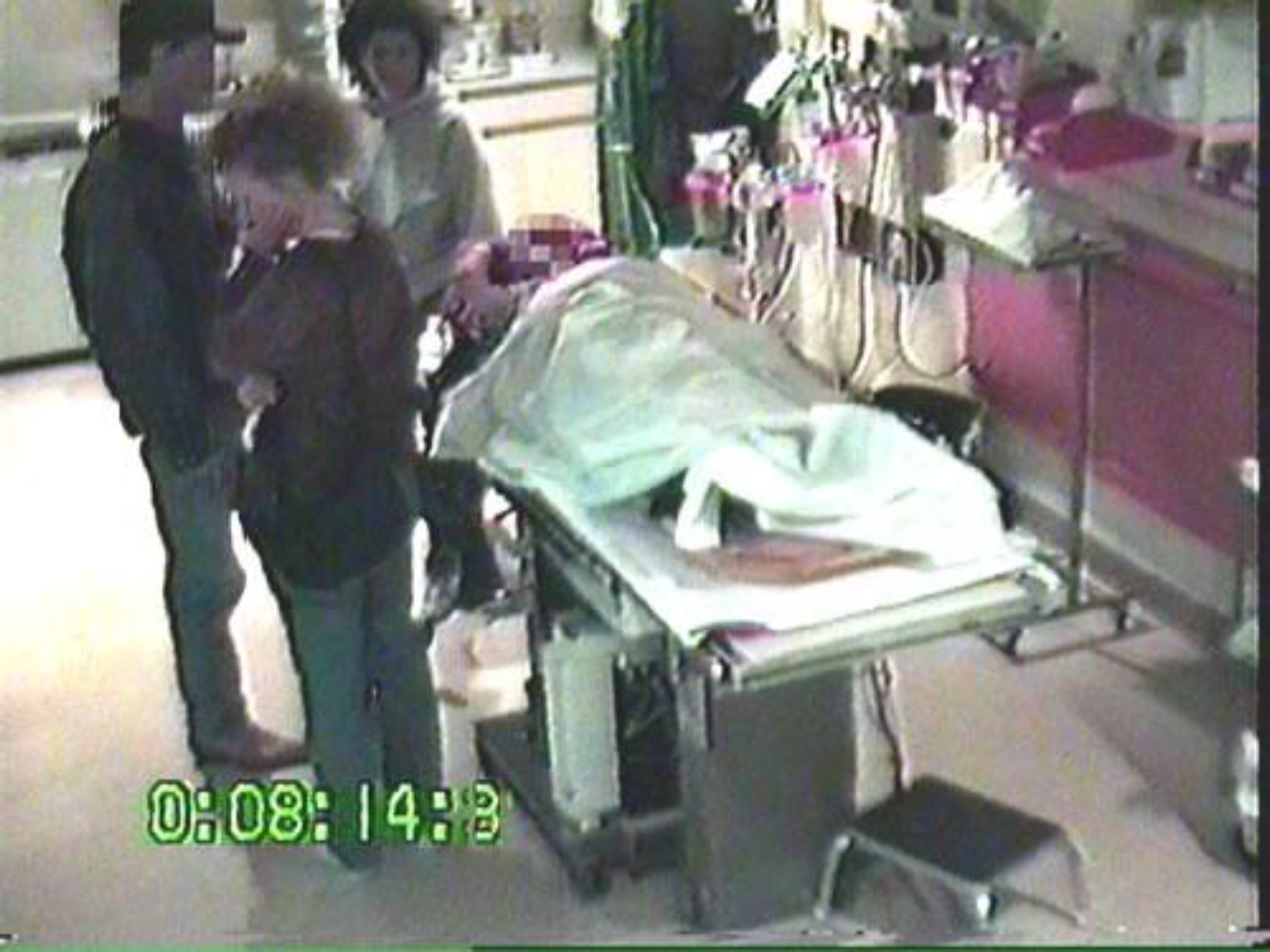
The second example is the category of Patient and Family Enduring. Note that in this series of pictures that patient and family are enduring. Patients were quiet and maintained control, and relinquished themselves to the necessary care. Note in Figure 2 that family members stand apart and are at a distance from the patient's head. There were minimal interactions between patient, family, and nurse. These behaviors are indicative of enduring.
Discussion
A model or framework can be used as a scaffold to direct the area of interest and analyze behaviors, such as those manifested in critical events. The scaffold was extraordinarily useful in coding behaviors, revealing patterns and developing categories of behaviors. Although the outcome of this research was complete in itself, observational research and use of a scaffold may be continued, such as using the developed knowledge as a theoretical framework and coding scheme for quantitative analysis. Research may progress to a phase of confirmation, using the emerging variables as a framework. The framework could be tested on new cases, thereby transforming analysis from induction to deduction, and increasing certainty.
Footnotes
1.
This foundation of studies provides more certainty than the broad conceptual categories (recommended by Spradley (1980) or Leininger (1988) which were mentioned in part 1). While the previous research do provide a deductive starting point, the scaffold is relatively known and verified.