




Abstract
This article explores teachers’ professional discretion and control within the local organizing of digitalization development work in the Swedish school sector. Drawing on qualitative data from two municipalities—including interviews and observations with teachers, principals, and municipal officials—the study investigates the space available for teachers’ professional control and discretion in this context. The findings show that teachers play central roles in organizing and shaping digitalization efforts. They enjoy a high degree of professional control and discretion, both in defining their roles and in deciding how digital tools are integrated into classroom practice. However, while discretion is widespread, teachers also express a need for clearer managerial guidance, particularly regarding overarching goals and expectations.
The study challenges the assumption that increased discretion is inherently beneficial, suggesting instead that discretion is valued differently depending on whether it concerns core pedagogical tasks or broader strategic development work. By examining how control and discretion are exercised, the article contributes to ongoing debates on digitalization, professional authority, and street-level discretion within networked organizational settings.
There are wide and ambitious objectives and high hopes around digitalization, with significant resources allocated to this matter. However, it is important to scrutinize how digitalization is implemented and its effects to find optimal ways of organizing and ensuring the desired outcomes are achieved. Understanding the impact on the teaching profession is particularly relevant, especially in a Swedish context, where the profession's status has been perceived as lowered and weakened. Evaluating space for professional control and discretion is crucial for enhancing the working environment and the overall position of teachers. This article also highlights the role of managers in the organization of digitalization. It appears that managers in this context tend to refrain from excessive management and are often quite absent. However, the article demonstrates that managerial control does not necessarily oppose professional control and discretion, as teachers themselves request more management in this area. Thus, the article provides insights into when and where teachers’ discretion needs to be safeguarded and when managerial control should be strengthened.
Introduction
This article explores local development work related to digitalization in the school sector and how teachers’ professional discretion and control are exercised within this organizing. The term organizing is used to emphasize its processual nature (Czarniawska, 2014a) and how digitalization is shaped through networks rather than being confined to individual and separate organizations. The study focuses on two municipalities in Sweden.
While digitalization has been widely studied, much of the research focuses on individual digitalization initiatives (Meijer & Bekkers, 2015) and how digital discretion affects public values and frontline workers (Busch & Henriksen, 2018). However, as emphasized by Plesner et al. (2018), while there are studies at the macro level and within individual organizations, there is a lack of research on the local organizational level—particularly regarding the management of digitalization-related development work in the school sector (Agélii Genlott, 2020; Plesner et al., 2018). Such work can include the implementation of common platforms, the use of standardized teaching materials 1 , and decisions regarding the overall direction and focus areas of digitalization. Meanwhile, the role of professionals —specifically teachers—in these types of arrangements is not sufficiently scrutinized (Gullberg & Svensson, 2020). Many studies take a pedagogical perspective, focusing on improving teachers’ digital competence (Klaassen & Löwstedt, 2020; Samuelsson, 2014; Tallvid, 2015) rather than examining their role in organizing digitalization.
In the broader debate on digitalization and professions, digitalization is often seen as a threat because it represents standardization (Plesner & Justesen, 2022) and may infringe on professional control and discretion, which are central to professional work (Abbott, 1988; Freidson, 2001). Control can be analyzed in terms of accountability—i.e., questions concerning who is in charge of and accountable for professional work (Buffat, 2015). Some perspectives link digitalization to managerial control which may threaten professional autonomy (Buffat, 2015) while others claim professionals can adapt and even strengthen their control (Petrakaki & Klecun, 2015). In the same vein, some authors argue that digitalization curtails discretion (Buffat, 2015; Gundhus et al., 2022) while others argue that it can create new spaces for discretion (Alshallaqi, 2022) and that professionals actively adapt to digitalization in various ways (Gullberg & Svensson, 2020; Marienfeldt, 2024). While context seems to matter (Ball et al., 2023; Pedersen & Pors, 2023), the specific context of strategic digitalization work requires further exploration. Different arrangements with varying sources of control can either curtail or enable discretion, depending on whether new spaces emerge or existing spaces are constrained.
Discretion has been widely discussed in relation to street-level bureaucrats (SLBs) and how they use flexibility, freedom, and expertise to make decisions while being part of a governance structure (Lipsky, 2010). Traditionally, discretion is examined in relation to client interactions (e.g.,Marienfeldt, 2024) often focusing on how decision-making is affected by digitalization (Bovens & Zouridis, 2002; de Boer & Raaphorst, 2023; Ranerup & Henriksen, 2022). However, there is a need to widen the concept of discretion since discretion is no longer limited to frontline interactions—professionals are increasingly engaged in strategic development work, where clients are not directly involved (Alvehus et al., 2021; Eklund, 2021a; Noordegraaf, 2020). For example, Ustek-Spilda (2020) explains how discretion operates in the back office, where policies are created but remain invisible in front-office work.
Given these shifts, there is a need to further explore what space there is for professional control and discretion in new organizational arrangements where development work is central. Such organizing can be expected to alter relationships between professionals and other actors, as well as within professional groups (Kallinikos, 2010; Petrakaki et al., 2012; Petrakaki & Klecun, 2015). This makes the organizing aspect particularly interesting to focus on and highlights the need to include not only teachers but also other actors, such as principals and municipal managers, in the analysis. These actors are part of the organizing process and thus have an influence on the role of teachers and the possibilities for professional discretion and control (Sandén, 2021).
Sweden presents an interesting case due to its broad digitalization agenda (Utbildningsdepartementet, 2017) and decentralized governance structure, where municipalities develop their own digitalization strategies in collaboration with school leaders, IT departments, and teachers with digital expertise (Kastberg et al., 2023). The national curriculum emphasizes that digital competence is an essential skill (Godhe et al., 2023) and that digitalization should be integrated into all school subjects. However, municipalities largely determine how and to what extent digitalization is implemented. While the Swedish National Agency for Education (Skolverket) provides national guidelines and recommendations, municipalities thus develop their own work. Interestingly, while there are high expectations and ambitious goals for digitalization in schools, there is no strict hierarchical governance structure holding the local level accountable (Kastberg et al., 2023). While teachers are expected to engage in digitalization, it is unclear to what extent, and how much discretion and control they actually exercise.
Given the significance of the local municipal level in Sweden, this article focuses on the local organizing of digitalization development work in the school sector. While previous research has explored how digital tools affect street-level bureaucrats’ discretion, there is still limited knowledge about how local organizing structures—often built on loose, networked arrangements—shape the conditions for professional control and discretion in development-oriented work.
This article addresses this gap. Rather than focusing on specific tools or top-down policy mandates, the analysis emphasizes the interplay between actors and the ways in which professional roles are enacted within these local structures. As shown in prior literature, different organizational arrangements—with varying degrees of managerial or professional control—can either enable or constrain discretion, depending on whether new spaces are created or existing ones are restricted (Alshallaqi, 2022; Busch & Henriksen, 2018; Lipsky, 2010). With this focus, the article aims to contribute with understanding of how professional discretion and control is exercised and shaped within networked forms of organizing. The research question is: What space is available for teachers’ professional control and discretion within the local organizing of digitalization development work?
Theoretical Framework
In this chapter, I will delve into two relevant concepts for understanding professions: discretion and control, and how digitalization is related to these concepts.
Professional Discretion
The term street-level bureaucracy is explained by Lipsky (2010) as encompassing both the unique conditions of the public sector and adherence to bureaucratic principles, while also requiring flexibility to meet citizens’ needs and respond to individual situations. The term is particularly useful for understanding the diverse demands and constraints that shape public sector work, as well as the opportunities within public sector organizing. Not least, it helps illuminate the role of front-line workers and the everyday challenges of their positions. One of Lipsky's key arguments is that policy is shaped in the interactions between front-line workers and citizens, as it is in these encounters that workers exercise discretion and authority,
Thus, one central aspect when it comes to street-level bureaucrats is the role they have in applying and giving content to different policy initiatives (Da Roit & Busacca, 2023) and the autonomy that exists with regard to the implementation of rules and standards (Ian & Josie, 2006). Traditionally, this discretion has been discussed in relation to policy-making that occurs through interactions with clients, specifically by frontline bureaucrats (Lipsky, 2010). As mentioned in the introduction, other roles that operate more in the back office (Löfgren, 2020; Ustek-Spilda, 2020), have also been identified, where discretion is exercised, though not necessarily in direct contact with clients.
Da Roit and Busacca (2023) further explain discretion as a link between the perspective of street-level bureaucrats and professional theory, emphasizing its significance regardless of whether one discusses street-level bureaucrats or members of a profession.
Lipsky (2010) illustrates how frontline workers, such as teachers, exercise discretion in their work while simultaneously being constrained by the structures within which they operate. This dilemma aligns with what professional theory describes as a collision between professional and bureaucratic control (Freidson, 2001). Therefore, control is a central factor in professionals’ ability to exercise discretion.
Professional Control
Whereas discretion involves the freedom and flexibility to act within a given structure, control is more closely related to authority and the ability of professionals to define their domain. Arguably, for professionals to exercise discretion, they must not be overly constrained by control from other actors, such as managers. Freidson (1994), who explored different logics, argued that professionalism is fundamentally based on professional control over both the content and context of work. In contrast, bureaucratic control is characterized by rules and standardization (Ouchi, 1979) and naturally threatens the flexibility and discretion of professionals. The bureaucratic logic, as defined by Freidson (2001), is characterized by managerial control. In a bureaucratic system, control is primarily exercised in a top-down manner, with professional workers guided by standardized principles on how to perform their work and subject to hierarchical supervision. Buffat (2015) defines control as being closely related to accountability. In this vein, the exercise of control entails the authority to hold someone accountable; for example, managerial control also involves ensuring the accountability of professional workers. In a system primarily based on professional control, as described by Freidson (2001), supervision and follow-up of professional work are primarily conducted by professionals themselves. Thus, in a system founded on professional control, professionals are accountable to each other in a more collegial manner rather than to higher levels in the hierarchical chain.
Digitalization, Control and Discretion
As discussed, there is some ambiguity in the literature regarding the relationship between digitalization and professional discretion. Löfgren (2020) emphasizes that the effects of digitalization are often portrayed in a dichotomous manner, with few nuanced descriptions. Furthermore, Löfgren (2020) explains that digitalization may cause destabilization due to shifts in control, where some professional workers may be more adaptable to change and, as a result, gain greater control over professional work than others. This shift may also strengthen managerial control by expanding opportunities for oversight and supervision of professional workers (Buffat, 2015; Löfgren, 2020). The dichotomous perspective described by Löfgren (2020) is evident in the curtailment thesis, as discussed by Buffat (2015), who argues that professional discretion can be curtailed by digitalization. In this view, control is largely perceived as a zero-sum game, implying that when professional control is diminished, it shifts to other actors, such as managers,
However, both Buffat (2015) and Busch and Henriksen (2018) contrast the curtailment thesis with the enablement thesis, which presents a more complex reality in which frontline workers actively utilize new technology and employ it in more strategic ways. Meanwhile, Bernhard and Wihlborg (2022) demonstrate that while discretion may be curtailed in some aspects, frontline workers can employ strategies and take on new roles to safeguard public values and enhance the inclusiveness of clients. Similarly, Ranerup and Henriksen (2022) suggest that digitalization can function in new hybridized ways. The division in the literature between these two theses is also highlighted by Alshallaqi (2022), who argues that the literature is split between proponents of the curtailment thesis and those who claim that digitalization creates new spaces for discretion. Alshallaqi (2022) concludes that this dichotomy is overly simplistic, and that digitalization can have both curtailing and enabling effects, which may vary depending on contextual factors.
In both the literature on professions and that on street-level bureaucrats, there are accounts of how workers adapt to digitalization and how professional work evolves to accommodate technological advancements (Gullberg & Svensson, 2020; Noordegraaf, 2020), for example by bending rules and leveraging autonomy to circumvent the curtailment of discretion (Marienfeldt, 2024). As we saw in the previous paragraph, some scholars emphasize that digitalization may create new spaces for discretion. (Alshallaqi, 2022). This aligns more with the view of professionals as active agents who are not passive recipients of their surroundings but have the ability to adapt to and leverage new circumstances (Alvehus et al., 2019b; Alvehus et al., 2021; Noordegraaf, 2015; Waring & Bishop, 2013). Here professionals can be described as connective (Noordegraaf, 2020) in the sense that they interact with and evolve in relation to other actors and changes in their environment. For example, they may move into managerial roles and take on responsibilities beyond their core professional work (Adams, 2020; Alvehus et al., 2021; Freidson, 1984, 1985; Waring, 2014). Research in schools has shown that moving into these spheres can actually strengthen professional control, as professionals become active in arenas where they can influence organizational matters as well as strategic and developmental work (Alvehus et al., 2021; Eklund, 2021b). Thus, a context in which professionals actively engage in development work may enhance control and, consequently, professional discretion. However, previous studies have also highlighted that strong professionals can resist digitalization initiatives (Busch & Henriksen, 2018). Thus, what can be concluded is that the role of professionals in this type of digitalization work requires further study.
Analytical Tool
The literature continues to display ambiguity regarding how digitalization relates to matters of discretion and professional control. To contribute to this discussion, it is crucial to examine who exercises control in the organizing of digitalization, as this determines the possibilities for discretion. Professional discretion depends on a degree of freedom from managerial control and presupposes professional authority within the domain of professional work. Thus, how control is exercised and where it is situated in relation to digitalization strategies is a key dimension.
In line with processual perspectives on organizing (e.g., Czarniawska, 2014a), this study understands digitalization not as a fixed system, but as an evolving structure shaped through everyday interactions and professional agency. By first zooming in on the organizing of local digitalization development work, this article adopts a perspective that considers digitalization as a broad and multifaceted concept, shaped not only by formalized control but also by various connotations and expectations. As we will see, digitalization is organized through networks rather than traditional hierarchical structures with clearly defined roles. Consequently, professionals do not solely act as implementers of public policy but engage in a more dynamic and interactive role. As emphasized by de Boer and Raaphorst (2023), networks are a relevant concept for understanding organizations that lack a strong central authority. Against this backdrop, the central concepts of this article—professional control and discretion—will be explored in relation this networked organizing. Two questions follow this theoretical framework and will guide the structure of the empirical section.
What role do teachers have in the local organizing of digitalization development work? How are professional control and discretion shaped and exercised within this organizing?
Structuring the findings according to these questions lay a foundation for a discussion around what space there is for professional discretion and control in this organizing.
Method
A Qualitative Research Approach
This paper is built upon data collected within a larger research project. In the project we were interested in digitalization as a reform agenda and in relation to the local context. We were also interested in understanding the interactions between different actors around this matter, and what relationships were formed. Therefore, it became important to conduct an empirical, qualitative study in which we tried to understand the connections between different actors and local strategies (Plesner et al., 2018). We tried to approach the issue with an open mindset, since we did not want to cling to theoretical pre-understandings but have a more inductive approach, allowing for different types of research questions to form. This interest is highly relevant to this paper specifically, since I intended to entertain different possibilities when it comes to the findings. Since there is ambiguity in the literature regarding enablement or curtailment and digitalization, I did not want to lock myself in either theoretical strand.
To receive a deep understanding of the phenomena we were interested in we conducted interviews with actors at all hierarchal levels locally, including municipal managers and administrators, principals, teachers with responsibilities concerning digitalization work and ordinary teachers (those with no such extra responsibilities).
We applied a qualitative approach which did not rely solely on interviews but also included observation as method. While interviews offer valuable insights into actors’ perspectives and interpretations, they may not fully capture the dynamic and often subtle interactions that take place in everyday organizational life. Therefore, we chose to observe actors in relevant contexts, particularly in meetings where digitalization was discussed and shaped. These observations allowed us to gain a more nuanced understanding of how roles, relationships, and power dynamics are enacted in practice (Van Maanen, 2011; Watson, 2011).
Interviews and Observations
We followed digitization in two different municipal school administrations, both of medium size. Our starting point was a meeting where we presented our idea to a network of municipal representatives and inviting those interested to contact us. This allowed us to identify municipalities with clear digitalization strategies and who were active in this work.
We began the data collection with an interview with representatives from the municipal administration. We quickly realized that much of the digitalization work was conducted primarily by two development leaders, one in each municipality. During these first interviews, we requested that development leaders anchored the project in the organizations and provided us with contact information to relevant interviewees. Since we were interested in different perspectives and had different interests within the research group, we ended up interviewing not only teachers but more relevant actors from the municipalities and principals. In this phase, we also conducted meeting observations, as these bring deeper understanding of the phenomena of focus than interviews. We selected meetings where digitization was the topic of some form, such as strategic meetings within the municipal administration and meetings between the municipal administration and teachers. On occasion we also observed local meetings on digitalization at individual schools. We also conducted follow-up interviews with foremost development leaders from the municipalities to see how the work had progressed.
In total, we conducted 29 interviews and observed 10 meetings. The interviews were conducted between December 2021 and June 2022. The Table 1 below shows a more detailed summary.
Summary of Interviews and Observations.

Summary of Interviews and Observations.
The interviews followed a semi-structured format which meant that there were overarching categories and themes but also an openness and flexibility. We tried to design the interviews as conversations, making the interviewees feel comfortable in bringing up own topics. In the initial interviews we tried to maintain a comprehensive picture of what was happening in the municipality, whereas later interviews were more in-depth and focusing on different observed themes. The interviews were conducted both physically and digitally, with flexibility to the requests of the interviewees. The interviews were recorded using voice memos on the phone.
The observations, which were both physical and digital, could complement the interviews as well as bringing up themes that we could follow up on when interviewing people. Sometimes meetings can capture issues more in depth than is possible in interviews and provide an understanding of informal aspects not visible in interviews, such as roles and relationships between different actors (Czarniawska, 2014b).
Interviews were transcribed verbatim. When taking meeting notes, we tried to note down what was said in broad strokes. Both interview transcripts and meeting notes were handled respectfully toward participating respondents. This means that we anonymized names of both municipalities and individuals during the phase of processing the material.
The empirical material was coded using the qualitative data analysis software NVivo. The coding related to the research questions of this article was conducted by the author. The following codes were applied:
Together, these codes provide a comprehensive understanding of the roles teachers play in the networks, the forms of professional control exercised, and the space available for professional discretion within this organizational arrangement.
The findings section will begin by outlining the roles of teachers in the organizing of digitalization development work. It will then explore their capacity to exercise professional control. Subsequently, the analysis will address how professional discretion was enacted and constrained in practice.
Quotations have been carefully selected to illustrate the empirical findings. Given the qualitative nature of the study, these quotations serve as important examples to ground the analysis in participants’ lived experiences.
Finally, the findings will be discussed in relation to existing literature, highlighting what they reveal about the conditions for professional discretion and control in this type of organizational setting.
Findings
The findings are structured around the two questions outlined in the theoretical framework and are further divided into subcategories for clarity. Overall, the findings reveal that teachers play a clear and central role in the organizing process and that they have space for both professional control and discretion. However, instances of infringement on these dimensions also emerge, underscoring the importance of contextualizing the findings and acknowledging the complexity of these concepts. This calls for a nuanced discussion (c.f. Alshallaqi, 2022).
What Role Do Teachers Have in the Local Organizing of Digitalization Development Work?
To answer this question, I will first describe the organizing of digitalization work and explain how this organizing to large extent was built upon networks. I will further put extra emphasis on the roles that teachers have in this organizing, since, as will be shown, teachers play and important and central role in this type of networked organizing.
The Organizing of Digitalization Work: Largely Based on Networks
In both municipalities, the organizing of digitalization work followed a similar pattern. Each municipal administration had one designated development leader responsible for driving digitalization initiatives, supported by IT and technical staff. These development leaders played a central role in promoting digitalization within schools. During interviews, they expressed strong engagement and optimism about their work. They regularly met with teachers, conducted surveys, disseminated information, and made efforts to understand teachers’ needs and priorities. Additionally, they organized courses and workshops aimed at enhancing teachers’ digital skills. Another important responsibility at the municipal level was the procurement of licenses and digital teaching materials to be used across the municipality.
At the school level, principals were formally responsible for promoting digitalization as part of school development. However, the findings indicate that, in practice, teachers—particularly those given additional responsibilities for digitalization—were the main drivers of this work. Although the titles for these roles varied between the two municipalities, they are referred to here as “digitalization teachers” for simplicity. Each school had at least one such teacher, but their involvement varied: some were highly active and had reduced teaching loads to accommodate their role, while others were less engaged and maintained full teaching schedules.
Interestingly, the hierarchical chain of command was not strongly evident in this organizational structure. Digitalization teachers had direct relationships with the municipal administration, and principals were generally less visible in the development work. Given the absence of a strong hierarchical structure, the organizing can be described as loosely networked, with limited managerial oversight and unclear accountability channels. The following quote illustrates the marginal role of principals in the process. When asked about the municipality's objectives regarding digitalization initiatives, this principal (2, Municipality A) responded:
“ I’m sure there are. However, I'm not entirely informed in that case.
Interviewer: “No. So, you don't have any goals or anything like that you work towards or anything?”
Respondent: “I probably should.
Interviewer: Okay, no, I don't know if you should.”
Respondent: “No, not that I know of right now.”
Principals and vice principals often described the responsibility for digitalization as extensive and therefore difficult to manage—especially when it came to engaging with the work in a detailed or hands-on way. "Often, the concepts become like this, that we should work with digitization. And then, it becomes so vast, you know. So that's why it becomes so difficult to delve into the details and, like, in what way?” (Deputy Principal, Municipality A)
The Roles of Teachers: at the Hub of These Networks
This relatively loose structure was reflected in the broad and varying definitions of the roles assigned to teachers with extra responsibilities for digitalization. In both municipalities, the specific content and scope of these roles differed from school to school. Throughout the semester, the digitalization teachers met with the municipal development leader on several occasions. These meetings served to inform them about municipal-level initiatives, such as the procurement of new digital teaching materials—a frequently discussed topic, as both municipalities had invested in comprehensive materials intended for use across subjects and schools. One key aim of these meetings was to prepare teachers for upcoming changes and reduce the risk of surprises. In addition to receiving updates, digitalization teachers were also expected to share this information with their colleagues. “Moreover, there's still a sense that their role could, or should, involve returning to school, sharing information, and holding meetings with other teachers after school hours or during planning periods” (assisting principal 1, Municipality A) “Those who are part of this digitalization group have the responsibility to share the information they gather from their meetings with us,” (Teacher 1, Municipality A)
There were, however, challenges related to gaining the necessary insight to effectively serve as the voice of the profession. As one digitalization teacher expressed during a municipal meeting, it was difficult to truly understand what was happening in colleagues’ classrooms. This lack of visibility made it hard to assess what was actually being implemented, how it was functioning in practice, and what specific needs existed (Observation 6, Municipality B).
While the digitalization teachers were active within these networks, they largely refrained from intervening in their colleagues’ professional domains. In interviews, many emphasized the importance of respecting professional boundaries and avoiding interference. There was a recurring theme that digitalization-related development work should be collaborative rather than imposed. One digitalization teacher (2, Municipality A), for example, noted that it was more effective to “play it out a bit” and “do it together.” At times, they even sought to shield colleagues from excessive development demands, acknowledging the risk of information overload. “So, they want us to sift. So, we sift quite a bit before we, well, that we now let go of this, maybe we let go of this, and go through it with those whom we believe are interested in it, like that. Because as a teacher now, you have so much to deal with.” (Digitalization teacher 2, municipality B)
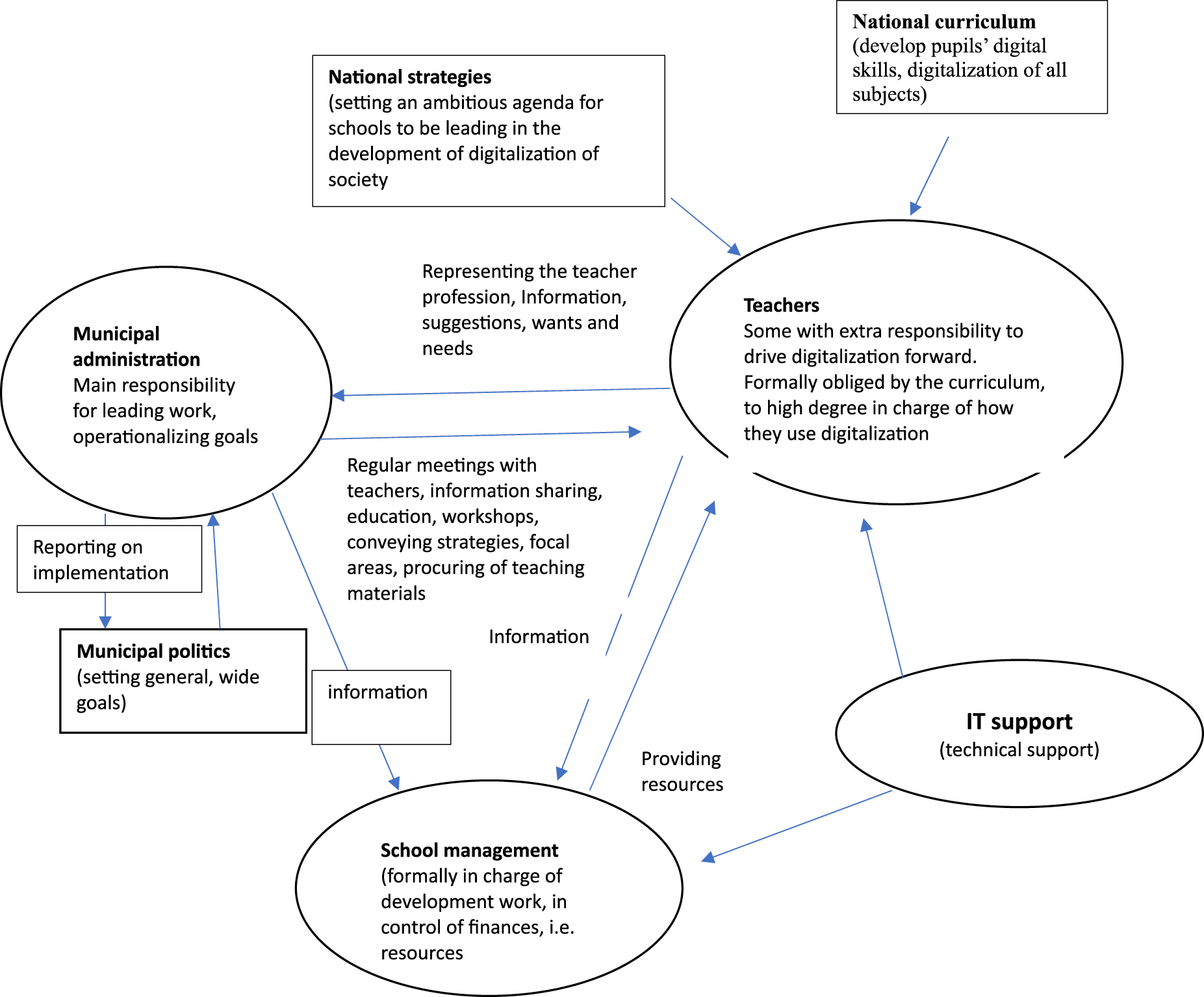
The Role of Teachers in the Network.
With the central role of teachers established, a foundation is now in place to apply the concepts of professional control and discretion.
This section will show that teachers enjoyed a substantial degree of professional control but also expressed a need for stronger managerial guidance. Second, it will highlight how this combination of strong professional control and limited managerial oversight created the conditions for a high degree of professional discretion.
A Wide Professional Control, but a Yearning for More Managerial Control
Most teachers—both those specializing in digitalization and those without specific responsibilities—emphasized that it was primarily teachers themselves who were driving digitalization efforts. However, one notable area where centralized municipal control was more prominent, and where teachers reported a lack of influence, concerned the standardized teaching materials procured by the municipalities. As previously noted, teachers had limited say in the selection or design of these packages. “Because we as teachers have been very free before to choose our own materials that suit us, that we like, or pick from different sources. And all of a sudden, one feels very restricted when it came, when it came from above, that now it's *teaching material* that applies.” (Teacher 1, Municipality A) “No, I don't know, it's not like someone comes and checks how much we actually work on it.” “So, I don't really feel regulated, I just think it's part of it. Or regulated for me has a bit of a negative connotation, that I have to, that it's something someone has decided.” (Teacher 3, Municipality B) “ I think maybe there's a need to set some expectations from the principal or the administration, like expecting the digitalization teachers to lead sessions at least once a month, and so on and so forth. So that it becomes, well, right now it feels like it's just an exchange of information. There needs to be demands set from a central level, and it needs to be seen that it trickles down into the operations, not just in the form of information but actually in action. Yeah...” (teacher 2 municipality B) “And perhaps we expect you to do this, this, and this. Then there's something to work towards, I think. And I would definitely see that there could have been a bit more formality in the whole thing.” (digitalization person 3 municipality A)
A Widespread Professional Discretion
This type of organizing, which grants professionals a significant degree of control, also enables them to exercise a substantial amount of discretion. Digitalization teachers had considerable influence over how they defined their roles within the networks—both in terms of how they communicated information from the municipal administration and how they represented their colleagues. As previously mentioned, they could, for example, filter or limit the information passed on to colleagues in order to prevent overload.
At the same time, although the municipality offered various courses to enhance teachers’ digital competencies, participation was voluntary, and respondents from both municipalities reported low levels of engagement. As such, despite the presence of structured initiatives and strategic development efforts, the actual content and impact of these initiatives largely depended on how individual teachers chose to use their discretion.
Furthermore, the loose and non-hierarchical nature of the organization, combined with the absence of micromanagement or accountability mechanisms, allowed teachers to exercise discretion in their day-to-day work. This included how they planned their teaching, which digital tools and materials they used, and the extent to which they engaged with digitalization efforts. As a result, the use of centrally procured teaching materials varied widely, with some teachers opting not to use them at all. "Now we've purchased *teaching material*. That means the municipality can see, look here, we're using digital teaching materials or that we have digital teaching materials. But hardly anyone actually uses them.” (Digitalization person 3, Municipality A) “You can't force anyone to use a digital resource. If you want to do it, you can, but you don't have to. Each teacher is responsible for their own classroom, you know.” "But it's mostly, I come back to what I said earlier, that someone else decides that these are the ones you should work with. We're not so used to that in Sweden, but in other countries, they have the same textbooks throughout the country. For example, in math, then you work with the same or so. But we don't do that, it's a big part, as I've said before, of our freedom and in our profession to be able to make our own of it. Because it should be as good as possible. And be able to adapt based on the children we meet, so.” (Teacher 1, Municipality A)
In the next section, these findings will be discussed in relation to existing literature, providing further insights into the dynamics of digitalization implementation in educational settings and its implications for professional discretion and control.
Discussion
What emerges from this empirical analysis is a dual reinforcement of both professional control and discretion among teachers within the specific organizing of digitalization observed in these cases. The findings reflect characteristics of what Da Roit and Busacca (2023) describe as “street-level netocracy”. The concept is used to describe organizations built on collaboration rather than traditional bureaucratic or professional norms. Although the networks in question are relatively loose, teachers occupy central positions within them. While municipal leaders are actively engaged in advancing digitalization strategies, they tend to do so without interfering in the teachers’ everyday work. As a result, the responsibility for managing digitalization efforts largely rests with the teachers themselves. Instead of being guided by hierarchical structures, the digitalization development work is organized through networks that prioritize collaboration and soft values. These networks are loosely structured, characterized by a lack of clear, standardized goals and limited mechanisms for holding teachers accountable for their digitalization practices. The minimal involvement of school management further reinforces this decentralized and loosely organized model.
Therefore, organizing of digitalization in the studied cases enhances professional control (c.f. Freidson, 2001). At the same time, all teachers retain a high degree of discretion. Both municipal administrators and digitalization teachers emphasize voluntarism, autonomy, and responsiveness to teachers’ individual needs in the digitalization process. This focus on flexibility highlights how digitalization efforts are designed to align with and support teachers’ professional discretion—both in development work and in the everyday integration of digital tools in teaching. Digitalization teachers have a degree of freedom to shape their roles and how they engage with others, while regular teachers exercise discretion in how actively they participate, whether and how they share feedback, and how they choose to incorporate digital initiatives into their own professional practice.
Interestingly, the findings indicate that one area where centralized, municipal control is more pronounced concerns the procurement of standardized teaching materials. Previous research has highlighted several challenges associated with the acquisition of such resources (Kormos & Wisdom, 2021). One notable challenge lies in identifying standardized packages that are applicable across different subjects and suitable for all teachers. While centralized control in this area tends to restrict professional discretion by narrowly defining the scope of professional work, teachers nonetheless maintain a degree of autonomy in deciding whether, how, and to what extent these materials are used in their teaching practice. As observed, this discretion is frequently exercised. As noted by Hassan and Geys (2016) despite significant investments in purchasing digital teaching materials, one potential outcome is that these resources may rarely or never be utilized by a certain number of teachers. Thus, even in this realm, teachers wield considerable discretion over the utilization of these materials.
The findings suggest that this type of organizing creates what Alshallaqi (2022) refers to as new “spaces for discretion.” Within this arrangement, digitalization teachers can determine which information to share with their colleagues and what issues to prioritize. They also shape how feedback from colleagues is communicated back into the network. Over time, this gives them significant influence over the direction of policy and the substantive content of digitalization initiatives. However, as emphasized by Ustek-Spilda (2020) and Löfgren (2020), the discretion referred to here is not always exercised in direct interaction with clients but often operates behind the scenes. The work carried out by digitalization teachers is not always transparent or visible, and they lack a clearly defined role within the hierarchical chain of command. As such, they do not function as traditional street-level bureaucrats who implement policy through direct client contact, as described by Lipsky (2010), Instead, they use these new spaces for discretion (Alshallaqi, 2022) and exercise discretion in more indirect ways—within the organizational back office (Ustek-Spilda, 2020) rather than in direct interaction with clients.
However, strong professional control and discretion are not universally embraced by teachers. Many express dissatisfaction with the lack of hierarchical control over digitalization efforts and advocate for greater managerial oversight and a more structured organization of digitalization initiatives. This nuanced perspective challenges the dichotomous view often presented in the literature, which tends to strictly separate managerial and professional control (Evetts, 2009, 2011; Freidson, 2001) and elevates discretion as a sacred value for professionals in all circumstances. However, what emerges from this study is that, in the context of the broad and somewhat ambiguous concept of digitalization, teachers are in fact calling for more managerial control (c.f. Buffat, 2015) even though this may, in practice, reduce their professional discretion.
Even though the content of digitalization work is largely within the discretion of teachers, there are societal norms strongly advocate for innovation (Bekkers et al., 2011) and schools seem particularly targeted in this regard. Previous research has described a “hype” (Selwyn, 2016) surrounding digitalization and has also characterized it as a reform agenda (Bejerot & Hasselbladh, 2011; Yeo & Marquardt, 2015). The interviews conducted revealed that teachers generally felt a normative pressure to develop their digitalization work, despite the vague formal requirements. None of the teachers expressed clear opposition to doing so. This suggests a form of normative pressure that is not rooted in control mechanisms or accountability regimes. Consequently, teachers may feel compelled to act, even though there is a lack of clarity regarding what specific actions are expected or how to proceed, which in turn can cause confusion.
These findings underscore that simply enhancing professional control and enabling discretion across all areas may not be sufficient. While previous literature has highlighted the role of professional elites as effective intermediaries—advocating for the profession and influencing decision-making at higher levels, particularly among local managers—the reality emerging from this study appears more nuanced (Alvehus et al., 2021; Eklund, 2021b). In this case, the channel of representation appears more ambiguous due to the network-based organization. Moreover, the areas in which teachers wish to exert influence—such as the selection of digital teaching materials—often fall outside their control. This suggests that more professional control and broader discretion in general are not always inherently better. Instead, there may be greater value in having clearly defined professional control and discretion over issues closely tied to the core of teachers’ professional work. Thus, professional discretion and control may be more valued when it concerns core pedagogical decisions—like the use of digital teaching materials—while being less appreciated when it comes to broader and more strategic areas of developmental work. This aligns with previous research suggesting that professionals do not necessarily seek influence over all organizational matters, but rather prioritize those closely linked to their daily professional practice (Alvehus et al., 2019a).
Concluding Remarks
This paper aimed to contribute with understanding of how professional discretion and control is exercised and shaped within networked forms of organizing. The findings show that this organizing is characterized by loosely structured networks and a noticeable absence of managerial control. Instead, professional control dominates, particularly through the role of digitalization teachers who are central to shaping the direction of the work. Moreover, the organizing affords a high degree of professional discretion—both in terms of how digitalization teachers define their roles and how individual teachers choose to engage with digital tools in their teaching.
The study contributes to the literature in several ways. It highlights the roles played by various actors in navigating the broad and ambiguous agenda of digitalization. It also reveals an organizational landscape marked by minimal managerial oversight and relatively invisible school leaders, with teachers emerging as the key agents of digital development.
This paper further deepens our understanding of the enablement or curtailment of discretion (c.f. Alshallaqi, 2022) and highlights the importance of context (de Boer & Raaphorst, 2023), particularly in terms of when such spaces for discretion are desirable—or not. While digitalization opens up new spaces for discretion—allowing teachers considerable freedom to determine how and what aspects of digitalization to engage with—it can also constrain discretion, as seen in the implementation of standardized digital teaching materials that limit professional autonomy. However, the relatively loose managerial control over the use of these materials still allows teachers a degree of discretion in practice. The conclusion drawn is that more discretion is not necessarily better; rather, discretion is valued differently depending on the domain in question.
Most importantly, the study challenges the assumption that more professional control and discretion are always beneficial. It shows that in the absence of managerial guidance—particularly in the face of broad goals and unclear expectations—teachers may experience uncertainty and a desire for clearer direction. The findings suggest that professional control and discretion may be most valuable when tied to core pedagogical work, whereas strategic and developmental areas might benefit from more structured managerial involvement.
Future research could further investigate the conditions under which digitalization enables or restricts professional discretion, as well as the role of managerial control in these processes. Given the limited involvement of school principals in this study, future research might explore how relationships between managers and professionals evolve in contexts where managers assume a more active role. Moreover, as digital technologies continue to advance rapidly—particularly with the emergence of artificial intelligence across sectors—there is a growing need for ongoing research to keep pace with these developments and assess their implications for professional practice and core professional values such as discretion and control.
Footnotes
Acknowledgements
The empirical material used in this paper was collected by the author in collaboration with Prof. Gustaf Kastberg Weichselberger and Ph.D. student Johanna Thalenius from the University of Gothenburg.

Funding
The author received no financial support for the research, authorship, and/or publication of this article.
Declaration of Conflicting Interests
The author declared no potential conflicts of interest with respect to the research, authorship, and/or publication of this article.