



Abstract
Background
Individuals with mobility disabilities are less likely to meet physical activity standards and are at greater risk of developing non-communicable chronic diseases at earlier ages. Public parks are an essential resource for participation in physical activity. However, environmental factors may limit the participation of wheelchair users. The objective of this study was to evaluate the feasibility of using the Path Environment Audit Tool (PEAT) and to explore the wheelchair accessibility of five public parks in Saudi Arabia through descriptive analysis.
Methods
A descriptive study design was implemented to evaluate wheelchair accessibility features of five public parks in Riyadh, Saudi Arabia, and process, resource, and management assessments were conducted. Phone GPS-App Strava was used to track the segments and measure their distances.
Results
Audits in multiple parks using PEAT were time-consuming despite being user-friendly. The descriptive analysis of paths and trails across the five parks showed some positive features, such as adequate bollard/gate clearance, but the path slope and condition of the path surfaces were more variable.
Conclusion
This study is the first to examine wheelchair accessibility in public parks in Saudi Arabia. Preliminary audits of paths/trials in five public parks revealed the strengths and weaknesses of accessibility and features that promote physical activity participation for wheelchair users. These findings can guide future use of PEAT in large-scale studies and inform environmental modifications.
Introduction
Built environment accessibility is a crucial part of any society that has persons with physical disabilities who participate in activities of daily living, such as employment and transportation. Without the equalisation of opportunities, many people are bound to live in isolation and poverty, especially in developing countries (Peterson, 2021). Approximately 1.5 billion people worldwide live with physical, mental, sensory, or intellectual disabilities (World Health Organization, 2011), with one in three people or more than 2.5 billion globally needing at least one assistive device. As the global population ages and the prevalence of communicable and non-communicable diseases increases, this figure will rise to 3.5 billion by 2050 (World Health Organization & United Nations Children’s Fund, 2022). In Saudi Arabia, the estimated prevalence of disability is 10.4%, which includes individuals with a wide range of disabilities largely attributed to cardiovascular disease and road traffic accidents (Tyrovolas et al., 2020; World Health Organization, 2011).
Extensive evidence suggests that participation in physical activity (PA) reduces the risk of secondary conditions and improves health and well-being for people with disabilities (Calder et al., 2018). Consequently, exercise guidelines suggest that adults, including those with mobility disabilities, should engage in at least 150 minutes per week of moderate-intensity aerobic physical activity and participate in strength training for two or more days per week (Center for Disease Control Prevention, 2018; National Health Service, 2022). However, individuals with mobility disabilities are 16–62% less likely to meet physical activity standards and are at a greater risk of injury and developing non-communicable chronic diseases at earlier ages compared to people without disabilities (Hollis et al., 2020).
Engagement and participation in occupation take place within the social and physical environment situated within context (American Occupational Therapy Association, 2010) and serve as an important resource for physical and psychosocial well-being, given that they offer opportunities for physical activity as well as a restorative space for people living in urban environments (Hartig et al., 2014; Wood et al., 2018). Schipperjin et al. (2017) found that living in a neighbourhood with more parks within 1 km of one’s home was associated with greater leisure-time physical activity. (Schipperijn et al., 2017) Furthermore, Han et al. (2013) found that vigorous physical activity, in particular, was supported by park availability (Han et al., 2013). In addition to promoting physical activity, research supports the benefits of green spaces and parks in terms of stress reduction and social cohesion (Hartig et al., 2014; Jennings & Bamkole, 2019; Wood et al., 2018). Although the health-promoting properties of parks are clear, people with mobility disabilities may not be able to access public parks due to environmental barriers.
Accessibility to wheelchair users in Saudi Arabia has improved in recent years; however, there is still room for further progress. In 2018, Saudi Arabia launched a new accessibility law that mandated that public and private entities provide equal access to people with disabilities, including wheelchair users. This mandate was enforced through The Saudi Building Code, a comprehensive set of regulations and standards established by the Saudi Arabian government to govern the design, construction, and maintenance of buildings in the Kingdom of Saudi Arabia (Saudi Building Code). It covers various aspects of building construction including structural integrity, fire safety, electrical systems, plumbing, and accessibility. Moreover, the requirements and guidelines for accessibility encompass provisions for features such as ramps, elevators, accessible parking spaces, signage, and restroom facilities to facilitate the movement and participation of individuals with disabilities in built environments (Saudi Building Code). Consequently, new buildings and public transportation services must be designed and constructed with accessibility in mind and existing facilities must be retrofitted to meet accessibility standards (AlShathri, 2019). In addition, Saudi Arabia’s Vision 2030 includes a strategic quality of life and health program, one of the goals of which is to reduce health risks associated with preventable diseases and target the disabled population through health promotion and prevention activities (Khayat et al., 2023; Kingdom of Saudi Arabia, 2016; Kingdom of Saudi Arabia Vision 2030, 2020; Tyrovolas et al., 2020).
Despite the new accessibility law, many barriers to accessibility still exist in Saudi Arabia, particularly for older buildings and infrastructure. One of the barriers is in relation to enforcement mechanisms, which may be lacking, leading to non-compliance by developers and builders, resulting in a lack of proper maintenance. Another barrier is rapid urbanization and development in Saudi Arabia, which may outpace efforts to incorporate accessibility features into infrastructure and built environments. In addition to the topographical challenges due to the geography and climate of Saudi Arabia, desert landscapes and extreme temperatures pose unique challenges for ensuring universal accessibility. Additionally, some cultural attitudes towards disabilities may contribute to social barriers and discrimination against disabled people, and may influence perceptions and priorities, leading to a lack of awareness and investment in making spaces accessible. Existing research on wheelchair accessibility in Saudi Arabia has focused on indoor spaces, such as mosques and public buildings (Abu Tariah et al., 2018; Khayat et al., 2023; Mohammad & Al-Harbi, 2016; Peterson, 2021).
To address these obstacles, it is crucial to strengthen frameworks to improve enforcement methods, raise awareness among the public, and promote inclusivity in urban planning nationwide. There are ongoing efforts to address these challenges and improve accessibility for wheelchair users and other people with disabilities in Saudi Arabia. For example, the Saudi government launched initiatives to raise awareness of disability rights and promote the inclusion of people with disabilities in society (AlShathri, 2019). Private companies and organizations have also implemented accessibility measures such as installing ramps and lifts to improve the accessibility of their facilities and services. Owing to their expertise in client-centered practice, environmental modification, and the promotion of healthy habits and routines, occupational therapists are perfectly prepared to advance accessibility and promote lifestyle changes, include increasing PA participation (American Occupational Therapy Association, 2020; Bar & Ratzon, 2016; Baxter & Porter-Armstrong, 2012; Fritz, 2014; Fritz & Cutchin, 2016; Nielsen & Christensen, 2018).
There is a growing body of evidence on the impact of the environment on PA, including data from studies that demonstrate the advantages of park availability. The association between certain social and physical environment components and PA engagement among people with mobility disabilities has also been studied. Evidence suggests that barriers to physical activity participation include a lack of support from family, friends, and healthcare providers, a lack of motivation, and a lack of facilities (AlQuaiz et al., 2021). Consequently, these studies emphasised the significance of social context and availability of facilities, as well as their motivational characteristics, in the promotion of physical exercise.
Previous studies have demonstrated that parks and paths/trails are significant resources for leisure-time physical activity and promote social participation and social cohesion (Cohen et al., 2007; Han et al., 2013; Jennings & Bamkole, 2019; Schipperijn et al., 2017). Guidelines for examining the accessibility of outdoor recreational areas and parks have been developed, which include a description of features that promote path/trail access for wheelchair users (Zeller, 2012).
However, not all parks are created alike, since their features and characteristics can affect how they are used and the therapeutic advantages they provide. For instance, features that promote wheelchair accessibility of paths/trails include clearance next to barriers and gates, access routes (including their surface conditions and materials), slopes and cross slopes of paths and trails, accessibility of viewing areas, resting intervals, trail/path maintenance, and accessibility of benches, picnic tables, and bathrooms (Bedimo-Rung et al., 2005; Troped et al., 2006; Zeller, 2012).
Although researchers have examined the accessibility of public parks in other cities (Perry et al., 2018), to our knowledge, no prior studies have examined wheelchair accessibility in outdoor spaces and/or parks in Saudi Arabia. Given that the current focus of urban planning in Saudi Arabia includes the development of open spaces to promote population well-being, the assessment of existing parks is timely, and can shed light on existing recreational resources and their potential gaps. Prior to conducting a large-scale evaluation of the physical activity-promoting qualities and accessibility features of parks, a “proof-of-concept study, a common methodological approach in healthcare quality improvement research, is necessary to evaluate its feasibility and implementation (Kendig, 2016). Process, resource, and management evaluations are included in feasibility studies to assist in a larger investigation. Furthermore, descriptive analysis should be prioritised over significance tests (Tickle-Degnen, 2013). This study aimed to assess the accessibility of paths and trails in five metropolitan public parks in Riyadh, Saudi Arabia.
Methods
Design
In this descriptive study, we examined wheelchair accessibility features of five public parks in Riyadh, Saudi Arabia, using the Path Environmental Audit Tool (PEAT), a tool developed to assess paths and trails for features that increase physical activity participation. A process, resource, and management assessment was done to evaluate the PEAT measure’s potential applicability to a larger size study (Tickle-Degnen, 2013; Troped et al., 2006).
Tool and measures
Existing auditing techniques are used to evaluate the characteristics of parks that encourage PA. However, given our interest in accessibility and physical activity participation for adults who are wheelchair users, the Path Environment Audit Tool (PEAT) was selected because it focuses on paths/trails rather than less relevant park features. In addition to an evaluation of design characteristics, facilities, and maintenance/aesthetics, the PEAT was designed using the following accessibility resources (National Center on Accessibility, 2024; U.S. Department of Agriculture, 2007; U.S. Department of Justice Civil Rights Division, 2010), which include specifications for accessible wheelchair seating spaces, slopes, cross slopes, and clearance spaces, with an acceptable percentage (66.6%) of factors related to accessibility (Aghaabbasi et al., 2018; Troped et al., 2006).
Questions on PEAT encompass various components (40 items in three dimensions) that are crucial for evaluating the physical accessibility of outdoor environments. It comprehensively assesses path features, including surface type, width, slope, and cross-slope, which directly influence the mobility of individuals using wheelchairs, walkers, or other assistive devices. Additionally, PEAT evaluates obstacles, such as curbs, steps, vegetation overgrowth, and debris, that may impede movement along the path. Moreover, safety considerations, such as lighting, signage, visibility, and the presence of hazards, were also examined to ensure a safe environment for all users, including those with visual impairments. The tool further appraises the availability and accessibility of amenities, such as seating, rest areas, water fountains, and parking spaces, contributing to user comfort and experience. Assessments extend to intersections, pedestrian crossings, ramps, and evaluating factors such as curb cuts, tactile paving, and signalisation to facilitate safe passage for individuals with mobility or sensory impairments. Lastly, PEAT examines wayfinding aids, such as signage and maps, to assist users in navigating the environment effectively, particularly for those with cognitive impairments or sensory processing difficulties. While the tool is comprehensive in examining features that promote physical activity participation in general, the focus of this paper is on eight items from the 36 items of PEAT. These items were carefully chosen based on their importance in assessing accessibility for individuals who use wheelchairs following the approach outlined by Troped et al. (2006). The selection process emphasised factors such as seating areas for wheelchair slopes, cross slopes, and clearance spaces as recommended by accessibility sources such as the National Centre on Accessibility, the U.S. Department of Agriculture and United States Department of Justice Civil Rights Division (National Center on Accessibility, 2024; U.S. Department of Agriculture, 2007; U.S. Department of Justice Civil Rights Division, 2010). This deliberate selection ensured that the assessment focused on elements that promoted participation in physical activities among adults who relied on wheelchairs.
It has been demonstrated that the PEAT is a valid instrument with moderate to high inter-rater reliability for its major items (k-values between .46–.71, observed agreement ≥81%) and significant agreement between PEAT audits and GPS-derived measurements (0.77; k-values were ≥.57) (Dragović et al., 2023; Joseph & Maddock, 2016; Troped et al., 2006; Zoellner et al., 2012). The PEAT and its’ manual can be accessed from Perelman School of Medicine, University of Pennsylvania’s website https://www.med.upenn.edu/beat/peat-materials.html
Procedures
Occupational therapists and physical therapists with professional training to assess accessibility formed the research team. To ensure the proper application of the PEAT measure, the research team examined the PEAT manual and scoring sheet and sought explanations from the measure’s author. The five parks chosen for the study were situated in the middle of the neighbourhoods and represented various geographic areas in the city, such as the north, south, east, and west.
Using PEAT, three members of the study team completed the assessments of each path segment. The audit findings were entered directly into an Excel spreadsheet categorised by park location and content section, using a tablet. In addition, iPhone GPS-App Strava was used to track the segments and measure their distances. Consistent with the PEAT guidelines, the beginning of a new segment was established when (1) there was a change in surface type and (2) there was a change in elevation. (2) When a trail or road intersected the path. (4) For long paths without any surface modifications or connecting paths/roads, an approximate distance of 500 m was chosen to divide the path into parts. The short portions were combined to an approximate distance of 500 m.
Analysis
To evaluate the park’s characteristics, descriptive statistics, including means and standard deviations. were computed. For the analysis, IBM SPSS Statistics for Windows, version 24 (Armonk, NY: IBM corp.) was utilised (IBM Corp, 2016).
Results
Process, resource, and management assessment
Collectively, three members of the study team completed audits of each path segment. The PEAT assessment was clear and simple to administer. Because of the researchers’ direct input into the Excel spreadsheet, inaccuracies caused by transcribing the results from the hard copy/paper version of the instrument were eliminated. The iPhone iOS-installed GPS application Strava (Strava Inc, 2009) was a valuable tool for tracking path segments and the time to complete it. In addition, screen images of GPS maps made it simple for auditors to document path and trail lengths. Depending on the size and quantity of the features present in each park, the audits took between 15 minutes to one hour and 40 min to complete. This schedule did not account for the travel time to parks.
Wheelchair accessibility features of five public parks in Riyadh.
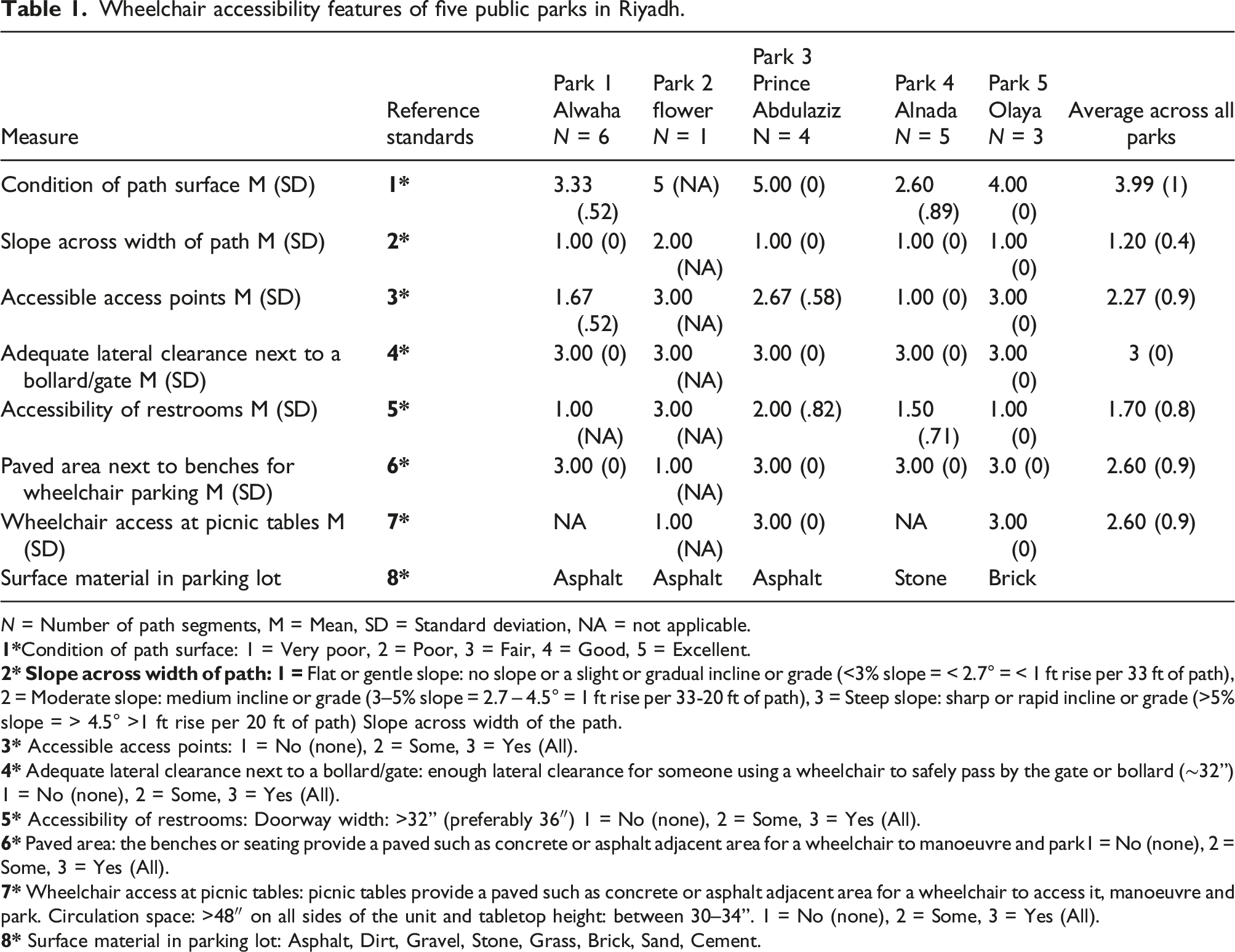
N = Number of path segments, M = Mean, SD = Standard deviation, NA = not applicable.
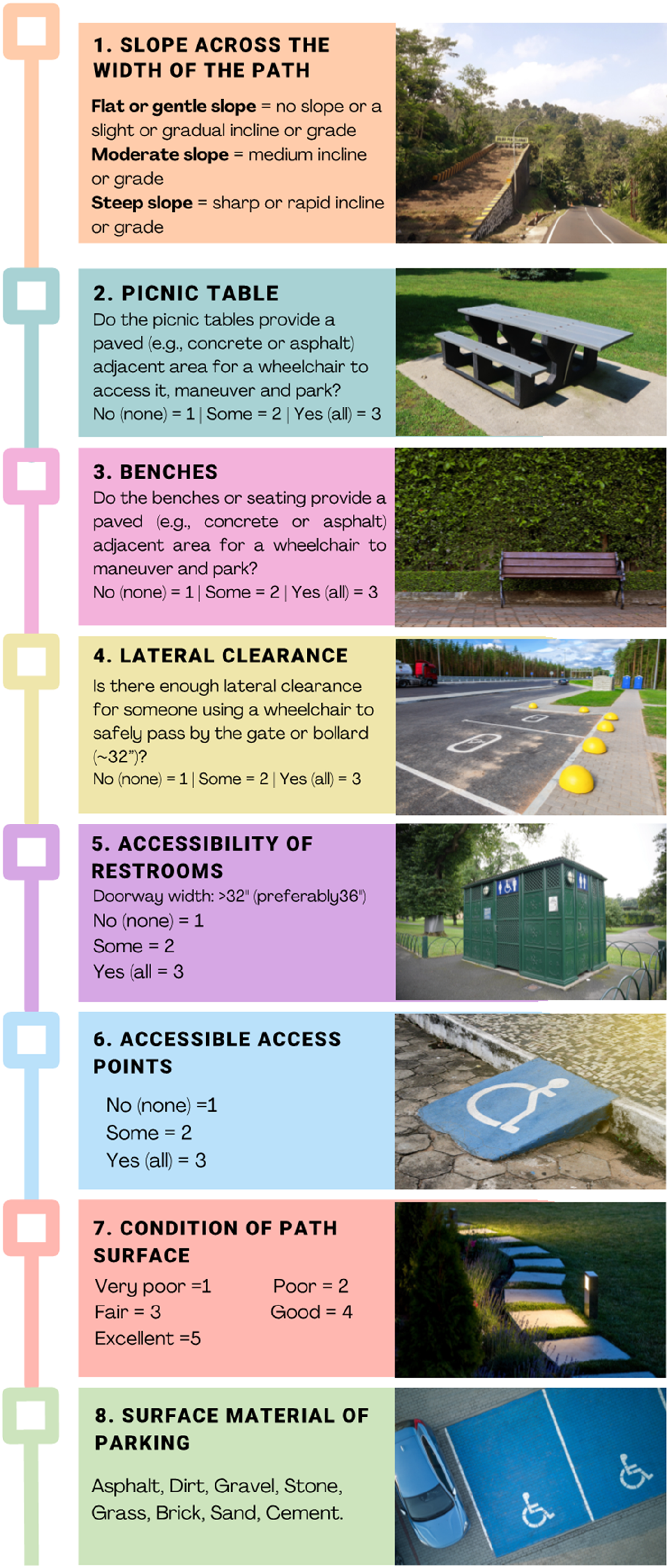
Reference standards for wheelchaor accessibility features of five public parks in Riyadh.
According to our findings, sufficient lateral clearance next to the gates was consistent across parks. All but one park had a flat/gentle cross-slope or lacked a paved area next to the benches. The other path/trial features in the five parks were more variable. For example, most parks have asphalt as the surface material in the parking lot. However, bricks and stones were used in two parks, which can present additional mobility challenges for wheelchair users. Except for one park, accessible bathrooms were not consistent across park segments. Moreover, several parks lacked consistency in accessible access points, hindering the use of park paths.
Discussion
This pilot study of wheelchair accessibility revealed both the strengths and limitations of the paths and trails in the five audited public parks. The results highlight the need for modifications to existing parks, such as maintenance to improve the condition of path surfaces, modifying bathrooms for improved accessibility, improving the accessibility of existing access points, or adding new access points that are fully wheelchair accessible.
The study findings in terms of path condition and lateral clearance next to a bollard or gate are good. While the parking surface material, accessibility of all entrances, and paved area around benches and picnic tables may be improved by using asphalt as a parking surface, ensuring all entrance points and the paved area around benches and picnic tables are suitable for people with disabilities (PwD) who are using wheelchairs, The slope across the width of the path and the accessibility of restrooms need crucial improvement to enhance the accessibility of PwD who use wheelchairs to utilize the parks efficiently. Enhancing the accessibility of the outdoor natural environment, such as parks, urban green spaces, and gardens, increases the utilization of nature settings in rehabilitation. Recently, exercise-based rehabilitation in an outdoor setting demonstrated a noteworthy improvement in terms of social, psychological, and physical advantages. In addition, it prevents several serious illnesses, including osteoporosis, and vitamin D insufficiency. Therefore, improving accessibility to outside nature enhances engaging in physical activity and exercise, which has a great impact on quality of life and general health and wellbeing (Busk et al., 2023; Manferdelli et al., 2019).
While utilizing the PEAT tool for assessing path conditions and lateral clearance, we encountered difficulties and identified areas that could be enhanced. One particular challenge involved evaluating the slope across the path’s width and ensuring restroom accessibility, which are essential for wheelchair users to navigate parks effectively. We suggested that future research teams include members with disabilities to diversify the study by incorporating devices like manual and power wheelchairs, thereby ensuring a more comprehensive and inclusive assessment of accessibility.
These findings suggest that further attention should be paid to urban planning and the development of new parks and green spaces to ensure that they are accessible to PwD, including wheelchair users, as recent national survey data showed that more than half a million Saudi citizens reported the presence of disabilities (Al-Hazzaa & AlMarzooqi, 2018). This emphasises the need to consider wheelchair-friendly public parks to improve PwD physical activity levels, psychological well-being, and quality of life (Zahra et al., 2022). Public parks in Saudi Arabia are used for spending time with friends, family, and children, practicing physical activities, and mental refreshment (Zahra et al., 2022). Therefore, providing a wheelchair-friendly public park offers PwD the right to participate with autonomy and dignity within their community according to World Health Organization recommendations and to accomplish Saudi Vision 2030 (Nikolajsen et al., 2021; Rahman & Nahiduzzaman, 2019).
Our findings are consistent with those of a previous study assessing the accessibility and space allocated for parks in Hail City. The study demonstrates that Hail’s parks are not easily accessible to the general population, as most of them are adjacent to a main road or highway road and are exposed to noise and air pollution, an inadequate number of toilets, and poor surfaces without clarification of suitability and accessibility for PwD use. This is consistent with other studies conducted across the Kingdom (Said & Touahmia, 2020). The current study’s findings are in line with previous national findings assessing street and mosque accessibility for PwD, as they were not pedestrian-friendly environments for the general population and did not meet the needs of wheelchair users (Mani et al., 2021; Mostafa, 2021; Nour, 2021). It is noteworthy that recent studies have revealed that certain mosques in Saudi Arabia have implemented accessibility features, including ramps and accessible prayer areas (Abu Tariah et al., 2018; Sarsak, 2021).
Globally, outdoor environmental assessments have primarily concentrated on the availability and inclusiveness of children’s playgrounds, walkability/wheelability of neighbourhoods, and wheelchair accessibility of national parks (Hand et al., 2012; Lynch et al., 2020; Moore & Lynch, 2015; Perry et al., 2018). Therefore, this study emphasizes that greater attention should be paid to public parks and their accessibility for wheelchair users in Saudi Arabia. Pending the results of research in other cities, more emphasis on accessibility of public parks may also be needed globally. Specifically, by applying occupational science concepts which underscore occupational therapy’s role in promoting being in nature, which is a significant factor when working with individuals who may be at a time of mental crisis or experiencing significant barriers to doing so, evidence suggests that an increase in personal connection to nature is associated with greater therapeutic outcomes from outdoor engagement (Firby & Raine, 2023).
In Saudi Arabia, the Ministry of Municipal and Rural Affairs may need to exert effective efforts to enhance the accessibility of public park features for PwD to accomplish Saudi Vision 2030 and attain their right to actively participate in the community without environmental barriers and improve their physical and mental health. By doing so, the concept of outdoor deprivation as a matter of occupational justice can be addressed, particularly when it is an important and emerging area of practice and research for occupational therapy and rehabilitation (Firby & Raine, 2023). Thus, this study laid the groundwork for further exploration in this field.
Future studies should include audits of additional parks in strategically selected districts and other major cities to serve as a resource for accessibility for wheelchair users and rehabilitation programs. These audits can be used to create a database and consumer guide to help wheelchair users identify parks that meet their accessibility needs. Furthermore, it is essential to conduct qualitative research to capture the experiences of wheelchair users when it comes to using public parks. The Ecology of Human Performance Model provides a useful structure to inform future occupational therapy initiatives related to assessment and intervention in outdoor settings (Dunn et al., 2003). By Combining occupational therapy skill sets with design disciplines, such as architecture, landscape architecture, interior architecture, and urban planning, it sets the stage for well-balanced outcomes that allow individuals with physical disabilities of all ages to engage and participate in their communities (Young et al., 2019).
One limitation of the study is that Troped et al. created the Path Environment Audit Tool (PEAT) in the United States back in 2006, since then, updated accessibility guidelines have been developed, (U.S. Department of Justice Civil Rights Division, 2010). Consequently, certain criteria defined in PEAT may now be outdated, like how it defines “no slope”. Updated tools that reflect new accessibility standards could provide accuracy and relevance when assessing path environments. Hence, future research could benefit from exploring and potentially incorporating or adjusting these tools to ensure that accessibility evaluations align with present-day standards and best practices.
This research adds to the expanding corpus of knowledge regarding the establishment of inclusive communities through the utilization of emerging data from Saudi Arabian contexts, despite the pledge to inclusiveness made by local authorities. The following suggestions were acknowledged: the necessity of conducting research that expands the understanding of universal design, particularly regarding outdoor community parks and spaces, participation, and engagement as they pertain to public parks and play places. To determine the reasons for non-use, it is necessary to expand research to include families that do not access or utilise outdoor community parks. To satisfy the needs of community engagement, occupational therapy must adopt new service delivery methods that emphasize outreach, policy, and community-level changes to support occupational participation.
Implications
To assist rehabilitation practitioners in clinical decision-making to encourage PA, the results of this study provide insight into the environmental elements that influence the engagement and performance of wheelchair users and individuals with mobility impairments in public parks and spaces. Moreover, the results indicate critical factors to consider during the process of strategizing and creating inclusive public parks and spaces, wherein occupational therapists could actively participate. Subsequently, initiating disability awareness intervention programs for stakeholders in collaboration with local authorities, disability organizations, and educators is one way to promote the involvement and inclusion of wheelchair users with mobility impairment.
Notwithstanding the presence of global regulations that safeguard the rights of people with disabilities, national and local legislation is crucial for promoting social transformation regarding the provision of accessible and inclusive public parks and spaces. Occupational therapists can participate in public discourse as advocates to facilitate policy changes at the national or local level. Collectively, we may advocate in public and media spheres regarding the importance of outdoor engagement in the lives wheelchair users and the sociocultural circumstances that impose limitations and marginalize individuals with mobility disabilities in public areas. Therefore, the distribution of the findings from this research will inspire ongoing national and international advocacy for accessibility in parks and their environments to promote the inclusion of community members and park visitors.
Conclusion
To our knowledge, this is the first study to examine wheelchair accessibility in public parks in Saudi Arabia. The results reveal both the strengths and limitations of the audited parks. Further research is warranted to expand the findings of this pilot study. Additionally, with appropriate resources, PEAT is a viable and acceptable tool for use in extensive studies. Nevertheless, additional audit items should be included to make the audit tool more suitable for wheelchair users and those living in hot climates.
Modifications to the environment and upkeeping of existing parks are necessary to encourage physical activity among wheelchair users in Saudi Arabia. Overall, while there are still challenges to overcome, there has been progress in improving accessibility for wheelchair users in Saudi Arabia, and the government and other stakeholders continue to work towards greater inclusion and accessibility for people with disabilities.
Footnotes
Acknowledgements
The authors would like to thank Dr Philip Troped, who developed the PEAT, for his time and effort in providing clarification regarding the measurement and its use.
Declaration of conflicting interests
The author(s) declared no potential conflicts of interest with respect to the research, authorship, and/or publication of this article.
Funding
The author(s) disclosed receipt of the following financial support for the research, authorship, and/or publication of this article: The authors extend their appreciation to the Deputyship for Research & Innovation, Ministry of Education in Saudi Arabia for funding this research work through the project number RI-44-0158.
Ethical approval
No ethical issues related to this study was required as there were no human participants involved in any of the stages of the study.
