



Abstract
Background
Ensuring effective return to work following acquired brain injuries is crucial from the perspectives of both quality of life and the economy. However, techniques of occupational therapy support for return to work remain relatively unelucidated.
Aims/Objectives
To clarify the specific contents of occupational therapy required for work and work support for clients with acquired brain injuries.
Material and Methods
An interview-based survey was conducted with participants who had >10 years of occupational therapy experience and had provided work support. We selected participants via snowball sampling. Data were analyzed using thematic analysis.
Results
A total of 20 participants (15 women and 5 men; 6, 12, 1, and 1 in their 30s, 40s, 50s, and 60s, respectively) were included. Six concepts were generated on reviewing the support for work items considered important by the occupational therapist as follows: “Support for vocational life,” “Support for interpersonal skills,” “Support for work,” “Support for illness, disability, and awareness,” “Support for utilization of compensation measures,” and “Support for goal setting.”
Conclusions
We clarified the specific contents of work support, including support for vocational life and support for work, that is administered by occupational therapists who provide work support for clients with acquired brain injury. The insights from the study improve understanding of OTs’ roles and contributions in supporting clients with acquired brain injuries in returning to work.
Keywords
Introduction
Acquired brain injury (ABI) is an umbrella term encompassing traumatic and non-traumatic brain injuries (Bruns & Hauser, 2003). Among working-age clients with ABIs, facilitating an effective return to work (RTW) after a leave of absence or quitting jobs while navigating the after-effects of the injury is crucial to ensure both quality of life and the greater economy. However, evidence-based rehabilitation programs aimed at successful RTW for client are currently lacking (Donker-Cools et al., 2016; Van Deynse et al., 2022). For clients, hospital-to-community support is important for work support; however, hospital rehabilitation focuses on return to physical function and daily activities rather than RTW (Medin et al., 2006; Radford et al., 2015). Post-ABI RTW constitutes a complex process that can be facilitated or impeded by organizational, social, or personal factors and accessibility to appropriate services (Brannigan et al., 2017; Teo et al., 2022). Regional and international studies have shown that occupational therapists (OTs) play a role in providing work support to clients (Johansson et al., 2021; Sato et al., 2018; Soeker, 2012, 2016; Stergiou-Kita et al., 2009, 2010; Öst Nilsson et al., 2017). OTs coordinate rehabilitation programs to provide work support for clients in some cases (Johansson et al., 2021; Öst Nilsson et al., 2017). In a study to evaluate work support provided by OTs for clients, Stergiou-Kita et al. (Stergiou-Kita et al., 2009, 2010) interviewed 10 Canadian OTs to develop a work-readiness evaluation model.
In Japan, OTs are well-versed in the significance of work, performance elements, and people’s lives, and are therefore suitable providers of vocational rehabilitation (Japanese Association of Occupational Therapists, 2006). Sato et al. (2018) conducted an interview-based study in Japan on OT-provided work support for post-ABI clients to clarify the formation process theory of area recognition and support. Despite clarity from regional and international research that OTs undertake work support for clients in various ways, the specific support techniques used by OTs have not been sufficiently clarified.
OTs play a key role in evaluating clients’ work abilities and potential (Innes & Straker, 2002). Despite its suitability in vocational rehabilitation, the reason for the usefulness of occupational therapy in vocational rehabilitation has not been elucidated. Vocational rehabilitation in Japan differs from that in other countries in some aspects of work policies for persons with disabilities. For example, Japan has an obligatory work system to promote employment of persons with disabilities (Matsui & Kikuchi, 2006). In contrast, the United States and United Kingdom use legislation, particularly the Disability Discrimination Act, to ensure employment and non-discrimination of people with disabilities (Matsui & Kikuchi, 2006). However, the importance of treatment and support for clients after illness or injury and support for the community is known internationally. Examining the type of support provided by Japanese OTs to clients with ABIs will contribute to the sharing of best practices and will enable mutual learning for work support for clients, not only in Japan but also worldwide.
We aimed to investigate the specific content of work support administered by OTs who are currently providing employment support for post-ABI clients in Japan.
Material and methods
Participants
OTs in Japan who had OT-specific work experience of more than 10 years and had provided work support to community-dwelling clients for more than 1 year were enrolled in this qualitative study. The number of years of experience was set as 10 years or more because of a difference in the quality of experience between OTs with less than and those with more than 10 years of experience, based on an interview survey of OTs in Japan (Sato et al., 2018).
For recruitment, specifically, four acquaintances of the first author, three acquaintances of the third author, two persons whom the first author was acquainted with through the Japanese Society of Occupational Therapy and the Japanese Society for Higher Brain Dysfunction, and 11 OTs selected based on the snowball sampling (Biernacki & Waldorf, 1981) were invited to participate in this study. We avoided stringent selection criteria, as the number of OTs providing community work support in Japan constituted less than 1% of the members of the Japanese Association of Occupational Therapists (2020) as of 2019.
Ten persons were interviewed in the studies conducted by Stergiou-Kita et al. (2009) and Sato et al. (2018). In the present study, we considered it appropriate to double the number of OTs interviewed in previous studies (Sato et al., 2018), that is, 20, to clarify the details of the work-support techniques used by OTs with clients.
Data collection
Interview Guide Used for Data Collection From the Participants.

aSpecific items of work readiness support (based on an individual’s ability as a hierarchical structure (Adapted from Matsui, & Kikuchi (2006). Syokugyo rehalilitation kaitei dai ni han [Vocational Rehabilitation Revised second edition]. Kyodo Isyo).
Disease and disability management
Physical function training, cognitive function training, assistance with awareness of the condition, and management of the disease.
Performance daily activities
Activities of daily living (ADL) training, instrumental activities of daily living (IADL) training, environmental setting (in the home), interventions on rhythm of life, consideration of orthotics, and assistive devices and self-help equipment.
Performance vocational activities
Group training, implementation of recreational activities, implementation of joint work, intention practice greeting practice, interventions on emotional control engagement with co-ordination, use of compensation measures, environmental adjustment (working environment), practice in reporting and communication, and learning the rules of the workplace.
Performance of vocational duties
Vocational training as preparation for job search.
Here, work readiness was defined as a state wherein an individual is provided the necessary conditions to continue working (Japan Society of Vocational Rehabilitation, 2012). Regarding the content of this item, we used the “Hierarchical structure and support for the overall picture of individual characteristics” model proposed by Matsui (Matsui & Kikuchi, 2006) – a conceptual model of vocational readiness that is widely used in the field of vocational rehabilitation in Japan. These researchers considered the characteristics of an individual’s ability as a hierarchical structure comprising four layers (Figure 1). In the interviews, we used the four-tier structure proposed by Matsui (Matsui & Kikuchi, 2006) and asked the interviewees to clarify the support that they regarded as important. An individual's ability is presented as a hierarchical structure (Adapted from Matsui, & Kikuchi (2006). Syokugyo rehalilitation kaitei dai ni han [Vocational Rehabilitation Revised 2nd edition]. Kyodo Isyo).
To make it easier for the interviewees to respond descriptively about the support that they consider particularly important, the first, second and third authors, who are experienced in OT support and research with clients, listed the specific items of the hierarchical structure comprising the four layers proposed by Matsui. Furthermore, while presenting these items to the participants, the authors asked them about their perspectives and specific methods of support which they consider particularly important (Table 1). To practice support for work readiness and work settlement, it is important to cooperate with vocational rehabilitation professionals (Ministry of Health, Labour and Welfare, 2009), such as vocational counsellors for persons with disabilities, job coaches, work support workers, work support personnel, and welfare facility support staff, and to support the employers (Brannigan et al., 2017; Donker-Cools et al., 2016; Johansson et al., 2021; Medin et al., 2006; Radford et al., 2015; Sato et al., 2018; Stergiou-Kita et al., 2009; Stergiou-Kita et al.; Van Deynse et al., 2022; Öst Nilsson et al., 2017); however, the extent of OT intervention in Japan is unclear; therefore, we enquired about the current state of support.
A single interview was conducted per participant and lasted approximately 1 hour. The interviews were recorded with the consent of the participants, and a verbatim record was made.
Data analysis
Thematic analysis (Braun & Clarke, 2008), which is a method for identifying, analyzing, and reporting themes in data, was adopted. Using thematic analysis, data can be explained in a minimally organized manner with rich content and the analysis promotes an understanding of the complete picture of remarks by a specific participant; moreover, it is possible to conduct an analysis from a case-centered perspective. Through thematic analysis, we hypothesized the possibility of generating key codes and themes for work support for people with ABIs based on the language used by the participants and to present them as a relationship diagram between themes. Prior et al. (2015) demonstrated the effectiveness of thematic analysis as a flexible and useful research tool by using a sample of OTs to provide rich, detailed, yet complex data descriptions.
In our analysis, we first created document segments from the narratives about the method and content of OT work support for clients with ABIs from the verbatim written data that were extracted for each participant. Next, the contents of the document segments were summarized individually and a code was assigned to each content item of the summarized document segments to organize them into themes. The contents of the theme-summarised document segments were arranged and references to the original document data were repeated multiple times from the generated code and theme. We considered the relationship between the themes and created a diagram of the results.
The first, second, and third authors are experienced in interview research. A series of analyses was supervised by the second and third authors, who are familiar with rehabilitation support for clients with ABIs.
Ethical considerations
This study was approved by the Kobe University Graduate School of Health Sciences Ethics Review Board (January 10, 2020; approval no. 710) and was conducted in accordance with the principles of the Declaration of Helsinki. The participants provided written informed consent.
Results
Questionnaire/interview survey results
Basic Attributes of Research Participants.
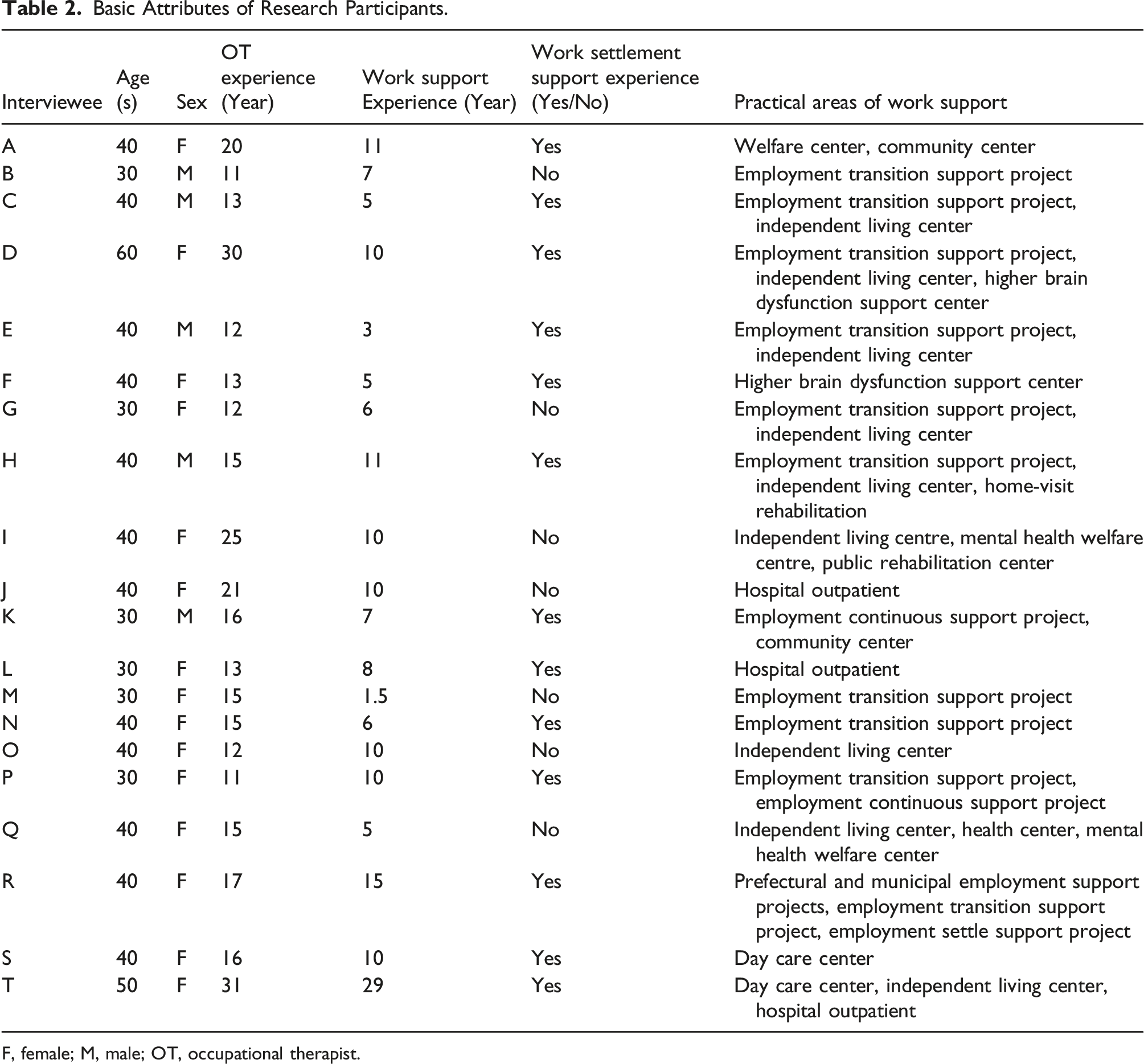
F, female; M, male; OT, occupational therapist.

A work readiness and work settlement support model for Japanese occupational therapists to support clients with acquired brain injury. A. B. C. D. E. F.
The goals set by the OT until the clients secured a job were meant to support their readiness for work, with the aim that “Clients make it possible to get a job and work while living a healthy vocational life.” To achieve this goal, the first step was to shift from support based on “Support for vocational life” to “Support for interpersonal skills” and “Support for work” while providing “Support for utilization of compensation measures.” The OTs provided support in the position of “Leader” that was simultaneously undertaken with “Support for illness, disability and awareness” provided from the standpoint of a “Therapist.” “Support for goal setting” was provided in parallel. After a client had been employed, “Support for work” was continuously provided through communication with the client, family, employer, and vocational rehabilitation professionals with the aim that “Clients are able to maintain and become habituated to their work.” A series of work support was provided while “Evaluating and understanding the information of a client.”
Concept description
Results of the Generated Concepts, Definitions, and Content/Ingenuity.

Support for vocational life
Promote awareness of one’s living conditions
Using daily life management charts and apps, the clients recorded their daily activities, such as sleeping hours, food intake, and shopping, and were supported to help notice any disruption to their daily rhythm.
Adjust one’s schedule and environment
The clients were supported to improve their activity levels by adjusting their time and environment, including adjustment of their rest and activity times, sleeping and waking times, facilitation of workplace visits and practical training, encouragement of awareness of dressing and dressing independently, and improvement in performing IADLs in the home environment.
Assistance in mastering ADL and IADL
In cases where there were problems with the use of public transport or ADL, direct training was provided.
Provide explanations and advice and facilitate discussions with the client and their family
The client’s daily living situations and thoughts were heard, and factual explanations and advice were provided. Problem-solving strategies were provided by using individual or group training.
Support for interpersonal skills
Group training
The OTs provided clients with opportunities to communicate and work together in groups, created an environment conducive to speaking up, and coordinated the division of roles and burdens.
Encourage reporting and communication
The clients were encouraged to take action by creating situations in group training and work activities wherein reporting was necessary. For those who had difficulty in reporting, support was provided to encourage the use of memory notebooks and alarm settings.
Taking necessary measures for aphasia
Communication support was provided to people with aphasia through expressive and supplementary means, such as waiting considerations and practice through sending text messages using standardized mobile phone text messages.
Support for work
Providing explanations and advice and facilitating discussions with the concerned individual and their family
In terms of work-readiness support, the OT played a role in explaining the purpose and significance of work training to the clients and their families, increasing awareness, and encouraging positive commitment. OTs assisted clients in preparing a guidebook that comprised an individualized strategy for dealing with each characteristic of people with disabilities, aided the creation of their curriculum vitae, and provided advice on pre-work issues and concerns.
Activities within the facility
The OTs used vocational assessment tools and ADL/IADL activities and work activities in the facility to assess and train the clients for work. Clients seeking to RTW that they performed before illness were provided in-facility mock exercises and practice job interviews.
Promoting activities outside the facility
The program was meant to encourage activities outside the institution, give them real work experience and make them reflect and realize their own strengths and challenges.
Help in looking for work
When seeking new work, OTs played a role in finding work placements and facilitating tours and work placements.
Providing explanations and advice and facilitating discussions with employers
As OTs offer long-term support, from work-readiness to work-settlement support, to clients, the OTs provided explanations to the employer and prepared and coordinated the work environment. The OTs made effective choice in their selection of the key workplace authorities who were receptive to the explanations, selected easily comprehensible words, and creatively modulated the extent of explanation provided.
In terms of work environment development and adjustment, OTs were involved in the work content and quantity of the client’s work and adjusted the human environment by organizing opinions and creating key persons.
Providing explanations and advice and facilitating discussions with vocational rehabilitation specialists
In cases where the OTs were un affiliated with an organization specializing in work support, they looked for work placements or collaborated with vocational rabilitation specialists in problem-solving. They visited the place of work and helped to solve problems, sometimes even consulting a social insurance consultant.
Support for the utilization of compensation measures
Promote awareness of the need for compensatory measures
Through group training and cognitive rehabilitation, the clients discussed the need for compensatory measures with each other and encouraged awareness by creatively working on tasks. Clients were made aware of the need for compensatory measures by having them set goals and establish a basis for implementing these measures.
Introduction of compensation measures
Compensation measures were proposed and introduced after assessing the client’s characteristics, timing of awareness, emergence of difficulties, and length of time until RTW. The method and timing of use were decided together with the client, although the introduction of compensation measures was not forced in the face of a client’s refusal to use them.
Training in the use of compensation measures
Training in the use of compensation measures was undertaken to facilitate the individual client’s adaptation, and the results were checked and modified if necessary. Compensation measures were utilized in group training to promote group dynamics, were not modified frequently, and were adjusted according to the client’s condition.
Support for illness, disability, and awareness
Promoting awareness of cognitive functions
Clients were encouraged to become aware of their higher brain functions through various mechanisms. Specifically, support was provided through efforts to enable the client’s aware ness of their higher brain function disability when they went out and on other occasions and by encouraging them to record the results of daily training tasks.
Explanation and feedback
The OT regularly explained and provided feedback on the client’s disability characteristics and current situation. Through the results of neuropsychological tests and daily training and activities, the disability characteristics and current situation were explained, and compensation measures and coping methods were suggested.
Training to improve cognitive function, physical function, and endurance
OTs provided training to improve clients’ cognitive function, physical function, and endurance through group and individual cognitive rehabilitation, training to improve hand dexterity, and teaching independent training.
Request for support from other occupations
The OTs worked with medical and home nursing staff to share information about the client’s daytime sleepiness, concentration and symptoms, and to request support by advising the client to seek medical attention if necessary.
Establishment of a safe environment that provides peace of mind
For clients with difficult emotional control and acceptance, the emphasis was on building trusting relationships with supporters and other clients and creating a safe environment.
Respond to client perceptions of disability
OTs were mindful of clients’ perceptions when explaining and giving feedback on the characteristics of their disability. Clients who did not accept compensation measures and those who were still in the process of understanding their illness were approached with caution and efforts were made to avoid criticism.
Training and repetition for a long time
To increase the client’s awareness of their disability, support was provided over time, and they were encouraged to build on their successes by repetitively doing the same things.
Support for goal setting
Joint planning of specific and achievable goals
The client’s needs, assessment results, living situation, and financial situation were reviewed. Through dialog with the clients, issues to be resolved were elicited, and specific, feasible goals were set together. The goals varied widely, including addressing ADL issues, taking breaks, and addressing cognitive issues, and OTs started with small goals to help the clients visualize them concretely.
Reflect on the status of target implementation
The implementation of the goals set with the clients was reviewed. Clients were provided a form to record their daily activities and their achievements were checked. When necessary, clients were encouraged to change or make their goals more specific.
Discussion
In this study, through interview-based research, we clarified six concepts of support for work readiness and work settlement that are considered important by OTs.
OTs provided “Support for interpersonal skills” and “Support for work” based on “Support for vocational life” in the support for work readiness. As “Support for vocational life,” previous studies have reported fatigue, rest and sleep status, and work productivity as factors for continued work by clients who have maintained work for a long time (Karcz et al., 2022; Palstam et al., 2018; Wei et al., 2016). OTs were aware that disruption of life rhythms due to cognitive dysfunction was a major obstacle to work (Sohlberg & Mateer, 2001; Cristofori et al., 2019), and they regarded support for all aspects of life, including work as the basis for work support. The OTs first provided support to promote awareness of the need for stability in the client’s life.
As “Support for interpersonal skills,” OTs recognized that any impairment in interpersonal skills would lead to difficulties at work and considered interpersonal skills an important prerequisite for getting a job, as well as “Support for vocational life,” even if the client’s functional disability was mild.
OTs provided “Support for vocational life” and “Support for interpersonal skills” followed by “Support for work” to clients. In contrast to the active intervention in work by OTs in previous studies (Johansson et al., 2021; Stergiou-Kita et al., 2009, 2010; Öst Nilsson et al., 2017), in Japan, vocational rehabilitation professionals help bridge the gap to the place of work. Therefore, OTs in Japan have often intervened indirectly, by communicating with employers through collaboration with vocational rehabilitation specialists. The present study has provided insights into the roles and responsibilities of OTs, highlighting their ability to effectively deliver direct support in a work-related context. Furthermore, the study emphasized the proficiency of OTs in conveying a comprehensive understanding of disabilities and occupational conditions to clients in a clear and accessible manner. In addition, the study underscores OTs’ capacity to simplify complex and intricate aspects of disability, facilitate a holistic understanding, evaluate the workplace environment, and offer natural support (Butterworth et al., 1996).
“Support for vocational life,” “Support for interpersonal skills,” and “Support for work” were provided alongside “Support for the utilization of compensation measures” and “Support for illness, disability and awareness”.
Barriers due to physical and cognitive disabilities caused by ABI have a significantly affect life and work (Sohlberg & Mateer, 2001; Cristofori et al., 2019), and OTs recognized that the client’s use of compensation measures against their disabilities was necessary for their work.
In “Support for illness, disability and awareness,” OTs promoted awareness of cognitive functions and the improvement of cognitive and physical functions and endurance. This led to “Support for vocational life,” “Support for interpersonal skills,” “support for work,” and “Support for utilization of compensation measures.” This was the only time wherein the OT provided support as a “Therapist.” The OTs placed importance on the client’s correct awareness of their own disability to help them work. “Support for goal setting” was provided in a series of work readiness support measures, and the OTs perceived such goal setting as effective for promoting the realization of work and the improvement of clients’ self-awareness and motivation (Maclean et al., 2002).
This study suggests that OTs provide support for clients to regain their normal lives, including work, and revealed that the OTs adjust the working environment and provide appropriate support through cooperation with the work side. For future developments in the field of vocational rehabilitation, it is necessary to build a common understanding of work support for workers with ABI among not only OTs but also other professionals.
Limitations
Despite the strengths of this study, the possibility of selection bias and differences due to the OT’s years of work-support experience, which was not descriptively examined herein, exists. For example, more experienced OTs might have offered clients a clearer perspective on disability compared to younger OTs who may still be in the process of fine-tuning their skills. Future research using a fact-finding complete survey is required to overcome the abovementioned limitations.
Conclusion
The study highlights the OT’s role in supporting clients’ RTW, emphasizing specific techniques used. We identified that OTs provide a variety of support, including for support for vocational life and work settlement. The findings of this study can be effectively used to build a shared understanding of the specific content of work support for clients receiving occupational therapy.
Footnotes
Acknowledgements

Author contributions
Conceptualization: R. Kurihara; Data curation: R. Kurihara; Formal analysis: R. Kurihara, T. Nagao, and R. Tanemura; Investigation: R. Kurihara; Methodology; Project administration; Software; Supervision; Validation; Visualization: T. Nagao and R. Tanemura; Roles/Writing - original draft: R. Kurihara; Writing - review & editing: T. Nagao and R. Tanemura.
Declaration of conflicting interests
The author(s) declared no potential conflicts of interest with respect to the research, authorship, and/or publication of this article.
Funding
The author(s) received no financial support for the research, authorship, and/or publication of this article.