



Abstract
Aim
The study aimed to describe the finger dexterity in office workers of an Asian population.
Methods
One hundred twenty-seven right-handed office workers, aged 21–50 with a similar split of male and female, were recruited with finger dexterity measured by the O’Connor Finger Dexterity Test. The grip strength, tip and lateral pinch strength of both hands were also measured.
Results
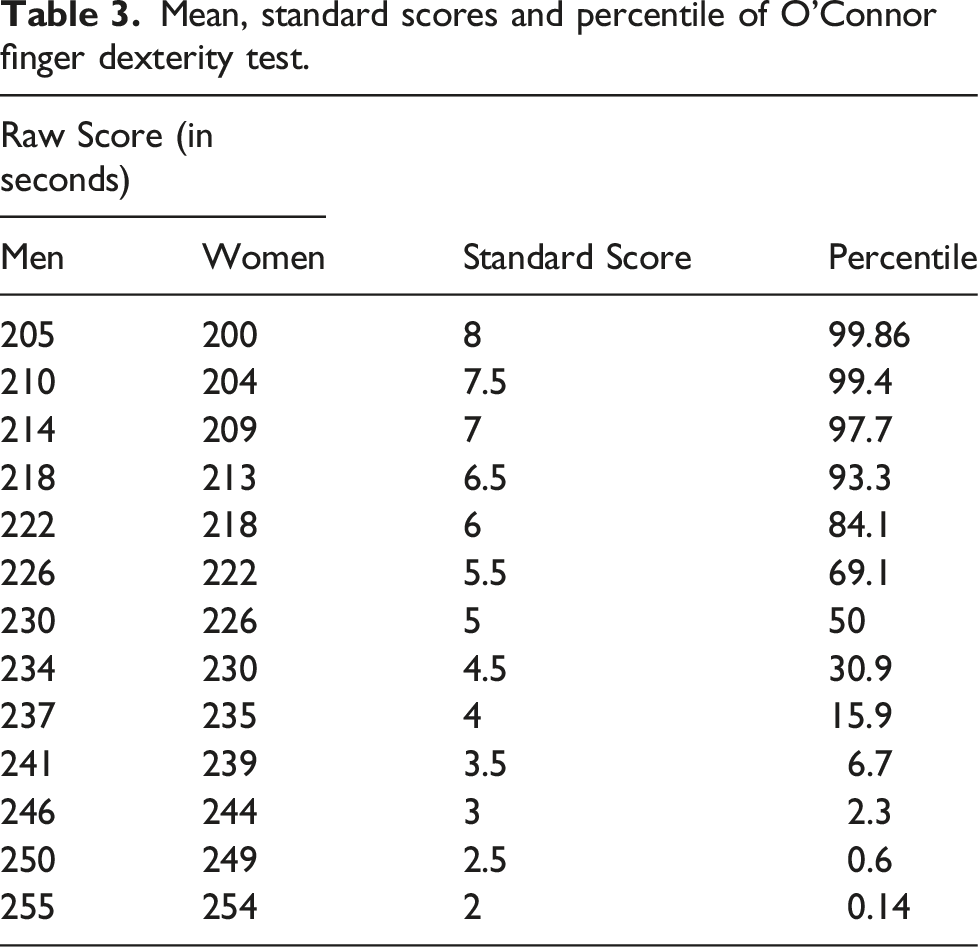
This study provided the percentile score of the O’Connor Finger Dexterity Test of both males and females in the Asian population. Raw scores of below 218 and 213 seconds in male and female participants respectively reach the 90th percentile, and above 237 and 235 seconds in male and female below the 10th percentile. Results showed no significant difference in local mean scores across different age groups, between male and female and with varying hours of working in typing, filing, and writing. A significant difference was only found in finger dexterity and years of working as office workers. No significant correlation was found between the finger dexterity with grip strength, tip and lateral pinch of the dominant right hand. The results were similar to the original normative score with similar work skills and demands.
Conclusion
The mean scores could be used as a valid reference for local occupational therapists to evaluate the finger dexterity of office workers. However, caution has to be taken that conclusions drawn can be biased because of the relatively small sample size, and the results cannot be generalized to represent a wider Asian population.
Introduction
Soft tissue injuries such as tendinitis, cumulative traumatic injury and carpal tunnel syndrome are common conditions affecting modern workers in all areas of occupational performance (Foye et al., 2007). Such conditions might be related to the repetitive movements of hand and fingers such as long hours writing, typing, filling; poorly designed furniture or equipment which does not fit to the workers’ individual physical needs; or the work conditions such as long hours remaining in sitting position, poor posture, and other complications (Cole et al., 2006). The conditions may induce issues on ones’ finger dexterity that prevent them from fulfilling their occupations and work tasks. Consequently, these office workers may be referred to Occupational Therapy for the impact of occupations due to the issues on finger dexterity they experience.
Finger dexterity is an important measure used in rehabilitation (Hung & Fong, 2019). Previous research has shown an association between people’s finger dexterity and grip strength (Martin et al., 2015). The O’Connor Finger Dexterity Test is a reliable measure and is commonly used by occupational therapists as an outcome of treatments on individuals’ finger dexterity (Silva et al., 2008). The O’Connor Finger Dexterity Test is a common assessment used by occupational therapists in Macau, where this study was conducted. The data collected can be used to formulate treatment plans to return work and occupations, and gather values to plan for discharge.
Normative data is very important to evaluate the result of any intervention and serve as reference values for rehabilitation or future research study. There are no past studies and research done on finger dexterity for local normative values of well-functioning office workers, and also there has been no study of norm data of finger dexterity in the Asian population using the O’Conner Finger Dexterity Test. With different anthropometry of Asians and the sample used to develop the norm (Lafayette lnstrument, 2011), it is warranted to establish a local norm for the Asian population.
The purpose of this study is to describe the distribution of finger dexterity in a group of well-functioning male and female office workers in Macau. The relationships between finger dexterity and age, gender, hand strength and time spent in the specific work tasks of the occupation are also explored.
Methods
Participants
This study had recruited 127 right-handed office workers, aged between 21 and 50 years old, by convenience sampling from local institutions; basically, administrative officers and secretaries of the Macau Centro Hospitalar do C. de S. Januario, Macau Water Suppl Co. Ltd. and other commercial companies. Exclusions were given to those with a history of tendinitis, arthritis of the arm and hand, recent 1-year history of wrist and elbow fractures, diabetes and peripheral neuropathies or other medical illnesses that might interfere with hand functions.
Procedure
Participants were all interviewed by researchers and gave informed written consent. Besides the O’Connor Finger Dexterity Test, grip, tip and lateral pinch strengths of both hands were also measured. Participants were asked for the specific job tasks involved in office work. This study was approved by the Departmental Research Committee of the Hong Kong Polytechnic University, Department of Rehabilitation Sciences.
Instruments
The O’Connor Finger Dexterity Test (Lafayette Instrument Co., USA) was used to test the rapid manipulation skills in picking up and placing small objects. It has been found useful in assessing finger dexterity in different traits and conditions (Hung et al., 1999; Silva et al., 2008). The test consists of an 11 × 5½ Formica topped Masonite board with a moulded shallow to store pins and 100 holes measuring 3/16 inch in diameter arranged in 10 rows of 10 holes each. Holes are spaced half-inch apart. There are pins of 1 inch long and about 1/16 inch in diameter. The participant was seated at a table measuring approximately 30 inches in height. The test set was placed about 12 inches from the table’s edge and to the participant’s right if they were right-handed. The participants were instructed to pick up three pins simultaneously and fill the holes as fast as they could. The time is taken in seconds of filling up the first 50 holes and the second 50 holes with pins were recorded by stopwatch separately. The time taken to fill the first 50 holes was recorded. The number of seconds to fill the second 50 holes was multiplied by 1.1. The raw score was computed by taking the mean of these two numbers.
Grip strength was measured with the Jamar dynamometer (Jamar, JLW Instruments, Chicago, IL) (Liu & Chu, 2006). Tip and lateral pinch strengths were measured by the pinch gauge (Jamar, JLW Instruments, Chicago, IL) (Mathiowetz et al., 1984). The maximum force from three trials of each strength testing was used. These measurements were taken according to the American Society of Hand Therapists (Fess, 1992).
Data analysis
The participants were categorized by age into three groups: 1) 21–30 years old; 2) 31–40 years old; and 3) 41–50 years old. The participants’ job tasks were categorized into three groups based on the number of hours engaged on each task, including typing, filing, and writing.
Descriptive statistics of all the assessment was reported. The raw score, standard score and percentile of the O’Conner Finger Dexterity Test were presented. The relationship between finger dexterity, age groups, sex and type of office work tasks was examined using analysis of variance (ANOVA). Independence t-test was applied to further examine the difference, if any, between the finger dexterity and the years of working. Pearson correlation was used to report on the relationship between finger dexterity and grip strength.
Results
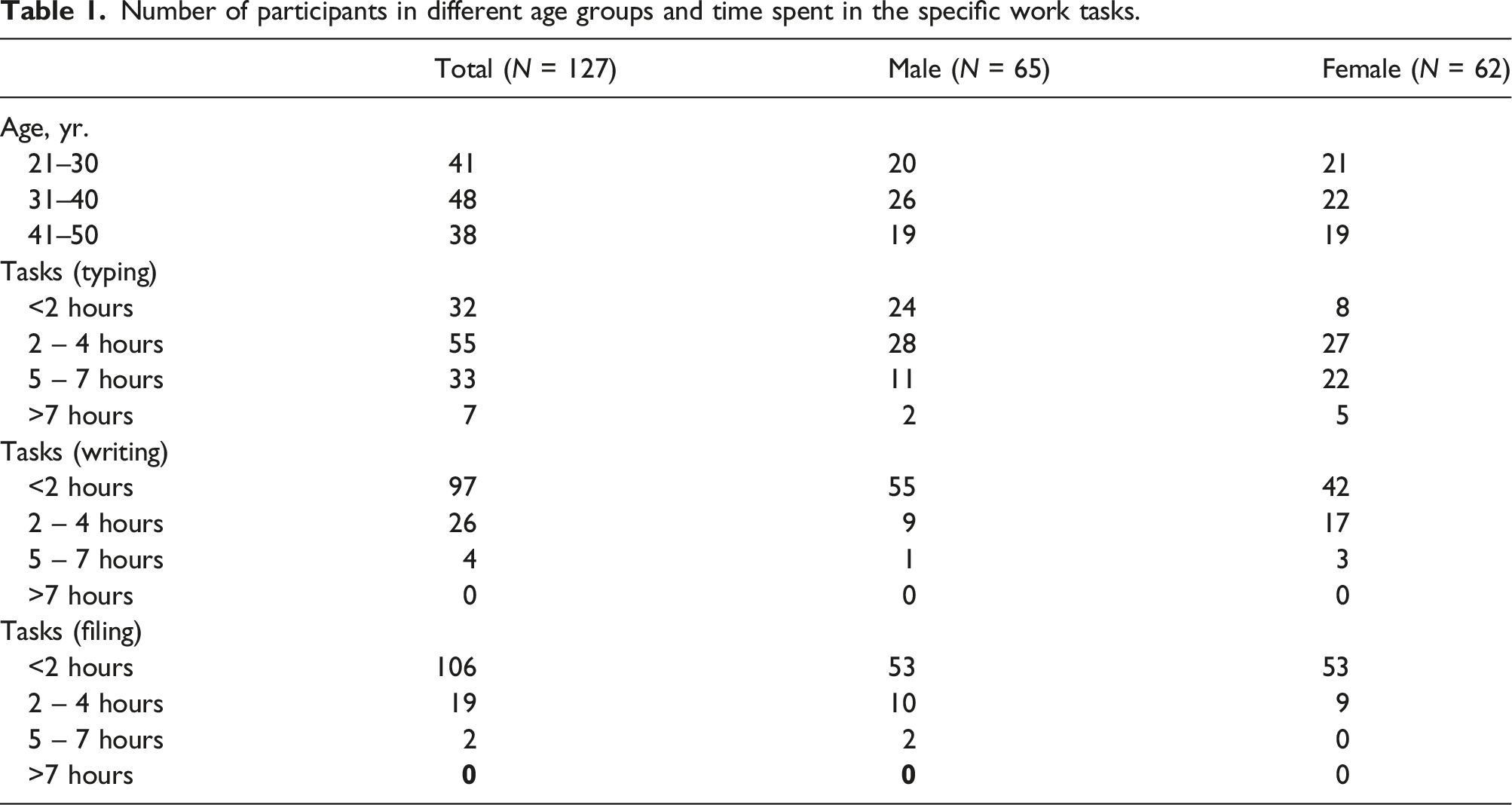
Number of participants in different age groups and time spent in the specific work tasks.
Data on all assessment across different age groups.
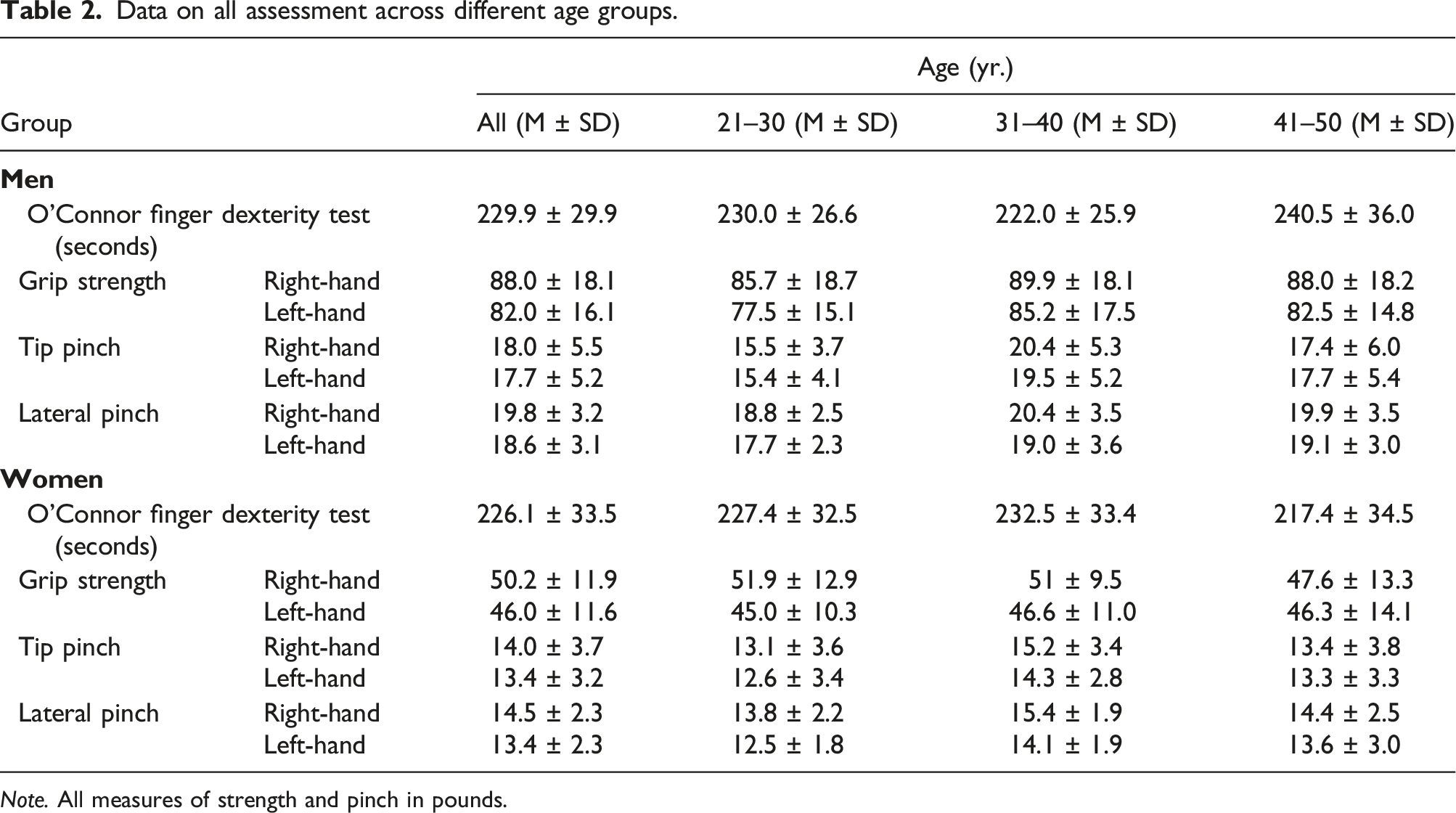
Note. All measures of strength and pinch in pounds.
Mean, standard scores and percentile of O’Connor finger dexterity test.
Comparing the results of finger dexterity between groups with different hours of work in specific job tasks, no significant difference was found (typing: p = .97; writing: p = .75 and filing: p = .63). Relating the finger dexterity with years of working as office workers, the test results showed a significant difference (p < .05).
No significant correlation was found between the finger dexterity with grip strength, tip and lateral pinch of the dominant right hand (O’Conner and grip strength: r = −0.04, p > .05; O’Conner and tip pinch: r = 0.04, p > .05; O’Conner and lateral pinch: r = 0.11, p > .05).
Discussion
This study provided the percentile score of the O’Connor Finger Dexterity Test of both males and females in the Asian population. To our knowledge, this would be the first study reporting the norm value in an Asian office worker population.
Comparing the results of the O’Connor Finger Dexterity Test of this study with the original normative scores (Lafayette lnstrument, 2011), the local mean score of both sex had achieved a higher score. On the contrary, the range of the standard deviation was smaller. This may be attributed to using a small sample and a homogenous group of participants who belong to a specific occupation in this study. While the original normative test had recruited a much bigger number of testees with various occupations, it might result in a bigger range in the raw score and standard deviation. Choosing the most similar trade in the original normative sample to compare, the standard scores of Bank Tellers would have a more similar score range with the sample in this study. As the work skills and demands are similar to the office workers in our study sample (Chuang, 2021), there may not be any discrepancies in finger dexterity. Based on these findings, the norms of this study can be considered consistent with the original norm with only slight variations that might be due to the difference in culture and ethnicity.
Regarding the differences between finger dexterity by sex, age and job tasks, the results of this study have shown no significant differences. It might be related to the specific occupation of the participants. As they were all a cohort of office workers, their job demands in terms of skills, use of equipment, type of tasks, hours of work per day, workplace environment would be similar. Another aspect that might be conducted to these results was that even though they were grouped in three categories with ages ranging from 21 to 50 years old, they were a group of active working young adults, so the differences were not remarkable. Due to a small sample group, it might also be an important factor that led to this result.
Relating the finger dexterity with years of working as office workers, the test results showed a significant difference. However, no significant difference was found in the finger dexterity and the types of tasks they engaged in. The significant difference between the finger dexterity and the years of working might suggest the training effect again. The results demonstrated that participants with longer years of work had higher mean scores in finger dexterity than the other two groups. It was knowing that in the past, there were studies referring to correlations between strength and body build, age and sex (Amirjani et al., 2007; Kamarul et al., 2006; Liu & Chu, 2006; Mathiowetz et al., 1984; Oxford Grice et al., 2003). However, no correlation was found between age, sex, grip strength and finger dexterity in this study. This might be due to a similar reason that the participants were coming from the same occupation. Their hand manipulation skills and dexterity would present similar abilities.
This study is limited by the small sample size and the convenience sampling methods that limit its generalizability. Although Gu et al. (2021) suggested a sample size of 500 and Bridges and Holler (2007) recommended 50 to 75 participants per group, our sample size of 127 would be considered insufficient to generate reliable normative scores. This poses a significant limitation to the study. While the finger dexterity shown by the O’Connor Finger Dexterity Test is an important body function parameter in the rehabilitation of office workers who might have hand injuries, other assessments reflect the activities and participation domain of the International Classification of Functioning, Disability and Health are also important. However. no comparison was provided on the results of the O’Connor Finger Dexterity Test and the performance with any other criterion-based assessment in this study.
Conclusion
Asian normative data for the local office worker population is essential for reference for rehabilitation purposes. Although this study has a small sample size with only 127 right-handed office workers, the results obtained in the mean scores were similar to the original normative score for bank tellers. Moreover, this data set offers a reference to the norm that is specific to this Asian group of population. The result suggests that the mean scores could be used as a valid reference of normative data for local occupational therapists to evaluate the finger dexterity of their clients and use as an outcome measure of the rehabilitation program. However, due to the relatively small sample size, conclusions drawn can be biased and may not be valid statistically. Furthermore, the results cannot be generalized to represent a wider Asian population. Future research is needed to collect enough data to develop normative data for the local general population.
Footnotes
Acknowledgments
The authors would like to thank all the participants in this research.
Declaration of conflicting interests
The author(s) declared no potential conflicts of interest with respect to the research, authorship, and/or publication of this article.
Funding
The author(s) received no financial support for the research, authorship, and/or publication of this article.
