



Abstract
Objective
This study was conducted to cross-culturally adapt the Motor-free Visual Perception Test 4 (MVPT-4) for use in Korean contexts and examine its psychometric properties.
Methods
The Korean MVPT-4 (K-MVPT-4) was developed via the process of translation, back-translation, and expert committee review. To establish internal consistency, test-retest reliability, concurrent validity and construct validity of the K-MVPT-4, 295 healthy people aged 10 to 79 years participated in this study. Participants completed the measures for the test-retest reliability on two occasions, 2 weeks apart.
Results
After three steps of cross-cultural adaptation, the K-MVPT-4 was revised to improve its alignment with Korean cultural norms. Cronbach’s α for internal consistency was .857 and intra-class correlation coefficient for test-retest reliability was .949. The K-MVPT-4 scores were significantly correlated with those of three motor-reduced subscales of the Korean Developmental Test of Visual Perception-Adolescent (K-DTVP-A) (r = .44–.46, p < .01). Participants’ age significantly influenced the K-MVPT-4 scores (p < .001) while their gender did not affect those scores (p = .409). As the age increased, the K-MVPT-4 scores decreased.
Conclusions
The findings indicated that the K-MVPT-4 is a reliable and valid test that Korean rehabilitation service providers can use with confidence to assess clients’ visual perceptual abilities.
Introduction
Visual perception is the ability to understand and interpret everyday life by integrating information received through the eye into the central nervous system (Schneck, 2013). It is a crucial preparatory function for self-care, productivity, and leisure activities (Brown et al., 2012) and plays a fundamental role in activities of daily living and learning (Rao, 1999).
Dysfunction in the visual-related regions of the brain and visual nerves causes problems related to visual perception (Newcombe & Russell, 1969). When visual perception disorders occur, it is difficult to identify objects and recognize spatial relationships (Schneck, 2013). Current literature shows that, due to these difficulties, people with visual perceptual disabilities are limited in their participation of daily activities such as dressing, eating, driving, writing, computer use, and leisure activities (James et al., 2015; Jones & Shinton, 2006; MacLeod et al., 2014).
For clients with visual perceptual dysfunction to return to daily life, a relevant measure to assess the degree of visual perceptual dysfunction should be primarily considered (Richardson, 2013). Such a measure is essential for identifying whether there is a problem related to visual perception and for establishing an intervention plan. Moreover, the evaluation of visual perception can predict safe and independent daily life (Fukui & Lee, 2009; Oswanski et al., 2007). Therefore, the application of a standardized evaluation tool to screen for disorders with visual perceptual dysfunction in clinical settings is important (Brown et al., 2012).
According to the literature describing current trends in the use of occupational therapy assessment tools, Korean occupational therapists typically apply the Motor-free Visual Perception Test (MVPT) (Colarusso & Hammill, 2003) for adults with disabilities, and the Developmental Test of Visual Perception (DTVP) (Reynolds et al., 2008) for children with disabilities, to assess their visual perceptual ability (Jo et al., 2015; S. H. Lee et al., 2018; Yoo et al., 2006). The MVPT is a representative measure for evaluating visual perceptual function by assessing specific tasks that do not require motor responses (e.g., drawing) (Brown & Peres, 2018). The original version of the MVPT was developed in 1972 and was revised to the MVPT-Revised (MVPT-R) in 1996, the MVPT-3 in 2003, and the MVPT-4 in 2015 (Brown & Peres, 2018). The MVPT-3 was recently cross-culturally adapted for Korean adults aged over 20 years (Pyun et al., 2013), although this version has not been officially published. Therefore, the original version of the MVPT-3 has been used for rehabilitation in Korean clients with stroke (Hwang et al., 2019; Y. G. Kim et al., 2018; J. H. Lee et al., 2014).
The MVPT-4 is a revised version of the MVPT-3. The revisions are as follows: (1) changes in the process of administering the items included in each subscale of visual perception; (2) a change in the number of items, from 65 to 45 items; and (3) using the same starting point regardless of the examinee’s age (Colarusso & Hammill, 2015). This latest revision has five subtests that assess five aspects of visual perception skills, however, the individual subtest scores are not calculated. Instead they are summed together to calculate one overall summary visual perceptual ability score. The MVPT-4 version provides only the total score, which represents the global visual perceptual capacity of people aged 4 to 80 s who have suspected visual perceptual problems. Compared to other evaluation tools that distinguish and scores for each visual perception scale, there is a lack of evidence about the usefulness of the global index (Snyder, 2015). Furthermore, the MVPT-4 is a reliable tool for evaluating visual perception capacity, but further research on its validity (e.g., criterion validity and predictive validity) is needed (Snyder, 2015; Stratton & Gadke, 2015). Despite the limitations of the MVPT-4, Colarusso and Hammill (2015) reported that MVPT-4 is “a quick, accurate, reliable, and valid assessment of overall visual perceptual ability” (p. 12).
As the MVPT-4 was developed for use in the USA and was not cross-culturally adapted within the Korean cultural context, understanding and interpreting the results of the MVPT-4 in Koreans is difficult (Brown & Peres, 2018). Brown and Peres (2018) found that although the MVPT-4 can be useful for the precise evaluation of visual perceptual skills, cross-cultural studies of the MVPT-4 are necessary because visual perception can be influenced by age and the socio-cultural environment. Therefore, this study aimed to cross-culturally translate the MVPT-4 into Korean and examine the psychometric properties of the Korean MVPT-4 (K-MVPT-4) to identify whether it can be applied to the Korean population.
Methods
Design
A cross-sectional and quantitative study design was used.
Participants
This study recruited participants living in four regions of South Korea, aged 10 to 79 years, via the quota-sampling method. This method helped to uniformly collect data according to the age, sex, and region of the participants. Occupational therapists contacted the participants and asked them to participate in the study. Participants were eligible if they met the following inclusion criteria: (1) no neurological impairments, (2) no visual impairments, (3) no problems with visual perception, (4) no history of ophthalmic diseases, (5) no problems with expressive or receptive language, and (6) agreement to participate in this study.
Instruments
The K-MVPT-4
The MVPT-4 was designed to evaluate the visual perceptual capacity of people aged 4 to over 80 years. Forty-five items consisting of visual stimuli are presented to the examinee, and the examinee selects one of the answer options using speech or gestures that do not require motor responses. This measure has the same starting point regardless of the age of the examinee and includes five sections that represent different types of visual perception skills (i.e., spatial relationships, visual discrimination, figure-ground, visual closure, and visual memory), and each section includes nine items and two practice items. Each item is rated as correct (score 1) or incorrect (score 0). Only the total score (i.e., the number of correct items), and not individual subscales scores, are calculated (Colarusso & Hammill, 2015).
A standardization study of the MVPT-4 was conducted in a sample of 2,160 individuals in 25 states across the USA. The Cronbach’s α for internal consistency of the MVPT-4 was .80, and the intra-class correlation coefficient for the test-retest reliability was .76. The content validity, concurrent validity, and construct validity of the MVPT-4 were also determined (Colarusso & Hammill, 2015).
In the present study, the Korean version of the MVPT-4 was developed via three processes: translation, back-translation, and expert committee review. First, two researchers who were fluent in both Korean and English translated the examinee directions of the MVPT-4 into Korean. Second, one expert, a native English speaker, translated the initial translated version back into English. Third, two versions of the translation and back-translation were reviewed by Academic Therapy Publications, which published the MVPT-4, to examine whether there were differences in meaning between the MVPT-4 and the K-MVPT-4. In addition, five Korean occupational therapists familiar with the MVPT reviewed the pre-final version of the K-MVPT-4 to identify whether all the translated terms and sentences were relevant and made sense.
Korean Development Test of Visual Perception: Adolescent (K-DTVP-A)
The DTVP-A was developed to assess visual perception and visual-motor integration abilities in people aged 11–74 years. It consists of two sections and six subtests: motor-enhanced (copying, visual-motor search, and visual-motor speed) and motor-reduced (figure-ground, visual closure, and form constancy). The motor-enhanced section asks the examinee to use their motor skills to respond to the item, while the motor-reduced section (motor-free) does not require motor responses (Reynolds et al., 2008).
The standardization study of the DTVP-A was conducted in a sample of 1,664 adolescents and adults in 19 states across the USA. The internal consistency of the DTVP-A’s motor-reduced section was estimated using Cronbach’s α, scoring .77 for figure-ground, .81 for visual closure, and .89 for form constancy. The test-retest reliability of the motor-reduced section was investigated using the intra-class correlation coefficient, scoring .71 for figure-ground, .70 for visual closure, and .74 for form constancy. The content validity, concurrent validity, and construct validity of the DTVP-A were also determined (Reynolds et al., 2008).
In this study, we used the motor-reduced section of the Korean DTVP-A (K-DTVP-A) to examine the concurrent validity of the K-MVPT-4. The K-DTVP-A was revised to measure the visual perceptual ability of Korean adolescents aged 9 to 19 years (Cho & Yoo, 2013). The standardization study of the K-DTVP-A was undertaken in 1,100 adolescents across South Korea. The internal consistency of the K-DTVP-A’s motor-reduced section was estimated using Cronbach’s α, scoring .74 for figure-ground, .82 for visual closure, and .88 for form constancy. The test-retest reliability of the motor-reduced section was investigated using the intra-class correlation coefficient, scoring .78 for figure-ground, .74 for visual closure, and .87 for form constancy (Cho & Yoo, 2013). The content validity, concurrent validity, and construct validity of the K-DTVP-A were also determined (Cho & Yoo, 2013).
Procedure
After ethical approval was obtained from the Wonkwang University Institutional Review Board (IRB) in South Korea (IRB number: WKIRB-202004-SB-014), and permission for the translation of the MVPT-4 into Korean was acquired from Academic Therapy Publications, the MVPT-4 was translated into Korean via three processes (translation, back-translation, and expert committee review). The recruitment of participants was undertaken in four regions of South Korea (Gyeonggi-do, Chungcheongnam-do, Jeollabuk-do, and Jeollanam-do) by five occupational therapists. Before participants agreed to be involved in this study, researchers trained five occupational therapists on how to apply the K-MVPT-4 and they explained the purpose and procedure of the study to the participants. A total of 295 individuals participated in the study.
Twenty-seven participants were asked to complete a retest of the K-MVPT-4 after 2 weeks to obtain information regarding its reliability. In terms of concurrent validity, 43 participants aged 11–19 years completed both the K-MVPT-4’s and K-DTVP-A’s motor-reduced sections. Each assessment lasted approximately 20–30 minutes, and they were undertaken in either the morning or afternoon to account for fatigue and the effect of one assessment on the other. All assessments were performed in a quiet and independent space to encourage participant response. The occupational therapist and participant sat face-to-face such that participants could not see the record form. When the participants found it difficult to decide upon an answer, they were encouraged to make their best guess.
Statistical analysis
Statistical analyses were conducted using the IBM Statistical Package for the Social Sciences 21.0 (SPSS version 21.0; IBM Corp., 2012). Descriptive statistics were used to examine the participant characteristics. Before statistical analyses were conducted, basic assumptions (i.e., independence, normality, and homogeneity of variance) about the data were examined using the Shapiro-Wilk test and Levene statistics.
The internal consistency of the K-MVPT-4 was calculated using Cronbach’s α, and its test-retest reliability was calculated using the Type 2,1 intra-class correlation coefficient (ICC2,1). To determine the extent to which the K-MVPT-4 can be considered a reliable measure, the scores were interpreted as follows: .75–1.00, excellent reliability; .60–.74, good reliability; .40–.59, moderate reliability; and <.40, poor reliability (Fleiss et al., 2013).
To examine the concurrent validity of the K-MVPT-4, the Pearson correlation analysis was used to compare the K-MVPT-4 score with each score of the K-DTVPT-A’s motor-reduced subscales (i.e., figure-ground, visual closure, and form constancy) as well as the total of these scores (i.e., motor-reduced visual perception [MRVP]). For the construct validity of the K-MVPT-4, the independent t-test and one-way analysis of variance were used to determine whether there was a significant difference in K-MVPT-4 scores according to the sex and age of the participants. In addition, if there was a significant difference among age groups, the Scheffe test was used to identify where the difference was.
Results
Characteristics of the participants
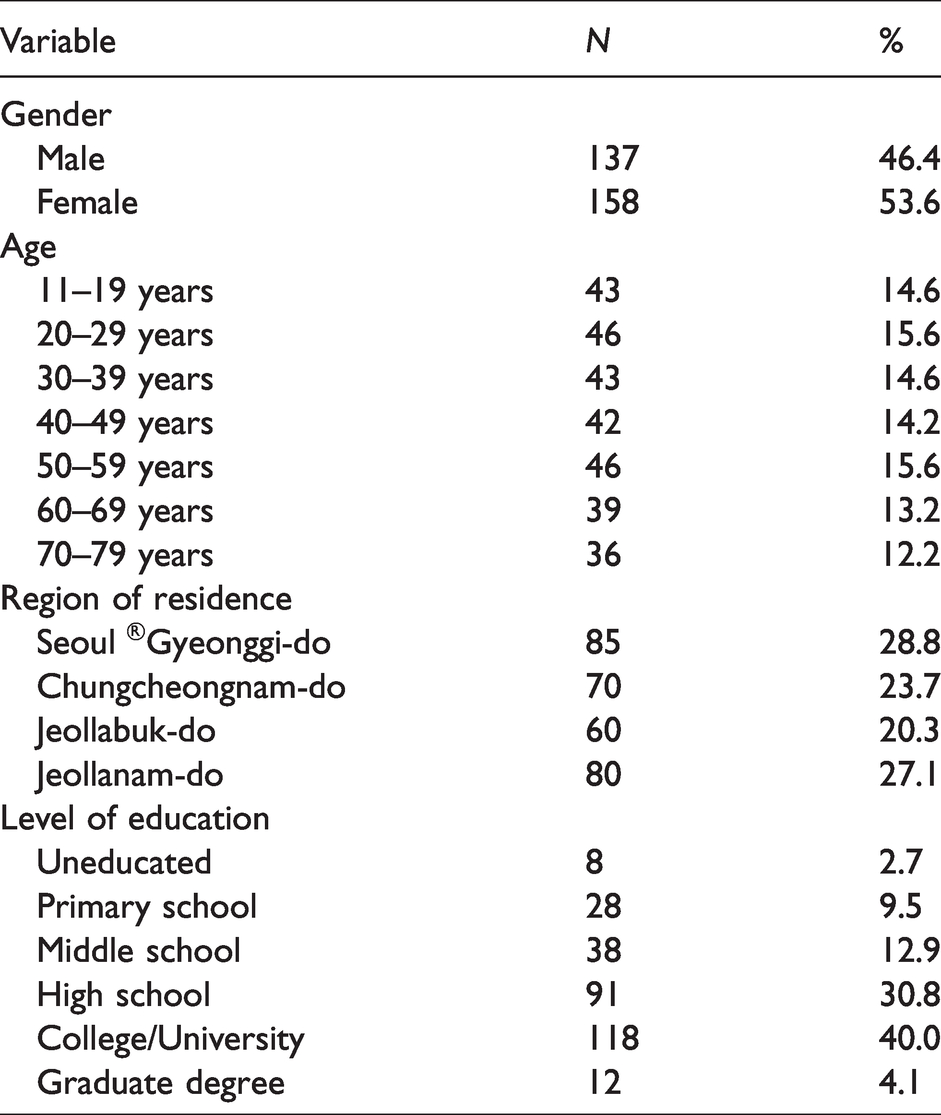
Two hundred and ninety-five healthy participants completed the K-MVPT-4. Slightly more women (n = 158, 53.6%) participated than men (n = 137, 46.4%), and approximately 40 participants from each age group were included. Most participants lived in Seoul, the capital city of South Korea, and Gyeonggi-do (n = 85, 28.8%). Detailed information on the characteristics of the participants is shown in Table 1.
Characteristics of participants (N = 295).
Reliability of the K-MVPT-4
Cronbach’s α was calculated to assess the internal consistency of the K-MVPT-4, and was .857 for all age groups. The ICC2,1 was calculated for the test-retest reliability of the K-MVPT-4 using data from the 27 participants who completed the measures on two occasions, 2 weeks apart. The ICC2,1 of the K-MVPT-4’scores was .949, indicating excellent agreement between the two occasions (Table 2).
Results of statistical analysis for MVPT-4.
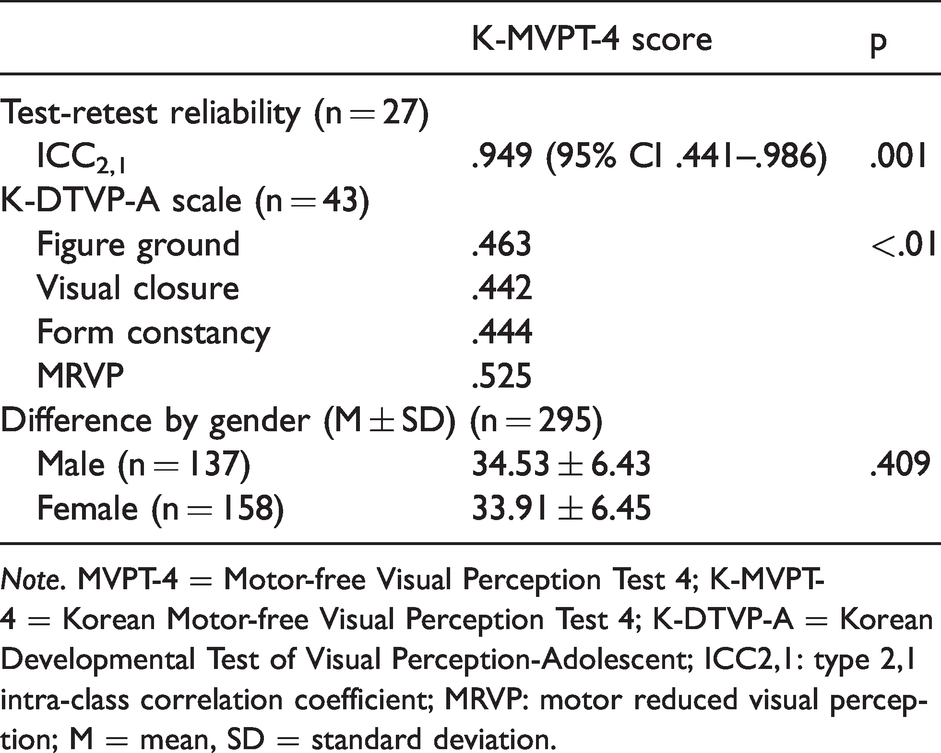
Note. MVPT-4 = Motor-free Visual Perception Test 4; K-MVPT-4 = Korean Motor-free Visual Perception Test 4; K-DTVP-A = Korean Developmental Test of Visual Perception-Adolescent; ICC2,1: type 2,1 intra-class correlation coefficient; MRVP: motor reduced visual perception; M = mean, SD = standard deviation.
Validity of the K-MVPT-4
To determine the concurrent validity, a sample of 43 participants completed the K-MVPT-4 and the motor-reduced section of the K-DTVP-A. There was a significant positive correlation between the K-MVPT-4 score and each score of the K-DTVP-A’s motor-reduced subscales, as well as the MRVP score (p < .01) (Table 2).
For construct validity, the K-MVPT-4 scores were analyzed according to the sex and age of the participants. There was no significant difference in the scores between men (mean = 34.53) and women (mean = 33.91) (p = .409) (Table 2). However, a significant difference in the scores was found in terms of age (p < .001). The scores decreased with age, and the highest score was found for participants in their 20 s (mean = 38.57) and the lowest score was found for participants in their 70 s (mean = 24.08) (Table 3). The results of the Scheffe test showed that scores of participants in their 10 s, 20 s, and 30 s significantly differed from those of participants in their 50 s, 60 s, and 70 s (p < .05). Detailed information of these results is shown in Table 4.
Differences in the K-MVPT-4 scores by age (N = 295).
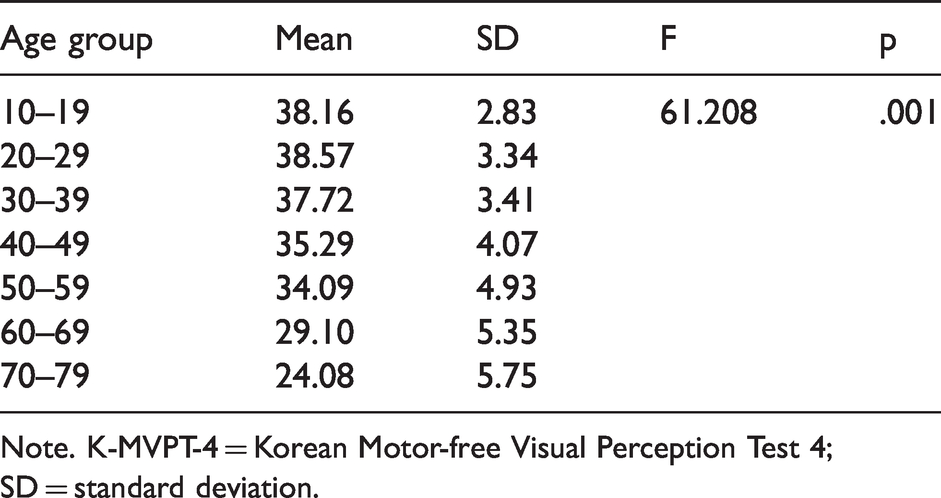
Note. K-MVPT-4 = Korean Motor-free Visual Perception Test 4; SD = standard deviation.
Post hoc comparisons using Scheffe test (N = 295).
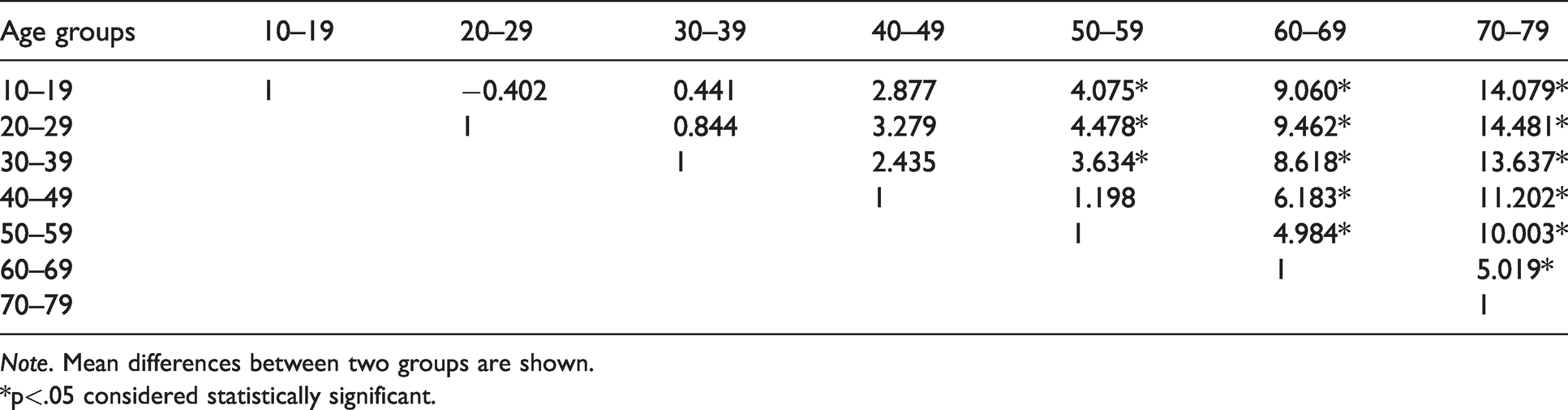
Note. Mean differences between two groups are shown.
*p<.05 considered statistically significant.
Discussion
The MVPT-4 assesses the visual perceptual ability in individuals of a wide age range and does not depend on motor skills (Colarusso & Hammill, 2015). Data from the MVPT-4 can be used for screening, diagnosis, intervention planning, and research purposes (Brown & Peres, 2018). Most Korean occupational therapists (68.5%) prefer to use the MVPT rather than other tests that assess cognitive and perceptual abilities (Yoo et al., 2006). However, the MVPT-4, the latest version of the MVPT, was standardized for the US population; thus, a cross-cultural adaptation of the MVPT-4 was needed for its use in the Korean cultural context. This study was therefore undertaken to translate the MVPT-4 into Korean, both in terms of language and culture, as well as to examine its reliability and validity.
The K-MVPT-4 can be clinically useful for the Korean population aged 10–79 years, based on our assessment of its psychometric properties. We examined the internal consistency to identify the extent to which items in this measure evaluate the same attribute (Isaac & Michael, 1995). The Cronbach’s α of the K-MVPT-4 was .857, which is greater than .75, the preferred value for cognitive tests (Field, 2013). This value was similar to that for the internal consistency of the original version of the MVPT-4 for the entire sample (alpha coefficient = .800) (Colarusso & Hammill, 2015). In addition, the test-retest reliability of the MVPT-4 using the Pearson correlation coefficient; however, this made it difficult to explain the importance of this minimal change in the standard error of measurement (Brown & Peres, 2018). To address this issue, we calculated the ICC2,1 because it can validate the consistency between measurements to minimize the variance in error (Yi, 2020). The ICC2,1 for the K-MVPT-4 was .949, which indicates that the K-MVPT-4 data are sufficiently reliable.
As for the MVPT, Korean occupational therapists also frequently use the DTVP for their clients. The K-DTVP was recently developed for Korean children aged 4–8 years (K-DTVP-3) (Moon & Kim, 2017) and adolescents aged 9–19 years (K-DTVP-A) (Cho & Yoo, 2013). To examine the concurrent validity of the K-MVPT-4, the K-DTVP-A, a relevant version of the DTVP, was used as the gold standard test, considering the applicable age range of the K-MVPT-4. The results showed a significant correlation between the K-MVPT-4 score and each score of the K-DTVP-A’s motor-reduced scales (i.e., figure ground, form consistency, and visual closure) as well as between the K-MVPT-4 score and the MRVP score. Given that the K-MVPT-4 and the motor-reduced scales of the K-DTVP-A evaluate similar visual perceptual abilities, our findings provide evidence for the concurrent validity of the K-MVPT-4.
The user manual of the MVPT-4 indicates that the average item discrimination index for age groups ranges from .025 to .390 (Colarusso & Hammill, 2015). This indicates that the MVPT-4 items provide good item discrimination (Brown & Peres, 2018). In addition, insignificant item bias was identified using differential item functioning (DIF) for groups based on sex and ethnicity (Colarusso & Hammill, 2015). This suggests that each item was not affected by sex or ethnicity of the participants. One of the limitations of this study is that the potential item bias of the K-MVPT-4 was not investigated using DIF. Instead of identifying potential item bias, we compared the K-MVPT-4 scores between men and women and found no statistically significant difference (p = .409). A previous study regarding the visual perceptual abilities of Koreans aged over 60 years reported similar findings, in that there was no difference in visual perceptual ability according to sex (H. S. Lee, 2010). However, other studies have reported inconsistent results for differences in the visual perceptual ability of children by sex (J. M. Kim & Song, 2007). Some studies reported that girls' visual perceptual ability is superior to that of boys in some visual perception areas (Karapetsas & Vlachos, 1997; Lachance & Mazzocco, 2006), whereas others reported that boys' visual perceptual ability is better than that of girls (Chung & Oh, 2002; E. Kim et al., 2014; K. S. Lee et al., 2004).
In this study, the average score of the K-MVPT-4 was highest for those in their 20 s and lowest for those in their 70 s, reflecting the decrease in visual perceptual abilities with age. This finding indicates that the K-MVPT-4 is able to evaluate age-specific visual perceptual capacity and supports the results of previous studies (Levine et al., 2000; Madden et al., 2005). Due to the influence of aging, the processes of visual perception in older people are inefficient compared with younger people (Levine et al., 2000). Furthermore, as the functioning of processing visual information is decreased, cognitive function related to visual-motor integration skills in older people is reduced (Madden et al., 2005). As reported in the MVPT-4 user manual, the average score of children aged 4 years with poor visual perceptual ability is 17.99, and increases up to the 40–59 year-age group. However, the average scores of the age groups over 60 years decrease (Colarusso & Hammill, 2015). These findings are consistent with the results of other studies that found decreased visual perceptual ability in older people (Levine et al., 2000; Madden et al., 2005).
The findings of this study prove that the K-MVPT-4 is a reliable and valid measure for Koreans aged 10 to 79 years, due to the cross-cultural adaptation. Korean rehabilitation professionals frequently use the MVPT-3, which was standardized for those living in the USA (Hwang et al., 2019; Jung et al., 2015; Y. G. Kim et al., 2018; J. H. Lee et al., 2014). The MVPT-4 is the latest version that has been adapted based on Korean culture, and the K-MVPT-4 is now ready to be used by Korean clients. However, as the standard K-MVPT-4 scores have not yet been calculated, only the raw scores can be used. The K-MVPT-4 can be used in a diverse group of individuals who have visual perceptual deficits caused by stroke, traumatic brain injury, cerebral palsy, autism, learning disabilities, Alzheimer’s disease, and multiple sclerosis, and also older adults in the general community. Visual perceptual difficulties may negatively affect performance in various activities such as self-care, education, work, and leisure (James et al., 2015; Jones & Shinton, 2006; MacLeod et al., 2014). Thus, Korean rehabilitation professionals, including occupational therapists, can use the K-MVPT-4 along with other measures that assess occupational performance in various settings, to set goals and plan interventions.
This study had some limitations. First, we recruited participants aged 10–79 years from four regions of South Korea. Therefore, our results may not be generalizable to the entire population of South Korea. Unlike the K-MVPT-4, the original version of the MVPT-4 was designed to measure the visual perceptual ability of people aged 4 to over 80 years. To address this limitation, future studies should recruit participants living in more widespread regions of South Korea as well as those aged from 4 to over 80 years. Second, the Korean version of the MVPT-4 did not have standard scores. The next step will be to increase the data regarding the general Korean population to better interpret the results of the measure. Third, the concurrent validity of the K-MVPT-4 was established by comparing the K-MVPT-4 score to the K-DTVP-A score, which was determined from children aged 11–19 years. To support the concurrent validity of the K-MVPT-4, a gold standard test that assesses the visual perceptual ability of people aged over 20 years is needed. In addition, the construct validity of the K-MVPT-4 could be developed by analyzing the K-MVPT-4 scores according to other factors that may influence visual perceptual ability (e.g., the presence of a disability, diagnosis, severity of disability, educational level, and annual income).
Conclusion
Our results showed that the K-MVPT-4 is a reliable and valid outcome measure that Korean rehabilitation service providers can use to assess the visual perceptual capacity of their clients with disabilities.
Footnotes
Declaration of conflicting interests
The author(s) declared the following potential conflicts of interest with respect to the research, authorship, and/or publication of this article: We have permission to translate the MVPT-4 into Korean for research purposes only. This Korean version may be different from any future Korean-published versions of the assessment on the market.
Funding
The author(s) disclosed receipt of the following financial support for the research, authorship, and/or publication of this article: This paper was supported by Wonkwang University in 2020.
