



Abstract
Background
Cultivating empathy towards persons with disabilities has been highlighted as an essential graduate attribute in the occupational therapy profession.
Purpose
With the aim to developing a more holistic understanding of disability, this project seeks to translate an experiential learning activity developed in Canada to the local Singaporean context. Small groups of two to three students were paired with a person with physical disability, known as a community teacher, for a series of visits to observe and participate in their self-care, productivity and leisure activities.
Method
A sequential explanatory mixed methods design was adopted with the administration of an adapted version of the Multidimensional Attitudes Scale Towards Persons with Disabilities on 51 first year occupational therapy students. Seventeen students participated in three focus group discussions at the end of the learning activity.
Introduction
The use of experiential learning in occupational therapy education has been found to be effective in inculcating a more holistic understanding of disability and empathy towards persons with disabilities (Jamieson et al., 2006; O’Riordan et al., 2001; Packer et al., 2000). A number of universities such as Queen’s University in Canada and Volgograd Medical College in Russia have provided such experiential learning where students partner with persons with disabilities within the community (O’Riordan et al., 2001; Packer et al., 2000).
Queen’s University's ‘The Lived Experience of Disability’ programme involved visits, tutorials and journaling where pairs of students together met once a week with persons with disabilities for a period of eight weeks at various locations, such as their homes or local malls. After each visit, each student wrote his/her reflection on how the person with disability lived and coped with his/her disability. Analyses were done on students’ journals as well as feedback sessions from the persons with disabilities and students. Findings from their study showed that students reported developing higher levels of empathy and a better understanding of the co-existence of health and disability (Jamieson et al., 2006; O’Riordan et al., 2001). O’Riordan et al. (2001) recommended reducing the number of visits as they found that high number of visits lead to repetition of activities; this led to diminishing returns in terms of the educational value of the subsequent visits. O’Riordan et al. (2001) also provided an honorarium to the persons with disabilities to acknowledge both their expertise and the time they dedicated to educating students. The authors of the present study incorporated these recommendations into this research after correspondence with O’Riordan (O’Riordan, personal communication, 16 February 2016).
At Husson University in the United States, occupational therapy students participated in a ‘service learning’ course, where students collaborated with persons with disabilities to complete access assessments of arts venues (Gitlow & Flecky, 2005). This course introduced the notion of disability as a unique human experience different for everyone. Results from student interviews and focus groups demonstrated positive outcomes of improved understanding of disability amongst students, awareness of the built environment in term of accessibility and increased confidence in advocating for persons with disabilities. (Gitlow & Flecky, 2005).
The benefits of experiential learning with persons with disabilities within the community context extend beyond occupational therapy. In a study where physiotherapy students were paired with persons with disabilities over an eight-week programme involving exercise and community activities, students demonstrated positive changes in attitudes towards disability and increased confidence in working with persons with disabilities (Shields & Taylor, 2014). In summary, persons with disabilities are well suited to work with students to develop their competencies through experiential and cooperative processes within the community context. This aligns with the entreaty from Swain and French (2001) of the need for a more equalized and reciprocal power relationship between healthcare professionals and persons with disabilities instead of a unidirectional relationship whereby healthcare professionals hold most of the power.
This study adopted a sequential explanatory mixed methods design, to explore the feasibility of implementing such an experiential learning programme in Singapore, a multi-cultural Asian context (Ang & Stratton, 1995). An adapted psychometric instrument would be administered, followed by student focus groups.
Significance of study and research questions
The overall objective of the study was to investigate students’ experiences in experiential learning through engagement with persons with disabilities in the community (also addressed as community teachers). This project embraces the principles of experiential learning (Kolb, 1984, 2014) by having students work closely with persons with disabilities in the community, learning from and with them. In this study, the students gained the concrete experience of going out with their community teachers to observe their activities in the self-care, work and leisure. The students then reflected on their experience and how it related to disability in the individual and societal contexts. The students compared their theoretical knowledge of disability with what they observed. Abstract conceptualization occurred where students gained new insights at the conceptual level (e.g. students considered the physical barriers in the built environment and possible infrastructure gaps). Active experimentation occurred as students proposed suggestions and solutions in their reflective reports to empower and assist persons with disabilities. The students also considered how they should interact with patients with disabilities in their future roles of occupational therapists.
This study sought to challenge students on their preconceived ideas on disability and reflected on how health and disability can co-exist for persons with disabilities in the community. This study informed the feasibility of such experiential learning as a pedagogy for first year occupational therapy students and the outcomes of learning from persons with disabilities. There were two research questions. (1) What is the experiential learning that will occur when persons with disabilities are engaged as community teachers to introduce to students their activities in self-care, productivity and leisure? (2) How do occupational therapy students’ attitudes towards disability change as a result of the experience? Students’ attitudes were measured using an adapted psychometric instrument and through focus group discussions.
Methods
Assessment tool
The adapted Multidimensional Attitudes Scale Towards Persons with Disabilities (MAS) is a 40-item multidimensional scale adapted from the original 34-item scale developed by Findler, Vilchinsky and Werner (2007) and the more recent 22-item scale by Vilchinsky, Werner and Findler (2010). The MAS is split into three constructs, Affect, Cognition and Behaviour. Affect can be separated into pleasant and unpleasant emotions towards a person with disability. Behaviour centres on either approaching or distancing actions towards a person with disability, while Cognition can be split into focusing or withdrawing attention from a person with disability.
Participants read a social scenario vignette that described a chance meeting between the participant and a person in a wheelchair of the same gender. After reading the short narrative, participants then had to relate to each item. Responses were marked on a 5-point Likert scale, ranging from 1 (not at all) to 5 (very much). Higher subscale scores indicated poorer attitudes in the three dimensions, such as more unpleasant emotions, withdrawing attention and distancing behaviour towards the person with disability.
Participant recruitments
Student participants
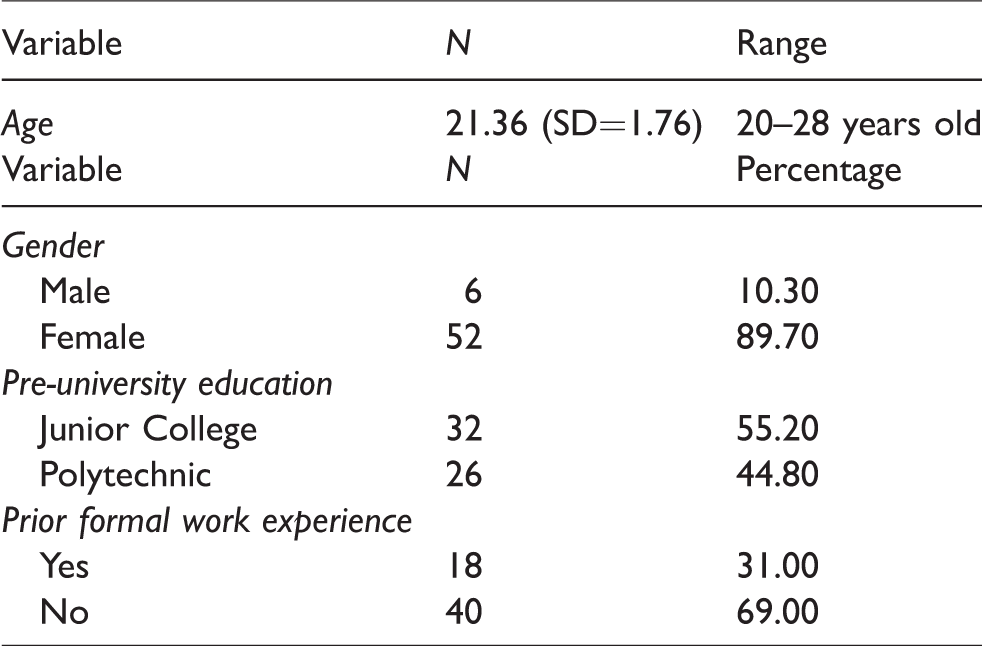
All 58 year one students, representing the entire cohort of the occupational therapy programme, were recruited during the very first trimester of their quadrennial degree course. Students were briefed in detail by the Principal Investigator at the start of the module and given opportunities to clarify doubts. Informed consent was then collected. Students were also informed of the rights to withdraw from the study at any point of time and that withdrawal would not affect their standing with the university in any way. As shown in Table 1, there were 52 females, the mean age of the students was 21.36 years (SD = 1.76). Fifty-one students (with complete data) were included in the statistical analyses, and 17 of the same students participated in the focus groups. The university’s Institutional Review Board granted ethics approval for this project (IRB number 20150002).
Demographic variables of all 58 participants who comprise the entire pioneer year 1 occupational therapy cohort.
Persons with disabilities participants
Participants were recruited from non-governmental organizations and recommendations from professional contacts. Prospective participants were interviewed and screened for suitability by either of the first two authors who are registered occupational therapists. Five general criteria were adopted in the screening of persons with disabilities. First, they have a physical disability. Second, they accessed community regularly and have independent mobility; severity of disability was not a criterion as long as the mobility requirement was met. Third, they were able and willing to communicate about their disability. Fourth, they were willing to introduce students to their activities of daily living. Fifth, they have come to terms with his/her disability. The researchers came into the project with the desire to empower persons with disabilities and to collaborate with them as partners. The educational goals of this project and the format of the meet-ups, confidentiality, potential risks and benefits were explained to the participants. An honorarium and transport allowance were provided to all the community teachers at the end of the project.
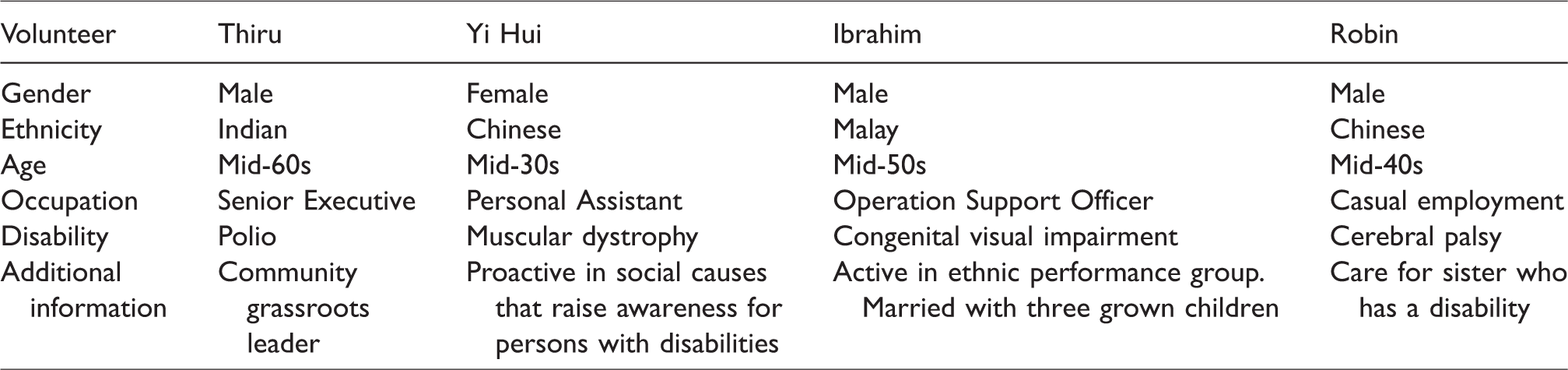
After screening and evaluation, 21 community teachers were selected and recruited, age ranging from mid-20s to mid-60s, with the mean age being 45.38 years old (SD = 12.16). Eighteen of them were male. Participants had a range of physical disabilities, such as spinal cord injuries, visual impairments, stroke and neuromuscular disorders. Examples of the profiles of recruited community teachers were included in Table 2. They were independent, without cognitive impairments, socially integrated and either gainfully employed or in the process of entering employment. Many of them communicated during the interview that they viewed their participation in this learning activity as an opportunity to educate a new generation of healthcare professionals and imprint a positive perspective of disability. Persons with disabilities in this experiential learning project were referred to as ‘Community teachers’ as this reflected their role as co-educators of the occupational therapy students.
Examples of profiles community teachers who participated in this project (names changed to protect privacy).
Key project stages
The following steps were taken to prepare the first year occupational therapy students for the experiential learning programme (Figure 1). In week 1 of first trimester, students were orientated on the learning outcomes, journaling, rules and precautions. Groups of two to three students were matched to one community teacher. Care was taken to consider the linguistic preference of the community teacher, ensuring that within the group, there was at least a student who could speak the mother tongue of the community teacher.
In week 2, students attended a 2 h lecture on professionalism and communication, conducted by a guest speaker who has a physical disability. In the first 2 h tutorial, students were given basic information about their individual community teachers and were asked to visualize their first meet-up and brainstorm conversation topics. In the second 2 h tutorial, they were given the opportunity to role-play their interactions and feedback was given on their communication skills. The tutors teaching in the module highlighted the importance of knowing a person before and beyond his/her disability.
Across a span of six weeks, the groups liaised and decided together with their community teachers on mutually convenient locations and timings for three meet-ups. Prior to each meet-up, the students would submit a safety record form informing the researchers of the brief details of the meet-up (e.g. location, timing). During each meet-up, they would learn how the person with disability engaged in their activities of self-care, productivity or leisure. For example, they would observe how a person with disability used public transport in a wheelchair, work, purchases meals in a busy food court and engaged in leisure activities such as wheelchair basketball or fishing.
After each meet-up, the student individually completed a reflective log to document about their observation, emotions and knowledge gained; they were encouraged to compare this learning with their previous encounter with persons with disabilities. Some guiding questions were provided to help students focus on specific aspects of reflection. At the end of the three visits, each student completed a summative reflective report. The summative reflective report facilitated students’ reflections on the community teacher’s ability and disability, occupation form and choice, what participation means and actions that can be taken at a societal level to help persons with disabilities participate in the community.
As a group, the students used their community teacher as a case study to apply occupational therapy theories learnt and content from three other modules across the trimesters, namely Health Systems- Singapore's Perspectives, Anatomy and Physiology 1, and Psychological and Sociological Perspective for Health Sciences. The students had to pick one of the common occupational therapy model (e.g. Model of Human Occupation) to explain what they have learnt about their community teacher, considering person, environment and occupations. The students also had to demonstrate how the content learnt in the three other concurrent modules applied to their community teachers. They presented their report to their cohort to obtain feedback, followed by a summative group report. The intention of these exercises was to help students deeply reflect on their meet-ups and enable horizontal integration of knowledge learnt in various academic modules.
Four weeks after their last meeting with their community teacher, the MAS was administered again to measure their attitudes towards persons with disabilities. Three focus groups comprising 17 of the same students were also conducted to elicit contextual feedback during the same period. To minimize bias, a research assistant who was not involved in grading or teaching the students was assigned to conduct the focus groups and de-identify the data.
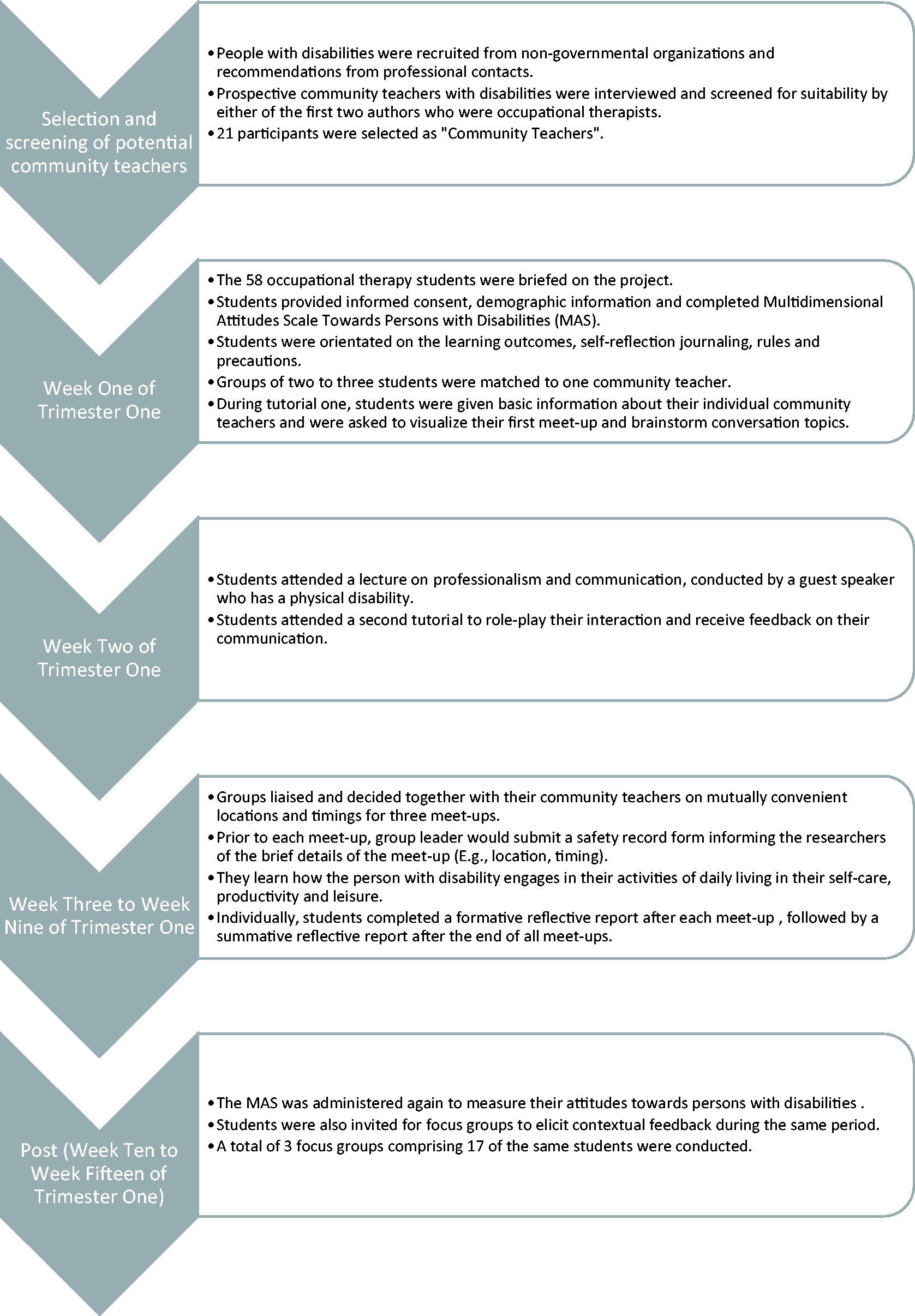
Key stages and steps of project.
Data analysis
A sequential explanatory mixed methods design was adopted. Quantitative data were analysed using IBM SPSS Statistics for Windows, Version 24.0 (Armonk, NY). Wilcoxon signed-rank tests were carried out and results were considered significant if P-values were less than or equal to 0.05. Fifty-one participants were included in the statistical analyses. The qualitative data were analysed using NVIVO Pro for Windows, Version 11.0 (QSR International Ltd). Focus groups were audio recorded and conducted by a research assistant and transcribed by a third-party professional service. Transcripts were de-identified by the research assistant. Two of the researchers coded the themes separately and met for multiple discussions to review and refine the themes until consensus was achieved.
Results
MAS internal reliability
Cronbach’s alpha reliability tests revealed that the MAS was internally consistent. Cronbach’s coefficient alpha, an internal reliability measure, was obtained for the subscales. As shown in Table 3, the coefficient alpha values calculated ranged from .605 to .879. Overall, the MAS demonstrated good internal reliability with coefficient alpha levels comparable to those in the original studies by Findler et al. (2007) and Vilchinsky et al. (2010).
Internal reliability of MAS subscales (Cronbach’s alpha).
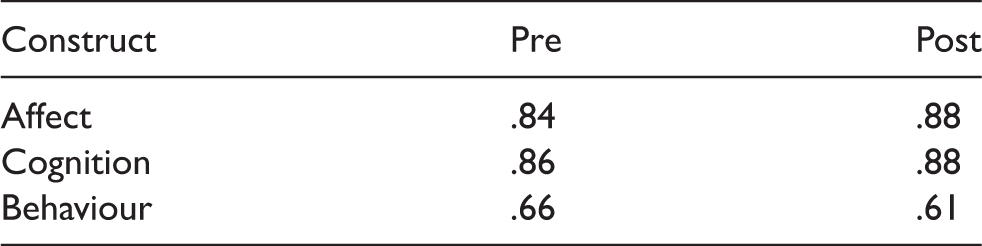
MAS: Multidimensional Attitudes Scale Towards Persons with Disabilities.
MAS subscales pre- and post-comparisons
Participants’ attitudes were found to be at about half the maximum score in the pre-phase prior to the start of the mentor meet-ups (refer to Table 4). The average participant’s Affect score was 42.94 out of 90, Cognition score was 26.12 out of 55 and Behaviour score was 23.78 out of 55.
Average MAS subscale scores and effect sizes.

MAS: Multidimensional Attitudes Scale Towards Persons with Disabilities.
aEffect size r = Z/√N.
Results indicated that students’ attitudes towards persons with disabilities significantly improved after the programme across all subscales. A Wilcoxon signed-rank test of Affect comparing pre- and post-phases yielded z = −5.43, P < .001 (two-tailed). The average score for Affect improved from 42.94 to 32.08. The same test for Cognition yields z = −4.20, P < .001 (two-tailed). The average score for Cognition improved from 26.12 to 21.41. Likewise, the test for Behaviour yielded z= −4.44, P < .001 (two-tailed). The average score for Behaviour improved from 23.78 to 20.65. As shown in Table 4, effect sizes ranged from medium to large (Field, 2013) with Affect subscale improving by .54, Cognition improving by .42 and Behaviour by .44.
Student focus group thematic analysis
Two of the authors (SML, ZAGG) read the three focus group text transcripts independently and initial themes relating to the research questions were identified. Face-to-face sessions were then held between the two authors that led to the selection of four themes that best explained and illuminated the attitudinal improvements of the students after the learning activity. The four themes are as follows: (1) changes in emotions, (2) learning specific to occupational therapy degree programme and profession, (3) challenging and changing prior stereotypes of persons with disabilities and (4) personal growth. The first three themes were aligned with the expected outcomes of the project. These three themes were aligned with the goal of investigating how occupational therapy students’ attitudes towards disabilities changed as a result of the experiential learning series of activities. The fourth theme, personal growth, was novel and was not an expected learning outcome in the conceptualization of this study.
Theme one: Changes in emotions
The first theme that emerged was changes in emotions that the students experienced throughout the learning activity. A common emotion initially experienced by the students prior to the meet-ups was a sense of anxiety. Students reported being afraid of offending their community teacher by saying something insensitive. However, many described how they were pleasantly surprised that their community teachers were open to answering their queries and regularly encouraged them to ask questions and clarify doubts. In particular, community teachers were willing to disclose how their disability arose. This astonished the students as they had anticipated that this would be a very sensitive topic to talk about. The openness and approachability resulted in students feeling gradually more comfortable and at ease with interacting with their community teacher. This triangulated with the quantitative findings that showed a significant increase in positive attitudes towards disability after the learning activity. Because, initially, I was actually very scared. There are some topics that are too sensitive to touch on. Like, for example, his accident. But, actually, during the meet-up it went very smoothly, and he was the one who initiated the entire conversation. Decided to talk about his own accident. And he actually, like emphasized that it’s okay, you guys can just ask me anything, because I know that you want to learn from me, and I will learn from you, also. So, I think it went very, very well. Yes, because, he was very sociable. And he made us feel very comfortable. (Participant Two, Focus Group Three) I was thinking…over-thinking, actually, about so many things about whether she was going to think I was too, uh…[whether] if I asked a question, am I too insensitive…[whether] I have to be very careful of what I do and say around her…she was actually very chill, like, it was…it was very relaxing, like, I didn’t have to worry so much, she’s just like a normal person. (Participant Seven, Focus Group One)
Theme two: Learning specific to occupational therapy degree programme and profession
The second theme that emerged was learning specific to occupational therapy degree programme and profession. Participants reported that before the learning activity, many of them were unsure whether to offer help or how to approach a person with disability. After the experiential learning, they were able to obtain that necessary hands-on knowledge and skills. This led to them having greater optimism and confidence. Participants also reported that this learning activity taught them that their interaction with clients could be dynamic wherein both could reciprocally learn from each other. At the university, the concept of client-centred practice was introduced. Through the focus group, such as the quote below, students were able to bring out the essence of client-centred practice, recognizing the importance of contributions from both the professional and the service recipient. I think this is very important especially with occupational therapists that we keep in mind that, um, both the client and us as therapists have something to bring to the table. And both should contribute when it comes to, like, planning intervention strategies. Uh like, ya…or having…implementing assessment plans for them, like, keep in mind that, like, both of us should be involved in the recovery process rather than, like, me dumping all my knowledge in trying to help them, and giving them as much help as possible. (Participant Three, Focus Group One)
Theme three: Challenging and changing prior stereotypes of persons with disabilities
All participants interviewed reported that interacting with their community teachers changed their prior assumptions of the capabilities of persons with disabilities in a wide range of scenarios. For example, several participants reported that prior to the learning activities, they had assumed that persons with disabilities lacked the capability to be independent or hold full-time jobs; persons with disabilities could not participate in sports or recreational activities. However, after interacting with community teachers, their opinions changed with deeper insights that with the right support and infrastructure, persons with disabilities could be independent, be in full-time employment, participate in sports such as wheelchair basketball and bowling, regularly travel overseas. This corroborated with the increase in positive attitudes towards persons with disabilities after the learning activity. Previously, prior to the community visits, I thought the people with disabilities would not be able to hold higher positions in their companies. But after the visit, I realized that they can hold higher positions. Because there’s a stigma that’s associated with people with disabilities, that they are not able to, you know, work as, ah, you know, as efficiently as people without disabilities. But I, after this, ah, visit, I learned that they can actually hold even better positions than people without disabilities, if they put their mind to it. (Participant Four, Focus Group Two) I realize that, uh, wheelchair people are actually very adventurous. They are not like…just stay in the place that they are familiar with. So, like my [Community Teacher], he went travelling; he went, like, a lot of different countries… … Ya, he goes overseas. Go to Thailand, go [to] Bali and all that stuff. (Participant One, Focus Group One)
Theme four: Personal growth
While the research focused on investigating students’ empathy levels and attitudes specific to disability, a novel outcome of the project was the personal growth that occurred in the students. Personal growth was interpreted by the authors to be insight and knowledge that the students could internalize to their own personal life beyond the context of disability or their role as future occupational therapists. Through their interactions with their community teachers and observing the challenges they faced, participants reflected and expressed their thankful appreciation of their own circumstances. One participant noted that prior to this learning activity, she had the tendency to underestimate the value of the things that she already had. She reported that she tended to self-indulgently focus on her own perceived misfortunes. However, after interacting with the community teachers and witnessing first-hand the difficulties that they faced, she realized that she should not dwell of her perceived sorrows and instead be more positive in her outlook. I’ve learned that, previously, I used to take a lot of things for granted. I used to wallow in self-pity about almost everything. But then, from my CT, I learned that sometimes there are greater adversities that people face, and they can take it in their stride. And you know, when you look at these people, you think that they are such an inspiration. So, I learned that I shouldn’t wallow in self-pity, and try to take, like peace, whatever it was just be happy every day. Just take one day at a time, and be happy every single day. So, I’m trying to live my life like that. (Participant Five, Focus Group Two) So, there are things that even though we…sometimes complain: oh, I have so much work to do, I want…I want to sleep some more. But, for them, work is like a liberation, I guess… …because they find themselves again. They feel youthful, they feel like they can contribute back to society. When…And I’m like, here thinking like I have a lot of work… … and why do I have to go to school, ya. So, I think that in some…it’s…it’s a change of mindset, ya. I learnt to appreciate more things around me. (Participant Four, Focus Group One)
Discussion
From comparing the pre- and post-scores on the MAS, significant improvements with moderate to high effect sizes were found on both overall score and all three subscale scores. This finding was particularly encouraging given that students appeared to have relatively positive attitudes prior to the learning activity. This suggested that this experiential activity is effective in improving attitudes towards persons with disabilities in healthcare students.
The narratives from the focus groups corroborate the quantitative findings and shed light on why students’ attitudes towards persons with disabilities improved. Students were able to contrast their prior stereotypes to the actual capabilities of their community teachers. Where previously students had assumed that persons with disabilities had limited capabilities in the home, workplace, social and recreational environments, they could now witness first-hand from their community teachers that persons with disabilities could function capably in the above-mentioned environments with the right support. Students were able to witness and empathize with the challenges that their community teachers faced from society and environment. For example, they observed how their community teachers were affected by stares from the public. These observations fostered a deeper empathy and understanding about the difficulties that persons with disabilities experienced. The results of this study supported what was found by Jamieson et al. (2006) where the Canadian students were reported to demonstrate a holistic understanding of living with a disability after the experiential learning.
Students were able to put concepts that they had learned in classrooms (such as client-centred practice and communication strategies) to real-world practice, by interacting with their community teachers. Such experiential learning fostered the internalization of client-centredness, which is an important aspect of developing professionalism amongst students (Ripat, Wener, Dobinson, & Yamamoto, 2014).
An unexpected outcome of the learning activity was the personal growth in the students. This referred to the knowledge, insight and motivation gained from this learning activity that extended beyond the institution’s occupational therapy programme. Students reported a deeper gratitude and appreciation for their own life circumstances and expressed a drive to be more appreciative in the future. This suggested that such an experiential learning activity can generate holistic benefits in the students’ development.
In clinical practice, not all therapists have the privilege of knowing the long-term outcome of their patients post-discharge. Clients may be discharged from services once rehabilitation goals are met. This also means that within their clinical practice, not every therapist may get the chance to witness persons with disabilities integrate into the society, being successful in sports, work or hobbies. The chance of witnessing positive outcomes of successful community integration is important for students, who will be future therapists, as this can help them set goals for the future clients.
This project also encourages a ‘power shift’ (Swain & French, 2001). Persons with disabilities are traditionally perceived to be the recipients of care, taking advice from occupational therapists or other professional expertise. In this project, persons with disabilities took on the role of community teachers, signalling to students that healthcare professionals can have a lot to learn from the lived experiences of persons with disabilities.
Such experiential learning experience provided first year students to discover ‘abilities beyond disabilities’. Their prior stereotypes of persons with disabilities were challenged and they gained a deeper empathy and understanding of challenges from the environment and society. The report challenged them to integrate across modules and apply textbook theories and principles to a real case study. The self-reflections, classroom presentations, lectures and tutorials enabled them to synthesize theory and apply knowledge.
Study limitations and future research
There was no control group in the study. However, the quantitative improvements as measured by the adapted MAS can be triangulated with the qualitative findings obtained from the focus groups. In other words, through the focus groups, the students were able to explain and describe how their attitudes towards disability changed.
Experiential learning showcasing an individual person with disability’s experiences to the students may result in students seeing disability from a narrow perspective. In addition, there is a broad range of physical disabilities that might not have been covered in this study. However, the group sharing presentations held at the end of the trimester helped ensure that students could be aware of the various disabilities of the different community teachers. Educators wishing to implement similar experiential learning projects may wish to broaden the range of physical disabilities, including persons with co-morbid mental health conditions.
An avenue for future research is to investigate the effectiveness of replicating this programme to other healthcare disciplines. Successful replication may demonstrate the cross-disciplinary effectiveness of experiential learning in improving core attitudes towards persons with disabilities. A second recommendation for future research is promoting inter-professional collaboration in this learning activity. For example, students from different disciplines could be grouped together. This may provide an additional benefit in enabling students to learn about their peers and the individual strengths of complementary disciplines (O’Riordan et al., 2011). Another potential consideration is to do a longitudinal study, looking at their change in attitudes before and after their clinical placements in the later years of candidature.
A further consideration is to broaden the range of disability to include persons with intellectual disability or mental health disabilities and their caregivers. Another novel application may be introducing a similar programme to therapists who may be experiencing burnout in their work, to rekindle their passion in the profession and for them to witness the potential long-term positive outcomes of rehabilitation.
Conclusion
This paper has demonstrated the successful translation of an experiential learning project from the Canadian context to the Singapore environment. Students’ attitudes towards disability improve holistically with the development of a deeper appreciation of life and increased confidence in interacting with persons with disabilities as future occupational therapy professionals. The project provided the concrete experiences that enabled students to observe, listen and learn from persons with disabilities. The reflective exercises provided a mechanism for assimilating these experiences into their occupational therapy profession and into their personal lives. Additionally, students had opportunities to synthesize their learnt theoretical knowledge with real-world applied interactions.
Footnotes
Acknowledgements
The authors are very grateful to the first-year students and the community teachers for their enthusiastic participation. In addition, the set-up of this study was greatly facilitated by the kind guidance of Ms Anne O’Riordan, who was the previous coordinator of the Lived Experience of Disability course at Queen’s University, Canada. We want to thank A/Prof Donald MacLaurin for preparing our students for the experiential learning. Last but not least, we would like to extend our deep appreciation to Mr Abhimanyau Pal, Executive Director of SPD, and Mr Alvin Lim, Chief Executive Officer of Bizlink, for their assistance in recommending us such wonderful community teachers from their respective voluntary welfare organizations.
Declaration of conflicting interests
The author(s) declared no potential conflicts of interest with respect to the research, authorship, and/or publication of this article.
Funding
The author(s) disclosed receipt of the following financial support for the research, authorship, and/or publication of this article: The authors would like to express our deep gratitude to the Singapore Ministry of Education for the generous funding that made this project possible (Tertiary Education Research Fund grant number R-MOE-A203-A002).