



Abstract
“Identifying significant predictors of PAL and optimizing BMI and body composition is crucial to safeguard the health and well-being of LEOs.”
Introduction
Law enforcement officers (LEOs) such as police officers and criminal investigators play a key role in safeguarding communities. In Brazil, LEOs may be affiliated with the federal government (e.g., federal highway police), state government (e.g., state military police), or municipal authorities (e.g., municipal guards).1,2 The duties vary across different types of LEOs, but all are essential workers responding to violence, accidents, or attacks, and therefore have a highly stressful and risky occupation. 3
LEOs face various occupational hazards, including physical injury, exposure to biological agents and pollutants, and sporadic but heavy physical labor. There is also evidence that the job stressors they experience may lead to mental health issues.4-6 As first responders, LEOs have high-demand/low-control jobs, making them susceptible to burnout. 7 Additionally, research has shown that various unhealthy lifestyle behaviors are prevalent among LEOs, including long periods of sitting, suboptimal dietary patterns, and physical inactivity, which likely contribute to cardiovascular disease (CVD).8-12 To support LEOs’ physical, mental, and social well-being, a recent systematic review has emphasized the importance of promoting a healthy lifestyle, based on the context of the interaction between life balance and the social, physical, and occupational environments. 12
Physical inactivity among LEOs, in particular, has been shown to be associated with prevalent health issues, such as obesity, CVD, hypertension, diabetes, and dyslipidemia. 9 LEOs spend the majority of their work time in patrol cars, at desks doing administrative work, and in meetings, which leads to long sedentary periods and physical inactivity.9,11 However, physical activity is essential for LEOs, not only for their health and well-being but also for their occupational performance. Physical activity is linked to LEOs’ functional fitness required for accomplishing the duties of criminal investigation and maintaining order. Evidence has also shown that physically active LEOs perform better in completing their job-related tasks during the physical readiness assessment, although this does not necessarily correlate with their actual job performance. 9
Research evidence suggests a connection between LEOs’ physical activity and quality of life (QoL).10,11 Although the evidence is limited, a cross-sectional study in China found a positive association between the frequency of exercise and QoL among criminal police officers. This linkage is particularly significant in LEOs’ perceived overall QoL and the anxiety/depression dimensions, 10 indicating the interconnected role of LEOs’ physical activity, QoL, and life balance.
There is currently a lack of evidence on LEOs in Latin America. The aim of this study is to investigate factors associated with physical activity among Brazilian military LEOs, with the hope of laying the groundwork for targeted interventions in the future.
Methods
Study Design and Population
The potential study population included active military LEOs at the 14 police departments of a northern state of Brazil (potential study base, N≈ 4050). The military police departments initially conducted a survey for internal management purposes. With support from leadership, the research team was able to obtain the data needed for the current study. In detail, for a period of approximately 10 days, the survey was publicized in all police units through posters posted in the unit and a verbal invitation made at each shift change. Thus, all members of the state military police, including those on administrative duties and those patrolling the streets (N≈ 4050), were eligible and were likely informed about the survey. Those who agreed (≈ 10% of the population) were provided with an anonymous, voluntary, paper-based survey. They were instructed to fill it out during their break time and return it back. Therefore, we used a convenience sampling strategy, and participation was completely voluntary and independent of their performance evaluation. All volunteers with complete data were included in the study. The Institutional Review Board (IRB) of the Universidade de Brasília and the Centro Universitário Luterano de Palmas approved this study, which included a waiver of individual consent regarding data previously collected for institutional purposes (No. 51071915.8.0000.0030 and 51071915.8.3001.5517).
Physical Activity Level (PAL)
The survey used the Portuguese version of the International Physical Activity Questionnaires (IPAQ) short-version to measure Physical Activity Level (PAL). 13 The Portuguese IPAQ has been validated for use among Brazilian adults. 14 We calculated the PAL as the total minutes per week of walking, moderate activity, and vigorous activity, using metabolic equivalent of tasks (METs) values of 3.3, 4.0, and 8.0 for walking, moderate activity, and vigorous activity, respectively. 13 The IPAQ defines moderate activity as an activity other than walking which is lasting at least 10 min and increases respiration, heart rate, and causes sweating.13,14 Vigorous activities are defined as those activities that significantly increase respiration, heart rate, and sweating. In our main analyses, we treated PAL as a continuous variable. Additionally, we dichotomized respondents into those who met target PAL (PAL: ≥150 min/week of combined walking, moderate and vigorous physical activity) and those who were below target PAL (PAL: <150 min/week of the combined alternatives). This classification aligns with recent health guidelines for physical activity.15-18
Quality of Life (QoL)
The Portuguese version of the World Health Organization Quality of Life Questionnaire (WHOQOL-BREF) was utilized in the survey to assess participants’ perceptions of their physical and psychological health, social relationships, and environment. 19 The WHOQOL-BREF consists of 26 questions and provides comparable validity to the longer 100-item WHOQOL-100. Scores for the 4 domains—physical, psychological, social, and environmental—were calculated separately and transformed to a scale ranging from 0 (worst) to 100 (best) according to the WHOQOL manual guidelines. This internationally validated instrument has been demonstrated to be both reliable and valid in Brazil. 20
Other Covariates
The survey collected information about the participants’ socio-demographics, including age (in years), sex (male/ female), educational level (≤ high school or ≥ college education), and relationship status (with or without a partner). Participants’ body mass index (BMI) was calculated by dividing weight in kilograms by the square of height in meters, based on self-reported weight and height. Obesity was defined as BMI ≥30 kg/m2. 21 In terms of their occupation, the survey inquired about their role in the force (field or administrative) as well as rank (officer or enlisted). All the variables considered were categorical, except age and BMI, which were used as continuous variables in the analyses.
Statistical Analyses
The participants’ baseline characteristics were presented as median (Q1, Q3) for continuous variables, as their distributions were skewed, and as frequency (%) for categorical variables. Groups were compared with the use of the Wilcoxon rank-sum test for continuous variables, and the chi-square test or Fisher’s exact test for categorical ones, as appropriate. The effects of different variables on PAL on a continuous scale were assessed using linear regression models. Any independent variables with a P value ≤0.2 in the univariable analyses were included in the multivariable regression models. In addition to using the univariate screening approach, we also conducted further analyses based on a hybrid approach. This involved including key demographic variables only, namely age, BMI, sex, role, rank, and educational level, in the multiple regression models. Collinearity was assessed using the variance inflation factor (VIF) for all multiple regression models built. The analyses were carried out using SPSS, version 20.0 (IBM, Armonk, New York) and the R software, version 4.3.0 (R Foundation, Vienna, Austria). A P value of <0.05 was considered statistically significant, and all tests performed were two-sided.
Results
Sociodemographic Characteristics and Quality of Life (QoL) of the Brazilian Military Law Enforcement Officers.
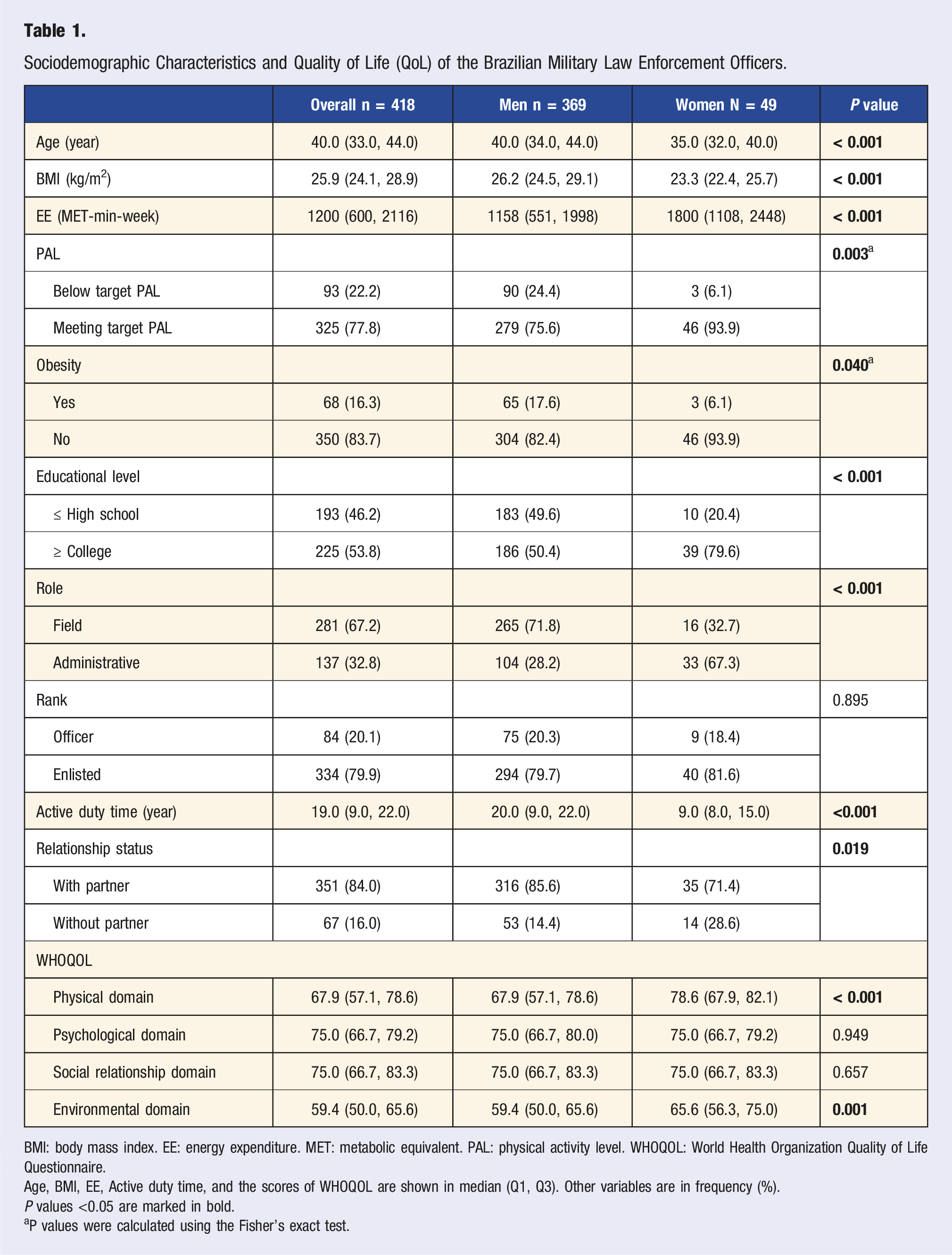
BMI: body mass index. EE: energy expenditure. MET: metabolic equivalent. PAL: physical activity level. WHOQOL: World Health Organization Quality of Life Questionnaire.
Age, BMI, EE, Active duty time, and the scores of WHOQOL are shown in median (Q1, Q3). Other variables are in frequency (%).
P values <0.05 are marked in bold.
aP values were calculated using the Fisher’s exact test.
Simple Linear Regression Analysis Examining Factors Associated With Physical Activity Levels as a Continuous Variable (METs/min/week) Among the Brazilian Military Law Enforcement Officers (n = 418).
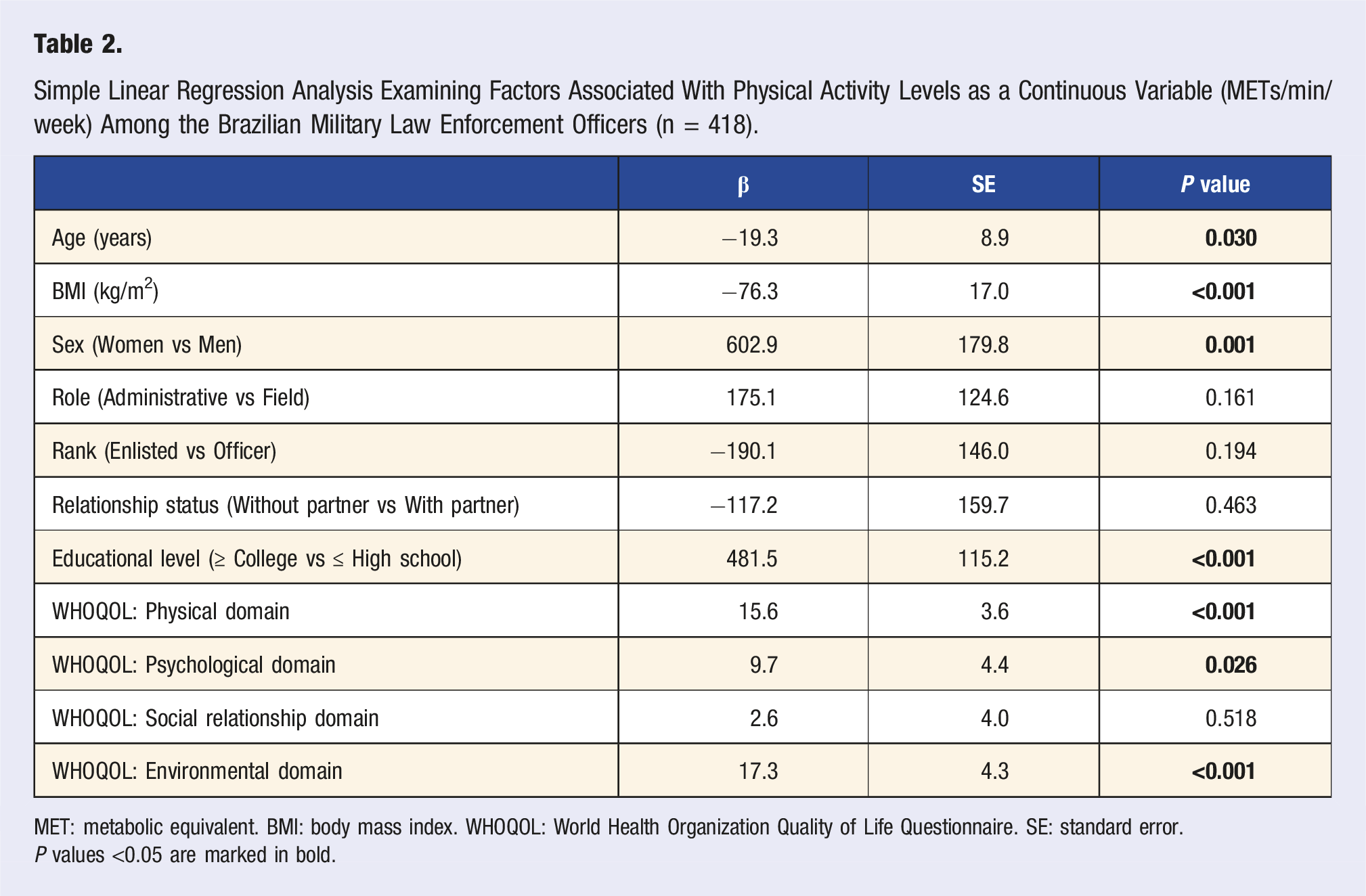
MET: metabolic equivalent. BMI: body mass index. WHOQOL: World Health Organization Quality of Life Questionnaire. SE: standard error.
P values <0.05 are marked in bold.
Multiple Linear Regression Analysis Examining Factors Associated With Physical Activity Levels as a Continuous Variable (METs/min/week) Among the Brazilian Military Law Enforcement Officers (n = 418).
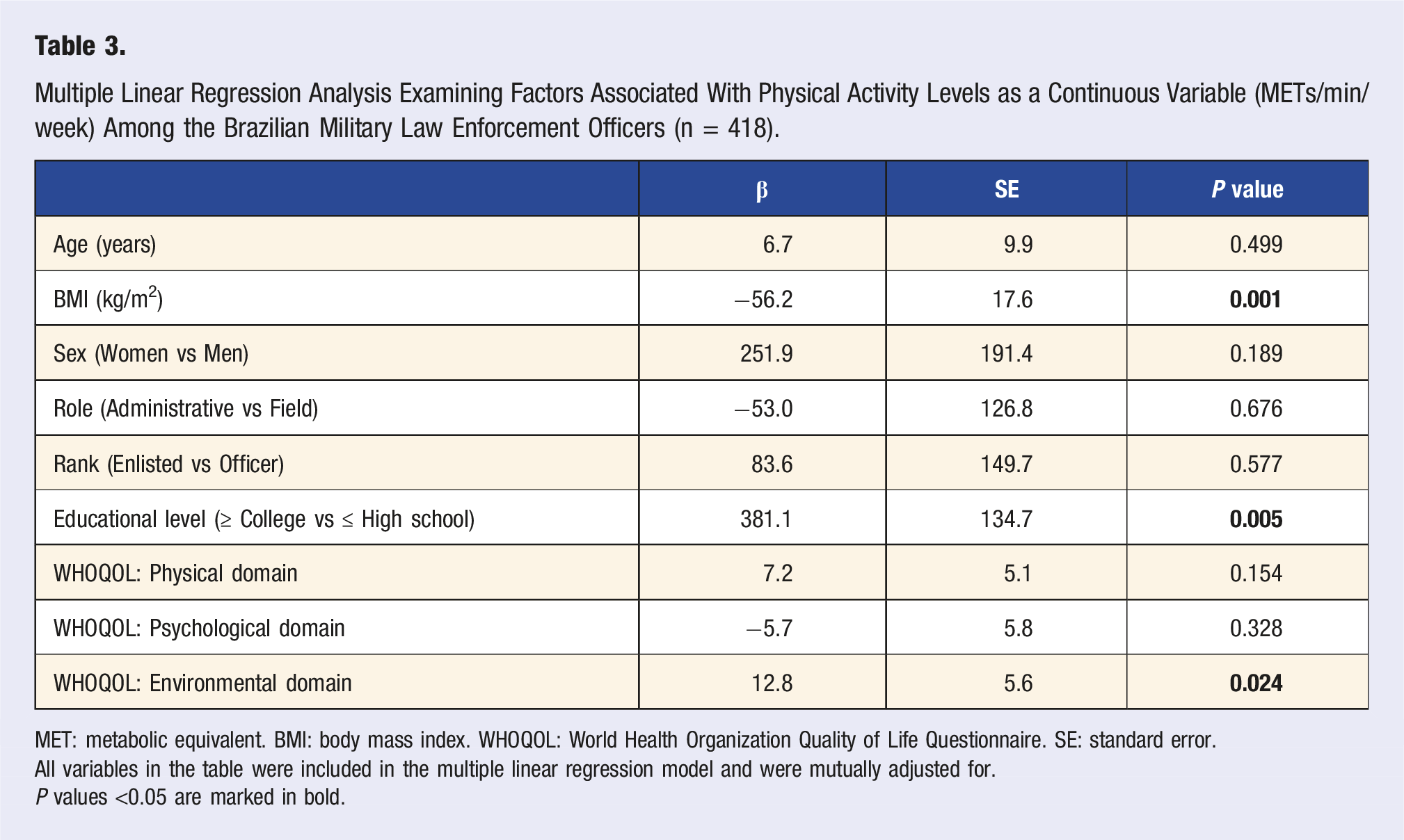
MET: metabolic equivalent. BMI: body mass index. WHOQOL: World Health Organization Quality of Life Questionnaire. SE: standard error.
All variables in the table were included in the multiple linear regression model and were mutually adjusted for.
P values <0.05 are marked in bold.
Comparison of Quality of Life Metrics Between Brazilian Military Law Enforcement Officers who met Target Physical Activity Level (PAL) and Those who Fell Below the Target PAL (n = 418).
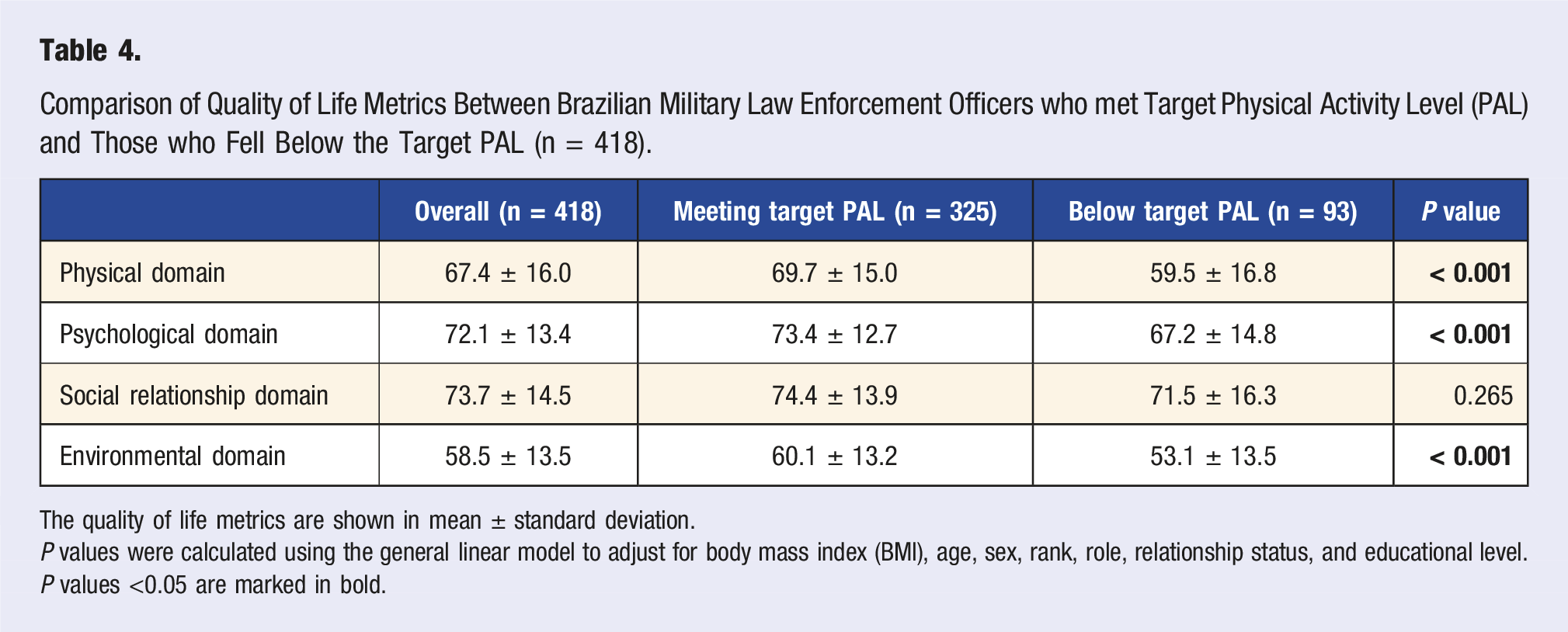
The quality of life metrics are shown in mean ± standard deviation.
P values were calculated using the general linear model to adjust for body mass index (BMI), age, sex, rank, role, relationship status, and educational level.
P values <0.05 are marked in bold.
Discussion
Our study is the first investigation to our knowledge into the factors associated with PAL among LEOs in Latin America. We found that BMI, educational level, and QoL—particularly in the environmental domain that reflects respondents’ life circumstances—were significantly associated with the PAL of Brazilian military LEOs. Specifically, after controlling for potential confounding factors, we observed that each one-unit increase in BMI was associated with a decrease of 56.2 MET-min/week in PAL. On the other hand, a one-unit increase in the environmental domain of QoL was linked to an increase of 12.8 MET-min/week in PAL, and higher educational attainment (college degree or higher) was associated with a mean PAL increase of 381.1 MET-min/week compared to those with a high school degree or lower.
Several sociodemographic factors have been shown to be associated with PAL among LEOs. A study using wristband devices to track police officers in the USA found that, on average, female officers took approximately 40 more steps at work and nearly 110 more steps off duty compared to their male counterparts. 23 Similarly, another study in Québec examining the cardiovascular health profiles of police officers found that females reported a significantly lower prevalence of obesity compared to males (7.3% for females vs 21.1% for males). 24 A recently published exploratory study among Brazilian civil police officers (those who perform investigative functions rather than street patrolling) (n = 55) found a tendency for a higher proportion of physically active women compared to men (P = 0.07). Women officers also had lower BMI but were younger than men. 25 In line with these findings, our study on Brazilian LEOs observed that female LEOs were more likely to meet target PAL and less likely to be obese in the crude analysis. Nonetheless, after controlling for covariates, no significant sex differences were noted.
In terms of other demographic factors, it has been suggested that educational level and health literacy may be associated with an individual’s PAL.26-28 For instance, a survey among Nigerian civil servants identified educational level as a significant predictor of PAL, with higher educational attainment linked to increased physical activity levels. 29 Similarly, a Japanese study found that adults with at least 2 years of college education had 54% higher odds of meeting physical activity recommendations, compared to those with a high school education or less. 30 Our findings are consistent with existing literature, highlighting educational level as a strong and independent factor associated with the PAL of Brazilian LEOs.
Several studies have also demonstrated a strong relationship between body composition and PAL. A study involving US police officers found that lower levels of fitness as assessed by a 2.4-km run, push-ups, sit-ups, and the distance reached in a sit-and-reach test were associated with higher body fat percentage. 31 Additionally, studies focusing on firefighters consistently demonstrated that BMI and waist circumference are inversely associated with cardiorespiratory fitness, which can further elevate the cardiovascular risk.32-36 In fact, low physical activity is more likely to predict a higher BMI. However, once BMI reaches a certain level, it creates a vicious cycle where obesity discourages physical activity. 37 Therefore, identifying significant predictors of PAL and optimizing BMI and body composition is crucial to safeguard the health and well-being of LEOs.
Another key finding of this study is that an increase in the environmental domain of QoL is associated with higher PAL among LEOs. To our knowledge, this is the first report of its kind among LEOs. The WHOQOL-BREF defines 4 domains of QoL, and the environmental health domain encompasses various factors, including financial resources, safety, health and social services, living conditions, opportunities for acquiring new skills and knowledge, recreational activities, overall environmental quality (such as noise and air pollution), and transportation. 38 Since it is unlikely that participants’ PAL would directly impact these environmental factors, we are confident in the directionality of our findings. In fact, a recent systematic review has identified numerous environmental factors that can hinder physical activity, such as affordability, physical barriers (i.e., poor sidewalks), extreme weather, inadequate facilities, accessibility issues due to distance, and work commitments. 39 Although there is limited evidence specifically regarding LEOs, our findings are consistent with studies on other populations, emphasizing the need to enhance environmental support for law enforcement officers to improve their physical activity levels and overall health. In addition, while the environmental health domain of the WHOQOL-BREF assesses the overall QoL related to environmental factors, future large-scale research is needed to determine if there is a specific set of environmental elements that influences the PAL of LEOs. Moreover, intervention studies, such as running a program that increases LEOs’ literacy on PAL, or trials can help establish the causal relationship between improvements in the environments of LEOs and increases in their PAL.
In addition to the environmental aspects, our research found that the physical domain of QoL is significantly associated with PAL after controlling for key demographic variables. The physical health domain of the WHOQOL includes factors such as pain and discomfort, medical treatment, energy levels, sleep quality, the ability to perform daily living activities, and work capacity. 38 There is substantial evidence showing a strong association between PAL and the physical domains of QoL.40,41 A Brazilian population-based study among adults, using the same QoL questionnaire, found a positive association between moderate and vigorous PA and the physical domain of QoL among men. 40 Additionally, another large systematic review involving general adult populations revealed a consistent positive relationship between PAL and physical health QoL across cross-sectional, cohort, and experimental studies that utilized different QoL measurement tools. 41 In terms of directionality, the literature generally supports the idea that improved physical health or functioning results from increased PAL.40,41 While our study design does not allow us to establish causality, our findings align with existing evidence and expand the understanding of this relationship to LEOs in Latin America, a group that has not yet been explored in current literature.
The current study has several strengths. First, we utilized validated tools to measure participants’ PAL and QoL, which helps minimize information bias. Second, the use of an anonymous questionnaire ensures confidentiality, allowing the participants to answer the survey as honestly as possible. This is crucial for ensuring the accuracy of measurements in LEOs, as LEOs typically adhere to a strict hierarchy and are less likely to report any negative experiences. In addition, we controlled for potential confounding factors in our analyses, which reduces confounding bias.
There are also some limitations in the study. First, participants were recruited using convenience sampling, and ≈10% of the population may result in biased estimates when individuals in certain roles were either over- or under-sampled; for example, if individuals with higher educational levels, better QoL, and higher PAL were more motivated to participate, the results may be underestimated. Conversely, if the association between psychological QoL and PAL is particularly strong among LEOs with higher education, and these officers were over-sampled, the findings could be overestimated. Second, a healthy worker effect may exist since LEOs must meet certain physical screening criteria to enter their careers, making them generally healthier than the general population. However, these healthy worker effects, if present, would lead to an underestimation of the associations. Third, due to the self-reporting nature of the PAL from participants, biases related to recall and social desirability may be present, as LEOs may over-report their PAL. However, these biases are likely to be non-differential across all LEO groups and are usually reduced with the use of anonymous reporting. In addition, the relatively small sample size of female LEOs may limit our statistical power in detecting sex differences. Furthermore, previous research has shown that IPAQ tends to overestimate PAL. 42 Nonetheless, this measurement error is likely non-differential across all participant groups, which may lead to an underestimation of our findings. Finally, this study was conducted among Brazilian military LEOs from a Brazilian northern state, and the findings may not be generalizable to other Brazilian regions, other occupations, or populations in different countries.
Conclusion
Our study identified that BMI, educational level, and QoL—particularly in the environmental domain that reflects respondents’ life circumstances—were significant factors associated with the PAL of Brazilian military LEOs. To the best of our knowledge, this is the first research of its kind conducted on military police officers in Latin America, addressing an important gap in knowledge. Although the cross-sectional nature of our study limits our ability to draw causal inferences, our findings are consistent with existing literature. Future, larger-scale longitudinal studies are necessary to establish causality. Additionally, intervention studies that focus on managing body composition and providing targeted support for individuals with lower socio-economic status or those living in underprivileged environments are essential to assess the impact of enhancing health and wellness through increased physical activity among law enforcement officers.
Supplemental Material
Supplemental Material - Factors Associated With Physical Activity Levels Among Brazilian Military Law Enforcement Officers
Supplemental Material for Factors Associated With Physical Activity Levels Among Brazilian Military Law Enforcement Officers by Fan-Yun Lan, Wélere G. Barbosa, Daniel R. Saint Martin, Edgard de Melo Keene von Koenig Soares, Costas A. Christophi, Stefanos N. Kales, Guilherme E. Molina, Luiz Guilherme G. Porto in American Journal of Lifestyle Medicine
Consent to Participate
The Institutional Review Board (IRB) of the Universidade de Brasília and the Centro Universitário Luterano de Palmas waived the requirement for informed consent to participate regarding data previously collected for institutional purposes.
Footnotes
Acknowledgments
The authors thank the Polícia Militar do Tocantins – PMTO for the support of this study.
Author Contributions
Conceptualization: WGB, DRSM, EMKKS, GEM, LGGP; Methodology: F-YL, WGB, CAC, SNK, GEM, LGGP; Data curation: WGB, DRSM, EMKKS, GEM, LGGP; Formal Analysis: F-YL, CAC, SNK, LGGP; Investigation and resources: WGM, DRSM, LGGP; Supervision: LGGP; Project administration: WGB, LGGP; Funding acquisition: WGB, LGGP; Writing—original draft: F-YL, LGGP; Writing—review and editing: F-YL, EMKKS, CAC, SNK, GEM, LGGP; Approval of the final version: all authors.
Declaration of Conflicting Interests
The authors declared the following potential conflicts of interest with respect to the research, authorship, and/or publication of this article: GWB is a police officer from the same state where the study was conducted.
Funding
The authors disclosed receipt of the following financial support for the research, authorship, and/or publication of this article: This work was supported by the Programa de Pós-Graduação em Educação Física da Universidade de Brasília [Edital PPGEF 05/2025].
Ethical Considerations
The Institutional Review Board (IRB) of the Universidade de Brasília and the Centro Universitário Luterano de Palmas approved this study (No. 51071915.8.0000.0030 and 51071915.8.3001.5517).
ORCID iDs

Data Availability Statement
Data may be made available upon reasonable request.
Supplemental Material
Supplemental material for this article is available online.
References
Supplementary Material
Please find the following supplemental material available below.
For Open Access articles published under a Creative Commons License, all supplemental material carries the same license as the article it is associated with.
For non-Open Access articles published, all supplemental material carries a non-exclusive license, and permission requests for re-use of supplemental material or any part of supplemental material shall be sent directly to the copyright owner as specified in the copyright notice associated with the article.
