



Abstract
Esports gamers compete in sanctioned tournaments whereas recreational gamers play video games casually for fun. Research suggests exercise might benefit esports performance. Regular exercise combined with prolonged sitting while gaming may lead esports gamers to be “Active Couch Potatoes,” (highly sedentary individuals who meet physical activity guidelines). This research investigated the relationship between esports gamers (n = 304), recreational gamers (n = 229), and the Active Couch Potato lifestyle. Participants reported time spent playing video games, esports participation, physical activity, and sedentary behavior. Using established guidelines, participants were categorized as Active (sufficient exercise, not sedentary), Not Active (insufficient exercise), or Active Couch Potato (sufficient exercise, highly sedentary). ANOVA revealed no difference in time spent gaming across physical activity groups (P = .332). Logistic regression examined relationships between physical activity groups, esports participation, sex, and age. Esports participation was the only significant predictor (P < .001). Crosstabs with Chi-square then described this relationship in detail: in the Not Active group, 64.7% were recreational gamers, 35.3% esports gamers; in the Active group, 28.9% were recreational gamers, 71.1% esports gamers; among Active Couch Potatoes, 61.2% were recreational gamers, 38.8% esports gamers (χ2 = 65.52, Sig.<.001). Relative to recreational gamers, a significantly greater proportion of esports gamers exceeded exercise guidelines and minimized sitting.
“Our data suggests that the sedentary, physically inactive lifestyle may be more typical of recreational gamers.”
Introduction
The number of American adults who play video games is at an all-time high and expected to increase. Currently, about 54% of adults play video games and interest is greatest among younger generations such as Gen Z (i.e., those born between 1997-2012) and Millennials (i.e., those born between 1981-1996). In 2022, young adults from these 2 generations spent more time playing video games than they did using any other type of media, including watching television. 1 Because video games are most often played while sitting, playing video games (i.e., gaming) is typically considered a sedentary behavior. 2 The negative health consequences associated with increased sedentary behavior are well researched and include disruption of lipid metabolism, insulin resistance and type 2 diabetes, cardiovascular disease, and greater mortality risk from all causes.3-9 Increased daily sitting also takes time away from physical activity and therefore limits opportunities to receive the health benefits of exercise. 10 Given the widespread and increasing popularity of gaming in our society, there is concern that individuals who spend long periods of time playing video games (i.e., gamers) may be an at-risk population for a sedentary, physically inactive lifestyle. 11
Gamers have often been stereotyped as sedentary, physically inactive, and even socially awkward.12,13 But these stereotypes are increasingly challenged and debunked.13,14 Particularly with the rise of esports. Esports are officially sanctioned gaming competitions between amateur or professional players and their teams. Amateur esports gamers may play for high school or university teams; while professional esports gamers compete for cash prizes, lucrative endorsement deals, and have tens-of-thousands (even millions) of fans who follow their exploits across multiple social media platforms. 15 Given what is at stake in esports (e.g., college scholarships, cash prizes), esports gamers may make different lifestyle choices than gamers who play only for casual recreation. For example, emerging research suggests that moderate and vigorous-intensity physical exercise may benefit esports performance.16,17 Potential performance benefits might motivate esports gamers to be more physically active than their recreational gamer peers. Yet, research investigating the lifestyle behaviors associated with frequent video game playing does not often distinguish esports gamers from recreational gamers. 18 This tendency to conflate esports and recreational gamers might be why a recent systematic review of gamers’ lifestyle behaviors such as physical activity and sedentary behavior produced equivocal results. 19
Despite emerging evidence that physical exercise might benefit esports performance, esports gamers must still spend many hours a day practicing (i.e., playing video games). For example, a study of collegiate esports players found that many sit up to 10 hours per day while playing video games. 20 If esports gamers are physically active, yet also sit for many hours each day practicing, they may be “Active Couch Potatoes.” The Active Couch Potato is an individual who meets established guidelines for daily physical activity (such as those established by the American College of Sports Medicine) but is also highly sedentary (i.e., more than 8 h per day). 21 Because research suggests that the negative health effects of too much sitting are independent of the benefits of regular physical activity, Active Couch Potatoes are at greater risk for negative health outcomes associated with sedentary behavior compared to a person who is similarly physically active yet engages in much less sitting.3,4,6,22,23 Given the research identifying potential benefits of physical activity on gaming performance, individuals who spend large amounts of time playing video games for recreational purposes may have different lifestyle behaviors than individuals who spend similar amounts of time playing video games for esports. As such, we hypothesized that esports gamers would be more likely than recreational gamers to meet established guidelines for physical activity, but that esports gamers would also still be highly sedentary making them more likely to qualify as Active Couch Potatoes (i.e., sufficiently physically active but simultaneously highly sedentary). Guided by this hypothesis, the purpose of this research was to investigate the relationship between esports gamers, recreational gamers, and the Active Couch Potato lifestyle. Because gaming behavior24,25 as well as physical activity behavior 26 has been shown to interact with age and gender, these variables were included in the initial analysis. Identifying populations of Active Couch Potatoes is important as they may inaccurately feel protected from the deleterious health effects of too much sitting as a result of meeting established physical activity guidelines.
Methods
Data Collection
Amazon Mechanical Turk (MTurk), a crowd-sourcing web service, was used to recruit experienced gamers to participate in an online survey. Participants were limited to the United States by IP address. The recruitment script explained that “only gamers can participate in this study. Non-gamers will be filtered out through a screening process.” After reading the informed consent document and agreeing to participate, 2 filtering questions were presented. These read: “What are the common keys for character movement (backwards, forwards, side to side) on a PC keyboard while gaming?” and “What is the most popular messaging app amongst gamers?” A total of 1416 individuals initiated the survey and through the filtering procedure and removing the data with systematic missing values, the final number of participants was 532 (n = 360 males; n = 172 females). After the filtering questions, the survey was divided in 2 parts and required about 10 minutes to complete. Part 1 assessed social and psychological aspects of the gamer lifestyle and is published here. 18 Part 2 used the valid and reliable International Physical Activity Questionnaire (IPAQ) to assess physical activity and sedentary behavior. 27 The survey also assessed time spent playing video games (min/day) and esports team membership (dichotomous variable: yes/no). In this sample of experienced gamers, those who answered “yes” will be referred to as “esports gamers” (n = 304) and those who answered “no” will be referred to as “recreational gamers” (n = 229). The minimum age for participating in the study was 18 years. The mean age of participants was 35.4 years (±10.1) and in that respect this sample is comparable to the larger population of US gamers where 80% of video game players are adults aged 18 or older with an average age of 31 years. 28
Physical Activity Group Definitions
We used the physical activity and sedentary behavior data to identify Active Couch Potatoes. The method for doing so was developed in a previous paper. 29 Briefly, established physical activity guidelines developed by the American College of Sports Medicine (ACSM) recommend that adults should do at least 150 min a week of moderate-intensity, or 75 min a week of vigorous-intensity physical activity, or an equivalent combination of both. 30 Additionally, research suggests that sitting more than 8 hours per day increases risk for all-cause mortality.21-23 Therefore, we identified any participant who sat 8 or more hours per day while also meeting the ACSM recommendations for physical activity as an “Active Couch Potato.” Similarly, individuals who did not meet the recommendations for physical activity were categorized as “Not Active.” Finally, individuals who met the physical activity guidelines and sat less than 8 h per day were categorized as “Active.” To summarize, established guidelines were used to create an activity variable with 3 physical activity groups: Not Active, Active, and Active Couch Potato.
Data Analysis
First, an ANOVA with Bonferroni post hoc tests compared mean values of time spent playing video games, moderate-intensity physical activity, vigorous-intensity physical activity, and sedentary behavior between the 3 physical activity groups (i.e., Not Active, Active, Active Couch Potato). The intent was to illustrate similarities and differences in time spent gaming, participating in physical activity, and sitting between these groups. Second, a multinomial logistic regression was used to examine the relationship between potential predictor variables (i.e., esports membership, sex, age) and the physical activity group variable. Multinomial logistic regressions are commonly used to model categorical dependent variables as is the case here. 31 Potential interactions between the regression’s predictor variables (i.e., esports* sex, esports* age) were examined using crosstabs with a Chi-Square test of statistical significance and independent samples T-tests. Finally, a crosstabs with a Chi-Square test of statistical significance was used to provide additional description of the relationship identified in the logistic regression. Data were analyzed using SPSS version 26 with α ≤ .05.
Results
ANOVA With Bonferroni Post Hoc Comparisons.
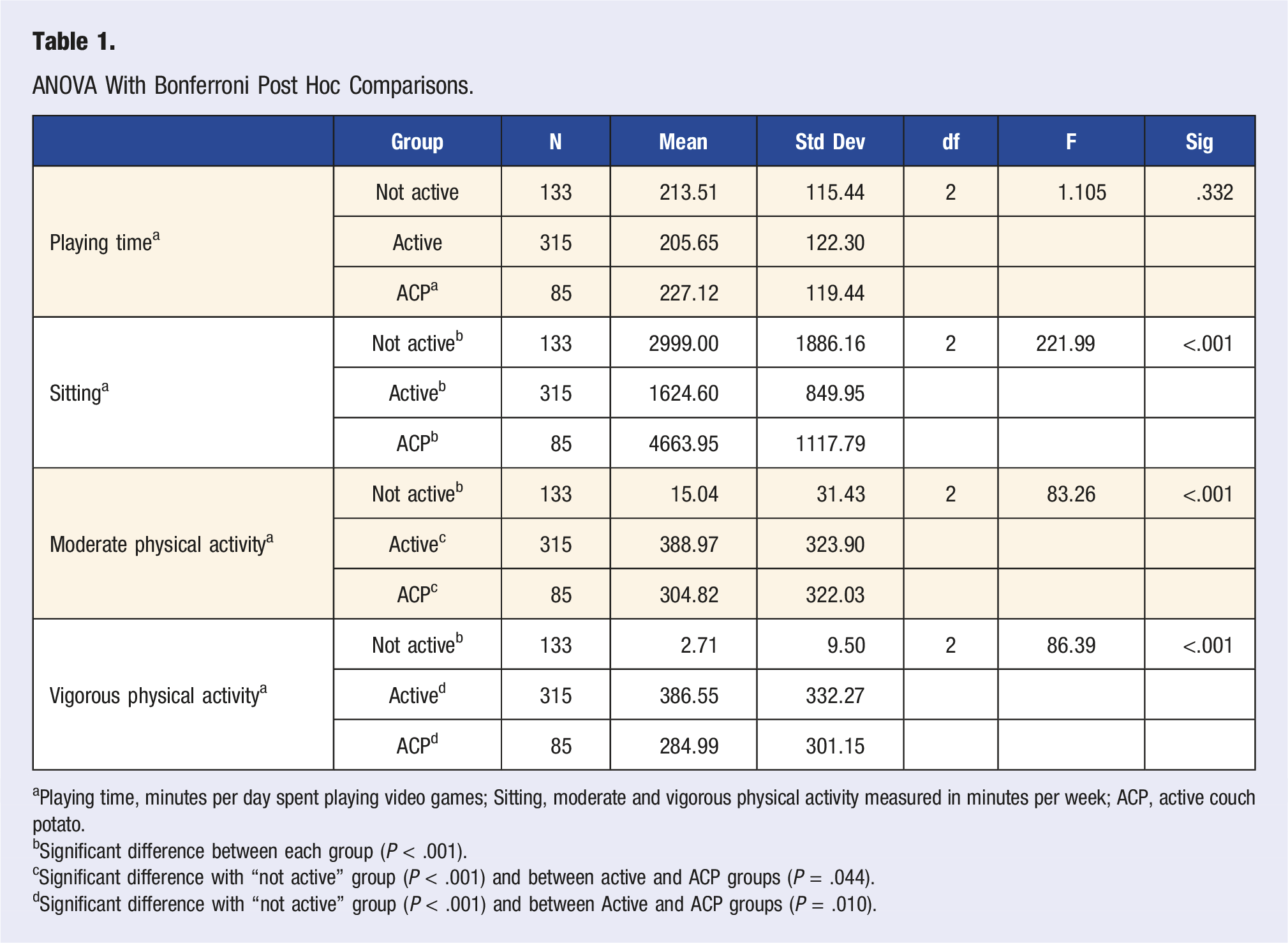
aPlaying time, minutes per day spent playing video games; Sitting, moderate and vigorous physical activity measured in minutes per week; ACP, active couch potato.
bSignificant difference between each group (P < .001).
cSignificant difference with “not active” group (P < .001) and between active and ACP groups (P = .044).
dSignificant difference with “not active” group (P < .001) and between Active and ACP groups (P = .010).
The potential relationship between physical activity group and the predictor variables (i.e., esports membership, age, sex) was assessed using a multinomial logistic regression. Accordingly, the likelihood ratio test was used to assess the importance of each predictor. 31 This test compares the strength of the model with the variable of interest to the strength of the model without the variable of interest. Using this approach, sex did not contribute to the model (χ2 = 3.13, df = 2, P = .209); age did not contribute to the model (χ2 = 4.51, df = 2, P = .105); however, esports membership did contribute to the model (χ2 = 58.98, df = 2, P < .001). Next, a crosstabs with Chi-Square identified a significant interaction between sex and esports membership (χ2 = 19.73, df = 1, P < .001). Specifically, 70% of females in the sample (122/172) participated in esports vs 51% of the males (182/360). Also, independent samples T-tests identified a significant interaction between age and esports membership (t = 3.43, df = 530, P < .001). Specifically, the mean age of esports gamers was 36.65 years compared to a mean age of 33.72 years for recreational gamers. Therefore, 2 interaction terms were added to the model (esports* sex, esports* age). The interaction terms did not make significant contributions to the model (χ2 ≤ 1.031, df = 2, P ≥ .597) while the significance of the original predictors remained unchanged. Thus, esports membership was the only significant predictor of physical activity group.
Logistic Regression of Physical Activity Group a and Esports Membership.
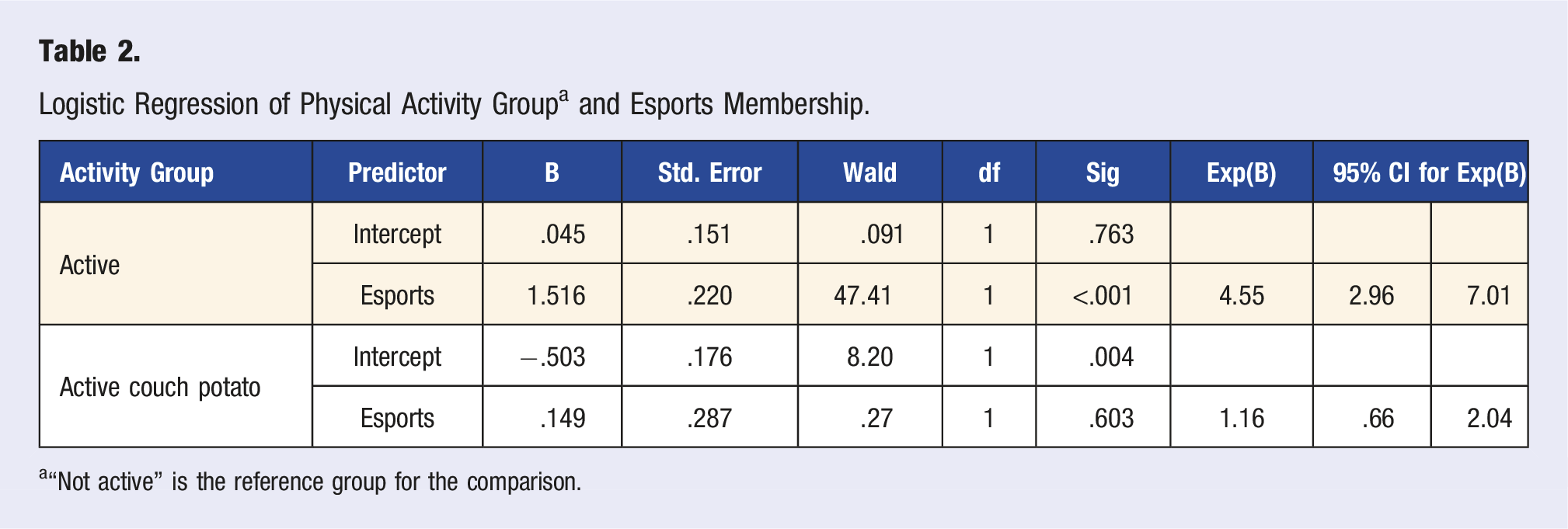
a“Not active” is the reference group for the comparison.
Crosstabs a Comparing Esports Participation With Physical Activity Group.
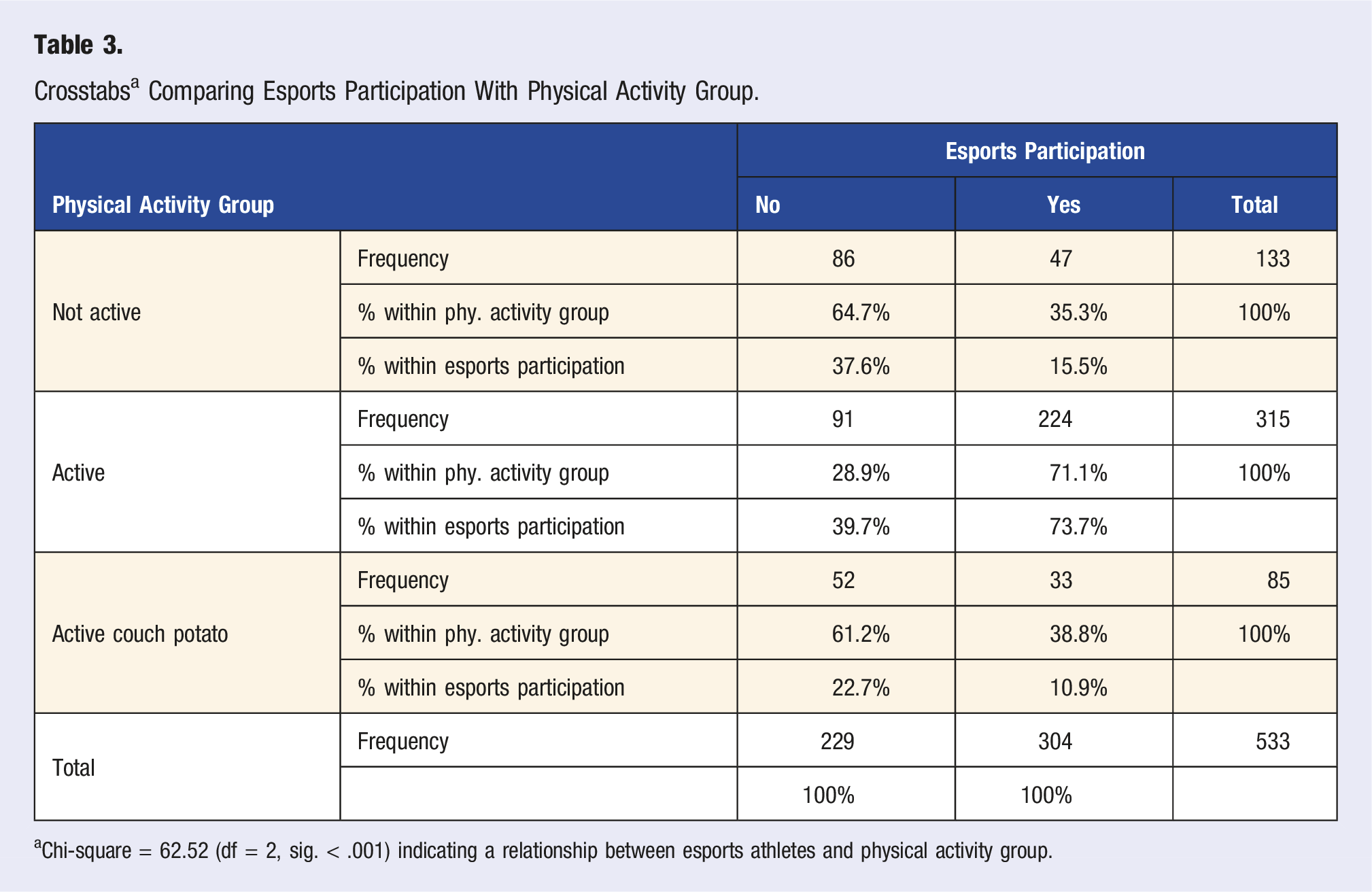
aChi-square = 62.52 (df = 2, sig. < .001) indicating a relationship between esports athletes and physical activity group.
Discussion
Our hypothesis that esports gamers would be more likely than recreational gamers to meet established physical activity guidelines was supported. However, our hypothesis that esports gamers would be more likely than recreational gamers to be Active Couch Potatoes was not supported. To briefly summarize, a logistic regression suggested that esports gamers were significantly more likely than recreational gamers to be categorized as Active compared to Not Active. Age, sex, and the interaction terms (i.e., age* esports, sex* esports) were not significant predictors of physical activity group. The relationship between activity group and esports membership was further described using a crosstabs analysis. Crosstabs suggested that esports gamers were significantly more likely than recreational gamers to be in the Active group which met physical activity guidelines and was not highly sedentary; conversely, recreational gamers were significantly more likely to be either in the Not Active group or Active Couch Potato group. Interestingly, there was no relationship between physical activity groups and time spent playing video games meaning that differences in sedentary behavior between groups came from activities other than gaming. Our survey did not assess what those activities might be and perhaps this is an area of interest for future research.
Taken together, this study suggests that not all experienced gamers adopt the same stereotypical sedentary, physically inactive lifestyle.12,13 Our data suggests that the sedentary, physically inactive lifestyle may be more typical of recreational gamers. Esports gamers, on the other hand, appear to be breaking that stereotype. Indeed, esports gamers are more likely than their recreational gamer peers to be sufficiently active and not highly sedentary. Perhaps esports gamers are motivated by the esports performance benefits that research suggests result from regular moderate and vigorous physical activity.16,17 Research examining esports gamers’ motivations for physical activity is an area for future research. Considering recreational gamers, this appears to be an at-risk population for the negative health consequences of sedentary behavior and physical inactivity. Health awareness messages which describe the importance of being both physically active and reducing sedentary time to prevent negative health consequences should target this population. Popular esports personalities, who according to our data may be more likely to engage in a healthy active lifestyle, may represent ideal messengers for promoting healthy behavior among the recreational gaming community.
Footnotes
Declaration of Conflicting Interests
The author(s) declared no potential conflicts of interest with respect to the research, authorship, and/or publication of this article.
Funding
The author(s) received no financial support for the research, authorship, and/or publication of this article.
Ethical Approval
All procedures were approved by the university institutional review board.
