



Abstract
Context
While a great deal of interest has been accorded to the cognitive effects of n-3 long-chain polyunsaturated fatty acids (LC PUFAs), there is a need for systematic review data that assess this outcome across the lifespan, accounting for population differences and highlighting methodological limitations of extant studies.
Objective
This systematic review addresses the effects of n-3s on human cognition and provides an overview on the current state of research and recommendations for future efforts.
Data Sources
Based on a thorough review of highly powered articles from PubMed (MEDLINE), Web of Science, and ProQuest Central, the authors evaluated articles published between 2000 and 2020 assessing LC PUFA status on cognition as a primary outcome measure. Using the PRISMA guidelines, the researchers’ primary aim was to provide a comprehensive overview of the articles.
Conclusions
The results indicate inconsistent effects of intervention, with benefits for specific groups on specific outcomes. Although results were rarely definitive across cognitive domains, and the majority of studies indicated the presence of a possible threshold effect in which LC PUFA needs were already being met, and supplementation did not have an additional effect, there is evidence for trends towards benefit in cognitive functions, in those experiencing early cognitive decline.
“Westernized diets and increased consumption of processed foods have meant that the majority of people consume significantly less n-3s than in previous years.”
Introduction
The cognitive effect of long-chain polyunsaturated fatty acids (LC PUFAs)—including docosahexaenoic acid, (DHA; 22:6, n-3), eicosapentaenoic acid (EPA; 20:5, n-3), alpha-linolenic acid (ALA; 18:3, n-3), and arachidonic acid (AA/ARA; 20:4, n-6)—has been addressed in a significant number of studies with various populations of interest. Given the global increase in the aging population, much of this research has focused on its neuroprotective effects among adults and the elderly. With lipids making up 50–60% of the brain’s dry weight and having effects on membrane fluidity and neurotransmission, it is particularly important to evaluate LC PUFA intake and supplementation’s potential effects on cognitive function and neuroprotection. 1
Unable to be synthesized de novo in human cells, dietarily derived LC PUFAs—and their consumption in the proper ratios—is a key area of interest in the nutrition field. Indeed, Westernized diets and increased consumption of processed foods have meant that the majority of people consume significantly less n-3s than in previous years. Estimates have suggested that there has been a significant shift from traditional diets with 1:1 ratios of n-6 to n-3 PUFAs to ratios closer to 20:1. 2 While it is evident that LC PUFA intake is necessary for cognitive function and their dietary lack is detrimental, empirical evidence on their efficacy for neuroprotective function has been mixed.
Because n-3 LC PUFAs function as cell membrane components, they affect both tissue formation and neuroprotection. 3 Therefore, extant studies on the subject can be divided into two categories: neurodevelopment and neuroprotection. The purpose of this systematic review is to evaluate the findings of highly powered studies designed to investigate the neuroprotective effects of LC PUFA supplementation, primarily including populations with Alzheimer’s Disease (AD), dementia, and mild cognitive decline (MCI). For comparative purposes, this review also includes studies conducted with populations of healthy adults, as well as those with depression, bipolar disorder, schizophrenia, and hypertension/cardiac comorbidities. Such studies also provide important insights concerning the cognitive mechanisms by which LC PUFAs affect cognition, the potential threshold effect of their consumption, and the specific cognitive outcome areas affected.
Methodology
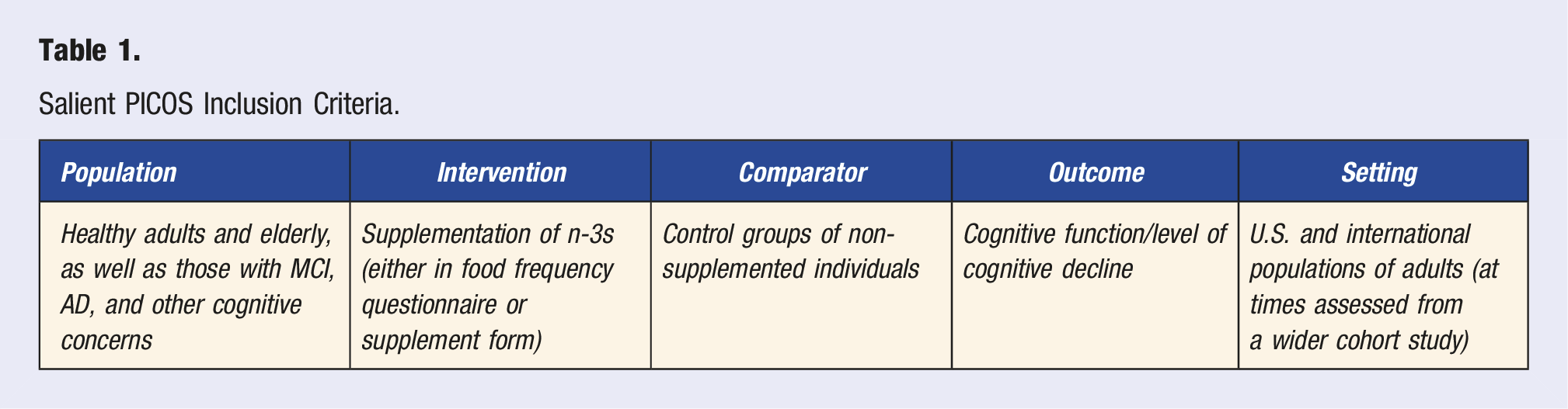
For the purposes of this systematic review, we searched PubMed (MEDLINE), Web of Science, and ProQuest Central, using filters for peer-reviewed articles published between 2000 and 2020. Search terms included: omega-3s; docosahexaenoic acid (DHA); cognitive function; macronutrients; healthy fats; polyunsaturated fatty acids; brain health; developmental outcomes; n-3 polyunsaturated fats; LC PUFAs; dietary fats; and brain function. In PubMed, results were additionally filtered to include only clinical trials conducted with humans. This initial search yielded 501 articles, which we reviewed first on the basis of title and metadata for the inclusion criteria of relevant, peer-reviewed articles published between 2000 and 2020 and written in English. After eliminating duplicates and narrowing the field to 181 articles, we then reviewed all abstracts to assess for the additional inclusion criteria of randomized controlled trials (RCTs), secondary analyses of RCTs, or sufficiently powered observational studies (case-control, prospective, or retrospective) with large sample sizes, conducted with human subjects. Exclusion criteria were case studies and case series study designs; underpowered studies; and those in which PUFAs were not a primary (or differentiable) independent variable (see Figure 1 for the literature search process and Table 1 for the PICOS inclusion criteria). Literature Search Flow Chart. Salient PICOS Inclusion Criteria.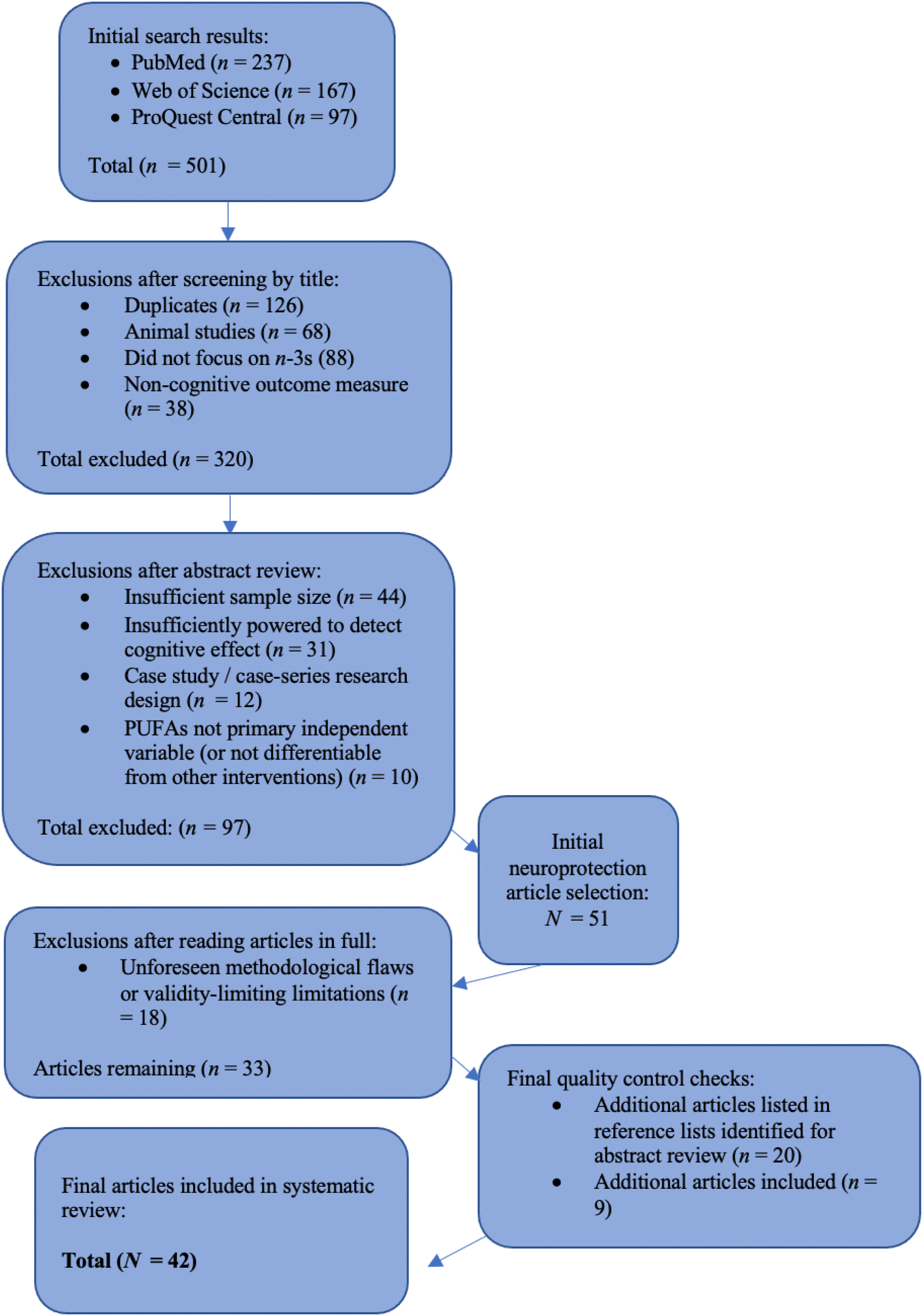
At this stage, it became evident that the extant literature could and should be subcategorized into that pertaining to the developing brain—studies that addressed the neurodevelopmental importance of n-3s from prenatal development to young adulthood—and that which addressed adulthood, focusing more on the neuroprotective effects of Omega-3s. As such, this article constitutes the second installment of a two-part series: neuroprotective effects of n-3 LC PUFA during adulthood and among the elderly. After abstract review, we selected 51 articles pertaining to neurodevelopment to read in full and narrowed these to a final set of 33 that met the inclusion criteria. To confirm the comprehensiveness of the literature included, we also consulted the reference lists of all articles published in the last 5 years, as well as previous literature review and meta-analysis articles, and used the “cited by” function in a university library database-wide search; we reviewed an additional 20 abstracts and included an additional 9 articles that met the inclusion criteria as a result of this process.
Results
Study Types and Participant Characteristics.

Instrumentation, Results, and Limitations.

Key Populations/Demographic Interactions
Mild Cognitive Impairment
Many studies have addressed populations with mild, rather than severe, levels of cognitive impairment, and have yielded mixed results. Bo et al. 13 identified cognitive improvements in individuals with mild-moderate AD, which contradict the results of previous studies—the authors suggested that this is due to the large sample size in their work. Freund–Levi et al. 14 found, via subgroup analysis, that decline rate was slower in the treatment group, but only among those with the mildest AD symptoms. Moon et al. 15 studied a similar population, but did not identify any positive effect of omega-3 supplementation.
AD/More Severe Cognitive Impairment
Overall, fewer studies have addressed populations with more severe levels of cognitive decline and AD. In part, this has been due to difficulties discerning the potential effects of n-3 supplementation in the presence of progressive cognitive decline. For example, Phillips et al. 16 suggested that cognitive disease progression may have caused their lack of significant findings of supplementation among a population with cognitive impairment or AD. Similarly, Quinn et al. 17 did not identify a significant treatment effect in relation to AD.
Sex-based Differences
Various studies have addressed sex-response differences in the cognitive efficacy of n-3 supplementation. Howe et al. 18 found that LC PUFA supplementation improved cerebrovascular responsiveness in women only and neurovascular coupling in men only, and suggested that future work should address gender differences in more detail. Similarly, Bo et al. 13 found that, while supplementation significantly improved perceptual speed, space imagery efficiency, working memory, and total BCAT scores in males, it only improved perceptual speed, space imagery efficiency, and total BCAT scores in females.
Limited Effect in a Younger, Healthy Population
Studies largely found limited effects of interventions conducted among members of a younger and healthy population. One study conducted with healthy university students found no effect of 4 weeks of n-3 PUFA supplementation on mood states or attention, memory, emotion recognition, or memory inhibition, though the results did indicate that members of the intervention group made fewer risk-averse decisions on a decision-making test and had higher scores on the control/perfectionism measure of the cognitive reactivity score. 19 A small study (N = 33) found n-3 supplementation for 35 days to improve mood states and decrease reaction time on attentional tasks. 20 The results of another study conducted on healthy young adults found that supplementation with 2 g of fish oil for 12 weeks resulted in increased cerebral region blood flow during cognitive task performance, but not with improved performance in those tasks. 21 In a study conducted with healthy, non-pregnant women, the authors found no effect of blood FA levels on cognitive performance, excepting an association between higher DHA levels and slower learning curve on the Stroop task. 22 Another study found no effect of fish oil supplementation on mood or cognition in a population aged 18–35. 23
Moon et al. 15 suggested that their null results may have been due to their population’s characteristics as relatively stable, dementia-free, younger than in other studies, and with less risk of vascular issues. Benton et al. 1 tested healthy young adults supplemented with DHA for 50 days and did not find any significant interactions between treatment and cognitive outcomes, but did find that patients treated with DHA tend to forget more on the word recall list test, which requires further investigation.
Mental Health Interactions
Emotional Effects and Depressive Symptoms
Dretsch et al. 24 studied soldiers regarding the potential protective effect of n-3 PUFAs on depression, due to the high prevalence of depression among that population, but the results did not support this finding. Duffy et al. 25 demonstrated a protective effect—that supplementation may protect against the worsening of depressive symptoms among members of vulnerable groups. Hashimoto et al. 26 found that supplementation improved patients’ apathy, and thereby reduced levels of caregiver burden.
An 8-year follow up of two previous large-scale RCTs found no effect of PUFA levels on the likelihood of recurrence of Major Depressive Disorder. 27 However, Rizzo et al. 28 found that PUFA supplementation may have a positive effect on depression in elderly women. Mazereeuw et al. 29 also measured depressive symptoms, but did not find any effect of n-3 supplementation. Phillips et al. 16 assessed mood, and did not find any particular effects of n-3 supplementation. Rogers et al. 30 did not find supplementation to affect cognitive function or depressive symptoms.
Schizophrenia
Pawełczyk et al. 31 noted that their results indicate that n-3 PUFA supplementation can have neuroprotective effects for healthy individuals, as well as those with the early stages of neurodegenerative disorders like schizophrenia, MCI, and AD.
Bipolar Disorder
A study conducted on a population of euthymic Bipolar Disorder patients and healthy controls found that supplementation with DHA only caused improvement among the healthy control group. 32 Further, improvement was only seen on the emotion inhibition test included in the neuropsychological test battery. The authors noted that the lack of effect on members of the Bipolar Disorder group may have been due to a masking effect of their tendency toward poorer diet and other unhealthy lifestyle characteristics.
PUFA Characteristics
Antioxidant Effects
Assman et al. found that long-term (8 years) supplementation with PUFAs produced improvements to cognitive functioning, but only if antioxidant supplementation is also provided. 33 McNamara et al. compared PUFAs with blueberry powder based on the antioxidant effects and found that both the fish oil and blueberry groups demonstrated a reduction in cognitive symptoms in everyday activities after the intervention. 34 Interestingly, they also noted the surprising finding that the combined fish oil and blueberry powder group did not demonstrate improvements, and suggested that this may have been due to a combined reaction of the two undermining potential benefits.
Which PUFAs/Their Source/Intervention Length
Otsuka et al. 35 found that higher serum DHA levels were significantly associated with lower levels of cognitive decline; EPA was not found to have the same correlation. This study was conducted among a sample of elderly Japanese individuals, as a population that tends to have a high level of fish consumption. Konagai et al. found that, while both krill and sardine oil promoted activity during the working memory task, only krill oil was shown to have activation effects during the calculation task; the difference between the two appears to be in their chemical incorporation form rather than differences in the amounts of EPA or DHA. 36 The researchers also studied event-related potential, and found that, compared to the MCT group, the group that received krill oil showed a significant decrease in latency, which reflects the rate of information processing. While both krill and sardine oil promoted activity during the working memory task, only krill oil was shown to have activation effects during the calculation task; the difference between the two appears to be in their chemical incorporation form rather than differences in the amounts of EPA or DHA.
Relatively few studies have assessed the effects of dietarily derived (rather than supplement-based) omega-3 consumption. A secondary analysis of a larger RCT used a food frequency questionnaire to assess consumption, and found that, compared to those who reported no fish consumption, those with a low level of fatty fish intake exhibited slower cognitive decline. 5
Key Types of Findings
The Threshold
Several studies suggested that their research should be repeated in populations deficient in n-3 PUFAs, as their population may already have been at the threshold for its benefits. Hooper et al. 37 conducted a secondary analysis of results with the MAPT study of those with the lowest omega-3 index scores, and found some effect of supplementation. More specifically, the results indicated that 3 years of n-3 supplementation may have a neuroprotective effect in the area of executive functioning, but only for those with low omega-3 index scores. Jackson et al. 38 also suggested that the null results of their 6-month DHA supplementation (alone and in combination with a multi-nutrient intervention) study may be explained by the fact that participants already had a significant omega-3 level. Dangour et al. 39 did not identify any effect of 24 months of n-3 supplementation on cognitive function, and suggested that this may have been attributable to the fact that study participants were already consuming a sufficient amount of LC PUFAs.
Neuroprotective Effect/Slowing Decline
Several studies have suggested that supplementation with omega-3s may slow decline rather than improving cognitive function.14,26,36 Several researchers identified the presence of reduced cognitive symptoms, or lower rates of cognitive decline, but no improvement as such.34,35 Phillips et al. 16 noted that their null findings may have been due to cognitive disease progression. Pottala et al. 40 indicated a potential neuroprotective effect of omega-3 levels; by measuring for cortical thickness, the researchers found that blood levels of EPA and DHA correlate with brain and hippocampal volumes, meaning that adequate omega-3 consumption may have a neuroprotective effect for diseases of brain atrophy.
Quinn et al. 17 addressed the fact that their null findings may have been due to not starting the intervention earlier. Heude et al. found that higher total n-6 polyunsaturated fatty acids and stearic acid levels were associated with increased cognitive decline a 4-year follow up study of a sample aged 63–74. 41 Jackson et al. did not find an effect of pre- and post-operative supplementation on cardiac surgery patients, inconsistent with the results of previous research. The authors noted that the study period may have been too brief, and that the mechanisms for improving cognitive function and preventing cognitive decline are different, which may explain the null results in this study. Andrieu et al. did not find a significant difference between placebo and control in a 3-year study with omega-3 supplementation and a multidomain intervention. Exploratory subgroup analysis suggested that n-3 supplementation in combination with the multidomain intervention may slow cognitive decline in certain groups, but the study design was not powered to detect this.
Specific Cognitive Outcomes
Executive Functioning
Based on the results of a Controlled Oral Word Association Test—a test of executive functioning—Hooper et al. 37 concluded that n-3 supplementation may have a neuroprotective effect in this area.
Working Memory
Konagi et al. found that supplementation improved working memory; Mazereeuw et al. found that supplementation did improve verbal memory performance significantly among a subgroup of participants who did not meet depressive episode criteria; Nilsson et al. identified improvements to working memory after 5 weeks of supplementation with EPA and DHA particularly in the more demanding parts of the test, and with word retrieval and figure retrieval.29,36,42,43
Mechanisms/Determinants of PUFAs’ Effects
Cerebral Mechanisms by which n-3s May Affect Cognition
Howe et al. 18 (2018) studied cerebrovascular responsiveness as a potential mechanism by which n-3s affect cognition. Similarly, Konagai et al. (2013) tested changes in oxyhemoglobin concentrations in the cerebral cortex during memory and calculation tests. McNamara et al. suggested that the positive cognitive effect they determined may have been due to brain glucose uptake. 34 Moon et al. 15 studied white matter hyperintensities (which have been shown to have associations with cognitive impairment). Pawełczyk et al. 31 noted reduced brain volume and cortical thickness in patients with schizophrenia, and that n-3 deficiencies have been linked to schizophrenia. Pottala et al. 40 addressed the connection between EPA/DHA and brain volume.
Cardiovascular Interactions
Jackson et al. 44 studied post-cardiac surgery population because of the reported cognitive decline after cardiac surgery, but did not find an effect of supplementation, but also did not produce results consistent with previous studies that had identified this cognitive decline. Mazereeuw et al. 29 studied a population with coronary artery disease, and did not identify any significant effect of pre- and post-operative n-3 supplementation on cognitive function. Nilsson et al. 42 found systolic blood pressure to be inversely related to cognitive test performance.
Discussion
Key findings of this systematic literature review are addressed briefly in this section, including the following: • Equivocal results regarding cognitive improvements among individuals with MCI—observed in some studies but not others; • Due to disease progression, LC PUFA supplementation may slow decline rather than yield improvements, but at times without clear results; and • LC PUFA supplementation appeared to have a limited effect among younger and healthy populations, potentially indicating the presence of a threshold effect and/or that sample participants were not deficient n-3s before the intervention. • Dosage of LC PUFA supplementation varies widely across studies, indicating the need for increased understanding of ideal EPA/DHA ratios and best practices in dosage amounts.
While public interest in and supplement availability of n-3s has increased in recent years, additional research is required to confirm their beneficial effects for certain populations. Several studies have failed to find supplementation to produce improvement in populations with MCI. 13 Compared to results with AD or more severe levels of cognitive impairment, this may indicate that LC PUFA supplementation is indicated more strongly for those with milder levels of cognitive decline. Among those with AD diagnoses, given the severity and progression of the illness, results tend to be still more equivocal. However, some studies have suggested that—while they did not facilitate improvement—intervention may have slowed the rate of cognitive decline. The relatively limited number of studies addressing AD or severe cognitive impairment, as well as the difficulty of measuring efficacy in terms of slower rates of decline, make the results difficult to parse and indicate that further research on this subject is required. Similarly, in populations with depression, bipolar disorder, and other mental health concerns, results have been shown to be unclear and effects may have taken the form of mitigating decline rather than yielding improvement.
Importantly, there remains uncertainty regarding the most effective dosages and ratios of LC PUFAs relative to their efficacy for an adult and aging population. In addition to a very limited number of studies assessing dietarily derived n-3s through food frequency questionnaires and serum/erythrocyte/RBC analyses, the majority of studies assessed the effects of supplementation with some combination of EPA and DHA. However, DHA dosages ranged from 560 mg to 1.7 g per day, and EPA dosages ranged still more widely from 90 mg to 1.7 g per day. While the majority of studies featured a combination, several studies assessed the effects of DHA in isolation. Further, there was a fairly even split of studies that supplemented with more EPA than DHA and those that included a higher ratio of DHA to EPA. These differences do not yet indicate a favorable pattern regarding which LC PUFAs/ratios are most effective, which should indicate that there is much more to be discerned regarding dosage before the results of such studies can be understood more definitively.
Another limitation of extant studies is—like those conducted with populations in periods of neurodevelopment—the presence of a threshold effect. Several researchers have suggested that their studies may not have yielded significant results due to the fact that research participants were already consuming an adequate amount of n-3s. Results also yielded several sex-differences, and unclear results regarding the cognitive mechanisms through which n-3s function, indicating the necessity of further research on the topic.
Conclusion
Several pervasive limitations consistently affected the results of the studies included in this systematic review, including lack of food frequency questionnaire or diet data; studies insufficiently powered to detect small effects and between group differences; pre-/post-test inconsistencies; sample populations with higher educational levels/better diets than the general population; short intervention periods/small sample sizes; the threshold effect/difficulty determining slowed decline as opposed to cognitive improvements; lack of clear gender comparison; inconsistencies in general and diverse domain-specific cognitive testing; and the lack of knowledge regarding the ideal dosage and ratios of LC PUFAs. Importantly, studies addressed in this systematic review included intervention in the form of a broad range of LC PUFA types and dosages, including DHA, EPA, but few included dietarily derived n-3s or food frequency questionnaires. As there may be an advantage in the bioavailability of dietarily derived over supplement-based n-3s over supplements, this may be a significant lacuna in the current research. 45
Though the results are inconsistent and not conclusive, several studies have indicated neuroprotective effects of n-3 LC PUFA supplementation on adult populations—including the elderly, those with varying degrees of cognitive decline, and various mental health concerns. Given the increasingly aging global population, prevalence of n-3 supplements in the market, the potential cognitive benefit of such supplementation, and paucity of comprehensive studies, future highly powered research is needed to conclusively identify the population that would most benefit the appropriate dosage, and method of delivery.
Footnotes
Declaration of Conflicting Interests
The author(s) declared no potential conflicts of interest with respect to the research, authorship, and/or publication of this article.
Funding
The author(s) received no financial support for the research, authorship, and/or publication of this article.
Data Availability
Data described in the manuscript, code book, and analytic code will be made available upon request pending approval of manuscript.
