



Abstract
Background: Poor diet is a leading cause of premature death and thus diet and lifestyle changes are needed; yet, no consensus exists regarding diets that provide the greatest benefit. One of these diets gaining popularity around the world is a plant-based, vegan diet. Recently, Netflix documentaries What the Health (2017) and The Game Changers (2019) have attempted to improve public awareness of veganism and plant-based diets. Methods: We used Google Trends to obtain data for keywords specific to plant-based diets, veganism, and documentary-specific terms over a time period before and after the release of the Netflix documentaries. We then created a forecasted model for trended search terms using autoregressive integrated moving algorithms and compared the actual trends to the forecast model to determine the effect of the documentaries on each selected term. Results: Search interest for the term “plant-based diet” increased significantly—2.8 times the mean forecasted value for What the Health (t = 12.892, df = 30.012, P < .001) and 2 times the forecasted mean for The Game Changers (t = 19.826, df = 30.118, P < .001). Additionally, following the release of The Game Changers, mean search interest for “plant-based athlete” was 2.8 times higher than the forecasted values. Conclusion: The documentaries What the Health (2017) and The Game Changers (2019) are associated with an increased interest in plant-based diets based on Google search trends, highlighting the need for continued research regarding plant-based diets and their health benefits related to chronic disease.
…media outlets are taking advantage of the rising interest in plant-based diets…
Introduction
Poor diet—a known contributor to obesity, heart disease, stroke, and diabetes1,2—is a leading cause of premature death and disability related to chronic disease in the United States. For example, more than 80% of deaths related to heart disease may be attributed to poor diet. 3 These poor health outcomes have created an urgent need for the US public to alter dietary patterns, resulting in the establishment of a $60 billion diet and weight loss industry. 4 While it is widely accepted that diet and lifestyle changes are critical to improve health outcomes, no consensus exists regarding diets that provide the greatest benefit.
One diet gaining recent popularity is the vegan or plant-based diet. A healthy plant-based diet consisting of fruits, vegetables, legumes, and whole grains—high in fiber, antioxidants, micronutrients, unsaturated fat, and low in saturated fat and heme iron—have been shown to lower heart disease risk by enhancing insulin regulation, decreasing inflammation and blood pressure, and improving lipid profile and vascular health. 5 We distinguish this form of diet from an unhealthful plant-based diet consisting of refined grains, processed foods, juices, and sweets, which has been associated with a higher risk for coronary heart disease. 5 A plant-based dietary pattern has been associated with a reduced risk of developing numerous chronic diseases. The Adventist Health Study 2 (AHS-2), a prospective cohort of 73,308 individuals, found that a vegetarian dietary pattern was associated with lower all-cause mortality and some reductions in cause-specific mortality. 6 Prospective studies have demonstrated that plant-based diets may lower blood pressure, 7 whereas poultry and red meat were found to increase incident hypertension. 8 Individuals who self-report following a plant-based diet have been shown to have a lower prevalence of hypertension, 9 type 2 diabetes, 10 lower BMI 11 and decreased total cholesterol, low-density lipoprotein cholesterol, and high-density lipoprotein cholesterol, when compared to individuals who consume meat. 12
Recently, following a plant-based diet to improve health has garnered attention from Netflix documentaries What the Health (2017) and The Game Changers (2019). These documentaries, while admittedly biased, shed light on the issues of obesity and illness related to the “traditional” American diet. These documentaries rally around a similar message: diets high in animal-based proteins may have unintended health consequences, while whole-food, plant-based diets may improve health and deter chronic disease. Though not all experts agree with this message, plant-based diets have become a popular dietary choice.13,14 Given recent literature demonstrating that social media users are more likely to adhere to dietary practices that are similar to what they see on social media, 15 understanding how popular media affects public perception of diets and other health topics is both timely and important. In this study, we use Google Trends to assess general public interest in a plant-based diet over time as well as interest in a plant-based diet following the releases of these Netflix documentaries, as well as, comparing the public interest for a “plant-based diet” in each individual US state with cardiac deaths per 100,000 people, prevalence of self-reported obesity, and diabetes diagnoses for each US state.
Materials and Methods
Google Trends
We used Google Trends (https://trends.google.com/trends/) to search for terms related to plant-based and whole-food diets espoused by the documentaries “What the Health” and “The Game Changers” on November 20, 2019. Google Trends is a platform that displays search volume data for specific inquiries as a relative search volume over time. As such, the search volume designated as 100% is the highest number of searches within a given time frame. Every other value represents a percentage of this highest volume search. Special characters, duplicate searches from the same user over a short period of time and search terms made by “very few” people are excluded from the results. These exclusions help to ensure that the data from Google Trends accurately reflects a true interest in a search term by a given population. 16
What the Health was released on Netflix’s streaming platform on June 16, 2017. We evaluated the search terms “vegan nutrition,” “vegan recipes,” “healthy diet,” “plant-based diet,” and “plant based on a budget during the time period of April 15, 2017 to July 17, 2017. We chose this time period to allow for ample comparison data before and after the release date and to reduce the possibility of confounding. The Game Changers was released on October 16, 2019. We evaluated the search terms “plant-based athletes,” “healthy diet,” “plant-based recipes,” “plant-based diet,” and “vegan nutrition” during the time period of August 17, 2019 to November 16, 2019. To evaluate trends in veganism over time, we searched and extracted data for the terms “vegan,” “vegetarian,” and “healthy” from 2004 (beginning of Google Trends data) to December 15, 2019.
Additionally, we extracted Google Trends data for searches related to the topic “plant-based diet” for all 50 US states from January 1, 2015 to December 1, 2019. Topic searches within Google Trends include both the exact term as well as related terms. For example, when searching the topic “Washington D.C.,” searches for “Capital of the USA” would also be included. State-by-state data within Google Trends are obtained by dividing the number of searches for the topic, that is, “plant-based diet,” by the total number of Google searches for that state. This result for each state is then displayed relative to the state with the highest rate of “plant-based diet” searches giving each state a relative search rate. We then compared each state’s “plant-based diet” relative search rate with cardiac deaths per 100,000 people, 17 the prevalence of self-reported obesity, 18 and diabetes diagnoses for each state using a linear regression function in Stata version 15.1 (StataCorp). 19
Statistical Analysis
Forecasted models of trend search terms and topics were created using autoregressive integrated moving algorithms (ARIMA). 20 The forecasted data were then compared to the actual search interest. To determine the effect of each documentary on the selected search term interest, Welch two-sample t-tests were used to determine if the difference between the mean forecasted interest and actual data was significant in the 30 days following the movie release date. Using an integral function, we also calculated the area between the daily predicted and actual data to assess the total area increase of interest during this time frame. For the more general search term “vegan,” we used data from January 2004 to December 2019, forecasting predicted values over 5 years from 2015 to 2019 and made comparisons using the same methods. For observational analysis, we plotted the search interest for “vegetarian” and “healthy” to compare with “vegan.” All analyses and figures, except for the state-by-state analysis, were completed using R version 3.2.1 (R Foundation) and related packages. We used linear regression to model individual relationships between search interest for the term “Plant-Based diet” per state and the percentages of 1) diabetes, 2) obesity, and 3) cardiac death rates per state.
Results
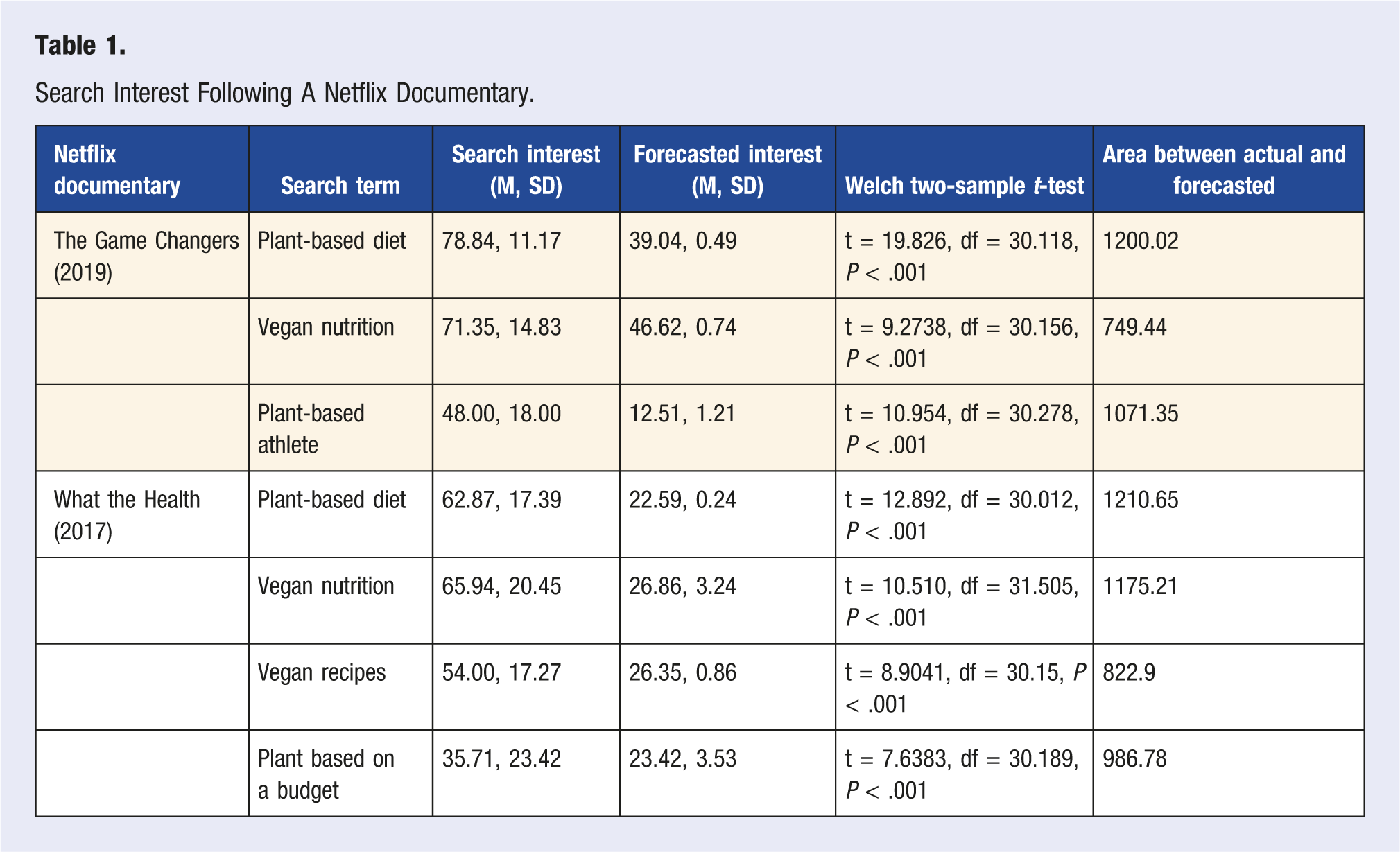
Search interest among specified terms related to each documentary was significantly higher than the predicted ARIMA values (Figure 1). In the month following each documentary release, the interest for the search term “plant-based diet” increased significantly—2.8 times the mean forecasted value for What the Health (t = 12.892, df = 30.012, P < .001) and 2 times the forecasted mean for The Game Changers (t = 19.826, df = 30.118, P < .001). Additionally, following the release of The Game Changers, mean search interest for “plant-based athlete” was 2.8 times higher than the forecasted values (t = 9.274, df = 30.16, P < .001). Mean search interest for “vegan nutrition” and “vegan recipes” in the month following the release of What the Health was also more than twice the forecasted interest. All search terms, means of actual and forecasted data, and the area between curves following these documentaries are presented in Table 1. Search interest in a plant-based diet following the release of a netflix documentary. (A) Actual vs expected search volumes for terms related to a plant-based diet following the release of The GameChangers on Netflix. (B) Actual vs expected search volumes for terms related to a plant-based diet following the release of What the Health on Netflix. Shaded area comprises the area under the curve showing the cumulative growth of search interest between the actual and forecasted values of the term. Search Interest Following A Netflix Documentary.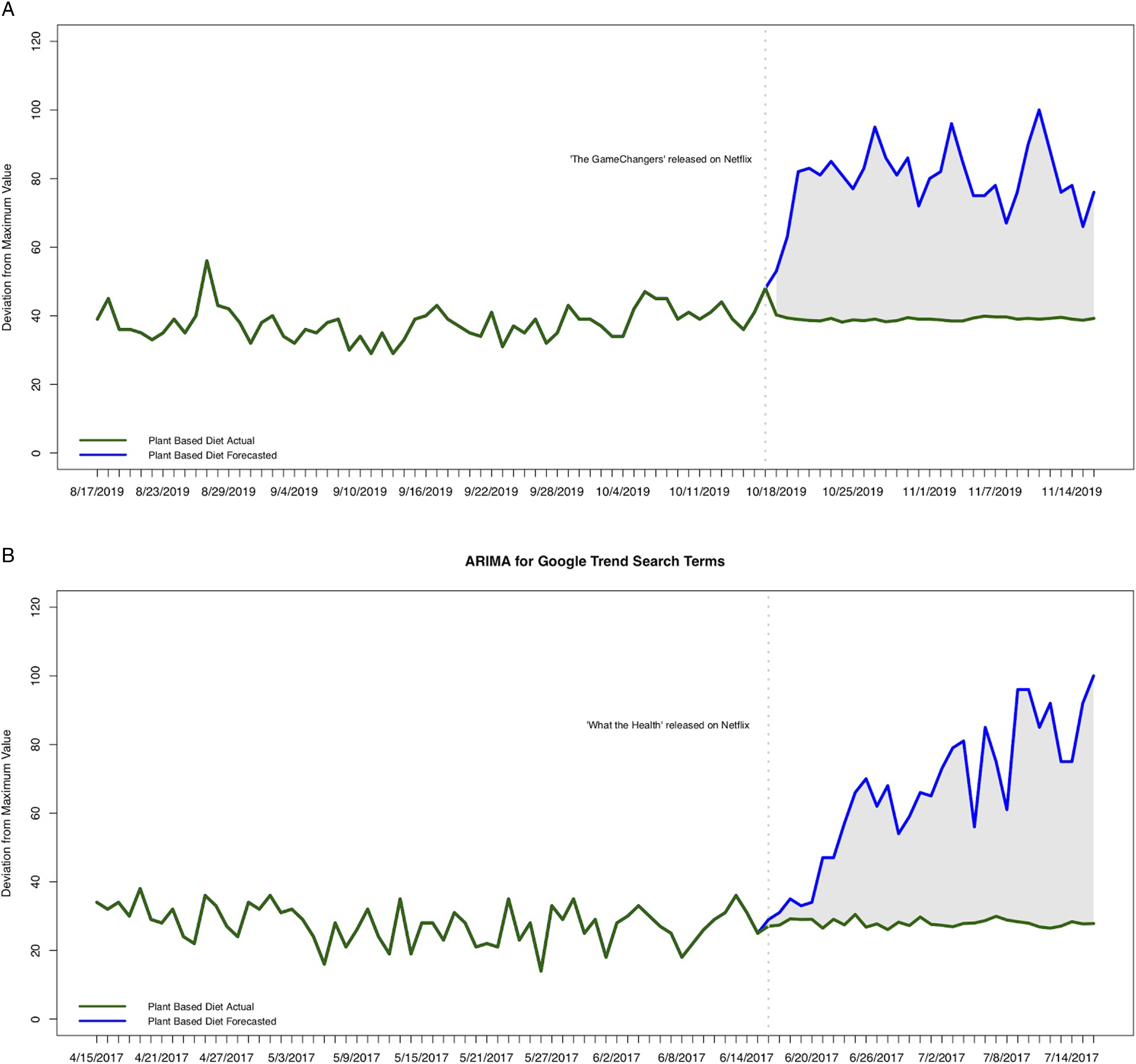
From 2004 to 2015, the term “Vegan” has shown a slowly increasing trend in search interest with a slope similar to the overall trend of the term “Healthy” (Figure 2). Since 2015, the search interest for “Vegan” increased beyond the forecasted ARIMA model, with an area between the actual and forecasted values estimated at a 55,751.16% increase for these 60 months (1826 days). After the rise in 2015, the mean monthly interest from 2016 to 2020 was significantly higher (t = 18.879, df = 47.564, P < .0001) than the forecasted interest from the ARIMA model (M = 74.48, SD = 13.84 vs M = 36.66, SD = 1.07, respectively). Trends in vegan, vegetarian, and healthy search terms over time. Gray shading is 95% confidence interval of forecasted values.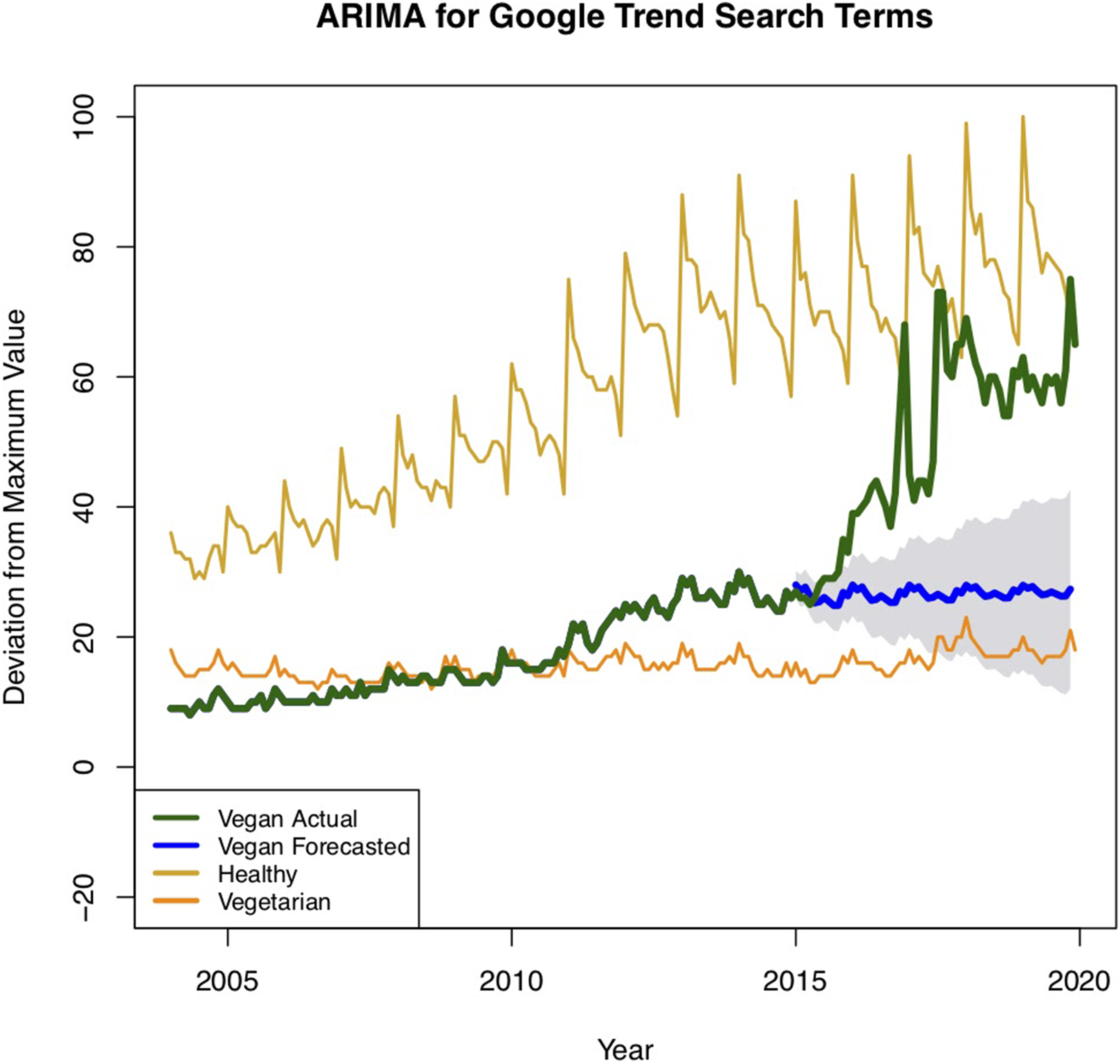
Discussion
Our study found increases in Google search volumes for terms related to plant-based diets following two Netflix documentary releases on the topic. Searches for plant-based diet proved to have the greatest difference between expected search interest and observed search interest for both documentaries. Closely behind were searches for plant based athlete following The Game Changers—which focuses on plant-based diets in athletes—and searches for vegan nutrition following What the Health—which focuses on plant-based diets as a whole. Further, we observed steadily increasing interest in the term vegan since 2004. These trends in the general population follow the rise in plant-based diets among athletes looking to gain a strategic edge in competition. 21 While plant-based diets are considered healthier than the standard American diet, without clear guidance from healthcare providers and experts in the field, individuals may be switching to this diet without knowing the full scope of their healthcare needs partly due to media and movies. Even though the mainstream media outlets are taking advantage of this trend, which may be beneficial to the United States as a whole, they are not doing it with scientific scrutiny or individualized health care in mind.
Further, plant-based meat and cheese alternatives have increased substantially in conjunction with consumer purchasing. A 2018 Nielson report on consumerism showed that, when combined, sales growth for vegan products and produce outpaced all other food categories. 22 These increased sales provide ample financial reasoning for media companies to capitalize on the shift toward a plant-based diet, in addition to the ethical and health-related focus of these documentaries. Media campaigns may prove their importance as research has shown that alternative sources of health advice are sought by persons who are younger 23 ; while older adults are more likely to seek such advice from medical professionals. 24 These shifts in consumerism and information-seeking behavior further demonstrate that medical professionals should actively engage both the younger generation, who may be more susceptible to misinformation found online, and older patients, who may be unaware of evidence-based alternative health options, in diet counseling. The medical and healthcare communities should participate in and partner with social and mass media ventures to promote evidence-based guidelines for healthy eating, while also countering the misinformation that exists in these spaces. 25
Most physicians are aware of the long-term complications of a poor diet but are seldom trained in diet counseling and nutritional intake. 26 Nutritional training and lifestyle medicine curriculum are beginning to take shape in the US,27,28 showing increased counseling efforts with patients. 29 Even though national initiatives such as “Meatless Mondays” are becoming more popular, the United States is still lagging in public attitude toward plant-based diets compared to other countries, 30 which may reduce medical providers’ willingness to discuss the topic with patients. Increasing screening for dietary behaviors and referring to knowledgeable dietitians may lead to better comprehensive outcomes for people with diabetes, 10 cardiovascular disease and hypertension, 31 kidney disease, 32 and cancer 33 —for which the dietary guidelines for people with or recovering from cancer specifically emphasize a plant-based diet. 33 Therefore, clinicians should either continue to engage with patients regarding the benefits of increasing fruit and vegetable consumption, if not a fully plant-based diet. In the event they feel unprepared to do so, they should engage in cooking and lifestyle medicine classes, or make referrals to dietitians who are innately qualified to discuss these topics.
Further, community efforts to incorporate meatless initiatives, such as Meatless Mondays may extend the reach of these plant-based diets. For example, in 2019, New York City Department of Correction joined the citywide Meatless Mondays project which extends meatless meals not only to staff but also individuals in custody. 34 This movement followed the city’s broader movement which included offering vegetarian meals in public schools free to all students once per week 35 which came after a study of dietary choices for students within public and private schools recommended reducing the servings of red and processed meat. 36 These school-based initiatives have also been implemented in Baltimore 37 and Los Angeles public schools 38 to promote healthy eating among children and within their communities. Following these examples, more communities, especially those with high rates of chronic disease, should implement similar initiatives.
Strengths and Limitations
Google Trends has a short but robust history in scientific research aimed at measuring public awareness of health issues and has sound methodology. 39 However, we are aware that Google Trends may not be completely representative of the population as a whole. Additionally, our study is limited in that we only used 1 source to acquire measures of public awareness and we are unable to determine the extent to which other confounding variables played a role.
Conclusion
The documentaries, “What the Health” and “The Game Changers,” highlight search interest spikes in an already increasing plant-based diet trend. With research supporting that a healthful plant-based diet consisting of fruits, vegetables, legumes, nuts, and seeds, is associated with chronic disease prevention, certain media outlets are contributing to and supporting the trends. With the potential to redirect the US population back toward healthy eating behaviors, media outlets are taking advantage of the rising interest in plant-based diets—which may be linked to the increased sales of plant-based meat and dairy substitutes. While these movies may be promoting healthier lifestyle behaviors, they may be doing so without scientific scrutiny or individualized, patient-centered care in mind; thus, individuals should seek guidance from their healthcare providers.
Footnotes
Declaration of conflicting interests
The author(s) declared the following potential conflicts of interest with respect to the research, authorship, and/or publication of this article: Matt Vassar is funded through the U.S. Department of Health and Human Services Office of Research Integrity and the Oklahoma Center for the Advancement of Science and Technology. All other authors have nothing to declare.
Funding
The author(s) received no financial support for the research, authorship, and/or publication of this article.
