



Abstract
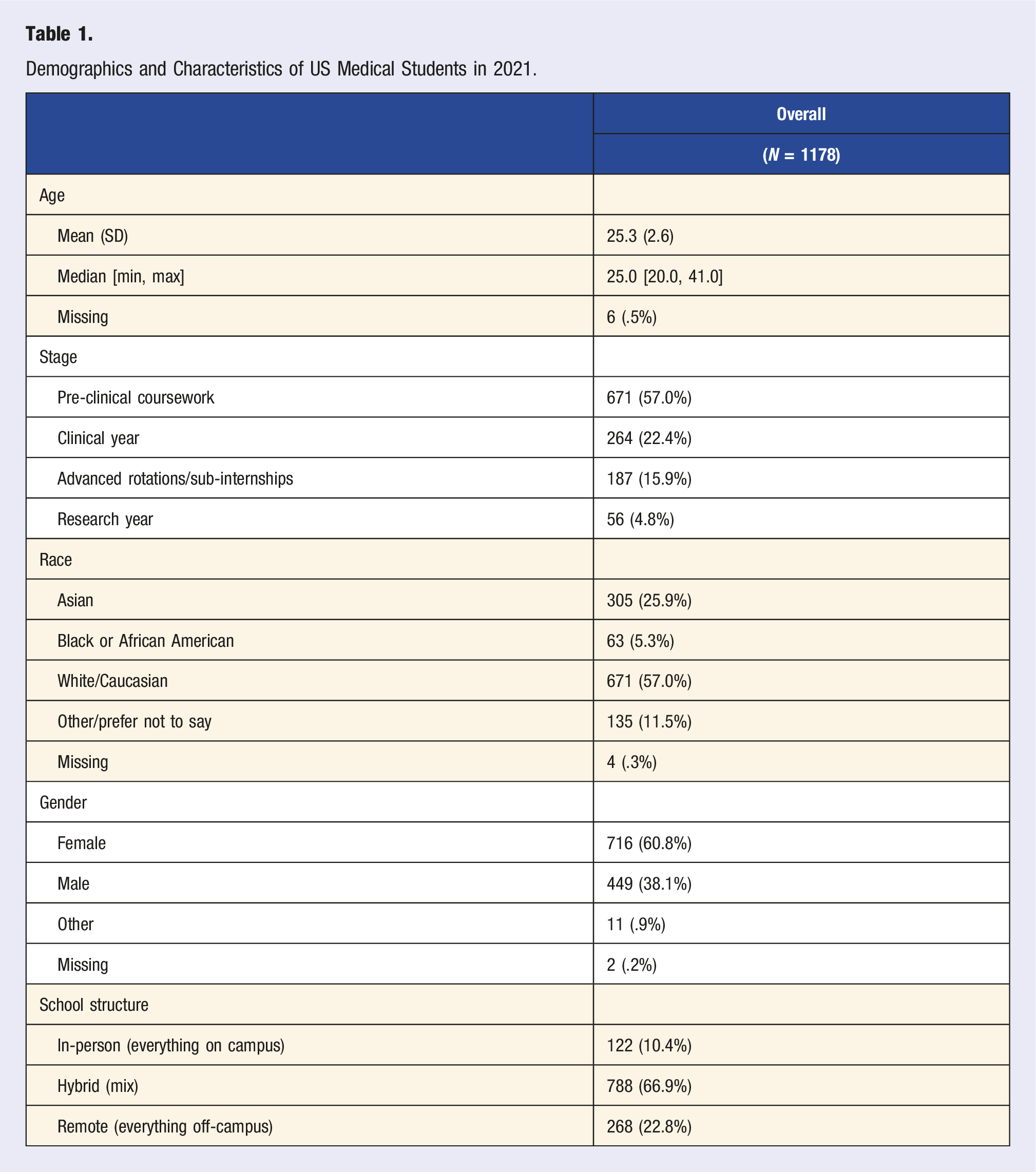
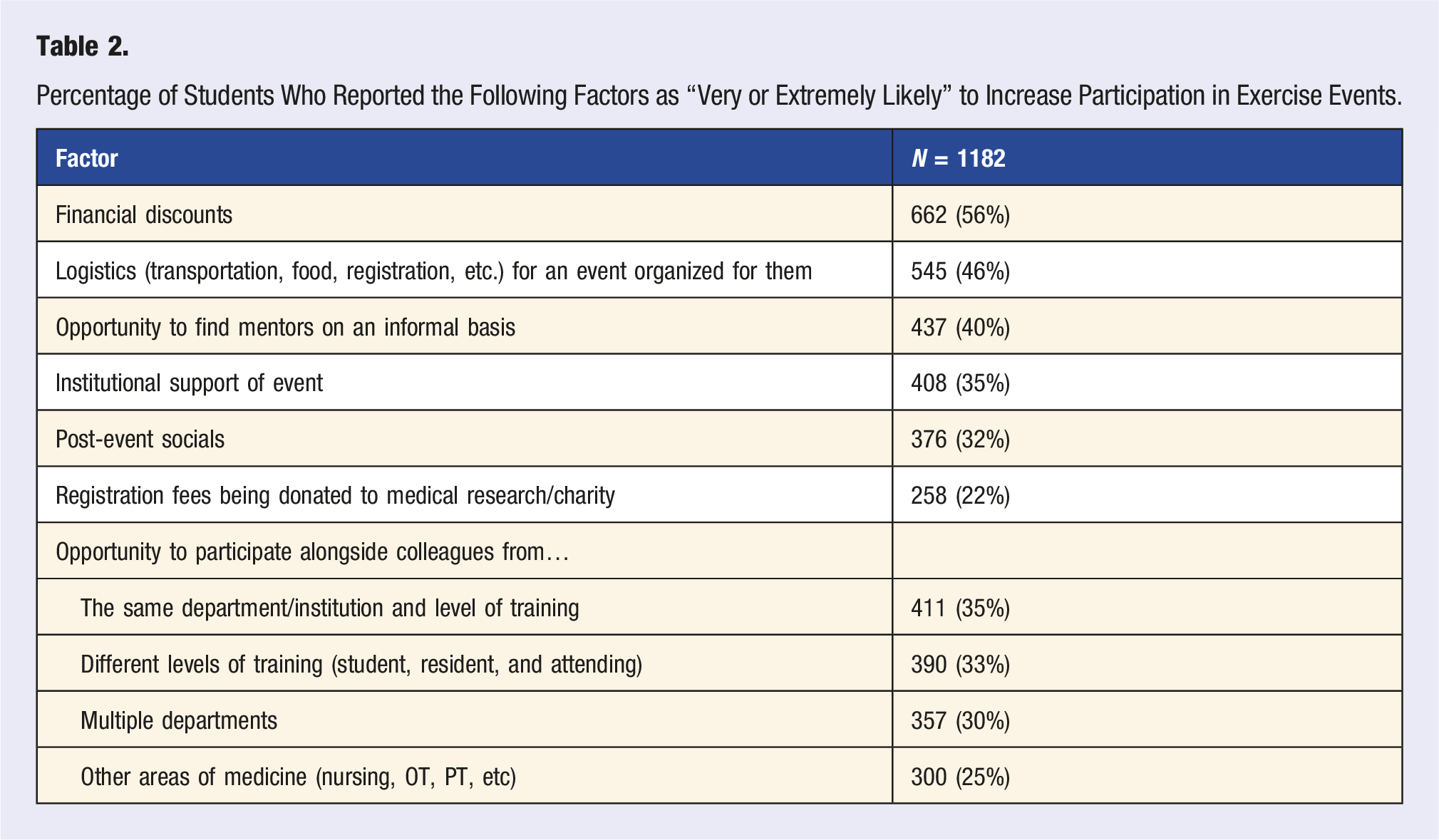
Physicians have a higher risk of burnout than many other professions, and burnout is associated with less altruistic professional values, worse patient–doctor relationships, and increased medical errors. Burnout begins in medical school, such that institutions should intervene early to facilitate increased engagement in forms of self-care, including but not limited to exercise. Exercise is negatively associated with burnout, but there is limited research on what motivates students to participate in exercise events and how events could be optimally designed to maximize attendance. Students from nine medical schools across the United States were invited to complete an online survey assessing the effectiveness of various factors at increasing participation in exercise events. Of 5500 invited students, 1182 (21%) responded. Mean age was 25 years, 61% were female, and 38% male. Fifty-seven percent identified as White, 26% Asian, and 5% Black. Students reported financial discounts (56%), having all logistics planned by event organizers (46%), and opportunities to find informal mentors (40%) as most likely to increase participation. To increase student participation in wellness events, institutions should prioritize available funding toward strategies that save students time and money while building community across levels of training and departments.
“... financial discounts, coordination of logistics, and the opportunity to find mentors on an informal basis were most effective at increasing participation in exercise events...”
Introduction
Many are drawn to medicine by a desire to care for others. The intensity of medical training ensures that trainees gain the experience to provide the highest quality patient care. Furthermore, healthcare workers identify hospitals as a stressful environment that never closes, where there is an expectation and culture that providers should always be available for patient care. 1 These altruistic desires may limit attention dedicated to self-care, which may contribute to burnout. Problematically, burnout leads to poorer patient care; previous studies have found providers experience 50% more self-reported medical errors, decreased empathy and altruism toward patients, and a lack of connection with colleagues as a result of burnout.2-5 Even at the trainee level, burnout is highly prevalent with over half of all US medical students meeting standardized criteria for burnout. 6 There is strong evidence suggesting that physical activity improves both mental and physical wellbeing and is associated with reduced burnout.7-10 In fact, physicians who are more physically active are more likely to counsel their patients to maintain active lifestyles; thus, there have been many calls for practitioners to adopt a physically healthy lifestyle both for the practitioner and patient benefit.11,12 As such, medical institutions and organizations like Medicine in Motion have prioritized wellness and exercise events designed to promote sustainable habits early to prevent and reduce burnout.
Medicine in Motion is an international nonprofit started by medical students in 2017 to address burnout in the field of medicine by building community through fitness and philanthropic events. 13 At most medical schools and hospital institutions, there are similar student and staff interest groups and committees whose mission is to organize events that bring peers and colleagues together for activities that benefit mental health and wellness including exercise, crafts, and social events. From our perspective (medical students and residents who have organized many wellness events), we have employed previously published strategies to overcome barriers to student participation in wellness events including insufficient awareness of opportunities, logistical challenges, lack of purpose, and lack of perceived support for participation. 13 However, even more important is the student participant perspective on which aspects of wellness programs are most likely to maximize attendance and effectiveness; there is a dearth of research into such components. In this study, we present results from a survey question on wellness exercise event participation distributed to medical students.
Methods
Exemption from Institutional Review Board (IRB) was granted by the Harvard Medical School IRB (IRB20-1953). All 5500 medical students at Boston University Medical School (Boston, MA), Geisel School of Medicine (Dartmouth; Hanover, NH), Harvard Medical School (HMS; Boston, MA), Tufts University School of Medicine (Boston, MA), University of California San Francisco School of Medicine (San Francisco, CA), University of Massachusetts Medical School (UMass; Boston, MA), University of Rochester School of Medicine (Rochester, NY), Wayne State University School of Medicine (Detroit, MI), and Weill Cornell Medical College (Ithaca, NY) were invited to fill out an electronic survey. These schools have active Medicine in Motion chapters whose chapter leaders invited all students at each school to participate strictly via all-student listservs and class messaging groups (Groupme and Facebook) rather than communication mediums targeting Medicine in Motion members to minimize selection bias. Participation was voluntary, and identifiable information was not collected. Students completed the survey between December 27, 2020, and January 17, 2021. Participation was incentivized by allowing students to participate in a lottery for custom Medicine in Motion athletic apparel (t-shirts and jackets), provided by New Balance Inc. and Medicine in Motion.
The survey covered demographics and queried factors that would increase participation in exercise events as part of a separate survey on medical student burnout. A panel of eight medical students from HMS, UMass, Tufts, and Dartmouth medical schools with prior publications or work in student wellness (e.g., leaders of student wellness groups or class wellness chairs) were invited to share factors they thought affected interest in participating in exercise wellness events. Factors were compiled and the top 10 were consolidated into a multiple-choice survey question: “How effective would each of the following be to increase the likelihood that you would participate in exercise or an exercise event?” Likert responses ranged from not effective to slightly, moderately, very, or extremely effective to increase participation in exercise events. For each factor, the number of participants responding “very” or “extremely” effective were summed and compared.
Results
Demographics and Characteristics of US Medical Students in 2021.
Percentage of Students Who Reported the Following Factors as “Very or Extremely Likely” to Increase Participation in Exercise Events.
Discussion
Combatting burnout at all stages of the medical journey has been an important area of discussion for decades.14,15 Interventional approaches have included institutional implementation of mindfulness initiatives, exercise, arts, and community building. 13 Physical exercise in particular has been associated with lower burnout.7-10 Yet, strategies to increase participation are rarely discussed. To aid ourselves and others in designing successful community-building programs, we directly asked medical students what would increase participation in such events. While our results were targeted toward exercise events, we believe that these strategies could be applied to a broad variety of community-building wellness initiatives. Medical students reported that “financial discounts, coordination of logistics, and the opportunity to find mentors on an informal basis were the most effective factors to increase participation in exercise events”. Students were also motivated to participate alongside peers, residents, physicians, and colleagues from other departments and medical professions, which parallels our finding that students sought informal mentorship opportunities at these events.
Students were most motivated to participate by personal financial discounts rather than proceeds being donated to medical research/charities. This may be reflective of increasingly high tuition and opportunity costs as few other fields require trainees to pay costly tuition followed by several years of additional postgraduate training as residents before student debts may be effectively repaid. The median debt of medical school graduates was $200,000 with 24% having over $300,000 in debt, and the average resident salary was $61,200 in 2019.16,17 While the cost of medical school education is beyond the scope of this study, our results suggest that within the current medical landscape, one of the most effective ways to boost participation in activities that may help decrease burnout is to provide financial discounts. However, in our experience, it has been exceedingly difficult to secure funding for exercise or wellness events from schools, medical societies, and public or private corporations. Thus, institutions, student groups, grassroots nonprofits, and other wellness organizations should leverage student, large-group, or nonprofit discounts to stretch limited funding further; they should also collaborate and pool administrative and advertising resources to broaden outreach, secure buy-in at all levels, and maximize the impact of such investments. 13
According to our sample, students also highly valued having well-planned logistics for an event. From start to finish, this could include a variety of components that would save the participant time, stress, and money. A well-planned event would have a seamless registration to ensure an enjoyable experience throughout. Such organizations could encourage students to participate in future events organized by the same group, establishing continuity and leading to more effective promotion of wellness. We have found that administrative approval and encouragement; adequate publicity; group transportation to/from offsite events; transportation of exercise equipment such as bikes, weights, or yoga mats; and clearly defined start/end times and expectations for the event may enhance the experience.
The other important component medical students highlighted was the opportunity for informal mentorship via social interaction with others at events from a variety of backgrounds. By operating outside the busy and often stressful hospital environment, wellness or exercise events facilitate access to friendly, informal, and fruitful grounds for establishment of meaningful connections among peers, near-peers, and faculty, which has been shown to prevent or reduce burnout.18,19 Anecdotally, student participants of exercise events we have hosted through Medicine in Motion have reported benefitting from personal and professional mentorship, career-selection advice and shadowing, networking, and research opportunities from participating faculty. These findings are consistent with previously published findings that mentorship provides trainees with emotional, psychosocial, and moral support; professional development; and increased likelihood of publication and promotion.18,20-22 Ideal events may encourage participants to bring friends but also foster new connections. Organizers could design outings with specific goals in mind and explicitly advertise that the purpose of the event is to facilitate meeting mentors, encourage existing friends to join, and/or provide an opportunity to socialize with those at other institutions or professional departments.
The study and discussion may provide guidance to institutions wishing to increase the value of wellness events for their students. Future research could evaluate the efficacy of different financial discount strategies or whether there is a “threshold cost” for standard one-hour events (e.g., a cycling, yoga, dance, or arts class) that students are willing to pay. Designing and implementing wellness events requires many components, and more detailed guidelines on how to engage in successful events from both the organizer and student perspective could help inspire widespread participation. A publicly available website (ie https://medmotion.org/) to share formal guides, ideas, and feedback for various event types may be useful. Additionally, formal post-event survey research may help elicit the most effective strategies for improving student wellbeing through community events. Adding educational components to exercise events could incentivize students to join while synergizing with the traditional medical school curriculum as medical students have been shown to receive limited training in physical activity education. 23 Best efforts should be made to offer a variety of event types with accessibility options and stress the nonjudgmental nature of events to mitigate barriers to entry such as lack of previous experience, fear of embarrassment in front of peers, or physical disability. For example, we have previously held events where smartphone apps convert any kind of physical activity (cycling, elliptical, walking, yoga, rowing, miscellaneous cardio, etc.) to metabolic equivalent of task minutes to standardize tracking of a participant’s preferred activity, and prizes were awarded for participation rather than performance.
Notably, a limitation of our study is that given the content of the survey, physically active students may have been more likely to respond, leading to selection bias. However, this was limited as much as possible by distributing the survey strictly to whole-class forums rather than Medicine in Motion members or other students known to be interested in exercise. To our knowledge, this is the largest national multi-site survey to assess medical student perspectives on these issues. We believe that our findings can aid institutions in designing programs to improve medical student participation, especially if they design inclusive events that consider prior participant experience and disability.
Conclusion
Ultimately, strategies most likely to increase student participation in wellness exercise events are those that save them time and money. Healthcare institutions and organizations targeting burnout may increase event participation by providing financial discounts, coordinating all event and equipment logistics to allow for seamless participation, and fostering informal mentorship by incorporating social events and colleagues. Interventions that combine these tactics may be more successful than those incorporating only one or few.
Footnotes
Acknowledgments
The authors would like to thank our collaborators in the Medicine in Motion Writing Group: Amanda Cao, Shani Aharon, Jacob Klickstein, Nicole Kim, Chris Lites, Derek Soled, Michael Duggan, Chase Marso, Valentina Sedlacek, Phoebe Huang, Nicholas Contento, Zane Norton, Jillian Haywood, Luke Andrews, Ashley Latona, Alice Lu, Aboubacar Wague, Anthony Nguyen, Emily Lau, Brendan Lynch, Erika Polanco, Alex Zhuang, and Aleksandr Talishinsky.
Declaration of conflicting interests
The author(s) declared the following potential conflicts of interest with respect to the research, authorship, and/or publication of this article: All authors are unpaid volunteers for the nonprofit organization, Medicine in Motion, an interdisciplinary group of healthcare providers dedicated to reducing and preventing burnout.
Funding
The author(s) disclosed receipt of the following financial support for the research, authorship, and/or publication of this article: This research received no specific grant from any funding agency in the public, commercial, or not-for-profit sectors. It was kindly supported by New Balance Inc., which donated the apparel used for survey participation incentives. New Balance Inc. did not participate in the design of the study; collection, analysis, and interpretation of data; or in writing the manuscript.
