



Abstract
Introduction: A nutrient-dense, plant-rich diet may be promising as a nutrition intervention for pregnant women for a number of factors. Factors include the possibility of a decreased risk for gestational diabetes, excess weight gain, and preeclampsia. Little is known about the experience of following this type of dietary pattern while pregnant and what barriers are present that should be addressed in a large-scale intervention. Methods: Qualitative interviews were used to understand the personal experience of women who aimed to eat a nutrient-dense plant-rich diet while pregnant. Semi-structured interviews were conducted from June to August 2020. Results: Three main themes regarding a nutrient-dense plant-rich diet emerged. First, family and social influence played an important role. Second, women who had a previous pregnancy felt they had fewer pregnancy symptoms on this diet. Last, the participants may have experienced a reduced milk supply on this dietary plan. Conclusion: Future research should consider family context as a factor in adherence to a nutrient-dense plant-rich dietary pattern, investigate the possible associations between nutrient-dense plant-rich dietary patterns and reduced nausea and vomiting in early pregnancy, and determine whether nutrient-dense, plant-rich dietary patterns contribute to a reduction in milk production for women who experience over-engorgement.
“...adherence to a plant-based lifestyle before, during, and after pregnancy may position women to minimize complications...”
Introduction
Recent trends reveal that plant-based dietary patterns are showing widespread acceptance as plant-based food sales have increased dramatically and consumers are purchasing more meat-free and dairy-free options. 1 Although there are a variety of reasons for choosing more plant-based foods, such as animal welfare, the environment, and religious purposes, one of the primary motivators across several age groups is the desire to preserve and/or improve health. 2 Plant-based dietary patterns have been shown to be beneficial for the reduction of chronic disease risk factors associated with coronary artery disease, hypertension, stroke, diabetes mellitus, and some cancers. 3
However, despite the increased popularity in plant-based dietary patterns, meat consumption remains an integral part of American culture, with only 4% of the US population following a diet that consists of no meat. 4 Due to meat consumption being such an integral part of American culture, people often perceive vegetarians and vegans as disrupting social settings that involve food. This negative view can result in a stigma that can make it challenging for people to adopt and maintain a plant-based diet. 4 The American Dietetics Association endorses plant-based diets as nutritionally sufficient and healthful for individuals in all parts of the life cycle including pregnancy and lactation. 5
Veganism and vegetarianism have been shown to be safe in pregnancy when individuals are able to consume the proper balance of essential nutrients.6,7 For women who choose to follow a plant-based diet during pregnancy, there is a need to pay special attention to nutrients such as B12, folate, iron, calcium, and DHA. 7 Women following a vegan diet while pregnant have less incidence of cesarean delivery, less postpartum depression, and lower neonatal and maternal mortality. 6
Recent studies show plant-based diets full of fiber, vitamins, and minerals have shown to have protective factors against pregnancy complications like preeclampsia and GDM. 6 The participants of this study were asked to follow a nutrient dense, plant-rich dietary pattern referred to as the Nutritarian Diet created by Joel Furhman, MD. 8 The Nutritarian Diet recommends the daily consumption of greens, beans, mushrooms, onions, berries, and seeds; and encourages the limited consumption of animal products and refined foods, including oils. 8 In this context, the definition of diet is habitual dietary patterns and not in reference to a short-term diet designed for weight loss or for medical purposes.
When researching the impact of plant-based diets it is important to further define the dietary choices beyond just plant-based or the absence of animal products. Following a plant-based diet high in refined carbohydrates, processed foods, and sugar-sweetened beverages can still lead to chronic disease. 9 The Nutritarian dietary pattern is an example of a nutrient-dense, long-term plant-based lifestyle that is designed to reduce the likelihood of chronic disease. 8
In the United States, between 2017 and 2018, the prevalence of obesity for women of ages 20–39 was 39.7%. 10 Excess weight gain during pregnancy leaves offspring at higher risk of being overweight and developing diet-related chronic diseases later in life. 11 Additionally, excess weight gain in pregnant women leaves them more vulnerable to gestational diabetes mellitus (GDM) and preeclampsia. 11 The prevalence of GDM in the United States has increased to approximately 14% of pregnancies. 9 Preeclampsia and GDM can result in serious complications for the mother and the baby.
The life course perspective identifies pregnancy as a transitional period of time, where women are more capable of making and sustaining health-motivated behavior change. 12 However, women face physiological challenges during pregnancy that make getting adequate nutrition a challenge. Nausea and vomiting are common pregnancy complications that occur in early pregnancy and are significantly reduced after 20 weeks gestation. 13 Severe nausea and vomiting in early pregnancy are associated with a decreased intake of fruits and vegetables, beans, pulses, citrus, and rice, and an increased intake of soft drinks and white bread. 13 Dietary changes due to nausea and vomiting are typically temporary and normal dietary habits resume as symptoms resolve later in pregnancy. 13
There is currently a gap in the literature concerning the experience of following a nutrient-dense plant-rich diet like the Nutritarian Diet during pregnancy. The goal of this study is to use qualitative interviewing to begin to understand the personal experiences of women who aimed to follow a nutrient-dense plant-rich dietary pattern while pregnant. Understanding these women’s experiences will help guide future research design to better characterize barriers and support for women choosing plant-based dietary patterns during pregnancy.
Methods
Study Sample and Procedures
Participant Demographics.
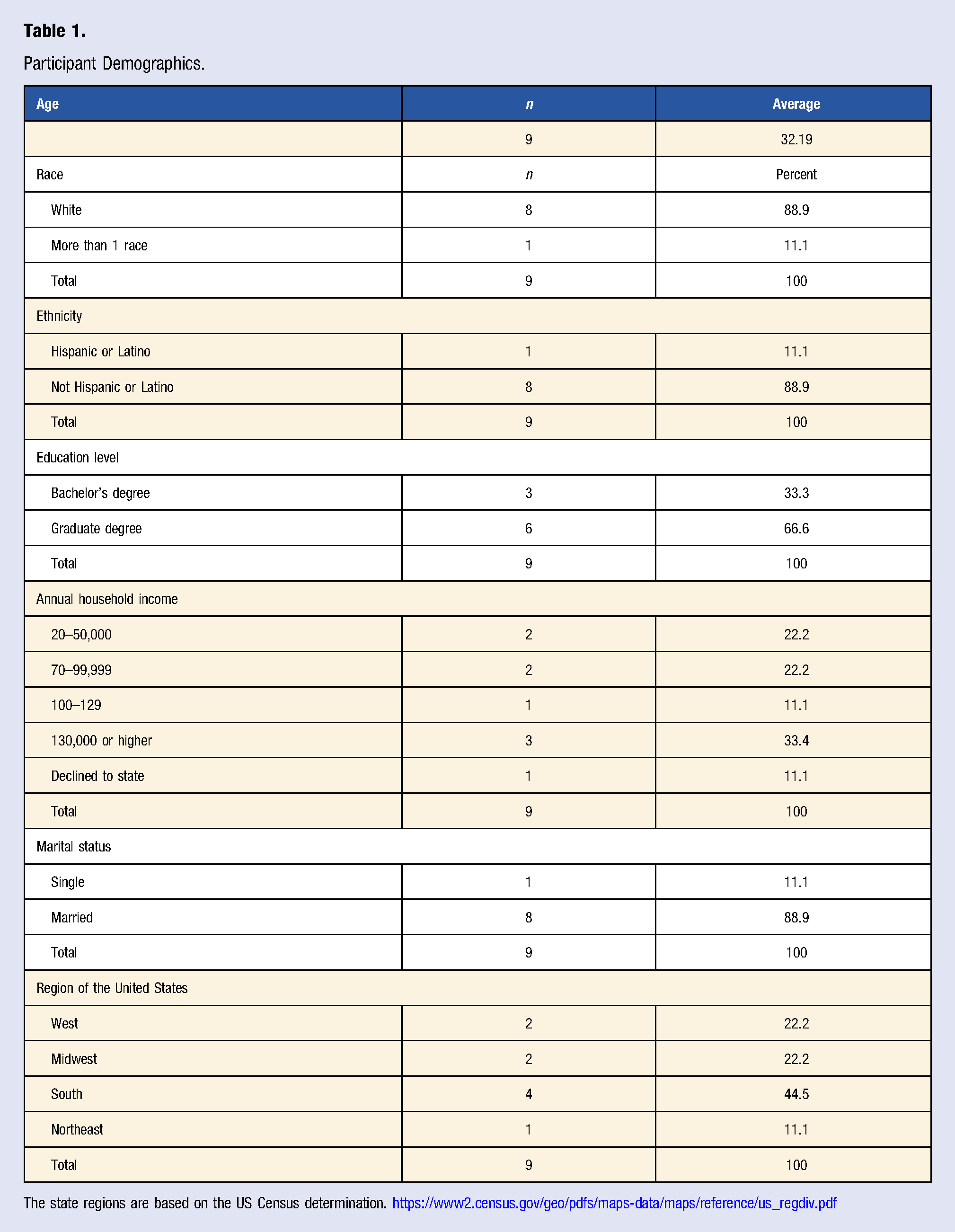
The state regions are based on the US Census determination. https://www2.census.gov/geo/pdfs/maps-data/maps/reference/us_regdiv.pdf
Telephone interviews were conducted in the NWHS lab on Northern Arizona University campus from June to August 2020. Interviews were conducted by AM who was trained prior by EE, an expert in interviewing and qualitative methodology. 14 Interviews were conducted using a semi-structured interview guide to ensure that similar questions and topics were covered in all the interviews but also allowed the interviewer flexibility to explore and examine responses. The first author, with insight from the research team, created the interview guide based on a literature review that examined the general population’s reasons for following a nutrient-dense plant-rich diet, and prior qualitative interviews examining pregnant women’s relationship to diet.
Interview question domains included: getting to know the participants, comparisons to previous pregnancies, motivations and beliefs of a nutrient-dense plant-rich diet while pregnant, barriers to the diet while pregnant, and postpartum.
All interviews were audio-recorded and transcribed verbatim for analysis. Quotes included in the results section have had all unnecessary “ums, uhs, and likes” removed for readability. At the completion of the interviews, all participants received a personal copy of the book 100 Best Foods, 2018 for taking the time to be interviewed. 15 Also, all participants were then entered in a drawing and two participants also received a copy of the book Eat for Life, 2020. 16 Both books were written by Joel Fuhrman, M.D. the inventor of the Nutritarian Dietary pattern. These materials were used as an incentive as they further support the intended diet style the participants sought to adhere to. All materials, consent forms, and procedures were approved by the Institute Review Board on the Northern Arizona University campus, project number 870260. All of the participants interviewed continued to stay in the larger NWHS study regardless of adherence to the Nutritarian dietary pattern. We may have missed some women who decided not to continue with a Nutritarian dietary pattern and discontinued study participation; however, several of the women interviewed expressed difficulty with the diet. We tried to capture a range of experiences. Future research should consider whether women who discontinued the diet had similar barriers or additional barriers to continuing.
Data Analysis
The analysis team consisted of three authors on this study AM, EE, and JS. All three of the authors independently reviewed the audio transcripts of the interviews to establish codes. We then developed a code list based on the codes found during the independent review. Each code was then clearly defined and put into NVivo version 12 software. The software was then utilized to identify quotes within the transcripts that correlated with each defined code. Each of the three authors then reviewed the codes with the quotes independently to find emerging themes. Consistent themes were found for each code during separate independent reviews.
Codes including the following domains: personal characteristics, reasons for starting the diet, feelings about the dietary regime, how long have they been on the diet, pregnancy experience, specific food preferences, Dr. Fuhrman references, supplements, social influence, challenges to following the diet, health outcomes, birth experience, comments about sticking to the diet, breastfeeding experience, regional differences, and self-diagnosis.
Results
Pregnancy Symptoms
Women with previous pregnancies not following the Nutritarian dietary pattern described having less nausea, weight gain, and fatigue with the Nutritarian pregnancy. Additionally, some women felt they experienced fewer pregnancy symptoms like nausea, excessive weight gain, and fatigue than their peers due to following a Nutritarian dietary pattern. Although they felt these pregnancy symptoms decreased, participants felt that following a Nutritarian diet during the first trimester of the pregnancy was very difficult due to general nausea they were still experiencing. This led to a decrease in nutrient-dense plant-rich food intake and a sense that they were not consuming adequate nutrients from their dietary intake: 1241: “I think I gained around like 35 pounds with my first couple of pregnancies and I definitely gained less weight with my last one. And then I still had nausea and fatigue but it definitely wasn’t as extreme.” 1772: “I’m trying to remember. Um, I just remember it was a lot better the fourth time. So usually my first pregnancy symptom is vomiting and I throw up, I mean, it was probably in the first three pregnancies once I started throwing up it was probably close to every day I would think until I was a few weeks into the second trimester probably. Um, and I remember my worst day as I threw up like four times on my worst days with those pregnancies. And then with the fourth one, when I was eating Nutritarian, um, I was done throwing up and feeling nauseous by like 11 weeks, like 10, 11 weeks, which was several weeks shorter than normal and my worst day I threw up twice. And I would go several days without throwing up. And so it was definitely decreased.”
Participants expressed a belief that their dietary practices helped prevent them from experiencing severe pregnancy symptoms and aided in their recovery after birth: 3355: “Yeah. And I know this is anecdotal evidence, but I feel like I haven’t had the same challenges that a lot of other mothers I know had. I didn't have as many issues breastfeeding. I didn’t have as many issues recovering. It was, of course, it was challenging, but it could have been much, much worse.” 2048: “Um, I do find, it seems like I don't have as many complaints as some other people I know as far as constipation and symptoms in that regard, because while I have been nauseous and the nausea is very mild, I can still kind of go about my business and go to work. And it doesn’t incapacitate me at all. as, so it’s the symptoms I have had have been very, very mild.”
During the first trimester, pregnancy symptoms of nausea and vomiting created food aversions against nutrient-dense plant-rich foods like salads and vegetables and increased cravings for carbohydrate-rich foods: 1332: “Eating like raw vegetables, a salad later or cooked vegetables was kind of hard. So I went for more of those comfort foods. So I made I made like vegan Mac and cheese, a little bit more, you know, homemade vegan, mac and cheese a little bit more, or like I would have like a plain potato and stuff.” 2370: “Yeah, so that was, um, in my first trimester. I was very nauseous and so basically the only things that I could keep down were like crackers, like saltines and bread.”
Food aversions caused the participants to feel that they could not follow the Nutritarian dietary pattern as recommended, and this left some participants concerned they were not getting adequate nutrients from the diet alone: 1241: “In my first trimester, I really wasn't getting enough folic acid, because I just didn't feel I could choke down enough greens or asparagus or you know a lot of the other foods. So I just thought and all the other podcasts I listened to as well with other plant-based like OB-GYN and all that. He’s really the only one that I found that says like you get, for sure you get enough in your diet. I mean, I think that you would for sure get enough in your diet if you had no problem eating you had no nausea and you were actually eating like you normally would but it’s really hard to eat like you normally would when you don't feel well.”
While participants described physical benefits and challenges associated with maintaining a Nutritarian Diet during pregnancy, many also described challenges and successes related to family and social situations. In the next section, we describe how participants reported family and social influences as key supports or challenges for following a plant-based dietary pattern during pregnancy.
Family and Social Influence
In interviews with pregnant and postpartum women following the Nutritarian Diet, women described family and social situations as substantial influences on their experiences and on their continued motivation to maintain the Nutritarian Diet. Particularly for women with young children, or whose spouses or parents were not convinced about the benefits of the dietary pattern, social situations were a common topic of conversation.
Family and social influence was particularly salient in the narratives of women with children who were also fed a Nutritarian Diet. Participants often described family conflict around feeding children a nutrient-dense plant-rich dietary pattern, especially with the children’s grandparents. Participants also expressed challenges feeding their children a Nutritarian Diet in social situations: 1241: “That’s one of the biggest challenges, for sure. Especially with raising children, because I actually get in arguments about it a lot. Because either side of our family that understands why I have to be, so incredibly extreme, of course and so, and even my own husband who believes in this a hundred percent and wants to eat this way at home, he also feels that when we’re out and about at a grandpa and grandma’s house, like just let them have a little bit and not be so strict because it’s just causing too much conflict amongst our family. So I have um allowed having definitely having some compromises. So my kids still eat pretty much whatever my family serves with exception of like, they’re not allowed to have like dairy milk as a drink, or we try really hard not to let them have juice.”
In those situations, many participants described doing the best they could despite feeling alone in their efforts. A common narrative was trying to maintain a nutrient-dense, plant-rich dietary pattern while still often allowing children to eat what parents or grandparents ate: 1241: “ You know, trying to make sure that they like to eat fruits and vegetables first before they ever get any servings of meat. Uh, and I hate it, but it’s just kind of like, I feel like I’m a lone soldier in a group of people that all disagree with me.”
Following a nutrient-dense, plant-rich dietary pattern was challenging during pregnancy as a time when extended family may feel more concerned and therefore more likely to offer advice: 2370: “So that or being able to tell my mom too because my mom had been, she was like whatever you want to do when you’re not pregnant is fine but I’m worried about your baby while you’re pregnant if you’re not going to be and she’s very anti soy and things, so it has caused a little bit of conflict in our family because even though I’m not 100% strict with it like I could be she still thinks that I’m way overboard strict and ya know it is a strict thing to be like no I’m sorry I am not going to eat that and navigating that with your kids to and saying I don’t want them to eat all of this junk food.”
Pregnancy was also challenging for women living with or eating with family since, as one explained, being tired and having food placed in front of you makes it challenging to stay motivated to make your own complete meals: 1920: “Yes well no. Because I moved back home. And my parents are definitely meat and potatoes kind of folks. And my dad does all the cooking and while I shall not blame my father, because I am the one that puts food in my mouth you know, being tired and pregnant, you eat what’s in front of you.”
For women with young children, social situations were particularly challenging. Birthday parties, for example, were noted as a time when keeping children on a strict diet was stressful if not impossible: 1241: “And so then it’s like, okay, so what am I supposed to do? Like take it, be that mom that takes it away and says you can’t have it and then have them have a complete meltdown. I mean, it, like I said, they don't even ask first or they’ll be asking like, is it okay for them to have it as they’re handing it to them? And then, so in those situations, I usually just pick my battles and just let them have it, just try and put a limit on it at least.”
Women noted that if their husbands were not following the dietary pattern, it was much more difficult to keep children away from parties or other unhealthy foods: 1772: “Or yeah. If we’re at someone’s house or at a party, like that’s really hard to say no to stuff. And then I think it, I don't know, it feels like it would be different if like my husband was on board and we’re doing it together and we could just support each other and be like, yeah, we just don’t eat that way.”
Eating out at restaurants was noted as a particularly challenging time to maintain the dietary pattern, particularly for children. Some participants explained that during those times, the children end up eating what others are eating: 1772: “Then the kids eat what he’s eating because we’ve tried having the kids follow, you know, what I eat when we’re out and it’s just such a mess. It’s really hard to get them to understand that they can’t have cake and dad in front of them is having cake.”
For women not willing to adjust to social situations and allow their children to go off the diet during those times, keeping children on the diet required substantial lifestyle adjustments. One mom, for example, explained that being able to control what her child ate was part of her decision to withdraw her child from school: 1772: “Yeah. And we actually, we started homeschooling a year and a half ago, and one of the reasons, not the reason, but one of the reasons was my kids were just getting so much crap at school, food-wise. I mean, we talked to the nurse, we talked to all our teachers and talked to everyone. She packed her own food and she still ended up getting, they still ended up getting her food at school that I had not said was okay. ”
Family and Social Influence Over Time
Participants felt the longer they maintained the diet, the less social and family criticism they received. For some, parents and extended family had concerns initially about nutrient deficiencies, but concerns lessened over time and families became accustomed to the diet: 3352: “Their concerns were mainly that I would be protein deficient or iron-deficient that somehow I would be hurting my health by not eating meat but I noticed that as years go by those criticisms get less and less.”
Dietary choices and support by the participant’s spouses, as noted by several participants above, were a key factor influencing women’s confidence to maintain a Nutritarian dietary plan and on their ability to feed their children the Nutritarian Diet: 2370: “And so it took my husband a little while but luckily he has come around and wants to do it now because I think it would be really difficult to feed your family and be the only one who wants to eat like this.”
Family and social influences often continued into the postpartum period, as some of the participants quoted above described. Breastfeeding was an aspect of postpartum that was particularly interesting in participants’ descriptions of maintaining a plant-based diet both during and after pregnancy.
Breastfeeding and Postpartum
The participants felt the Nutritarian Diet did not have a big influence on their ability to breastfeed and felt they were successful following the Nutritarian Diet while breastfeeding. There was a feeling that they needed to consume a higher volume of food on a nutrient-dense plant-rich dietary pattern to support breastfeeding. Breastfeeding on the Nutritarian Diet may have resulted in a more adequate and desirable milk supply for the participants. There was a general feeling that lack of time, the shock of a new baby, and sleep deprivation made following the Nutritarian Diet more challenging postpartum: 2370: “I haven't really noticed diet affecting breastfeeding. I know definitely my water intake greatly affects my milk supply. So making sure that I consistently get like a hundred ounces a day which is kind of was, hasn’t been too hard because during when all I was pregnant, I was drinking that amount of water.”
The women who had previous breastfeeding experiences not following a Nutritarian diet experienced less engorgement on the Nutritarian Diet, while others who did not have previous breastfeeding experience mentioned having a lower and more appropriate milk production: 1772: “And yeah, usually I’m engorged for three to four days. And with Kara, the Nutritarian baby, it was like one day. And so that was a huge, huge difference. And so I felt like my hormones and stuff were able to regulate my milk a lot better and I didn't have as much overproduction as when I was eating meat and dairy. Hmm, and sugar and all that.” 2372: “Okay. The first pregnancy, I had a crazy, crazy oversupply of milk and I was eating all kinds of animal products and fried food and you know, whatever else. And this time I seem to be making like more, the appropriate amount of milk.” 3352: “I didn't have any, well, I don't know any different, but. I didn't have that many issues. I feel like I was experiencing a little bit of the low milk supply that every mom, I think, experiences, but it took me about a week to get back on track.”
Participants expressed feeling that making their own dietary choices was challenging postpartum due to cooking less of their own meals. They felt it was more challenging to plan and prep food while caring for their baby and there was a feeling of eating whatever was easiest: 2370: “Yeah, definitely and I think, especially now with a kid, it’s like, I just don't have the bandwidth to like plan ahead to like figure that piece out. So it’s just like, okay, whatever’s here is what I’m going to eat.” 3352: “The first month was very difficult because my husband and I weren't able to cook our own meals. My mom was coming in and cooking and for her, it was a very unfamiliar territory. So she tried, but she was also using more oil than we’re used to and occasionally using chicken. but now we’re back on track. It took us three months until three months, postpartum to get back on track where I’m able to cook what I like myself.” 1920: “But that doesn't necessarily work out or I say, oh, I’ll make, I’ll clean the lettuce, or I’ll clean the spinach while she’s taking a nap and well, then she doesn't take her nap.”
Experiences among participants in this study suggest that a nutrient-dense, plant-based dietary pattern may support breastfeeding, particularly for women who have had past difficulties with engorgement. The difficulty of engaging in meal preparation during this period, however, suggests an additional need for attention to family and social contexts to support women attempting to adhere to a plant-based lifestyle during and after pregnancy.
Discussion
A key finding of this study was the significant impact that social influence had on the participant’s ability to maintain the Nutritarian Diet and be able to successfully feed their children a Nutritarian Diet especially while pregnant. Participants who had social support from people who followed a similar dietary pattern felt it increased their self-efficacy to follow the Nutritarian Diet. Several participants who did not have social support from people following a nutrient-dense plant-rich dietary pattern felt that their dietary choices created conflict. Participants who more recently adopted the Nutritarian dietary plan felt the uniqueness and specificity of the diet created conflict amongst themselves and their spouses and their extended family. These findings relate to the idea that since traditional American social and cultural dietary patterns have meat and processed foods as staples, particularly during holiday and social gatherings, vegetarianism and veganism can be viewed pessimistically and create social stigma that can make following a nutrient-dense plant-rich dietary pattern more challenging. 4
In addition, those participants who had more experience with the Nutritarian dietary pattern prior to this pregnancy reported more confidence in dietary adherence as well as facing the challenging family and social situations.
Further, lobbying by industries as well as government subsidies and policies perpetuate meat and dairy dietary preferences through inclusion in supplementary nutrition programs and government-sanctioned dietary advice. 17
This study found that it was challenging for some participants to adhere to a nutrient-dense plant-rich dietary pattern during early pregnancy due to nausea and vomiting. Women noted it was hard to consume their normal diet in early pregnancy due to nausea and vomiting and gravitated toward comfort foods that included more processed foods and were less nutrient-dense. Since they were not able to meet the general guidelines of the NWHS, the participants felt like they may not be getting adequate nutrition through their dietary intake alone. This is consistent with the literature that women often experience temporary dietary changes in early pregnancy due to pregnancy symptoms of nausea and vomiting regardless of dietary preferences. 13
In addition, those participants who had more experience with the Nutritarian dietary pattern prior to this pregnancy reported more confidence in dietary adherence as well as facing challenging family and social situations.
Although the participants experiencing nausea felt they had less pregnancy-related nausea and vomiting on the Nutritarian dietary pattern in comparison to previous pregnancies. However, these participants noted extreme symptoms in past pregnancies not following the Nutritarian dietary pattern, where extreme nausea and vomiting lasted well beyond the 20 weeks of pregnancy. Due to their past experience with extreme nausea and vomiting lasting beyond 20 weeks which is not considered normal pregnancy symptoms, their experience may not be generalizable to other pregnant women.
Participants who experienced previous pregnancies where they did not follow a Nutritarian dietary pattern experienced less weight gain during the Nutritarian pregnancy. This is consistent with the literature that shows plant-based diets are preventative against excess weight gain in pregnancy. 18 Per participant reports, there was no incidence of elevated blood pressure or GDM in our study population. This is consistent with the literature that suggests plant-based dietary habits have an association with a decreased risk of GDM and preeclampsia. 9 Participants also found during the breastfeeding phase that they experienced less engorgement and reduced milk production and supply following the Nutritarian Diet.
Further research is needed to investigate the link between plant-based diets and fewer symptoms of nausea and vomiting in early pregnancy. Future studies should also look at the association between decreased milk production and supply and plant-based diets.
Limitations
Limitations of the study are focused on the study population. The study population consisted of primarily Caucasian women. The women were also a very educated population. The study population was also small and only consisted of nine participants. This study population may not be generalizable to the general population, and future research should be conducted to solidify the findings of this study. In addition to the above limitations, it needs to be noted that all of these interviews and some of the pregnancies took place during the COVID-19 global pandemic which may have influenced participant experiences in the intervention as well as study outcomes. However, this was not central to the experiences described by the participants.
Conclusion
Plant-based dietary patterns are a plausible option for women throughout the lifecycle, including pregnancy. In fact, adherence to a plant-based lifestyle before, during, and after pregnancy may position women to minimize complications and some undesirable side-effects of pregnancy. Women in this study who adhered to a Nutritarian Diet reported positive experiences including decreased nausea and what they felt was an appropriate breast milk supply. Further research is needed to understand the implications and potential health benefits of following a nutrient-dense diet before, during, and after pregnancy. Additionally, future research should investigate whether a nutrient-dense, plant-rich diet impacts milk production postpartum, as some of our participants observed.
This study suggests that intervention research, to better understand the outcomes of following a nutrient-dense, plant-rich diet during pregnancy, should take into account the difficulty of adhering to the diet early in pregnancy and in social situations and offer additional support for women to navigate those situations. Additional support could include having the spouses involved in nutrition counseling. Future research could investigate the benefits of an educational handout and other materials from healthcare providers regarding the safety of plant-based diets during pregnancy that they can share with their friends and family.
These findings begin to address a gap in the literature surrounding women’s experiences of following a nutrient-dense plant-rich diet during pregnancy that may have important implications for designing and interpreting future research on pregnancy outcomes for women following nutrient-dense, plant-rich diets. Future studies should use the findings of this study to further investigate plant-based pregnancies and the concerns and myths of obtaining adequate nutrient intake while pregnant. Understanding the experience women face when attempting to follow a plant-based diet while pregnant will help guide future interventions. Future investigations should also consider tracking pregnant women who enter pregnancy while practicing high adherence to the Nutritarian Diet lifestyle and are able to maintain strict adherence throughout the pregnancy.
Supplemental Material
sj-pdf-1-ajl-10.1177_15598276211040454 – Supplemental Material for A Qualitative Exploration of Pregnancy Experience With a Nutrient-Dense, Plant-Rich Dietary Pattern: A Pilot Study
Supplemental Material, sj-pdf-1-ajl-10.1177_15598276211040454 for A Qualitative Exploration of Pregnancy Experience With a Nutrient-Dense, Plant-Rich Dietary Pattern: A Pilot Study by Allison P. McNelly, Emery R. Eaves, Julia C. Gardner, Wendy S. Wetzel and Jay T. Sutliffe in American Journal of Lifestyle Medicine
Footnotes
Declaration of Conflicting Interests
The author(s) declared no potential conflicts of interest with respect to the research, authorship, and/or publication of this article.
Funding
The author(s) disclosed receipt of the following financial support for the research, authorship, and/or publication of this article: This work was supported by the Nutritional Research Foundation and the Vitamix Foundation.

Supplemental Material
Supplemental material for this article is available online.
References
Supplementary Material
Please find the following supplemental material available below.
For Open Access articles published under a Creative Commons License, all supplemental material carries the same license as the article it is associated with.
For non-Open Access articles published, all supplemental material carries a non-exclusive license, and permission requests for re-use of supplemental material or any part of supplemental material shall be sent directly to the copyright owner as specified in the copyright notice associated with the article.
