




Abstract
Lower back pain is a leading cause of work absence and activity limitations globally, with a 60% to 85% lifetime chance of occurrence. This article highlights the role that lifestyle medicine plays in managing lower back pain as a cost-effective intervention strategy. It is suggested that lifestyle medicine strategies, such as incorporating whole foods and a plant-based diet, sustainable physical activity and mind-body exercises, restorative sleep, stress resiliency, awareness and mitigation of substance abuse and addiction, and establishing meaningful social networks and self-care strategies, be a part of managing chronic lower back pain.
Factors that may influence pain include physical and emotional health, nature of the injury or illness, social environment or cultural upbringing, acuity or chronicity of the symptoms, memory, and personality.
Introduction
An individual has a 60% to 85% lifetime chance of experiencing lower back pain. 1 Based on sample interviews of the US civilian population in 2018, 31.6% of women and 28.0% of men aged ≥18 years reported having lower back pain in the past 3 months. 2 In 2014, a report 3 in the Journal of Pain showed that “Activity-limiting low back pain, in particular, has a worldwide lifetime prevalence of approximately 39% and a similar annual prevalence of 38%.”(p. 570) Also, a Clinical Practice Guideline by Delitto et al 4 in 2012 reported that lower back pain is a leading cause of work absence and activity limitation throughout the world.
According to the Mayo Clinic health information resource on back pain, 5 there is an increased risk of developing back pain as a result of factors such as advancing age, diseases (such as arthritis or cancer), excess body weight, improper lifting, lack of exercise, psychological conditions such as depression and anxiety, and smoking. Incorporating lifestyle medicine strategies into a clinical care program may help individuals suffering from chronic lower back pain. In the Lifestyle Medicine Handbook, 6 the authors outlined 6 pillars of lifestyle medicine. The primary components included incorporating whole foods and a plant-based diet, exercise, restorative sleep, stress resiliency, awareness and mitigation of addiction, and establishing meaningful social connections. This article aims to review selected lifestyle interventions to treat and manage chronic lower back pain.
Basic Pain Science
The Taber’s Cyclopedic Medical Dictionary defines pain as “an unpleasant sensory and emotional experience arising from actual or potential tissue damage or described in terms of such damage.”7(p.1735) Factors that may influence pain include physical and emotional health, nature of the injury or illness, social environment or cultural upbringing, acuity or chronicity of the symptoms, memory, and personality. 7 Some causes of mechanical lower back pain include muscle strain, ligament sprain, herniated nucleus pulposus, osteoarthritis, spinal stenosis, spondylolisthesis, or scoliosis. 8
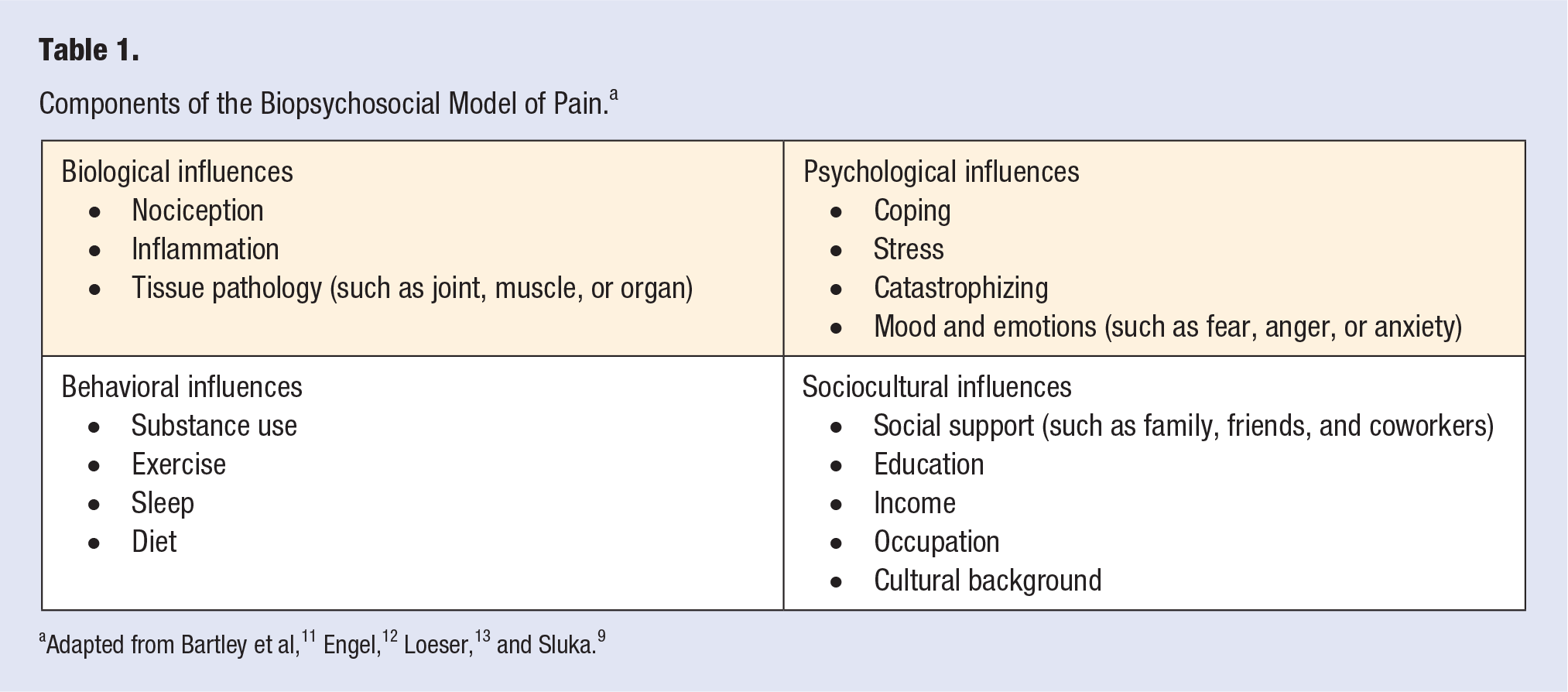
The biological model of pain assumes that all pain has a distinct physiological cause. The current medical approach uses the Biopsychosocial Model of Pain because it incorporates the interaction between the biological, psychological, and sociocultural variables. 9 Many of the Biopsychosocial Model of Pain variables are also components of lifestyle medicine (Table 1).6,10
Components of the Biopsychosocial Model of Pain. a
Clinical Concepts
The focus on clinical care should target not only the latest therapeutic interventions, but also the manner in which the therapy is effectively delivered to the patient. Clinicians need to improve other aspects of clinical care, such as building a therapeutic alliance, including shared decision-making, motivational interviewing, and establishing interprofessional collaborations.
A therapeutic alliance is where clinicians and patients establish a collaborative and purposeful relationship. This professional bond can lead to positive therapeutic changes and may improve pain outcomes. 14 In other words, the context of clinical interventions can enhance the therapeutic effect. A study in 2020 by Kinney et al 15 showed that establishing a therapeutic alliance with patients may positively affect chronic musculoskeletal pain. For example, to build a therapeutic alliance, the clinician could allow the patient to be a part of the decision-making process, make the patient feel welcome with their words and actions, and minimize distractions during treatment. 16 Other strategies to interact effectively with patients may include allowing sufficient time for empathetic dialogue, being attentive and sensitive to personal and cultural needs, and showing a genuine interest in their life circumstance. 17
Shared decision-making, where the clinician and patient decide using the best evidence available and include the patient’s values and preferences into the decision-making process, may also help improve long-term therapeutic outcomes.18-20 For example, besides providing treatment options for the patient, the clinician could explain the pros and cons of selected interventions and identify the patient’s treatment preferences. Furthermore, to improve decision making, the clinician could use phrases such as, “What if we try . . . ?”, “Would you consider trying . . . ?”, or “Would you be open to . . . ?” 21
Another clinical strategy to treat patients with lower back pain is to use motivational interviewing to empower and motivate patients to change their behavior. 22 This collaborative approach uses a goal-oriented communication style and pays attention to the language of change.23,24 The 5 necessary communication skills used in motivational interviewing include24,25 asking open-ended questions, affirming (or praising) a person’s good intentions or efforts, using reflective listening, summarizing the person’s situation, and finally, informing and advising the person. For example, an open-ended question may be phrased as, “How can I help you with your back pain?” To affirm or praise the person’s good intentions, the clinician could say, “You did a great job quitting smoking six weeks ago.” The health care professional could address reflective listening by stating to the patient, “I understand you feel overwhelmed with your current situation.” Additionally, the person’s situation can be summarized by the clinician as, “Let me see if I understand you so far. Your back pain started . . .” Some practitioners may end the motivational interviewing session with, “Did I miss anything?” before moving into the physical examination or intervention phase.
Engaging with different professionals in a collaborative approach can help patients, families, and caregivers receive quality care while enhancing a clinician’s knowledge and presence in the community and potentially reducing health care costs. 26 An article 27 in Medical Education Online concluded, “Given the importance of quality care outcomes and the recognition that collaborative practice improves these outcomes, interprofessional education should be a high priority for every training institution.” Some suggested strategies to improve interprofessional collaboration include attending interdisciplinary meetings and conferences, creating interdisciplinary rounds at hospitals and clinics, organizing biannual meetings in the community as “lunch and learn” opportunities, and finally, connecting with health care providers from a variety of professions on social media sites such as LinkedIn. 28
Finally, clinicians also need to be aware of a person’s readiness for change. To help a patient change a lifestyle behavior, such as to quit smoking or increase physical activity, it would be helpful to know if the person is ready and open to making changes. There is some evidence for using the Pain Stages of Change Questionnaire in assessing if a person is likely to join a self-management intervention program. 29 The readiness for change model is based on the Transtheoretical Model of Behavior Change or the Stages of Change Model.30,31 One version of the model starts with the precontemplation stage, where the person is not considering changing behavior. The next stage is the contemplation stage, where the person is considering changes in their behavior and progresses to the preparation stage, where the person is ready to take action. The action stage, where the person is taking active steps to change their behavior, is the model’s next level. Finally, the maintenance stage is where the person is sustaining and maintaining changes and preventing a relapse.
Lifestyle Interventions
Evidence-based practice involves scientific research, clinical expertise, and patient values. 32 This section will highlight selected scientific research using lifestyle interventions for managing chronic lower back pain. Table 2 provides a review of various nonpharmacological and conventional, integrative, educational, and novel intervention strategies for addressing back pain.
Review of Nonpharmacological Strategies for Lower Back Pain.
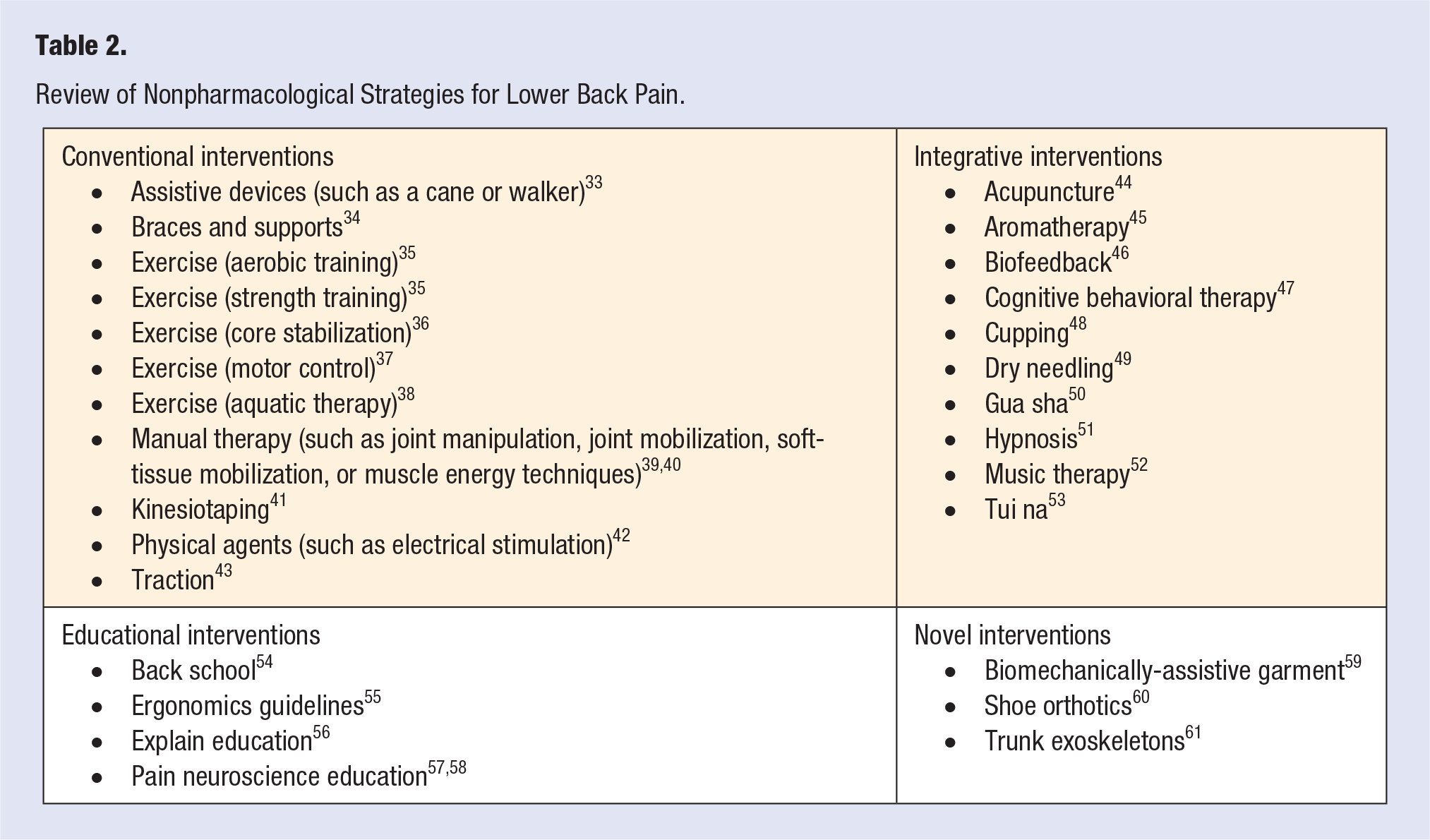
A review 44 in the Annals of Internal Medicine indicated several nonpharmacological therapies for chronic lower back pain. Some of these evidence-based interventions include exercise, psychological therapies, multidisciplinary rehabilitation, spinal manipulation, massage, and acupuncture. However, the authors of this review point out that many of these interventions have low to moderate evidence, with usually short-term analgesic effects. For this reason, these approaches may not be broadly incorporated but used on a case-by-case basis in the clinical setting.
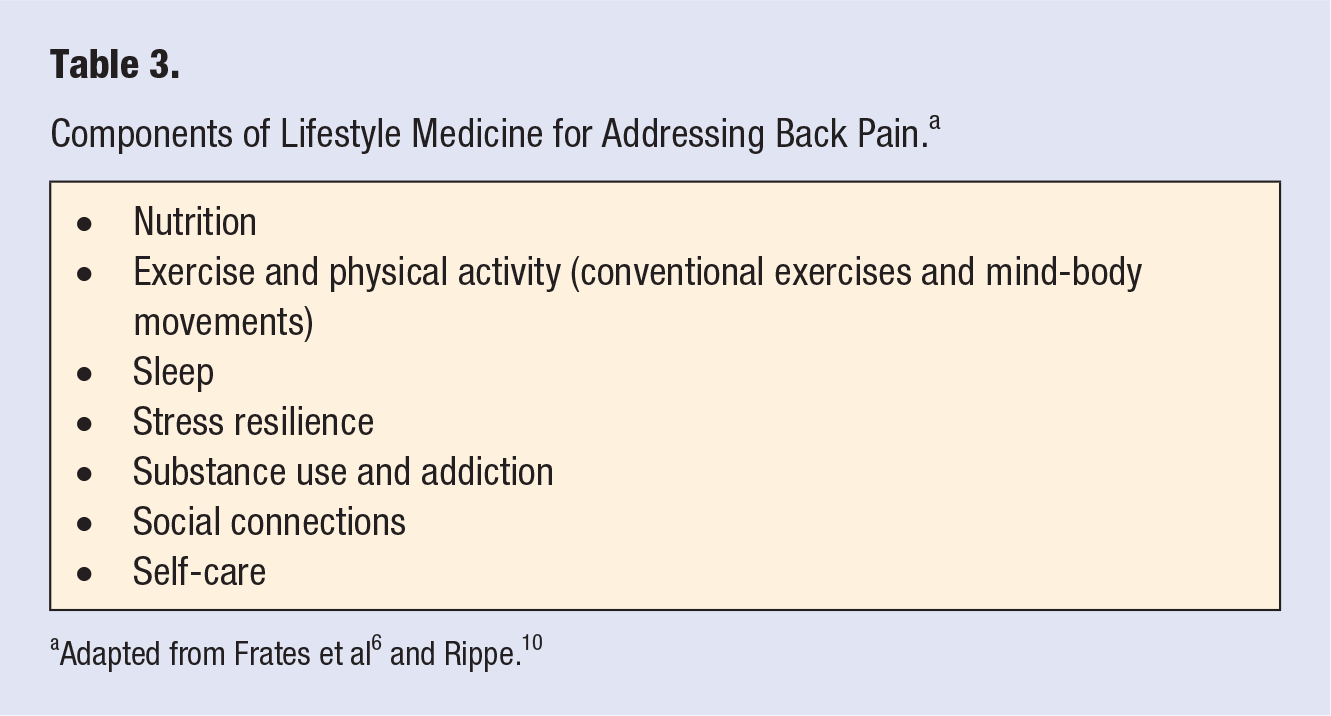
Why should clinicians use lifestyle medicine interventions for managing chronic lower back pain? A randomized controlled trial 62 in the European Journal of Pain showed that healthy lifestyle interventions might be cost-effective and reduce medication and absenteeism costs. Furthermore, there is a movement to address lifestyle factors and empower patients with self-care strategies to manage pain and disease. Table 3 outlines the components of lifestyle medicine that can be used for addressing lower back pain. Other benefits of using lifestyle medicine include helping clinicians diversify their clinical practice to have more treatment options and improving therapeutic alliance and interprofessional collaborations.
Components of Lifestyle Medicine for Addressing Back Pain. a
Nutrition and Back Pain
Healthy eating patterns play a crucial role in not only reducing lower back pain but also reducing excess body weight, which is one of the risk factors for developing back pain. A randomized controlled trial 63 in Nutricion Hospitalaria looked at the effect of diet in patients with fibromyalgia who have lower back pain. The study combined core stabilization exercises with a lacto-vegetarian diet and found that it contributed to pain reduction and improved body composition. Furthermore, a study by Roffey et al 64 in the Spine Journal found that a 52-week medically supervised and nonsurgical weight loss program showed improvement in back pain and function.
As a part of an interprofessional collaboration program, the patient could consult with a culinary medicine 65 specialist or a registered dietitian in order to gain knowledge about the foundations of cooking to reduce pain and inflammation using foods. 66 The patient may also be counseled to try the Mediterranean diet for weight loss 67 or use a targeted diet that includes low glycemic foods to help modulate pain. 68
Conventional Exercise, Physical Activity, and Back Pain
Clinicians understand the value of physical activity in helping prevent and treat a variety of medical conditions. Conventional exercises that include aerobic, strength, flexibility, and balance training may help patients improve endurance, increase core strength, loosen tight muscles, and improve coordination and stability. A systematic review 69 in the British Journal of Sports Medicine showed that leisure-time physical activity may reduce the risk of lower back pain. In 2015, Searle et al 70 concluded that resistance and stabilization exercises were beneficial for treating chronic lower back pain. The key is to help patients find meaningful and sustainable physical activities or exercises. For example, one patient may find walking, hiking, or biking enjoyable, whereas another person may prefer dancing, swimming, or weight training.
Mind-Body Exercises and Movements
Mind-body or integrative movements may be another form of exercise or physical activity. This type of exercise combines specialized movements, controlled breathing, and mental focus to improve overall health, balance, flexibility, and strength. 71 Mind-body movements may include yoga, tai chi, qigong, and Pilates.
Yoga is a system of physical postures and coordinated diaphragmatic breathing that originated in India. 7 A randomized noninferiority trial 72 in the Annals of Internal Medicine concluded that a yoga program for nonspecific chronic lower back pain was noninferior to physical therapy for pain. An earlier systematic review by Cramer et al 73 found moderate evidence for yoga’s effectiveness for individuals suffering from chronic lower back pain.
Tai chi is a traditional Chinese martial art that uses a series of slow, controlled movements to improve balance, strength, flexibility, relaxation, and mental concentration. 7 A randomized controlled trial 74 in Medicine concluded that tai chi alone or along with physical therapy may be beneficial for individuals with lower back pain. Another randomized study by Liu et al 75 found that tai chi reduced lower back pain in adults aged 50 years and older.
Qigong is an ancient Chinese practice that uses movement, breathing exercises, relaxation, and meditation. 7 In 2019, Li et al 76 concluded that a type of qigong called Baduanjin was effective for lower back pain. Another systematic review 77 in the Journal of Clinical Medicine found that mindful exercises such as qigong and tai chi may be beneficial for managing chronic lower back pain.
Pilates is a bodywork system created by Joseph Pilates that uses specialized equipment or mat exercises to improve strength, flexibility, balance, and mental concentration. Randomized controlled trials in 2017 and 2018 by Cruz-Diaz et al78,79 reported that a Pilates intervention effectively managed chronic lower back pain.
Sleep and Back Pain
Clinicians need to be better informed about sleep hygiene guidelines because sleep quality may affect individuals with lower back pain. A review article 80 in Physical Therapy stated that “Stress and sleep are consistently interconnected, as evidenced in numerous studies reporting strong associations between anxiety levels and insomnia severity, such as in people with chronic low back pain.”(p. 328) In practical terms, guiding patients in restorative sleep strategies may be a significant intervention in some instances. For example, sleep hygiene guidelines may include helping a patient create a sleep-friendly environment, which includes a comfortable room (dark, quiet, and cool) and bed, in addition to using a supportive pillow, embracing mindfulness, and minimizing bright light and intense activities (such as exercise or television) near bedtime.
Furthermore, appropriate light exposure through outdoor light and sunshine is especially essential in the morning on awakening and during the day because it is necessary to improve sleep quality, mood, alertness, cognition, and reaction time and prevent depression. 81 A randomized controlled trial in 2014 by Leichtfried et al 82 reported that “light therapy even in low dose could improve depressive symptoms and reduce pain intensity in chronic nonspecific back pain patients.” Strategies that may increase natural light exposure include having breakfast near a window or on a balcony, porch, or patio, sitting near a window at work, going for an outdoor walk at lunch, working in a garden, including more outdoor activities, and remodeling the home to add more windows or skylights.
Stress and Back Pain
A study by Herman et al 83 found that mindfulness-based stress reduction may be a cost-effective strategy for helping individuals with chronic lower back pain. There are many different mindfulness-based stress reduction techniques, such as diaphragmatic breathing, 84 square breathing (also known as box breathing), 85 mindfulness-based body scan, 86 and walking meditation. 87 The essential component of many of these strategies is to help the individual get their breath under control. Therefore, teaching patients breathing control may be a good start. For example, during a square breathing technique, the person could breathe in slowly for 3 s, pause the breath for 3 s at the end of the inhale, exhale slowly for 3 s, and finally, pause the breath for 3 s. This sequence could be repeated 2 to 10 times or longer to promote relaxation.
Substance Use, Addiction, and Back Pain
Yang et al 88 in Spine, among others,89-92 showed that behavior-related factors, such as smoking and alcohol consumption, were associated with lower back pain. A cohort study 93 in the BMJ Open concluded that combining lifestyle behaviors of nonsmoking, moderate alcohol consumption, physical activity, and a healthy diet appeared to decrease the risk of lower back pain in women. More recently, Skillgate et al 94 found that healthy lifestyle behaviors may also be protective for men with lower back pain.
Social Connections and Back Pain
Individuals with lower back pain may find that workplace, financial, and social pressures can affect their ability to manage their condition. 95 For this reason, clinicians can help patients find counselors, social workers, or connections in their community to help them heal and recover. In 2020, a perspective article 96 in the New England Journal of Medicine identified several social-prescribing interventions, such as gym or exercise classes, art-based therapies, volunteer opportunities, self-help groups for specific conditions, parenting programs, and community activities that include gardening, cooking, and sports.
Self-care and Back Pain
Self-care and self-management strategies, such as ergonomic instructions, proper body mechanics, joint protection and energy conservation guidelines, self-massage, self-acupressure, flare-up management, and pain neuroscience education, may be useful techniques to help patients manage their back pain. For example, the patient may be advised to use variable sitting postures to migrate tissue loads in the hip and back region. 97 Also, instructions in proper body mechanics and joint protection guidelines 98 may help patients properly lift, push, pull, carry, and bend during activities of daily living. Furthermore, one energy conservation strategy 99 may advise a patient to alternate between difficult and easy tasks at home or work to avoid overloading muscles and joints.
Other simple self-care techniques may include teaching the patient self-massage and self-acupressure techniques100,101 to reduce spasm and pain. Additionally, many patients with back pain could benefit from flare-up management education. 102 This educational strategy would empower individuals to create their own “toolbox” of useful techniques and strategies to manage symptoms when flare-ups occur. Finally, some individuals may need pain management education or counseling.57,103
Conclusions
Research supports the use of lifestyle medicine strategies outlined by the American College of Lifestyle Medicine (https://www.lifestylemedicine.org/) to manage lower back pain with low-cost nonpharmacological interventions. Clinicians should incorporate a plant-based diet, sustainable physical activity and mind-body exercises, restorative sleep, stress resiliency, awareness of substance abuse and addiction, establishing meaningful social networks, and self-care strategies. Also, using motivational interviewing, shared decision-making techniques, and interprofessional collaborations may help clinicians establish a therapeutic alliance with their patients to improve desired medical outcomes.
Footnotes
Declaration of Conflicting Interests
The author(s) declared no potential conflicts of interest with respect to the research, authorship, and/or publication of this article.
Funding
The author(s) received no financial support for the research, authorship, and/or publication of this article.
Ethical Approval
Not applicable, because this article does not contain any studies with human or animal subjects.
Informed Consent
Not applicable, because this article does not contain any studies with human or animal subjects.
Trial Registration
Not applicable, because this article does not contain any clinical trials.
