




Abstract
There is a large amount of food waste in the United States, with high financial and environmental costs. Okara, also known as soybean (curd) residue or soy pulp, is the byproduct of tofu and soy milk, has high nutrition value, and is available at a reasonable price. While it is often disposed, it may instead be incorporated into our daily diet in a variety of novel healthy products. Public health practitioners may help address the issue of food waste by encouraging the use of “waste” such as okara through work with consumers and companies. These efforts may lead to increased food security and promote the health of humans and the environment.
Food that could be consumed but is otherwise discarded contributes to economic, environmental, and health problems affecting the US population and beyond.
Weight, body image, health, and diet are intricately intertwined and are issues of interest in the United States. In 2015-2016, the prevalence of obesity was 39.8% and affected about 93.3 million US adults. 1 Obesity is associated with development of chronic conditions such as diabetes, cardiovascular disease, and cancer, 2 as well as with body dissatisfaction. 3 Poor diet contributes to obesity and related problems in the United States, as many US adults do not meet recommendations for a healthy diet. In 2015, for example, only 12.2% met fruit intake recommendations and 9.3% met vegetable intake recommendations. 4
While obesity rates continue to rise with numerous consequences, the United States also faces broader problems with regard to the food system on which its citizens rely. In 2017, almost 41 million tons of food waste were generated. 5 Food that could be consumed but is otherwise discarded contributes to economic, environmental, and health problems affecting the US population and beyond. The US Department of Agriculture defines “food waste” as the “loss of edible food along the food chain during production, processing/manufacturing, retailing, and consuming.” Food wasted costs the consumer a substantial dollar amount, may accelerate climate change, and may be detrimental to health if nutritious foods are discarded in favor of high-energy nutrient-poor foods (eg, students discarding food served through the National School Lunch program). In 2015, Americans disposed 37.6 million tons of food waste. 6 According to the Environmental Protection Agency, a large portion of edible waste ends up in landfills and contributes to approximately 16% of methane emissions in the United States. 7 The US government has identified food waste as a major problem and is actively working on reducing food waste by 50% by the year 2030. Addressing the issue of food waste is an important step in ensuring sustainability of the US food system and simultaneously may allow for improvement of health and weight.
One way to address the issue of discarded food is to create novel products from nutritious components of food often wasted.
Innovation for Food Waste Reduction
Okara, also known as soybean (curd) residue or soy pulp, is the byproduct of tofu and soy milk and is globally produced in abundance by the soy industry (Figure 1). Dried okara consists of about 57-59% dietary fibers (42-57% insoluble, 2-17% soluble), 15-34% protein, 6-16% fat, as well as a considerable amount of mineral elements such as calcium, potassium, iron, and antioxidant substances, including isoflavones.8-12 Because of the high nutritional value, okara has numerous health benefits such as improving glucose tolerance and hypolipidemic effects. Therefore, it may help prevent diabetes, cardiovascular disease, obesity, as well as improving intestinal health through prebiotic functions.13-17 In addition, higher dietary fiber intakes may reduce the risk of cancers, including colorectal cancer.18-21 Moreover, the fiber-induced health benefits may expand to improved brain health. 22 As US adults do not consume sufficient amounts of fruits and vegetables, which are important sources of dietary fibers and antioxidants, okara may make an important contribution to diet quality. Dietary fibers can produce short-chain fatty acids by fermentation in the colon, which may contribute to some calories. Still, consumption of sufficient amounts of dietary fibers is an important step in addressing the problem of obesity in the United States. Okara is also a plant source of protein, providing an alternative to animal-based proteins and potentially leading to reduction of saturated fat intake. Okara has been produced worldwide including Asian countries such as Japan, Korea, China, Singapore,23,24 and has a huge potential to become an alternative flour. 10 As long as soy products such as soy milk or tofu are produced, okara will be continuously produced. Although okara has high nutritional value, it is often used as animal feed and mostly disposed through incineration. 25 Therefore, finding ways to reuse okara and reduce food waste should be considered to promote the health of the environment. Okara is also the future of global food and contributes to human health.
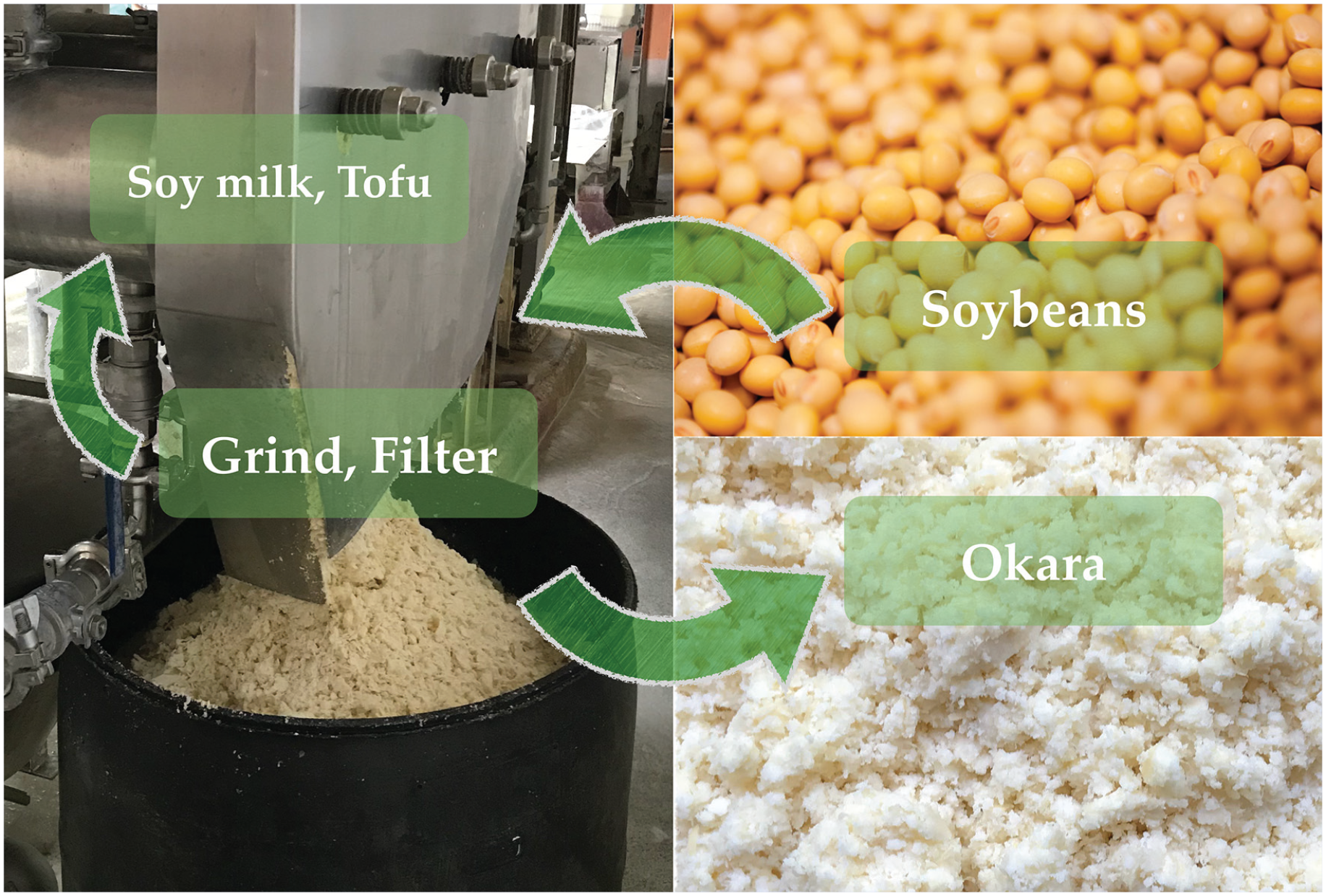
Generating methods of okara. 26
Okara may be used to create a variety of products and has been previously studied as a component of snack foods 27 and food items such as biscuits, 28 cookies, 29 pasta, 24 among others. Novel products may be created using okara to appeal to the American consumer. Pizza is one of the most popular food in the United States. However, most pizza crust contains wheat (and therefore, gluten) as well as other common ingredients that cause allergies such as milk or eggs. A new product, okara pizza crust, will expand the opportunities for everyone to enjoy having pizza regardless of their health issues. There are numerous ways to make okara pizza crust. An example of a potential recipe (Figure 2) is to combine the raw okara and starch such as potato starch or tapioca starch, add water and a pinch of salt as needed, and mix until the dough is smooth and earlobe-soft. Replacing water with tomato puree (juice or sauce) can add even more antioxidant properties. 30 Nutrient-dense, gluten-free pizza dough using okara is a delicious alternative to standard pizza crust. It is higher in protein/dietary fiber and lower in fat. Approximately 95% of adults and children in the United States are not getting enough dietary fibers, and consuming one 8-inch okara pizza crust provides about 30% of their daily needs. 31 Other possibilities are to incorporate okara into baked goods such as donuts, muffins, pancakes, bread, nutrition bars, as well as other popular food items including nuggets and burger patties. 32 Adding okara to these popular food items increases value through addition of dietary fibers and proteins. High-energy low-nutrient snack foods common in the United States could be altered to increase diet quality. The shelf life of raw okara in the refrigerator is only a few days due to the high moisture content10,33 but is well-tolerated in the freezer. A powder form of okara can also be produced, which has a long shelf-life and can be incorporated into soup, stew, and other items. 32
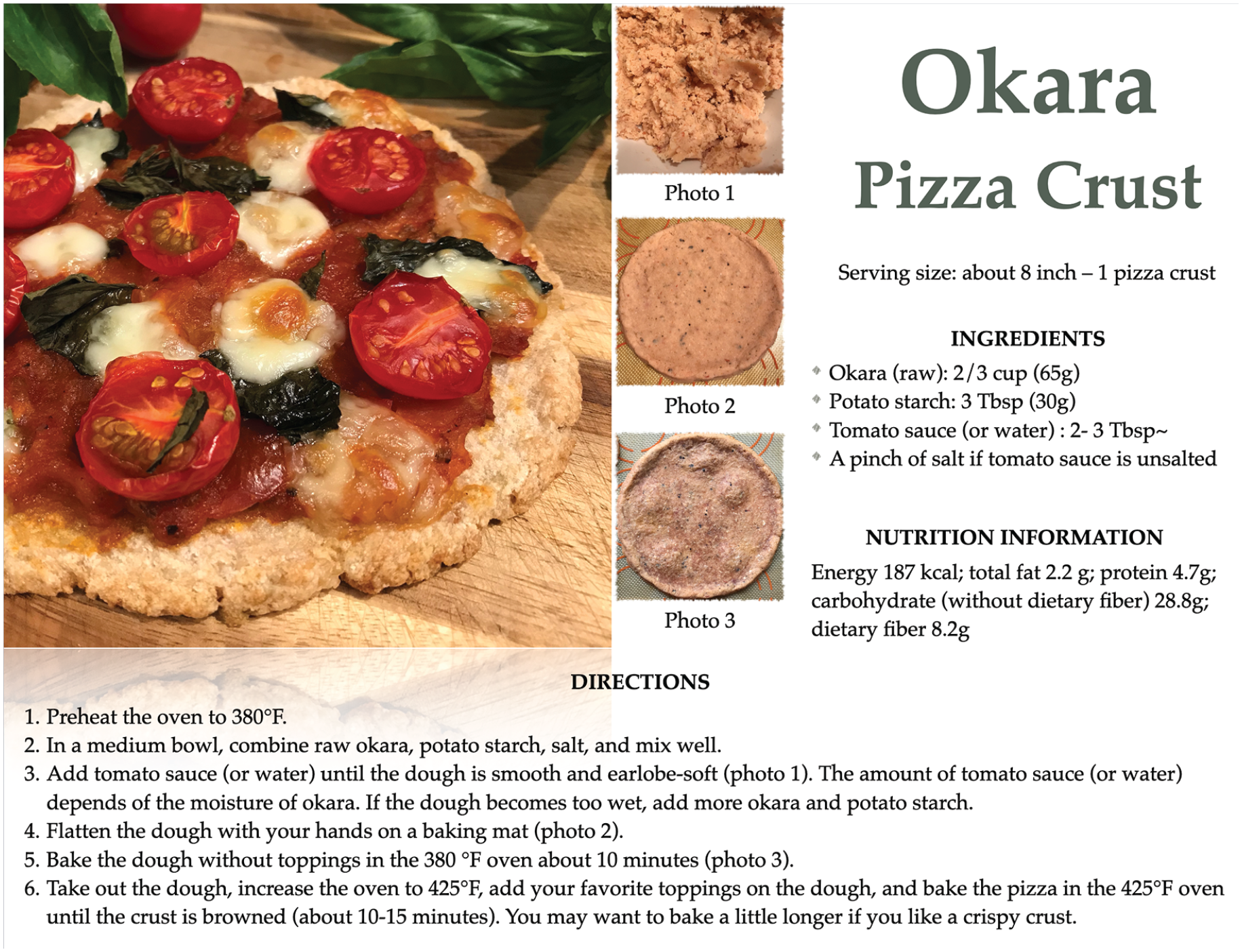
Okara pizza crust recipe.
Public Health Practitioners and Opportunities
Public health practitioners play an important role in devising solutions to issues related to food security, and thus food waste reduction. 34 One of the ways public health practitioners may help address the issue of food waste is through education to encourage the use of “waste” such as okara in preparing food products. This could be done at the consumer level—okara is currently available for purchase in some US supermarkets, but many consumers are unaware of the nutritional benefits. Encouraging consumption of this ingredient could not only improve demand and lead to less waste but also add fiber and protein to the diet at a reasonable price. Public health practitioners could also interact with companies at the food production level—for example, by working with tofu factories to decrease waste of okara by establishing a process to donate or sell the byproduct. In addition, public health practitioners may also educate companies about diverting byproducts from the landfill through composting or using them as animal feed, in cases in which it may not be feasible/desirable to use them for human consumption.
Conclusions
Incorporating okara into the diet is one of the novel ways to reuse and reduce food waste. Currently, most of the food waste products are recognized as just “food waste;” however, educating about ways to reuse food waste can change people’s perspective as well as bring awareness of the value of using products that are often discarded. It is important for public health practitioners to address the idea of reusing food waste products with multilevel approaches. As a results of the efforts, “food waste” may become “treasured food” in the future.
Footnotes
Declaration of Conflicting Interests
The author(s) declared no potential conflicts of interest with respect to the research, authorship, and/or publication of this article.
Funding
The author(s) received no financial support for the research, authorship, and/or publication of this article.
Ethical Approval
Not applicable, because this article does not contain any studies with human or animal subjects.
Informed Consent
Not applicable, because this article does not contain any studies with human or animal subjects.
Trial Registration
Not applicable, because this article does not contain any clinical trials.