



Abstract
Chronic disease now affects approximately half of the US population, causes 7 in 10 deaths, and accounts for roughly 80% of US health care expenditure. Because the root causes of chronic diseases are largely behavioral, effective therapies require frequent, individualized interventions that extend beyond the hospital and clinic to reach patients in their day-to-day lives. However, a mismatch currently exists between what the health care system is equipped to provide and the interventions necessary to effectively address the chronic disease burden. To remedy this health crisis, we present an individualized, data-driven digital approach for chronic disease management and prevention through precision behavior change. The rapid growth of information, biological, and communication technologies makes this an opportune time to develop digital tools that deliver precision interventions for health behavior change to address the chronic disease crisis. Building on this rapid growth, we propose a framework that includes the precise targeting of risk-producing behaviors using real-time sensing technology, machine learning data analysis to identify the most effective intervention, and delivery of that intervention with health-reinforcing feedback to provide real-time, individualized support to empower sustainable health behavior change.
Keywords
‘Because the root causes of chronic diseases are largely behavioral, effective therapies require frequent, individualized interventions that extend beyond the hospital and clinic to reach patients in their day-to-day lives.’
Introduction
Despite medical advancements of the 21st century, a major health crisis remains unsolved. Although improved sanitation, antibiotics, vaccines, and other medical interventions have reduced the US population’s burden from acute diseases, chronic disease now affects approximately half of the US population, causes 7 in 10 deaths, and accounts for roughly 80% of US health care expenditure. 1 Because the root causes of chronic diseases are largely behavioral, effective therapies require frequent, individualized interventions that extend beyond the hospital and clinic to reach patients in their day-to-day lives. 1 However, a mismatch currently exists between what the health care system is equipped to provide and the interventions necessary to effectively address the chronic disease burden. 1 To remedy this health crisis, we present an individualized, data-driven digital approach for chronic disease management and prevention through precision behavior change, as shown in Figure 1. The rapid growth of information, biological, and communication technologies makes this an opportune time to develop digital tools that deliver precision interventions for health behavior change to address the chronic disease crisis.1-6 Building on this rapid growth, we propose a framework that includes the precise targeting of the risk-producing behavior using real-time sensing technology, predictive data analysis to identify the most effective intervention, and delivery of that intervention with health-reinforcing feedback to provide real-time, individualized support to empower sustainable health behavior change.
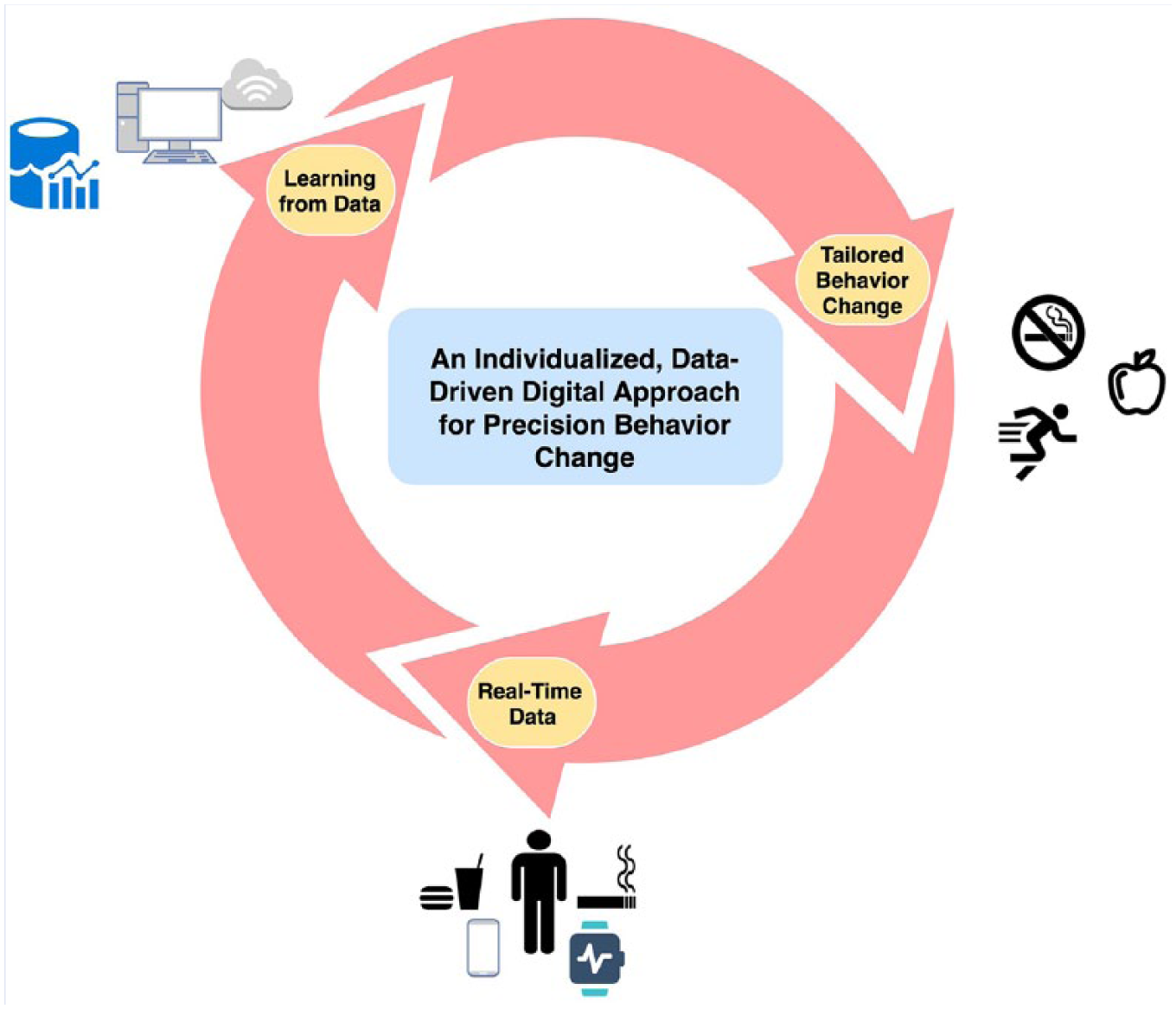
An individualized, data-driven digital approach for precision behavior change. This approach consists of 3 main components: (1) real-time sensor data about behaviors and health states; (2) learning from data through methods such as machine learning; and (3) the delivery of tailored behavior change strategies based on algorithms that adapt to the unique characteristics of each individual. Each component is essential in this continuous cycle of data collection, learning, and increased individualization of support for health behavior change.
Imprecise Interventions in the Era of Precision Medicine
Chronic disease management in many health care systems consists of 15- to 30-minute visits to the doctor’s office every few months, pharmacological treatment, and healthy lifestyle recommendations that are disease oriented, nonspecific, and have low patient compliance. 7 This generic, episodic approach to chronic disease management has failed to improve individual and population health. 1
In 2015, the Precision Medicine Initiative was launched with the goal of creating a “new era of medicine—one that delivers the right treatment at the right time.” 8 Although the vision is to take into account “individuals’ health history, genes, environments, and lifestyles,” 8 thus far, the major investments in precision medicine have primarily been within the realm of genetic medicine. 9 In contrast, the use of diverse data sources regarding lifestyle, environmental, cultural, socioeconomic, and behavioral factors to individualize prevention and treatment has not progressed at the same rate.10-14
Framework for Precision Behavior Change
Today’s sensor technology, personal health devices, and mobile health (mHealth) applications enable the collection of highly relevant, real-time data and provide the opportunity to deliver more precise behavior change interventions to individuals in their daily lives in the “right context at the right time.” Big data from wearable technologies combined with advancements in computing power, statistical methods, and machine learning (ML) algorithms enable the development of individualized, data-driven, digital behavioral interventions. However, numerous open questions require investigation: How do we optimize interventions given a patient’s characteristics?, What are the elements of interventions that best promote healthy behaviors? How do we determine the optimal timing of interventions? and How can we maintain user engagement in health behavior change? Here, we present a framework and a set of novel tools for data-driven approaches to optimize the delivery of precision behavior change interventions through digital health technology.
Tools for the Design and Delivery of Precision Digital Therapeutics
Despite the abundance of mHealth applications, the majority are not customized to the individual user and have not been evaluated for validity and efficacy.15-17 As a result, digital health technology can benefit from the integration of evidence-based adaptive design.
Learning About Behaviors and Health States from Sensor Data
To tailor behavioral interventions, validated measures of the individual’s health-related behaviors and health status are essential. Requiring manual data input is not practical; the burden is likely to result in incorrect and/or incomplete data entry. Thus, automatic ascertainment of behaviors and health states through the use of nonintrusive sensors is preferred.5,18 The advancement in sensor technology and novel ML algorithms are enabling the development of behavior and health state estimation techniques from sensors for a range of measures from disease severity to mood and sociability. For example, ML can now be used to derive intraday and long-term disease state fluctuations in neurodegenerative disorders. 19 Additionally, mobile phone sensors and ML enable the detection of high-risk drinking and the triggered delivery of mHealth interventions to reduce alcohol consumption and alcohol-related injuries. 20
Increasing the Precision of mHealth Interventions Through Machine Learning
Combining mHealth intervention designs with ML enables real-time behavior and disease assessment to guide interventions. Currently, adaptive and in-the-moment interventions are primarily based on preprogrammed decision rules developed from domain knowledge.16-18 Rather than using predefined rules to dictate the delivery of interventions, the precision of behavior change technologies can be improved with ML. For example, a smoking cessation program may trigger an intervention when wrist sensors detect that the patient is smoking. Additionally, preemptive messages could also be delivered based on learning the predictors of smoking for that individual and prompting an intervention when the individual is at high risk of relapse (eg, deliver a smoking cessation message when the patient is approaching his or her typical smoking location). Similarly, to encourage physical activity, the context of the patient can be detected from accelerometer data and GPS location as well as calendar and weather information. This real-time detection can inform the content and design of interventions using techniques proven to be beneficial in controlled trials. With ML built into the app, the ideal times to trigger the delivery of interventions could also be learned from the collected data. For instance, patterns in the patient’s sedentary behavior can be learned and used to predict when the user may benefit most from interventions to promote physical activity. Microrandomized trials (MRTs) and online personalization algorithms are methods to optimize the delivery and content of interventions through the modeling of causal effects and time-varying effects. 21
Developing Data-Driven Tailoring Strategies
The MRT is an experimental design that can generate the data required to optimize the decision rules and interventions. Each time an intervention might be delivered to the individual, the individual is randomized among the different options for the intervention. Suppose the intervention consists of multiple components—for example, to promote physical activity—the application can include both an “evening component” aimed at helping the user plan next-day physical activity as well as a “throughout the day component” involving brief, tailored physical activity suggestions. 16 The evening component might be randomized each evening between 2 intervention options: a message to prompt physical activity planning for the following day and no message. The day component might be randomized multiple times per day between a tailored activity suggestion and no message. In MRTs, individuals may be randomized hundreds or thousands of times during the study. Three key reasons make MRTs well suited for constructing mHealth interventions. MRTs enable (1) estimation of the causal effect of each intervention component and the component’s time-varying effects; (2) assessment of whether the dynamic context, current predictions, and detections modify the effect of the intervention; and (3) highly efficient within-person and between-person comparisons that require far fewer participants than traditional randomized controlled trials. 21 Furthermore, the use of MRTs provides a bridge to the implementation of reinforcement learning algorithms in mHealth intervention development. In reinforcement learning, the randomization probabilities are gradually moved toward the best performing treatment as data accumulate for an individual. These algorithms are commonly used in online advertising and provide promising approaches to develop novel tailoring strategies in real time because data are collected on the responses of the user to the delivered treatments. 22 Furthermore, both individual- and group-level data can be used to enable tailoring between and within individuals to enable the optimal delivery of the intervention in the right context and at the appropriate time. Overall, these ML approaches allow for development of tailored interventions that are learned in a data-driven manner.
From Research to Real-World Impact: Addressing Current Challenges
Although there is growing excitement for the potential of digital therapeutics to support health behavior change, numerous challenges must be addressed before the real-world impact of this technology can be realized on a large scale. One major concern is the quality of these digital health technologies. To address this concern, the Food and Drug Administration has started the Software Precertification (Pre-Cert) pilot program in the Digital Health Innovation Action Plan to develop a company-focused approach for the regulation of digital health and software technologies by ensuring quality development processes. 23
Additionally, there is increasing recognition of the importance of involving a multidisciplinary team that collectively can address the nuances of end-to-end development and deployment of digital health technologies in clinical care to improve health outcomes. Although current behavioral theories are based largely on static snapshots of behavior, mHealth provides the technology to capture and contextualize behavioral data in real time. 24 As a result, there is a growing need for data analysis approaches that can inform the development of dynamic health behavior theories. Methods are currently being developed for assessing treatment effects from longitudinal data in which treatment, response, and potential moderators are time varying.25-27 Adaptive and ML technologies are also in development to enable continuous learning and refinement of algorithms to support health behavior change in a manner that is responsive to real-world settings. 27 Overall, combined effort from experts in medicine, nursing, public health, behavioral science, business, engineering, statistics, and computer science are required to translate these research developments into useful tools that are tailored to the individual’s unique personality and factors driving health behaviors.
Footnotes
Acknowledgements
This work was supported by the Johns Hopkins School of Medicine Medical Scientist Training Program (National Institutes of Health: Institutional Predoctoral Training Grant T32), the National Institutes of Health (Ruth L. Kirschstein Individual Predoctoral NRSA for MD/PhD: F30 Training Grant), and the Johns Hopkins Individualized Health (inHealth) Initiative.
Declaration of Conflicting Interests
The author(s) declared the following potential conflicts of interest with respect to the research, authorship, and/or publication of this article: SW, SLZ, and SAM declared no potential conflicts of interest with respect to the research, authorship, and/or publication of this article. SSM serves on the scientific advisory boards of Amgen, Sanofi, Regeneron, Esperion, Novo Nordisk, Quest Diagnostics, and Akcea Therapeutics and reports grants from Apple, Google, iHealth, Nokia, Maryland Innovation Initiative, American Heart Association, Aetna Foundation, P J Schafer Memorial Fund, and David and June Trone Family Foundation. SSM reports a patent pending filed by Johns Hopkins as a co-inventor for a method of LDL-C estimation. SSM is a founder of and holds equity in Corrie Health, which intends to further develop the platform. This arrangement has been reviewed and approved by the Johns Hopkins University in accordance with its conflict of interest policies. SS is a founder of and holds equity in Bayesian Health. SS also serves on their board. The results of the study discussed in this publication could affect the value of Bayesian Health. This arrangement has been reviewed and approved by the Johns Hopkins University in accordance with its conflict of interest policies.
Funding
The author(s) disclosed receipt of the following financial support for the research, authorship, and/or publication of this article: SW is supported by the Johns Hopkins School of Medicine Medical Scientist Training Program (National Institutes of Health: Institutional Predoctoral Training Grant - T32), National Institutes of Health: Ruth L. Kirschstein Individual Predoctoral NRSA for MD/PhD: F30 Training Grant, and the Johns Hopkins Individualized Health (inHealth) Initiative.
Ethical Approval
Not applicable, because this article does not contain any studies with human or animal subjects.
Informed Consent
Not applicable, because this article does not contain any studies with human or animal subjects.
Trial Registration
Not applicable, because this article does not contain any clinical trials.
