



Abstract
Most chronic illnesses in developed nations are largely preventable. Lifestyle Medicine adds tremendous value to traditional methods for the delivery of healthcare by focusing on preventing, reversing and treating chronic illness. By helping individuals focus on nutrition, physical activity, stress management, quality sleep, mental health and purposeful living, the risk and incidence of chronic illness decreases dramatically. This article describes the team approach to preventive health care including the value of Wellness Coaching and how the Group Visit model of health care improves access to care and quality outcomes.
Chronic diseases are responsible for 7 of 10 deaths each year, and treating people with chronic diseases accounts for most of our nation’s health care costs.
1
Four health risk behaviors—lack of exercise or physical activity, poor nutrition, tobacco use, and drinking too much alcohol—cause much of the illness, suffering, and early death related to chronic diseases and conditions.
2
In the last 20 years, the number of adults diagnosed with diabetes has more than tripled. More than 84 million US adults—that is 1 in 3—have prediabetes.
3
The Gap
‘To this day, most medical school and residency programs include only a few hours of training in lifestyle medicine.’
For health care reform to deliver real value, we need to expand what we call health care. The current model is unaffordable and getting worse with the fast-growing burden of chronic disease caused by unhealthy lifestyles. Physicians and other providers spend most of their time helping patients manage chronic illnesses after they are established and are costly to treat rather than preventing or delaying them years earlier. Little time is available to pursue a productive conversation on lifestyle medicine as to prevent, treat, or even cure chronic diseases.
We propose that health care systems deliver new value by providing lifestyle medicine to prevent, treat, and cure the chronic diseases that are responsible for most health care costs. Lifestyle medicine also addresses what people value—a good quality of life supported by a high level of health and well-being.
A University of Pittsburgh Medical System team, including leading preventive medicine physician Michael Parkinson, surveyed physicians about their low engagement in supporting lifestyle medicine. 4 The survey indicated that reimbursement was the lowest on their list of concerns. Among the most prevalent reasons for not participating were “time available” and the “lack of knowledge and skills.”
Time is certainly a concern when it comes to patient care. The quality of health care has regressed along with third party involvement, medical legal issues, and the financial consequences of the business of medicine. The average patient visit with a physician in the exam room is purported to last 7 minutes. Physicians are hard pressed to manage more and more patients each year to stay solvent, driven by the financial demands of a practice that sadly compromises the support needed by patients to adopt healthy lifestyles.
“Lack of knowledge and skills” is also a real challenge. To this day, most medical school and residency programs include only a few hours of training in lifestyle medicine. Medical school students and residents learn little about the health benefits of nutrition; and they do not learn how to write a prescription for exercise. They focus little on stress management, the importance of quality sleep and good mental health, but learn so much about writing prescriptions for medications, when and why to send patients for procedures, and the ins and outs of surgery. Most of physician training is focused on how to treat chronic illnesses and cancers After they have occurred but little training on the Prevention of chronic disease.
Lifestyle Medicine
Lifestyle Medicine involves the use of evidence-based lifestyle therapeutic approaches, such as a predominantly whole food, plant-based diet, regular physical activity, adequate sleep, stress management, avoidance of risky substance use, and other non-drug modalities, to prevent, treat, and, oftentimes, reverse the lifestyle-related, chronic disease that’s all too prevalent.
5
The foundations for lifestyle medicine and optimal wellness are operationalized in a variety of assessments and models. Lee Health focuses on a “Wellness Wheel” with 6 areas of focus (see Figure 1):
Nutrition
Physical activity
Stress management
Quality sleep
Mental health
Purposeful living
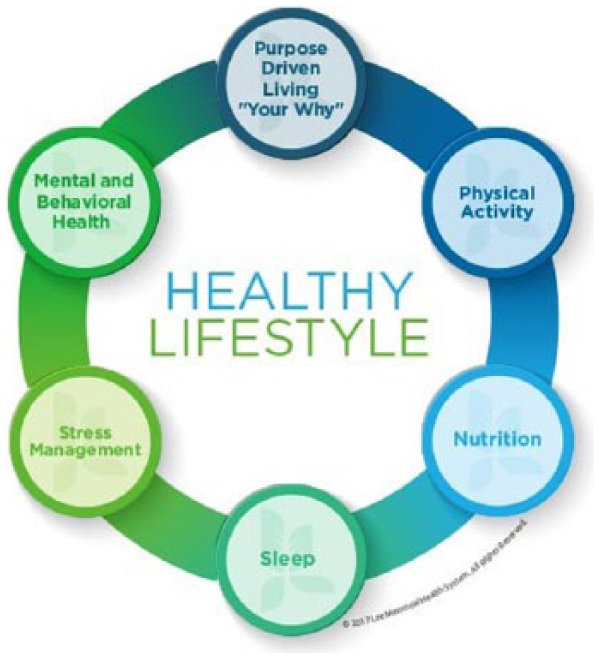
Wellness wheel used at Lee Health.
The wellness wheel is used to develop an intentional action plan for healthy living, and over time these parameters are assessed and used as metrics for success. The wellness wheel is supplemented by educational resources as needed by the patient and the family.
Filling the Gap: The Lifestyle Medicine Team
The lifestyle medicine team includes 2 roles that expand the knowledge and skills of the clinical team: lifestyle medicine consultants and health and wellness coaches (HWCs). Together they fill the gap of educating and supporting patients on how to live healthier lifestyles. The lifestyle medicine consultant is a physician, nurse practitioner, or other health care provider specifically trained to provide preventive health care. This professional focuses on identification of risk factors for chronic disease and helps a patient decrease and hopefully eliminate these risks. He/she helps a patient understand that most chronic illnesses are the result of an unhealthy lifestyle and how changes in lifestyle will reverse and, in many cases, even cure chronic disease. In addition to the lifestyle medicine–trained provider, the lifestyle medicine team may include a dietitian, an exercise specialist, a psychological counselor, a sleep specialist, and other health care providers who focus specifically on preventing illness, mitigating risk factors and attempting to resolve the underlying cause of the disease.
The HWC is a skilled professional trained in coaching competencies, typically combining a coach certification with lifestyle medicine education and a background in nursing, nutrition, exercise, or mental health. The arrival in 2017 of national standards and national board certification of health and wellness coaches, led by a partnership of the National Board of Medical Examiners and the International Consortium for Health & Wellness Coaching (ICHWC), 6 is establishing a well-trained HWC workforce to support patients in making positive, sustainable change of their lifestyles. The content of the national certification examination includes 4 categories (coaching structure, coaching process, health and wellness, and ethical guidelines), encompassing 26 domains and 140 competencies. 7 The HWC is well-versed in the behavioral risk factors for chronic diseases, as well as commonly used biometric measures, lifestyle medicine and wellness, and the impact of lifestyle medicine on chronic disease. To be eligible to become an NBC-HWC (national board certified health and wellness coach), coaches complete a HWC training and education program approved by ICHWC. 8
The HWC collaborates with individuals and groups to identify “readiness” for change, foster autonomous motivation, and creatively navigate barriers to enhance engagement in health-promoting habits. With the application of this approach, the HWC explores possibilities and facilitates change. This process is distinct from the expert approach, which is focused on prescribing expert recommendations. The HWC is nonjudgmental and curious, and helps patients discover their strengths and potential. Motivational interviewing techniques used to enhance active participation start with an open, accepting, and compassionate mindset. The HWC meets the individual where he/she is at on his/her wellness journey and helps the person understand the deeper meaning and value of good health. The HWC helps a patient get to the root of her/his apparent noncompliance, which oftentimes represents a lack of confidence in the face of his/her present life challenges. There may be an underlying mental health issue such as depression that limits the ability to maintain optimal health. Together, the HWC and patient unpack these challenges, navigating one challenge at a time (or more if a patient is ready), and then, together they celebrate success.
The HWC helps the patient develop a personal vision and action plan based on what the individual is ready, able, and willing to change. Over time, the coaching process helps the patient steadily develop confidence as new strengths are gained and as a more positive mindset begins to emerge.
Limits of Payment Models
The path to wellness is the optimal focus of every patient-provider encounter. But the current system of fee-for-service does not incentivize the patient or the provider to get onto or stay on a path to optimal wellness. The provider is compensated for spending time with the patient regardless of the clinical outcome, and there is no incentive for the patient to be more responsible for his/her health. A patient is not encouraged and supported to improve his/her lifestyle; he/she is not incented to be more compliant with taking prescribed medications; and the provider is compensated for his/her time even though the patients’ chronic illnesses are not well controlled.
In a value-based reimbursement system where a provider is rewarded for helping the patient achieve optimal wellness, a struggling, noncompliant patient leads to a financial disincentive for the provider. Such a system places more responsibility on the physician and does not properly incentivize the noncompliant patient. This appears to be an unfair system given the impact of an unhealthy lifestyle in causing many chronic diseases. When the patient fails to eat healthy food, does not exercise, and lives an unhealthy lifestyle, the physician is negatively affected by caring for such a patient.
Today in both models, fee-for-service and value-based care, the incentives for the provider and the patient are counterproductive. A more appropriate system would incent both the physician and the patient. The physician would be held responsible for recommending the best up-to-date clinical treatment including lifestyle medicine; and the patient would be monitored and held responsible for changing his/her lifestyle, at his/her own pace, to support the best clinical treatment protocols. One approach to deal with the financial problems inherent in the current payment model is to require the patient to have “skin in the game,” meaning if he/she is unwilling to participate in healthy lifestyle behaviors he/she would bear more of the cost of his/her health care. However, a penalty alone is not ideal because many patients today face significant challenges in making healthy lifestyle choices—including financial and psychological resources, as well as work demands and an environment that is not fully supportive. Hence, it is important to understand why an individual is not willing and able to engage in healthy lifestyle choices and to provide full autonomy on where to focus change efforts. Readiness to change depends on an adequate level of both intrinsic motivation (internal desire not external pressure or incentive) and self-efficacy (belief that change is possible).
Accountable Care at Lee Health
Lee Health has developed an ACO (Accountable Care Organization). The ACO comprises a comprehensive team of physicians, advanced nurse practitioners, dietitians, psychologists, exercise specialists, and HWCs who together with the patient and his/her family work toward optimal health. In this system, the patient is engaged more intently and is encouraged to make the appropriate changes in lifestyle to support wellness. Many health plans are now working with ACOs and are making adjustments in health plan benefits when the patient does not engage and participate in the necessary chronic disease management programs.
One example is the patient with uncontrolled diabetes who becomes responsible for a higher health insurance premium if he/she does not participate in diabetic education classes. In these classes a dietitian works with an HWC to help the patient overcome barriers to success. The HWC helps the patient determine his/her “readiness” and collaborates with the patient to develop an action plan the patient is ready to work on. Short-term and long-term goals are agreed upon in advance and over time these metrics are monitored and tweaked. The HWC helps the patient cultivate positive resources (eg, strengths, positivity, creativity, resilience, and growth mindset) that support sustainable growth. Given that team communication is essential to make the ACO work most efficiently, the HWC regularly reports to the team on the patient’s progress.
The Lee Health Lifestyle Medicine program is planning to provide lifestyle medicine consultations in employee health clinics. Lee Health is a self-insured health care system with 13 000 employees and 19 000 individuals in the health plan. The health plan costs are one of the largest expenses of the system. Helping employees and dependents become and stay healthier goes directly to the bottom line by increasing productivity and decreasing absenteeism. Also, and most important, taking care of the most precious asset of the health system (its employees) is the right thing to do.
Lifestyle medicine services can be delivered as individual sessions or as group visits. The group visit is a medical visit with usually 10 to 15 and sometimes 20 patients with a similar illness. The group visit model lends itself well to the delivery of lifestyle medicine with its focus on teaching people how to become and stay healthy. Lifestyle medicine consultations can also be done as virtual (Skype) visits that are helpful since many individuals are unable to get in to see a physician, especially when they travel to distant places but still need medical follow-up. This connection makes the individual accountable to his/her action plan for healthy living and gives the provider the opportunity to check in with the patient on a regular basis to see if he/she is maintaining personal responsibility and continuing with the clinical recommendations made by the physician.
At Lee Health, senior leaders have “put their money where their mouths are” by supporting nurse practitioners, physicians, and other health care providers to train in lifestyle medicine and health and wellness coaching. In a lifestyle medicine clinic, patients are referred to a HWC who works well with patients challenged by life stressors. The HWC connects on a personal and professional level with patients meeting them where they are and discovering their core values, needs, possibilities, and strengths.
How to Get Started
Lifestyle medicine courses, conferences, websites, 9 and the scientific literature are vital to learning how to deliver lifestyle medicine as value-based care where physicians and providers get paid based on how well patients fare in controlling or reversing chronic disease. Fortunately, educational resources are abundant for the physician and other health care providers who wish to create a lifestyle medicine team. One great resource is the Lifestyle Medicine textbook edited by Dr James Rippe (2nd edition available and next edition near completion). Several CME conferences are available including those delivered by the Institute of Lifestyle Medicine, American College of Lifestyle Medicine, Plantrician, and the International Conference on Nutrition in Medicine sponsored by the Physicians Committee for Responsible Medicine. Robust educational websites include Nutritionfacts.org 10 and the Centers for Disease Control and Prevention. The American College of Lifestyle Medicine and Wellcoaches Corporation 11 deliver a lifestyle medicine course for coaches (as well as a lifestyle medicine coach credential), which is also valuable to other health care professionals.
Reading the American Journal of Lifestyle Medicine as well as research articles on lifestyle medicine and HWC published in other peer-reviewed journals are vital for the lifestyle medicine team. This journal published a compendium of the health and wellness coaching literature in 2017, 12 which included 72 randomized controlled studies with positive outcomes for a variety of diseases and in a variety of settings; an updated compendium is under way given the rapid growth of the HWC literature.
Now in reference to randomized control trials (RCTs), which are the typical method of gathering “evidence-based medicine,” it is important to point out that RCTs have limitations in lifestyle medicine. They compare an “intervention” group, using one specific intervention, to a control group. In contrast, research in lifestyle medicine is more often based in real-world settings, involving multiple interventions that are highly customized, rendering randomized studies with a control group impractical. While this research does not meet the definition of an RCT nonetheless, the medical outcomes are real. Over the last 8 years the Lee Health lifestyle medicine team has collected anecdotal evidence from 800 patients treated with a plant-based nutrition and exercise program for a myriad of illnesses including heart disease, diabetes, obesity, autoimmune diseases, cancers, and more. The results are impressive as many individuals decrease or stop traditional medications and therapies. Hundreds of individuals were able to either lower the dose or even stop medications for diabetes, hypertension, hyperlipidemia, arthritis, psoriasis, reflux, irritable bowel symptoms, musculoskeletal pains, and more. Many reported increased energy and functionality, improved cognition, decreased anxiety, and improvements in depressive symptoms. All this is a reflection of true value-based care.
The American College of Lifestyle Medicine recently launched a board certification program for physicians through the American Board of Lifestyle Medicine. 13 This certification program requires the provider to complete 30 hours of online study, attend at least one conference dedicated specifically to lifestyle medicine, take a board review course, and then complete the board exam. Lifestyle medicine and HWC go hand in hand, and as part of the certification process for the American College of Lifestyle Medicine, one of the modules focuses on the fundamentals of wellness coaching and behavior change. All practitioners learn the fundamentals of coaching, motivational interviewing, and evaluating the readiness of each individual to make positive changes in behavior and mindset to improve health. Lifestyle medicine–trained physicians can use basic coaching skills and collaborate with a trained HWC in order to help each patient on his/her journey toward optimal health.
Integration of the lifestyle medicine provider and the HWC into the traditional model of health care provides a comprehensive support system for individuals to become and stay healthy. When this is done there is a positive clinical and financial return on the investment.
A health care provider interested in becoming a health and wellness coach can start by investigating programs approved by the International Consortium for Health & Wellness Coaches for eligibility to sit for the national board certification of health and wellness coaches. We recommend Wellcoaches as the leader in developing HWC who are well prepared to deliver value-based care. Positive outcomes of the Wellcoaches protocol, described in the Coaching Psychology Manual, 14 peer-reviewed and published by Wolters Kluwer, are evident at Lee Health and are reported in 10 peer-reviewed papers of practice-based research including nearly 22 000 clients and 8 case studies.
Wellcoaches provides 2 training options: an 18-week distance teleclass format or a 4-day residential workshop. Training topics, laid out in the Wellcoaches Coaching Psychology Manual, include the following:
Role of the coach
Skills for growth promoting relationships
Motivation and confidence
Expressing compassion
Harvesting the positive
Wellness assessments, vision, plans, goals
Generative moments
Appreciative goal review
Coaching session protocols
Outcomes measurement and research
Wellcoaches teaches the importance of self-care and mindfulness allowing coaches to be “all in” and fully present with clients during each interaction. Trainees have many opportunities to role play as the coach or client through the program, quickly learning to deliver coaching sessions with real clients. As part of the certification process each coach trainee participates in mentor coaching sessions and walks the walk by creating and implementing a personal wellness vision and plan.
In partnership with a lifestyle medicine consultant and the clinical team, the HWC is a much-valued expert in helping patients change when change is hard.
Conclusion
The lifestyle medicine team, lifestyle medicine consultant and HWC, is poised to transform health care by addressing the true cause of many chronic diseases. Let us close where we began: We propose that health care systems deliver new value by providing lifestyle medicine to prevent, treat and cure the chronic diseases which are responsible for most healthcare costs. Lifestyle medicine also addresses what people value—a good quality of life supported by a good level of health and well-being.
It is time to put the lifestyle medicine team in place. Please join us as we revolutionize health care!
Footnotes
Declaration of Conflicting Interests
The author(s) declared the following potential conflicts of interest with respect to the research, authorship, and/or publication of this article: Margaret Moore is a shareholder and employee of Wellcoaches Corp. Salvatore Lacagnina and Sarah Mitchell have no conflicts of interest to disclose.
Funding
The author(s) received no financial support for the research, authorship, and/or publication of this article.
Ethical Approval
Not applicable, because this article does not contain any studies with human or animal subjects.
Informed Consent
Not applicable, because this article does not contain any studies with human or animal subjects.
Trial Registration
Not applicable, because this article does not contain any clinical trials.