



Abstract
Plant-based nutrition can be protective against a number of chronic diseases. The objectives of this study were to determine the medical community’s knowledge of plant-based nutrition and assess whether participants would be willing to adopt or recommend this diet to patients. A questionnaire was emailed to more than 4000 students and faculty at Rush University Medical Center. A total of 64 physicians were analyzed. The majority (58%) were female and physician attendings (72%). Most (79%) believed that a plant-based diet is most similar to a vegetarian or vegan diet. When asked if they would recommend a plant-based diet to patients, 33% said yes and 51% said maybe. When asked if they would consider adopting a plant-based diet, 28% said yes, 34% said maybe, and 8% said for a short amount of time. In a convenience sample of physicians, most were aware of the definition and health effects of plant-based nutrition, but fewer were well versed in the details of this diet. More than half were open to potentially recommending or adopting a plant-based diet. Education about plant-based nutrition is essential to increase knowledge and understanding about this dietary pattern.
‘Those who use plant-based nutrition exclusively, often called vegans, tend to have a lower body mass index, diabetes risk, serum cholesterol levels, and blood pressures than the general population.’
Introduction
There is a growing body of evidence that plant-based diets can be protective against and potentially curative for a number of chronic diseases. Those who use plant-based nutrition exclusively, often called vegans, tend to have a lower body mass index, diabetes risk, serum cholesterol levels, and blood pressures than the general population. 1 It has recently been shown that avoidance of dietary animal protein in favor of vegetable protein is associated with decreased cause-specific mortality.2,3 Vegans, therefore, have lower risk of death from cardiovascular disease, cancer, and other causes.2,3 The current proposal for this beneficial health effect is based on the nutrient composition of vegan diets because vegans typically consume increased amounts of fiber, vitamins C and E, folic acid, iron, and phytochemicals and consume less saturated fat, heme iron, insulin-like growth factor-1, cholesterol, and calories when compared with omnivores.1,4,5
With this pilot study, we assessed knowledge about plant-based nutrition in a single-center academic setting. In addition, we determined this community’s willingness to recommend a plant-based diet to their patients and adopt a plant-based diet for themselves.
Methods
Participant Recruitment
A convenience sample was recruited from Rush University Medical Center in July of 2015. Potential participants were contacted using the academic center’s email listserv for clinicians, residents, fellows, and students.
Questionnaire
A unique 20-item questionnaire was created to assess knowledge about plant-based diets (please see the appendix for a complete list of questionnaire items).
Procedure
A generic email was sent out inviting individuals to participate in a voluntary research study that would take 15 minutes to complete. After clicking on the questionnaire link, participants were directed to the questionnaire on the SurveyMonkey website. The first page of the questionnaire obtained informed consent. It included the purpose of the research study, that the study was completely voluntary, and that all information would be kept confidential. The participants were given contact information of the study coordinator and were told that the Rush Institutional Review Board approved the study. Electronic consent was obtained by selecting “agree” or “disagree” with regard to participating in the study (please see the appendix for informed consent agreement). Participants were not compensated for their time.
Funding
The research study was conducted through and funded by the Department of Medicine, Division of Cardiology.
Statistical Analyses
χ2 Tests with 1 degree of freedom were utilized to compare frequencies of responses for the questions of adopting a plant-based diet for themselves and recommending a plant-based diet to their patients. Specifically, we compared the responses of residents and fellows (combined) with those of attendings.
Results
Population Characteristics
The questionnaire was sent out to more than 4000 residents, fellows, physician attendings, and students. A total of 106 individuals consented and completed at least 50% of the questionnaire. With regard to level of training, 12 (16%, n = 73) were residents, 6 (8%) were fellows, 46 (63%) were physician attendings, and 9 (12%) were other (PhD, PharmD, RD, Fellowship Coordinator, Nurse). Because 42 individuals skipped this question, we decided to limit our analyses to the 64 physicians who completed this question, which included residents, fellows, and attendings. Most of the respondents were female (n = 37/64, 58%). With regard to age, 1 (2%, n = 64) was 18 to 24 years old, 21 (33%) were 25 to 34 years old, 20 (31%) were 35 to 44 years old, 6 (9%) were 45 to 54 years old, 14 (22%) were 55 to 64 years old, and 2 (3%) were 65 to 74 years old. When asked about the highest level of education received, 64 (100%) had a graduate level degree.
Nutrition Responses
The majority (n = 55/61, 90%) believed that vegans do not eat red/white meat, fish, dairy, or eggs and that vegetarians do not eat any meat (including red/white meat, fish) but do eat other animal products (including dairy and eggs; n = 48/61, 79%). When asked what best describes a plant-based diet, 37 (61%, n = 61) believed that it was similar to a vegan/vegetarian diet, and 22 (36%), believed that meat was limited or excluded. When asked what type of a diet a plant-based diet mostly correlates with, 22 (36%, n = 61) chose a vegetarian diet, 26 (43%) chose a vegan diet, and 13 (21%) chose a vegetarian diet with fish products.
When asked how long the respondents believed it would take to educate a patient about plant-based nutrition, 42 (67%, n = 63) believed that it would take between 15 and 30 minutes. When asked if they would recommend a plant-based diet to their current or future patients, 20 (33%, n = 61) said yes, 10 (16%) said no, and 31 (51%) said maybe. When asked if they would consider adopting a plant-based diet, 17 (28%, n = 61) said yes, 18 (30%) said no, 21 (34%) said maybe, and 5 (8%) said only for a short amount of time. When asked how long they would be willing to adopt a plant-based diet for, 15 (25%, n = 60) were willing to try it for 6 months or more.
When examining residents and fellows versus physician attendings with regard to the definition of a plant-based diet, 49% of attendings believed that a plant-based diet was most similar to a vegan diet, whereas, 61% of residents and fellows believed that a plant-based diet was most similar to a vegetarian diet (see Figure 1). Residents and fellows were slightly more willing than attendings to recommend a plant-based diet to future patients: 39% versus 30%, χ2 (n − 1) = 0.13, P nonsignificant (see Figure 2). Attendings were more willing to adopt a plant-based diet for themselves when compared with residents and fellows: 30% versus 22%, χ2 (n − 1) = 0.10, P nonsignificant.
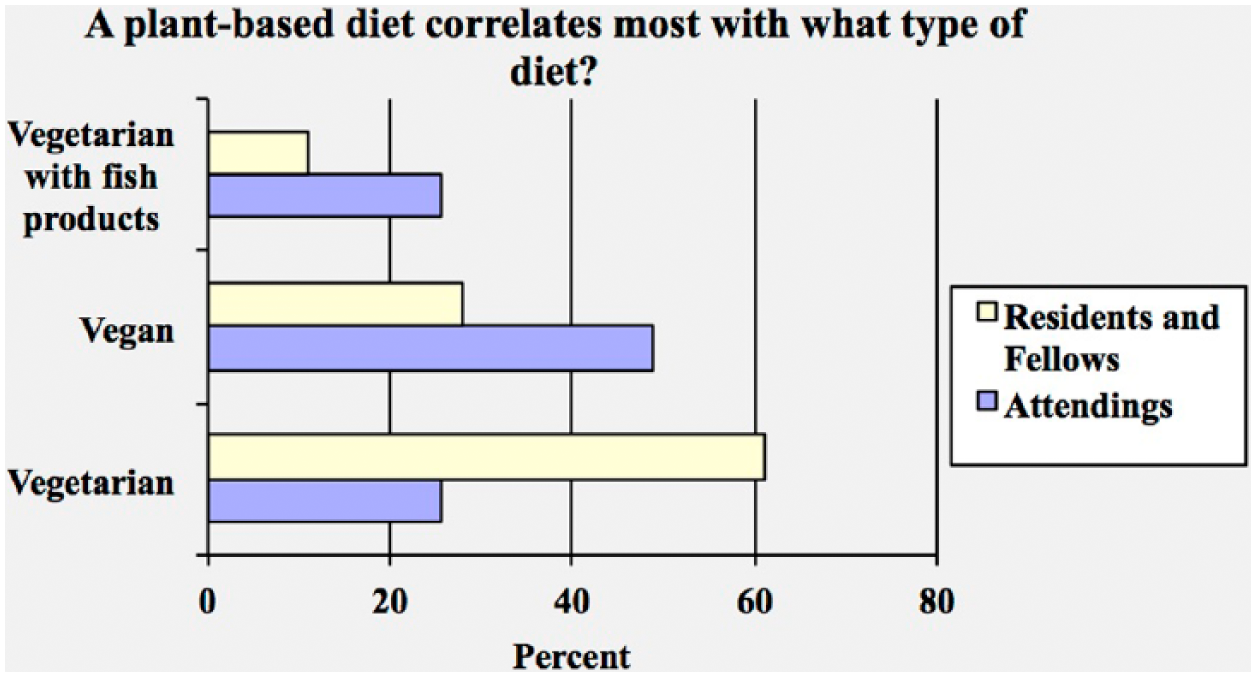
Definition of plant-based nutrition: Rush University Medical Center residents and fellows versus physician attending’s opinion on what type of diet is most similar to a plant-based diet. Most (61%) residents and fellows believed that a plant-based diet was most similar to a vegetarian diet, whereas the majority of attendings (49%) believed that a plant-based diet was most similar to a vegan diet.
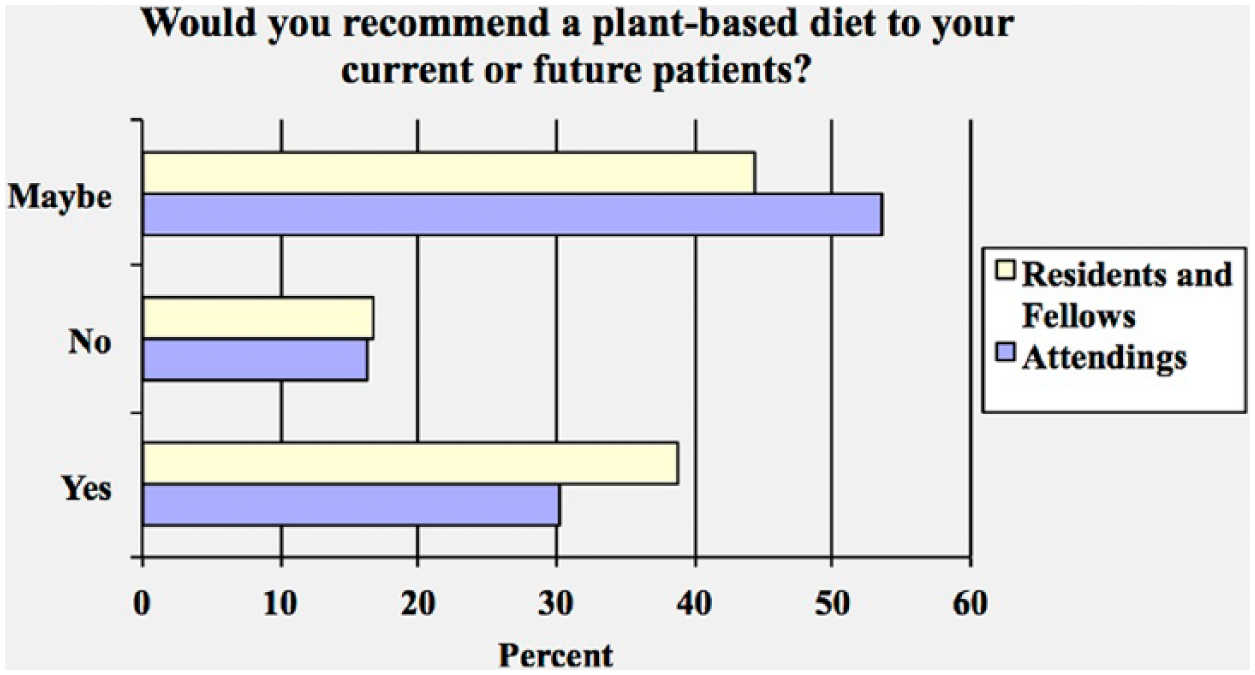
Recommending plant-based nutrition: Rush University Medical Center residents and fellows versus physician attending’s acceptance of recommending plant-based nutrition to patients. Residents and fellows were slightly more willing than attendings to recommend a plant-based diet to future patients: 39% versus 30%, χ2 (n − 1) = 0.13, P nonsignificant.
Discussion
In a convenience sample of more than 4000 medical professionals and students recruited from Rush University Medical Center, 106 completed at least 50% of the questionnaire and only 64 responded to the question regarding level of training, and thus were included in analyses. The majority of participants were female (58%), between the ages of 25-34 years old (33%), and were physician attendings (72%).
Most participants (90%) correctly categorized a vegan diet as one in which an individual does not eat red/white meat, fish, dairy, or eggs, and 79% correctly categorized a vegetarian diet as one in which individuals do not eat meat (including red/white meat, fish) but do eat other animal products (including dairy and eggs).
Participants were mixed on whether they believed that a plant-based diet was most similar to a vegetarian diet (36%), a vegan diet (43%), or a vegetarian diet with fish products (21%). Though plant-based nutrition can be subjective, it is classically defined in the literature as one that emphasizes whole, plant-based, unrefined, unprocessed foods and limits/excludes meat, dairy, and eggs. 6
Participants were mixed on whether they would recommend plant-based nutrition to their current/future patients, with 33% saying yes and 51% saying maybe. Residents and fellows were more willing than physician attendings to recommend a plant-based diet to future patients (39% vs 30%; see Figure 2). Because of the growing body of literature regarding the beneficial effects of plant-based nutrition on health, a position statement was published in the Kaiser Permanente journal in 2013 and suggested that physicians should consider recommending a plant-based diet to their patients. 6 When participants were asked if they would consider adopting a plant-based diet, 28% said yes and 34% said maybe. Physician attendings were more willing to adopt a plant-based diet for themselves when compared with residents and fellows (30% vs 22%). These findings represent opportunities for medical professionals to be educated about the beneficial effects of plant-based nutrition.
The majority of respondents correctly identified several features of plant-based nutrition, including the fact that you can get enough protein (78%), processed foods are avoided (80%), and animal protein is limited/excluded (85%). With regard to nutrition knowledge, 93% correctly identified that dark green leafy vegetables are high in iron, 94% correctly agreed that nuts are high in protein, and 92% correctly disagreed that animal proteins are the only quality protein sources (Table 1).
Likert Scale Results for Physician Attendings, Residents, and Fellows.
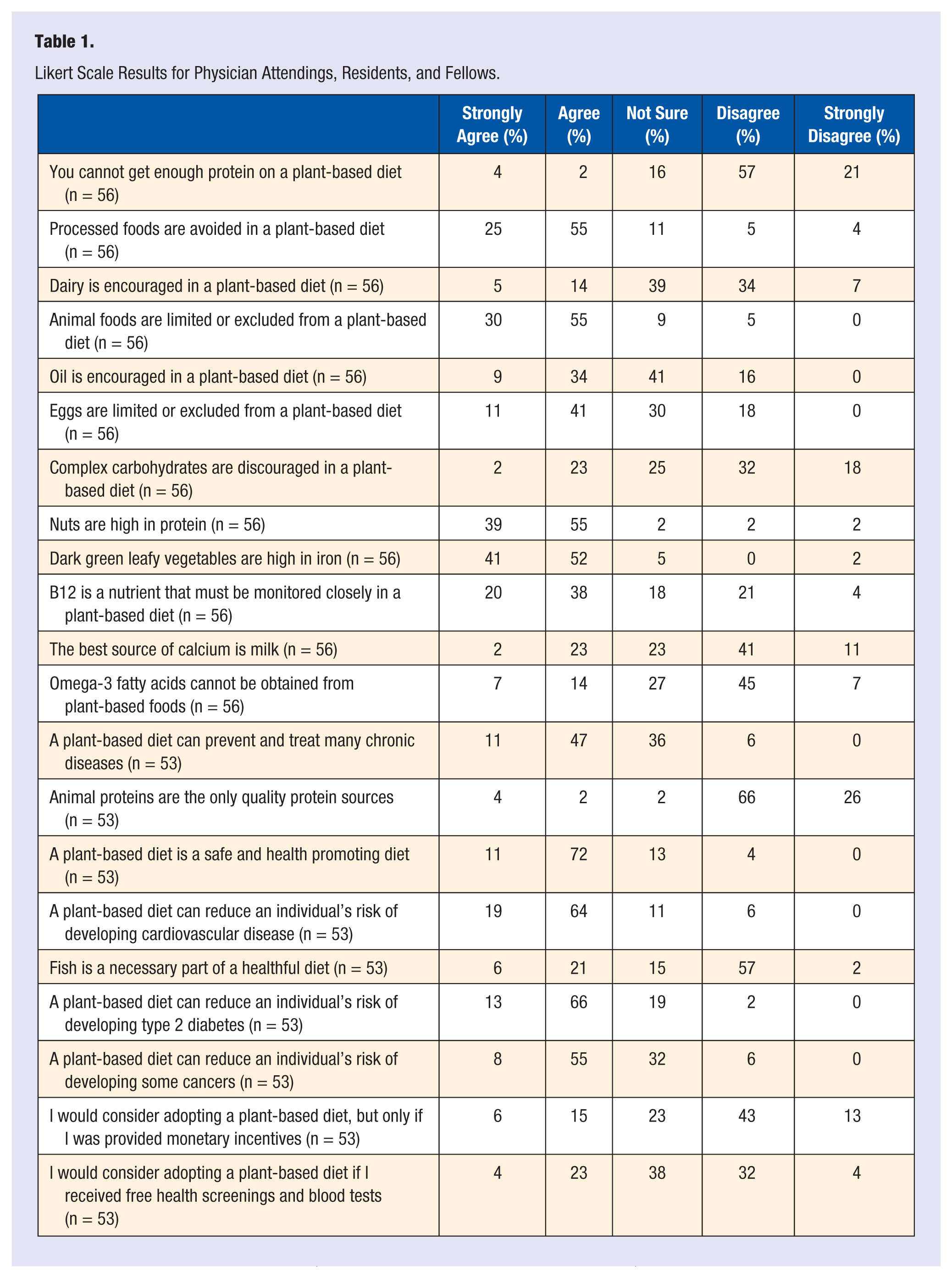
The majority (83%) agreed that a plant-based diet is a safe and health-promoting diet and that this dietary pattern can reduce an individual’s risk of developing cardiovascular disease (83%), type 2 diabetes (79%), and some cancers (63%) as well as prevent and treat many chronic diseases (58%).
Participants were less confident with regard to other features of plant-based nutrition. Only 41% correctly disagreed with the statement that dairy is encouraged in a vegan plant-based diet, and only 52% believed that eggs are limited/excluded on a plant-based diet. A slight majority (58%) correctly agreed that B12 is a nutrient that must be monitored closely on a plant-based diet and that omega-3 fatty acids can be obtained from plant-based foods (52%). When asked whether fish is a necessary part of a healthful diet, 59% correctly disagreed.
Several studies of note have supported the beneficial effects of plant-based nutrition in preventing and treating chronic disease.6-13 One population that is particularly useful to examine when observing the long-term effects of vegetarian diets is the Seventh-Day Adventists (SDA). This religious group does not use tobacco or alcohol, and most follow variations of a vegetarian diet. 7 In a 6-year prospective study of 24 044 SDA, researchers found that risk of fatal coronary heart disease among nonvegetarian SDA males was 3 times greater than that for vegetarian males of comparable ages (P < .01). 7 In another study examining 73 308 SDA, with a mean follow-up of 5.79 years, it was found that vegans and vegetarians had lower risk of all-cause mortality when compared with nonvegetarians, with a hazard ratio of 0.88 (95% CI = 0.80-0.97). 8 When compared with SDA pescatarians, SDA vegans had a 2.6 kg/m2 greater reduction in body mass index, a 55% reduced incidence of diabetes, and a 60% reduction in incidence of hypertension. 3 In a follow-up study with 500 SDA participants, vegans and vegetarians were found to have significantly lower systolic and diastolic blood pressures when compared with omnivores (β = −6.8, P < .001, and β = −6.9, P < .001). 9
Investigations into other populations have found similar results. In a cross-sectional study, with a 12-year follow-up period, comparing 6000 vegetarians and 50 000 nonvegetarians in the United Kingdom, it was found that vegetarians and vegans had significantly lower mortality than nonvegetarians for all-cause mortality and for malignant neoplasms, after adjusting for smoking, body mass index, and social class. 10 Researchers also found significant positive associations between consuming animal fats, eggs, and cheese and ischemic heart disease mortality (P < .01). 10 Furthermore, a meta-analysis investigating cardiovascular disease mortality and cancer incidence in 7 studies, totaling 124 706 participants, vegetarians were found to have a significantly lower ischemic heart disease mortality (29%) and overall cancer incidence (18%) when compared with nonvegetarians. 11 In a prospective cohort study of 131 342 US health care professionals, researchers found that plant protein was associated with decreased all-cause mortality (P < .001) and cardiovascular mortality (P = .007). 2 They further found that substituting 3% of any type of animal protein with plant protein improved the hazard ratios for all-cause mortality: 0.66 (95% CI = 0.59-0.75) for processed red meat, 0.88 (95% CI = 0.84-0.92) for unprocessed red meat, and 0.81 (95% CI = 0.75-0.88) for eggs. 2
When properly planned, a plant-based diet can reduce one’s risk of obesity, diabetes, heart disease, high-blood pressure, cancer, and several other chronic diseases.1-14 Vegetarian diets are often more healthful because they contain lower amounts of total fat, saturated fat, cholesterol, and total energy while tending to be higher in polyunsaturated fatty acids, fiber, vitamins C and E, folate, iron, magnesium, and copper. 13 Vegetarian diets are consistent with the Dietary Guidelines. 12 In fact, the Dietary Guidelines explains that our body produces cholesterol on its own, thus “people do not need to obtain cholesterol through foods” and “individuals should eat as little dietary cholesterol as possible” because this eating pattern is associated with decreased risk of cardiovascular disease and obesity. 14
The current study has several limitations. The population was a convenience sample from a single institution located in the Midwest. In addition, as completion of the questionnaire was voluntary, respondents were possibly motivated by interest and/or knowledge about nutrition in medicine, which could have also potentially biased the results. We intentionally did not define plant-based nutrition in the study questionnaire because we wanted to assess individuals’ perceptions about the definition and components of a plant-based diet. Although this may be seen as a potential limitation, 85% of respondents correctly agreed that animal protein is limited/excluded in plant-based nutrition. The sample size was small, and only physicians were analyzed; thus, it would be important to also examine knowledge about plant-based nutrition in other allied health practitioners. In the future, expanding the questionnaire to include questions about motivations and barriers to incorporating plant-based nutrition in medicine, in addition to trying to reach a larger and more culturally diverse population, would help improve our understanding of the perception and knowledge regarding a plant-based diet in the medical community.
With this study and future research, the ultimate goal is to promote further investigation and acceptance of plant-based nutrition by medical societies, patients, and health care practitioners. Large randomized controlled clinical trials are necessary to bolster evidence regarding the efficacy of plant-based diets in disease prevention. Results from this research can then be used to generate evidence-based treatment guidelines for health care practitioners. Finally, developing broad-based nutrition education in medical schools and residencies and for current medical professionals is essential to further the message about the importance of plant-based nutrition in preventing and treating disease.
Conclusion
The findings from this small pilot study provide insight into medical professionals’ knowledge and opinion regarding plant-based nutrition. The results from this study demonstrate acceptability of physicians in discussing any form of nutrition with their patients. This study highlights the need for future research into physician’s abilities to empower their patients to change their nutrition patterns, which can lead to improved patient health outcomes, fewer procedures, lower costs, and ultimately prevention and treatment of many chronic diseases.
Footnotes
Appendix
Acknowledgements
The research was supported by the Department of Medicine, Division of Cardiology, Rush University School of Medicine.
Authors’ Note
Please contact Amanda Krause at
Declaration of Conflicting Interests
The author(s) declared no potential conflicts of interest with respect to the research, authorship, and/or publication of this article.
Funding
The author(s) received no financial support for the research, authorship, and/or publication of this article.