



Abstract
Many interventions aim to improve dietary patterns but not all are able to maintain these changes long term. Interventions informed by theory may facilitate dietary behavior changes and maintenance of these changes for longer periods of time. PubMed and PsychInfo were searched for theory-based interventions with long-term assessments of fruit and vegetable (FV) and fat intake. We identified 335 unique titles; 20 were included for review. Most interventions (65%) were based on social cognitive theory. Assessments of FV and fat ranged from 12 to 72 months postrandomization, and 15 studies reported significant intervention effects. Only 6 studies directly tested theory in relation to diet and of those, significant findings indicated self-efficacy, motivation for dietary change, perceived competence to eat more FV and less fat, and multiple processes of change were associated with long-term maintenance of healthy eating. Overall, this review indicates that theory-informed interventions are generally successful for long-term improvements in diet quality, although such improvements are often modest. Most studies did not directly measure theoretical constructs in relation to diet outcomes, thus limiting our ability to describe how theory-based interventions specifically promote long-term diet change. Recommendations for future research and practical recommendations for long-term maintenance of diet change are discussed.
‘Interventions that purposefully incorporate theory-based strategies have been recommended for improving dietary behaviors both initially and in the long term.’
Long-term maintenance of positive changes in nutrition habits remains elusive for many people. Although numerous research trials have focused on dietary modification, relatively few have incorporated long-term follow-up and reported successful outcomes with regard to maintenance of behaviors. To support persistent behavior change, the use of theory-based approaches is recommended, 1 yet little is known about how theory may directly contribute to the long-term effectiveness of diet interventions.
Interventions that purposefully incorporate theory-based strategies have been recommended for improving dietary behaviors both initially and in the long term.2,3 However, the literature remains equivocal in this area, with some suggesting that commonly used theories, including social cognitive theory (SCT) and the transtheoretical model (TTM), are unlikely to enhance intervention effectiveness for diet change. 4 In contrast, a recent systematic review found interventions informed by theory were more successful in improving diet compared with those not utilizing theory 2 ; however, the authors did not specifically examine the long-term impact of such interventions. Several theoretical elements, including self-monitoring, self-efficacy, and goal setting, have been identified as integral features shared by many diverse theories and have been linked to successful diet outcomes.5,6 An examination of theory-based interventions targeting long-term improvements in diet quality, including key components for achieving target outcomes, may provide insight into successful strategies for maintaining behavior change.
The purpose of this review was to identify and describe the components of theory-based interventions capable of generating long-term improvements in diet quality. We focused on studies that sought to improve markers of fruit and vegetable (FV) and fat intake, as these changes are recommended by nearly every major health organization and are primary components of most chronic disease prevention programs. Moreover, a recent analysis of diet quality of US adults from 1999-2012 noted improvements in several dietary components (whole grains, fish, sugar sweetened beverages), but no observed change in total FV or saturated fat intake over the same period of time. 7 This null finding for FV and fat highlights the need to identify and analyze interventions capable of achieving sustained improvements in these diet patterns.
Method of Review
We searched the online databases PubMed and PsychInfo for theory-based behavioral lifestyle interventions with a focus on long-term change in dietary patterns as a component of the intervention. The search was conducted on June 9, 2016. For the purpose of this review, long-term was defined as follow-up point(s) ≥12 months postrandomization, irrespective of intervention length. Articles were searched using the following terms: intervention OR program; long-term OR maintenance; diet quality OR diet pattern OR behavior; and theory. After removal of 29 duplicates, a total of 335 unique articles were identified. We further limited articles to those that explicitly stated a behavioral theory as a basis of the intervention and reported change in a dietary outcome among adults with no history of eating disorders. Titles and abstracts were independently reviewed by the four authors, leading to the subsequent exclusion of 305 articles due to lack of compliance with the specified criteria or because they were a review, editorial, or methods paper, or cross-sectional/qualitative in nature. In addition to the 30 remaining articles, 7 articles identified outside of the search were admitted after searching references from relevant papers, particularly a review by Chapman. 8 Finally, articles that did not report changes in both FV and fat (total and/or saturated fat) intake and those published prior to 2000 were excluded, thus yielding 20 articles for review. All eligible studies were in the form of randomized controlled trials (RCTs) or cohort randomized trials. Studies with interventions targeting multiple lifestyle behavioral outcomes (physical activity, smoking cessation, etc), as well as those with multiple dietary outcomes in addition to FV and fat intake (fiber, sodium, etc), were admitted for review. However, this review only reports on the outcomes of interest.
Results
The search process identified 20 unique studies with theory-based interventions and assessments of FV and fat intake at periods ≥12 months after randomization. Across all studies, the total number of participants was 28 743 (range 77 to 5407 participants), and intervention lengths ranged from 2 weeks to 48 months. Nearly all studies assessed diet outcomes immediately postintervention. Six studies conducted follow-up assessments at more than 1 long-term time point, with the longest follow-up at 72 months postrandomization. Table 1 provides an overview of the characteristics of included studies.
Characteristics of Studies Included in the Review.
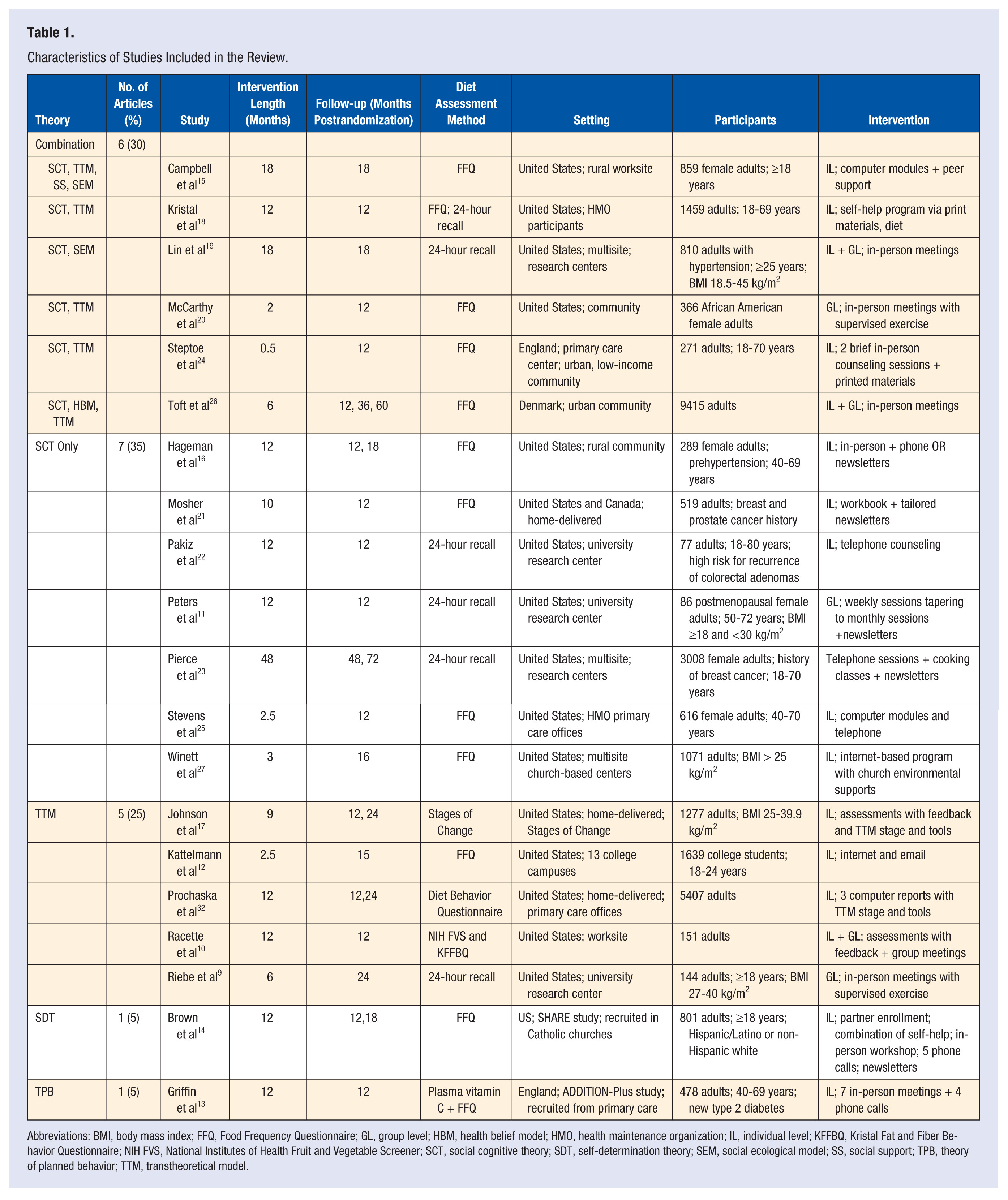
Abbreviations: BMI, body mass index; FFQ, Food Frequency Questionnaire; GL, group level; HBM, health belief model; HMO, health maintenance organization; IL, individual level; KFFBQ, Kristal Fat and Fiber Behavior Questionnaire; NIH FVS, National Institutes of Health Fruit and Vegetable Screener; SCT, social cognitive theory; SDT, self-determination theory; SEM, social ecological model; SS, social support; TPB, theory of planned behavior; TTM, transtheoretical model.
Overall, 15 studies demonstrated a significant intervention effect (between-group differences) for either FV and/or fat at 1 or more long-term follow-up. Three studies did not report a significant intervention effect for either FV or fat but rather reported a significant change from baseline, indicating a within-group difference at a long-term follow-up.9-11 Two studies12,13 did not report significant findings for FV or fat outcomes at any long-term follow-up (Table 2).
Significant Improvements in Fruit and Vegetable or Fat Intake at Long-Term Follow-up Time Points by Theory.
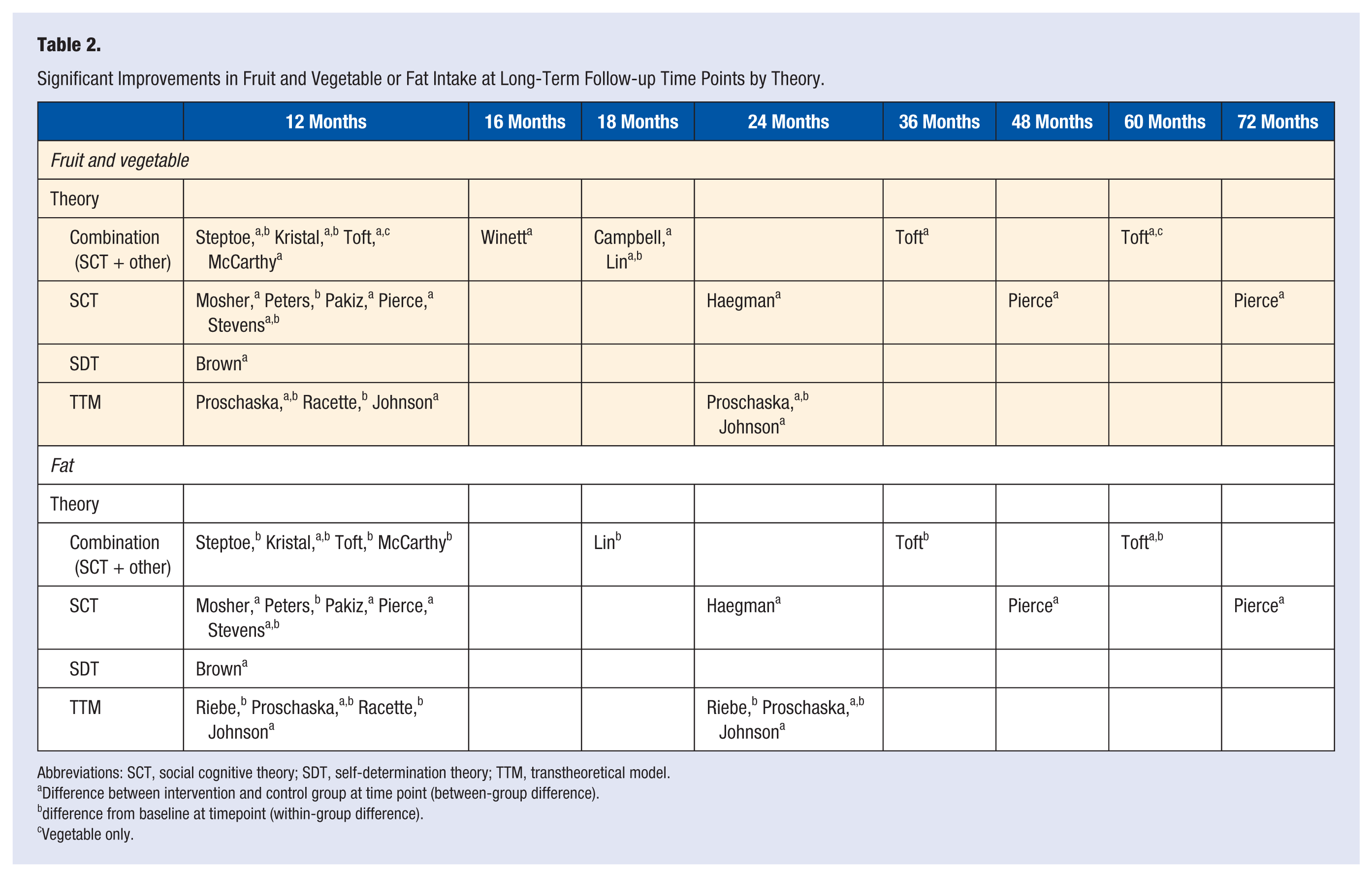
Abbreviations: SCT, social cognitive theory; SDT, self-determination theory; TTM, transtheoretical model.
Difference between intervention and control group at time point (between-group difference).
difference from baseline at timepoint (within-group difference).
Vegetable only.
Long-Term Changes in Fruit, Vegetable, and Fat Intake
Fifteen studies reported significant between-group differences for increased FV intake at 1 or more long-term follow-up, indicating a successful intervention effect14-27 (Table 2). Of the 5 studies that did not achieve long-term intervention effects for FV increases: Kattelmann et al 12 reported significant between-group differences at a 3-month assessment, although those findings had attenuated by the long-term follow-up; Griffin et al 13 had a usual care control group that may have obscured significant findings; Riebe et al 9 reported unexpected findings with a significant decrease in FV intake at 24 months; and both Peters et al 11 and Racette et al 10 had significant increases in FV from baseline but not compared with a control group. About half of the studies in this review (8 studies) reported intervention effects for FV intake that extended beyond 12 months. Two studies measured and were successful at maintaining an increase in FV intake at 36 months or more23,26; however, while Toft et al 26 reported a significant intervention effect for FV at 36 months, the differences only remained for vegetables at the 60-month follow-up. Of the 4 studies with multiple follow-up time points, only Pierce et al 23 reported regression toward baseline intake values. However, this study utilized the longest follow-up period of all studies and achieved recommended levels of intake for FV at all long-term time points.
Regarding dietary fat, 10 studies had significant intervention effects for reducing intake of total fat or saturated fat as a result of a theory-based intervention (Table 2). The distribution of significant long-term findings for reductions in dietary fat was similar to those of FV findings. However, changes in fat were less likely to be reported as intervention effects (between-group differences) and more commonly were reported as differences from baseline to follow-up.
Theoretical Aspects of Long-Term Diet Change
A majority of interventions (65%) in this review utilized SCT, 28 either alone (7 studies) or in combination with at least 1 other theory (6 studies). The TTM 29 was the next most prevalent theory (5 studies), while self-determination theory (SDT) 30 and the theory of planned behavior (TPB) 31 were the basis of 1 study each (Table 1). In this issue, a brief description of these theories is provided by Joseph et al. 3 Of the 18 studies with significant changes at any long-term follow-up, 10 explicitly linked theory or a theoretical construct to outcome success in their results or in the discussion of the results* and 6 directly tested theoretical constructs in relation to diet outcomes.9,14,17,18,21,32
Social Cognitive Theory–Based Interventions
SCT was the theory most frequently cited out of all interventions that achieved significant long-term intervention effects for FV or fat (12 of 15 studies). SCT-based interventions primarily focused on components such as goal-setting, self-efficacy, addressing barriers, knowledge of risks and benefits, and motivation. Among all studies utilizing SCT, only that of Mosher et al 21 explicitly tested any theoretical construct and found that changes in self-efficacy were associated with improved diet. Only 3 out of 7 studies using a theory other than SCT14,17,32 reported significant between-group differences at a long-term follow-up.
Transtheoretical Model–Based Interventions
Four TTM-based interventions reporting significant intervention effects9,17,18,32 explicitly stated that theory played a role in the intervention’s success and also directly measured a component of the theory. Johnson et al’s 17 individually tailored, stage-based intervention was successful for moving intervention participants (in preaction stage at baseline) to action or maintenance for consuming recommended amounts of FV and fat. Prochaska et al 32 had similar findings with a multi-behavior, stage-based intervention, showing treatment effects for moving participants to action or maintenance for reducing fat and increasing FV consumption. Kristal et al 18 delivered an intervention based on TTM and SCT and measured participants’ movement through stages of dietary change for fat and FV. In contrast to Johnson et al 17 and Proschaka et al 32 who used behavioral criterion when measuring stage (eg, readiness to consume less than 30% energy from fat or five servings of FV per day), Kristal et al 18 measured stage of change as a “measure of cognitive and behavioral engagement in the diet change process” with self-reported ratings of “very low, low, in the middle, high or very high” consumption of fat or fruits and vegetables and found significant intervention effects for FV and fat but only for those already in action or maintenance, and not preaction stages. Riebe et al 9 measured decisional balance, processes of change, and self-efficacy in relation to dietary outcomes and found a significant reduction from baseline to follow-up for saturated fat intake but, similar to Kristal et al, 18 found that changes were larger for those already in action stages. Additionally, Riebe et al 9 found a significant increase in FV intake from 5.4 servings per day at baseline to 5.7 servings per day at 6-month follow-up. However, at 12 and 24 months, FV intake significantly decreased below baseline levels to 4.9 and 4.4 servings per day, respectively.
Theory of Planned Behavior– or Self-Determination Theory–Based Interventions
Only 1 study in this review utilized TPB, and the authors did not report any long-term change in FV or fat. 13 The 1 study that based its intervention on SDT reported an intervention effect for both fat and FV and also directly tested constructs in relation to the theory. Specifically, changes in lack of motivation for dietary change and perceived competence to eat more FV were significant among the treatment group. In this study, there was an intervention effect for both FV and fat; however, authors described that it is more likely that the intervention prevented a decline in the treatment group rather than encouraged an increase.
Discussion
The current article provides an in-depth review of recent theory-based interventions that facilitated maintenance of long-term changes in FV and/or fat consumption. Of the 20 articles in this review, 18 reported significant findings for either FV and/or fat at 1 or more long-term assessments; however, only 15 described intervention effects signaling that the theory-based intervention played a role in promoting dietary changes. Only half of the studies referenced theory in the discussion of their findings or described findings in relation to the theory used, and even fewer studies9,14,17,18,21,32 (6 studies) explicitly measured a theoretical construct and analyzed it in relation to a dietary outcome measure. Additionally, even when theory was explicitly measured, the theory as a whole was not evaluated (ie, only selected constructs of the theory directly tested).
With regard to theory, SCT, either alone or in combination with other theoretical models, was by far the most prominent theoretical basis for interventions. Despite the prevalence of SCT-based interventions in this review, only 1 study directly measured any construct related to the theory. Mosher et al 21 based the FRESH START intervention on SCT, which has a number of core constructs including self-efficacy, self-regulation, outcome expectations, and observational learning among others. 33 Even though it was the authors’ stated purpose to focus specifically on self-efficacy due to it being one of the primary constructs in SCT and due to the lack of other research formally evaluating self-efficacy as a mediator of the effects on diet, self-efficacy alone does not comprise the theory. Therefore, identifying relationships between individual constructs and diet outcomes may be useful for making recommendations regarding the construct measured, but interpretations regarding the use of the whole theory should be based on more inclusive evaluations. This limits our ability to draw conclusions about the specific impact of theory on long-term diet changes.
Studies utilizing TTM were the most consistent regarding overall testing of theory in relation to diet change. Out of 4 TTM-only studies with significant long-term diet outcomes, 3 studies explicitly measured stage of change.9,17,32 The fourth study created an intervention that addressed multiple stages of TTM, but it neither individually tailored the intervention nor measured stages of participants. 10 Another study 18 utilized a combination of TTM and SCT for their intervention and measured movement through TTM stages but no SCT constructs. Common components of TTM-based interventions cited in this review included goal setting, stimulus control, relapse prevention, stage-tailored communications, and enhancing motivation. Only Riebe et al 9 measured multiple constructs of TTM in addition to stage of change for dietary behavior and reported significant relationships between 4 distinct constructs and the ability to maintain dietary fat at less than 25% total intake at 2 years. However, this study did not report a significant intervention effect for either fat or FV and actually found lower intake of FV at long-term follow-up.
Several limitations of this review are noted. Although most studies reported significant long-term diet change, very few reported participants achieving and maintaining recommended intakes. Current dietary guidelines recommend limiting saturated fat to less than 10% of total energy intake per day. 34 Many of the studies in this review reported a reduction in total dietary fat as an outcome variable. Only 2 studies14,16 specifically noted a significant reduction in saturated fat, and only 1 study 16 discussed findings in relation to meeting the current recommended intake of less than 10% of total energy from saturated fat. Based on supplemental data, Brown et al 14 likely achieved recommended intakes of saturated fat, although findings were not explicitly stated as such. A similar limitation exists with reports of FV intake. Studies reporting a significant intervention effect for FV intake typically saw only modest increases, and only 1 study reported FV intake meeting the recommended levels of 3 servings of vegetables and 2 servings of fruit per day. 34 Another limitation is found in the diversity of measurement procedures used for assessing diet outcomes, making it difficult in some cases to ascertain if recommended levels were achieved. Many studies had multiple follow-up time points and, in most cases, reported detailed descriptions of within-group and between-group differences at each time point. However, in some cases when treatment effects (based on intervention) were reported, we were unable to assess if there were also significant within-group differences.
Practical Recommendations
This review elucidated constructs that have been related to long-term maintenance and therefore might be successful if used by practitioners or those attempting to counsel on maintenance of dietary improvements. The specific theoretical components of interventions directly measured and explicitly linked to maintenance of diet change (increase in FV or decrease in fat) included self-efficacy or self-efficacy-related constructs such as motivation and competence.9,14,21 Thus, integrating behavior change techniques that address self-efficacy may be useful when the goal is to maintain long-term changes in FV and/or fat. Additionally, many of the theory-based interventions reviewed utilized tailored feedback, including individualized reports of dietary intake and messages relevant to the population of interest, with most TTM interventions including messages tailored to the stage of change. More detailed evaluations of theory’s role in long-term adherence to dietary improvements is needed, specifically direct measures of theory in relation to long-term maintenance of diet quality.
