




Abstract
The prevalence of overweight and obesity among youth has increased markedly in the past 2 decades in the United States. According to the Centers for Disease Control and Prevention, in 2010, more than one-third of children and adolescents were overweight or obese. A number of obesity prevention and intervention programs focus on the individual by utilizing intrapersonal theories to encourage the individual to eat healthy and participate in physical activity. The purpose of the current article is to go beyond the individual level and approach obesity with an ecological perspective because it may prove to have a larger influence. The ecological systems theory (EST) by Bronfenbrenner postulated that human development is influenced by a reciprocal relationship between the individual and their social system. In the context of physical activity, health behaviors occur within and are influenced by the multiple systems within which youth reside. This manuscript explores Bronfenbrenner’s EST framework comprising 4 systems: microsystem, mesosystem, exosystem, and macrosystem. Each level of the system is explored and applied to the obesity epidemic among youth.
‘It has been acknowledged in the literature that childhood obesity has a multifactorial etiology, involving both individual and environmental factors.’
Introduction
Obesity, once considered a personal health issue, is increasingly prevalent among families, social networks, and the world as a social health issue. From 1976 to 2008, the prevalence of obesity in children 2 to 5 years old increased from 5.0% to 10.4%, whereas for children 6 to 11 years old, the rates of obesity increased from 6.5% to an astounding 19.6%. 1 According to the Centers for Disease Control and Prevention, 2 more than one-third (35.7%) of the adult population in the United States is obese. The growing escalation in the rates of obesity among youth raises concerns related to the short-term and long-term negative health consequences for this population. According to the research, overweight and obese youth are also more likely to develop severe obesity and other chronic diseases as adults.3,4 Most obesity prevention and intervention programs focus on the individual by utilizing intrapersonal theories to encourage the individual to eat healthy and participate in physical activity. Although approaching the obesity epidemic at the intrapersonal level has proven successful, the purpose of the current article is to go beyond the individual level and approach obesity with an ecological perspective because it may prove to have a larger influence.
Previous research has identified a number of the influential factors for childhood overweight and obesity.5,6 It is common for physical activity intervention programs to focus solely on the individual without considering the influence of other contexts that also affect youth (eg, family, school, youth programs, and peer groups). It has been acknowledged in the literature that childhood obesity has a multifactorial etiology, involving both individual and environmental factors.7,8 Thus, it is imperative for researchers to examine potential contributing factors in the development of childhood overweight and obesity from the multiple contexts in which children live.
Bronfenbrenner postulated in his ecological systems theory (EST) that human development, especially psychological and social aspects, is influenced by a reciprocal relationship between the individual and the social system.9,10 More specifically, an individual’s surroundings may shape his or her attitudes, beliefs, and behaviors while those factors are also affecting their environment. In the context of physical activity, health behaviors occur within and are influenced by the multiple systems individuals reside within. Bronfenbrenner’s social ecology framework comprises 4 systems: (1) microsystem; (2) mesosystem; (3) exosystem; and (4) macrosystem (see Figure 1).
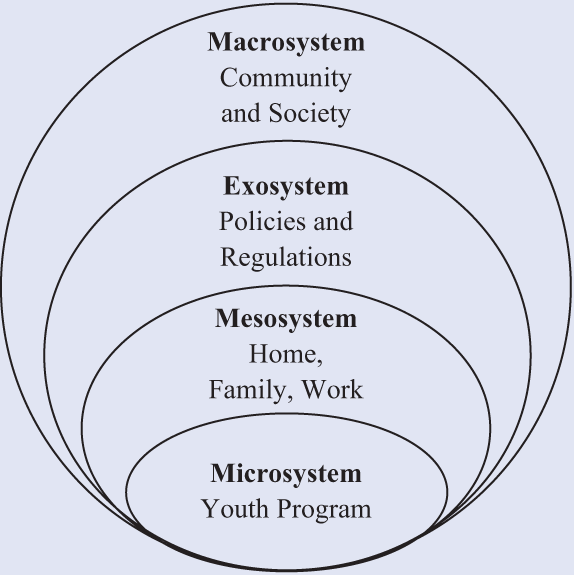
An Ecological Systems Model.
Microsystem
According to EST, every individual is influenced by his or her interconnections with the environment. EST proposes that individuals exist within a variety of settings and are directly and indirectly influenced by environmental entities, such as home, school, work, community, and society. 11 These multiple layers, starting at the individual level and extending outward, affect individual health behaviors. The microsystem involves direct interactions between the individual and individuals in their immediate environment, such as at home, school, or work. The microsystem also encompasses the individual’s attitudes, beliefs, knowledge, family interactions, and social relationships. 7
Mesosystem
Youth play a role in a variety of influential contexts each day, including home, school, work, youth programs, and other free time peer settings, which constitutes their mesosystem. 12 The mesosystem includes the interaction between 2 microsystems. In other words, when 2 or more contexts within a microsystem connect, then a mesosystem has been created. 9 The mesosystem consists of the interrelationships the individual experiences. For example, a mesosystem exists if a health education teacher and a parental organization (eg, parent teacher association) work in tandem to develop a school physical activity intervention. 13 Thus, a parent-focused, school-based childhood obesity prevention program would be considered part of the mesosystem.
Exosystem
An exosystem is created when 2 or more microsystems are linked; however, the individual is not at the center of at least one of the microsystems, but the microsystem still exerts influence over the individual. 14 In other words, exosystems are composed of factors external to the individual and in which the individual is not directly involved in, but these factors still affect the individual. For example, if a parent had a long day at work and was too tired to take the child to the park to play, the parent’s work environment is indirectly influencing the child’s home setting. In some cases, these factors could present as the equivalent to barriers to obesity prevention on the intrapersonal level (low socioeconomic status, unsafe neighborhoods, availability of fresh produce, etc). In a broader perspective, the funding and budget cuts public school systems are experiencing do not directly involve the children in those schools, but the children are influenced when physical education programs are cut. Therefore, funding issues and even school lunch regulations are factors that compose children’s exosystems.
Macrosystem
The macrosystem encompasses all the other systems (microsystems, mesosystems, and exosystems) and includes the culture of the systems. 14 Culture is a broad concept that includes, but is not limited to, attitudes, behaviors, beliefs, knowledge, lifestyles, norms, and values. More specifically, cultural attitudes and beliefs surrounding eating habits and body shape can increase childhood obesity. For example, lack of knowledge regarding proper portion sizes and underlying cultural norms of children having to finish all the food on their plate or eating second helpings of food 15 only stand to increase the amount of food youth are consuming. Norms relevant to body shape and perceptions of what is considered attractive and healthy differ according to racial and ethnic cultures. Black and Hispanic cultures favor fuller body shapes and sizes as compared with White culture 16 and, consequently, tend to identify heavy child body shapes and sizes as healthy. 17
Application of EST
Bronfenbrenner’s EST has been reported to be bidirectional, meaning that one level of the system (eg, the microsystem) is affected by another level of the system (eg, the macrosystem), and vice versa. 11 For example, youth (microsystem) are thought to be highly influenced by schools (mesosystem), which are nested within communities (exosystem), which are nested within society at large (macrosystem). It is in the microsystem where most youth obesity prevention programs are created because these programs only affect one level of the youth’s environment (home, school, or after-school program).
In the microsystem, individual elements of the participants must be taken into consideration when developing youth obesity prevention and intervention programs. Gender, sexual orientation, race/ethnicity, physical abilities, and self-efficacy should all be considered when constructing a program. 8 Physical ability varies widely on an individual basis and according to age. New technology can not only encourage youth to participate in physical activity, but it can also be appropriately tailored to physical ability. For example, Microsoft is pilot testing the effects of Xbox Kinect, a gaming console that registers physical movement such as running, jumping, and dancing as youth play various games. 18 The Kinect exercise room was implemented in an elementary school in Northwest Arkansas in November 2012 and served as the starting point for possible creation and integration of similar exercise rooms throughout the nation. Microsoft is offering free Xbox Kinect trials for K-12 schools and offers additional discounts to academic institutions to purchase the Kinect system. 19
A prevention program implemented on the mesosystem level increases the likelihood of success because more than one of the youth’s microsystems is influenced by the program. For example, rather than implementing a school program where youth only experience the intervention at school, creating a combined school and home approach that incorporates parental involvement increases the likelihood that youth will adopt the behavior(s) the intervention is trying to foster. In the above scenario, children would receive the intervention both at school and home. This approach has been widely used and proven successful when creating drug education programs that target children at elementary school age and younger.20-24 However, program designers must assess the level of willingness parents have to be involved in a combined school and home approach because parental commitment to work and other family duties may prevent them from full program participation. Garden-based youth nutritional programs have been implemented in schools and as part of the community in an effort to increase young people’s consumption, preferences, and attitudes toward fruits and vegetables. Ratcliffe et al 25 implemented a garden-based educational program for sixth graders at 2 schools that included garden activities during school hours and on the weekends to allow students to model behaviors for friends and family. More specifically, students were asked to invite friends and family to community garden events to demonstrate the garden activities they learned throughout the 13-week program. In addition to gardening activities, such as planting and harvesting, students learned how to prepare and cook the fruits and vegetables grown in the garden, which increased self-efficacy relevant to consuming fruits and vegetables. This program was implemented on the mesosystem level because it influenced the self-efficacy of youth (intrapersonal level) and 2 or more microsystems (school, home, and/or peer environments).
It is much more difficult to implement change on the exosystem level because programs at this level are mainly concerned with policies and regulations, the development of which tends to be time-consuming. However, approaching childhood obesity prevention at this level would include the following: advocating for physical activity to be mandatory in schools rather than cut because of budget limitations; stricter regulations of school lunches in primary care facilities in addition to elementary, middle, and high schools; regulating the number of new fast food restaurants built in lower-income areas; building more parks and recreational areas for children to play; and providing free and safe aftercare programs for children with parents who work long hours. Youth comprise a population that is not able to advocate for their own needs; thus, it is imperative for teachers, school officials, parents, community leaders, and health educators to advocate for their needs. For example, in 2010, the San Francisco, California, Board of Supervisors banned McDonald’s from including toys in happy meals that did not meet nutritional standards. 26
In addition to advocating for policy changes, it may be beneficial for schools and communities to create partnerships on the macrosystem level with external organizations that can provide the desired services without having to go through the “red tape.” As previously mentioned, the collaboration of Microsoft with the school district and the elementary school to pilot test the Kinect exercise room would be a prime example of creating an external partnership. Additionally, the National Football League (NFL) partners with schools and local youth sports teams to implement the Play 60 program. 27 The Play 60 program is a youth health and fitness program that focuses on decreasing childhood obesity by encouraging youth to participate in 60 minutes of physical activity every day. 27 The program has been implemented at the grassroots level to affect schools, after-school programs, and youth sports teams. Professional football players are often personally involved and visit different schools and city sports leagues to encourage program participation.
Conclusion
Utilization of Bronfenbrenner’s EST framework may enable researchers to explore the different levels of systems that influence physical education programming and school food health programs that affect obesity among youth. A program that appropriately addresses multiple system factors rather than just microsystem factors may have a higher success rate. When designing programs that incorporate multiple system factors, creating long-term partnerships may serve as an integral component. The EST framework should be used as a tool for multidisciplinary collaboration with the goals of uncovering predisposing and enabling factors of childhood obesity across different socioeconomic, cultural, racial/ethnic, and age groups to develop tailored, research-based prevention and intervention programs that lower the short- and long-term health risks associated with obesity and its comorbidities among youth.