




Abstract
This article provides a comprehensive review of Internet– and Website–based physical activity interventions targeting adult populations. Search procedures identified 72 unique Internet-based physical activity interventions published in peer-reviewed journals. Participants of the studies were predominately White, middle-aged (mean age = 43.3 years), and female (65.9%). Intervention durations ranged from 2 weeks to 13 months (median = 12 weeks). Forty-six of the studies were randomized controlled trials, 21 were randomized trials without a control condition, 2 were non–randomized controlled trials, and 3 used a single-group design. The majority of studies (n = 68) assessed outcomes immediately following the end of the intervention period, and 16 studies provided delayed postintervention assessments. Forty-four of the 72 studies (61.1%) reported significant increases in physical activity. Future directions for Internet-based physical activity interventions include increasing representation of minority and male populations in Internet-based efforts, conducting delayed postintervention follow-up assessments, and incorporating emerging technologies (ie, cellular and Smartphones) into Internet-based physical activity efforts.
Benefits of using Internet-based technology to promote physical activity include the potential to reach a large number of people at a relatively low cost . . .
Physical activity is an independent risk factor for reducing all cause mortality; 1 thus, the more physically active people are, the less likely they are to die prematurely. Additional health benefits of physical activity include the prevention and treatment of various health conditions, including cardiovascular disease, type 2 diabetes, osteoarthritis, metabolic syndrome, stroke, high blood pressure, and select cancers such as breast and colon. 2 Given the overwhelmingly positive health benefits associated with physical activity, it is not surprising that researchers have long attempted to discover effective methods in which to promote physical activity.
Internet– and Website–based physical activity interventions represent a potential method in which to intervene and promote physical activity. These types of interventions show promise because many Americans already use the Internet on a daily basis. National statistics show that approximately 71% of Americans have household Internet access and that this percentage increases to 77% for those who have attended some college and to 89% for those who have a college degree. 3 Rates of Internet use are similar among men and women3,4 but slightly higher among Whites (84%) than African Americans (73%) and Latinos (74%). 5 However, recent trend data indicate that Internet use (via cellular and Smartphone technology, in particular) among racial/ethnic minorities is rapidly approaching levels reported by Whites. 4 Benefits of using Internet-based technology to promote physical activity include the potential to reach a large number of people at a relatively low cost; ability to provide 24-hour access to intervention materials, which increases the convenience, access, and exposure of intervention messages; and the capacity to instantaneously deliver tailored intervention messages to participants without the delays commonly found in print or telephone-delivered interventions. 6
Past reviews have been conducted on this topic. However, approximately 5 years has passed since the most recent narrative reviews were conducted.7,8 The purpose of this article is to provide a comprehensive up-to-date review of Internet-based physical activity intervention research targeting adult populations. As a more recent meta-analysis 9 focused strictly on studies with randomized controlled trial designs, the current review includes relevant studies of all research designs to provide a more complete picture of what has been performed thus far in this fast moving field of research. Findings derived from this review provide important insight on the current status of the published literature on Internet- and Web-based approaches to promoting physical activity.
Method of Review
The current review focused exclusively on Internet– and Website–based interventions targeting adult populations. Articles were included in the review if they (a) focused on adult populations (defined as including individuals ≥18 years of age), (b) were published prior to August 2012, (c) used the Internet or email as the primary intervention delivery method, (d) identified physical activity as the primary or one of the primary focuses of the intervention, (e) provided both baseline and postintervention outcomes for a physical activity measure, and (f) were published in English. Articles were excluded from the review if they (a) focused exclusively on child or adolescent populations, (b) focused exclusively on elderly populations, or (c) targeted individuals with severe mental illness (ie, schizophrenia or any other mental illness that may have inhibited comprehension of intervention); however, studies focusing on individuals with depression/anxiety were included in the review.
Articles were located by searching the PubMed and PsycINFO electronic search databases. The search strategy involved locating articles at the intersection of 2 key concepts: (a) type of behavior and (b) type of intervention delivery. Search terms used for type of behavior included “physical activity” and “exercise.” Search terms for type of intervention delivery included “Internet,” “Web-based,” and “email.” An example of a search iteration performed included “physical activity AND Internet.” Two independent reviewers performed the search procedures and abstracted articles to be included in the review; any disagreements regarding inclusion/exclusion criteria were resolved by the 2 reviewers reaching a consensus. Reference lists of relevant articles retrieved during search procedures were reviewed to identify additional Internet-based physical activity studies not retrieved during the online search process.
Results
Seventy-two unique Internet-based interventions promoting physical activity met the inclusion criteria for the review. Articles were published between 2001 and 2012, with the modal year of publication being 2009 (n = 11). Tables 1, 2, and 3 provide a brief summary of each of the studies included in the review.
Studies With Randomized Controlled Trial Designs.

Abbreviations: PA, physical activity; NR, not reported; SCT, Social Cognitive Theory; TTM, Transtheoretical Model; TPB, Theory of Planned Behavior; HBM, Health Belief Model; 7-Day PAR, 7-Day Physical Activity Recall; IPAQ, International Physical Activity Questionnaire; BRFSS, Behavioral Risk Factor Surveillance System; SE, Self-efficacy Theory; SEM, Social Ecological Model; PMT, Protection Motivation Theory; GLTEQ, Godin Leisure Time Exercise Questionnaire.
Studies With Randomized Trial Designs.
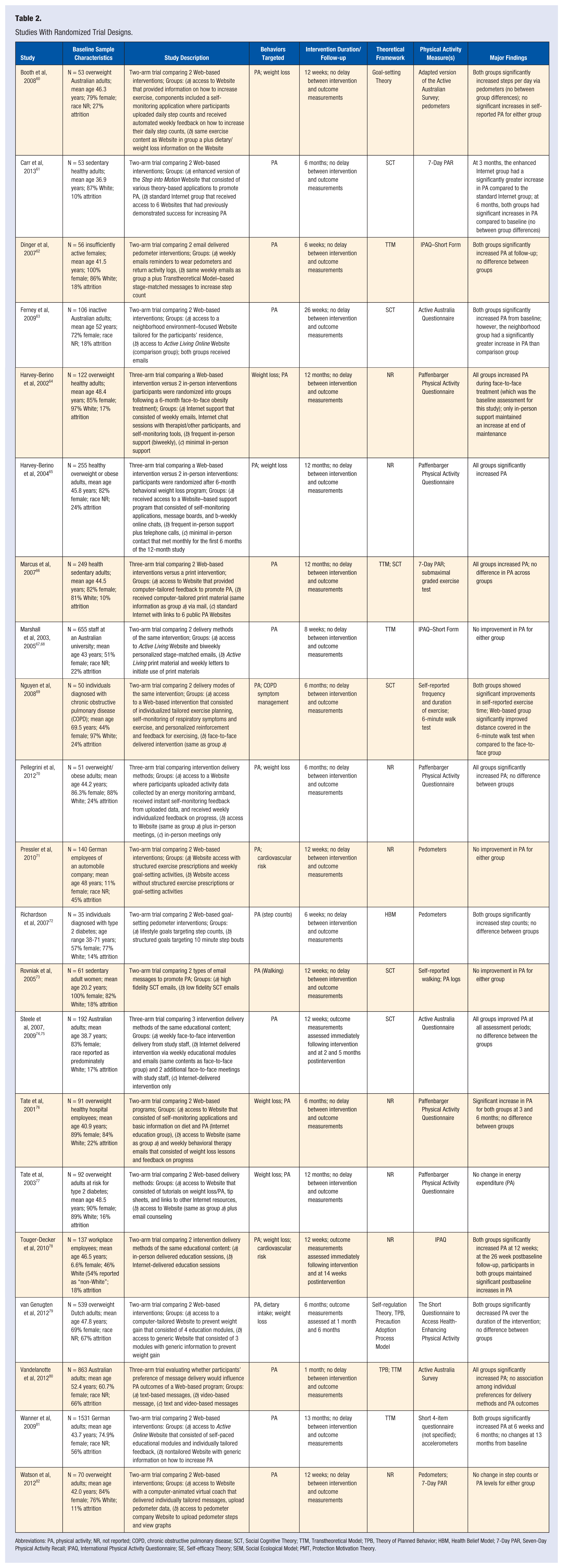
Abbreviations: PA, physical activity; NR, not reported; COPD, chronic obstructive pulmonary disease; SCT, Social Cognitive Theory; TTM, Transtheoretical Model; TPB, Theory of Planned Behavior; HBM, Health Belief Model; 7-Day PAR, Seven-Day Physical Activity Recall; IPAQ, International Physical Activity Questionnaire; SE, Self-efficacy Theory; SEM, Social Ecological Model; PMT, Protection Motivation Theory.
Participant Characteristics
The total number of participants enrolled in the studies was 24 966, and the median sample size was 142.5 participants (mean = 346.8, standard deviation [SD] = 462.7) per study. Samples ranged from 15 to 2159 participants, and participants were mostly middle-aged (mean age 43.3, SD = 10.8) and female (65.9% female, excluding 2 studies that did not include the number of males/females). The majority of the studies targeted both males and females (n = 62); however, 7 studies focused exclusively on women* and 3 studies focused exclusively on men.41,42,48 Few studies included a substantial number of racial and ethnic minorities despite the fact that these populations, specifically African Americans and Latinos, report disparate levels of physical activity 2 and share a disproportionate disease burden of many conditions associated with insufficient physical activity levels (ie, obesity, cardiovascular disease, colon cancer). 88 Only one study comprised a majority Hispanic sample (78%), 37 and no studies consisted of a majority Black/African American sample. Other studies with notable samples of minorities included those conducted by LaChausse (44% Hispanic/Latino), 32 Glasgow (22% Hispanic/Latino), 19 Gow (22% Black), 20 and Winett (23% Black). 58
Eleven countries were represented by the 72 studies included in the review. Most were conducted in the United States (n = 49), followed by Australia (n = 7), † the Netherlands (n = 5),28,45,52,56,79 Canada (n = 3),33,50,59 and the United Kingdom (n = 2).25,39 Other countries represented from studies included in the review were Belgium, 54 Germany, 71 Scotland, 51 South Korea, 29 Switzerland, 81 and Taiwan. 24 Study populations targeted by the Internet-based interventions varied. The most frequently targeted populations were worksite employees (n = 16), overweight/obese adults (n = 13), university students (n = 10), healthy adults (n = 9), insufficiently active/sedentary adults (n = 7), and individuals diagnosed with type 2 diabetes (n = 7).
Among studies providing ample data to calculate attrition (n = 68), attrition ranged from 0% to 69%, and the mean attrition across studies was 22.3% (SD = 14.5). Attrition appeared to be slightly higher among interventions with longer durations. For example, mean attrition rates for interventions less than 6 months in duration (n = 49) was 20.9 (SD = 13.8), and attrition rates for studies with a duration of 6 months or greater (n = 20) was 24.4 (SD = 14.7).
Study Design and Duration
Of the 72 studies included in the review, 46 were randomized controlled trials (Table 1), 21 were randomized trials without a control group (Table 2), 3 were single-group pre–post test designs, and 2 were non–randomized controlled trials (Table 3). Studies were considered randomized controlled trials if they reported using either a no-contact/wait-list control group (n = 25) or an attention contact/usual care control group (n = 21). Among the 21 randomized trials not using a control group, 11 compared 2 types of Website–based interventions, ‡ 6 evaluated Website–based versus in-person interventions, § 2 evaluated a Website–based intervention versus a print-based intervention,66,67 and 2 compared 2 email-based approaches.62,73 Duration of the interventions ranged from 2 weeks to 13 months, and the mean duration across the studies was 17.5 weeks (SD = 14.2, median = 12 weeks). Fifty-two studies had a duration of less than 6 months, and 20 studies had a duration of 6 months or greater.
Studies With Single Group or Nonrandomized Designs.
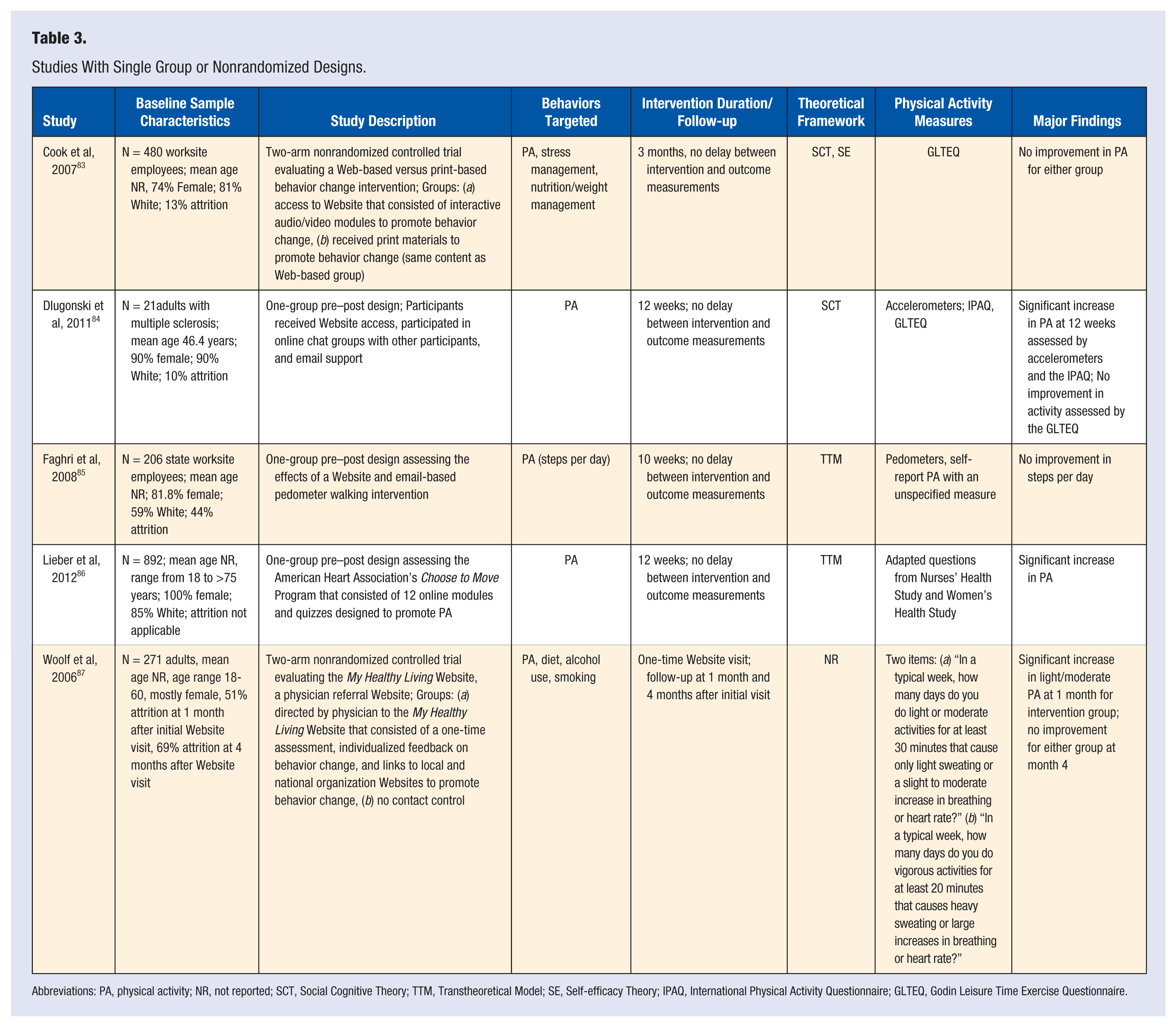
Abbreviations: PA, physical activity; NR, not reported; SCT, Social Cognitive Theory; TTM, Transtheoretical Model; SE, Self-efficacy Theory; IPAQ, International Physical Activity Questionnaire; GLTEQ, Godin Leisure Time Exercise Questionnaire.
Behaviors Targeted
Thirty-seven of the studies targeted physical activity as the sole outcome of the intervention. The remaining 35 studies targeted multiple behavioral outcomes that included physical activity. Examples of additional behaviors targeted by interventions included weight loss (n = 19), improvement in diet/nutritional intake (n = 8), self-management of cardiovascular risk factors (n = 7), self-management of type 2 diabetes (n = 1), weight control (n = 1), and self-management of arthritis (n = 1).
Theoretical Backgrounds
Forty-nine studies (68%) identified a behavioral health theory driving intervention activities. Of these, 37 identified a single behavioral theory and 12 identified more than 1 behavioral theory in which intervention activities were based. The most commonly identified theories were the Social Cognitive Theory (n = 24) and Transtheoretical Model (n = 27). Other theoretical backgrounds included Self-efficacy Theory (n = 6), Theory of Planned Behavior (n = 6), the Social Ecological Model (n = 3), Health Belief Model (n = 2), Precaution Adoption Process Model (n = 2), Self-management/Self-regulation Theory (n = 2), Social Support Theory (n = 1), Protection Motivation Theory (n = 1), and Goal Setting Theory (n = 1).
Intervention Delivery
A variety of Internet-based methods were used to deliver the physical activity interventions. The majority of studies employed a Website–based approach for the primary intervention delivery method (n = 48). Six studies were email-only based,22,47,49,55,62,73 20 studies evaluated combined website– and email-based approaches, ǁ and 1 study used a combined approach consisting of a Website, email, and text messages. 25 Additionally, several studies included non-Internet-based approaches such as in-person contact19,38,58,70,74 and telephone contact 56 to complement their Internet-based physical activity promotion efforts.
Internet-Based Components to Promote Physical Activity
A variety of Internet-based strategies were used to promote physical activity. One of the most prominent methods identified was the use of Web-based educational/informational modules for participants to self-navigate (n = 16). ¶ For example, Magoc and colleagues 37 used the WebCt platform to deliver 7 structured educational modules to promote physical activity. These modules were based on the Social Cognitive Theory and covered various topics such as self-monitoring, goal setting, and identifying barriers to physical activity. Additionally, the modules were accompanied by various tasks (ie, specifying barriers to physical activity, setting behavior goals) for participants to complete over the course of the intervention.
Several studies (n = 9) reported the use of automated computer-tailored feedback to promote physical activity. # In the Step into Motion trial conducted by Marcus et al, 66 participants completed monthly online questionnaires throughout the duration of the 12-month intervention. Responses to these questionnaires were analyzed using a computer algorithm, which provided instantaneous, individually tailored feedback to participants on strategies for increasing physical activity.
Another approach used by researchers to promote physical activity involved providing participants with frequent access to study staff via email or through message boards/chat rooms on the study Website (n = 13).** For example, in a study conducted by Carr et al, 61 participants were encouraged to pose physical activity and health-related questions to study staff by using an “Ask the Expert” message board on the study Website. Study staff monitored the message board forum and responded to participant posts. The purpose of this message board forum was to foster social support for physical activity and to maintain participant engagement in the study.
Many studies also reported incorporating goal-setting and self-monitoring applications with their Internet-based physical activity promotion efforts (n = 27). †† Examples of these strategies include recording physical activity or step counts performed on the study Website in order to track progress throughout the Intervention. For instance, Booth et al 60 asked participants to upload their pedometer assessed step counts to the study Website on a weekly basis. Once participants uploaded their steps, the online system automatically calculated each participant’s average daily step count and provided feedback on strategies to maintain and/or improve their physical activity levels.
Last, several studies included online-based applications to promote social support among participants (n = 10). ‡‡ Liebreich and colleagues 33 allowed participants to interact with each other via message boards on the study Website. These boards provided a forum for participants to exchange ideas and receive support from each other in order to promote behavior change. Similarly, Dlugonski et al 84 fostered social support among participants via scheduled, online chat sessions. Participants in this study were asked to engage in twice per week chat sessions for discussions regarding physical activity behavior change.
Analyses to Account Missing Data
Studies employed various strategies to account for missing data at follow-up assessments. The majority of studies (n = 31) evaluated physical activity outcomes using a complete case approach and only included participants with complete physical activity data at both the baseline and follow-up in outcome analyses. §§ Twenty-one studies assessed outcomes based on the intent-to-treat principle and carried forward participants’ previous assessment data for missing data at follow-up, ǁǁ and 5 studies reported outcomes using both complete case and intent-to-treat analyses.45,48,54,64,80 Other statistical approaches used by studies to account for missing data included mixed model repeated measures (n = 6), ¶¶ multiple imputation (n = 3),19,27,50 and a “pragmatic approach” (n = 1). 58 Three studies did not report how missing data were accounted for in statistical analyses.30,40,57
Assessment of Physical Activity
The majority of the studies (n = 68) reported a physical activity outcome immediately following the conclusion of the Internet-based intervention. Additionally, 16 studies reported more distal physical activity outcomes of the intervention within the article or in a subsequent publication. ## Among these studies, the delayed postintervention assessment periods ranged from 1 to 9 months following the conclusion of the intervention (median = 6 months).
Various measures were used to assess physical activity across the studies. Fifty-six studies reported physical activity outcomes using a self-report measure only, 7 studies reported physical activity outcomes using an objective measure only*** and 9 reported physical activity outcomes using both self-report and objective measures. ††† Among studies using an objective measure, 11 used pedometers, ‡‡‡ 4 used accelerometers,12,38,81,84 and 1 used ActiWatches (an accelerometer-based tool developed for the study). 25 The most frequently used self-report measures were the International Physical Activity Questionnaire (n = 12), Godin Leisure Time Exercise Questionnaire (n = 8), Seven-Day Physical Activity Recall (n = 8), Paffenbarger Physical Activity Questionnaire (n = 6), and the Active Australia Survey (n = 4). Additionally, 4 studies incorporated an aerobic fitness outcome (eg, submaximal treadmill test or walk test),37,59,66,69 and 3 studies did not specify the measure used to assess physical activity.59,81,85
Physical Activity Outcomes
The majority of studies (n = 44, 61.1%) reported a significant improvement in physical activity for 1 or more of the Internet-based approaches evaluated by the intervention, 27 studies reported null outcomes, and 1 study reported a significant decrease in physical activity. 79 Among the 16 studies with delayed postintervention follow-up assessments, 6 reported significant improvements in physical activity at the end of the intervention and at the delayed follow-up assessment(s), §§§ 6 reported null physical activity findings at all assessment periods,16,20,34-36,52 and 4 reported significant improvements in physical activity at the end of the intervention but null findings at the delayed follow-up assessment.13,24,57,87
Significant improvements were found in 6 of the 7 studies reporting only an objective measure of physical activity ǁǁǁ and 33 of the 54 studies using only a subjective measure to assess physical activity. Among the 9 studies using both objective and subjective measures, 4 reported significant improvements in physical activity for both measures,25,50,53,60 and 1 study reported an increase in pedometer measured physical activity but not self-reported activity. 84 Thirty (57.7%) of the 52 studies with durations less than 6 months reported significant improvements in physical activity and 14 (70.0%) of the 20 studies with durations of 6 months or greater reported significant improvements in physical activity.
Of the 37 studies targeting only physical activity, 26 (59.1%) reported a significant increase in physical activity; meanwhile, 18 (51.4%) of the 35 studies targeting multiple health behaviors reported a significant increase in physical activity. Among the 49 studies identifying a behavioral theory as the basis of intervention activities, 30 (61.2%) reported improvements in physical activity at the most proximate assessment following the conclusion of the intervention. Similarly, 14 (60.9%) of the 23 studies that did not identify a behavioral theory reported positive increases in physical activity.
Four studies compared an Internet-based versus a print-based approach to deliver the exact same physical activity intervention. Results for these studies were identical for both delivery methods; 2 studies reported significant increases in physical activity,29,66 and 2 studies reported null findings.67,83 Nine studies evaluated Internet-delivered versus in-person delivered physical activity interventions. Four of these studies specified delivery of the same intervention material to participants in both the in-person and Internet groups.69,70,74,78 Results from these 4 studies showed significant improvements in physical activity for both the in-person and Internet-delivered groups. The remaining 5 studies showed similar findings with 2 studies demonstrating significant increases in physical activity for both delivery methods,21,65 2 showed null findings for both delivery methods,23,32 and 1 showed a significant increase for the in-person group but null findings for Internet group. 64
Discussion
The current article provides a comprehensive review of Internet-based studies promoting physical activity among adult populations. Findings indicated that most Internet-based physical activity interventions (61.9%) were associated with significant increases in physical activity, which is consistent with the findings of previous reviews7,8,89 and meta-analyses on this topic.9,90 This study adds to the physical activity literature in several ways. First, it provides an updated narrative review of Internet-based approaches to promoting physical activity. Prior to this review, the most recent systematic reviews were conducted in 2007;7,8 the current article included articles published through August 2012. Second, this review included intervention studies of all research designs, which provides a full overview of published Internet-based physical activity interventions. Previous systematic reviews and meta-analyses examining Internet-based physical activity interventions have restricted their inclusion criteria to only include studies with randomized research designs.7-9
Results of this review showed that the use of randomized controlled trials have increased in recent years. Earlier reviews (conducted in 2007) reported a much lower prevalence of randomized controlled trials in their studies (ie, n = 10 and n = 14).7,8 We identified 46 randomized controlled trials, with 33 published after 2007. Thus, the study designs of Internet-based physical activity interventions have improved in recent years.
Several studies compared Internet-based versus in-person69,70,74,78 or print-based29,66,67,83 delivery of the same physical activity intervention material. All these studies yielded the same physical activity outcomes regardless of the delivery method. This finding suggests that Internet-delivered physical activity interventions are equally as effective in promoting behavior change as more established delivery methods such as in-person or print. Furthermore, since Internet-based interventions have the potential to reach a greater number of people at a lower cost, they represent a cost-effective method in which to promote physical activity.6,91
A number of studies reported the use of additional communication strategies, such as telephone calls 56 and in-person contact,19,38,58,70,74 to complement their Internet-based physical activity efforts. However, a surprising finding was that only 1 study 25 identified the use of mobile/cellular phone technology to complement their Internet-based physical activity efforts. Mobile and cellular/Smartphone phone technology represents a rapidly growing field of communication that can provide an additional point contact with participants (ie, via SMS/text messaging). Furthermore, these additional contacts can help prompt/direct the participants to the study Website, thereby boosting Website utilization and potentially resulting in greater increases in physical activity. Future studies should attempt to incorporate cellular/Smartphone technologies into their Internet-based physical activity intervention activities as these technologies may assist with the successful promotion of physical activity.
A promising finding of this review was that longer-term interventions (greater than 6 months in duration) appeared to be as successful in promoting improvements in physical activity as shorter-term interventions, which differs from a previous review on this topic. 8 However, fewer longer-term interventions (in comparison to shorter-term interventions) were identified in the literature with only 20 studies in the current review having intervention periods of 6 months or longer. Additionally, only 20% of Internet-based physical activity studies (n = 16) incorporated delayed follow-up assessments to evaluate the longer-term impacts of their physical activity efforts. While the results of these studies were encouraging with 60% (6 out of 10) of the studies that reported significant improvements in physical activity at the end of the intervention also reporting sustained improvements in physical activity at delayed follow-up assessment, the need exists for more studies to incorporate delayed postintervention follow-up assessments. Incorporation of more distal postintervention assessments of physical activity will provide valuable insight as to whether initial increases in physical activity are maintained after the end of the intervention period.
An unexpected outcome of this review was that theoretically based interventions had similar outcomes as non–theoretically based interventions. This was surprising due to the significant body of research suggesting that physical activity interventions grounded in behavioral theory are more effective than non–theoretically based interventions.8,90 A possible explanation for the similar physical activity findings across these studies could involve the fidelity in which theoretically based interventions actually targeted the intended theoretical constructs. Future researchers should further explore whether theoretically based physical activity interventions are more effective than non–theoretically based interventions. We also found that interventions targeting multiple behavioral outcomes were similarly as efficacious as those targeting physical activity only, which mirrors the outcome of a previous review on this topic. 8 Thus, this finding provides support for incorporating other behavioral outcomes with Internet-based physical activity efforts, as targeting multiple behaviors does not appear to adversely affect physical activity outcomes.
Attrition remains a point of concern for Internet-based interventions. The mean attrition among the studies included in the intervention was approximately 22%, with studies longer in duration reporting higher attrition. Researchers should continue to investigate ways to maintain participant engagement in Internet-based approaches to physical activity. Potential strategies may include increasing monetary or tangible incentives for participants, updating Website content more frequently, and increasing contact with participants (ie, via email, telephone or text message).
Findings of this review indicate several issues for improvement in future Internet-based physical activity studies. Only one fifth of the studies reviewed (n = 16) reported using an objective measure to assess physical activity. Due to the various methodological issues associated with self-report of physical activity (eg, recall bias, overreporting of activity), 92 future studies should attempt to incorporate objective physical activity measures into their evaluation plans. Additionally, less than one third of the studies reported physical activity outcomes using intent-to-treat analyses. Intent-to-treat analyses provide a conservative estimate of study outcomes and help account for attrition-related bias. 93 Therefore, it is our recommendation, along with other resarchers,8,9 that future studies use an intent-to-treat approach when assessing study outcomes.
Future studies should also attempt to incorporate delayed postintervention follow-up assessments as they provide a method to evaluate the longer-term impacts of the Internet-based physical activity interventions. Furthermore, the need exists for additional studies to explore the effectiveness of Internet-based physical activity interventions among men. In this review, the majority of participants were female (66% across all studies) and only 3 studies focused exclusively on males. Given that 50% of men are insufficiently active 2 and that they are equally as likely to use the Internet as women,3,4 Internet-delivered interventions may provide a method in which to successfully promote physical activity in this population.
Last, minimal research has evaluated the effects of Internet-based physical activity interventions among minority populations such as African Americans or Latinos. The current review identified only 1 study comprising a majority Latino population 37 and no studies with a majority African American population. Data suggest that only 42% of Latinos and 40% of African Americans achieve recommended physical activity levels 2 and that these populations are disproportionately affected by many health conditions associated with insufficient physical activity. 88 Future studies should attempt to oversample these populations in their recruitment efforts and/or design Internet-based interventions specifically for these populations. Moreover, with recent data showing that the Internet-related digital divide is rapidly closing among these populations,4,5 Internet-based methods may provide a key strategy in which to intervene and help resolve physical activity–related health disparities.
Conclusions
The current study provides a comprehensive review of Internet-based physical activity interventions targeting adult populations. Overall, the literature suggests that Internet-based physical activity studies are an efficacious method in which to promote physical activity. However, several methodological issues exist among published studies that need to be addressed by future studies (ie, longer postintervention follow-ups, targeting minority/male populations). As Internet-based technology continues to advance at a rapid pace, researchers should attempt to stay abreast of emerging technology trends and incorporate new and innovative technologies (ie, the use of cellular and SmartPhones) in their Internet-based physical activity promotion efforts.