




Abstract
The obesity epidemic, particularly in young people, is the greatest threat to public health this century. Several dietary factors have recently been identified to play a critical role in the etiology of this disease. Of particular interest is the common dietary habit of skipping breakfast, which has been strongly associated with obesity. Cross-sectional studies indicate that young people who habitually eat breakfast have a higher-quality diet, eat fewer unhealthy snacks, and have better body weight management compared with those who skip breakfast. Additionally, breakfast consumers also exhibit better glucose control throughout the day compared with those who skip the morning meal. These data lend support for the addition of breakfast to reduce factors contributing to obesity and diabetes in young people. Although evidence exists illustrating the benefits of cereal-based breakfast compared with skipping the morning meal, less is known with respect to the consumption of other breakfast foods, namely those rich in dietary protein. This article provides clinical evidence documenting the strong protective effect of breakfast consumption to prevent and/or treat obesity/type 2 diabetes and promote overall health in young people.
Of special interest is the unhealthy habit of breakfast skipping, which . . . strongly mirrors the rise in obesity.
Background
Obesity, and the health complications associated with this epidemic, continues to negatively affect the lives of American young people, leading to reduced quality of life and life expectancy.1,2 In particular, the increased prevalence of obesity is accompanied by an increase in type 2 diabetes, which is now one of the most common chronic diseases among young people. 3 Additionally, young people display a more rapid progression of type 2 diabetes and a reduced response to standardized treatment compared with adults. 4 Thus, it is essential to identify the potential contributors and successful strategies that target weight control in the youth population to reverse the obesity epidemic and prevent or delay serious health complications, including type 2 diabetes.
Researchers have identified numerous dietary factors that appear to play a critical role in the etiology of obesity: snacking (of high-fat and/or high-sugar foods), 5 consumption of sugar-sweetened beverages, 5 large portion sizes, 6 fast food consumption, 7 exposure to powerful food stimuli (advertisements, commercials, and so on), 8 absence of home meals, 9 and breakfast skipping. 10 Of special interest is the unhealthy habit of breakfast skipping, which is not only associated with each of the dietary factors mentioned above but strongly mirrors the rise in obesity.11-14 This article provides clinical evidence documenting the strong protective effect of breakfast consumption to prevent and/or treat obesity/type 2 diabetes and promote overall health in young people. In addition, we explore whether the types of foods consumed at breakfast play a significant role in improving appetite, satiety, and glucose control.
Breakfast in America
Breakfast is defined as the first eating occasion of the day occurring within 2 hours of waking, before 10:00
The habit of skipping breakfast is particularly common in adolescents.11,13,16 In fact, approximately 32% of adolescents skip breakfast on a daily basis, 10 and up to 60% skip breakfast ≥3 times per week. 11 Finally, adolescents who skip breakfast are more likely to be older, overweight girls who participate in unsuccessful and unhealthy weight loss practices.13,17-19
Protective Effects of Breakfast
Weight Gain and Obesity
In the past 10 years, numerous, large cross-sectional and prospective studies have examined the relationship between obesity and breakfast skipping.10,11,13,18,20 These studies indicate that there has been a substantial decline in breakfast consumption in the past 20 years, which has closely paralleled the significant increase in obesity.10,11,13,17,18,20 Breakfast frequency was found to be inversely associated with BMI in a dose-dependent manner, such that the fewer the number of breakfast eating occasions, the greater the increases in BMI.12,13,17 Furthermore, overweight and obese young people are 2 times more likely to skip breakfast than their normal-weight counterparts.17,21 When grouped according to frequency of breakfast consumption, those who skip breakfast have an increased prevalence of being obese, having higher BMI percentiles, and having higher BMI z scores when compared with those who habitually consume the morning meal.10,17 This common, yet unhealthy, dietary behavior of skipping breakfast is disconcerting at this sensitive life stage because of the fact that dietary habits and practices are developed and become solidified during adolescence and will continue throughout adulthood, further affecting body weight and overall health and well-being. 2
One of the key studies surrounding breakfast and obesity prevention/treatment pertains to the men and women who are part of the National Weight Control Registry (NWCR). 22 To date, the NWCR has followed more than 5000 individuals who have lost at least 13.6 kg for at least 1 year, with the goal of identifying the characteristics of individuals who have succeeded at long-term weight loss. 22 When examining the dietary habits of these individuals, the majority (78%) reported eating breakfast on a daily basis, whereas only 4% never eat breakfast. 22 Taken together, these data suggest that a strong protective effect exists with the daily consumption of breakfast to prevent weight gain and obesity.
Diet Quality
Along with the effects of breakfast on body weight management, observational studies indicate that those who frequently eat breakfast consume a higher-quality diet, including more fruits, vegetables, milk, and whole grains, compared with those who skip breakfast.10,11,23-26 This leads to an increased consumption of key vitamins (vitamins A, C, B-6, B-12, thiamin, riboflavin, niacin, and folate), minerals (calcium, phosphorus, magnesium, iron, and potassium), and dietary fiber but lower amounts of dietary fat and cholesterol.10,11,23-26 Furthermore, breakfast consumers eat fewer unhealthy snacks, including soft drinks, sweets, and salty snacks, all of which are caloric dense, high in saturated fat, and/or high in sugar.25-27
Glucose Control
Several acute experimental studies examined the effects of breakfast consumption on glucose and insulin metabolism. In a study by Farshchi et al, 28 10 healthy, lean breakfast-consuming women were asked to follow 14 days of skipping breakfast or consuming a 500-kcal breakfast meal each day. Skipping breakfast led to greater daily energy intake versus eating breakfast, despite the additional 500 kcal consumed with breakfast. 28 This study also found that breakfast skippers had higher fasting total and LDL cholesterol along with reduced insulin sensitivity to a breakfast test meal compared with breakfast eaters. 28 These data were confirmed by Jovanovic et al, 29 who examined the effects of skipping breakfast in breakfast-consuming obese, type 2 diabetic adults. Skipping breakfast, rather than consuming a 650-kcal breakfast, led to compromised glucose control at the next meal. 29 Specifically, when breakfast was skipped, there was a much larger rise in plasma glucose in response to a standardized lunch meal compared with when breakfast was consumed. 29
Appetite Control and Satiety
A key mechanism surrounding the improvements in energy intake and body weight management with breakfast consumption includes the beneficial changes in appetite control and satiety when the morning meal is consumed. For example, data from our lab indicate that the addition of a 500-kcal breakfast leads to significant postbreakfast reductions in perceived appetite, increases in perceived fullness, increases in the satiety hormone PYY (peptide YY), and decreases in the neural activations in brain regions controlling food motivation and reward in habitual breakfast-skipping adolescents.30,31 Furthermore, the addition of breakfast leads to a reduction in energy intake at lunch. 30
Are All Breakfast Meals Equally Beneficial?
According to the cross-sectional study by Deshmukh-Taskar et al, 10 the types of foods consumed at breakfast can affect health outcomes. In their study, breakfast-consuming children and adolescents were retrospectively grouped according to whether they ate RTECs for breakfast or “other” breakfast foods, defined as any food not considered a RTEC. Those who consumed the RTECs had a lower BMI z score for age, lower BMI percentile for age, smaller waist circumference, and/or lower prevalence of obesity compared with those who consumed other foods at breakfast. 10 Furthermore, those in the RTEC group consumed larger amounts of vitamin A, C, B-6 and B-12, thiamin, riboflavin, niacin, folate, calcium, phosphorus, magnesium, iron, potassium, and dietary fiber but lower amounts of dietary fat and cholesterol compared with those consuming the other breakfast foods. 10 One point to consider is the fact that the other breakfast group in this study included the consumption of a wide range of foods, varying in dietary fat, added sugars, and dietary protein. 10 Based on the established benefits of increased dietary protein (see “Dietary Protein” section below), it is possible that those who consume high-protein breakfast meals might have similar, if not improved weight management, diet quality, and energy intake regulation compared with those who consume RTECs.
Glycemic Index (GI)
Most experimental breakfast studies to date incorporate carbohydrate-based RTECs and examine the effects of low- versus high-GI breakfast foods.30-35 Three acute, randomized cross-over design studies assessed the effects of low- versus high-GI breakfast meals on postbreakfast appetite, satiety, glucose control, and subsequent (ie, lunch) intake.30-32 Although Pereira et al 30 and Warren et al 32 found reduced perceived hunger following the low- versus high-GI breakfast, Brindal et al 31 found no differences in perceived hunger and/or satiety. Some 32 but not all30,31 found significant reductions in lunch energy intake following the low- versus high-GI breakfast meals, wherein the low-GI breakfast meals led to improved glucose control when compared with the high-GI breakfast meals.30,31 Three long-term studies have also been completed. Clark et al 34 found improved postbreakfast glycemic, insulinemic, and free-fatty acid responses following 3 weeks of consuming a low-GI versus high-GI breakfast. However, Henry et al 33 and Tsihlias et al, 35 whose studies were 10 weeks and 24 weeks long, respectively, found no differences when comparing chronic consumption of low- versus high-GI breakfast meals.
Conflicting findings might be a result of the varying dietary components within and between the breakfast meals. For example, whereas some studies developed low-GI meals by incorporating fiber,34,35 others primarily used a combination of increased fiber and fat while reducing carbohydrates30-32 or matched macronutrient and fiber but varied sugar and carbohydrate type. 33 Thus, further research is needed to formulate a consensus on the dietary components that alter GI and their effects on obesity and type 2 diabetes.
Dietary Protein
Dietary protein is critical to the health and well-being of individuals of all ages but even more important in growing children and adolescent. 36 Whereas the recommended dietary allowance for protein intake for adults is defined by the Food and Nutrition Board as 0.80 g protein/kg/d, adolescents (ages 15-19 years) are prescribed a daily intake of 0.85 g protein/kg/d (10%-15% of daily intake as dietary protein). 36 In adults, higher-protein diets, defined as those containing 25% to 40% of daily intake as protein, have led to greater reductions in total energy intake,37,38 body weight,37,38 and fat mass 39 along with a greater preservation of lean body mass 40 compared with eating10% to 15% of daily intake as dietary protein. Along with these benefits, protein-rich diets lead to acute and long-term alterations in appetite control and satiety. Specifically, single meals and overall diets rich in dietary protein lead to postmeal, daily, and/or long-term reductions in feelings of perceived hunger, increases in perceived fullness (satiety), reductions in the hunger hormone ghrelin, and increases in the satiety hormone PYY.41-43
To investigate the incorporation of increased dietary protein at breakfast, we compared satiety response when protein was consumed at breakfast, lunch, or dinner. 44 Dietary protein consumed at breakfast led to greater initial and sustained feelings of fullness (satiety) compared with that consumed at lunch and dinne. 44 These data support the inclusion of increased dietary protein at the morning meal.
We examined whether the addition of a normal-protein versus high-protein breakfast beneficially alters appetite control, satiety, food motivation/reward, and subsequent food intake in habitual breakfast-skipping adolescents.45,46 Both breakfast meals were 500 kcal; the normal- protein breakfast contained 15% of the meal’s calories as protein (ie, 18 g protein), whereas the high-protein meal contained 40% of the meal’s calories as protein (ie, 50 g protein).45,46 Regardless of protein content, the addition of breakfast led to increased satiety, increased perceived fullness, and increased PYY concentrations throughout the morning compared with skipping breakfast. 45 Breakfast consumption also led to prelunch reductions in brain activation in regions controlling food motivation and reward. 46 However, the high-protein breakfast provided additional benefits through reductions in morning perceived appetite compared with the normal-protein breakfast. 45 Furthermore, the high-protein breakfast led to greater reductions in neural activation associated with food cravings and executive control compared with the normal-protein breakfast. 46 Subsequent (ie, lunch) energy intake was also lower following the high-protein breakfast versus skipping breakfast or consuming the normal-protein breakfast. Recent, preliminary findings from our lab found that a breakfast containing 35 g of protein led to increased satiety and reduced reward-driven eating behavior compared with a normal protein breakfast or breakfast skipping. Thus, these findings suggest that the addition of a protein-rich breakfast might be an effective strategy to improve appetite control and satiety in young people.
Barriers to Eating Breakfast
This article provides evidence supporting the need to consume breakfast, and particularly a protein-rich version, as a strategy to combat obesity and/or type 2 in young people. However, although the data are strong and convincing, it is critical to take a step back and identify the barriers that lead to the common, continued behavior of skipping breakfast.
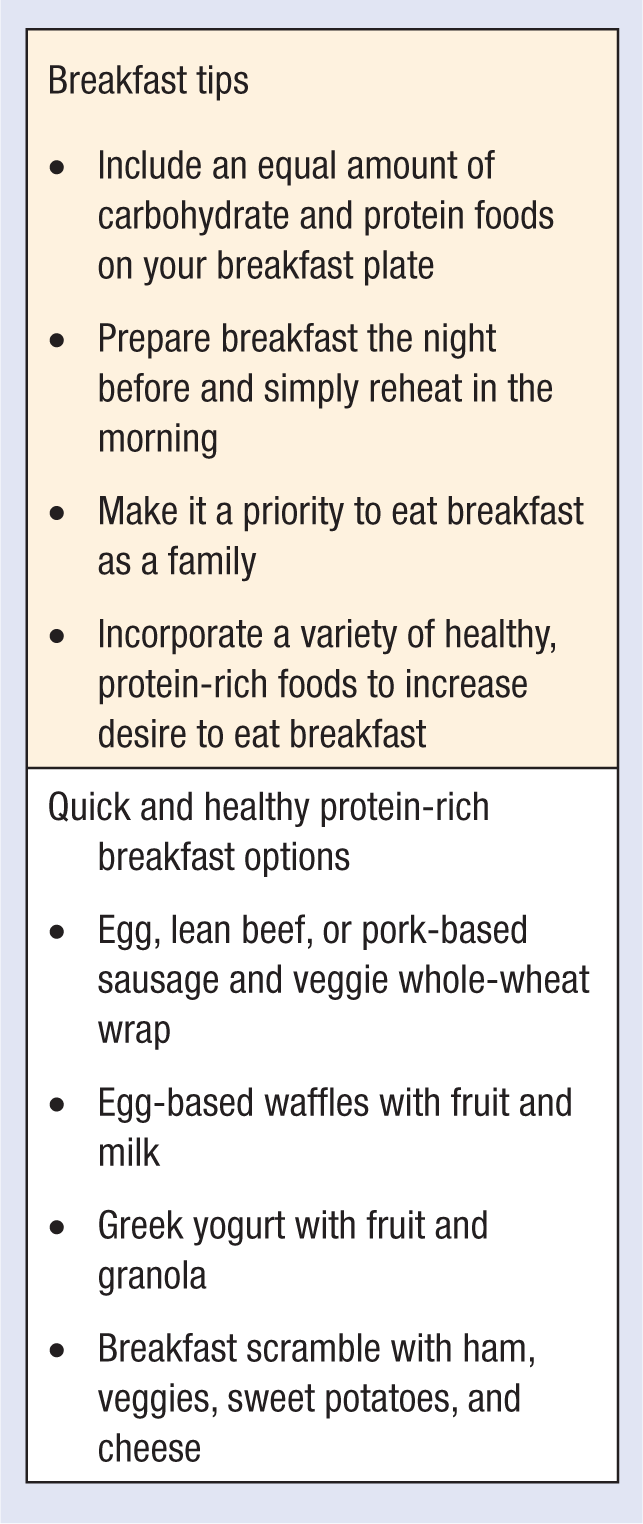
In a recent survey involving approximately 500 individuals, nearly 60% indicated the lack of hunger on waking was a primary reason. 47 Additionally, 50% said that there simply was not enough time in the morning. 47 Other reasons included the lack of convenience, forgetting to eat, and not sure what to eat. 47 More emphasis is now needed to (1) encourage young people to make breakfast a priority as part of a healthy lifestyle; (2) provide strategies for preparing quick, healthy, protein-rich meals; and (3) increase the availability of high-quality, prepared breakfast meals. Several easy, yet healthy, protein-rich breakfast tips and strategies include the following (see table below).
Conclusions
Breakfast skipping is a common dietary practice among adolescents. The addition of breakfast reduces factors contributing to obesity and diabetes in young people by increasing satiety and perceived fullness along with improving glucose control throughout the day. Recent evidence suggests that a healthy, protein-rich breakfast leads to further improvements in appetite control and satiety, reduced food motivation and reward, and reduced subsequent food intake and is a promising area for future research. Thus, breakfast consumption remains a key component to obesity and diabetes prevention, particularly for young people.