




Abstract
A lack of cooking skills and reduced food preparation knowledge are significant barriers to the production of home cooked meals in the United States. The benefits and barriers to healthful eating in relationship to decreased food preparation ability are summarized in this review. In particular, home food preparation barriers, the consequences that result from eating out frequently, and the benefits of home-produced meals are presented. Strategies for preparing meals at home and specific recommendations for health care professionals are presented in this article.
Introduction
Food preparation practices have changed drastically in the past 50 years. Families and individuals live in a fast-paced society, and thus, home-prepared meals are not produced on a regular basis. Even though the times have changed, food choice continues to have a great impact on the health of each family member.
Americans are eating outside the home more often and they are also consuming more premade, convenience food than before.1,2 The increased frequency of eating outside the home is a major health concern because of the numerous adverse consequences that result from this.2,3 For example, when food is obtained away from home, it is generally higher in fat, saturated fat, and cholesterol. 4 As a matter of fact, restaurant meals are significantly higher in kilocalories, fat, and saturated fat as compared with meals prepared at any other location (home, friend’s home, school, day care, or place of employment). 5 In contrast, home prepared meals are higher in several nutrients, including fiber, calcium, folate, iron, and vitamins B6, B12, C, and E. 6 Similarly, improved cooking skills could increase the consumption of fruits, vegetables, and whole grains. 2 Therefore, the discontinuance of home-prepared meals places individuals “at risk” for nutrient imbalance or nutrient deficiency.
Research supports the conclusion that individuals who lack cooking skills are more likely to regularly eat out or to eat convenience meals.
America’s changing demographics (proliferation of convenience food and restaurant-provided meals) affects the lifestyle of both adults and children. However, it has the greatest impact on children because they are less likely to learn cooking skills in this environment.2,7
In the past, cooking skills were routinely taught by parents or learned at school. Research supports the conclusion that individuals who lack cooking skills are more likely to regularly eat out or to eat convenience meals. 8 Learning to cook empowers people to prepare healthful meals, provides a sense of personal achievement, and provides the knowledge needed to evaluate food alternatives and options when eating away from home.8,9 Research studies have also shown that improvements in cooking skills lead to increased cooking frequency, improved food knowledge, a change in food preferences and self-efficacy toward cooking, and decreased food costs.10-12 Thus, enrolling in cooking classes provides the opportunity for individuals to eat more healthful meals for the remainder of their lives. 2
Purpose Statement
The purpose of this manuscript is to review research studies and summarize the relationship between food preparation ability and healthful eating. In particular, home food preparation barriers, the consequences that result from eating out on a frequent basis, and the benefits of home-produced meals will be reviewed. Strategies for preparing more meals at home and specific recommendations for health care professionals will be provided in this manuscript. These topics are important because if individuals placed a greater value on food preparation ability, this “practical skill” would lead to improved implementation of nutrition recommendations and long-term behavior interventions.
Home Food Preparation Barriers
There are several obstructive barriers to home food production. The primary barriers include lack of time for meal preparation, children’s after-school activities and other priorities, daily stressful occurrences, and frustration from prior attempts to eat in a healthy manner. 13 In the United States, 70% of women are employed outside the home. 14 When meals are prepared at home, working women desire to spend less than 15 minutes preparing the evening meal. 15 In 2010, meals eaten outside the home accounted for 49% of the food dollar, compared with only 25% in 1955. 16
A lack of cooking skills and food preparation knowledge are additional primary barriers related to home-cooked meals in some households. About 10% of the adults in the United Kingdom state that they do not know how to cook, and this limits their food choice. 17 A similar percentage is reported for adults in the United States. 7 Additionally, a growing reliance on convenience foods is decreasing the opportunities for children to learn food preparation by observation. 7 Food and nutrition professionals from the United States, Canada, United Kingdom, and Australia have expressed concern that an entire generation of young adults has emerged that lacks the ability to cook. 7
Walter et al18,19 identified multiple home food preparation barriers among college students. These included nonfamiliarity with cooking (they lacked parental role models), lack of time, a disdain for grocery shopping/large supermarkets, and an annoyance with kitchen cleanup. The students with the least ability and the lowest interest in cooking had already developed a pattern of eating out as a solution to meal production. The most common findings of their research were (1) lack of time to prepare food, (2) lack of kitchen facilities, (3) regret for not being taught how to cook during childhood, and (4) the belief that cooking was an overwhelming task.18,19 An unexpected and novel finding was that several students thought it was more expensive to prepare food at home than to eat out.
Caraher et al 20 reported that 25% of the men (16-74 years of age) in their research study had absolutely no cooking skills, and they did not feel confident enough to prepare food from basic ingredients. As a result of this barrier, 12.7% of the men admitted that their food choices were limited because of their inability to cook. The main message from this study is that we cannot expect people to consume food that they cannot prepare.
There were 3 themes that were identified by Gough and Conner 21 regarding the perceived barriers to healthful food preparation among men of all ages. The 3 themes were (1) time and expense constraints; (2) an overly intrusive health lobby, which increased their resistance to changing their eating habits; and (3) the view that healthful food choices were monotonous, poor tasting, and nonsatisfying. These findings are important because they reveal a pessimistic attitude and perhaps a distrust of conventional health messages.
Low-income overweight and obese mothers were studied by Chang and colleagues. 22 They reported the following barriers to preparing healthful meals: family members often refused to eat nourishing food, children’s special food requests had to be accommodated, preparing healthful meals was not encouraged, stressful daily events interfered with cooking, and there was a general disinterest in or dislike of low-fat foods. This information is particularly relevant because family members need to encourage one another, not discourage each other. The family atmosphere needs to be conducive to healthful food production.
The adult population of the 15 member state of the European Union has also been studied to determine the primary and secondary barriers to eating healthier among European citizens. 23 The primary barriers to healthful eating were time and taste factors (irregular work hours, busy schedule, and a reluctance to give up certain foods). Other important barriers were lack of will power, higher food costs/price, consideration of food preferences of others, preferring to eat out, and unwillingness to change food habits. Secondary barriers included lack of cooking skills, limited cooking facilities, lack of nutrition knowledge, lack of food availability, the fact that experts keep changing their minds, long duration of food preparation, and the perception that healthful food is too perishable. One of the most significant findings from this study was the self-admission that almost 80% of the adults in Europe had difficulty following a healthier diet. 23
Swedish researchers studied the attitudes and barriers to implementing dietary advice among first-degree relatives of patients with type 2 diabetes. 24 They reported that individuals generally wanted to follow the dietary advice they were taught, but they had difficulty implementing the advice because they (1) lacked ideas for meals/cooking, (2) some of the recommended foods did not taste good, (3) suggested foods were not available at the restaurants they dine at, and (4) their family members did not like the recommended foods. Once again, attitude shifts and comfortable eating habits have created additional barriers to home food production and the implementation of a medically required food plan.
Adolphus and Baic 25 investigated the current recommendation to increase fish consumption and the barriers to implementation of that advice among young adults. They reported that almost 20% of the sampled population had difficulty preparing and cooking fish. Thus, it was clear that public health recommendations are in jeopardy of being ignored if the general population lacks the cooking skills to prepare the suggested food.
Current practice in health education is to teach what to eat. It is possible that more time and effort needs to be spent on teaching how to make healthful food. Several compelling arguments can be made in favor of traditional home food production rather than outsourcing our food production tasks.
Empirical Evidence of Actual Meal Preparation Time
As previously stated, a frequently quoted reason to eat outside the home is lack of time to prepare meals. It is interesting to note that the average weekly time spent on meal preparation by all women in the United States has been steadily declining since 1965. 26 During the 1960s, meal preparation and cleanup required 8.4 hours per week. Among employed women, meal preparation and meal cleanup currently requires an average of only 5.3 hours per week. 26
Nonemployed women currently spend 10.1 hours per week preparing food and cleaning up afterward. In contrast, nonemployed women from the 1960s spent 16.1 hours doing these tasks. 26 Thus, contemporary meal preparation requires considerably less time compared with previous decades. Perhaps the reality is that we are less willing to cook, rather than too busy to cook. It also seems that the assumptions about the length of time required to prepare meals are outdated?
Consequences of and Concerns About Decreased Food Preparation Ability
The inability to produce meals at home results in several unfavorable consequences. When eating outside the home, both food quantity and nutrition quality are affected. 27 When individuals and families eat at home, they have an increased opportunity to control food choice and preparation technique and a decreased obligation to eat large portions.
Poti and Popkin 3 systematically examined trends among children (2-18 years of age) for relationships among eating location, food source, and energy intake. They reported that foods obtained from away-from-home sources had lower nutritional content than foods prepared at home. The proportion of total energy obtained from all nonhome, nonschool food sources was only 9% in 1977, but it increased to 22% in 1996 and almost 34% in 2006.3,28 In 2006, the main source of food eaten away from home was fast food for both young children (2-12 years of age) and adolescents. 28 They concluded that fast food eaten at home and store-prepared food eaten away from home were contributing to the increase in total kilocalorie intake of American children. The results of this research verify an ongoing need to study food preparation patterns and food selection decisions.
Marquis 29 explored the role of convenience in meal preparation among college students. Her study confirmed the fact that convenience was the most important food selection factor for this population group. The 3 main findings revealed the following relationships: the more convenience-oriented the students were with regard to food preparation (1) the more difficulty they had in deciding what to eat and in maintaining a varied diet, (2) the more likely they were to perceive cooking as a major constraint, and (3) the less likely that they would have been taught by their parents to be autonomous in the kitchen. Marquis 29 concluded her study with the recommendation to parents to be aware of the importance of instructing their children (both boys and girls) on ways to become autonomous in the kitchen.
Benefits of Home-Produced Meals
There are multiple benefits to preparing healthful food at home. One of the primary benefits is chronic disease prevention (lower incidence of heart disease, gastrointestinal cancers, strokes, obesity, and diabetes).30,31 Furthermore, individuals who prepare food at home are more likely to eat smaller food portions and consume less fat, salt, sugar, cholesterol, and kilocalories.27,32-34 Home-prepared meals are higher in fiber, calcium, folate, iron, and vitamins B6, B12, C, and E and lower in saturated fat and trans fatty acids. 6 Eating meals at home is associated with increased fruit and vegetable intake and less fried food and soda as compared with restaurant-prepared food. 6
Additional benefits for family meals include conversation among family members, togetherness, laughter, relaxation, family connections, time to plan upcoming activities, and the chance to say grace or pray together as a family. 35 Overwhelming social and civil benefits include (1) a reduction in drug, alcohol, and tobacco use; (2) better academic performance; (3) improved relationships with both parents; (4) less promiscuity among teenagers; and (5) higher attendance at religious services among teenagers who share frequent family dinners (5-7 per week) compared with teenagers who have infrequent family dinners (0-2 meals per week). 36
Eating meals at home has other tangible advantages, including family connections, belonging to a specific family unit, and the transference of a food heritage to the next generation. 37 Parents who eat with their children on a frequent basis convey the message that their children are important to them—important enough to include them in their busy lives—and when needed, they are available as a support network.
Specific Nutrient Information From Original Research
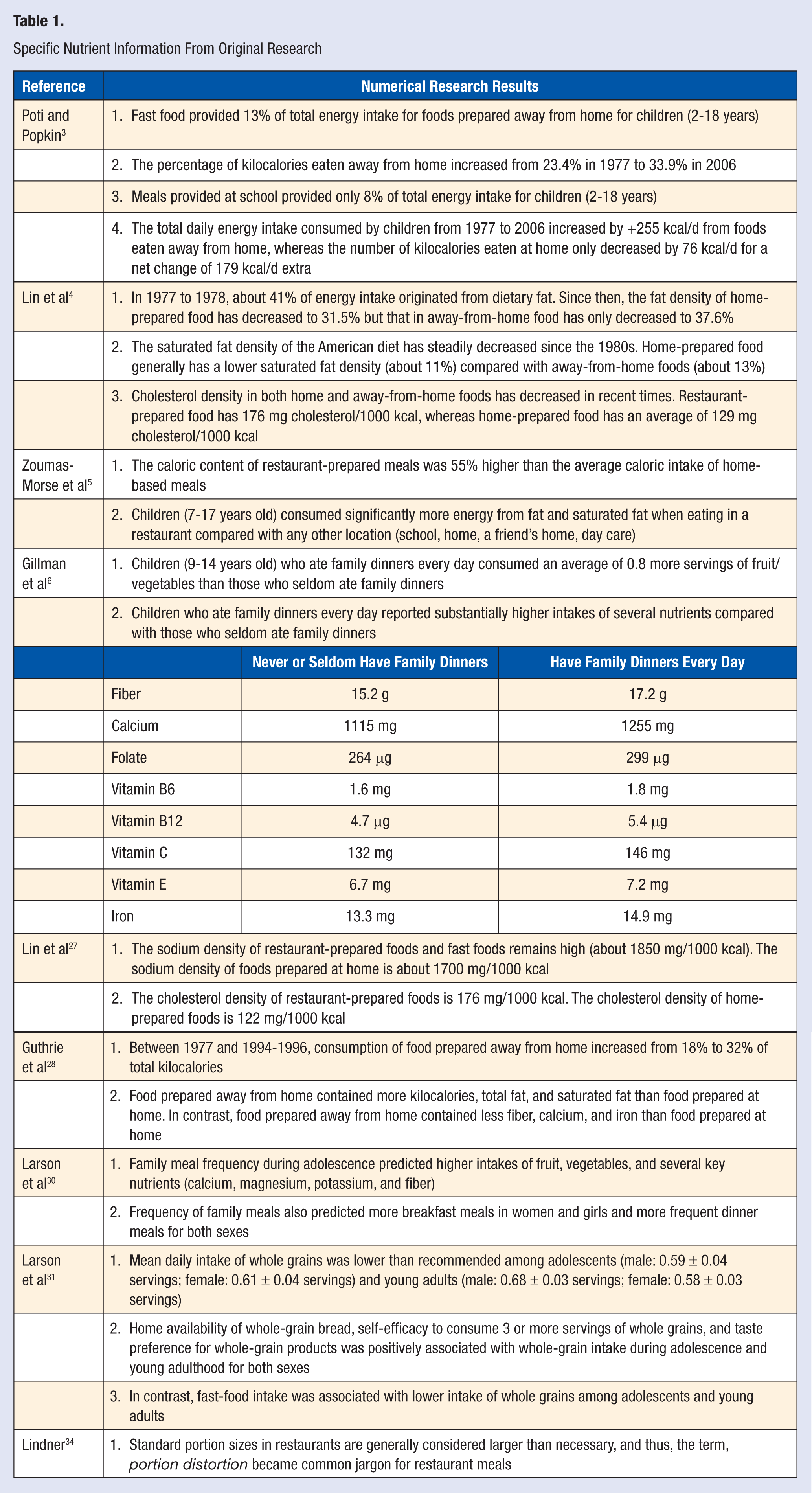
Home food production among college students has been studied.1,18,19 They reported several benefits and practical motivating factors unique to this population. These included: the desire to save money, to eat nutritious food, to control the preparation technique, to save time, to take pride in being able to produce nice meals, and to use the knowledge and cooking skills that comes from practicing behaviors learned from various role models. Larson30,31 reported results that were consistent with previous research findings. When young adults cook for themselves (at home), they are less likely to eat fast food on a regular basis, and they are more likely to meet their food and nutrient goals for whole grains, fruits, and vegetables and calcium intake. 31
Chang and colleagues 22 reported that improved personal appearance, the ability to play with their own children, and social support from family members and friends were motivating factors for healthful eating among low-income overweight and obese mothers participating in Women, Infant, and Children programs. These results support a compelling argument for the need to continue to encourage mothers to prepare family meals.
Effective Home Meal Production Habits
Practical advice regarding home meal production is listed below. These helpful tips and ideas are relevant because research has demonstrated that individuals who participate in cooking skill education are more likely to make changes in their dietary intake compared with individuals who do not have this opportunity.35,38,39
Plan menus for 1 week before you grocery shop.
Make family meals a priority, especially evening meals and weekend meals.
Keep the menus and recipes simple.
Model the food habits you want your children to develop.
Create a relaxed and comfortable eating environment.
Minimize meal time distractions (TV, computer games, phones, etc).
Have healthful food consistently available in the home (fruit, vegetables, etc).
Make healthful food look and taste appealing (use garnishes, add spices, etc).
Make gradual changes, such as adding 1 additional family meal per week.
Keep food staples on hand at all times (bread, cereal, cheese, milk, etc).
Encourage eating at a slower pace.
Encourage conversation among all family members.
Take turns preparing food and cleaning the kitchen.
Create some special food events—holidays, celebrations, and so on.
Frequently prepare culture-specific food, based on family heritage.
Recommendations for Health Care Professionals
Health care professionals have an abiding influence on patients. The recommendations they make tend to be considered authoritative. Thus, it is always beneficial to recommend healthful lifestyle choices for families and to encourage ongoing preparation of family meals. Listed below are some specific recommendations to offer:
Emphasize the importance of making family meals a priority.
Recommend a well-stocked kitchen pantry.
Encourage portion control and moderate kilocalorie intake.
Suggest some easy-to-prepare family meals.
Urge mindful eating (awareness of food intake, appetite management, etc).
Propose gradual but sustained improvements.
Commend any effort to include young children in meal production.
Limit the amount of unhealthful food that is stored at home.
Endorse food variety, balance, moderation, and adequacy.
Reinforce and frequently mention the benefits that come from family meals.
Remind parents that they serve as role models for their children.
Conclusions
There is little argument that the eating behaviors of Americans have deteriorated over the past several decades. An increase in the consumption of restaurant and prepackaged foods has contributed to this deterioration. 40 In contrast, foods prepared and eaten at home tend to be healthier. This factual claim is particularly striking considering the current health crisis we find ourselves in. Americans seem to be more concerned about convenience and ease of food preparation rather than health, wellness, and nutrition. Therefore, health intervention messages should emphasize foods that are both easy to cook and nourishing to eat.