



Abstract
The volatiles chemical composition and biological attributes of coriander (Coriandrum sativum L.) leaves essential oil obtained by two extraction techniques namely supercritical fluid extraction and hydro-distillation is appraised. The coriander essential oil yield (.12%) by hydro-distillation was slightly higher than that of supercritical fluid extraction (.09%). The physico-chemical variables of the essential oil obtained from both the techniques varied in significantly (P < .05). GC-MS analysis identified 23 different components in supercritical fluid extracted oil and 18 components in hydro-distilled essential oil having linalool as major component (51.32% and 61.78%, respectively) followed by phytol (12.71%). The oil recovered by supercritical fluid extraction exhibited greater DPPH radical scavenging activity as well as reducing power as compared to the essential oil obtained by hydro-distillation technique along with a stronger biofilm inhibition and least hemolysis. The results of antimicrobial activity revealed that super critical fluid extracted essential oil has potent antifungal and antibacterial activity against P. multocida and A alternata, whereas hydro-distilled essential oil displayed better antimicrobial potential against E coli and A niger. Overall, these results depict that supercritical fluid extraction is superior than hydro-distillation with regard to isolation of better-quality coriander essential oil for nutra-pharmaceutical developments.
Keywords
Introduction
Coriander (Coriandrum sativum L.), belonging to the family Apiaceae (Umbelliferae), has been described as one of the oldest herbs used for culinary and medicinal purposes.1,2 A native to Italy, this species is now broadly cultivated in different zones of the world such as North Africa, Russia, Central and Eastern Europe, Asia (Pakistan, India, Bangladesh, and China), and Mediterranean regions (Egypt, Morocco, and Malta).3,4 It can be grown throughout the year, but the best growth is observed between the months of October and February and flowers are produced between June and July. 5 Because of its uses as a flavoring agent in foods and cosmetics, this annual herb has a greater economic value. The fruit and seeds of coriander are aromatic, having a mild bittersweet and spicy taste. 6 The dried coriander seeds are employed as a component of curry powder and these are also used in stews and minced meat dishes. The fresh leaves of coriander have often been utilized in salads, making sauces and to garnish the food due to their characteristic aroma and attractive green color.7,8
The main producers of coriander are Czech Republic, Poland, Romania, Mexico, Argentina, India, and Guatemala. 5 Countries like Ukraine and India have the major control over the global market and trade of coriander oil. 9 The oils obtained from coriander are also used in body care products, perfumes, cosmetics, and cosmeceuticals. 10 The coriander seed and fresh leaves were studied to check the occurrence of different biologically actives ingredients which impart various biological and health promoting attributes.2,11,12 Conventionally, different parts and products of coriander plant have been used to treat gastrointestinal disorder like dyspepsia, diarrhea, pain, anorexia, flatulence, and vomiting. 2
A variety of medicinal herbs have been tested for essential oil (EO) production and commercialization.13,14 In particular, various EOs can be produced from different parts, that is, aerial (flower, buds, stem, leaves, fruits, peels, bark, wood, and seed) and underground (roots) of aromatic plants.15,16 The majority of odoriferous plants have been investigated to contain EO which can be obtained from dried, partially dehydrated or fresh parts of plants. 16 Chemically, plants EOs mainly contain terpenoids (volatile constituents) which are of great biological importance due to their multiple pharmaceutical applications. 16 The main applications of EOs include their uses as preservatives and flavoring agents, as well as potent bioactive agents.17,18 Besides the traditional use of EOs as health and healing agents in aromatherapy, these have also been documented as potential ingredient in preparation of flavored foods, perfumery products, cosme-nutraceuticals, and natural therapeutics.17,19
The processing methods used for the handling and storage of plant materials as may affect the quality and quantity of EOs isolated. 20 The plant’s genetic, environmental and physiological factors as well as well as extraction techniques employed can alter the volatiles composition and ultimately the yield and quality of EO extracted from different sources. 21 Among different techniques, SCFE (supercritical fluid extraction) is employed for the extraction of EOs from different plant materials including basil, 17 sweet gale, 22 and jasmine. 23 In this green extraction method, the aromas from the plants are extracted/isolated using supercritical fluid such as liquid CO2. Carbon dioxide is an inert gas having mild values of critical temperature (31.1°C) and critical pressure (7.38 MPa) and is considered to be non-hazardous and non-toxic. The supercritical fluid extraction method is more selective and safer as compared to conventional methods (hydro-distillation) and the extracted product contains no residual solvent but have value added benefits. 24
The Soon valley, situated in the Punjab province of Pakistan, with Sakesar as the highest peak in the Salt Range, covers around 300-square-mile area. The valley has impressive scenic beauty due to presence of several waterfalls, natural lakes and ponds, and lush green mountains. The agro-ecological and agro-climatic characteristics of the Soon valley, in terms of mild temperature, distinct topography, and low rainfall, are unique as compared with the neighboring regions resulting in unique phytochemical composition of the medicinal flora in this specific area. 25
In one of our recent studies, we appraised and compared the volatiles composition and biological principles of basil (Ocimum basilicum L.) essential oil obtained by different techniques. 17 As a part of our ongoing research activities, in the present research work, we planned to appraise the unexplored biochemical profile of coriander leaves harvested from unique Soon valley of Punjab, Pakistan. So, this research project is specifically framed to appraise the biological attributes and composition of essential oil obtained from coriander plants grown in this region. As per our best understanding, this report is the first one which compares the yield, volatile bioactives profiling and biological attributes of coriander leaves essential oil produced by two different techniques, that is, hydro-distillation and SCFE.
Experimental
Sample Collection
The plant parts (stem and leaves) of coriander (Coriandrum sativum L.) were obtained during spring season from Soon Valley, District Khushab, Punjab, Pakistan (Coordinates: 32o58/N 72o15/E). A taxonomist from Botany Department, University of Sargodha, Sargodha, Pakistan, further authenticated the specimen. The collected samples were washed and dried (moisture content 6.50%) at room temperature prior to extraction of EO.
Chemical and Reagents
Free radical of 2,2-diphenyl-1-picrylhydrazyl (DPPH), trichloro-acetic acid, ammonium thio-cyanate, ascorbic acid (vitamin C), aluminum chloride (AlCl3), ferrous chloride, potassium ferri-cyanate, sodium nitrite, ferric chloride, butylatedhydroxytoluene (BHT) (99.0 %), butylatedhydroxyanisole (BHA), dimethyl sulfoxide, 3-(4,5-dimethylthiazol-2,5-diphenyl tetrazolium bromide) (MTT), penicillin/ streptomycin solution, and fluconazole were supplied by Sigma Chemical Corporation, USA. Sterile resazurin tablets for the purpose of sterilization were obtained from BDH Laboratories. All other chemicals such as chloroform, ammonium thiocyanate, ferrous chloride, methanol, and sodium carbonate (anhydrous) used in the research were acquired from Merck, Germany, unless stated otherwise. Analytical grade reagents and chemical were used for this research work.
Recovery of EO
The pulverized coriander leaves samples were processed for the extraction of EO using two different techniques for comparative study: conventional hydro-distillation (HD) technique and modern supercritical fluid extraction (SCFE) technique.
Hydro-Distillation
EO was recovered using Clevenger-type apparatus. For this purpose, plant sample (3 kg) was hydro-distilled for 3 hours. The recovered oil was dehydrated over sodium sulfate (anhydrous). After filtration, recovered oil was preserved at −4°C until analyzed for different experiments.16,17
Supercritical Fluid Extraction (SCFE)
A commercial SCFE instrument (Deven’ supercritical private, Ltd., India) was used for the recovery of EO from coriander plant material. The plant sample (5 kg) was placed in the extractor and heated for 60 minutes at 45°C before the starting the process. Flow rate of supercritical CO2 was adjusted as 10 mL/minute, under 100 bar pressure at 45°C. The extraction was done for 90 minutes under static condition and then for 30 minutes under dynamic conditions. The EO was collected at outlet and preserved at −4°C for experimental uses. 26
Analysis of Essential Oils
Yield and Physical Analyses
The yield (%) of the isolated EO was determined by weight of initially used plant. The physical analyses of the EOs include color, solubility (in 70% alcohol), density (25°C), and refractive index (25°C). These analyses were conducted following Abbas et al, 17 Density and refractive index of EO were measured by densimeter (Anton Paar, model DMA 602, Austria), digital refractometer RX-7000a (Atago Co. Ltd., Japan), respectively.
Gas Chromatography (GC)
The bioactives chemical profiling of the extracted coriander EO was studied using gas chromatography (PerkinElmer, Model 8700, USA) coupled with FID detector. Capillary column (HP-5MS, 30 m length, .25 mm diameter) was used in which thickness of stationary phase was .25 μm. The temperature of the column was initially adjusted at 80°C (for 3 min), followed by a gradual increase in temperature by 4°C per minute till 220°C, and finally maintained at 220°C for 10 minutes. The mobile phase used was an inert noble gas (He) which was allowed to flow at the rate of 1.5 mL per minute. The sample of EO (1.0 μL) was introduced in the injector (220°C) in a split mode, while detector temperature was maintained at 290°C.
GC-MS Analysis
The volatile bioactive components were further authenticated by using another advanced technique gas chromatography coupled with mass spectrometer (GCMS) (Agilent, model 6890N, MS-5975). For this analysis, the type of column and its temperate programming was the same as previously used in GC-FID method along with the same carrier gas with same flow rate, but here the detection of the components was performed using mass spectrometer with electron ionization mode (70 eV). Identification of separated components was carried out by comparing their mass spectra with those of standard spectra published in NIST mass spectral library and finding out the retention indices (RI) relative to the normal alkane (C9–C24) and compared with the RI values of authentic compounds.17,27
Antioxidant Potential
The antioxidant potential of the extracted coriander EO was estimated by performing different assays including reducing potential and free radical scavenging capacity.
DPPH. Scavenging Assay
A stable free radical, DPPH, was employed to evaluate antioxidant ability of recovered EOs. 17 Various concentration of sample (.5–100 μg/mL) were mixed with 1.0 mL dilute solution of DPPH free radical (90 μmolar) and rectified methanol (95%) to make the total volume of mixture up to 4 mL. Positive control (butylated hydroxy toluene) was processed for comparing with the activity of the sample essential oil. The final solution was incubated and OD was recorded at 515 nm followed by construction of a plot between inhibition (%) and concentration to calculate IC50 value (concentration that scavenged 50% of the free radical).
Estimation of Reducing Power
The tested EOs were assessed for their reducing ability using following the method used by Abbas et al. 17 Different amounts of EOs ranging from 2.5 mg to 10 mg were reacted with Na phosphate buffer (.2 M, pH = 6.6, 5.0 mL) and potassium ferricyanide (1.0%, 5 mL). After incubating at 50°C, this mixture was mixed with trichloroacetic acid (10%, 5.0 mL) followed by centrifuging for 10 minutes to separate upper layer which was diluted with water (5.0 mL). The resultant solution was added to iron (III) chloride (.1%, 1.0 mL) to record its optical density (OD) at 700 nm.
Antimicrobial Potential of EOs
Antimicrobial activity of tested EOs was evaluated against different pathogenic strains of bacteria (S. aureus, P. multocida, E coli, and B subtilis) and fungus (A. flavus, A niger, A alternate, and G lucidum,) were used. Nutrient agar (NA) at temperature of 37°C was used as culture medium to grow bacteria while potato dextrose agar (PDA) at 30°C was used for fungal growth. The growth medium was purchased from Oxoid (Hampshire, UK). Streptomycin was used as standard drug for bacterial strains while fluconazol was selected as standard drug for fungus.
Inhibition zone of the tested EO was measured by the disc diffusion method 28 by considering 6 mm of sample-soaked filter paper discs and placed on the already incubated culture of bacteria and fungus. The corresponding standard drugs were named as positive control; however, filter paper disc without sample was named as negative control. The inhibition zone was calculated after 24 hours of incubation for bacterial strains and 3 days of incubation for fungal strains.
Furthermore, to calculate the minimum inhibitory concentration of EO that inhibited the growth of the microorganism, micro dilution broth method previously used by Abbas et al 17 was selected. The MIC (minimum inhibitory concentration) value (mg/mL) gives a good knowledge regarding the antimicrobial activity of the tested EO, smaller the MIC value greater is the antimicrobial activity.
Biofilm Inhibition
The biofilm inhibition of EOs was checked against E coli and S aureus following a modified method reported by Regev-Shoshani et al. 29 The cell suspension of microorganism (100 μL) was added into 96-well micro titre plate along with the EO sample. After incubation for 3 days at 37°C, the liquid was removed and 100 μL of crystal violet solution (1%) was added. After staining for 30 minutes, dye was removed, and wells were washed. It was incubated again for 15 minutes after adding rectified ethanol (95%) and then the absorbance was noted at 570 nm. Positive control (rifamacin) was also processed under similar experimental conditions.
Hemolytic Activity
The assay of hemolytic activity was performed in vitro on human erythrocytes of O blood group reported by Malagoli. 30 Blood sample was obtained from volunteers, centrifuged for 5 minutes at 5000 rpm, and 2.0% suspension of erythrocyte was made in phosphate buffer saline. In this process, .85% of NaCl solution was added into various concentration of the EO solutions (50–500 μg/mL), followed by the addition of already prepared erythrocyte suspension, which was kept at room temperature for 30 minute, upper layer of the mixture was collected to record the OD at 540 nm. Positive control (triton X-100) and negative control (phosphate buffer saline) were processed under similar experimental conditions. Hemolytic activity (%) was estimated by comparing with the absorbance value of positive control. 31
Statistical Analysis
Three different samples of coriander plant leaves/EOs were used in each extraction technique to perform replicate experiments. To evaluate significant difference (P < .05), ANOVA (analysis of variance) was conducted by STATISTICA v5.5 (Computer software). The data were computed as mean ± standard deviation. 32
Results and Discussion
Yield and Physico-chemical Analysis
Yield (%) and physico-chemical parameters of coriander EOs.

Note: Data is reported as mean ± SD, superscript (a) within the same column show significant (P < .05) differences of means between the two essential oil extraction methods.
*SCFE = Supercritical fluid extraction.
Composition of Coriander Essential Oil
Percentage composition comparison of some major component in coriander EOs produced by SCFE and HD techniques.

Note: Data is reported as mean ± SD, superscript within the same row displays a significant (P< .05) differences of means between SCFE and HD.
*RI = Retention index; **SCFE = Supercritical fluid extraction.
a = Identification by retention index.
b = identification by comparing with authentic compounds.
c = identification by comparing of mass spectra.

Structure of some major components of coriander essential oil
Antioxidant Potential
Antioxidant potential of coriander EOs.

Note: Data is reported as mean ± SD, superscript (a, b) within the same column show significant (P < .05) difference in values for SCFE and HD.
*DPPH = 2,2-diphenyl-1-picrylhydrazyl. **SCFE = Supercritical fluid extraction. ***BHT = Butylated hydroxy toluene.
In reducing power assay, the yellow color of ferric ions is changed into bluish green color of ferrous ions after reduction. The reducing potential of EO depends upon the color intensity of the final reaction mixture, which shows that there is a direct relationship between the color intensity and the antioxidant powder. 17 A gradual increment in the absorbance was recorded with increasing concentration of sample. At the concentration of 10.0 mg/mL, SCF-extracted EO showed better reducing potential (1.32) as compared to hydro-distilled EO (1.20) but less than standard synthetic antioxidant compound, which showed the absorbance of 1.91 at concentration of 10.0 mg/mL.
Foudah et al 40 reported in his research work that coriander essential oil is a promising reservoir of natural antioxidants. In another study, 41 the antioxidant potential was determined in oil and extracts from seeds and leaves of coriander. Overall, from the results of antioxidant activity it can be concluded that EO obtained from SCFE has better antioxidant and nutra-pharmaceutical potential as compared to EO obtained by hydro-distillation, which reveals the superiority of SCFE techniques over traditionally used hydro-distillation technique.
Antimicrobial Activity
Antimicrobial potential of coriander EOs.

Note: Data is reported as mean ± SD, superscript (a, b, c) within the same row show significant (P < .05) differences of means between the two essential oil extraction methods. ** Standard drug Streptomycin for bacteria while Fluconazole for fungus.
*SCFE = Supercritical fluid extraction.
Several essential oils, which are mainly composed of terpenoids, were also studied for the occurrence of phenolic antimicrobial components.15,17,43-45 The phenolic compounds present in the plant essential oils show higher antimicrobial effect as compared to aldehyde, alcohol, and ketones.46,47
Other Bioactivities (Biofilm Inhibition and Hemolytic Activity)
Bioactivities of coriander EOs.
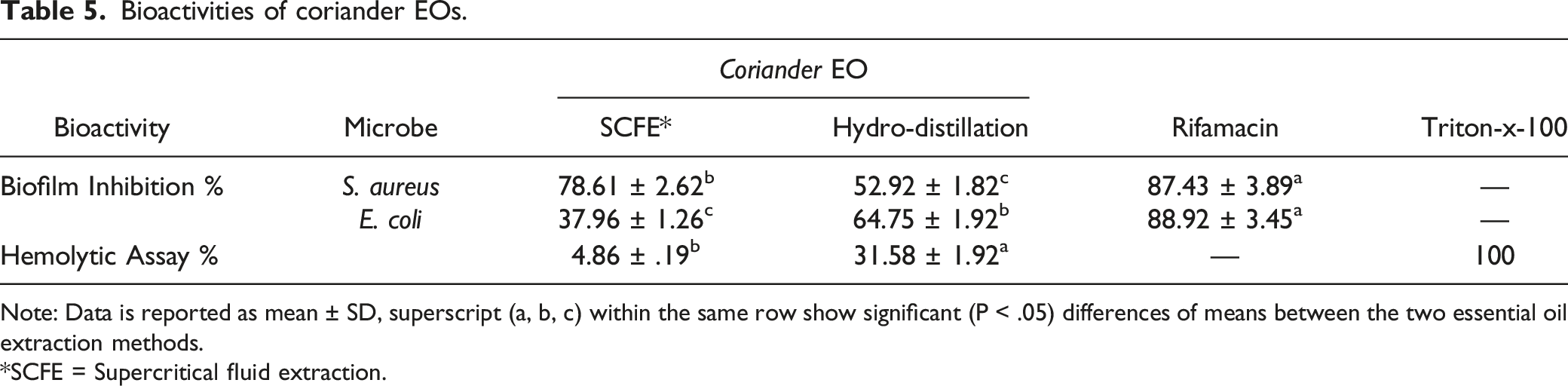
Note: Data is reported as mean ± SD, superscript (a, b, c) within the same row show significant (P < .05) differences of means between the two essential oil extraction methods.
*SCFE = Supercritical fluid extraction.
It is observed that some antioxidant compounds may have good antioxidant activity but also possess hemolytic effect, due to this reason they may not be able to use in pharmaceutical preparation. Hence for a good and safer antioxidant, it must have least hemolytic attributes. Therefore, in this project, hemolytic activity of tested EO was assessed (Table 5). The results clearly showed that the EO obtained by SCFE method has far less hemolytic activity (4.86%) as compared to the EO extracted by hydro-distillation (31.58%). These findings also support that the SCFE technique is better than conventional hydro-distillation technique toward isolation of nutra-pharmaceutical grade EOs. There are no previous literature reports available with which we can compare our results of the hemolytic activity. Hence, the present investigation revealed that the coriander EO is safer since no toxicity was observed, which have potential application for the development of nutra-pharmaceutical agents. The plants produced bioactive agents and these bioactive agents can be used for different fields for practical applications.56-58
Conclusion
Although the yield and physico-chemical attributes of the coriander EOs tested were significantly varied for SCFE and HD techniques. However, the results revealed that the coriander EO obtained from both the techniques have significant variations with regard to the biological activities. The EO obtained by SCFE technique possesses better biological potential due to presence of higher quantity of different potent bioactive components in comparison to EO recovered by hydro-distillation. Thus, in terms of their nutra-pharmaceutical applications, SCFE can be considered to be superior extraction techniques for the recovery of biologically active volatile components. These research findings might motivate more researchers to explore the essential oil and phytochemicals profiling and biological potential of other medicinal plants from Soon Valley, especially meeting the demand of local modern food and pharmaceutical industry. Such data might also encourage the local growers and community to cultivate and harvest such medicinal herbs on large scale and install on farm SCFE plants for isolation of valuable essential oils with multiple food and nutra-pharmaceutical applications.
Footnotes
Acknowledgments
The authors express their gratitude to Princess Nourah bint Abdulrahman University Researchers Supporting Project (Grant No. PNURSP2022R158), Princess Nourah bint Abdulrahman University, Riyadh, Saudi Arabia.
Declaration of Conflicting Interests
The author(s) declared no potential conflicts of interest with respect to the research, authorship, and/or publication of this article.
Funding
The author(s) disclosed receipt of the following financial support for the research, authorship, and/or publication of this article: Princess Nourah bint Abdulrahman University Researchers Supporting Project number (PNURSP2022R158) Princess Nourah bint Abdulrahman University, Riyadh, Saudi Arabia.
