




Abstract
The aim of this study was to evaluate antioxidant and antimicrobial potential of Peganum harmala fruit. Ethanolic extract was prepared and phytochemical screening showed the presence of a lot of chemical compounds. Fourier transform infrared spectroscopy (FTIR) spectra indicated the presence of organic acids, hydroxyl and phenolic compounds, amino groups, aliphatic compounds, and functional groups such as amide, ketone, aldehyde, aromatics, and halogen compounds. Antioxidant activity of the ethanolic extract of P. harmala by the DPPH method showed 71.4% inhibition, whereas IC50 ± SEM (μg/mL) was .406 ± .11. Antibacterial activity was performed against Escherichia coli, Bacillus subtilis, Bacillus pumilus, Micrococcus luteus, Pseudomonas aeruginosa, Staphylococcus aureus, Staphylococcus epidermidis and Bordetella bronchiseptica. Maximum antibacterial activity was exhibited by Bacillus subtilis (24.33 ± 2 mm) and Bacillus pumilus (23.33 ± 2 mm). Zone of inhibition was 19 ± 2 mm by P. aeruginosa, and it was 18.33 ± 2 mm by Bordetella bronchiseptica. Staphylococcus aureus and Staphylococcus epidermidis had inhibitory effect in the range of 12.33 ± 2 mm and 13.66 ± 3 mm, respectively. 11.66 ± 2 mm and 10 ± 2 mm was zone of inhibition by Micrococcus luteus and E. coli, respectively. Antifungal activity was performed against Aspergillus terreus, Aspergillus fumigatus, Aspergillus flavus and Candida albicans. Ethanolic extract of P. harmala showed antifungal activity against Aspergillus flavus (5 ± 1 mm) and Candida albicans (4 ± 1 mm). Mild antifungal activity was reported by Aspergillus fumigatus (3 ± 1 mm), whereas no activity was exhibited by Aspergillus terreus. Further research is needed in order to evaluate the cytotoxic effects of P. harmala as well.
Introduction
Medicinal plants have been used for treating illnesses from centuries. 1 Careful observations of the efficacy and use of traditional medicinal plants markedly contribute to its healing properties. 2 Such medicinal plants are frequently used even if their chemical composition is not known. 3 All over the world especially in third world countries, indigenous medicinal plants are of great importance especially in health care system. 4 About 250 to 500 thousand of plant species are present on the earth, and just about 1 and 10% are utilized by humans and animals as food. 5 Pakistan is blessed with a diversified wealth of medicinal flora and a number of plant species are still unknown. 6 That’s the reason treatment with medicinal plants is in vogue as it is cheaper and no strict quality control or standardization methods are in practice by the local healers. 7 In developing countries, infectious diseases are important risk factors for increased morbidity and mortality of the general population. 8 Pharmaceutical companies are trying their best to develop such antibacterial and antifungal preparations that can address microbial resistance. 9 Bacteria have the ability to develop resistance against the antibacterial drugs, so there is need of such medications that can cope with such genetic and structural changes/adaptations of bacteria. 10
Peganum harmala is also known as wild rue or Syrian rue. 11 It is also known as “Harmal” by locals. 12 It belongs to Zygophyllaceae family. 13 Peganum species are distributed widely in Mediterranean, North Africa, Middle East, India, southern parts of Iran and Pakistan. 14 P. harmala is also called as “Espand” in Iran. 15 Conventionally P. harmala is propagated from the seeds. 16 P. harmala fruit is frequently used for the treatment of various ailments in traditional system of medicine in areas where it is present naturally. Its fruit is used as antiseptic and analgesic in conventional medicine. 17 It also possess numerous pharmacological properties such as narcotic, 18 alterative, 19 anthelmintic, 20 antiperiodic, 21 emetic 14 and antispasmodic. 22 P. harmala has been utilized for the management of many diseases such as jaundice, 17 emmenagogue, lumbago, 23 colic, 24 asthma 25 and as a stimulant. 26 Seeds have hallucinogenic and hypothermic properties. 14 Recent pharmacological studies indicate anti-histaminic, 27 hypoglycemic, 16 vasorelaxant, 28 immunomodulator, 29 antitumor, 30 hepatoprotective, 31 analgesic, 32 cytotoxic, 33 antioxidant, 34 anti-spasmodic 35 and insecticidal effect. 36 P. harmala also has reported antimutagenic 37 and antioxidant potential. P. harmala fruits yield a red dye and oil. 12 Ripe fruits have more alkaloid content as compared to unripe fruits. 38 Anti-inflammatory and analgesic effects of its fruit are because of the presence of alkaloids. 39 It is also effective in peripheral as well as central nervous system for its analgesic properties. 40 P. harmala is also used in the form of smoke to kill various parasites like molds and algae as well as various bacterial strains. 41 The aim of current research is to evaluate phytochemical as well as antioxidant and antimicrobial (both antibacterial and antifungal) potential of P. harmala as a potent traditional medicinal plant.
Materials and Methods
Plant Collection and Identification
P. harmala (Harmal) fruit was collected from Cholistan Desert near to Bahawalpur, South Punjab, Pakistan. The fruit was authenticated and identified by Dr Ghulam Serwar, Assistant Professor, Department of Botany, The Islamia University of Bahawalpur, and voucher numbers were obtained for Harmal, 34/Botany.
Extract Preparation
Dried fruit was ground to get coarse powder that was soaked into 70% ethanol for 15-days proceeded by the filtration initially with the muslin cloth and subsequently with filter paper. At that point, the acquired filtrate was instilled for solvent evaporation into the revolving evaporator to obtain the unrefined concentrate. Within the unrefined system, the acquired plant separates were then placed away in the completely closed-off container for further use. 24
Phytochemical Screening
Various chemical tests were performed using hydro-ethanolic extract of P. harmala to detect the presence of various phytoconstituents like terpenes, flavonoids, saponins, steroids, cardiac glycosides, proteins, carbohydrates, alkaloids, tannins and phenolic compounds. 22
Fourier transformed infrared spectroscopic analysis
The plant extract was checked utilizing Fourier transform infrared spectrometer in the scope of 4000–400 cm−1. The resultant spectral information contrasted with the reference graph to recognize the presence of functional group in the extract. 42
Antioxidant Activity
Antioxidant activity was performed by using the DPPH method as mentioned by Ratshilivha et al in 2014 with some modifications. Ascorbic acid was the standard control. 100 μL was the total volume of assay comprising of 90 μL of DPPH solution (.1 mM) and 10 μL of the ethanolic extract (5 mg/mL) in every well of 96-well plate. The prepared well plate was incubated for 30 minutes at 37°C. The absorbance was taken at 517 nm with Synergy HT Bio Tek® USA microplate reader. 19 The experiment was done in triplicate. Radical scavenging activity was determined by the following formula:
(%) Inhibition = 100 − (O.D. of test solution/O.D. of control) ×100
Antimicrobial Activity
Bacterial and fungal strains (test organisms)
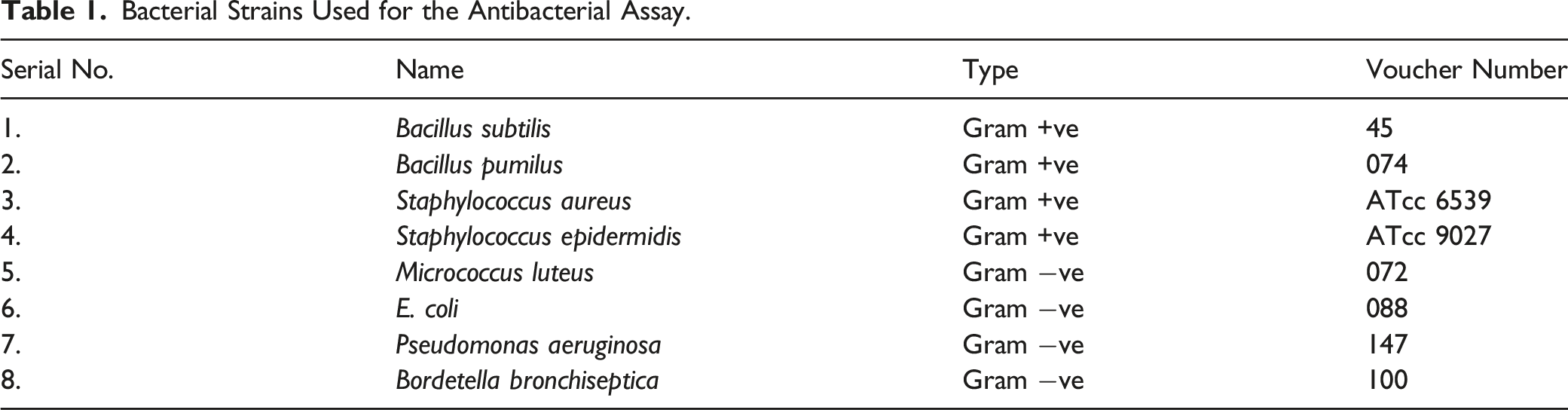
Bacterial Strains Used for the Antibacterial Assay.
Fungal Strains Used for the Antifungal Assay.

Inoculums preparation
Phytochemical Screening Extracts of P. harmala.

Antioxidant Activity of P. harmala Extracts at .5 mg/Well.

Preparation of agar
28 g of nutritional agar was dissolved in clean water and sterilized in an autoclave for 15 minutes at 121°C and 15 lbs pressure.
Antibacterial activity
Petri dishes were sterilized in a heated air oven at 180°C for 30 minutes before being installed in an aseptic laminar flow hood. At 35°C, sterilized nutritional agar was cooled. In petri plates, 20 mL of sterilized nutrient agar was transferred and left to solidify at room temperature. 60 μL inoculums were placed in a petri plate and disseminated using a sterile L-shaped rod. On the 6 mm filter paper disc, 30 μL of 50 mg/mL, 25 mg/mL, 12.5 mg/mL, 6.5 mg/mL and 3.125 mg/mL concentrate was put. After drying, the inoculated petri plates were mounted on them. Petri dishes were placed in the refrigerator for diffusion after filtration of the filter paper bacterial culture and then transported to the incubator for 24 hours of incubation at 37°C. To compare antibacterial impacities, ciprofloxacin was used as a positive control of 30 μL per filter paper disk and DMSO as a negative control. Following that, the inhibitory region was measured in millimeters (mm). Both experiments were carried out in triplicate, and mean data was calculated. 43
Antifungal activity
Petri dishes were sterilized in a warm air furnace at 180°C for 30 minutes before being put in an aseptic setting in a laminar flow hood. The autoclave was used to sterilize Sabouraud’s dextrose agar medium, which was then cooled to room temperature. At room temperature, 20 mL of Sabouraud’s dextrose agar was flowed into petri plates, causing it to solidify. The sterile paper disc was then produced. 60 μL inoculums were placed in a petri plate and disseminated using a sterile L-shaped rod. The filter paper disc was soaked in 30 μL of 50 mg/mL, 25 mg/mL, 12.5 mg/mL, 6.5 mg/mL and 3.125 mg/mL ethanolic extract and put on petri plates. After drying, the inoculated petri plates were mounted on them. Petri dishes were placed in the refrigerator for diffusion after filtration of the filter paper fungal culture and then transported to the incubator for 24 hours of incubation at 37°C. To compare antifungal effects, terbinafine (5 mg/mL) was utilized as a positive control while DMSO was used as a negative control. After that, the inhibitory region was measured in millimeters. Both processes were repeated 3 times, with the average values calculated. 44
Results
Phytochemical Screening
Phytochemical screening of ethanolic extract of P. harmala revealed the presence of various chemical components. P. harmala extract was found to be enriched with secondary metabolites such as carbohydrates, phenols, flavonoids, cardiac glycosides, steroids, alkaloids (turbidity formation), proteins and tannins. However, saponins and terpenoids were found to be absent on standard test performed on P. harmala extract (Table 3).
Fourier Transform Infrared Spectroscopy Analysis of P. harmala
The peaks at 3922.22 and 3861.26 cm−1 showed the presence organic acids (-COOH). The peaks 3750.49 and 3719.81 indicated hydroxyl and phenolic compounds. The peaks at 3516.82–3152.48 cm−1 refer to the presence of amino groups. The peaks at 2952.79, 2846.44, and 2704.63 cm−1 corresponds the presence of aliphatic compounds (C–H bend). The peak at 1615.48 cm−1 is an ester peak. The peaks from 1267.10 cm−1 to 1001.45 cm−1 indicated the presence of functional groups such as amide, ketone, aldehyde, aromatics (C–C and C–O) stretch (in–ring), and aliphatic amines (C–N stretch). The peaks from 921.74 cm−1 to 615.19 cm−1 revealed the presence of halogen compounds (C-Cl, C-F, C-Br). Spectra of P. harmala are shown in Figure 1. FTIR spectra of P. harmala.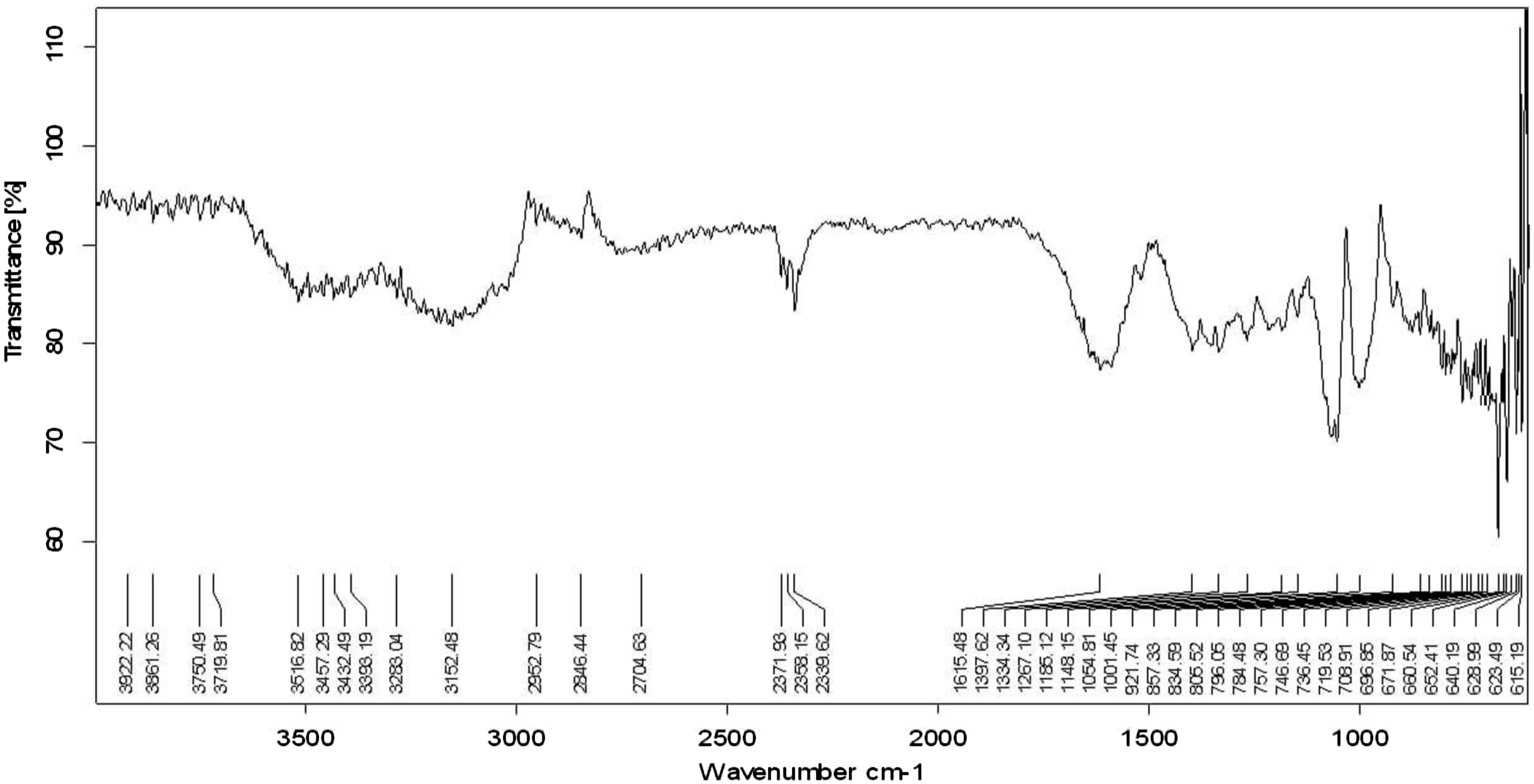
Antioxidant Activity
The ethanolic extract of P. harmala exhibited antioxidant potential with DPPH. % inhibition of the extract was 71.4%, whereas IC50 ± SEM (μg/mL) was .406 ± .11. Results showed that ethanolic extract had a significant free radical reduction capability by changing the color of DPPH from purple to yellow
45
(Table 4 and Figure 2). Graphical representation of DPPH assay of P. harmala.
Antibacterial Activity
Antibacterial Activity of P. harmala Ethanolic Extract.

Antifungal Activity
Antifungal Activity of P. harmala Ethanolic Extracts.

Discussion
Effect of P. harmala fruit extract on different bacterial and fungal strains was tested. Numbers of therapeutic and medicinal effects of P. harmala are known to the world. 16 Presence of large concentration of alkaloidal content is said to be the reason of these affects. These compounds are produced by the plant in order to provide protection against many insects, microorganisms and herbivores. 46 As main components of P. harmala are fat soluble and aromatic, that’s why extraction with ethanol derives more chemical constituents of the plant. 47 That’s why 70% ethanol was used for extraction of this plant. 48
The objective of this paper was evaluation of antimicrobial efficacy of P. harmala in order to know a potential therapeutic agent. With the help of recent findings, it is clear P. harmala has a lot of noticeable properties as antioxidant, antibacterial, and mild antifungal activities. 49 A number of secondary metabolites present in P. harmala can have their role in attributing the above mentioned activities. 50 Therapeutic properties of P. harmala are mostly due to high concentration of alkaloidal content in its various parts. 51 Beta-carbonyl derivations such as harmalol, harmaline, deoxyisopeganine, isopeganine and peganine are the most important alkaloids. 52 On the other hand, quinazoline derivations deoxyvasicinone, vasicine and vasicinone are also present. 53 The most important alkaloid that was studied in many researches is harmaline. 54 P. harmala also has reported cytotoxicity despite the numerous therapeutic properties. 16 Many severe side effects such as nervous, gastrointestinal, hepatic and cardiovascular complications have also been observed by the systemic use of high concentration of P. harmala. 55 Toxicity is mainly attributed due to ability to intercalate into DNA and inhibitory effect on monoamine oxidase (MAO). 56 Although P. harmala extract had noticeable inhibitory effect on various bacterial strains as compared to positive controls, 57 cytotoxic effects of P. harmala ethanolic extract on epithelial carcinoma of uterus cervix, human embryonic skin fibroblast and oral epithelial carcinoma are also reported. 58 But toxicological studies are still needed to further investigate its toxicity level and its mechanism of action.
Conclusion
P. harmala ethanolic extract has the capacity to inhibit the growth of many bacteria. Although ciprofloxacin had reported antibacterial activity, P. harmala extract also has comparable results. It also exhibited good free radical scavenging activity and has the capability to be effective against many illnesses. Further investigations are needed in order to get an effective remedy against the resistant bacterial strains.
Footnotes
Declaration of Conflicting Interests
The author(s) declared no potential conflicts of interest with respect to the research, authorship, and/or publication of this article.
Funding
The author(s) received no financial support for the research, authorship, and/or publication of this article.
