




Abstract
Effluents from textile industry using wool pose serious environmental nuisances in Tunisia that are mainly due to their pollutant load and the release of unpleasant odors. In order to minimize these hazards and to take advantage of these wastes for the sake of our environment, the present work consists on valuating wool wax from washing effluent on olive (Olea europea), germination and growth. Extraction was made in water at 70°C or hexane using sonication followed by concentration of the extracts in soxhlet apparatus. Results showed that this waste is characterized by its richness in total lipid content with extraction yields of 60.7 and 95.6%, respectively. GC-MS analysis of wax showed its richness on fatty acids. Six saturated fatty acids ranking from 15 to 27 carbon atoms were characterized. Furthermore, diluted wax at a dose of 1.25 mg/g significantly improves germination of olive seeds by germination index calculation, to reach a maximum of 150 ± 17%. In fertigation experiment, the use of the same dose of diluted wax promotes plant length to reach 45.7 ± 2.52 cm. GC-MS analysis after derivatization showed significant enhancement of auxin production in plants treated with 1.25 mg of wax/g of soil compared to control with a concentration of 1.1 ± .1 and .7 ± .2 ng/mg, respectively. This leads us to valuate wool wax as environmental friendly natural product in agricultural and fertigation practice of olive plant.
Introduction
Wool is the fiber that protects and covers the body of some animals such as sheep and camels. Sheep wool was used by humans since 4.000 BC. The original fiber is usually dirty with three different components, the animal grease, secreted by the sebaceous glands and usually called wool wax, the suintin, secreted by the sweat glands, and the dirty related to the daily life of the animal. 1 Hens, before processing, a washing step is necessary in order to ensure the quality of the final product. The most commonly used method consumes large amounts of water and surfactants. At the end of washing process, water with the remaining material constitutes the liquid phase. In Tunisia, apart from being unsightly and emitting odors, wool washing wastes are usually not treated and directly rejected in environmentally sensitive areas thereby causing serious problems which must be resolved. 2 Thus, alternative treatment systems which are both more efficient and more environment friendly are required. Washing liquid effluents are usually dried to reduce waste volume and used as fertilizer in agriculture due to its high content in potassium and organic material. 1
The olive tree (Olea europaea) is one of the most important fruit trees in Mediterranean countries, where they cover 8 million ha, accounting for almost 98% of the world crop. 3 In Tunisia, olive agriculture is one of the most important agricultural activities. 4
Except the work of Zoccola et al. in 2017 on chemical converting of waste wool into nitrogen fertilizers, 5 there is no scientific research on the valorization of wool wax on O. europea agriculture. Thus, the aims of the present study were: 1) to extract wax or grease from wool washing effluent, 2) chemical characterization of wool wax, 3) assessment of wax effect on O. europaea germination and growth, and 4) characterization of phytohormones such as auxin in treated plants.
Material and Methods
Wool Samples Collection
Wool from Barbarine and Black of Thibar sheep was collected after mowing season in Mai 2018 and stored in G-TEX SARL center of collection located in Ksour Essef-Mahdia, Tunisia.
Wax Extraction
100 g of wool were washed by 500 mL of heated water at 70°C or hexane for 1 hour using a sonicator. The liquid effluent was then filtered throughout a funnel every 10 minutes and concentrated using a rotary evaporator and the yellowish cream was recovered. After that, kinetics of the extraction yield was made. To avoid degradation, samples were stored at 4°C at the Laboratory of Functional Physiology and Valorization of Bioresources, High Institute of Biotechnology of Beja-Tunisia, until use.
Wax Characterization
The pH was measured using a pH meter (INOLAB) according to the potentiometric method. Electrical conductivity and salinity were measured using a MEAS/Cond 8 conductivity meter. Determination of the dry matter was carried out by adding 5 g of cream to 20 g of dry sand. The whole is dried for 2 h in the oven at 105°C. Total nitrogen was determined by the Kjeldahl method. 6 Total phosphorus was measured calorimetrically.
Chemical Oxygen Demand (COD) Determination
COD is defined as the amount of oxygen equivalents consumed in oxidizing the organic compounds of samples by strong oxidizing agents. COD is considered one of the most important quality control parameters of an effluent in wastewater treatment facility. COD analysis used a slight modification of colorimetric method. 7 3.7 mL of COD reagent (BDH Laboratory Supplies, England) mixed with 3.30 g/L K2Cr2O7 were added to 2 mL of dilute sample, incubated at 150°C for 2 h, and the absorbance measured at 600 nm.
Total Lipid Determination
The total lipid determination in cream was carried on according to CM Lee method. 8 Briefly, 25 mL of chloroform methanol were added to 3g of cream. After addition of 10 mL of .5 M NaCl, the solvent was evaporated on a hot plate. The beaker was weighted and the obtained weight gain represents the weight of lipids extracted.
Lipid content (%) = [Lipid extracted (g)/Sample weight (g)] x [ (chloroform layer + amounts lost) (ml)*/3 mL] x 100
Gas Chromatography Analysis
GC-MS analysis of the wax was performed according to the method of Tada et al. in 2014 9 with slight modifications using a DB-1 HT fused-silica capillary column (15 m x .25 mm, film thickness of .10 µm; 6890 N, Agilent Technologies, USA). The injector and detector temperatures were set at 390°C, and the column temperature was programmed to rise from 120°C to 240°C at 15°C/min, then from 240°C to 390°C at 8°C/min, and finally maintained at 390°C for 6 min.
For auxin characterization, the same method was used except the ion source held at 220°C, the injector 250°C, and the transfer line 290°C.
Samples (1 µl) were injected through a split-injector (1/5). MS spectra were detected in EI mode. Samples and standards were dissolved in hexane (.1-1.0 mg/mL). Each sample solution was injected in triplicate, and reproducibility of the results was confirmed.
Fatty acid methyl esters of wax were identified by comparison with the standard fatty acid esters (Sigma, USA) and were quantified as percentages of the total peak areas.
In vitro Germination Test
Germination test was assessed using Zucconi test by measuring seed germination. 10 Olive seeds were placed, after moving external pit, on a screen in a glass petri dishes with dimensions of 110 mm × 20 mm. Seeds were irrigated with .5 mL of wax diluted in water to 10% (10-.62 mg/g) then was capped and kept in a dark incubator at 25°C temperature for 15 days. A germination index (GI) was calculated by counting the grown seeds and determining the average sum of seeds roots elongation in each tested sample by the following formula:
GI (%) = NE / NT X LE / LT X 100
NE: number of germinated grains irrigated by diluted wax, NT: number of germinated grains in the control irrigated by water, LE: average length of the radical of germinated grains for the sample, LT: average length of the radical of germinated grains for the control.
All the experiments are carried out on triplicates.
Fertigation Practice
The main objective of this experiment is to test the cream effects on plant growth, number of leaves and branches and to optimize its beneficial concentrations for the species. This essay was conducted in accordance with the natural climatic conditions favorable to the growth of olive. Indeed, all the pots were placed in a greenhouse designed as a growth chamber programmed for a photoperiod of 12 h of light and 12 h of darkness, with a photosynthetic photon flux density of 300 µmol m−2 s−1; temperature, 24 ± 1/18 ± 1°C day/night; and relative humidity, 60/70 ± 3%. The test was carried out in a polystyrene honeycomb plate filled with soil. Pants aged two weeks are carefully irrigated with 10 mL of water or diluted wax with a dose of 10-.62 mg/g soil for 90 days. In the same period, the measure of plant growth parameters (total plant length, leaves, and ramifications number) was continually done.
Auxin Characterization in Treated Plants
Leaves of plants previously treated with wax were moved, dried, ground, and extracted with water at 4°C as previously reported by Jager et al. 11
Subsequently, the extract was dried on a rotary evaporator. Extracts for analysis of auxin were taken up in 30 mL of KHSO4 (.3 N) and distilled water, respectively, and partitioned three times with 10 mL of chloroform. The organic phase was then dried under rotary evaporation, transferred to a tapered-bottom vial, and taken to complete dryness in a sample concentrator. Trimethylsilylation was then performed by adding 40 mL N, O-bis (trimethylsilyl) trifluoroacetamide (BSTFA) containing 1% trimethylchlorosilane (TMCS) to the dry sample with 10 mL pyridine to aid dissolution and heating to 80°C for 30 min. Subsequently, the extract was dried under nitrogen and 15 mL BSTFA (1% TMCS) were added. The sample was then placed in an oven at 80°C for a further 30 min and then injected in GC-MS.
Statistical Analysis
All experiments were carried out on triplicates. Analysis of variance (ANOVA) was done with the software STATISTICA, using Tukey’s test. Differences in P values below .05 were considered significant (P < .05). GC-MS data sets were imported into SIMCA 13 (Umetrics AB, Umea, Sweden) for processing using principal component analysis.
Results
Wax Extraction
To obtain the best wool wax recovery using an optimal extraction time, a kinetic study was carried out using water at 70°C and hexane (Figure 1). The results highlight the importance of this parameter. When we used water at 70°C, a low proportion of wool wax was extracted during the first 20 min. However, when hexane was used, the extraction rate of wax increased. Extraction yields were 60.7 and 95.6%, respectively. The solvent did not have any influence on the extraction rate after 50 min. Kinetics of wax extraction yield from wool using water and hexane.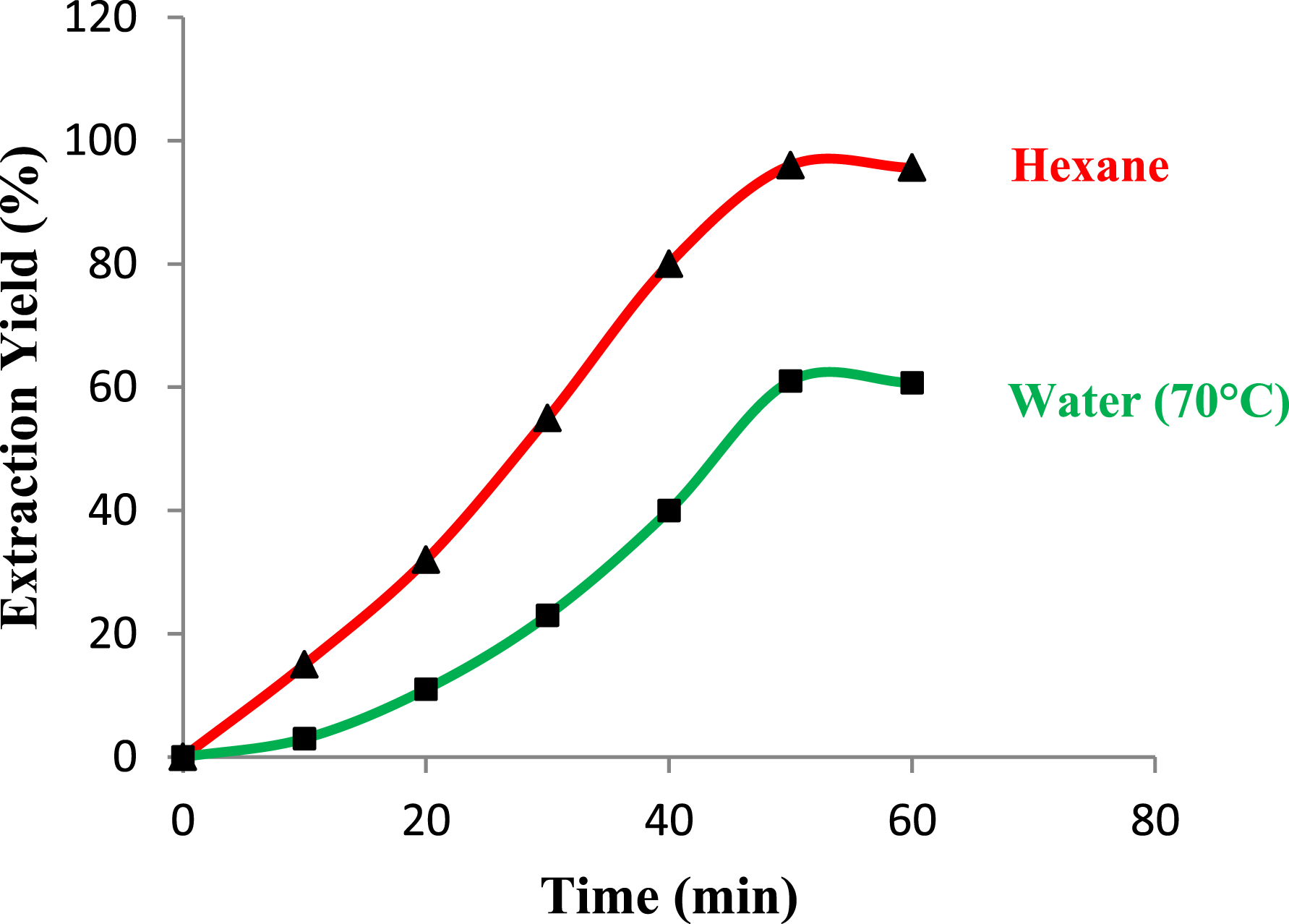
Wax Characterization, COD and Total Lipid Determination
Wool Wax Physiochemical and Total Lipid Content Analysis.

Gas Chromatography Analysis
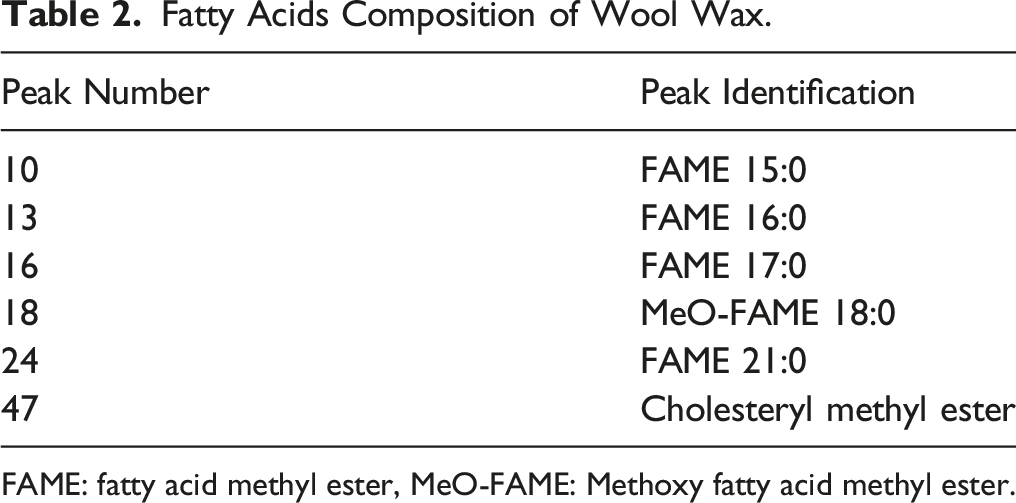
Fatty Acids Composition of Wool Wax.
FAME: fatty acid methyl ester, MeO-FAME: Methoxy fatty acid methyl ester.
In vitro Germination Test
In another experiment, the determination of the germination index of olive seeds during 15 days of treatment showed that this parameter is significantly higher using diluted wax and compared by water control. It reaches a maximum of 150 ± 17% at a dose of 1.25 mg/g and then gradually decreases (Figure 2). Germination index (GI) of olive seeds using different concentrations of wool wax. All experiments were made in triplicates. Values are expressed as means ± SD, *Indicates significant differences (P< .05).
Fertigation Practice
Irrigation with diluted wax showed an increase of stems length average compared to the control. It reaches the maximum of 45.7 ± 2.52 cm in plants irrigated by a dose of 1.25 mg/g soil (Figure 3). However, below and above this concentration an antagonistic effect resulting in a decrease of plant length was noted, confirming the toxicity of wax at high doses. In another experiment, auxin in treated plants was characterized by GC-MS analysis after derivatization step. A significant enhancement in auxin levels was noted in plants treated with 1.25 mg of wax/g of soil according to control (1.1 ± .1 and .7 ± .20 ng/mL, respectively). Variation of plant length using different concentrations of wool wax and correlation with auxin level. All experiments were made in triplicates. Values are expressed as means ± SD, *Indicates significant differences (P< .05).
Discussion
Using water at 70°C and hexane, extraction yields were 60.7 and 95.6%, respectively. The solvent did not have any influence on the extraction rate after 50 min. The resultant profile suggests that the extraction rate is limited by the solubility of some wool wax components. This is logic because hexane is a non-polar solvent. Our results are similar to those found by Dominguez et al. 12
Physicochemical characterization showed that wax is characterized by the absence of alcohol which could not therefore be at the origin of a possible toxicity. This result is in contradiction with those cited by Collins and Davidson who found amounts of alcohol in wax. 13 The unsaponifiable portion of wool wax consists of aliphatic monoalcohols, alkane 1,2-diol, cholesterol, triterpene alcohols, and small amounts of hydrocarbons and auto-oxidation products. 13 High COD values were noted confirming high pollution degree of effluents. However, Low composition of water moisture (3 to 6%) coupled with a large amount of phosphate (4.2 to 4.7%) and conversely low doses of protein (.08%) and nitrogen (.07%) were noted. These results are in agreement with those reported by the same authors. Besides, small amounts of nitrogen are found in wool wax and suggested that this element may be represented by phospholipids. Moreover, it contains traces of polypeptides and inorganic phosphate. 13
Using GC-MS, six compounds were identified compared to NIST library with domination of cholesterol. 7-ketocholesterol, which is known to be present in lanolin especially as a product of aging, is not detected in our study. This is in conflict with conventional data of lanolin analysis, where it was found in form of its degradation product 7-keto-3,5-cholestadiene. 14 Our results are in accordance with those found by the same authors in another publication. 15
Lanolin consists of a complex mixture of esters and polyesters of high molecular weight alcohols and fatty acids. 15 It has been reported from gas chromatographic investigations that the aliphatic alcoholic compounds in lanoline comprise 17.1% aliphatic non alcohols, 16 8.7% of aliphatic alkane-diols, 68.3% of sterol and triterpene alcohols, and finally 5.9% of unidentified polyols. 17
The effect of wax on olive seeds germination for 15 days of treatment showed a germination index of 150 ± 17% at a dose of 1.25 mg/g and then gradually decreases (Figure 2). These results are in agreement with those found by Lan et al. 18 and Abida et al. 19 and it can be explained on the one hand by the presence of nutritional elements as phosphate that stimulate germination and on the other hand by the high fatty acid content. In the same fashion, diethyl aminoethyl hexanoate (DA-6), a plant growth regulator, increases germination and seedling establishment of soybean by increasing fatty acid metabolism and glycometabolism. 20
Irrigation with diluted wax at 1.25 mg/g soil increases stem length average to reach 45.7 ± 2.52 cm compared to the control. To hypothesize the mode of action of wool wax and its fatty acids on phytohormones, auxin in treated plants was characterized by GC-MS analysis. A correlation between auxin levels and length improvement was noted in these plants comparing to control with levels of 1.1 ± .1 and .7 ± .20 ng/mL, respectively. Similar amount of auxin were found by Sheflin et al. in sorghum plants using UPLC MS/MS assay. 21 For our best knowledge and literature survey, this is the first report on auxin enhancement in O. europea by wool wax fatty acids. Auxin or indole-3-acetic acid (IAA) is a key plant growth hormone, involved in diverse processes as branching, gravitropism, phototropism, and seed development. 22 However, its biosynthetic pathways still not well understood. Although there is good evidence that the amino acid tryptophan is an early precursor. 23 Roudier et al. showed that very-long-chain fatty acids are involved in polar auxin transport and developmental in Arabidopsis thaliana. 24 Besides, wounding and/or stress of plant tissues can have a major impact on auxin biosynthetic route used by plants.24,25
Conclusion
Industrial use of wool release liquid waste which ranks among the main environmental hazards in the whole Mediterranean region. Our study focused on valorization of wax from these liquid effluents in agriculture. Being rich on fatty acids, wool wax improves Olea europea germination and growth at a dose of 1.25 mg/g by enhancing auxin production. This leads us to use wool wax as natural product in agricultural and fertigation practice.
Footnotes
Acknowledgments
The authors are grateful to all persons who helped to conduct this study.
Author Contributions
AISSANI N ensured the preparation of the experimental protocol and its realization, involved in all the analyzes carried out, wrote the manuscript, and interpreted the results obtained. GHIDAOUI M proved wool and financed the study. SEBAI H participated in revision and correction of the manuscript. All authors have reviewed and approved the submission of this manuscript version.
Declaration of Conflicting Interests
The author(s) declared no potential conflicts of interest with respect to the research, authorship, and/or publication of this article.
Funding
This scientific work was cofunded by the Tunisian Ministry of High Education and Scientific Research and GTEX sarl in the behalf of Mobidoc postdoc scholarship.
