



Abstract
Professor Ludwik Dobrzyński, an eminent scientist and popularizer of science, passed away on January 11, 2022, in his home in Warsaw, Poland, just before his 81st birthday. He was a specialist in solid-state physics. Later in his career, Ludwik also became interested in the effects of small doses of ionizing radiation on health. Professor Dobrzyński was one of the most outstanding physicists at the Polish Institute of Nuclear Research (IBJ), later transformed into the National Centre for Nuclear Research (NCBJ) at Świerk near Warsaw. He was also a well-recognized personality among the international low-dose radiation research community.

Youth
Ludwik Roman Dobrzyński, the son of Jerzy and Teofila née Preger, was born on January 27, 1941, in Asino, a town on the Chulym River in the Tomsk Oblast, USSR. Like thousands of other Polish families, Ludwik’s parents were deported to Siberia after the Soviet Union invaded Poland in 1939 at the beginning of World War II. Luckily, the Dobrzyński family survived the ordeal and returned a couple of years after the war.
In 1964, Ludwik graduated from the Faculty of Mathematics and Physics, University of Warsaw (UW), upon defending his M. Sc. thesis, “Research on the rotation of ammonium ions in solid solutions.” In 1969 he defended at IBJ his PhD dissertation, “Investigation of the internal magnetization distribution in Co-Fe alloys.” In 1975 based on his dissertation, “Fourier analysis of magnetic shape factors of some 3d metal alloys with the fcc structure” Ludwik obtained at IBJ a post-doctoral habilitation degree.
Early Research and Political Activities
Dr Dobrzyński’s first place of employment (1963 to 1982) was IBJ, where he advanced from the initial position of a technician to becoming assistant professor of physics. At the second Department of the Solid-State Physics, he employed thermal neutron scattering to study the structures and dynamics of the crystal and magnetic lattice. Eventually, he became deputy head of the Department. In 1964 he joined the Polish Physical Society and from 1964 to 1980 he was a member of the Polish Teachers' Union. In September 1980 he became a member of the independent trade union (NSZZ) of the Workers of Science, Technology and Education. He organized a section of the union at the Institute, was elected a delegate to the founding convention and in October 1980 became a member of the “Solidarity” (“Solidarność”) movement. In 1980–1981 he chaired the Solidarity cell at the second Department of IBJ. At the same time, he acted as secretary to the editorial board of the IBJ Information Bulletin of the NSZZ “Solidarność" where he contributed several articles. In 1981 he became a member of the Scientific Council of IBJ, but in December 1982, during the martial law period, he was expelled from the Institute because of his trade union activities. For a few months of 1983 he was employed by the National Concert Bureau and worked as a dancing teacher to earn his living.
From October 1983 the scientific career of Dr Dobrzyński developed at the city of Białystok in north-eastern Poland, where he joined the Department of Physics -the local branch of Warsaw University (later of the University of Białystok). On December 1, 1985, Ludwik was appointed assistant professor and on February 1, 1991, associate professor. On January 14, 1992, he obtained the state title of Professor of Physical Sciences. From September 1, 1995, he became full professor of physics at the University of Warsaw and at the University of Białystok.
Career Development
Ludwik Dobrzyński held several executive positions. For several months, he was head of the Department of Physics at the University of Bialystok. From 1990 to 1993 he served as dean of the Faculty of Mathematics and Natural Sciences at that University
Professor Dobrzyński served on many national and international advisory boards and scientific societies including the Physics Committee of the Polish Academy of Sciences (PAN, 1991–1993), the Condensed Matter Physics Section of the Physics Committee of PAN (1993–1996), the Scientific Council of the Institute of Atomic Energy at Świerk (1995–1999), the Senate Committee on Budget and Finance of the University of Warsaw (1996–1999), the Society for the Promotion of Science (since 1997), the Education and Social Information Commission at the National Council for Nuclear Studies (1997–2000), and the Public Awareness of Nuclear Science (PANS) in Europe (1999–2022). In addition, from 2001 until his death, he participated as an advisor to and later as Alternate to the Representative of Poland to the United Nations Scientific Committee on the Effects of Atomic Radiation (UNSCEAR). He was also a member of the editorial board of the Physica Scripta scientific journal.
Main Research Interests and Activities
Ludwik Dobrzyński studied the crystal and magnetic structures of solids using X-ray diffraction and neutron and magnetometric techniques, Mössbauer spectroscopy and Compton scattering. The Compton Spectroscopy Laboratory, which he organized in the 1980s, was the only one of this type in Poland and one of a few in the world. It used highly active sources of gamma radiation to study the electron momentum distributions. He also introduced and developed the so-called maximum entropy method, providing optimal results with limited initial information.
After returning to Świerk, Professor Dobrzyński’s interests expanded to the use of Bayesian methods for data analysis. Of special interest to the readers of the Dose-Response journal are the final 15 years of his work. They were devoted to studies of the impact of low doses of ionizing radiation on health. In 2019, he co-organized the 18th Meeting of the Polish Radiation Research Society and particularly the accompanying international seminar, “Applications of low radiation doses in medical diagnosis and therapy.”
Together with his colleagues, Ludwik statistically analyzed the dose-effect relationships in the nuclear workers from all around the world. He coordinated the analysis of the health effects of low doses on the staff of NCBJ institute. Ludwik participated in analyses of the influence of natural radiation, radon in particular, on the risk of cancer. Several scientific papers on this subject were published, also in Dose-Response. His final Dose Response paper was devoted to the methodology of researching the effects of radon on health. Prof. Dobrzyński was also interested in biophysical modeling of the effects of ionizing radiation on the neoplastic transformation of cells. In this respect, he co-authored a derivation of the Gompertz curve which, with use of biophysical relationships, describes the dynamics of tumor development. He has developed a mathematical description of neoplastic transformation based on the physics of nucleation and crystal growth, the so-called Avrami curve. One of the latest scientific publications by Professor Dobrzyński was devoted to the so-called Yonezawa effect, more commonly known as the priming dose effect. This was also the subject of his last talk, given at the 2021 international Gliwice Scientific Meetings, just a few weeks before his death.
Other Scientific and Popularizing Achievements
Ludwik Dobrzyński completed his research internships at several institutions abroad including the Institute of Atomic Energy in Kjeller, Norway (1965-1966, 1993-1994), the United Institute for Nuclear Research in Dubna, USSR (1969-1971), the Brookhaven National Laboratory, USA (1985), the Cassaccia Institute for Nuclear Research, Italy (1994), the University of Delft, Netherlands (1995), and the University of Paris VI (1991-2001). He participated in synchrotron radiation measurement sessions at ESRF in Grenoble and at the Daresbury Laboratory in the UK. These internships fostered cooperation with and travels of scientists from Ludwik’s own institute to many research centers abroad.
Professor Ludwik Dobrzyński has authored and co-authored close to 300 scientific papers and popular articles, the monograph “Neutrons and Solid-State Physics,” a chapter in the Oxford University Press monograph “X-Ray Compton Scattering” (2004), and numerous educational materials and reports on radiological protection and biological effects of ionizing radiation addressed to pupils, students, and teachers which were posted on the website of the NCBJ Education and Training Section. He also submitted to the Polish press numerous articles popularizing nuclear energy and nuclear physics research.
In 1986, Prof. Dobrzyński was conferred with a team award of the Minister of Higher Education and in 1994 the scientific award of the Minister of National Education. In 1996, he was decorated with the Badge of Merit for the Białystok Region and in 2003 he was honored with the Golden Cross of Merit. In 2010, he received the Medal of the National Education Commission and in 2011 the Medal of the University of Białystok, the highest distinction of the University. He has also won several awards from the Rector and the Vice-Rector of the University of Warsaw as well as the Rector of the University of Bialystok.
During his work in Białystok, Ludwik founded and chaired the Magnetism School and the International School of Physics and Condensed Phase Chemistry organized by the Solid-State Physics Department and held in Białowieża until 2009. For 20 years of their operation the schools gained a reputation of being a forum where young people could rub elbows with scientists from many countries, exchange experiences, and attend at lectures where the latest trends in the condensed phase research were discussed. In 2000, Prof. Dobrzyński, supported by his Institute, organized for the first time in Poland the “Sagamore XIII,” a prestigious, cyclical conference on charge density distributions and electron spins and momenta. In 2010 ha also organized the “CMD23—the 23rd General Conference of the Condensed Matter Division of the European Physical Society.
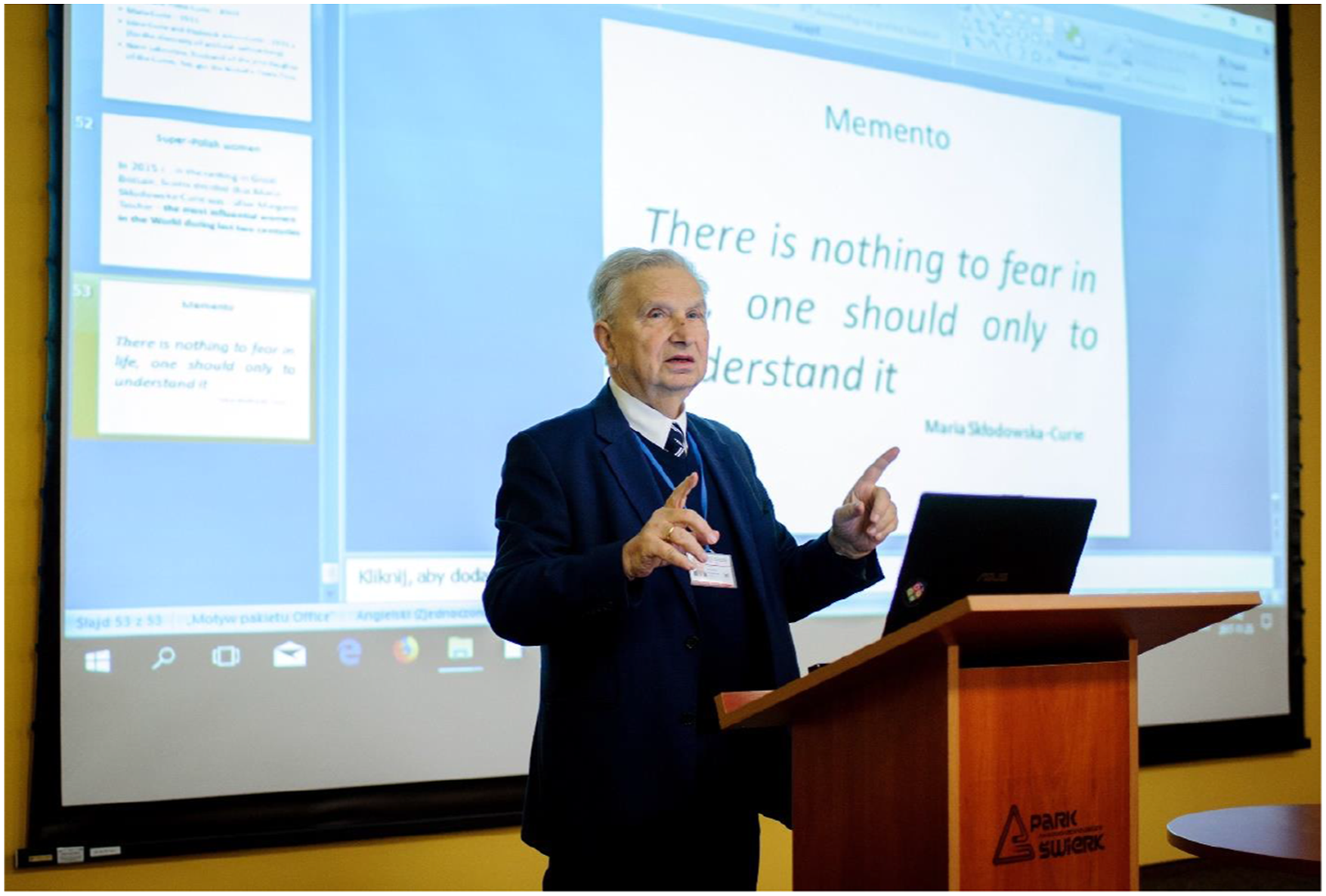
Professor Dobrzyński was a very active promoter of physical sciences. Every year, he conducted several popular lectures, including those invited by the Congresses of Polish Physicists. He regularly participated in the Festival of Science and Art in Białystok and in the “Science Picnics” in Warsaw. He also organized and for 27 years conducted the Solid-State Physics Seminar to which renowned physicists presenting their latest achievements in the field were invited.
Professor Dobrzyński was a very good lecturer, recognized by his wit and good humor and cherished by his students, who appreciated his notorious digressions to areas often remote to the main topic of the lecture. Professor prepared several scripts of his monograph lectures which were highly regarded by the students. Over his scientific career, Ludwik Dobrzyński supervised and promoted ten PhD students including 2 authors of this article.
A Good Man
Professor Dobrzyński’s perseverance, reliability, and diligence in executing of the tasks he undertook became proverbial. It is difficult to find a more competent, meticulous, and insightful natural scientist with such broad horizons who did not avoid issues bordering on physics, biology, chemistry, or medicine and who employed nuclear research methods in these areas. In his activities, the Professor typically displayed great energy and organizational talent. Notably, he always took interest in the private life of his colleagues and collaborators whom he gladly offered advice and help. His encouragement, support, and career advice to many in the scientific community will be forever appreciated and missed.
Finally, let us recall Ludwik’s favorite hobbies, which included playing the violin and the piano. Apart from Polyhymnia, he was no stranger to the muses of other fields of art such as theater, poetry, and dance. From 1965 to 1967 he participated, as a member of the Polish national team, in the international ballroom dancing competitions. His talents were fully apparent during the banquets of the Schools of Physics and Condensed Phase Chemistry in Białowieża, his favorite international meeting. During these events, he always made a welcome toast, full of wit and humor. This was always a prelude to the hops in which he sparkled on the dance floor and, whenever possible, played the violin or piano.
Dear Ludwik, we are missing you badly!
Footnotes
Acknowledgments
We wish to thank Prof. Eugeniusz Żukowski of the Univeristy of Białystok for his help in providing unpublished biographical data of Prof. Ludwik Dobrzyński, especially concerning his career in Białystok.
Declaration of Conflicting Interests
The author(s) declared no potential conflicts of interest with respect to the research, authorship, and/or publication of this article.
Funding
The author(s) received no financial support for the research, authorship, and/or publication of this article.
