



Abstract
An analysis of China’s domestic publications revealed that China’s hormesis-related research was enormously underestimated. China’s documented hormesis-related research spans at least four decades, covers a broad spectrum of research areas, and is more abundant than previously thought. These findings should be considered in historical assessments of the concept of hormesis. Moreover, similar to the international literature, different terms have been used to describe the same phenomenon (hormesis), which hampers communication, generalization of findings and accumulation of knowledge. Hence, we advocate that ‘hormesis’ should be cited as a keyword in all the relevant publications written in Chinese language.
Keywords
Although China ranks second (615 records) after USA (993 records) in terms of total publication records including the term ‘hormesis’ or ‘hormetic’ for all years (third comes Italy with 265 records), the championship in hormesis research shifted dramatically from USA to China in the recent years (Web of Science; Search method: All Fields; accessed 6 April 2022). China has emerged as the new powerhouse of hormesis research, becoming the largest producer of hormesis-related publications in 2019-2020. 1 China’s takeover became clearer in 2021. China (82 records) outperformed USA (73 records) with 12% more publications in 2020; however, this difference raised to 40% in 2021, with 106 records for China versus 76 records for USA (Web of Science; Search method: All Fields; total number of search records: accessed 6 April 2022). Not only do these indicate that China is leading the world in hormesis research, but they also suggest a plateau state for USA versus an explosive growth for China. It is unclear if this overtaking is here to stay for long, but considering that China has now become the world’s leader in various scientific metrics, including the total number of publications and patents, 2 one may expect that the growth of China’s hormesis research will continue in the near future.
As stated before, studies reporting findings suggestive of hormesis have also been published in China’s domestic journals. 1 However, the exact proportion of hormesis-related publications in China’s domestic journals and the origins of hormesis research in China were not evaluated. Here, we examine these by searching three leading Chinese literature databases.
Hormesis-relevant publications in China’s domestic journals. For each keyword, all manuscript aspects were searched (e.g. theme, keyword, title, or abstract). The last search was done on April 6, 2022. The survey was done by two independent reviewers and cross-checked. CNKI: China National Knowledge Infrastructure (https://www.cnki.net/). CSTTPB: (VIP) Chinese Science and Technology Periodical Database (http://lib.cqvip.com/). WFD: Wanfang Data (https://wanfangdata.com.cn/index.html). 低剂量兴奋效应 (dī jìliàng xīngfèn xiàoyìng): low-dose stimulation. 毒物兴奋效应 (dúwù xīngfèn xiàoyìng): hormesis (literally: toxic substances make the receptor excited). n/a: non-available. Note that in the title of some studies, while the text is in Chinese, ‘hormesis’ is written directly in English, even in 1990; in a study titled ‘"Hormesis"现象与低水平电离辐射-范正平’. 3
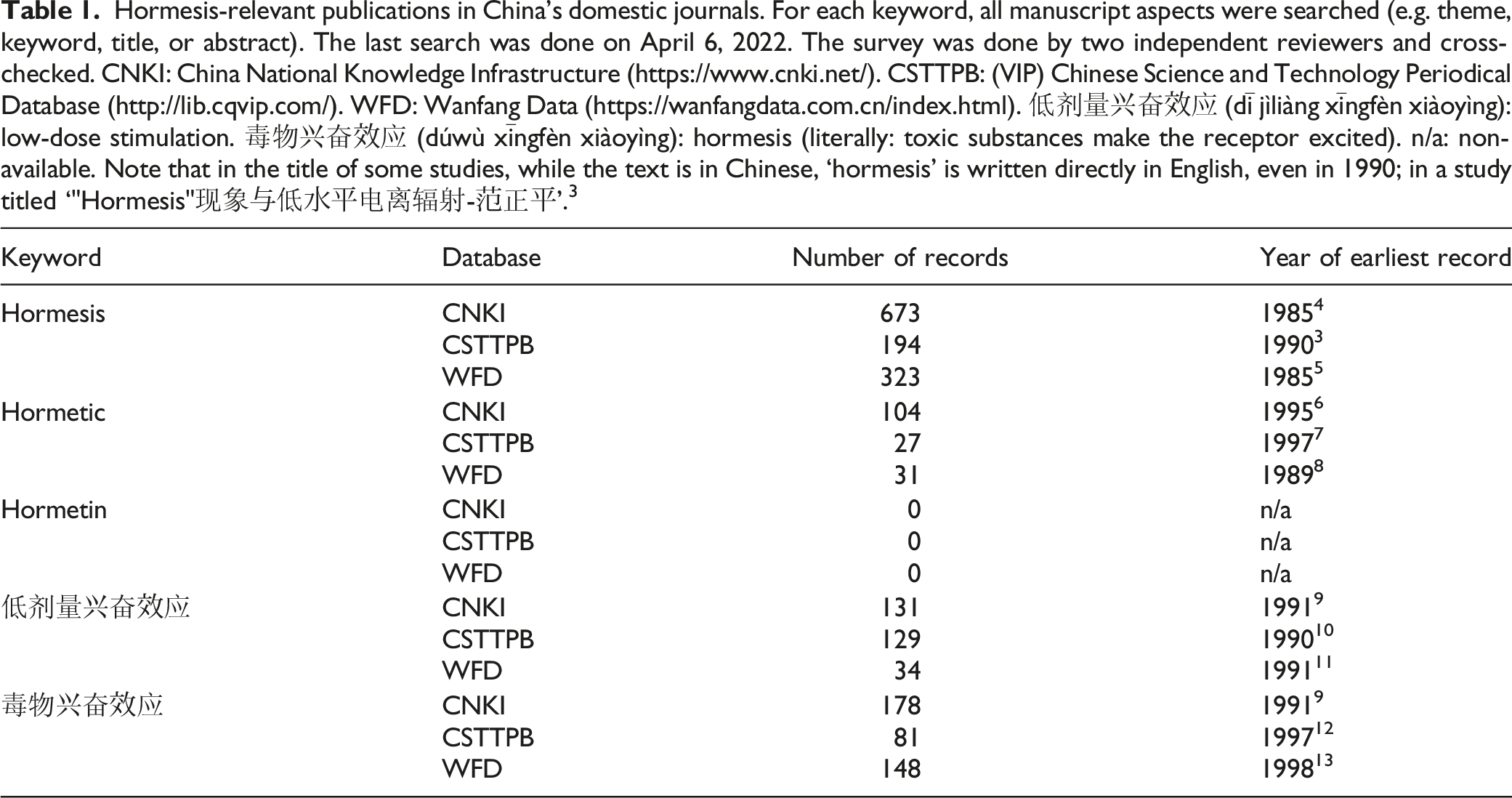
Importantly, while the earliest record of hormesis-related research revealed by the search within the Web of Science was in 2005, the new search in Chinese databases now reveals that the first documented report for hormesis-related findings dates back to 1985, extending the previously assumed span by 20 years and showing that hormesis phenomena have been known within China’s scientific community for at least four decades. Even reviews putting hormesis into the context of toxicology for further development were published in Chinese language earlier than the earliest record revealed by the Web of Science. 14 These findings also indicate that the entire hormesis literature is profoundly larger than previously thought. Similar to China’s domestic literature, this may be the case in several other countries where numerous studies are published in languages other than English, calling for similar examinations in other non-English domestic literatures.
This new analysis, however, reveals another important issue. The terminology used to describe hormesis within and across disciplines and research fields has been widely varied in the international literature (including dozens of terms), a matter that has been widely discussed in several review-type publications. Here, this new analysis indicates that this problem is even more significant because even more terms have been used in non-English languages as well, as is the case in China. At least two English terms and two Chinese terms were used in Chinese scripts (Table 1). However, the use of different terms to describe the same phenomenon impedes scientific progress and the accumulation of knowledge. Therefore, we advocate that researchers should report the English term ‘hormesis’ (even in the keywords only) regardless of the scripts’ language. This practice will permit tracing of the studies by the international scientific community and ultimately facilitate progress in the field.
Footnotes
Declaration of conflicting interests
The author(s) declared no potential conflicts of interest with respect to the research, authorship, and/or publication of this article.
Funding
The author(s) disclosed receipt of the following financial support for the research, authorship, and/or publication of this article: E.A. acknowledges support from The Startup Foundation for Introducing Talent of Nanjing University of Information Science & Technology (NUIST), Nanjing, China (No. 003080) and the Jiangsu Distinguished Professor program of the People’s Government of Jiangsu Province. H.S. acknowledges support from the National Natural Science Foundation of China (No. 22006116).
