



Abstract
The poultry sector is one of the most vibrant segments of the agriculture industry of Pakistan. In addition to different infections, ammonia (NH3) production from litter material of broiler is the most harmful pollutant and causes serious threats for the environment. To overcome this problem, different methods are proposed assuring poultry bird’s health and production. This study was carried out to evaluate the effect of toxic levels of NH3 on the haematology and serum proteins of broiler birds and its amelioration by using different modifiers. The recovery of Escherichia coli (E. coli) from liver and spleen of broiler birds was also carried out. A total of 100 birds were divided into 5 separate groups (groups A–D). The groups C, D and E were treated with potassium aluminium sulphate, aluminium silicate and Yucca schidigera plant extract, respectively. Blood and tissue samples were collected after slaughtering the birds at 42 days of age. This study revealed increased RBC, total leucocyte count, Hb and heterophils percentage. Serum proteins were decreased in Yucca-treated and potassium aluminium sulphate–treated groups. This study concluded that NH3 production was reduced by the application of different modifiers, and these modifiers also neutralized the changes in blood parameters induced by NH3.
Introduction
The poultry sector is an important and vibrant segment of agriculture in Pakistan with a significant contribution to the national GDP (1.3%). 1 Commercial poultry production in Pakistan started in the 1960s and has been providing a significant portion of daily proteins to the Pakistani population ever since. Its contribution in agriculture and livestock is 6.4% and 11.5%, respectively. 2 Currently, the turnover of Pakistan poultry industry is about Rs. 564 billion. During its evolution, the industry enjoyed promotional policies of the Government but has faced several challenges such as disease outbreaks. 1 Carbon dioxide, hydrogen sulphide, methane, and ammonia (NH3) are stress-causing agents present in the environment of poultry shed. NH3 is considered the most harmful due to its pungent smell and irritant nature that is primarily released by the litter degradation in poultry houses. 2 In poultry house, the main source of NH3 is faecal material containing uric acid, urea, and NH3. 3 NH3 emission from chicken excreta is due to high amino acids and protein diets given to the chickens to accelerate growth.4,5 NH3 volatilization from the breakdown of uric acid and urea has a major impact on the poultry industry and the environment. 6 In the presence of microbial enzymes, high pH and moisture, uric acid, and urea are converted into NH3 by the action of uricase and urease enzymes, respectively. 7 Some bacteria such as Bacillus, Pseudomonas, and Clostridium have uricolytic activity and speed up the conversion of uric acid into NH3. 8 Raised NH3 level in the environment has lethal effects on different organs, that is, respiratory system, 9 spleen, 10 liver, 11 intestine 12 and brain. 13
High NH3 levels in poultry production houses can have damaging effects on the birds, such as respiratory disease outbreaks, reduced growth rate, high mortality and low feed efficiency. Acid-based litter amendments have been wildly used in broiler operations to reduce NH3 concentration during the brooding period. 14 In this context, the litter must be treated properly to control proliferation of insects, growth of pathogenic microorganisms, moisture, and the production and volatilization of NH3. 15
Litter reuse during several consecutive flocks is a management practice that has been widely adopted in the production of broilers. Reusing the litter reduces the production costs, minimizes the problem of material availability and decreases the amount of waste generated by the production of chickens, in addition to maintaining or even improving the performance of animals. However, it is necessary to adopt efficient litter treatments to reduce risks to human and poultry health. Acidifiers, alkalizers, adsorbents, agricultural gypsum and superphosphate are the conditioners mostly used to treat poultry litter. The conditioner chosen must be able to reduce negative points and enhance the favourable characteristics of the poultry litter. 16
Volatilization of NH3 can be controlled by reducing pH, temperature, moisture and microbial activities. Litter treatment amendments with acidifiers including aluminium sulphate, sodium bisulphate and ferric sulphate are being used to reduce the pH of litter material. Feed supplemented with zinc, 17 charcoal 18 and Yucca schidigera plant extract 19 can also be used to reduce NH3 concentration in the environment. Saponins and polyphenols present in Yucca schidigera extract have urease inhibiting, antioxidant and antiviral properties 20 that may result in the reduction of NH3. Environmental stress is an ignored issue in the poultry practice, so this trial was performed using broiler birds as model animals with the objectives to study the effect of induced NH3 levels on haematology, serum proteins profile and amelioration of NH3 by using potassium aluminium sulphate, aluminium silicate (Genbiom®; Beijing Biogenbaal Technology & Development Co., Ltd) and Yucca extract (DK Yucca®; Desert King International). Recovery of E. coli from the liver and spleen of these broiler birds was also carried out.
Materials and Methods
Broiler Birds, Diet and Environment
A total of 100-day-old broiler chicks both male and female were procured from a local commercial hatchery. The basal feed was provided to all the birds during the first 14 days. Sawdust was used as a bedding material.
Equipments and Experimental Protocol
At day 15, the birds were weighed and randomly divided equally into 5 groups (A–E) separately sealed with polythene sheets. Litter material of brooding time was also equally distributed into all pens. Group A served as positive control and group B as negative control. Litter material of groups C and D was treated with powder spray of potassium aluminium sulphate (30 g/m2) and aluminium silicate (15 g/m2 nanoparticles Genbiom®; Beijing Biogenbaal Technology & Development Co., Ltd), respectively, while Yucca schidigera plant extract (1 mL/10 L) (DK Yucca®; Desert King International) was added to the drinking water of group E. Water and litter treatments were done on a daily and weekly basis, respectively, for the experimental period of 27 days after the partitioning of the birds. To increase the moisture level of litter, 20 mL water was sprayed on the litter twice a day in each pen except negative control, during the experimental period. NH3 levels were measured by digital ammonia metre twice a day.
Haematological and Biochemical Determinations
Birds were slaughtered at 42nd day of age, and their blood sample was collected and divided into 2 halves. One half was transferred into an EDTA anticoagulated evacuated tubes for haematological study while second half was transferred to an evacuated tube without anticoagulant for biochemical determinations such as serum proteins. Total erythrocyte count (TEC) and total leucocyte count (TLC) were counted using haemocytometer (Natt and Herrick, 1952). Haemoglobin (Hb) was determined by Drabkin’s method and packed cell volume (PCV) was measured by the micro-haematocrit method (Benjamin 1978). Differential leucocyte count (DLC) was performed through microscopic examination of Giemsa-stained blood film. 21 Serum total proteins were estimated by the biuret method. 22 Serum albumin was determined by bromocresol green dye (BCG) binding method. 23 Globulins were calculated by subtracting albumin from total proteins. 24
Histopathology
Tissue samples from the liver and spleen were collected in plastic bags for isolation and identification of the E. coli. Selected pieces of the liver and spleen were fixed in neutral buffered formalin for histopathologic examination. After fixation, the sections were placed in labelled tissue cassettes, processed to paraffin wax. Following embedding the tissue sections in paraffin wax, 4 µ thick sections were prepared using the rotary microtome, placed on glass slides, deparaffinized and then stained with haematoxylin and eosin (H&E) stain following the standard procedure. The stained tissue sections were then examined under optical microscope 25 (Binocular, Olympus, CX-31 made in Japan).
Isolation of E. coli
E. coli was cultured on nutrient agar and MacConkey agar and confirmed with Gram staining, catalase, methyl red and Voges–Proskauer tests as described by Dadheech et al (2016). 26
Data Analysis
The data from the above experiment was subjected to analysis of variance technique and means were compared by Dunnett’s test for difference from negative control group by using SAS statistical software version 9.2. The level of significance was considered P < .05.
Results
The mean values of ammonia (ppm) and haematological parameters (mean ±SD) in broiler birds under study.

The values with sign * are significantly (P<.05) different from the negative control group.
Group A: positive control, group B: negative control, group C: potassium aluminium sulphate treated, group D: aluminium silicate treated, and group E: Yucca treated; ppm: parts per million; SD: standard deviation.
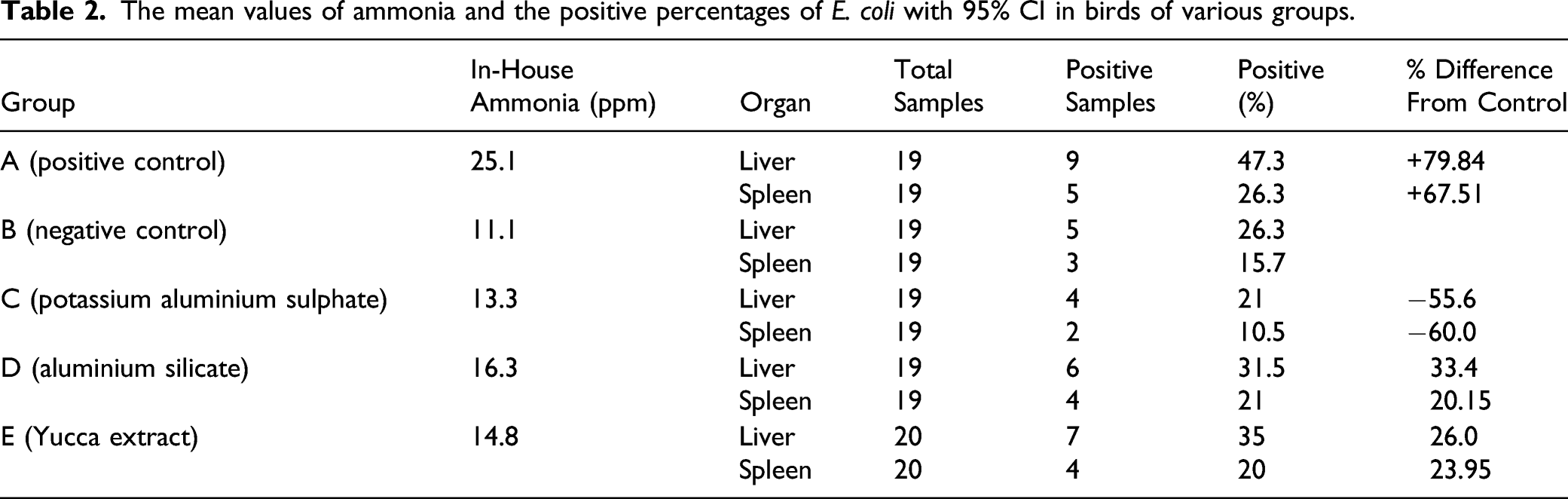
The mean values of ammonia and the positive percentages of E. coli with 95% CI in birds of various groups.
Discussion
High protein diets given to the chicken for rapid growth result in NH3 emission from chicken excreta. 5 Increased levels of NH3 in poultry production houses can have deleterious effects on birds resulting in various abnormalities including respiratory disease outbreaks, increased mortality, decrease growth rate and low feed efficiency. Acid based litter amendments have been wildly used in broiler operations to reduce NH3 concentration during the brooding period. 14 High NH3 level is associated with impaired immune system functions leading to various disorders affecting the growth rate and damages the respiratory system.27,28 Haematological investigations play vital role in the diagnosis and treatment strategies of an abnormality that can influence the patient’s outcome. 28 This study investigated the effect of induced high NH3 on the haematological and serum protein profile of broiler birds and their amelioration through the use of different modifiers. Findings of current study showed that increased erythrocyte count in positive control group broiler birds might be due to increased erythropoiesis as a result of lack of oxygen in the tissues. Lack of oxygen may occur due to impaired oxygen carrying capacity of RBCs. Olanrewaju et al (2008) 29 reported higher respiratory rates in the birds exposed to high NH3 levels which showed that oxidative stress may occur in broiler birds due to high atmospheric NH3. The increase in packed cell volume in the positive control group indicates an increased erythropoiesis as a compensatory mechanism of producing RBCs in response to the hypoxic condition. 24 In accordance with the present study findings, increased haematocrit values in rabbits exposed to high NH3 level were also reported by Dyavolova et al. 30 The TLC was relatively higher in the positive control group as compared to the negative control group. Stress conditions may be a reason behind this relative increase in leucocyte number, which enhances the production of stem cells from lymphoid organs and these stem cells can be differentiated into white blood cells. 31 In NH3-exposed birds, damage to the tracheal membranes lowers the resistance of the birds which expose them to various secondary infections including Newcastle disease, E. coli infection and coccidiosis. 32 In a previous study conducted in our lab, increased leucocyte count was observed in the rabbits exposed to high NH3 levels. 30 NH3 is an environmental stressor, and according to Dhabher et al (1995), 33 stress causes a decrease in lymphocyte and increase in heterophil percentage. Stress causes an increase in corticosterone level of plasma, and this corticosterone is responsible for depletion in various functions of the immune system including the proliferation of lymphocytes. 34 Results of this experiment were similar with the findings of von Borel et al (2007) 35 who exposed the pigs to 0, 30 and 50 ppm NH3 and observed an increase in heterophil percentage, while decrease in lymphocyte percentage. The results of the present study were not in agreement with the study conducted by Guston et al (1994) 36 who exposed the pigs to 0, 25, 50 and 100 ppm NH3 and revealed no difference in differential leucocyte count and TLC.
The results indicated that total serum proteins were significantly (P < .05) lower in the Yucca-treated group than the negative control group. According to Kucukkurt and Dundar (2013), 37 plasma total proteins were lowered by Yucca feeding in rats. On the contrary, Kaya et al (2003) 38 observed no significant difference in the serum total proteins after giving Yucca powder to the quails. So various studies indicated that Yucca has a depressing effect on serum total proteins in broiler, pigs and rats. Non-significant difference was observed in the values of albumin between different treatment and control groups; however, the values of serum albumin were found relatively lower in the Yucca supplemented group as compared to other groups. Similarly, in the previous study, albumin level was significantly reduced in the quails after feeding of 100 ppm Yucca powder. 38 Results of this study were not aligned with the results of Alagawany et al (2016), 39 which showed that albumin concentration was positively affected by increasing supplementation of Yucca in the feed of laying hens. Therefore, conflicting serum globulins were significantly (P < .05) lower in positive control, potassium aluminium sulphate– and Yucca-treated groups as compared to the negative control group. In the previous study, Wei et al (2015) 40 described that high NH3 level decreased the serum globulin concentration and also concluded that combination of high NH3 and relative humidity adversely affect the total proteins, albumin and globulins in serum. The decrease in total proteins, albumin and globulins may be due to hepatocyte damage or impaired amino acid transport and protein synthesis.41,42 In another study, birds exposed to high NH3 level had higher alanine aminotransferase (ALT), aspartate aminotransferase (AST) and creatine kinase (CK) concentrations in serum indicating the impaired liver functions due to NH3 exposure. 43 Therefore, the results of our present study indicate that damage to the liver is reflected by low serum proteins. Reports on serum albumin levels but on the serum total protein values were lower; thus, the albumin levels can obviously be lower as observed during the present study and in some other studies.
The E. coli recovery was found highest in the liver (47.3%) and spleen (26.3%) of the positive control group, while it was lowest in aluminium sulphate–treated group. The damage to tracheal tissue due to NH3 exposes the birds to secondary infections including E. coli. 44 Oyetunde et al (1978) 45 exposed the chicken to E. coli infection alone and in combination with NH3 and dust. The E. coli infection was developed more in the birds exposed to a combination of NH3 and dust; these results are in agreement with the results of this experiment. In another study, Chung et al (2015) 46 concluded that birds reared on litter treated with aluminium sulphate were less affected by E. coli infection. Katsunuma et al (2000) 47 conducted a study to determine the effect of Yucca saponins on various bacterial populations and found no inhibitory effect on E. coli population. The current study revealed that high levels of induced NH3 causes liver cells necrosis, inflammation and changes in the structural boundaries of the spleen in broiler birds. The findings of our study are in agreement with the published studies who reported similar results.10,39
Conclusion
The present study concluded that increase in TEC, TLC, heterophil percentage and haemoglobin value, while a decrease in lymphocyte percentage, was observed in response to high NH3 in the positive control group. The use of different modifiers reduced the atmospheric NH3, normalized the blood parameters and decreased the E. coli recovery from the liver and spleen. It was concluded that high NH3 level adversely affects the performance of birds. Based on this study, use of different acidifying agents such as aluminium silicate, potassium aluminium sulphate and Yucca Schidigera extract effectively reduced the atmospheric NH3 level leading to improved health of broiler birds. These findings have useful implications in understanding the toxic mechanisms of NH3 on the intestine of broiler birds.
Footnotes
Acknowledgments
The product Genbiom (aluminium silicate) supplied by the Bai Yunhua (Beijing Biogenebaal Technology and Development Co., Ltd.) for the research purpose is highly acknowledged. This manuscript has been derived from M Phil Pathology research thesis of Mr Muhammad Junaid Asif.
Conflict of interest
The authors have no conflict of interest.
Funding
The author(s) received no financial support for the research, authorship, and/or publication of this article.
