



Abstract
Purpose
The secondary metabolites in plants are the basis of defense and stress balance, which is an important aspect in plant growth. The UV-B treatment (a biotic stress) and salt stress on bitter melon (Momordica charantia L.) were studied, and the impact of pre-sowing seed treatment was evaluated on the basis of biochemical and enzymatic biomarkers, antioxidants, and wound-healing potential during early growth stages.
Methods
The UV-B treatment for 5 and 10 min and salt stress 250 mM and 500 mM treatments were applied, and 21-day seedling tissue were collected for total phenolic contents (TPC), total flavonoid contents (TFC), antioxidant, chlorophyll contents, hydrogen peroxide, total soluble sugar, enzymes activities, and wound-healing potential studies.
Results
The TPC, TFC, diphenyl picrylhydrazyl (DPPH), chlorophyll contents, and total soluble sugar were recorded higher at 5 min treatment with UV-B and salt stress at 250 mM concentration. Antioxidant enzymes activities were recorded higher for 10 min UV-B treatment and 500 mM salt treatment. Wound-healing potential was found significant at 5 min treatment with UV-B radiation, which was studied in vivo in rabbits. The LC-MS analysis revealed a variety of phenolic compounds in the seedlings.
Conclusion
The study concluded that treatments significantly affect the biological activities of bitter melon seeds at the seedling stage, and the seeds contain important phenolic compounds responsible for its antioxidant potential and enzymatic activities. Future studies could be focused on the later stages of growth, development, and yield characteristics subjected to salt stress along with UV-B radiation treatment.
Introduction
Plants are the vital foundations of bioactive compounds (antioxidants), which are employed for the preparation of herbal-based health complements.1-3 Due to the very fast population growth, food demand is increased many folds. The population of world is projected to grow to 9.5 billion in 2050; hence, there is a need to enhance the food supply. 4 At present, there is a challenge for researchers and biotechnologists to develop and apply the strategies to fulfill the world’s food needs. Various techniques have been applied to enhance the vegetables’ and crops’ yields. 5 The employed techniques not only enhance the yield, but these plants also contain a diversity of bioactive moieties, which are accountable for the biochemical activities.6-8 The vegetables and fruits are excellent bases of biologically active compounds, which are responsible for health-related processes in the living organisms, that is, radical scavenging9-11 and blood pressure control, and preclude the tissue from cancer and cardiovascular diseases.12,13 The low concentration of bioactive compounds did not work properly to prevent the oxidative process and resultantly, deterioration starts in the tissues. The intake of bioactive ingredient-based food items is highly recommended to avoid the tissue damage, protein crosslinking, lipid oxidation, and DNA mutation. 14
The metal ion chelators, free-radical scavengers, or oxygen scavengers that react with oxygen are regarded as antioxidants, and the carotenoids and phenolics act as scavengers of free radicals in the body of living organisms.15,16 The pre-sowing treatment with salt, acid, laser, and UV-B irradiation can enhance the germination, growth, and biochemical and regulatory pathways, ultimately increasing the yield. However, the abiotic stress exposure for longer time and higher concentration may accumulate the reactive oxygen species (ROS), that is, hydrogen peroxide, singlet oxygen, superoxide, and hydroxyl radical.17-19 The ROS attack lipids, nucleic acids, and proteins, and equilibrium among ROS and their scavenging by the antioxidative systems plays a vital role. The antioxidant defense system defends against oxidative damage,20,21 and the ROS generation is controlled by the supplement of antioxidant, that is, glutathione, thioredoxine, ascorbic acid, and carotenoids as well as by glutathione peroxidase, superoxide dismutase, and catalase enzymes.22-24 The oxidative stress tolerance is controlled genetically, which is in existence due to improvement in crops using various approaches. The pre-sowing physical, chemical, and biological treatments have been used in this regard, and very promising outcomes have been documented.25-27
The Momordica charantia L. (bitter melon) is a Cucurbitaceae (family) member, which is very frequently used as a vegetable. It has also medicinal properties, that is, anticarcinogenic and hypocholesterolemic. 12 Bitter melon is reported to be a potential good source of phytochemicals (phenolics and carotenoids). 28 Hence, pre-sowing seeds of B. melon were treated with stress (NaCl 250 mM and 500 mM) and UV treatment for 5 and 10 min. After 21 days, seedlings were collected (control and treatment group), and the biochemical stress markers and phenolic and flavonoid contents were also assessed. The antioxidant potential was also documented using the free-radical scavenging method (DPPH method). Moreover, the in vivo effect of treatment was studied as a wound-healing potential on the experimental model rabbit. Finally, the phenolic contents were determined by LC-MS analysis.
Material and Methods
Chemicals and Reagents
The analytical grade chemicals, i.e., casein, dichloroindophenol, methionine, trichloro-acetic acid, riboflavin, ninhydrin, nitroblue, tetrazolium, and toluene were obtained from Sigma (USA). Folin–Ciocalteau’s reagent (FC-reagent), thiobarbituric acid, potassium iodide, Rochelle salt, anthron, and glacial acetic acid were obtained from Merck (Germany). Triton X 100, hydrogen peroxide, bovine serum albumin, and potassium diphosphate were procured from Bio-Rad, Fluka (USA) and MP Bioforma (France).
Seed Collection and Treatment
The B. melon seeds were attained from AARI (Ayub Agriculture Research Institute, Faisalabad, Pakistan). Healthy seeds are picked and disinfected with NaClO (0.5%) for 5 min and then rinsed with water. Seeds were subjected to UV treatment for 5 and 10 min and salt stress (250–500 mM). Treated and control seeds are sown in pots that already have been filled with sand and clay. The pots were soaked with mineral water (nestle water) and half-strength of Hoagland’s. Seeds were vertically placed on the upper surface, and 1 cm of additional soil (sand and clay) was placed to cover the seeds. The pots were regularly sprayed with water and on the 21st day of seedling, fresh samples were collected and their different biochemical activities, chlorophyll contents, total biomass, and total phenolic and flavonoid contents were estimated. Effects of pre-sowing treatments on seed and phenolic contents were documented using the LC-MS technique. The wound-healing potential was also documented in rabbits, by inducing wounds on their dorsal surface.
Biochemical Analysis
Total Phenolic Contents (TPC)
For TPC analysis, seedling tissue was homogenized in 80% acetone, and the homogenates were spun for 10 min at 12,000 rpm. Supernatant was obtained in Eppendorf tubes and used for TPC determination. The supernatant (1 mL) was assorted with 2 mL of water, and 1 mL of FC-reagent was dropped and the volume is increased to 10 mL with more water addition. Now, BioTek, model μ-QuantTM, Winooski, VT, USA, was used to record the absorbance (755 nm). Total phenolic contents were estimated using the calibration curve, and the result was stated as gallic acid equivalents per (mg/g) of fresh weight. 29
Total Flavonoid Content (TFC)
For TFC analysis, a 100 μL of extract (1 mg/mL ethanol) was mixed with ethanol and made the volume up to 1 mL, and then 4 mL of water was transferred along with 300 μL of 5% NaNO2 solution. Then, AlCl3 (10%, 300 μL) was supplemented after 5 min, and the suspension was kept for 6 min. Now, 2 mL NaOH (1 M) is dropped, and the volume is raised to 10 mL with water. The absorbance was measured after 10–15 min at 755 nm (BioTek, model μ-QuantTM, Winooski, VT, USA). The calibration curve was used to estimate the TFC and stated as catechin equivalents per (mg/g) of fresh weight. 30
Diphenyl Picrylhydrazyl (DPPH) assay
For the DPPH assay, seedling tissues at 21 days were collected, and crude extracts were prepared and their scavenging abilities against synthetic oxidant DPPH were checked. A fresh solution of DPPH is prepared in ethanol. Methanolic (5 mL, 0.004%) of DPPH was added in 50 mL of extract into the extracts (50 µL), which was incubated for 30 min at 25°C, the absorbance record vs a blank at 517 nm.
31
The scavenging ability was measured as depicted in equation (1)

Chlorophyll Contents
For chlorophyll analysis, 0.5 g of fresh seedling are macerated and then 4 mL acetone (99%) is poured with ethanol (2 mL, 2:1 v/v), and contents are stirred for 1 min, left for 30 min in the freezer in the dark, and centrifugation was done for 10 min at 2000 rpm. Tubes are protected with foil (Al), and acetone/ethanol (2:1 v/v) (5 mL) was mixed in it and agitated for 1 min. Now, the optical density was monitored at 663 nm and 645 nm, and following equations (2–4), chlorophyll contents were estimated.
32



Hydrogen Peroxide (H2O2)
For H2O2 analysis, 0.5 g sample was homogenized with C2HCl3O2 (0.1%, 5 mL (w/v)), and centrifugation was done for 15 min at 12,000 rpm. Then, 0.5 mL of the supernatant is assorted in 0.5 mL K3PO4 (10 mM) buffer (pH 7.0) and 1 mL KI (1 M), and optical density was recorded at 390 nm for H2O2 estimation. 33
Total Soluble Sugar (TSS)
For the measurement of TSS, the extract (100 μL) was homogenized with H2O (900 μL) and anthrone reagent (1 mL), and the mixture was heated for 8 min. Then, the optical density of the pre-cooled mixture was recorded at 630 nm. The soluble sugar was quantified using the standard curve for TSS. 34
Enzyme Activities
The inhibition of nitrobluetetrazolium was performed for super oxide dismutase (SOD) activity evaluation, 35 whereas for SOD analysis, 1 mL of suspension containing Triton-X in 17.5 mL of water (0.0375 mL), methionine (222 mg), riboflavin (13.2 g), and nitrobluetetrazolium (15 mg) was mixed with the extract, and this suspension was subjected to irradiation (15 min, 350 μmol m−2s−1). The one unit of SOD is the amount of enzyme that inhibits 50% of nitrobluetetrazolium, which was measured at 560 nm. The POD and CAT were analyzed as precisely reported elsewhere. 36
Identification of Compounds
Extraction of Phenolic Compounds
The extraction was performed as precisely reported elsewhere 37 with slight change. The fresh seedling (1.0 g) was assorted in chilled absolute methanol (20 mL) for 10 min, centrifuged at 2500 × g for 10 min, and the supernatant was separated, which was performed thrice, and at the end, the supernatants thus obtained were combined and evaporated at 45°C to dryness using a rotary evaporator. The extract was stored at 4°C until analysis.
LC-MS Analysis
For LC-MS analysis, the extract was passed from a syringe filter (0.45 µm). The Luna RP C-18 column (3.0 µm particle size, 4.6×150 mm) (Phenomenex, USA) was equipped with a pump. The methanol and acidified water (0.5% formic acid v/v) were used as a mobile phase. The gradient system was adopted for elution at a flow rate of 0.3 mL/min (10% to 30% in 5 min; from 10% to 50% in 20 min and maintained this till the end of analysis). A 20-min re-equilibration time was used, and the column was kept at 25°C during analysis with 5.0 µL injection volume, and the electron spray ionization mass spectrometer (LTQ XLTM linear ion trap Thermo Scientific River Oaks Parkway, USA) was used. The spectra acquired over a mass range from m/z 260 to 800 using negative ion mode. The optimum values of the ESI-MS parameters of sheath gas and auxiliary gas were 45 and 5 units/min, respectively; spray voltage, +4.0 kV; capillary voltage, −20.0 V; capillary temperature, 320°C; and tube lens, −66.51 V. The molecular ions were processed through Xcalibur software (Thermo Fisher Scientific Inc, Waltham, MA, USA) for accuracy of the mass spectral data.
Wound-Healing Analysis
Healthy male rabbits were selected and used for the wound-healing study. Prior consent was obtained from the Animal Research Board of University of Agriculture Faisalabad, Faisalabad, Pakistan. For study, healthy male rabbits (15 animals, 3 animals in each group included) with average weight (2 to 2.5 kg) were selected and kept under observation for 48 to 72 h (12 h photoperiod, 25 ± 1°C, access to food and tap water), and then wounds were induced.
Induction of Wound
The hair (dorsal side) was shaved with electric shaver 12–24 h before the wound induction, and they were kept under the supervision of a qualified veterinarian. The xylocaine (5 mg/kg) was used to anaesthetize. For the wound, the dorsal side of the lumber region (3 × 3 cm) is tempted with sterilized scalpel blades.
38
The wound size was measured using the relation shown in equation (5)
39

Results and Discussion
With the increasing world population, the major concern is to meet the food demands. For this purpose, different physical and chemical methods are used to fulfill the food needs. Pre-sowing bitter melon (Momordica charantia L.) seeds were treated with UV irradiation for 5 and 10 minutes and salt stress NaCl solution (250 mM and 500 mM), and after 21 days, seedling tissue was collected from untreated and treated groups, and change in various biochemical and enzymatic activities was measured, and the effect of treatment with respect to concentration and time was also measured.
Total Polyphenol and Flavonoid Content
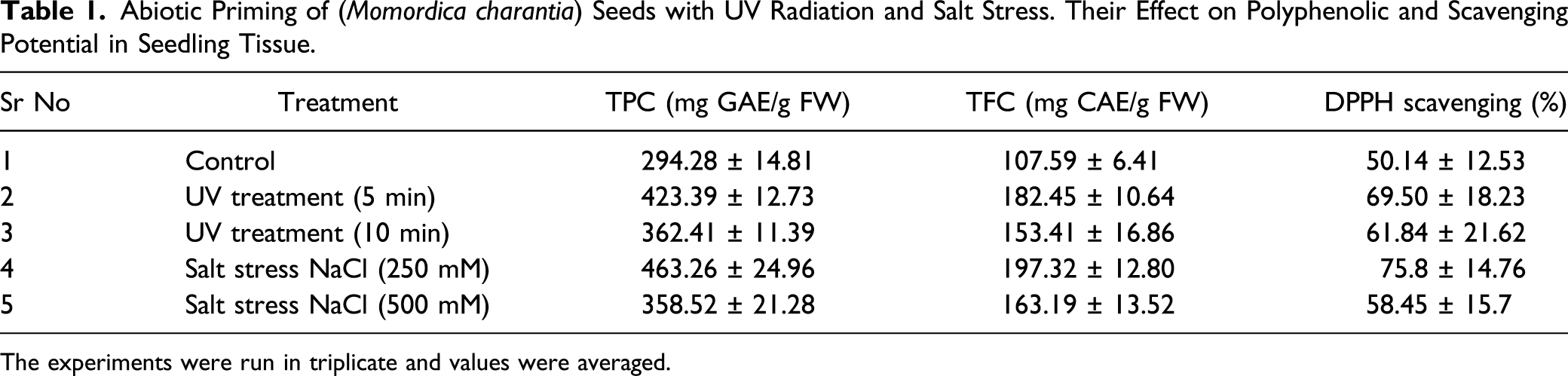
Abiotic Priming of (Momordica charantia) Seeds with UV Radiation and Salt Stress. Their Effect on Polyphenolic and Scavenging Potential in Seedling Tissue.
The experiments were run in triplicate and values were averaged.
DPPH Scavenging Activities
The DPPH free-radical scavenger results are given in Table 1. The DPPH scavenging potential of untreated seedling tissue shows 50.14% free-radical inhibition. But in pre-sowing seeds treated with UV irradiation for 5 and 10 min, free-radical scavenging potential initially increases up to 69.50% at 5 min, but as treatment time increases, free-radical scavenging potential decreases up to 61.84% because UV treatment is phototoxic. For longer time exposure, it decreases the synthesis of different secondary metabolites which affect the plant’s overall potential. Similar to UV treatment, salt stress also affects the plant growth at 250 mM and free-radical scavenging potential increases up to 75.8%, but at higher concentration, free-radical scavenging potential decreases up to 58.45%. The TFC and TPC showed positive correlation with DPPH. The phenolics have direct correlation with antioxidant activities because of their H-donating capacity, and previous reports are also in accordance with the present study that reports positive correlation with phenolics and antioxidant activity.41,44
Chlorophyll Contents, Hydrogen Peroxide and Total Soluble Sugar
Chlorophyll Contents, Hydrogen Peroxide, and Total Soluble Sugar of Pre-Sowing Seeds Treated with UV and Salt Stress of Momordica charantia L.

The experiments were run in triplicate and values were averaged
Enzymatic Activities
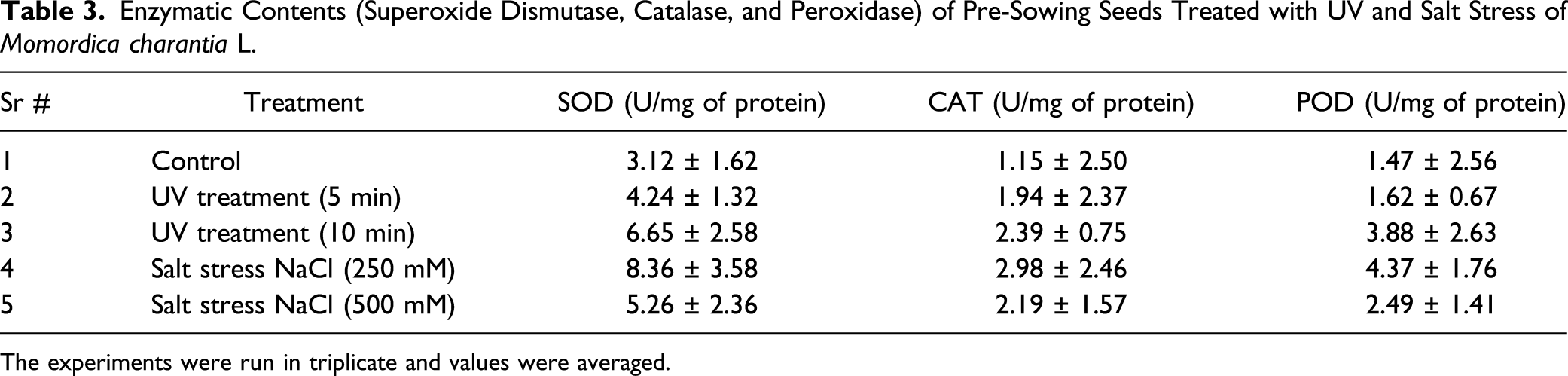
Enzymatic Contents (Superoxide Dismutase, Catalase, and Peroxidase) of Pre-Sowing Seeds Treated with UV and Salt Stress of Momordica charantia L.
The experiments were run in triplicate and values were averaged.
Peroxidase (POD) Activities
Enzymes play an important role in biological activities. They are also used as a biomarker whenever any biotic or abiotic stress influenced or was applied on a system, which affected the normal biological process. Pre-sowing, Momordica charantia seeds were treated with UV and salt stress (250 mM and 500 mM of NaCl solution), and at 21 days of seedling, tissue was collected and change in the enzymatic level of POD was measured through the calorimetric method and given in Table 3. Significant impact of UV and salt stress on Momordica charantia seeds was noted, and the POD level in control, UV, and salt stress were (1.47 ± 2.56 unit/mg of protein), (1.62 ± 0.67 unit/mg of protein), (3.88 ± 2.63 unit/mg of protein), (4.37 ± 1.76 unit/mg of protein), and (2.49 ± 1.41 unit/mg of protein), respectively. Seeds treated for short time not only sped the germination process, and the positive impact on plant biomass was also measured. Seeds treated for longer time not only damaged the plant tissue but even reduced the growth. UV-B treatment damaged the DNA and protein, and disturbed the membrane’s permeability. Similar to the biophysical method for pre-sowing seed treatments, salt stress also regulates the cellular process, but when higher concentration of salt was used, negative impacts on seedlings were measured.
Wound Healing
In the current study, rabbits were selected, and three rabbits were kept in each group. Using aseptic condition, 3 × 3 cm open wounds were created on the dorsal lumber region of the body. All experimental animals were arranged into 5 groups, that is, control group (G1), UV-treated group for 5 minutes (G2), UV-treated group for 10 minutes (G3), salt stress 250 mM (G4), and salt stress 500 mM (G5). To avoid bias, from each group, 30 mg of extract was applied on the open wound twice a day for 14 days. Healing of wounds was monitored on the 14th day of treatment. The result showed that bioactive compounds extracted from the UV-treated for 5 minutes, pre-sowing seed group of Momordica charantia showed promising healing of open wounds, followed by UV-treated group for 10 minutes. A similar result was also reported in Figure 1 for the salt stress group for sodium chloride (250 mM and 500 mM). At lower concentration, seedling tissue showed good growth and also synthesized secondary metabolites, having promising wound-healing potential. But as concentration increases, it reduced the growth of seedling tissue and also synthesized lower concentration of bioactive compounds having less medical importance.
46
Wound-healing potential of pre-sowing seeds of Momordica charantia UV and salt stress.
The percentage of wound reduction was measured on the 14th day, and for the control group, the open wound was healed up to 18.27% by the natural healing process because the control group did not receive any medical application. But UV treatment for 5 minutes showed tremendous wound healing up to 86.28% within 14 days of wound induction (Table 4). But in UV treatment for 10 minutes, less concentration of bioactive compounds synthesis occurs, and as a result, wound-healing potential was also reduced up to 46.49% when compared among UV treatment in a time-dependent manner; significant decreased healing potential was found as exposure time increases. A similar result was documented in salt stress also, and when 250 mM solution of NaCl was used, wound-healing potential of Momordica charantia was also increased up to 81.42%. But as concentration increases, wound reduction was reduced up to 28.33%. The images presented in Figure 1 show the wound reduction in different groups as a function of the number of days (zero to fourteen days). These results clearly indicated that wound reduction is maximum in G2 and G3 and minimum in G1 and G5 at fourteen days. UV treatment for 5 minutes and salt stress at 250 mM concentration showed promising potential in wound healing. It shows that at low concentration of salt and UV treatment, plant biomedical importance along with their growth and yield can be increased many folds.
Phenolics in Extracts
The phenolic compounds are the plant’s secondary metabolites that balance the plants with its environment,47,48 that is, plant defense mechanisms and their synthesis are also often induced by different kinds of biotic or abiotic stress. The analysis of Momordica charantia extract was performed and p-coumaric acid, Methyl gallate, Carpacin, Gallic acid, Syringic acid, Ferulic acid, Digallic acid, Catechin, Isoquercetin and Kaempferol 7-O-glucoside were found as major components and their structures are displayed in Figure 2, which are detected in comparison to standard (retention time) and literature data. This technique is used for the phenolics component analysis. It is also equally employed for structural clarification and the separation of different components present in the Refs. 49 and 50. The ESI (Ionization by electrospray) in LC-ESI-MS/MS analysis is one of useful techniques in this analysis and has been applied for this purpose successfully in different modes.
51
The ESI negative mode is applied for molecules that has carboxyl groups, which yields ion [M-H]-due to presence of carboxylate anion.52,53 Structure of phenolic compounds identified by LC-MS-MS of Momordica charantia seedling extract treated with UV and salt stress.
Wound Sizes and Their Reduction as a Function of Treatment in Different Groups.

The experiments were run in triplicate and values were averaged.
LC-MS-MS of Momordica charantia Seedling Extract Treated with UV and Salt Stress.

Conclusion
The study concluded that the irradiation and salt stress treatments significantly affect the TPC, TFC, DPPH, chlorophyll contents, and total soluble sugar contents of bitter melon seedlings. The antioxidant enzymes (POD, CAT, and SOD) activities were also affected significantly in UV-B treatment and treated seedlings under salt stress. The wound-healing potential of extract was found to be significant, which was studied in vivo in rabbits. The extract’s characterization revealed the presence of different phenolic compounds in bitter melon seedlings raised from UV-B treated seeds, which are responsible for its antioxidant potential. Future studies would be focused on growth characteristics at later stages and the yield of bitter melon.
Footnotes
Acknowledgment
This research was funded by the Deanship of Scientific Research at Princess Nourah bint Abdulrahman University through the Fast-track Research Funding Program.
Declaration of Conflicting Interests
The author(s) declared no potential conflicts of interest with respect to the research, authorship, and/or publication of this article.
Funding
The author(s) disclosed receipt of the following financial support for the research, authorship, and/or publication of this article: This research was funded by the Deanship of Scientific Research at Princess Nourah bint Abdulrahman University through the Fast-track Research Funding Program.
