



Abstract
We explored whether long noncoding RNA growth arrest-specific transcript 5 (LncRNA-GAS5) small interfering RNA (siRNA) reduced cartilage destruction in obese mice with adjuvant-induced arthritis. We studied the effects of LncRNA-GAS5 siRNA on the polyarthritis index; hind paw swelling; and the serum levels of certain biochemicals, cytokines, and oxidative stress parameters. We measured the expression levels of matrix metalloproteinases (MMP)-13, NF-κB, fibroblast growth factor (FGF) 21, p38, Akt, and PI3K in cartilage via Western blotting and quantitative reverse transcription PCR. Long noncoding RNA-GAS5 siRNA reduced joint swelling; the serum levels of arthritis-associated biochemicals, cytokines, and oxidative stress markers; and cartilage MMP-13, NF-κB, FGF21, p38, Akt, and PI3K levels. Cartilage miR-103 expression was reduced. Histopathologically, LncRNA-GAS5 siRNA ameliorated the pathological changes of cartilage. Long noncoding RNA-GAS5 siRNA prevented cartilage destruction by inhibiting miR-103 expression.
Introduction
Rheumatoid arthritis (RA) is an autoimmune disorder associated with progressive joint degeneration 1 characterized by osteophyte formation, loss of articular cartilage, and extracellular matrix degradation. 2 Rheumatoid arthritis causes global disability. The etiopathogenesis is incompletely known but increases in the levels of growth factors, chemokines, and cytokines, and changes in synovial factor (SF) levels are involved. 3 Increased SF levels enhance the secretion of matrix metalloproteinases (MMPs) and mediators of inflammation. 4 Bone degeneration reflects changes in the ratios of osteoclasts to osteoblasts 5 and chronic inflammation develops. 6 In obese patients, the levels of pro-inflammatory cytokines rise and those of anti-inflammatory cytokines fall. 7 Fibroblast growth factor (FGF) triggers differentiation of white to brown adipose tissue, further enhancing obesity 8 ; thus, FGF may be a useful therapeutic target. 9 Conventional therapies are inadequate, and RA remains poorly managed.
Long noncoding RNAs (LncRNAs) are noncoding RNAs longer than 200 nucleotides. The growth arrest-specific transcript 5 (GAS5) gene suppresses tumor growth; LncRNA-GAS5 suppresses cell proliferation of prostate, colorectal, and bladder cancers. 10 LncRNA-GAS5 reduces miR-23a expression, thereby protecting against hepatic fibrosis by attenuating the PTEN/PI3K/Akt pathway. 11 Long noncoding RNA-GAS5 stimulates miR-103 expression, helping to prevent endometrial cancer. 12 miR-103 expression is enhanced in patients with osteoarthritis; modulation thereof prevents arthritis by reducing the levels of inflammatory mediators. 13 We explored whether LncRNA-GAS5 small interfering RNA (siRNA) protected against RA.
Materials and Methods
Animals
C57BL/6 mice (4 weeks old) were held under a 12-h/12-h light/dark cycle at 60% ± 5% relative humidity and 24 °C ± 3 °C. All animals were fed 60 kcal of fat daily. All animal protocols were approved by the institutional animal ethical committee of Jingzhou Traditional Chinese Medicine Hospital, China (approval no. IAEC/JTCMH/2018/08).
Experimental
Thirty animals were divided into 3 of 10 groups (control, RA, and RA/LncRNA-GAS5). Rheumatoid arthritis was induced as previously described. 14 Isometric incomplete Freund’s adjuvant (IFA) was prepared via emulsification with 2 mL of bovine type II collagen solution and acetic acid, and 0.1 mL was injected for 3 weeks into the paw plantar surfaces of mice that weighed >30 g. Rheumatoid arthritis development was assessed by evaluating hind paw swelling. The siRNA targeting LncRNA-GAS5 was injected into the tail vein (25 nmol/kg) together with the Entransfer-in vivo reagent according to the manufacturer’s protocol on days 7 and 14, 30 minutes after IFA administration.
Estimation of the polyarthritis index and hind paw swelling
The polyarthritis indices and hind paw swelling were determined at the end of the experiment. Swelling was estimated using a volume displacement method and was scored as final paw volume/original volume. The polyarthritis index ranges from 0 to 4: 0—no swelling, 1—little erythema and slight edema, 2—erythema from the ankle to the tarsal bone and slight edema, 3—erythema from the ankle to the tarsal bone and moderate edema, 4—erythema and edema throughout the leg.
Estimation of biochemical parameters
Serum high-density lipoprotein (HDL), low-density lipoprotein (LDL), aspartate aminotransferase (AST), and alanine aminotransferase (ALT) levels were estimated using commercial kits following the manufacturer instructions. The quantitative turbidimetric test was used to estimate C-reactive protein (CRP) concentrations. Interleukin (IL)-17, IL-6, and IL-4 levels were estimated via commercial enzyme-linked immunosorbent assays (ELISAs) as per the manufacturer instructions.
Oxidative stress markers
Serum malondialdehyde (MDA), reduced glutathione (GSH), and superoxide dismutase (SOD) levels were estimated via commercial ELISAs as per the manufacturer instructions.
Immunohistochemistry
Cartilage IL-17 and FGF21 levels were measured immunohistochemically. Isolated cartilage was fixed in 10% (vol/vol) formalin, embedded in paraffin, sectioned at 5-µm thickness, and incubated for 60 minutes at 60 °C. Hydrogen peroxide was used to neutralize endogenous peroxidase activity. The sections were incubated overnight with antibodies against IL-17 and FGF21 diluted in phosphate-buffered saline. The secondary antibody was horseradish peroxidase–labeled goat anti-rabbit IgG; the sections were incubated with this antibody for 60 minutes at room temperature. Diaminobenzidine was added, followed by counterstaining with hematoxylin. All sections were hydrated, sealed, and observed under an inverted microscope.
Real-time polymerase chain reaction analysis
Cartilage RNA was isolated using TRIzol reagent. A RevertAid First Strand cDNA Synthesis Kit (Fermentas) was used to reverse-transcribe RNA. The primers described below were mixed with RT2 SYBR Green Master Mix (Superarray) followed by Quantitative SYBR Green PCR.
Western blotting
Total proteins of cartilage were extracted into ice-cold radioimmunoprecipitation lysis buffer; the DC assay was used to estimate proteins that were then separated using 10% (wt/vol) sodium dodecyl sulphate polyacrylamide gel electrophoresis, transferred to polyvinylidene difluoride membranes, and blocked with 5% (wt/vol) fresh nonfat dry milk powder. The membranes were incubated at 4 °C overnight with primary antibodies against MMP-13, NF-κB, FGF21, p38, Akt, PI3K, and β-actin and then with appropriate secondary antibodies for 60 minutes at room temperature. Chemiluminescence was used for band enhancement and ImageLab software (Bio-Rad) was used to perform densitometric analysis.
Histopathological analysis
Cartilage tissues were fixed in 10% (vol/vol) formalin, paraffinized, and sectioned at 5-µm thickness. The sections were stained for 5 minutes at 37 °C with hematoxylin and washed for 10 minutes with water. Eosin (5% wt/vol) was added for 3 minutes followed by dehydration with alcohol. Histopathological changes were evaluated under a light microscope.
Statistical analysis
All data are shown as means ± SE of the mean (SEM; n = 10). Results were compared using 1-way analysis of variance and the Dunnett post hoc test (GraphPad Prism ver. 6.1 software; GraphPad). P values < .05 were considered to be significant.
Results
Long Noncoding RNA-GAS5 siRNA Reduces the Polyarthritis Index and Hind Paw Swelling
Figure 1 shows the effect of LncRNA-GAS5 siRNA on the polyarthritis index and hind paw swelling. Both parameters were higher in RA than control mice but were reduced in RA mice by LncRNA-GAS5 siRNA treatment.

Effect of LncRNA-GAS5 siRNA on the polyarthritis index and hind paw swelling. Mean ± SEM (n = 10); ## P < .01 compared to controls; **P < .01 compared to the RA group. GAS5 indicates growth arrest-specific transcript 5; LncRNA, long noncoding RNA; RA, rheumatoid arthritis; siRNA, small interfering RNA.
Long Noncoding RNA-GAS5 siRNA Normalizes Biochemical Parameters
The serum HDL level was lower in the RA than the control group but the levels of AST, ALT, LDL, and CRP were higher. LncRNA-GAS5 siRNA reduced these levels in RA mice (Table 1).
Effects of LncRNA-GAS5 siRNA on Serum Biochemical Parameters.a
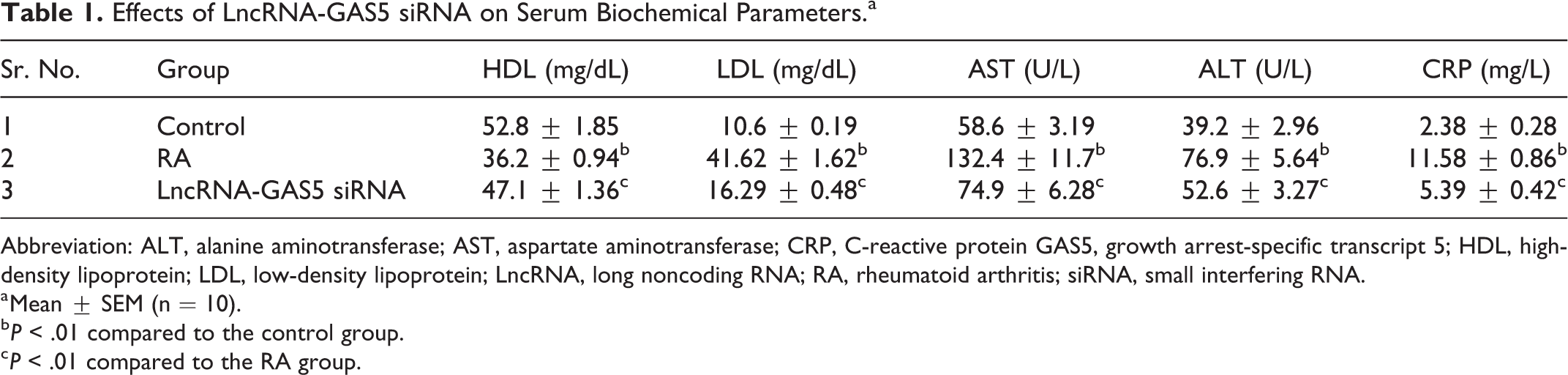
Abbreviation: ALT, alanine aminotransferase; AST, aspartate aminotransferase; CRP, C-reactive protein GAS5, growth arrest-specific transcript 5; HDL, high-density lipoprotein; LDL, low-density lipoprotein; LncRNA, long noncoding RNA; RA, rheumatoid arthritis; siRNA, small interfering RNA.
a Mean ± SEM (n = 10).
b P < .01 compared to the control group.
c P < .01 compared to the RA group.
Long Noncoding RNA-GAS5 Normalizes Cytokine Production
The serum levels of IL-4, IL-6, and IL-17 are shown in Figure 2; these were higher in RA than control mice, but LncRNA-GAS5 siRNA reduced these levels in RA mice.

Effect of LncRNA-GAS5 siRNA on serum cytokine levels. Mean ± SEM (n = 10); ## P < .01 compared to the control group; **P < .01 compared to the RA group. GAS5 indicates growth arrest-specific transcript 5; LncRNA, long noncoding RNA; RA, rheumatoid arthritis; siRNA, small interfering RNA.
Long Noncoding RNA-GAS5 Normalizes Oxidative Stress
Glutathione and SOD levels were lower in the RA group than the control group, but the MDA level was higher. Long noncoding RNA-GAS5 siRNA treatment of RA mice restored the levels of these markers to those of the control (Figure 3).

Effects of LncRNA-GAS5 siRNA on the levels of serum oxidative stress markers. Mean ± SEM (n = 10); ## P < .01 compared to the control group; **P < .01 compared to the RA group. GAS5 indicates growth arrest-specific transcript 5; LncRNA, long noncoding RNA; RA, rheumatoid arthritis; siRNA, small interfering RNA.
Long Noncoding RNA-GAS5 Normalizes IL-17 and FGF21 Expression Levels
Cartilage IL-17 and FGF21 levels were immunohistochemically analyzed. FGF21 expression was reduced and IL-17 expression enhanced in RA compared to control cartilage. Long noncoding RNA-GAS5 siRNA treatment of RA mice restored the levels to those of the control (Figure 4).

Effect of LncRNA-GAS5 siRNA on cartilage IL-17 and FGF21 expression levels. FGF indicates fibroblast growth factor; IL, interleukin; siRNA, small interfering RNA.
Long Noncoding RNA-GAS5 Normalizes FGF21, MMP-13, and IL-17 Expression Levels
We used quantitative real-time polymerase chain reaction to assess the effect of LncRNA-GAS5 siRNA on the levels of cartilage mRNAs encoding FGF21, MMP-13, and IL-17 (Figure 5). Matrix metalloproteinases-13 and IL-17 expression increased and FGF-21 expression fell in the RA compared to the control group. Long noncoding RNA-GAS5 siRNA treatment of RA mice restored the levels to those of the control (Figure 5).

Effect of LncRNA-GAS5 siRNA on the levels of cartilage mRNAs encoding FGF21, MMP-13, and IL-17 (qRT-PCR assay). Mean ± SEM (n = 10); ## P < .01 compared to the control group; **P < .01 compared to the RA group. FGF indicates fibroblast growth factor; GAS5, growth arrest-specific transcript 5; LncRNA, long noncoding RNA; MMP, matrix metalloproteinases; RA, rheumatoid arthritis; qRT-PCR, quantitative real-time polymerase chain reaction; siRNA, small interfering RNA.
Long noncoding RNA-GAS5 siRNA Normalizes the Expression Levels of MMP-13, NF-κB, FGF21, p38, Akt, and PI3K
The level of cartilage FGF-21 protein fell and those of MMP-13, NF-κB, p38, Akt, and PI3K rose in the RA compared to the control group. Long noncoding RNA-GAS5 siRNA normalized the expression levels of all proteins (Figure 6).

Effect of LncRNA-GAS5 siRNA on the expression levels of cartilage MMP-13, NF-κB, FGF21, p38, Akt, and PI3K (Western blot assay). Mean ± SEM (n = 10); ## P < .01 compared to the control group; **P < .01 compared to the RA group. FGF indicates fibroblast growth factor; GAS5, growth arrest-specific transcript 5; LncRNA, long noncoding RNA; MMP, matrix metalloproteinases; RA, rheumatoid arthritis; siRNA, small interfering RNA.
LncRNA-GAS5 siRNA Ameliorates miR-103 Underexpression
The cartilage miR-103 level was lower in the RA than the control group. However, LncRNA-GAS5 siRNA normalized miR-103 expression (Figure 7).

Effect of LncRNA-GAS5 siRNA on cartilage miR-103 expression. Mean ± SEM (n = 10); ## P < .01 compared to the control group; **P < .01 compared to the RA group. GAS5 indicates growth arrest-specific transcript 5; LncRNA, long noncoding RNA; siRNA, small interfering RNA.
Long Noncoding RNA-GAS5 siRNA Ameliorates Histopathological Changes
Cartilage and bone damage, bone destruction, and pannus formation were evident in the RA group compared to the control group. Long noncoding RNA-GAS5 significantly reduced these pathologies (Figure 8).

Effect of LncRNA-GAS5 siRNA on the histopathology of cartilage tissue. GAS5 indicates growth arrest-specific transcript 5; LncRNA, long noncoding RNA; siRNA, small interfering RNA.
Discussion
Rheumatoid arthritis is a chronic inflammatory autoimmune disease associated with synovial tissue destruction and bone damage. 15 The available drugs are inadequate. We explored whether LncRNA-GAS5 siRNA protected against cartilage destruction in obese mice with adjuvant-induced arthritis. Long noncoding RNA-GAS5 siRNA reduced the polyarthritis index and hind paw swelling, and normalized serum biochemical, cytokine, and oxidative stress parameters; cartilage MMP-13, NF-κB, FGF21, p38, Akt, and PI3K protein levels; the miR-103 level; and histopathological changes. Rheumatoid arthritis is an inflammatory joint disorder; the polyarthritis index and hind paw swelling increase in animal models of RA, 16 as we also found. Reductions in these parameters reduce cartilage injury 17 ; LncRNA-GAS5 siRNA afforded such reductions. The increased serum cytokine levels in RA patients contribute to joint inflammation; anti-inflammatory drugs are used to manage RA. 18 Long noncoding RNA-GAS5 siRNA reduced the serum cytokine level in RA mice. In obese subjects, white adipose tissue is converted into brown adipose tissue, increasing the cytokine levels and predisposing such subjects to RA. 19 We thus induced RA in obese mice. The levels of serum cytokines; oxidative stress markers; biochemical lipid parameters; and AST, ALT, and CRP changed in RA mice; LncRNA-GAS5 siRNA normalized all of these alterations.
Autoimmune disorders, including RA, are associated with increased expression of PI3K and Akt; several drugs seek to reduce these rises. 20 Matrix metalloproteinases-13 expression is regulated by both PI3K and Akt via changes in the levels of inflammatory cytokines that maintain synovial fibroblast numbers. 21 Matrix metalloproteinases-13 expression is enhanced in RA patients, in turn reducing cartilage FGF21 expression, triggering cartilage destruction. 22 We found that LncRNA-GAS5 siRNA normalized cartilage MMP-13, PI3K, Akt, FGF21, IL-17, and NF-kB expression. Also, histology showed that LncRNA-GAS5 siRNA protected against the development of pathological cartilage changes. Increased miR-103 expression aggravates inflammatory disorders, including RA. 23 miR-103 modulates PI3K and Akt expression, enhancing chondrocyte apoptosis; inhibition of such apoptosis protects against RA. Long noncoding RNA-GAS5 siRNA reduced cartilage miR-103 expression compared to that in RA mice.
Conclusion
Long noncoding RNA-GAS5 protects the cartilage of RA mice by modulating the PI3K/Akt/FGF21 pathway via inhibition of miR-103 expression.
Footnotes
Authors’ Note

Acknowledgment
The authors thank the Jingzhou Traditional Chinese Medicine Hospital, China, for facilitating our work.
Declaration of Conflicting Interests
The author(s) declared no potential conflicts of interest with respect to the research, authorship, and/or publication of this article.
Funding
The author(s) disclosed receipt of the following financial support for the research, authorship, and/or publication of this article: There is no external funding for presented protocol, and Jingzhou Traditional Chinese Medicine Hospital, China, provided necessary facility to conduct the presented work.