




Abstract
Objective:
To investigate the protective effect of repaglinide on rat with atherosclerosis.
Methods:
Sprague Dawley (SD) rats were divided into control, model, repaglinide, and metformin groups. In addition to the normal group, rats were given intraperitoneal injection of streptozotocin and high-fat diet (HFD). Meanwhile, repaglinide or metformin was administrated to the treatment rats, respectively, for 4 weeks. Serum, plasma, liver, epididymal fat, and aorta thoracica were obtained to observe the protective effect of repaglinide on rat with atherosclerosis.
Results:
Compared to the control group, blood glucose was increased in the model group (P < .05), while it was decreased in the drug-administered groups. In addition, the levels of endothelin 1, TG, TC, low-density lipoprotein cholesterol, atherogenic index, liver index, and epididymal fat index were significantly increased, but the levels of high-density lipoprotein cholesterol, plasminogen activator inhibitor 1, and antiatherogenic index were decreased significantly in the model group compared to the control group (P < .05, respectively). And these effects were reversed by treatment with repaglinide (P < .05, respectively).
Conclusion:
Our results suggested that repaglinide may regulate the formation of early atherosclerosis through the abovementioned mechanisms.
Introduction
Atherosclerosis is the most common and important type of arteriosclerotic vascular disease. It is characterized by accumulation of lipids and complex sugars, hemorrhage and thrombosis, hyperplasia of fibrous tissue and calcinosis, and gradual degeneration and calcification of the middle layer of the artery. Atherosclerosis is very harmful to human body. The formation of atherosclerosis is defined as the formation of plaque in the blood vessel wall which is very easy to rupture. After plaque rupture, thrombus formation will occur, which will lead to blockage of blood vessels, angina, myocardial infarction, stroke, hemiplegia, aphasia, renal artery stenosis or lower extremity artery stenosis, and even death.
Normal people’s insulin secretion is pulsed, and a secretion peak will appear after meals to deal with the blood sugar caused by a large amount of food after meals, while in patients with type 2 diabetes, the peak of insulin will delay, reduce, or even disappear after meals, resulting in high postprandial blood glucose. Postprandial hyperglycemia has shown to be more likely to induce heart and vascular disease than fasting hyperglycemia and to promote the occurrence of diabetic complications. 1
Diabetes is usually the result of insulin resistance, which is closely related to atherogenic index (AI). In fact, insulin not only regulates blood sugar but is also the main regulator of the metabolism of fat and protein, 2 other major substances in our body. Therefore, in patients with type 2 diabetes, due to the biological regulation of insulin, there are often disorders of lipid metabolism, the most common being the rise in triacylglycerol and the decline in high-density cholesterol, leading to the occurrence of cardiovascular and cerebrovascular diseases.
Repaglinide, a type 2, diuretic reglinide, is a new oral hypoglycemic agent with amino acid structure. It has non-sulfonylurea insulin secretion–promoting hypoglycemic drug and antihyperglycemic activity. It can stimulate the pancreas to release insulin and reduce the blood glucose levels rapidly. 2 Therefore, the purpose of this study was to investigate the effect of repaglinide on blood glucose, endothelial function, lipid metabolism, and inflammatory reaction in a rat model of atherosclerosis.
Materials and Methods
Materials
Main reagents
Repaglinide (Novoline) was purchased from Novo Nordisk, Denmark. Dimethyl Shuangding was purchased from Beijing Jingfeng Company (Beijing, China). Rat embryon-1 enzyme-linked immunosorbent assay (ELISA) detection kit and rat plasminogen activator inhibitor-1 ELISA detection kit were obtained from Beijing Kainuochun Biotechnology Co., Ltd (Beijing, China). Triglyceride (TG enzyme method) kit, Total Cholesterol (TC Enzyme) kit, high-density lipoprotein cholesterol (HDL-C) plasma kit, and low-density lipoprotein cholesterol (LDL-C) plasma reagent kit were obtained from Nanjing Bioengineering Research Institute (Nanjing, China). The remaining reagents were preset for domestic analytical purity.
Experimental animals
Healthy male Sprague Dawley (SD) rats, specific pathogen-free (SPF) grade, weighing 180 to 220 g, were provided by the Laboratory Animal Science Department of the Peking University School of Medicine, with license number SCXK (Beijing, China; 2012-0008). Ordinary animal feed: basic feed, including Corn 40% to 43%, bran 26%, soybean cake 29%, salt 1%, bone meal 1%, and lysine 1%—was provided by Beijing Keao Xieli Feed Company (Beijing, China). Animal high-fat feed: high fat diet (HFD), including lard 10%, cholesterol 1%, bile acid 0.2%, egg yolk powder 10%, sucrose 10%, and basic feed 68.8%, was provided by Beijing Branch Animals (Beijing, China).
Conditions
The rats were housed in independently isolated breeding cages at a temperature of 20°C to 25°C, relative humidity of 45% to 75%, in a 12-hour day and night alternate. The rats were free to eat and drink.
Methods
Establishment of type 2 diabetes model
A total of 60 male SPF SD rats were adaptively reproduced in the animal room for 1 week. They were randomly divided into control group, model group, repaglinide (high and low) groups, and metformin group. Rats in the control group were intraperitoneally injected with an equal volume citrate buffer. Rats in other groups were intraperitoneally injected with streptozotocin (STZ; 35 mg/kg). The rats in the control group were given basic feed and those in other groups were given HFD for 4 weeks. The blood glucose levels of rats were measured by using a portable blood glucose meter, and rats with blood glucose level ≥11.1 mmol/L were successfully diabetes model. After beginning the experiment, each group was continuously administered with gastrointestinal intervention for 4 weeks according to body weight: Control group—0.2 mL/kg CMC-Na; model group—0.2 mL/kg CMC-Na; metformin group—150 mg/kg; repaglinide high-dose group—2 mg/kg; and repaglinide low-dose group—1 mg/kg.
Animal treatment and experimental index detection methods
The changes in mental activity and body weight of rats before and after the establishment of type 2 diabetes model were observed, and the organ index was calculated. The blood glucose levels of rats were detected by a portable blood glucose meter. The levels of TG, TC, HDL-C, and LDL-C in the blood of rats were detected by commercial kits before and after. In addition, the levels of TG and TC in liver of rats were detected by commercial kits. The endothelin 1 (ET-1) and plasminogen activator inhibitor 1 (PAI-1) contents in rats were detected by ELISA.
Experimental Results
Statistical analysis was done using SPSS17.0 (International Business Machines, corp., Armonk, New York). Significant differences between groups were assessed by 1-way analysis of variance. All data were expressed as means ± standard deviation. Differences were considered statistically significant when P < .05.
Results
Effect of Repaglinide on General Conditions of Diabetic Rats
The rats in the control group were generally in good condition, including obvious weight gain, good mental state, shiny fur, free movement, and sensitive response. No rat death occurred in the control group. The rats in the model group all had symptoms of polydipsia and polyuria obviously after intraperitoneal injection of STZ, and their food intake increased, their spirits were debilitating, and they were wasted. They needed to change the litter twice a day. During this period, the activity was reduced, the response was dull, the hair color was dull, and hair loss occurred in the later stage, and some rats had loose stools. In the model group, 1 rat died, 1 had peritoneal effusion, and 2 rats had opaque lens in the eyes with lesions and decreased vision. The rats in the administration group were slightly better than those in the model group. The coat color was shinier and more sensitive, and no rats died and there were no eye lesions.
Effect of Repaglinide on Blood Glucose in Experimental Diabetic Rats
The effect of repaglinide on fasting blood glucose levels in experimental diabetic rats
The fasting blood glucose (FBG) levels of the model group, metformin group, and repaglinide group were significantly higher than that in the control group before administration (P < .01), suggesting that the diabetes model was successfully established. There was no significant difference between the model group, metformin group, and repaglinide group. After 4 weeks of administration, compared to the control group, the FBG levels in the model group were significantly increased, with an increase of 21.58% (P < .01). The FBG levels in the metformin group and repaglinide group were significantly lower than that in the model group (P < .01), among which the metformin group had a hypoglycemic rate of 12.53%, and the repaglinide groups had hypoglycemic rates of 2.53% and 1.26%, respectively (Table 1).
Effect of Reglinide on Fasting Blood Glucose in Experimental Diabetic Rats (n = 8).

Abbreviation: FBG: fasting blood glucose.
a Compared to the blank group, P < .01.
b Compared with the model group, P < .01.
c Compared with the model group, P < .05.
The effect of reglinide on postprandial blood glucose in experimental diabetic rats
Compared to the control group, the postprandial blood glucose levels in the model group were significantly increased (P < .01) and in the repaglinide groups were decreased (P < .05; Table 2). The experimental results showed that repaglinide had a reduction in postprandial hyperglycemia.
Effect of Repaglinide on Postprandial Blood Glucose in Experimental Diabetic Rats (n = 8).

Abbreviation: PBG: postprandial blood glucose.
a Compared to the blank group, P < .01.
b Compared with the model group, P < .01.
c Compared with the model group, P < .05.
Effect of Repaglinide on Endothelial Function in Experimental Diabetic Atherosclerotic Rats
The results are shown in Table 3. Compared to the control group, the levels of ET-1 and nitric oxide (NO) in the model group were significantly increased (P < .01). After 4 weeks of administration of repaglinide and metformin, the levels of ET-1 and NO in rats were significantly reduced (P < .01). These results showed that reglinide had certain effects on improving endothelial function.
Effects of Repaglinide on ET-1 and NO in Serum of Experimental Diabetic Atherosclerotic Rats (n = 8).

Abbreviations: ET-1, endothelin 1; NO, nitric oxide.
a Compared to the blank group, P < .01.
b Compared with the model group, P < .01.
c Compared with the model group, P < .05.
Effect of Repaglinide on Lipid Metabolism in Experimental Diabetic Atherosclerotic Rats
The effect of Repaglinide on the visceral index of experimental diabetic atherosclerotic rats
The experimental results showed that compared to the control group, the epididymal fat index in the model group was significantly reduced (P < .01). Four weeks after the drug intervention, the epididymal fat index was significantly increased in the metformin and repaglinide groups (P < .05). The results showed that repaglinide significantly increased the epididymal fat index and improved insulin resistance in diabetic rats, and its lipid–body ratio also increased. The liver index in the model group was significantly higher than that in the control group (P < .01) and significantly decreased in the repaglinide and metformin groups than the model group. The experimental results suggested that the drug had an effect in improving liver hypertrophy and maintaining liver function (Table 4).
Effect of Repaglinide on the Epididymal Fat Index and Liver Index of Experimental Diabetic Atherosclerotic rats (n = 8).

Abbreviation: PBG: postprandial blood glucose.
a Compared to the blank group, P < .01.
b Compared with the model group, P < .01.
c Compared with the model group, P < .05.
The effect of repaglinide on TG and TC in serum of experimental diabetic atherosclerotic rats
Compared to the control group, the TG and TC contents in the serum in the model group were significantly increased (P < .01). After 4 weeks of drug intervention, the serum TG and TC contents of metformin and repaglinide group were significantly lower than that of the model group (P < .01; Table 5). The results of this experiment indicated that both metformin and repaglinide can reduce serum TG and TC.
Effects of Repaglinide on TG and TC in Serum of Experimental Diabetic Atherosclerotic Mice (n = 8).

Abbreviations: TC, total cholesterol; TG, triglycerides.
a Compared to the blank group, P < .01.
b Compared with the model group, P < .01.
c Compared with the model group, P < .05.
Effect of repaglinide on HDL-C and LDL-C in serum of experimental diabetic atherosclerotic rats
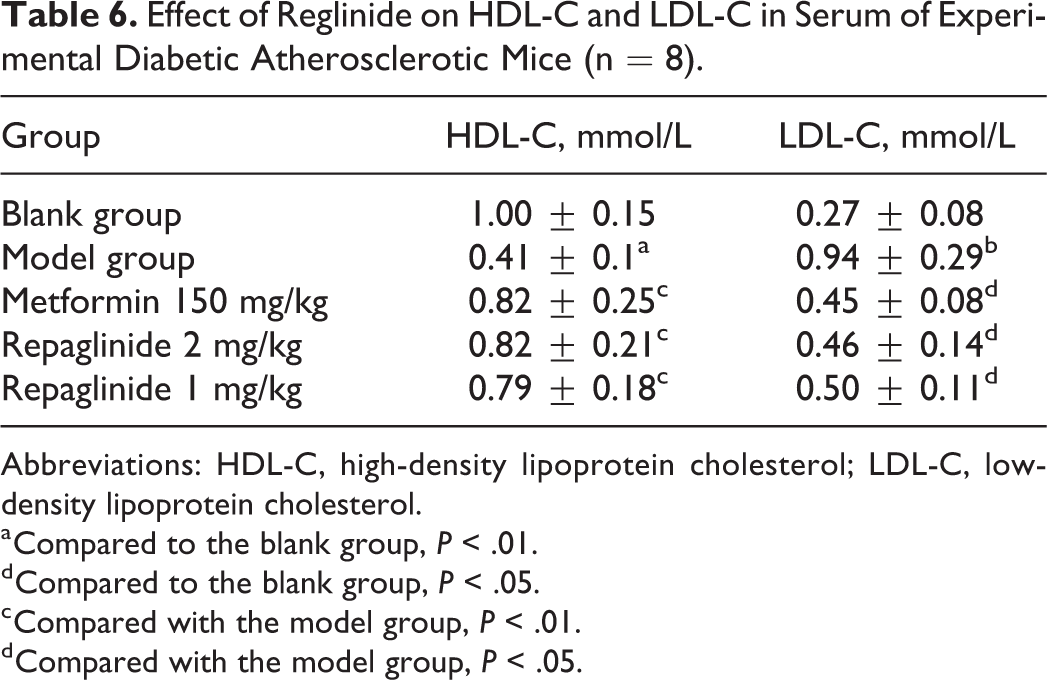
Compared to the control group, the levels of LDL-C were significantly increased, and the levels of HDL-C were significantly reduced in the model group (P < .05). After intervention with metformin and repaglinide, the levels of LDL-C decreased significantly, and the levels of HDL-C increased significantly (P < .05; Table 6). The HDL-C content of the high-dose repaglinide group and the metformin group were the same. The experimental results showed that repaglinide can regulate HDL-C and LDL-C and lipid metabolism disorders, thereby achieving the purpose of anti-atherosclerosis.
Effect of Reglinide on HDL-C and LDL-C in Serum of Experimental Diabetic Atherosclerotic Mice (n = 8).
Abbreviations: HDL-C, high-density lipoprotein cholesterol; LDL-C, low-density lipoprotein cholesterol.
a Compared to the blank group, P < .01.
d Compared to the blank group, P < .05.
c Compared with the model group, P < .01.
d Compared with the model group, P < .05.
Effect of repaglinide on liver lipid metabolism in experimental diabetic atherosclerotic rats
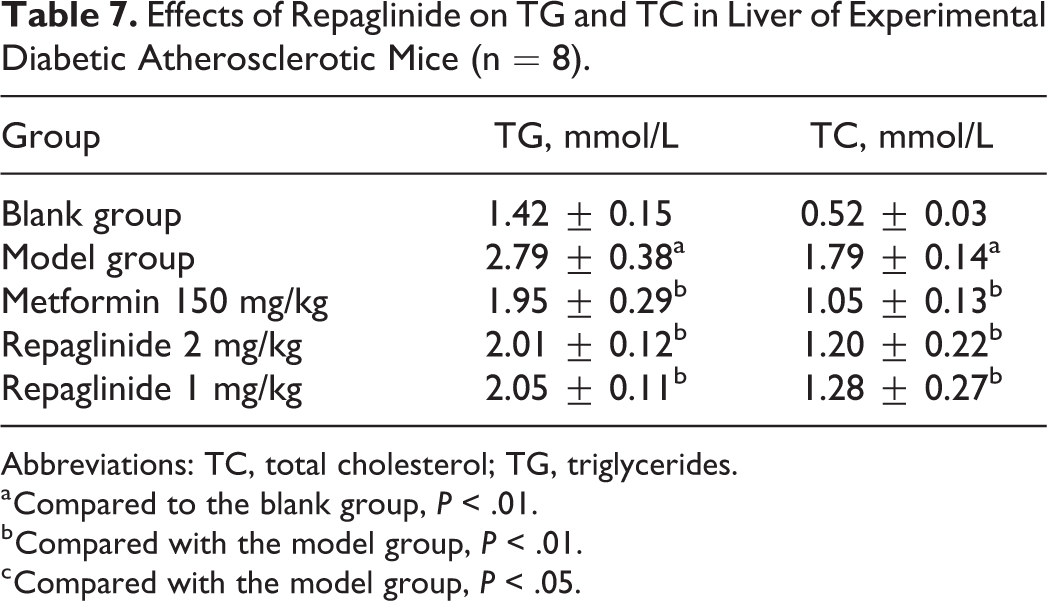
The levels of TG and TC in the liver of the model group were significantly higher than that of the control group (P < .01). After 4 weeks, compared to the model group, the TG and TC contents of the metformin and repaglinide groups were significantly decreased (P <.01; Table 7).
Effects of Repaglinide on TG and TC in Liver of Experimental Diabetic Atherosclerotic Mice (n = 8).
Abbreviations: TC, total cholesterol; TG, triglycerides.
a Compared to the blank group, P < .01.
b Compared with the model group, P < .01.
c Compared with the model group, P < .05.
Effect of repaglinide on the levels of inflammation in experimental diabetic atherosclerotic rats
The contents of C-reactive protein (CRP) and PAI-1 in the model group were significantly higher than that in the control group (P < .01). After 4 weeks of administration, compared to the model group, the CRP and PAI-1 levels in the metformin and repaglinide groups were significantly reduced (P < .01; Table 8). The levels of CRP and PAI-1 in the high-dose repaglinide group were slightly lower than in the low-dose repaglinide group, but those in both repaglinide groups were significantly lower than that in the metformin group.
Effect of Repaglinide on CRP and PAI-1 in Blood of Experimental Diabetic Atherosclerotic Rats (n = 8).

Abbreviations: CRP, C-reactive protein; PAI-1, plasminogen activator inhibitor 1.
a Compared to the blank group, P < .01.
b Compared with the model group, P < .01.
c Compared with the model group, P < .05.
Discussion
Although the pathogenesis of atherosclerosis is more complicated, it involves the initial vascular endothelial dysfunction, lipid metabolism disorders, and a series of inflammatory reactions. The results of this study showed that repaglinide not only has a good hypoglycemic effect but also has the effects of improving endothelial function, regulating lipid metabolism, and anti-inflammatory properties. It is inferred that it may affect the formation of early atherosclerosis through the abovementioned mechanisms.
The results of this experiment showed that repaglinide can effectively control FBG. At the same time, it can significantly reduce postprandial blood glucose, thereby improving vascular disease caused by postprandial hyperglycemia and reducing the occurrence of vascular complications. Metformin’s hypoglycemic effect is mainly reducing glucose production in the liver and enhancing peripheral tissues to reduce the absorption of glucose in the small intestine, thereby lowering blood glucose and improving insulin resistance. Repaglinide is a non-sulfonylurea insulin secretion–promoting hypoglycemic drug. Its biggest advantage in the treatment of diabetes is that it mimics the physiological insulin secretion pattern. 1,2 Its mechanism of action is inhibiting the ATP-dependent potassium channels in the β-cell membrane of the pancreas and the outflow of potassium ions from β-cells, causing the cell membrane to depolarize, thereby opening up voltage-dependent Ca2+ Channel and causing Ca2 + influx and stimulating insulin release. The rapid opening effect of repaglinide is similar to the first stage of food-induced physiology, insulin secretion. The fast-closing effect does not cause the increase in basal or second-phase insulin secretion.
Vascular endothelial cells are a layer of flat cells that continuously cover the entire vascular cavity. They have complex physiological functions. They maintain vascular tension, maintain the body’s coagulation and fibrinolytic system balance, inhibit platelet aggregation, reduce endothelial permeability, and reduce the expression of adhesion molecules, and it plays an important role in inhibiting the proliferation of vascular smooth muscle cells. Platelet dysfunction, microcirculation disorders, tissue hypoxia, and increased production of thromboxane-damaged substances caused by long-term glucose metabolism disorders in patients with type 2 diabetes can lead to vascular endothelial damage and vascular disease. The oxidized lipids and glycated hemoglobin produced during hyperglycemia can damage the structure of coronary arterial micro-vessels and impair microvascular dilatation. 3,4 The level of plasma endothelial ET-1 in diabetic patients is elevated, and its elevation is closely related to diabetic macro-vascular and microvascular disease, and its level is positively correlated with the severity of atherosclerosis. 5 NO is the most important vasodilatation factor. It is mainly synthesized and secreted by endothelial cells and activated macrophages and smooth muscle cells. It can inhibit the secretion of vasoconstrictive substances such as endothelin. At the same time, NO can inhibit the oxidation of LDL and the proliferation of vascular smooth muscle. The change of NO in diabetes is a process that changes with the course of disease, that is, the compensatory synthesis of NO is increased in the early stage, and the synthesis of NO is decreased in the later stage. After the artery is stimulated by Ach, the increase in NO is less than that of the normal control. It is speculated that changes in vascular endothelial integrity caused by high glucose or high glucose–induced downregulation of Ach receptors can reduce NO synthesis in vascular endothelium. 6 However, the results of this experiment showed that the NO synthesis in the model group was increased. The reason for the analysis may be that the animal model established in this experiment is relatively short, and the rats are in the early stage of diabetes. Therefore, the compensatory synthesis of NO is increased, and the vascular smooth muscle caused by endothelial damage in diabetes is inhibited. The experimental results showed that after 4 weeks of intervention, repaglinide can inhibit the proliferation of smooth muscle cells. The reason may be that repaglinide can reduce ET-1 and the influx of calcium ions in endothelial cells to weaken the vasoconstriction effect. At the same time, it can inhibit the proliferation of vascular smooth muscle caused by endothelial damage in diabetic patients by reducing NO and improve endothelial function, thereby affecting the formation of atherosclerosis in early diabetic rats.
The occurrence of atherosclerosis in diabetic patients is related to many factors, but abnormal plasma lipid levels are the most important factor. Dyslipidemia in type 2 diabetes is characterized by increased TC and LDL-C and decreased HDL-C. 7 The abovementioned dyslipidemias all cause atherosclerosis and together constitute a group of risk factors for macrovascular disease. In addition, high LDL-C and FFA can participate in the pathogenesis of large blood vessels by upregulating the expression of C5 or F21 gene in macrophages. 8 Low-level HDL-C is an independent risk factor for coronary heart disease, independent of LDL-C, TG, and other lipid and non-lipid factors. The results of this experiment showed that repaglinide can significantly reduce LDL-C. Meanwhile, repaglinide can increase HDL-C, promote reverse cholesterol transport, and remove excess cholesterol from the arterial wall, thereby achieving the purpose of anti-atherosclerosis. In the treatment of diabetic patients, in addition to controlling blood glucose, more attention should be paid to the treatment of dyslipidemia.
Abnormal fat accumulation or distribution in the body is an important incentive and pathological basis for diseases such as type 2 diabetes, hypertension, coronary heart disease, and abnormal blood lipids. Some research results show that the epididymal fat index of OLETF rats with spontaneous type 2 diabetes is increased, 9 and the results of this experiment show that the epididymal fat index in the model group rats is significantly decreased. The reasons may be as follows: (1) the experimental animal model is different. In this study, an animal model of type 2 diabetes was established using HFDs and chemical induction methods. (2) Rats with diabetes have obstacles to glucose transport and utilization. The energy mainly comes from the breakdown of lipids in the body, which makes the diabetic rats extremely severe. The results of this experimental study indicated that the epididymal fat index of rats in the repaglinide group increased significantly. It was possibly because repaglinide improved insulin resistance, thereby increasing the use of exogenous glucose and reducing the fat breakdown in the body. In addition, it can effectively reduce the liver index and inhibit liver hypertrophy, thereby improving liver function.
The mechanism of lipid metabolism disorder is related to the destruction of intracellular cholesterol. Sterol regulatory element binding protein (SREBP) plays an important role in the steady state regulation of intracellular cholesterol. SREBP can directly inhibit insulin receptor substrate (IRS)-2, thereby promoting diabetes. 10 The molecular mechanism by which insulin resistance occurs is a defect in the insulin receptor signal transduction pathway of target cells. In target tissues of obese patients with type 2 diabetes, such as muscle and vascular endothelial cells, the IRS/Phosphatidylinositol kinase (PI3 K) pathway is significantly impaired. This study showed that repaglinide can significantly reduce the liver TG and TC contents and improve liver lipid metabolism. At the same time, it can regulate blood lipid metabolism disorders. The cause of the disorder of lipid metabolism of repaglinide may be related to its interference in the SREBP and IRS/PI3K signaling pathways. Elevated HDL-C levels can competitively inhibit LDL-C receptors, block SREBP signaling pathway, and reduce lipid synthesis to regulate lipid metabolism and exert its anti-atherosclerotic effect.
Inflammation is an important factor in promoting the formation of atherosclerosis. Inflammation itself is directly involved in the entire process of atherosclerosis and its complications. The first is vascular endothelial dysfunction, which is marked by increased vascular endothelial permeability and increased adhesion factors, and then monocytes adhere to the vascular wall and migrate through the endothelial cell layer toward the vascular wall into macrophages. In recent years, some studies have suggested that diabetes itself is an inflammatory disease and proposed the inflammation theory of diabetic macrovascular complications. 11 -13 The results of this study showed that the CRP and PAI-1 activated in the model group were significantly higher than those in the control group, which may be related to the decrease in insulin sensitivity, resulting in the decline in the physiological effect of insulin and the increase in CRP synthesis. Meanwhile, CRP can be activated through the classical pathway. Complement induces the production of PAI-1 messenger RNA and PAI-1. At the same time, the hyperglycemic state of diabetic patients can activate the diacylglycerol–protein kinase C signaling pathway and further promote the synthesis of PAI-1. Hyperlipidemia is an independent factor for elevated PAI-1 levels in plasma. CRP decreased significantly after administration of repaglinide, suggesting that repaglinide has a positive effect on the control of inflammation, and repaglinide treatment can prevent and delay the development of atherosclerosis. The anti-atherosclerotic effect of PAI-1 may be due to the fact that repaglinide is achieved by blocking the overexpression of PAI-1 in the body, improving the function of the vascular coagulation and fibrinolytic system and reducing microthrombosis.
In summary, this study used HFD combined with a small dose of STZ to establish an experimental model of diabetic atherosclerosis in rats. By measuring blood glucose, aortic pathological sections, AI, and AAI, the establishment of the model is determined. The effect of repaglinide on the formation of early atherosclerosis in experimental diabetic rats was explored. The following conclusions were drawn: Reglitazone can inhibit the early formation of atherosclerosis in experimental diabetic rats. Reglitazone was effective in lowering blood glucose, especially postprandial blood glucose in experimental diabetic rats. Repaglinide can effectively reduce the levels of ET-1 and NO in experimental diabetic atherosclerotic rats, inhibit vascular smooth muscle proliferation, and show an effect on improving endothelial function. Repaglinide can effectively reduce the levels of TG, TC, LDL-C, and AI in serum, increase the levels of HDL and AAI, and improve blood lipid metabolism disorders in experimental diabetic atherosclerotic rats. Reglitazone can effectively reduce liver index and liver TG and TC synthesis, inhibit liver hypertrophy, maintain normal liver function, and regulate liver lipid metabolism disorders. Repaglinide can effectively inhibit the expression of CRP and PAI-1 in experimental diabetic atherosclerotic rats, reduce the inflammatory response, and delay the occurrence and development of AS.
Footnotes
Declaration of Conflicting Interests
The author(s) declared no potential conflicts of interest with respect to the research, authorship, and/or publication of this article.
Funding
The author(s) received no financial support for the research, authorship, and/or publication of this article.
