



Abstract
Background:
Occupational exposure of radiation among medical radiation workers contributes to the subsequent increased risk of thyroid cancer. Long noncoding RNAs (lncRNAs) are emerging as important regulators of cancer biology. However, little is known about lncRNA expression in thyroid cancer tissues from patients who are exposed to medical occupational radiation. The purpose of this study is to reveal the transcriptomes difference between thyroid cancer tissues and adjacent nonneoplastic thyroid tissues.
Methods:
Microarray technology was used in this study. Quantitative reverse transcription polymerase chain reaction was adopted to verify 6 differentially expressed lncRNAs. Gene ontology and pathway analyses were performed using standard enrichment computational methods. Potential target genes of the differentially expressed lncRNAs were predicted with 2 independent algorithms.
Results:
A total of 23 lncRNA and messenger RNA transcripts were found differentially expressed in the thyroid cancer tissues (fold change ≥2.0, P < .05). This differential lncRNA expression may affect many pathways, including those involved in cysteine and methionine metabolism, Huntington disease, propanoate metabolism, and carcinogenesis.
Conclusions:
Our study provides a transcriptome-wide screening and analysis of the lncRNA expression profile in thyroid cancer tissues from patients with medical occupational radiation exposure and lays the foundation for further investigation of lncRNAs related to thyroid cancer development and carcinogenic risk of medical occupational radiation exposure.
Introduction
The incidence of thyroid carcinoma is accelerating at a speed of 4% increment per year, which is higher than most other cancer types, in both developed countries like the United States and developing countries like China. 1,2 Previous studies suggested that increased medical surveillance, technological advances, and earlier detection of small lesion have contributed to the increasing reported incidence of thyroid cancer. 3,4 On the other hand, it may also represent a true rising trend of thyroid cancer occurrence. Different factors have been reported to be related to thyroid cancer occurrence, such as genetic factor, sex hormone, iodine deficiency, and in particular, occupational exposure of radiation. 5 –7
Radiation is commonly used in modern medication and numerous novel radiology procedures have been introduced. 8 There are about 2,3 million diagnostic radiology professionals worldwide and the number is rapidly increasing. 9 Ionizing radiation, in the forms of x-rays, γ rays, and radon gas, is a known carcinogen. 10 Occupational exposure groups include radiology workers, medical radiation technologists, diagnostic radiographers, underground miners, and nuclear accident liquidators. 11 Exposure to ionizing radiation activates many carcinogens, deactivates tumor suppressor genes, and causes DNA abnormalities and chromosomal instability. 12,13 According to a study in 2013, thyroid cancer risk (hazard ratio = 3.88, 95% confidence interval [CI]: 1.09-13.75, P trend .01) in female radiologists was significantly higher in the quartile with the highest radiation exposure compared to those in the other 3 quartiles. 14 However, how occupational exposure to radiation leads to a higher incidence of thyroid carcinoma remains unclear. Thus, it is urgent to investigate the mechanisms that link medical occupational radiation exposure to the development of thyroid carcinoma, in order to develop effective diagnostic and therapeutic methods.
Long noncoding RNAs (lncRNAs), that is, RNA molecules that are longer than 200 nucleotides and not translated into proteins, have been found to participate in many cellular processes including cell-cycle regulation, transcriptional regulation, epigenetic regulation, and the regulation of cellular differentiation. 15,16 In recent years, research on lncRNAs has become a hot topic in the field of molecular biology. Actually, about 2% of human genome encodes proteins (ie, exons). The rest non–protein-coding regions include introns, regulatory elements, and genes coding for transfer RNA, ribosomal RNA, microRNA, and so on. 17 According to a recent study, there are 21 306 protein-coding and 21 856 noncoding genes in human genome (https://doi.org/10.1101/332825). Among these noncoding genes, numerous of lncRNA have been found to play critical roles in development of various diseases or identified as essential biomarkers in diagnosis and therapy. 15,18 Shao et al reported that lncRNA RMRP plays a crucial role in gastric cancer and can be used as a novel biomarker. 19 Jia et al suggested that lncRNA-DANCR could be a potential target for preventing prostate cancer metastasis. 20 In addition, a meta-analysis showed that the overexpression of lncRNA-H19 could serve as a reliable biomarker of poor prognosis in different types of cancers. Recently, increasing studies have been revealed that lncRNA is an emerging player in thyroid cancer. 21 A recent review written by Murugan et al points out that some lncRNA are deregulated in thyroid cancer including LINC00271, MEG3, and NAMA. 22 From the perspective of Murugan et al, they suppose that these identified lncRNA could be considered as prospective novel therapeutic targets and prognostic markers in thyroid cancer. However, the causation of thyroid cancer is typically complex. Different risk factors may lead to the different transcriptomes for thyroid cancer. Oczko-Wojciechowska et al indicated that the transcriptome of thyroid cancer was different when the cancer status altered and the type of RET gene was mutated. 23 Hence, we hypothesis that occupational medical worker with exposure of radiation may have the different transcriptome for thyroid cancer.
In the present study, we measured the different expression profiles of lncRNAs and messenger RNAs (mRNAs) between thyroid carcinoma tissues and paired, neighboring nonneoplastic thyroid tissues from patients with medical occupational radiation exposure using microarrays. Subsequently, R software was used to analyze the pathways and gene ontology (GO) in order to investigate the gene function and predict the potential target genes of lncRNAs. Quantitative reverse transcription polymerase chain reaction (qRT-PCR) was used to validate 6 differentially expressed lncRNAs. The findings of our study suggested that altered expression of lncRNAs associated with frequent medical occupational radiation exposure may lead to the tumorigenesis of thyroid carcinoma. Characterizing the changes in lncRNA expression profile in those population with medical occupational radiation exposure may give some clue to the diagnosis and treatment of thyroid carcinoma.
Materials and Methods
Patients and Tissue Samples
The research protocol of this study was approved by the ethics committee of the Hunan Province Cancer Hospital, Changsha, China (code: XYGW201606). The participants were informed and the consent forms were signed before surgery. The thyroid carcinoma tissue specimens and the paired adjacent normal thyroid tissue samples were collected from 40 patients with medical occupational radiation exposure, and the surgeries were conducted in the Internal Medicine Department of Thyroid and Radionuclide Therapy at the Hunan Cancer Hospital, The Affiliated Cancer Hospital of Xiangya School of Medicine, Central South University. After the surgical operation, the tissue samples were preserved in liquid nitrogen immediately and stored in a −80°C freezer before use. According to the Chinese National Occupational Diagnostic Criteria founded by the National Health and Family Planning Commission of People’s Republic of China (GBZ112-2002), thyroid carcinoma associated with medical occupational radiation exposure is diagnosed according to the following criteria: (1) the patient received a specific dose of ionizing radiation, and thyroid cancer occurred after the latent period; (2) the patient has clinical symptoms of thyroid cancer; (3) laboratory tests show positive results of thyroid cancer, including T3 and T4 levels; and (4) workplace investigation shows that the risk factor of radiation exposure exists and the workers are subjected to this risk factor. According to the Specifications of Individual Monitoring for Medical Occupational Radiation Exposure (GBZ128-2002), each occupationally exposed worker was monitored by using a Thermo luminescent dosimeter for 1 year, and the annual effective dose (mSv/a) was calculated. In the present study, 3 pairs of thyroid cancerous and noncancerous tissues were used to perform microarrays for lncRNA and mRNA profiling, and the remaining 37 pairs were used for qRT-PCR analysis to verify microarray results. The patients enrolled in this study had never previously conducted radiotherapy or chemotherapy before the surgical operation. The clinical and pathological characteristics of the 40 patients are summarized in Table 1.
Clinical and Pathological Characteristics of 40 Occupational Radiation Exposure Thyroid Carcinoma Cases.

Abbreviation: TNM, tumor–node–metastasis.
RNA Microarray
The microarray analysis was conducted by Shanghai Qiming Biotechnology Corporation (Shanghai, China) using the SBC Human lncRNA microarray (version 5.0). This microarray included approximately 60 000 lncRNAs defined by the current lncRNA databases. The lncRNA databases included GENCODE (version 17), LNCipedia (version 2.1), Lncrnadb, Noncoder (version 3), Ensembl, NCBI, UCSC, HTA2.0, and Agilent G3 (version 2). The probes of SurePrint G3 Human Gene Expression 8 × 60K (Agilent Technologies, Santa Clara, California), which can detect 39 887 mRNAs, were included in the microarray analysis as well.
RNA Extraction and Purification
Total RNA was extracted with the TRIzol Reagent Kit (Life Technologies, Carlsbad, California) according to the manufacturer’s instructions. RIN numbers for RNA integrity were detected using the Agilent 2100 BioAnalyzer kit (Agilent Technologies). Total RNA was purified using the RNeasy Mini Kit (QIAGEN GmbH, Hilden, Germany) and the RNase-Free DNase Set (QIAGEN, GmbH).
RNA Amplification and Labeling
A Low Input Quick Amp Labeling Kit was used to amplify the total RNA, as well as to label the total RNA by One-Color (Agilent Technologies). Subsequently, the RNeasy Mini Kit (QIAGEN GmbH) was used to purify the labeled complementary RNAs.
Microarray Hybridization
The Gene Expression Hybridization Kit (Agilent Technologies) was used for the microarray hybridization according to the manufacturer’s instructions. After 17 hours of hybridization, the slides were washed with the Gene Expression Wash Buffer Kit (Agilent Technologies).
Data Collection
Agilent Microarray Scanner and the scan control software (version A.7.0.3) were employed to scan all the microarray slides using the default settings (dye channel, green; scan resolution, 3 μm; 20 bit). Data were extracted with Feature Extraction Software (version 10.7; Agilent Technologies), and raw data were normalized using the Quantile algorithm, Gene Spring Software (version 11.0; Agilent Technologies).
Gene Function Analysis
The GO project provides a controlled vocabulary to describe the genes and gene products of any organism (http://www.geneontology.org). The ontology covers 3 domains: biological process, cellular component, and molecular function. Fisher exact test was used to determine whether the overlap between the differential expression list and the GO annotation list is greater than that expected by chance. Pathway analysis is a functional analysis that maps genes to Kyoto Encyclopedia of Genes and Genomes (KEGG) pathways. The P value denotes the significance of the GO term and thus the pathway that correlates with the conditions. A lower P value represents a higher significance of the correlation between the pathway and the GO terms. A P value of ≤.05 is recommended. 14
LncRNA Target Prediction
Long noncoding RNA target prediction was performed for the differentially expressed lncRNAs. First, the target genes acting in cis was searched on the UCSC genome browser (http://genome.ucsc.edu/) to facilitate gene annotations and to visualize lncRNAs and potential target genes. If the genes of interest were located within a 10-kbp window upstream or downstream of the lncRNAs, it was considered that the lncRNAs might regulate the gene in cis. We also analyzed the abilities of the lncRNAs to bind to mRNA molecules using the algorithm of mRNA sequence complementarity and RNA duplex energy prediction.
Quantitative Reverse Transcription Polymerase Chain Reaction Validation
In order to verify the microarray results, we randomly selected a total of 6 differently expressed lncRNAs in occupational radiation exposure-associated thyroid cancer and measured the mRNA expression levels of these genes by qRT-PCR.
Statistics
All data are represented as means (standard deviation). A fold change of ≥2.0 (P < .05) was used as a cutoff for differential expression of lncRNAs and mRNAs screened by microarray. SPSS for Windows software (version 22.0; SPSS Inc, Chicago, Illinois) was used to perform statistical analyses such as Student t test. P < .05 was considered statistically significant. R software (R Development Core Team, Austria, Vienna) was used to analyze the volcano plot of differentially expressed mRNAs and lncRNAs as well as the top 10 GO term enrichments and KEGG pathways for the differentially expressed mRNAs.
Results
Differentially Expressed LncRNAs in Thyroid Cancer
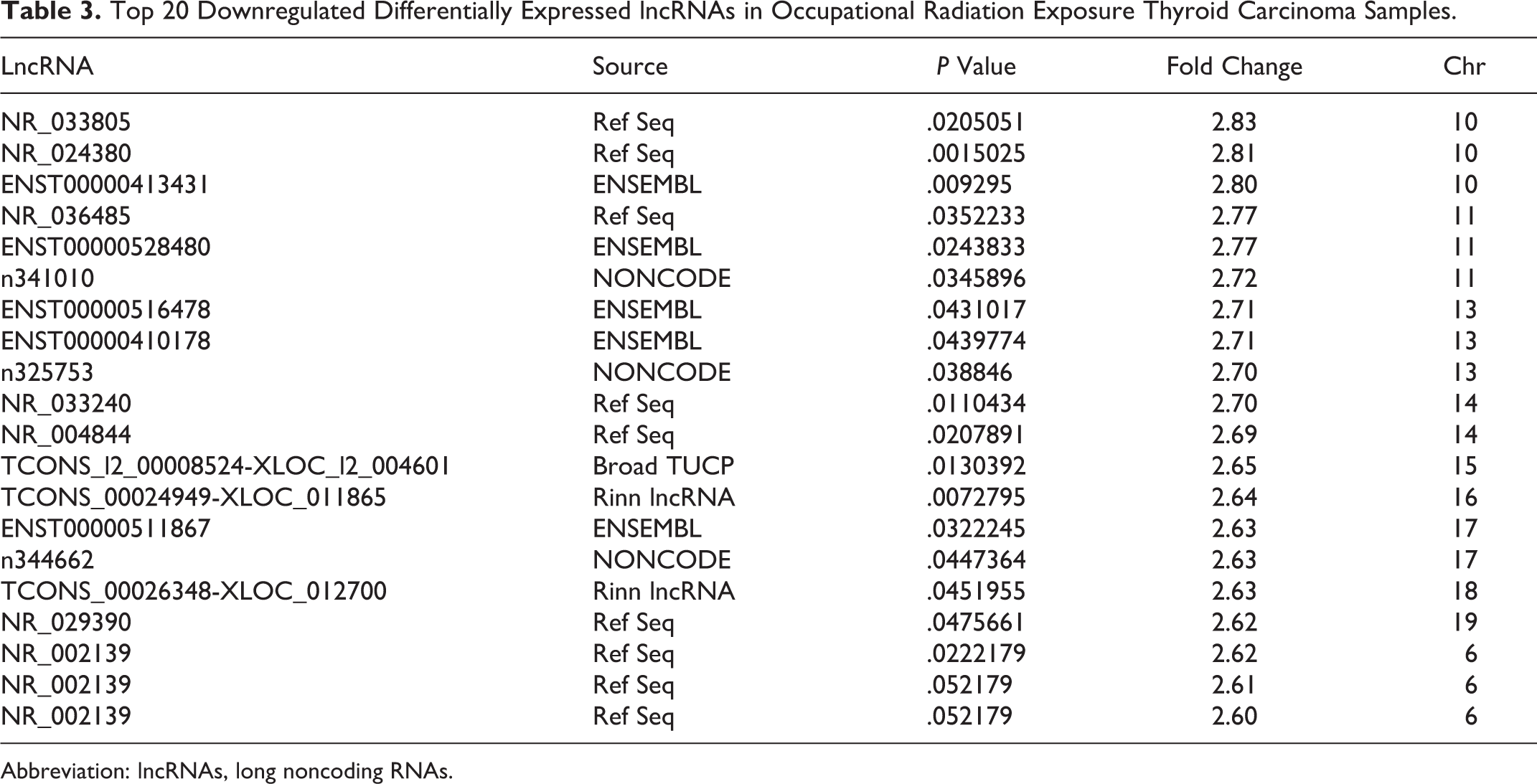
In this study, the mean thyroid radiation level for all enrolled participants was 0.834 Gy. To uncover the differentially expressed lncRNAs in thyroid carcinoma associated with medical occupational radiation exposure, a high-throughput analysis of lncRNA and mRNA expression was conducted between thyroid carcinomas and matched nonneoplastic thyroid tissues from patients with thyroid cancer who exposed to medical occupational radiation. From the microarray data, 783 mRNAs were upregulated and 316 mRNAs were downregulated in thyroid carcinomas. Twenty-three lncRNAs were upregulated and 18 lncRNAs were downregulated in the thyroid carcinomas as compared to the matched nonneoplastic tissues. Moreover, a group of lncRNAs were found downregulated in thyroid carcinoma, but none of them showed a ≥2.0-fold change (Figure 1A). Based on the lncRNA expression levels, the specimens were allocated into groups by Hierarchical clustering analysis (Figure 1B). The top 20 upregulated and downregulated lncRNAs are presented in Tables 2 and 3, respectively. The most upregulated lncRNA was n336302 (fold change: 26.32).
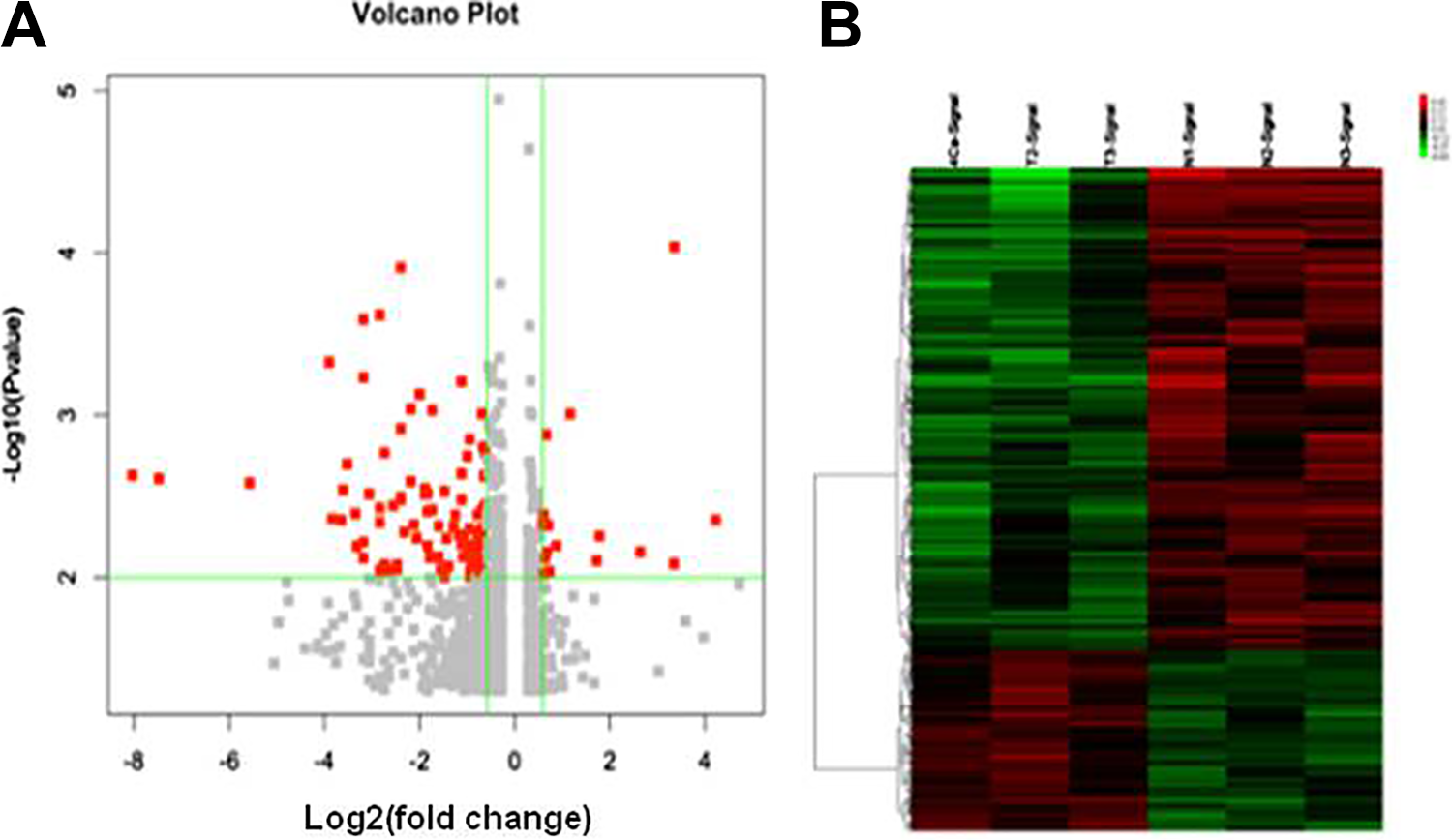
Microarray analysis of differentially expressed lncRNAs in thyroid carcinoma associated with medical occupational radiation exposure. A, The volcano plot of differentially expressed lncRNAs between thyroid carcinomas and matched nonneoplastic thyroid tissues from patients with medical occupational radiation exposure. The vertical lines correspond to 2.0-fold upregulation and downregulation. The horizontal line represents a P value of .05. B, Hierarchical clustering analysis of the differentially expressed noncoding RNAs (ncRNAs). Red indicates high expression and green indicates low expression. The columns present 3 pairs of samples, and the rows show the identified differentially expressed lncRNAs. lncRNAs indicates long noncoding RNAs.
Top 20 Upregulated Differentially Expressed lncRNAs in Occupational Radiation Exposure Thyroid Carcinoma Samples.

Abbreviation: lncRNAs, long noncoding RNAs.
Top 20 Downregulated Differentially Expressed lncRNAs in Occupational Radiation Exposure Thyroid Carcinoma Samples.
Abbreviation: lncRNAs, long noncoding RNAs.
Using the same criteria as for lncRNAs, 1099 mRNAs were found differentially expressed between medical occupational radiation exposure–associated thyroid carcinoma samples and paired nonneoplastic tissues. Among them, 783 mRNAs were upregulated and 316 mRNAs were downregulated in thyroid carcinomas (Figure 2). The top 20 differentially expressed mRNAs are listed in Tables 4 and 5, respectively. The most upregulated mRNA was FN1 (fold change: 94.12), and the most downregulated mRNAs included MKL1, GCAT, and SDCBP2 (fold change: 0.83).

Microarray analysis of differentially expressed mRNAs in thyroid carcinoma associated with medical occupational radiation exposure. A, The volcano plot of differentially expressed mRNAs between thyroid carcinomas and matched nonneoplastic thyroid tissues from patients with medical occupational radiation exposure. B, Hierarchical clustering analysis of the differentially expressed mRNAs. mRNAs indicates messenger RNAs.
Top 20 Upregulated Differentially Expressed mRNAs in Occupational Radiation Exposure Thyroid Carcinoma Samples.

Abbreviation: mRNAs, messenger RNAs.
Top 20 Downregulated Differentially Expressed mRNAs in Occupational Radiation Exposure Thyroid Carcinoma Samples.

Abbreviation: mRNAs, messenger RNAs.
Functional Analysis of Differentially Expressed Genes
To avoid omission of any thyroid cancer–related genes, we performed functional analyses for all the differentially expressed mRNAs. It was found that the most enriched GOs associated with the differentially expressed transcripts were “regulation of small GTPase mediated signal” (P = 2.44E−05; Figure 3A), “cytoskeleton” (P = 1.34E−05; Figure 3B), and “cadmium ion binding” (P = 4.63E−06; Figure 3C). The most enriched pathway was “oocyte meiosis,” which could be related to 11 differentially expressed genes. Some of pathways were associated with cancer, such as “pathways in cancer” (associated with 26 genes), “tryptophan metabolism” (associated with 6 genes), and “ascorbate and aldarate metabolism” (associated with 4 genes; Figure 3D).

Function analysis of differentially expressed genes in thyroid carcinoma. Note. All the difference were significant.
Long Noncoding RNA Target Prediction and Functional Analysis
We took advantage of the mRNA expression profile in this study and integrated the 1093 predicted lncRNA cis target genes with the differently expressed mRNAs in thyroid cancer. Analyses using DAVID (version 6.7) showed that the associated signaling pathways of these integrated target genes were enriched (Table 6). “Cysteine and methionine metabolism,” “Huntington disease,” “propanoate metabolism,” and “pathways in cancer” were the most enriched pathways that were associated with the differentially expressed genes cis targeted by lncRNAs. It was estimated that these enriched pathways might be regulated by lncRNAs in the tumorigenesis of thyroid carcinoma associated with medical occupational radiation exposure.
Pathway Analysis of Differentially Expressed Cis Target Genes and Their Related lncRNAs.

Abbreviation: lncRNAs, long noncoding RNAs.
Quantitative Reverse Transcription Polymerase Chain Reaction Validation of Differentially Expressed lncRNAs in Thyroid Carcinoma
Six lncRNAs that were differentially expressed in thyroid carcinoma were selected for qRT-PCR verification in 37 pairs of thyroid cancer and paired nonneoplastic tissues. Of the 6 lncRNAs, n336302, n335249, n335243, and ENST00000509033 were upregulated, while NR_024380 and ENST00000516478 were downregulated in thyroid carcinoma from patients with occupational exposure to radiation. The results of qRT-PCR were consistent with the microarray data. The 6 lncRNAs were differentially expressed in thyroid carcinoma specimens with the same trend (upregulated or downregulated compared to the paired nonneoplastic thyroid tissue), and the differences reached statistical significance (P < .05; Figure 4).

Validation of lncRNA microarray data by quantitative reverse transcription polymerase chain reaction (qRT-PCR). Four upregulated (A) and 2 downregulated (B) lncRNAs from microarray data were verified by qRT-PCR of RNA extracted from thyroid carcinoma tissues and paired adjacent non-neoplastic thyroid tissues. The relative expression level of each lncRNA was normalized, and the data displayed in histograms are expressed as means (SD). *P < .05, thyroid carcinoma tissue versus paired adjacent non-neoplastic thyroid tissue. lncRNAs indicates long noncoding RNAs; SD, standard deviation.
Discussion
In this study, we used 3 paired occupational medical workers’ thyroid cancer tissues and adjacent tissues to reveal their transcriptome. In general, a total of 23 lncRNA and mRNA transcripts were found differentially expressed in the thyroid cancer tissues (fold change ≥2.0, P < .05). This differential lncRNA expression may affect many pathways, including those involved in cysteine and methionine metabolism, Huntington disease, propanoate metabolism, and carcinogenesis. Quantitative RT-PCR was conducted to further verify that the deregulated lncRNA expression was consistent with microarray assay.
With the increasing involvement of radiation in trades and professions, more occupational workers are being exposed to ionizing radiation, including radiologists, radiologic technologists, diagnostic radiation workers, uranium miners, and nuclear industry workers. 24,25 The biological effects of ionizing radiation and its relationship with carcinogenesis have been well studied and have attracted great attention in the recent years. 26,27 It is noted that occupational exposure to radiation may cause thyroid cancer, and radiologists and radiologic technologists have been reported to endure a significantly increased risk of thyroid cancer. 28,29 Previous studies regarding the transcriptomes of thyroid cancer have discovered numerous novel transcriptomic alterations. Wang et al used RNA sequencing to detect the transcriptome profile in 12 papillary thyroid cancer tissues compared to paired normal adjacent tissues. The results indicated lncRNA NONHSAT076747 and NONHSAT122730 were associated with thyroid cancer metastasis, whereas NONHSAG051968 was negatively associated with thyroid cancer’s size. 30 Lan et al also performed the relative study and found thousands of significantly differentially expressed lncRNA and mRNA in papillary thyroid cancer tissues compared to the adjacent normal tissues, 31 of which 1805 dysregulated lncRNA were found to have cis or trans target genes. Han et al collected 3 pairs of stage I papillary thyroid cancer tissues and adjacent normal tissues to perform RNA-seq assay, the results indicated that 719 differentially mRNA were identified, among these mRNAs, COMP, COL3A1, ZAP70, and CD247 were suggested to be promising biomarkers for early-stage thyroid cancer through qRT-PCR verification. 32 Results of lncRNA and mRNA profiles from our study are different from previous studies. For instance, some lncRNAs such as ENST00000509033 and ENST00000540332 are not reported in previous studies. Some significantly expressed mRNAs such as HLA-DQA2, SERPINA1, and ZEP36L1 are also the first identified in patients with thyroid cancer with occupational medical radiation exposure. This suggests that, first, occupational medical radiation-induced thyroid cancer exhibits its unique transcriptomic profile as compared to other type of thyroid cancer; second, in real-time clinical practice, it is more better to focus attention on discovering specific biomarkers or targets in specific status thyroid cancer. For instance, RNA-seq on iodine deficiency–related thyroid cancer could reveal the transcriptomic profile and properly prompt the potential biomarkers for its diagnosis and therapy. Therefore, in the future study, RNA-seq should be performed based on the causation of thyroid cancer rather than without any classification.
In most of reported RNA-seq-relative literatures, GO and KEGG are used to predict the possible functions of identified lncRNA and mRNA. Lan et al performed global analysis of lncRNA expression profile in papillary thyroid carcinoma (PTC), 31 and many lncRNA-related pathways were linked to cancer, such as “p53 signaling pathway,” “pathways in cancer,” “MAPK signaling pathway,” and “PPAR signaling pathway.” Han et al’s study indicated that differently expressed mRNA was involved in multiple pathways including p53 signaling pathway, cell adhesion molecules, and extracellular matrix–receptor interations. 32 Qiu et al’ study also found the differently expressed mRNA may be associated with extracellular matrix pathway; in addition, these mRNA may be linked with cell-cycles pathway. 33 Moreover, cysteine, 34 methionine, 35 and propanoate metabolism have been previously implicated in thyroid carcinomas. Similarly, our study of lncRNAs in thyroid carcinoma associated with medical occupational radiation exposure also identified pathways linked to cancer, such as “cysteine and methionine metabolism,” “Huntington disease,” “propanoate metabolism,” and “pathways in cancer.” These findings, together with our microarray data, suggest that lncRNAs may contribute to medical occupational radiation exposure–associated thyroid carcinogenesis. However, the specific molecular mechanisms underlying the functions of lncRNAs in occupational radiation exposure-induced thyroid carcinoma requires further investigation in future.
There are some limitations in this study. First, it was limited specimens used for the microarray analysis that may generate a lower number of identified lncRNAs. In the further study, more thyroid cancer tissues will be used to conduct microarray analysis. Second, although the use of microarrays for lncRNA expression profiling is common, there are some limitation of microarrays method, including cross-hybridization artifacts, relatively low abilities to quantifying transcripts, and the knowledge of the sequences that may influence the construction of transcriptomic profile. In future study, RNA sequencing is considered to be employed to reveal the presence and the quantity of RNAs.
Long noncoding RNA target predictions provided strong candidates of potentially functional lncRNAs and target genes in patients with thyroid carcinoma with radiation exposure. Further research is needed to verify the functions of these differentially expressed lncRNAs and their potential regulatory relationship with the cis and trans target genes in thyroid carcinoma associated with radiation exposure.
Conclusion
To date, this is the first study reporting the lncRNA expression profile in patients with thyroid carcinoma with radiation exposure using large-scale screening. A large number of lncRNAs and mRNAs were found to be differentially expressed in thyroid carcinomas associated with occupational radiation exposure compared to paired adjacent nonneoplastic thyroid tissues. Many lncRNAs may participate in the biological pathways related to the pathogenesis of PTC through cis- and/or trans-regulating target protein-coding genes. Our study lays the foundation for future functional and mechanistic studies of lncRNAs underlying the tumorigenesis of radiation-induced thyroid carcinoma. These differentially expressed lncRNAs would provide novel targets for studies on the pathways and molecular mechanisms of thyroid cancer and aid the development of therapies for this disease.
Footnotes
Authors’ Note
Shi Feng, Yibin Fan, and Ruixue Huang conceived the study. Shi feng performed and designed the experiments. Yibin Fan analyzed the data. Ruixue Huang wrote the first draft of the manuscript, and Shi Feng helped polish the language of the manuscript. All authors read and approved the final manuscript. Feng shi and Ying Liu contributed equally in this study.
Declaration of Conflicting Interests
The author(s) declared no potential conflicts of interest with respect to the research, authorship, and/or publication of this article.
Funding
The author(s) disclosed receipt of the following financial support for the research, authorship, and/or publication of this article: This study was supported by the National Natural Science foundation of China (N0. U1803124) and the Natural Science foundation of Hunan Province, China (No. 2019JJ40396).
