




Abstract
Endotoxin damage is an acute, multi-organ disease, the most typical symptoms of which are liver injury and inflammatory cytokine storm. Endotoxin tolerance is described as the pretreatment of lipopolysaccharides (LPS) before the toxin invasion, which is consistent with the adaptive response induced by low-dose radiation (LDR). In this study, we verified that LDR could resist the endotoxin damage by suppressing the increase of inflammatory cytokines, including interleukin 6, tumor necrosis factor, and NO, to improve the survival and relieve the inflammatory cell infiltration, in which low dose of LPS performed consistently with LDR.
Introduction
It is accepted that ionizing radiation (IR) can harm living systems at the macro and the micro levels, through which intracellular and/or extracellular free radicals generate and induce the reactive oxygen species and mediate the immune system, both of which can damage the biosystem. 1,2 People chronically exposed to radiation are most susceptible to the IR effects, which include cardiovascular disease. 3 However, there are also distinct biological differences caused by low-dose radiation (LDR) and high-dose radiation (HDR), depending on the dose/dose rate, time of exposure, and type of tissue. 3 The mechanism of the roles played by LDR in organisms currently remains undefined. For example, the risk of HDR (1 Gy or higher) in cancer is statistically significant, whereas the risk of LDR (<0.1 Gy) is uncertain. 4,5
In contrast to linear-no-threshold that claims no threshold for damaging effect of radiation on living systems, LDR is ruled less than 0.2 Gy at low linear energy transfer (LET) or 0.05 Gy at high LET in the rough. 6,7 In practice, because of the diversity of the objects (animals, organs, tissues, or cells) in radiation, the threshold of LDR varies in a wide range. 8 Studies have demonstrated that LDR can induce the immune enhancement termed as hormesis, 4,9 effects that can promote proliferation, increase the life span, improve fertility, and induce adaptive responses (ARs) 10 –13 characterized by the resistance of normal tissues to HDR, owing to LDR pretreatment. Both hormesis and AR of LDR can cause responses in immune systems, which have a genetic and physiological basis in biosystems. 4,14 –18 The LDR can develop the vitality of natural killer cells, 19 activate dendritic cells, 20 shift naive helper T cells to Th1 cells, 21 and increase the level of cytokines such as interferon-γ, tumor necrosis factor α (TNF-α), and interleukin 2 (IL-2). 21 In addition, AR of LDR can reduce the apoptosis rates and mediate the cell cycle progression in mice. 22 The underlying mechanisms for hormesis and AR remain elusive.
In our early literature research, a large number of SCI studies suggest that giving mice a 0.5 Gy irradiation weekly for continuous 4 or 5 weeks (0.5 Gy × 4 or 0.5 Gy × 5) can play an anti-inflammatory or anti-immune role. 6 However, the mechanism of the effects of LDR on endotoxin shock 23 is not clear. It is a very important topic, especially in Critical Care Medicine, where the 2 most typical symptoms are liver injury 24 and inflammatory cytokine storm. 25 It is known that low doses of lipopolysaccharide (L-LPS) can induce LPS tolerance, which is one of the core mechanisms for the prevention and treatment of bacterial endotoxin shock. 23
We here propose that repeated LDR (0.2 Gy × 4 or 0.5 Gy × 4) could mediate the inflammatory cytokine storm induced by high doses of LPS, thereby avoiding the endotoxin shock.
Materials and Methods
Reagents
The LPS extracted from Escherichia coli was purchased from Sigma (Saint Louis, Missouri) and dissolved in normal saline with the final concentration of 5 mg/mL. The high doses of LPS stimulation in mice were 0.5, 1, and 2 mg, intraperitoneally (IP). The L-LPS stimulation ranged from 10 to 80 µg/mice, IP.
Animals
C57BL/6 mice, age 6 to 8 weeks, were purchased from the Animal Center of the Second Military Medical University (Shanghai, China) and were housed in a standard animal lab room for 1 to 2 weeks before the experiment. All studies were ratified by the Animal Center, following the National Institute of Health Guide for the Care and Use of Laboratory Animals.
Irradiation
The γ ray from the 60Co Radiation Center of the Second Military Medical University acted as the source of the LDR. The mice were irradiated at 0.2 and 0.5 Gy weekly for continuous 4 weeks. The irradiation for L-LPS group began after 24 hours of L-LPS stimulation.
Hematoxylin and Eosin Staining
Mice were killed after 24 hours of high-dose LPS stimulation. The livers were separated and fixed in 4% paraformaldehyde, and stained by hematoxylin and eosin (H&E) with pathology evaluated using a digital microscope (IX51 Olympus microscope, Tokyo, Japan).
Enzyme-Linked Immunosorbent Assay
Blood was collected in 1.5-mL tubes 24 hours post-LPS stimulation and kept at room temperature for 30 minutes, then centrifuged at 3000 rpm for 10 minutes. The supernate was collected and stored at −20°C. Levels of IL-6, TNF, NO, and LPS were detected using enzyme-linked immunosorbent assay (ELISA) kits (Jianglai, Shanghai, China).
Statistical Analysis
The difference between 2 groups was analyzed by 2-tailed Student t test. Analysis of variance was used to estimate the difference among 3 groups. Kaplan-Meier analysis was applied to evaluate the overall survival of treated mice, as previously described. All experiment data were tested in GraphPad Prism 6.02 (GraphPad Software, La Jolla). P < .05 was considered statistically significant.
Results
Repeated or Single LDR Could Mitigate the Endotoxin Damage in Mice Survival
The effects of LDR on endotoxin damage were verified by repeated irradiation (0.2 Gy × 4 and 0.5 Gy × 4) to the mice before the LPS stimulation (dosage 0.5, 1.0, or 2.0 mg/mouse, IP). The results indicated that the group 0.2 Gy × 4 resisted endotoxin damage better than group 0.5 Gy × 4 and that both groups could improve mouse survival rates significantly in each dose of LPS (Figure 1A). Moreover, a single LDR (0.2 Gy) could alleviate death induced by endotoxin damage, whose effects were weaker than the fractionated LDR (Figure 1B).

Repeated or single LDR could mitigate the endotoxin damage in mice survival. A, The repeated LDR could improve the survival with variable doses of LPS. The mice were irradiated weekly for continuous 4 weeks. The 0.2 Gy × 4 group caused the best LPS resistance. B, The single LDR could also increase the survival rate for lethality damage by endotoxin. Differences in survival between the 2 groups of mice were evaluated by Kaplan-Meier analysis. N = 6. LDR indicates low-dose radiation; LPS, lipopolysaccharides.
Repeated or Single LDR Could Reduce the Inflammatory Cell Infiltration in Liver to Resist the Endotoxin Damage
Liver damage is one of typical effects induced by endotoxin. We monitored the inflammatory cell infiltration and damage in mouse liver by H&E staining (Figure 2A). The LDR groups, especially that of 0.2 Gy × 4, exhibited less cell infiltration and more normal liver cells, which was in accord with the survival curves (Figure 2B).

Repeated or single LDR could reduce the inflammatory cell infiltration in the liver to resist endotoxin damage. A, The H&E staining fixed 24 hours post-LPS stimulation revealed that 0.2 Gy × 4 group had the least inflammatory cell infiltration, then 0.5 Gy × 4 group, 0.2 Gy group, and the 0 Gy group damaged worst. B, The infiltrated cell number in each horizon (×200). More than 3 horizons were counted in each H&E section. *P < .05. H&E indicates hematoxylin and eosin; LDR, low-dose radiation; LPS, lipopolysaccharides.
Repeated LDR Could Stimulate the Inflammatory Cytokine Mildly and Mitigate the Inflammatory Cytokine Storm Induced by High Dose of LPS
The inflammatory cytokine storm is another form of endotoxin damage. The ELISA results demonstrated that the inflammatory cytokines IL-6, TNF, and NO could upregulate mildly by LDR induction. In this case, the group 0.5 Gy × 4 reacted the best, which was inconsistent with an earlier statement (Figure 3A). It was concluded that LPS stimulation could increase the inflammatory cytokines, but the increase was resisted by LDR groups, especially in the 0.2 Gy × 4 group (Figure 3B).

The repeated LDR could stimulate the inflammatory cytokine mildly and mitigate the inflammatory cytokine storm induced by high dose of LPS. A, The inflammatory cytokines IL-6, TNF, and NO all increase mildly after LDR. B, The LPS stimulation increased the aforesaid inflammatory cytokines, but the increase was resisted in LDR groups. *P < .05. LDR indicates low-dose radiation; LPS, lipopolysaccharides; IL-6, interleukin 6; TNF, tumor necrosis factor.
Low Dose of LPS Could Act as LDR in the Endotoxin Damage
In attempts to explain the molecular effects of LDR on endotoxin damage, it was noted that LDR could increase the LPS levels in LDR mouse serum (Figure 4A). The ectogenic stimulation of L-LPS could also change it in serum along with dose increase, in which the dose of 10 µg/mouse caused a level of LPS in the serum equal to that with the LDR of 0.2 Gy × 4 group (Figure 4B). The L-LPS (10 µg/mouse) also had a similar survival curve and could suppress the inflammatory cytokine storm as well (Figure 4C).
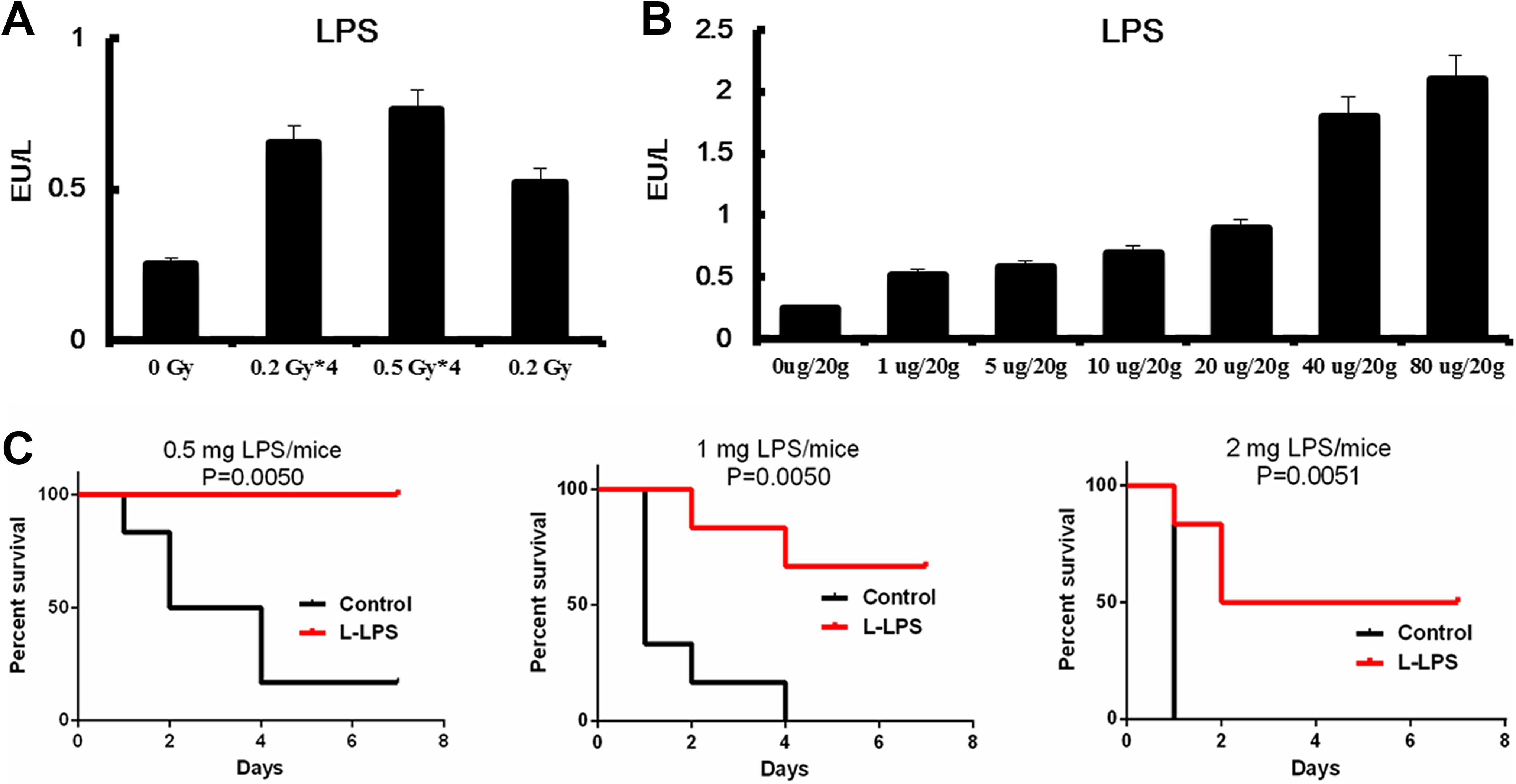
The low dose of LPS could act as LDR in the endotoxin damage. A, The level of LPS in the serum post-LDR increased with the dosage of irradiation. B, The level of LPS in the serum post 24 hours of L-LPS stimulation increased consistently with LDR. C, The L-LPS could improve the survival to resist endotoxin damage. N = 6. *P < .05. LDR indicates low-dose radiation; LPS, lipopolysaccharides.
Discussion
Both HDR and LDR have widely different effects on biosystems. 3 Although LDR does not cause marked damage in the short term, long-term exposure to LDR may lead to organism damage or tolerance and hereditary effects. 3 As the effects and mechanisms of HDR have been reported widely in major journals, the LDR is receiving more attention as well. One of the most crucial parts of LDR is the AR, 26 which is defined as a pretreatment before the organism is exposed to the HDR. It is also described as tolerance to stronger stimulation, in which inflammatory cytokine upregulates and immune systems strengthen, resulting in a high-threshold state to resist invasion of foreign matter.
We speculated that the AR induced by LDR could withstand the LPS infection to avoid endotoxin damage by regulating the immune system. In this study, we found that single or fractionated LDR could mitigate the endotoxin damage in mice survival, especially the 0.2 Gy × 4 group, mainly resisting LPS. Corresponding to the survival curve, the LDR groups alleviated liver damage and the 0.2 Gy × 4 group exhibited less cell infiltration and more normal liver cells. To verify the molecular mechanism, we monitored the inflammatory cytokine in the serum after LDR. As expected, IL-6, TNF, and NO had been raised to different degrees, showing a weak correlation of measurement. When high doses of LPS were given, the cytokine in LDR groups increased significantly less than the control group, so as to resist the inflammatory cytokine storm and endotoxin damage. We also found that L-LPS could perform as LDR to enhance the body tolerance to the high-dose LPS invasion, in order to relieve the endotoxin damage (Figure 5B).

The preliminary mechanism of LDR and L-LPS resisting endotoxin damage. A, The inflammatory cytokine storm was mitigated by L-LPS in line with LDR. B, The working model for this study. The LDR, as well as L-LPS, could increase the inflammatory cytokines, including IL-6, TNF, and NO, which could boost immunity and keep body a high threshold state, so as to resist the inflammatory cytokine storm and alleviate the inflammatory cell infiltration in the liver, to avoid endotoxin damage. LDR indicates low-dose radiation; L-LPS, low dose of LPS; LPS, lipopolysaccharides; IL-6, interleukin 6; TNF, tumor necrosis factor.
Endotoxin tolerance defined as a less response to high dose of LPS was revealed in earlier studies. 27 We also reported that LPS could activate Toll-like reporter 4 (TLR4) to induce radioresistance 28 and that polymyxin B attenuated LPS-induced death via a TLR4-Myd88-IL-6 pathway, 29 which might perform as L-LPS in this study.
Some questions remain. The LDR was administered in 2 groups: 0.2 Gy × 4 and 0.5 Gy × 4. The former behaved better in survival curve than the latter (Figure 1A), but it was inconsistent in the inflammatory cytokine increase (Figure 3A). Because there were greater levels of TNF and NO in the 0.5 Gy*4 group, it is difficult to explain the levels of the inflammatory cytokine needed to resist the endotoxin damage. The concentration of LPS in the serum post-LDR was dosage dependent (Figure 4A and B). Whether the dosage of LDR and LPS stimulation has a quantitative criterion to resist endotoxin damage is still undetermined. Further studies will analyze the relation between the dosage of LDR/LPS and the tolerance of endotoxin.
In conclusion, our study verified that LDR, as well as L-LPS, can increase the inflammatory cytokines IL-6, TNF, and NO, which boost immunity and alleviate the inflammatory cell infiltration in the liver, to avoid endotoxin damage.
Footnotes
Authors’ Note
Suhe Dong, Wen Qian, and Tingting Liu contributed equally to this work.
Acknowledgments
The authors thank every researcher in this study.
Declaration of Conflicting Interests
The author(s) declared no potential conflicts of interest with respect to the research, authorship, and/or publication of this article.
Funding
The author(s) disclosed receipt of the following financial support for the research, authorship, and/or publication of this article: The radioactive source was supported by the 60Co Radiation Center of the Second Military Medical University.